Black friday Up to 3 extra licenses FOR FREE + Special offer for TI LOOKUP Get it now
Webinar
February 26
Better SOC with Interactive Sandbox Practical Use Cases
Register now

DarkSide

54
Global rank
54 infographic chevron month
Month rank
59 infographic chevron week
Week rank
0
IOCs

DarkSide ransomware is a novel ransomware strain involved in high-profile incidents. Its attacks lead to data theft and encryption, causing significant damage to victims.

Ransomware
Type
Ex-USSR
Origin
10 August, 2020
First seen
13 August, 2026
Last seen

How to analyze DarkSide with ANY.RUN

Type
Ex-USSR
Origin
10 August, 2020
First seen
13 August, 2026
Last seen

IOCs

IP addresses
2.23.246.9
135.233.95.135
48.209.138.168
23.59.18.102
20.190.159.2
74.179.77.204
48.209.138.189
23.11.40.157
40.126.31.130
23.48.23.156
172.211.123.249
57.153.246.3
2.16.204.138
20.190.159.68
23.52.181.141
135.236.137.147
95.100.102.101
172.211.123.250
2.16.164.49
20.165.94.63
Hashes
4826c0d860af884d3343ca6460b0006a7a2ce7dbccc4d743208585d997cc5fd1
44b87df9f68f5a3084c7d80c1c7492ca5209e816a4e83fdbd6e2fcb6f1ff936f
f6c559c031b7b16b1edf34b38e74b6bf3a7106ca34881d7f5c63b8e0d7ac3694
f9991e41c93f8c5df2151626af256c4cef325ac70303c7e05e60886e6109c361
eacd09517ce90d34ba562171d15ac40d302f0e691b439f91be1b6406e25f5913
283d9164ff05daaf8a624c5dc11e36b43d016de80b30a00926c5af5dbcab11b4
f57fbe395fd68c7132adbd3520bcf193065dc6217e904d6eea531680b62317de
90560e7aa1bf7708371bb2041461932169168638bb2b6bf67c55e18c4b48c618
9639441a9d36e7e4fda980961b75eeb334540b8cfbcee71eb3cd857e0a838e0c
08191a5f9ab34e5d09b1b14e26f84fea10da6bf7132d94866803d25420d39e31
4c20d06c8eb5cea2bfabd46931e5e8a8a93db4a87f490997bf91b386bfbb20bb
2d60c87ba1c2aa6dfb385acdf8c2db6922d0dcc1598a4b717667c5190ae2e1c0
855f3e9dcb29fee920d03c559382ca4ccc16869d338644ff8e7a54af04f378fc
528194cd2a49846bf6db9208176b5f1483829a56e6afec88ea73da2f7d5fe549
46a9f920cb9049c9be7bf3afba7ec13b0d0d170029363a115f429996822d4871
704d28223a4320a853df4a19d48c7015cf79d56a5317cc3475b6305fa43dcc05
8f05bafd61f29998ca102b333f853628502d4e45d53cff41148d6dd15f011792
81970dbe581373d14fbd451ac4b3f96e5f69b79645f1ee1ca715cff3af0bf20d
9efa735bbf7b61c3f94281e925ee48ce4cc659d267c0255d54e4700f4404eec0
73526ddb1d23d595680badd6bd87f5dd82869606a7cf7e8707758d48d848257e
Domains
google.com
www.microsoft.com
go.microsoft.com
slscr.update.microsoft.com
settings-win.data.microsoft.com
login.live.com
ocsp.digicert.com
fe3cr.delivery.mp.microsoft.com
crl.microsoft.com
www.bing.com
client.wns.windows.com
licensing.mp.microsoft.com
oneocsp.microsoft.com
connectid.analytics.yahoo.com
gtracenep.admaster.cc
id.hadron.ad.gt
script-api.ccgateway.net
www.googletagmanager.com
yr.c.lencr.org
static.cloudflareinsights.com
URLs
https://go.microsoft.com/fwlink/?linkid=2257403&clcid=0x409
https://login.live.com/rst2.srf
https://settings-win.data.microsoft.com/settings/v3.0/onesettings/client?osversionfull=10.0.19045.4046.amd64fre.vb_release.191206-1406&localdeviceid=s%3abad99146-31d3-4ec6-a1a4-be76f32ba5d4&flightring=retail&attrdataver=186&osuilocale=en-us&osskuid=48&app=wosc&appver=&isflightingenabled=0&telemetrylevel=1&devicefamily=windows.desktop
https://login.live.com/ppsecure/deviceaddcredential.srf
http://ocsp.digicert.com/mfewtzbnmeswstajbgurdgmcgguabbq50otx%2fh0ztl%2bz8sipi7wewvxdlqqutijuibiv5unu5g%2f6%2brks7qyxjzkceaz1vqyrvgl0erhqlcpm8gy%3d
http://crl.microsoft.com/pki/crl/products/microoceraut2011_2011_03_22.crl
http://www.microsoft.com/pkiops/crl/micsecserca2011_2011-10-18.crl
https://settings-win.data.microsoft.com/settings/v3.0/flightsettings/fsservice?processorclockspeed=3094&isretailos=1&oemmanufacturername=dell&flightingpolicyvalue=3&enablepreviewbuilds=4294967295&osversionfull=10.0.19045.4046.amd64fre.vb_release.191206-1406&managepreviewbuilds=3&branchreadinesslevelsource=0&attrdataver=186&processorcores=6&branchreadinesslevelraw=16&totalphysicalram=6144&tpmversion=0&oemmodelnumber=dell&systemvolumetotalcapacity=260281&deviceid=s%3abad99146-31d3-4ec6-a1a4-be76f32ba5d4&app=fss&appver=10.0&smartactivehoursstate=1&activehoursstart=20&securebootcapable=0&activehoursend=13&devicefamily=windows.desktop
https://settings-win.data.microsoft.com/settings/v3.0/wsd/waasassessment?os=windows&osver=10.0.19041.1.amd64fre.vb_release.191206-&ring=retail&sku=48&deviceclass=windows.desktop&locale=en-us&deviceid=bad99146-31d3-4ec6-a1a4-be76f32ba5d4&flightring=retail&telemetrylevel=1&hidovergattreg=c%3a%5cwindows%5csystem32%5cdriverstore%5cfilerepository%5chidbthle.inf_amd64_9610b4821fdf82a5%5cmicrosoft.bluetooth.profiles.hidovergatt.dll&appver=10.0&processoridentifier=amd64%20family%2023%20model%201%20stepping%202&oemmodel=dell&updateoffereddays=4294967295&processormanufacturer=authenticamd&installdate=1661339444&oemmodelbaseboard=&branchreadinesslevel=cb&oemsubmodel=j5cr&isclouddomainjoined=0&deferfeatureupdateperiodindays=30&isdeviceretaildemo=0&flightingbranchname=&osuilocale=en-us&devicefamily=windows.desktop&wuclientver=10.0.19041.3996&uninstallactive=1&isflightingenabled=0&osskuid=48&processorclockspeed=3094&totalphysicalram=6144&securebootcapable=0&app=waasassessment&processorcores=6&currentbranch=vb_release&installlanguage=en-us&deferqualityupdateperiodindays=0&servicingbranch=cb&oemname_uncleaned=dell&tpmversion=0&primarydisktotalcapacity=262144&installationtype=client&attrdataver=186&processormodel=amd%20ryzen%205%203500%206-core%20processor&isedgewithchromiuminstalled=1&osversion=10.0.19045.4046&ismdmenrolled=0&activationchannel=retail&honorwufbdeferrals=0&firmwareversion=a.40&trendinstalledkey=1&osarchitecture=amd64&defaultuserregion=244&updatemanagementgroup=2
http://www.microsoft.com/pkiops/crl/microsoft%20ecc%20product%20root%20certificate%20authority%202018.crl
https://settings-win.data.microsoft.com/settings/v3.0/waas/featuremanagement?isclouddomainjoined=0&processoridentifier=amd64%20family%2023%20model%201%20stepping%202&currentbranch=vb_release&accountfirstchar=&activationchannel=retail&oemmodel=dell&flightring=retail&attrdataver=186&installlanguage=en-us&osuilocale=en-us&webexperience=1&flightingbranchname=&chassistypeid=1&osskuid=48&app=cdm&installdate=1661339444&appver=&osarchitecture=amd64&defaultuserregion=244&telemetrylevel=1&osversion=10.0.19045.4046&devicefamily=windows.desktop
https://slscr.update.microsoft.com/sls/%7b522d76a4-93e1-47f8-b8ce-07c937ad1a1e%7d/x64/10.0.19045.4046/0?ch=686&l=en-us&p=&pt=0x30&wua=10.0.19041.3996&mk=dell&md=dell
http://www.microsoft.com/pkiops/crl/microsoft%20ecc%20update%20secure%20server%20ca%202.1.crl
https://fe3cr.delivery.mp.microsoft.com/clientwebservice/ping
https://slscr.update.microsoft.com/sls/ping
https://slscr.update.microsoft.com/sls/%7be7a50285-d08d-499d-9ff8-180fdc2332bc%7d/x64/10.0.19045.4046/0?ch=686&l=en-us&p=&pt=0x30&wua=10.0.19041.3996&mk=dell&md=dell
https://settings-win.data.microsoft.com/settings/v3.0/wsd/muse?processorclockspeed=3094&flightids=&updateoffereddays=4294967295&branchreadinesslevel=cb&oemmanufacturername=dell&isclouddomainjoined=0&processoridentifier=amd64%20family%2023%20model%201%20stepping%202&sku=48&activationchannel=retail&attrdataver=186&ismdmenrolled=0&processorcores=6&processormodel=amd%20ryzen%205%203500%206-core%20processor&totalphysicalram=6144&primarydisktype=4294967295&flightingbranchname=&chassistypeid=1&oemmodelnumber=dell&systemvolumetotalcapacity=260281&sampleid=95271487&deviceclass=windows.desktop&app=muse&disabledualscan=0&appver=10.0&oemsubmodel=j5cr&locale=en-us&isalwaysonalwaysconnectedcapable=0&ms=0&defaultuserregion=244&updateserviceurl=http%3a%2f%2fneverupdatewindows10.com&osver=10.0.19045.4046.amd64fre.vb_release.191206-1406&os=windows&deviceid=s%3abad99146-31d3-4ec6-a1a4-be76f32ba5d4&deferqualityupdateperiodindays=0&ring=retail&deferfeatureupdateperiodindays=30
https://settings-win.data.microsoft.com/settings/v3.0/wsd/updatehealthtools?os=windows&osver=10.0.19041.1.amd64fre.vb_release.191206-&sku=48&deviceclass=windows.desktop&locale=en-us&deviceid=s:bad99146-31d3-4ec6-a1a4-be76f32ba5d4&sampleid=s:95271487&appver=10.0.19041.3626&flightring=retail&telemetrylevel=1&hidovergattreg=c%3a%5cwindows%5csystem32%5cdriverstore%5cfilerepository%5chidbthle.inf_amd64_9610b4821fdf82a5%5cmicrosoft.bluetooth.profiles.hidovergatt.dll&appver=&processoridentifier=amd64%20family%2023%20model%201%20stepping%202&oemmodel=dell&updateoffereddays=4294967295&processormanufacturer=authenticamd&installdate=1661339444&oemmodelbaseboard=&branchreadinesslevel=cb&oemsubmodel=j5cr&isclouddomainjoined=0&deferfeatureupdateperiodindays=30&isdeviceretaildemo=0&flightingbranchname=&osuilocale=en-us&devicefamily=windows.desktop&wuclientver=10.0.19041.3996&uninstallactive=1&isflightingenabled=0&osskuid=48&processorclockspeed=3094&totalphysicalram=6144&securebootcapable=0&app=sedimentpack&processorcores=6&currentbranch=vb_release&installlanguage=en-us&deferqualityupdateperiodindays=0&oemname_uncleaned=dell&tpmversion=0&primarydisktotalcapacity=262144&installationtype=client&attrdataver=186&processormodel=amd%20ryzen%205%203500%206-core%20processor&isedgewithchromiuminstalled=1&osversion=10.0.19045.4046&ismdmenrolled=0&activationchannel=retail&firmwareversion=a.40&trendinstalledkey=1&osarchitecture=amd64&defaultuserregion=244&updatemanagementgroup=2
https://licensing.mp.microsoft.com/v7.0/licenses/content
https://www.bing.com/threshold/xls.aspx?t=5&dl=1&f=9&wsbc=1
Last Seen at

Recent blog posts

post image
Intelligence-Driven SOC: Modernizing Threat M...
watchers 7256
comments 0
post image
Supply Chain Security: How ANY.RUN Helps US a...
watchers 2927
comments 0
post image
Smile, You're on Camera. Part 2: Hiring Lazar...
watchers 33151
comments 0

What is DarkSide Ransomware

DarkSide is a cybercriminal group — and a ransomware of the same name — believed to have originated from Eastern Europe.

DarkSide operates as a Ransomware-as-a-Service (RaaS) — essentially, it is offered to affiliates who then conduct the attacks. These affiliates, vetted through an interview process, reportedly agree to a revenue split of 25% for ransoms under $500,000, and 10% for amounts exceeding $5 million. In exchange, they gain access to the control panel.

The DarkSide's code is not publicly accessible and bears similarities to another notorious ransomware threat — REvil. This correlation could suggest that DarkSide is either a derivative or a partner of REvil. Both groups have their origins in the ex-USSR, employ similar techniques and tactics, and use similarly structured ransom notes.

Like most threats originating from the Commonwealth of Independent States (CIS), DarkSide conducts a pre-attack check to ensure that the potential victim is not located in ex-USSR territories or Arabic states. This is achieved by accessing the system languages. The kill switch is activated if the language setting is set to:

  • Russian
  • Ukrainian
  • Belarusian
  • Tajik
  • Armenian
  • Azerbaijani
  • Georgian
  • Kazakh
  • Kyrgyz
  • Turkmen
  • Uzbek
  • Tatar
  • Moldovan Romanian
  • Or Syrian Arabic

Note that ANY.RUN interactive cloud sandbox enables you to set system language —among other settings — before launching a virtual machine. This can help to observe how DarkSide behaves under different device configurations.

Use ANY.RUN free for 14 days

Try the full power of interactive analysis

Start your free trial

When it comes to victim geography, DarkSide primarily targets the US, with Canada, France, Belgium, and other Western European countries following closely. This threat is notorious for executing high-profile attacks across various business sectors. It's worth noting, however, that DarkSide steers clear of targeting charitable organizations, healthcare facilities, educational institutions, and non-profits, presumably adhering to an internal code of conduct.

Some of the most notable incidents DarkSide was involved in include the Colonial Pipeline ransomware attack in May 2021. This attack led to a voluntary shutdown of a pipeline supplying 45% of fuel to the East Coast of the United States. The group extorted about 75 Bitcoin, nearly $5 million. Another notable incident includes the Ransomware attack on IT managed services provider CompuCom in March 2021. This attack resulted in over $20 million in restoration expenses, causing significant financial damage to the company.

DarkSide Ransomware technical details

After DarkSide ransomware gains initial access, it establishes command and control primarily through an RDP client over port 443, routed through TOR. Some samples may use Cobalt Strike as a secondary command and control mechanism, with customized stagers deployed on targeted devices.

The group uses various tools such as Advanced IP Scanner, psexec, and Mimikatz to scan networks, run commands, and steal credentials. After a reconnaissance phase, an Active Directory reconnaissance tool is used to gather additional information about users, groups, and privileges.

The attackers mine credentials from user profile folders and use a script named Invoke-mimikatXz.ps1 to extract credentials from servers. Once domain admin credentials are obtained, they perform a DCSync attack to replicate AD information, gaining access to password data for the entire domain.

The group uses an active Windows server as a hub to store data before exfiltration. Data from servers is compressed into 7zip archives with a simple naming convention. They also relax permissions on file systems to access files with any domain user account.
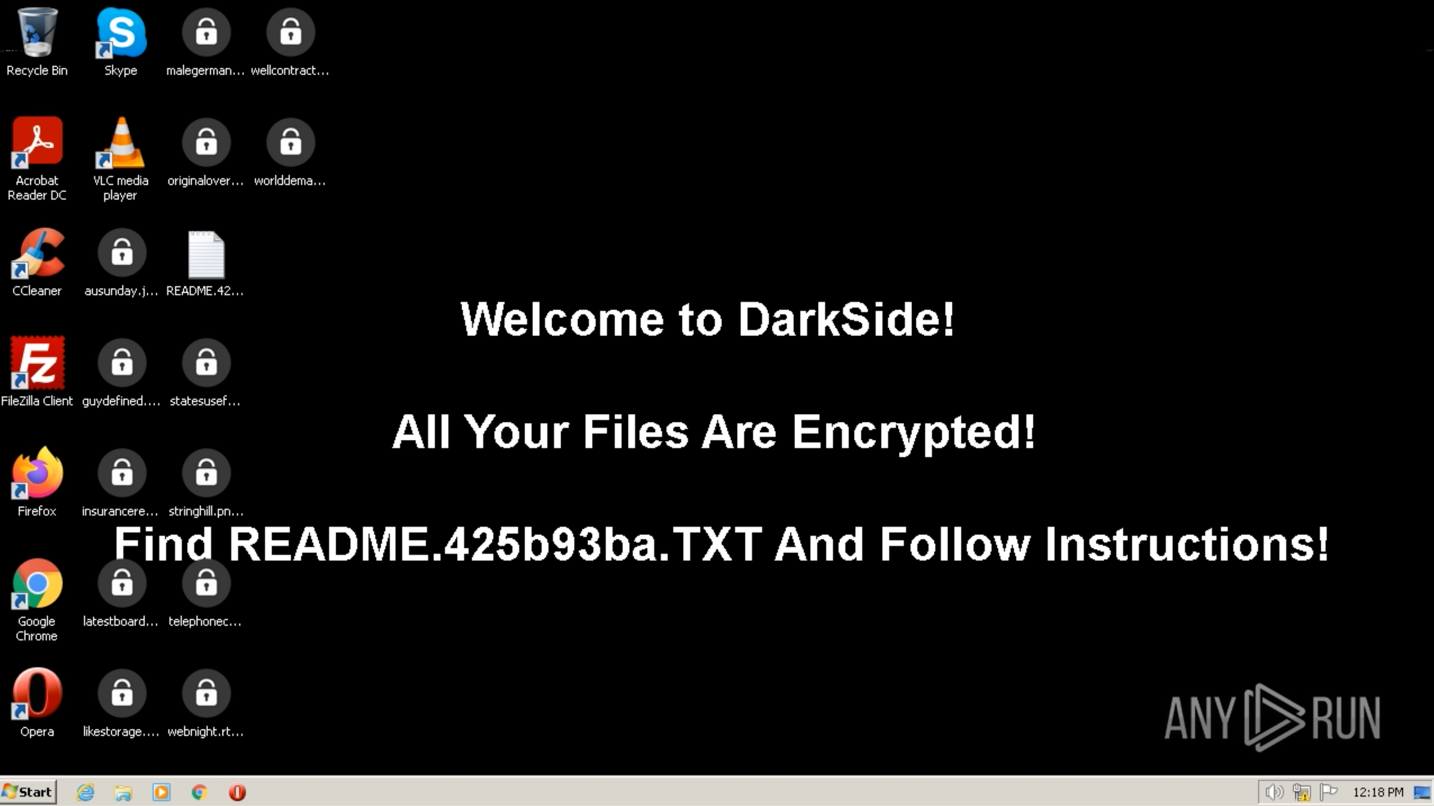
DarkSide infection

Workstation’s desktop after the DarkSide infection

Before deploying ransomware, DarkSide maps the environment, exfiltrates data, gains control of privileged accounts, and identifies backup systems, servers, and applications. The ransomware code is delivered through established backdoors and is customized for each victim. The ransomware evades signature-based detection mechanisms by using unique executables and extensions and employs anti-forensics and anti-debugging techniques.

The ransomware first copies itself to a temporary path and injects its code into the existing process. If it detects debugging or VM, it stops. The ransomware then dynamically loads its libraries to avoid detection by AV and EDR solutions.

The malware deletes the shadow copies on the victim device using an obfuscated PowerShell command. After the deletion, the malware closes specific processes to avoid locked files and begins its encryption routine, appending an 8-character string to the end of the encrypted file names. It avoids encrypting files with certain extensions and creates a ransom instructions file for decryption.

Analyzing a Dark Side ransomware sample in ANY.RUN

The execution process of DarkSide is typical for ransomware. For comparison, you may take a look in most popular ones - Phobos or Maze. First, the executable file makes its way into the infected system and runs, then the main malicious activity begins. After the start of execution, the ransomware may delete shadow copies and stop execution of the security software. When all targeted files get encrypted, DarkSide drops a ransom note and changes wallpaper on the desktop, like in the following sample.
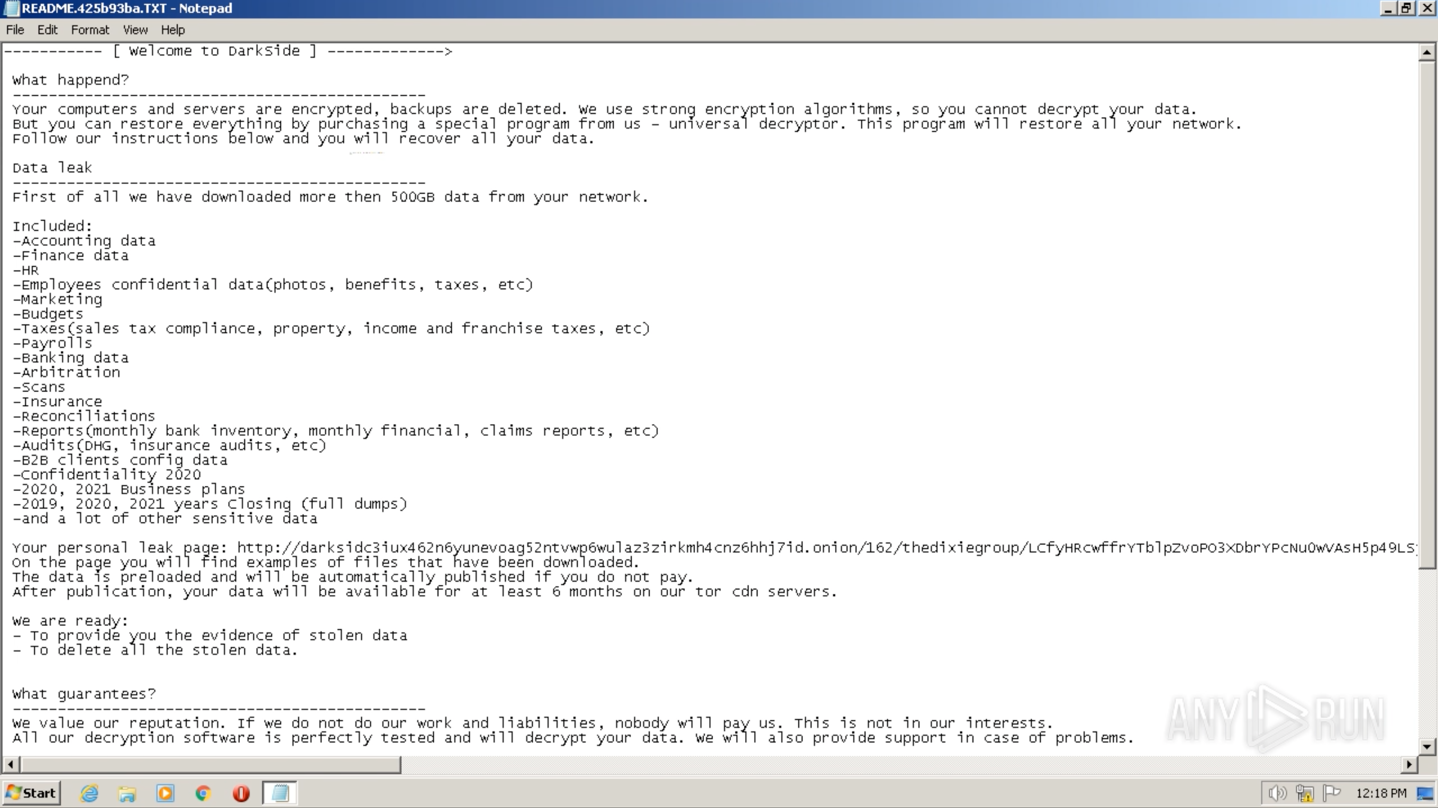
Darkside’s ransom note

DarkSide’s ransom note

DarkSide Ransomware distribution

DarkSide ransomware primarily distributes through phishing campaigns and leverages Remote Desktop Protocol (RDP) abuse and known vulnerabilities for initial access.

Ransomware operators employ social engineering and highly targeted spear phishing campaigns to trick users into downloading malicious content. Alternatively, they are known to exploit weakly secured RDP endpoints. The group also targets unpatched servers and remotely exploitable systems, sometimes accessing Virtual Desktop Infrastructure (VDI) via compromised contractor accounts.

DarkSide Ransomware: conclusions

As early as May 2021, the DarkSide group announced that they had lost access to part of their hacking infrastructure due to "significant pressure from the U.S.," pledging to shut down their operations.

However, if the similarities with REvil (and by extension, GandCrab its precursor) indeed indicate a connection between these groups, it is highly improbable that DarkSide's ransomware activities will diminish.

We will likely continue to observe the use of this ransomware code, making the study of the tactics and techniques deployed by this operation vitally important.

To expedite your results — like acquiring strings and malware configurations — consider analyzing DarkSide samples in ANY.RUN. Our cloud malware sandbox can detect this threat and extract its configuration automatically, saving you hours of manual deobfuscation and code reversal. You can also experiment with system configurations to observe how this threat behaves under different conditions.

Ready to give it a shot? Create a free ANY.RUN account a free ANY.RUN account.
HAVE A LOOK AT

Spyware screenshot
Spyware
spyware
Spyware is a stealth form of malware whose primary objective is to gather sensitive information, such as personal data, login credentials, and financial details, by monitoring user activities and exploiting system vulnerabilities. Spyware operates secretly in the background, evading detection while transmitting collected data to cybercriminals, who can then use it for malicious purposes like identity theft, financial fraud, or espionage.
Read More
Fog Ransomware screenshot
Fog is a ransomware strain that locks and steals sensitive information both on Windows and Linux endpoints. The medial ransom demand is $220,000. The medial payment is $100,000. First spotted in the spring of 2024, it was used to attack educational organizations in the USA, later expanding on other sectors and countries. Main distribution method — compromised VPN credentials.
Read More
Cephalus screenshot
Cephalus
cephalus
Cephalus is a targeted ransomware threat discovered in 2025. It’s known for infiltrating organizations that deal with sensitive data through compromised RDP access. It leverages DLL sideloading with a legitimate SentinelOne executable. Cephalus is able to exfiltrate data and destroy backup options. Its payload is also tailored to each victim, which makes identification and mitigation more complex.
Read More
GuLoader screenshot
GuLoader
guloader
GuLoader is an advanced downloader written in shellcode. It’s used by criminals to distribute other malware, notably trojans, on a large scale. It’s infamous for using anti-detection and anti-analysis capabilities.
Read More
MetaStealer screenshot
MetaStealer
metastealer
MetaStealer is an info-stealing malware primarily targeting sensitive data like login credentials, payment details, and browser history. It typically infects systems via phishing emails or malicious downloads and can exfiltrate data to a command and control (C2) server. MetaStealer is known for its stealthy techniques, including evasion and persistence mechanisms, which make it difficult to detect. This malware has been actively used in various cyberattacks, particularly for financial theft and credential harvesting from individuals and organizations.
Read More
DarkComet screenshot
DarkComet
darkcomet rat darkcomet rat
DarkComet RAT is a malicious program designed to remotely control or administer a victim's computer, steal private data and spy on the victim.
Read More