


A Security Operations Center rarely struggles because it lacks alerts.
It struggles because every alert creates work: validate the indicator, understand the behavior, check whether the threat is known, determine its scope, decide whether to escalate, contain the incident, and make sure the same attack is easier to detect next time.
When these steps depend on disconnected tools, analysts lose time moving between dashboards, manually enriching IOCs, recreating investigations for senior analysts, and searching for context that should already be available. The SOC becomes a relay race in which every handoff drops a few pieces of evidence.
This is the hidden cost of fragmented security operations. It increases alert fatigue, slows response, creates unnecessary escalations, and leaves experienced analysts handling routine investigations that could have been resolved earlier.
Key Takeaways
- A SOC needs connected intelligence, not just more alerts. Fragmented tools force analysts to manually collect context, repeat investigations, and lose evidence during handoffs.
- Threat Intelligence Feeds strengthen monitoring from the start. Fresh indicators and malicious infrastructure context help teams prioritize alerts and identify active threats faster.
- Interactive Sandbox analysis provides behavioral proof. Analysts can safely investigate suspicious files, URLs, scripts, and archives instead of relying only on static verdicts.
- In-browser data inspection helps expose evasive phishing. SOC teams can observe dynamically loaded content, injected forms, redirects, scripts, and credential collection behavior that static URL scans may miss.
- Threat Intelligence Lookup turns isolated artifacts into investigation pivots. Analysts can enrich IOCs, IOBs, and IOAs, connect them to related samples and infrastructure, and access the full sandbox analysis behind an indicator.
- Structured reporting speeds up response and escalation. Tier 1 Reports preserve investigation evidence and give Tier 2, Tier 3, and incident response teams a clearer starting point.
- Threat hunting and detection engineering improve the entire SOC loop. Behavioral searches, Threat Intelligence Reports, and YARA Search help teams find activity that alerts miss and convert investigation findings into stronger detections.
What Changes When Intelligence Is Connected
When detection, triage, response, and hunting instead run as one continuous, intelligence-fed process, every stage strengthens the next:
- Noise gets filtered early. Live feeds rule out known threats before they consume analyst time.
- Investigations move faster. Interactive analysis reveals hidden behavior in real time instead of waiting on static reports.
- Decisions are backed by context. A single indicator connects to millions of past analyses, turning isolated alerts into recognizable patterns.
- Escalations carry evidence, not guesswork. Findings move between tiers as structured, decision-ready intelligence rather than raw technical data.
This is what it looks like to operationalize threat intelligence across the full SOC workflow — not as a bolt-on lookup tool, but as the connective layer underneath monitoring, triage, response, and detection engineering. Below is how ANY.RUN’s Threat Intelligence suite — Threat Intelligence Feeds, Threat Intelligence Lookup, and Interactive Sandbox — fuels each stage.
1. Monitoring: Prioritize What Matters with Threat Intelligence Feeds
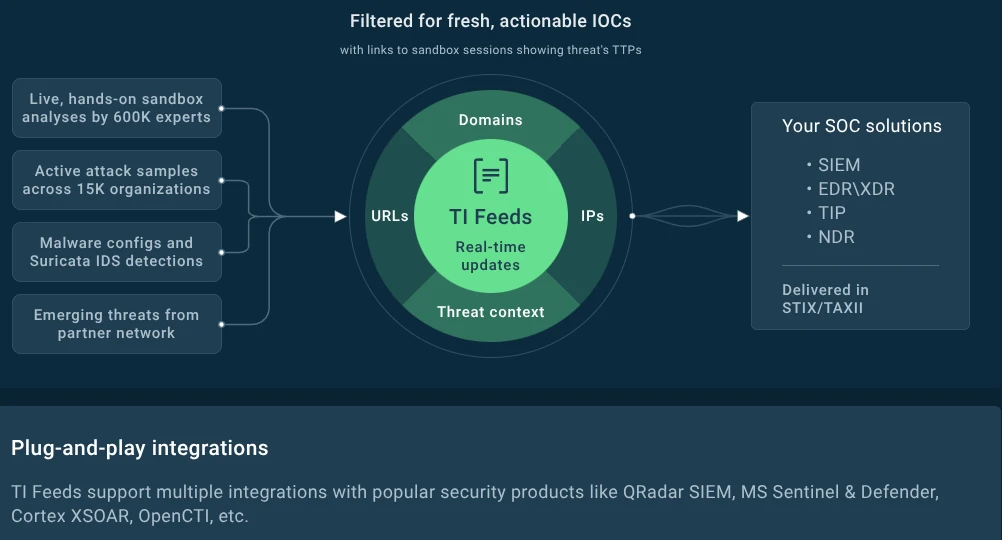
The first challenge in any SOC is deciding which alerts deserve attention at all. With live IOC streams collected from a global analyst community, ANY.RUN’s Threat Intelligence Feeds work as that early filter. Analysts and automated systems see instantly whether an IP, domain, or an URL has already been confirmed malicious, ruling out duplicates before they ever reach a human queue.
Every indicator in the feed is actionable and connected back to a sandbox analysis, so monitoring systems aren’t just receiving a red flag. They’re inheriting the behavioral evidence behind it. That context is what separates a feed analysts trust from one they learn to ignore.
TI Feeds are delivered in multiple formats with straightforward integration paths into SIEM, TIP, and SOAR platforms. The filtering happens automatically, at the point of ingestion — not after an analyst has already spent time on a case that should have been ruled out in milliseconds.
For monitoring specifically, this means:
- Continuously updated indicators feeding directly into existing detection stacks;
- Fewer duplicate or already-confirmed alerts reaching the human queue;
- A baseline of global telemetry that flags infrastructure before it’s used against your organization.
Threat Intelligence Feeds help teams:
- identify known malicious infrastructure earlier;
- enrich alerts automatically;
- prioritize events connected to active malware or phishing campaigns;
- update blocklists and detection logic with fresh data;
- reduce time spent manually checking external threat intelligence sources;
- improve correlation between internal telemetry and current attacker activity.
This gives analysts a better starting point. Instead of beginning every investigation with “What is this indicator?”, they can begin with “How urgent is this, and what attack activity is it connected to?”
2. Triage: Validate Alerts with Behavioral and Historical Context
Triage is the decision point that determines whether an alert becomes a closed ticket, an escalation, or a full incident. For Tier 1 analysts, the goal is not to perform a complete forensic investigation for every event. It is to quickly determine whether the object is malicious, understand enough of its behavior to assess risk, and provide evidence for the next action.
ANY.RUN supports this process through two connected capabilities:
- Interactive analysis of suspicious files and URLs in the Sandbox;
- Context enrichment through Threat Intelligence Lookup.
ANY.RUN’s Interactive Sandbox allows analysts to detonate suspicious files, scripts, archives, and URLs in an isolated environment and observe their behavior in real time. The Sandbox gives analysts the proof behind the alert. It transforms a suspicious file or URL from an unknown object into an observable attack chain.
ANY.RUN’s Threat Intelligence Feeds come in multiple formats with simple integration options, making it easy to plug into your existing SIEM, TIP, or SOAR setup.
Detect evasive phishing with in-browser data inspection
Phishing analysis creates specific challenge. A suspicious page may look harmless to an automated scanner but reveal credential theft behavior only after a user interacts with it.
ANY.RUN’s in-browser data inspection helps analysts examine phishing pages from inside the browser session. It provides visibility into dynamically loaded content, injected forms, script execution, redirect chains, and network activity.
This makes it easier to investigate phishing pages that:
- imitate trusted login portals;
- load malicious content only after interaction;
- use hidden or dynamically injected credential forms;
- redirect victims through multiple pages;
- send submitted credentials to attacker-controlled infrastructure;
- use browser-side scripts to evade static URL analysis.
In practice, this gives triage analysts:
- A complete execution tree from the initial URL to the final rendered page, with detection-triggering stages highlighted.
- HTTP request-level visibility into the full redirect chain, useful for both validation and later detection engineering.
- An HTML DOM Changes view showing exactly what code was injected after the page loaded — revealing what static analysis structurally cannot see.
- A dedicated Indicators tab collecting every URL, domain, IP, and content hash tied to the analyzed page, ready for pivoting.
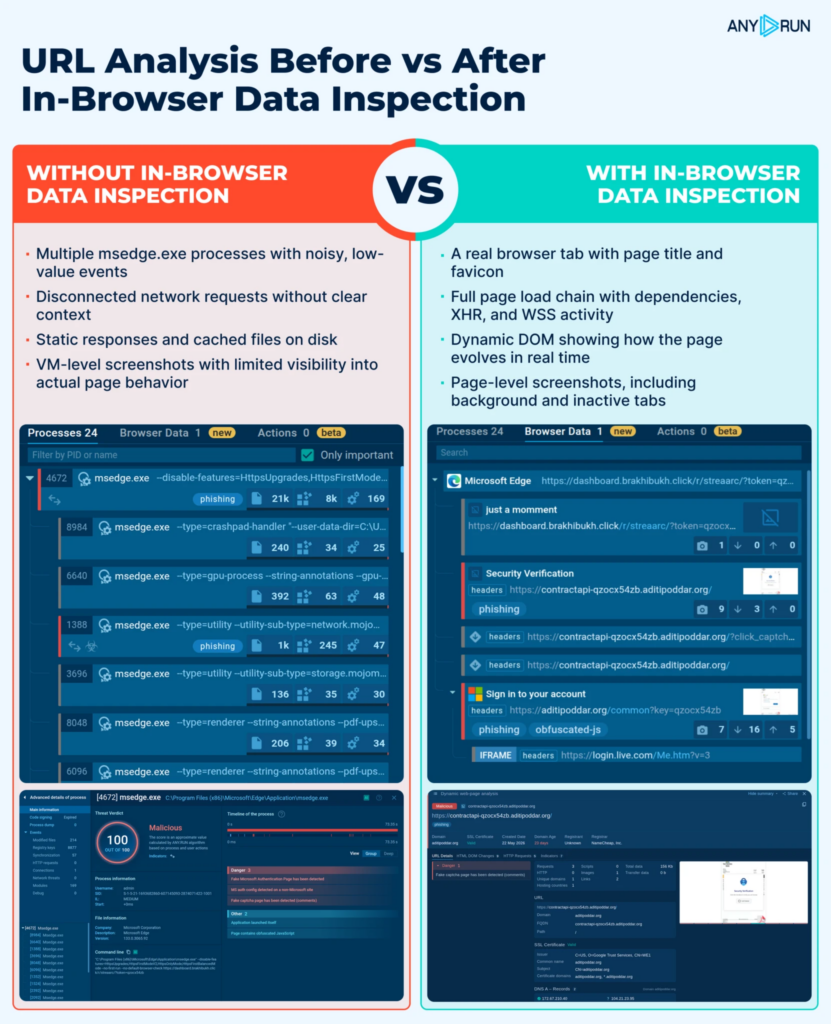
Because this evidence is collected and correlated within a single workflow, junior analysts can validate suspicious URLs with far more confidence — and far less escalation by default — while still capturing everything a senior analyst or detection engineer would need later.
Enrich Indicators with Behavior and Context
A sandbox session explains what one suspicious object does. Threat Intelligence Lookup helps analysts understand whether it is part of something larger.
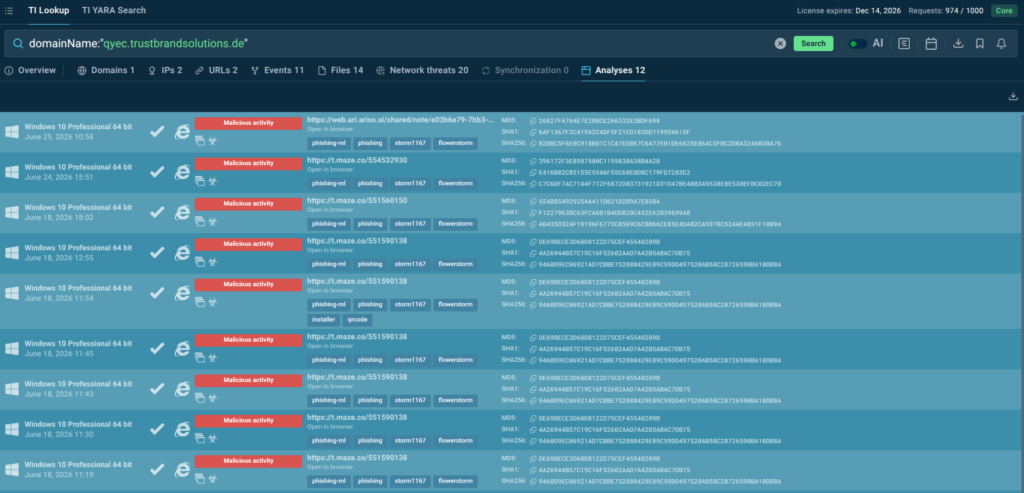
Threat Intelligence Lookup is designed as a searchable repository of indicators and event data extracted from interactive sandbox sessions, with direct access to the related analysis when an indicator is found.
This includes:
- IOCs: hashes, IP addresses, domains, URLs, file names, and registry artifacts;
- IOBs: mutexes, command lines, process behavior, dropped files, loaded modules, and network patterns;
- IOAs: attacker techniques and attack chains, including persistence, credential theft, lateral movement-related behavior, and command-and-control activity.
The distinction matters because attackers can rotate static IOCs quickly. A hash may change after a minor rebuild. A domain may disappear after a few hours. But behavioral patterns, execution logic, mutexes, registry modifications, and process chains can provide more durable clues for investigation.
With Threat Intelligence Lookup, an analyst can start with one artifact from an alert and pivot into related activity:
- Search a suspicious domain and find associated phishing pages;
- Search a hash and identify related malware families;
- Search a mutex or command line and discover additional samples using the same behavior;
- Search a destination IP and identify connected command-and-control infrastructure;
- Search MITRE ATT&CK techniques to investigate samples exhibiting a particular behavior;
- Open linked sandbox sessions to review the full attack chain behind an indicator.
3. Response: Turn Investigation Evidence into Faster Action
Once an alert is confirmed, the SOC needs to decide what to do next.
Containment may involve blocking infrastructure, isolating an endpoint, resetting credentials, removing malicious files, investigating related hosts, or escalating to incident response. These actions depend on understanding more than a single IOC.
A domain may be one part of a phishing kit. A file hash may be one stage of a multi-step infection chain. A suspicious process may have created persistence, downloaded another payload, or contacted infrastructure that should also be blocked.
Connect Threat Intelligence Lookup to Full Sandbox Analysis
The combination of Threat Intelligence Lookup and Interactive Sandbox creates a direct path from an indicator to the evidence behind it.
An analyst can begin with a suspicious hash, URL, domain, IP address, mutex, process name, registry key, or command line in Threat Intelligence Lookup. From there, they can access linked sandbox sessions and inspect the complete behavioral analysis.
This lets response teams determine:
- how the threat entered the environment;
- what processes and scripts it launched;
- what files it created or modified;
- whether it established persistence;
- which infrastructure it contacted;
- whether it attempted credential theft or data exfiltration;
- what additional indicators should be blocked or investigated;
- which MITRE ATT&CK techniques are relevant to containment and remediation.
This connection reduces the risk of narrow response actions, such as blocking one visible domain while missing related infrastructure, secondary payloads, or persistence mechanisms.
Use Tier 1 Reports for Escalation and Case Handoffs
A SOC investigation often loses momentum at the escalation stage.
Tier 1 analysts may identify suspicious behavior, but Tier 2, Tier 3, or incident response teams frequently receive a mixture of screenshots, raw logs, copied IOCs, and incomplete notes. The receiving analyst then has to reconstruct the investigation before taking action.
Tier 1 Reports help standardize this handoff. They package the findings of a sandbox analysis into a structured, decision-ready report that can support triage, escalation, incident response, and communication with stakeholders.
A Tier 1 Report can include:
- a verdict and threat classification;
- an executive-friendly summary;
- key IOCs;
- observed behavior;
- MITRE ATT&CK mapping;
- process and network evidence;
- recommended next steps for the investigation.
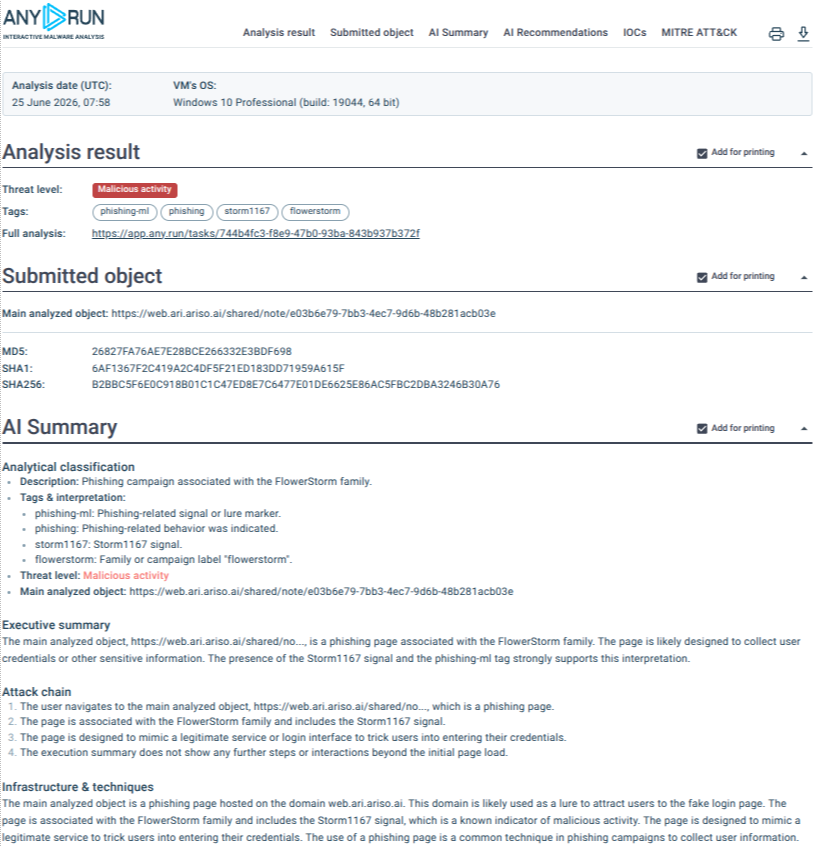
This helps Tier 1 analysts explain why a case should be escalated. It also helps senior analysts begin from the evidence already collected instead of repeating routine validation work.
4. Threat Hunting & Detection Engineering: Getting Ahead of the Next Alert
Monitoring, triage, and response all start with something that already happened — an alert, a submitted sample, an indicator. Threat hunting and detection engineering exist to get ahead of that: finding what alerts miss, and building detections that hold up against attackers who rotate infrastructure and rename their tools faster than static IOC lists can track.
Threat hunters use hypotheses to search for suspicious behavior. Detection engineers turn those findings into rules, queries, signatures, and automated controls that strengthen future monitoring.
ANY.RUN supports both workflows by giving analysts access to behavioral intelligence, campaign context, and a large corpus of real-world malware samples.
Hunt With Threat Intelligence Lookup
Threat Intelligence Lookup supports hunting by allowing analysts to search for behavioral artifacts, not only static indicators.
A threat hunter can begin with a suspicious mutex, file path, registry key, command line, destination IP, HTTP response pattern, or MITRE ATT&CK technique. From there, they can identify related malware samples, campaigns, and infrastructure.
This supports key hunting challenges, such as:
- tracking a malware family through stable behavioral artifacts;
- investigating suspicious infrastructure observed in internal telemetry;
- validating whether an alert pattern is connected to known malicious activity;
- expanding one IOC into a campaign-level investigation;
- identifying related indicators for retrospective searches;
- reducing false positives by comparing an internal event with observed malware behavior.
We cover this in depth — including hands-on examples of hypothesis validation against live phishing techniques, tracking entire malware families from a single mutex, and turning one alert into a full threat actor profile — in Intelligence-Driven Threat Hunting: How SOCs Find What Alerts Miss.
Use Threat Intelligence Reports for Campaign-Level Awareness
Threat Intelligence Reports support a broader layer of SOC operations.
While Tier 1 Reports focus on one specific suspicious object or incident, Threat Intelligence Reports provide analyst-led research into active threats, malware families, phishing campaigns, ransomware operations, threat actors, and emerging techniques.
They can help teams:
- prioritize threats relevant to their industry;
- understand malware delivery methods and victimology;
- identify likely attacker behaviors;
- prepare response playbooks;
- improve awareness among security and IT teams;
- inform executive risk discussions;
- guide detection and hunting priorities.
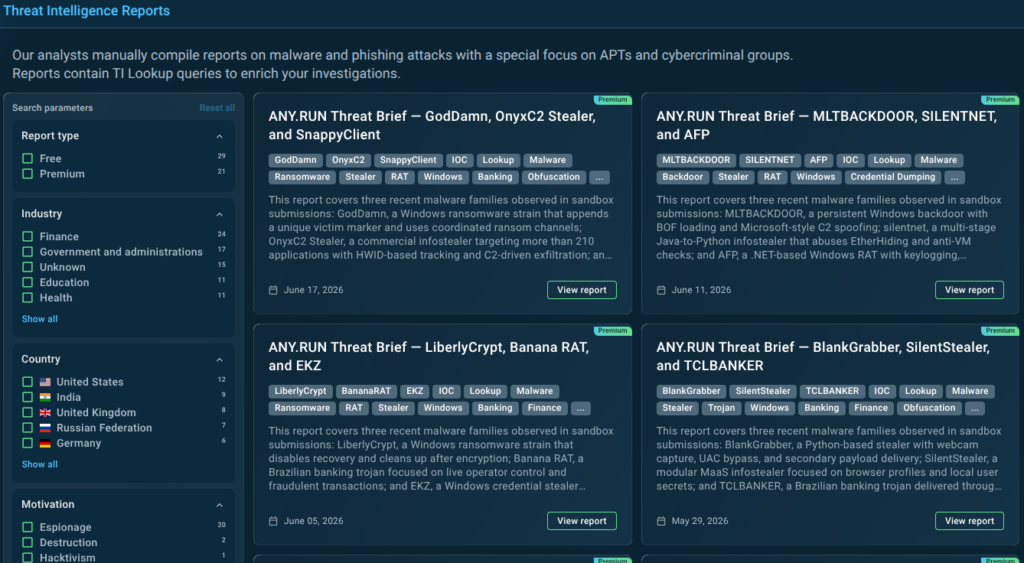
For example, if a SOC sees a rise in suspicious activity associated with a particular malware family, a Threat Intelligence Report can help analysts understand the family’s common infection chain, persistence techniques, infrastructure patterns, and business impact.
Validate Detections with YARA Search
Detection engineering is where investigation findings become long-term defensive value.
Detection engineering lives or dies on whether a rule generalizes — whether it catches a malware family’s future builds, or breaks the moment the author changes a hardcoded string. TI Lookup’s YARA Search is where rules get validated before they ever reach production, run against an enormous corpus of real-world samples rather than a small internal test set.
This implies a practical rule-development cycle:
- Analyze a suspicious sample in the Sandbox;
- Identify stable strings, code patterns, or structural characteristics;
- Create an initial YARA rule;
- Test the rule against real samples;
- Review matches for accuracy and false positives;
- Refine the rule;
- Validate it again before deployment.
This makes detection engineering less speculative. Instead of assuming a rule will work in production, teams can test it against real malware samples and identify where it is too narrow, too broad, or vulnerable to superficial attacker changes.
Business Impact: A Connected SOC Instead of a Tool Collection
The business value of ANY.RUN is not simply access to more threat data. It is the ability to reduce friction between the workflows that determine whether a SOC can operate efficiently at scale.
| SOC challenge | How ANY.RUN supports the workflow | Business impact |
|---|---|---|
| Alert overload | TI Feeds enrich and prioritize suspicious activity | Analysts focus on higher-risk events |
| Slow validation | Interactive Sandbox reveals file, URL, and phishing behavior | Faster triage and lower response time |
| Evasive phishing | In-browser data inspection exposes browser-side behavior and data flows | Better detection of credential theft attempts |
| Missing context | TI Lookup connects IOCs, IOBs, and IOAs to related analyses | More confident decisions and broader investigations |
| Repeated investigation work | Linked Lookup and Sandbox data preserve behavioral evidence | Less manual enrichment and duplication |
| Slow escalation | Tier 1 Reports standardize investigation findings | Faster handoffs to senior analysts and incident response |
| Reactive security posture | Threat hunting capabilities support proactive searches | Earlier discovery of threats that alerts miss |
| Weak or noisy detections | YARA Search validates rules against real samples | Better detection quality and fewer false positives |
| Limited strategic visibility | Threat Intelligence Reports explain campaigns and threat trends | Better prioritization and risk communication |
| Analyst skill gaps | Real analysis sessions and structured reports support learning | Faster onboarding and stronger analyst capability |
The pattern across all four stages is the same: intelligence that’s connected to behavioral evidence, available at the moment a decision needs to be made, in a form the next person in the chain can use without redoing the work. That’s what turns threat intelligence from a reference lookup into infrastructure the entire SOC — and MSSPs running multiple environments — can scale on without proportionally scaling headcount.
Conclusion
A SOC doesn’t fail because analysts lack skill or because tools lack data. It strains under fragmentation — context lost between monitoring and triage, between triage and response, between a single finding and the durable detection it should have become.
ANY.RUN’s Threat Intelligence — TI Feeds, TI Lookup, and Interactive Sandbox, including in-browser data inspection, Tier 1 Reports, Threat Intelligence Reports, and YARA Search — closes the gaps by fueling every stage of the SOC workflow from the same connected source of evidence. Monitoring filters noise before it reaches a human. Triage turns alerts into verified, contextualized decisions. Response carries that evidence intact through every handoff. Hunting and detection engineering convert what was learned into coverage that holds before the next campaign even starts.
Finally, the strongest SOC workflows do not end when a ticket is closed. Every investigation should improve the next one.
Threat Intelligence Feeds strengthen monitoring. The Interactive Sandbox provides behavioral proof. In-browser data inspection helps expose evasive phishing. Threat Intelligence Lookup adds historical and campaign context. Tier 1 Reports improve escalation and response. Threat Intelligence Reports guide broader prioritization. YARA Search turns analysis into stronger detections.
Together, these capabilities create a continuous intelligence loop:
Monitor → prioritize → analyze → enrich → respond → hunt → improve detections → monitor better.
The result isn’t just faster individual investigations — it’s a SOC that compounds what it learns, case after case, instead of relearning the same threats from scratch every time they reappear under a new IP.
About ANY.RUN
ANY.RUN, a leading provider of interactive malware analysis and threat intelligence solutions, helps SOC teams, MSSPs, and enterprises investigate threats faster and make more confident security decisions.
Its cloud-based Interactive Sandbox lets teams safely analyze suspicious files, URLs, and emails in real time, observe malicious behavior as it unfolds, and collect clear evidence for faster response.
ANY.RUN’s Threat Intelligence solutions add broader context around threats, infrastructure, and attacker activity. Together, these capabilities support faster triage, stronger detection, better-informed response decisions, and more efficient security operations at scale.


0 comments