



Cyber risk is increasing, but so is the cost of managing it. More than 514,000 cybersecurity job listings appeared in the US between May 2024 and April 2025, while the mean annual wage for an information security analyst reached $132,510.
Even after the budget is approved, hiring can take three to six months, with additional time needed for onboarding and training. Meanwhile, alert volumes keep growing, senior employees remain tied up in routine investigations, and the financial exposure from a delayed response does not disappear.
The real challenge for CFOs is finding a way to strengthen security without turning every increase in workload into another hiring request.
The Headcount Trap
When the SOC is overloaded, hiring often looks like the obvious solution. More alerts come in, investigations take longer, and the team asks for additional analysts.
But headcount is a costly way to solve an efficiency problem.
Each new hire adds salary, benefits, recruitment costs, training, and management overhead. It can also take months before that person is ready to handle investigations independently. During that time, experienced employees are still carrying the workload while also supporting onboarding.
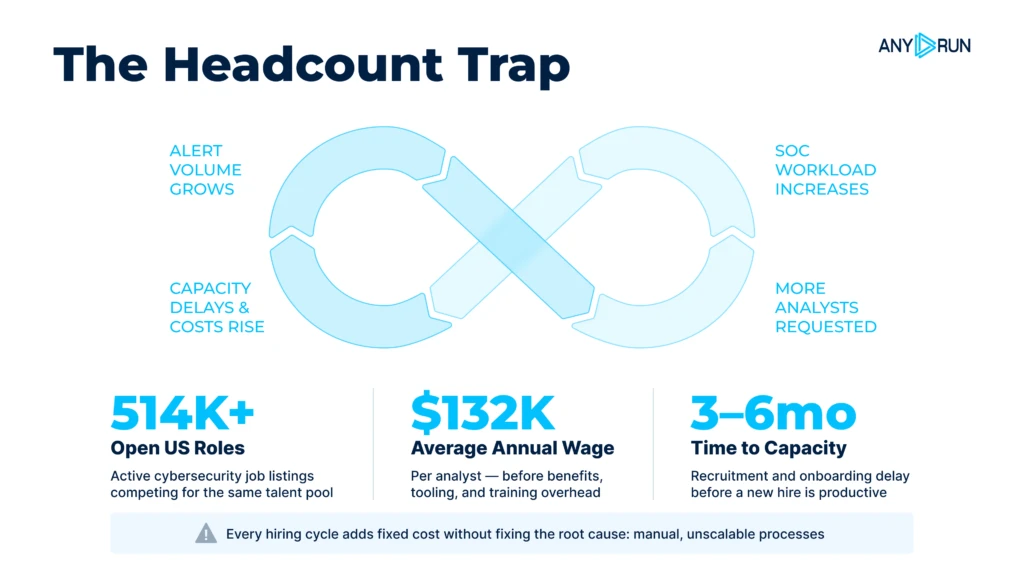
The result is a cycle many CFOs know well: alert volume grows, the security budget grows with it, but the underlying process stays the same. Routine cases still consume senior time, manual checks still slow investigations, and the next hiring request is never far behind.
Adding people may increase capacity for a while. It does not fix the work that makes the SOC expensive in the first place.
The Financial Cost of Slow Incident Response
An overloaded SOC creates costs that are easy to overlook in the security budget. Payroll is only the most visible expense. Manual investigations, repeated escalations, delayed containment, and business disruption can all increase the total cost of managing cyber risk.
Each alert has a unit cost. A Tier 1 analyst reviews it, a more experienced employee may validate it, and a senior specialist may step in when the available evidence is unclear. The company can end up paying several employees to work on the same case, driving up the cost per investigation.
CFOs can estimate this direct expense using a simple calculation:
Annual investigation cost = Annual case volume × Average handling time × Fully loaded hourly labor cost
The same calculation can be applied to escalations. It shows how much high-cost senior capacity is being used for routine cases that could have been resolved earlier with clearer evidence and faster access to threat context.
Manual Work Limits Operating Capacity
SOC teams often spend hours opening files, checking URLs, comparing indicators across separate sources, reproducing suspicious activity, and preparing reports. These tasks are necessary, but they do not always require senior expertise.
When they take too long, backlogs grow and expensive specialists have less time for complex incidents, threat hunting, and detection improvement. The company may then need to approve additionalheadcount or contractor spending simply to maintain current service levels.
The financial value of faster investigations can be measured as:
Annual capacity recovered = Time saved per case × Annual case volume
That capacity may translate into delayed hiring, fewer contractor hours, lower escalation rates, or more cases handled by the existing team. It improves the operating leverage of the SOC by allowing workload to grow without an equal increase in payroll.
Delayed Response Increases Loss Exposure
The financial impact rises sharply when a genuine threat remains active while the SOC gathers enough evidence to respond.
The average cost of a data breach in the US reached $10.22 million in 2025, according to IBM. That figure can include recovery expenses, operational downtime, legal and regulatory costs, customer notification, and lost business.
Not every slow investigation leads to a breach. Still, longer decision times extend the period during which the company carries the risk of a larger financial event.
For CFOs, faster investigation supports both cost control and loss prevention. It reduces the unit cost of security operations, protects senior capacity, and helps contain threats before their financial impactgrows.
Expand SOC Capacity Without Growing Payroll
Improving SOC economics does not require every investigation to reach a highly paid senior specialist. Junior and mid-level analysts can handle more cases when they receive clear evidence early in the process.
For many US SOCs, the more practical model combines automation with full attack-chain visibility. Suspicious files and URLs can be analyzed automatically, while analysts see the processes launched, files created, network connections, redirects, extracted indicators, and detected behaviors within seconds.
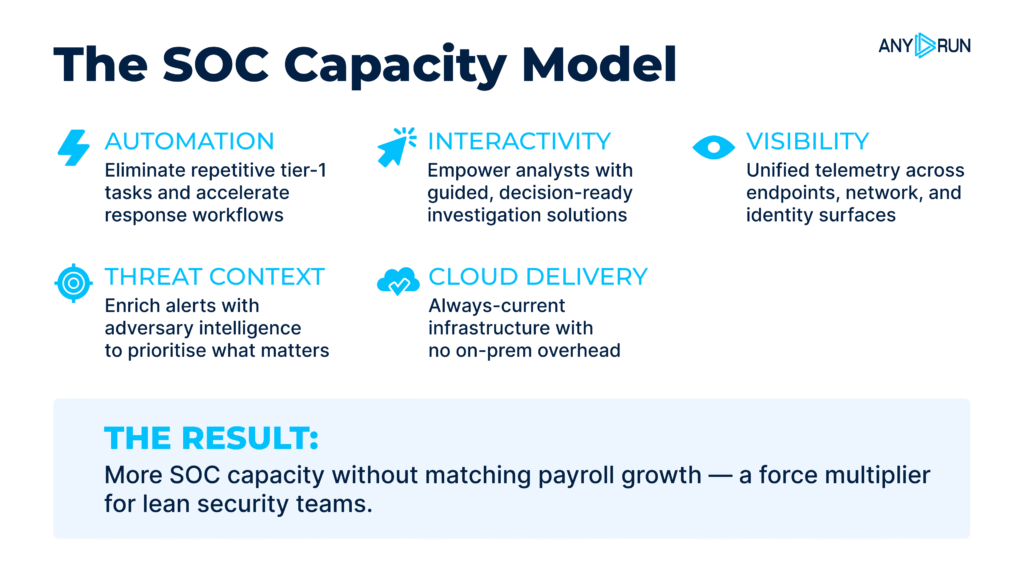
This removes much of the time spent rebuilding an investigation across several tools. It also gives less-experienced analysts enough context to understand what happened, decide whether the activity is malicious, and escalate serious cases with the evidence already attached.
The staffing impact is significant. Routine alerts stay with junior and mid-level analysts, while senior specialists spend more time on complex incidents, threat hunting, detection engineering, and response planning. New employees can also become productive faster because the investigation process is clearer and less dependent on specialist knowledge.
Speed of adoption matters as well. A solution that requires lengthy deployment, custom infrastructure, or months of training delays the return on the investment. Cloud-based solutions with intuitive workflows can begin reducing handling time sooner and help the SOC absorb more work before another hiring cycle becomes necessary.
For CFOs, this creates a more efficient workforce mix. The company gets more value from existing payroll, lowers its dependence on scarce senior talent, and increases security capacity without adding the same level of fixed cost.
The Efficiency Engine Behind a Lower-Cost, Higher-Capacity SOC
ANY.RUN brings interactive analysis, automated investigation, threat intelligence, and full attack visibility into one cloud-based workflow. The financial value comes from reducing the work required per case, allowing more investigations to remain with junior and mid-level analysts, and avoiding the infrastructure costs of an internal malware-analysis environment.
Reduce the Cost of File and URL Investigations
Investigating a suspicious file, link, email, or phishing page can take hours when analysts must reproduce each stage manually and collect evidence across several tools.
ANY.RUN’s Interactive Sandbox can expose the full attack flow in approximately two minutes. Analysts see the processes launched, files created, network connections, HTTP requests, redirects, IOCs, behavioral indicators, screenshots, and MITRE ATT&CK techniques in one investigation view.
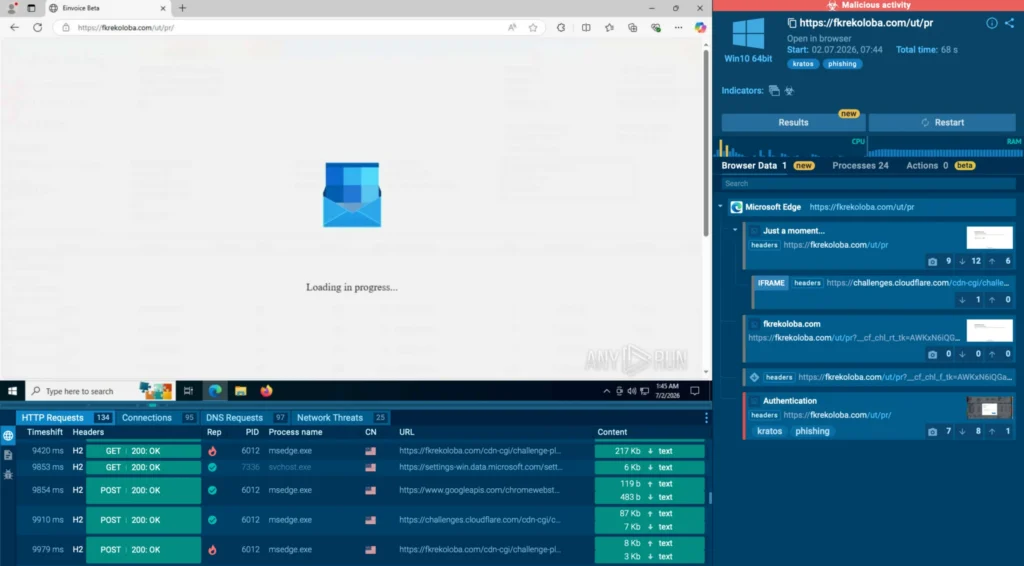
Automated Interactivity performs many of the actions an analyst would otherwise complete by hand. It can launch attachments, extract and follow links, click through pages, solve CAPTCHA challenges, and continue through multi-stage attacks. The sandbox mimics the actions required to keep the malicious flow running instead of stopping when a threat waits for user input.
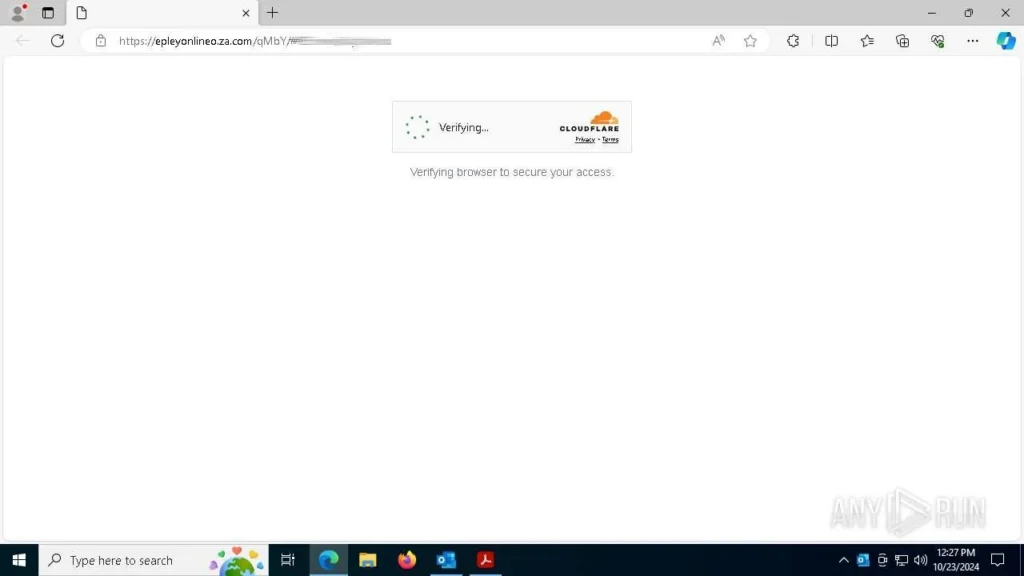
This reduces handling time and keeps analysts from rebuilding the same evidence manually. Junior and mid-level employees can make decisions with greater confidence, while senior specialists become involved only when the case genuinely requires deeper expertise.
Lower the Labor Cost of IOC Enrichment
An isolated IP address, domain, URL, or file hash often requires several searches before an analyst can determine its relevance. Each additional source adds handling time, and incomplete context increases the chance of an unnecessary escalation.
Threat Intelligence Lookup gives analysts access to data collected from sandbox sessions submitted by 15,000 organizations and 600,000 security professionals worldwide.
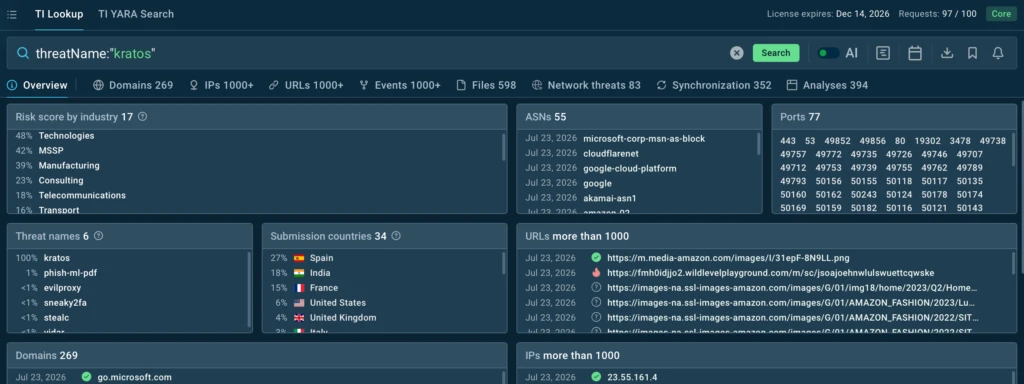
Each indicator is connected to the sandbox sessions where it appeared. The analyst can review related samples, infrastructure, network activity, behavior, and attacker techniques without assembling the investigation from separate sources.
The cost benefit grows with case volume. Shorter enrichment time reduces the unit cost of each investigation, helps the team process more alerts, and lowers the amount of senior labor spent validatingroutine indicators.
Get More Value from Existing Security Investments
Security systems lose value when they depend on stale indicators or require employees to research and validate incoming intelligence manually.
ANY.RUN’s Threat Intelligence Feeds provide continuously updated malicious IP addresses, domains, and URLs extracted from live sandbox investigations. New indicators are added as current malware and phishing threats are analyzed, rather than relying only on historical or broadly aggregated data.
Every IOC is connected to supporting context and the relevant sandbox session. This lets the SOC see why an indicator was classified as malicious and review the behavior and TTPs behind it without beginning a separate investigation from zero.
The feeds can be delivered into SIEM, SOAR, XDR, EDR, and threat intelligence systems through existing integrations, APIs, SDKs, and STIX/TAXII.
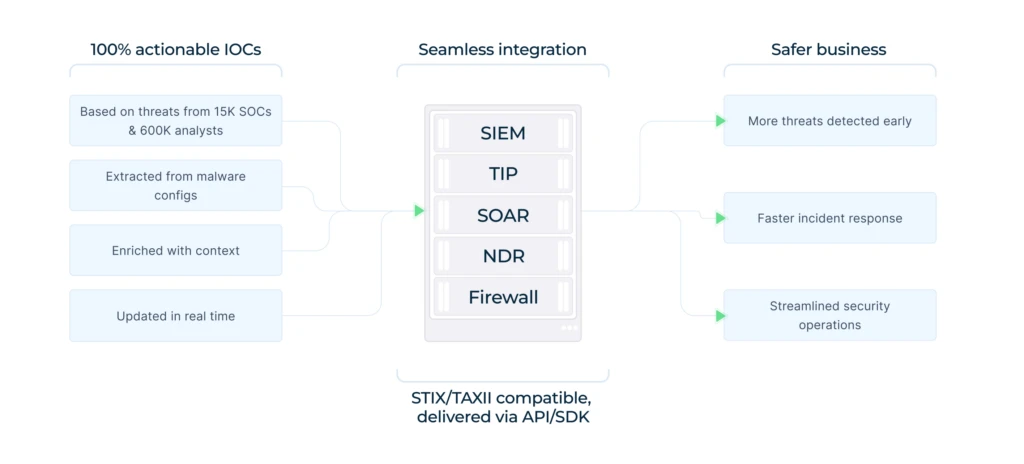
This increases the return on systems the company already funds. Fresher intelligence improves their detection coverage, while analysts spend less time collecting, checking, and distributing indicators across the security stack.
Lower TCO with Cloud Delivery
An internal malware-analysis environment carries costs beyond the initial hardware purchase. It requires isolated servers or virtual machines, operating-system images, security controls, updates, maintenance, internal support, and additional capacity as submission volume grows.
ANY.RUN is cloud-based and fully accessible through a browser. Teams can begin investigating threats without deploying dedicated servers or asking internal engineering teams to build and maintain a separate analysis environment.
This makes the total cost of ownership easier to forecast. The company avoids much of the capital spending, maintenance work, infrastructure support, and future expansion associated with an on-premises sandbox.
The savings build across all four areas: fewer analyst hours per investigation, lower dependence on senior specialists, better use of existing security investments, and less infrastructure overhead. The SOC gains capacity while payroll and operational costs remain more controlled.
The CFO Payoff: Lower Costs, More Capacity, Less Risk
ANY.RUN helps convert security improvements into measurable financial outcomes:
- Lower operating cost per case: Reducing MTTR by up to 21 minutes per investigation means fewer paid hours spent handling each alert and more capacity from the existing payroll.
- Delay additional hiring: A workload reduction of up to 20% for Tier 1 gives the SOC room to absorb higher alert volumes before another recruitment cycle is required.
- Protect high-cost specialist capacity: A 30% reduction in Tier 1-to-Tier 2 escalations keeps more routine work away from senior employees and lowers the blended labor cost of investigations.
- Improve workforce productivity: With 94% of users reporting faster triage, the team can process more cases within the same staffing budget and reduce the cost created by growing backlogs.
- Shorten time-to-productivity: Visual attack evidence and structured reports help junior employees become effective sooner, reducing onboarding pressure on senior staff.
- Avoid infrastructure spending: Cloud delivery removes the need to purchase, maintain, and expand dedicated malware-analysis hardware and virtual environments.
- Increase the return on the existing security stack: Actionable IOCs and threat context strengthen the SIEM, SOAR, XDR, and other systems already included in the security budget.
- Reduce financial exposure: Earlier threat detection and faster response help limit the likelihood that a manageable security event develops into costly downtime, recovery work, regulatory action, or lost business.
Together, these outcomes improve the unit economics of the SOC. The company can handle more risk with the team and systems already in place, while keeping payroll growth, infrastructure costs, and potential incident losses under tighter control.
About ANY.RUN
ANY.RUN, a leading provider of interactive malware analysis and threat intelligence solutions, helps organizations investigate threats faster and make response decisions based on clear behavioral evidence.
Its solutions include the Interactive Sandbox for enterprise-scale malware and phishing analysis, along with Threat Intelligence products built on investigation data from more than 15,000 organizations. This intelligence helps security teams enrich alerts, uncover active threats earlier, and add relevant context to detection, investigation, and response workflows.
ANY.RUN is SOC 2 Type II attested, demonstrating its commitment to strong security controls and customer data protection. For SOCs, MSSPs, and enterprise security teams, the platform helps reduce investigation uncertainty, accelerate triage, and turn threat analysis into actionable findings.



0 comments