Black friday Up to 3 extra licenses FOR FREE + Special offer for TI LOOKUP Get it now
Webinar
February 26
Better SOC with Interactive Sandbox Practical Use Cases
Register now

Mars Stealer

143
Global rank
127 infographic chevron month
Month rank
110 infographic chevron week
Week rank

Mars Stealer is a malware program designed to steal sensitive information from infected systems. It can access browser credentials, cryptocurrency wallets, and system information. The malware utilizes advanced evasion techniques and transmits stolen data securely through a C&C server.

Stealer
Type
ex-USSR
Origin
1 June, 2021
First seen
9 October, 2026
Last seen

How to analyze Mars Stealer with ANY.RUN

Type
ex-USSR
Origin
1 June, 2021
First seen
9 October, 2026
Last seen

IOCs

IP addresses
20.190.160.64
74.178.76.128
48.209.138.168
23.52.181.212
172.211.123.249
74.178.76.54
95.100.158.114
48.192.1.64
150.171.109.106
23.209.214.100
48.192.1.65
2.16.241.227
48.209.138.189
95.100.102.101
23.48.23.146
172.211.123.248
57.153.246.3
48.209.133.15
128.24.231.65
23.219.160.19
Hashes
d5cf930756370de6c8bc9e98003056761655b80e4ad0337602ad0d33740a6d8f
772c8625cde6caf1573e9e61f43a9cdcda1e9d957c67f190a9685ddc036df1f7
f49b515eedeed1abe391bc32f15ce43d3582cb6c41ff944fa9c79f476d5824ba
c001b2c8b46b34e555f329a8885b3e0014b6dfeb686ba8445177764487792d72
9bc533130a44071a690cc5b8e18db9157fb40c7d9b82fb6bae2ee00b3218fd6f
08bf3d453bda53f92992c6ca94098e158f805db3f68ec921d5e24cd90380d452
c08f2ebdc5adecfb67ffd9de298a8e7cf40851be01bde6f914d383c807100be2
9012e5f8c8b9986e8d9968f62da444464cc7db57811ff48b21c5f5f2cb516622
5c42497a3b2529d5d469a02bf5e32dac5696cbe2d443a1c75b5fc59f3502b370
d4a3cd4cedbc1987396dfcf571fb5c2a7184546824503d0c44a382bf56e0fcde
8f976956cac14dd16a76f89d51febd5606a0748cafb06f0587218451b571a86c
6b892e17d86f74e9131cb4b796ed8162ce63242c475beb88cae8eec59c77fa8d
a4b4d8e028939cb7848f2b0a0a434520f18d6ec1e72bed4d8c764be2f91e6b54
1b3d6e1878afbd806dc16b15bf36ea113429b64c7597236f81c91406cf727b1c
28825ea8245e6bcd88c3b4d744e07712f905d316d7005845629b4f98b7d533b9
e908466af6563b62d8f8c4bc870beb33b8fdb8682bf7c775a40ea1c6a8f49bf5
0e24672ae24a06f2c30bfeaa1c72bdd0916285097115fb105ef00b7c926375a7
54a5ec6205c8e24ca57013f57ffc10f374ddfc91b2187eff643be92f5e7fd602
6f20d866841c4514782a46142df22b70b8da9783c513e3d41d8f3313483fe38d
a3acc39d4b61f9cc1056c19176d1559f0dacbb0587a700afdbe4d881040ccd52
Domains
google.com
crl.microsoft.com
login.live.com
www.microsoft.com
settings-win.data.microsoft.com
fe3cr.delivery.mp.microsoft.com
slscr.update.microsoft.com
www.bing.com
activation-v2.sls.microsoft.com
client.wns.windows.com
ecs.office.com
self.events.data.microsoft.com
nexusrules.officeapps.live.com
watson.events.data.microsoft.com
go.microsoft.com
ocsp.digicert.com
copilot.microsoft.com
clients2.googleusercontent.com
edge.microsoft.com
edge-consumer-static.azureedge.net
URLs
https://login.live.com/rst2.srf
https://login.live.com/ppsecure/deviceaddcredential.srf
https://slscr.update.microsoft.com/sls/%7b522d76a4-93e1-47f8-b8ce-07c937ad1a1e%7d/x64/10.0.19045.4046/0?ch=686&l=en-us&p=&pt=0x30&wua=10.0.19041.3996&mk=dell&md=dell
https://fe3cr.delivery.mp.microsoft.com/clientwebservice/ping
http://crl.microsoft.com/pki/crl/products/microoceraut2011_2011_03_22.crl
http://www.microsoft.com/pkiops/crl/microsoft%20ecc%20product%20root%20certificate%20authority%202018.crl
http://crl.microsoft.com/pki/crl/products/microoceraut_2010-06-23.crl
http://www.microsoft.com/pkiops/crl/microsoft%20update%20signing%20ca%202.2.crl
http://www.microsoft.com/pkiops/crl/microsoft%20ecc%20update%20signing%20ca%202.2.crl
https://slscr.update.microsoft.com/sls/ping
https://slscr.update.microsoft.com/sls/%7be7a50285-d08d-499d-9ff8-180fdc2332bc%7d/x64/10.0.19045.4046/0?ch=686&l=en-us&p=&pt=0x30&wua=10.0.19041.3996&mk=dell&md=dell
http://www.microsoft.com/pkiops/crl/microsoft%20ecc%20update%20signing%20ca%202.1.crl
https://activation-v2.sls.microsoft.com/slactivateproduct/slactivateproduct.asmx?configextension=retail
http://www.microsoft.com/pkiops/crl/microsoft%20time-stamp%20pca%202010(1).crl
http://www.microsoft.com/pkiops/crl/microsoft%20update%20signing%20ca%202.3.crl
http://www.microsoft.com/pkiops/crl/micsecserca2011_2011-10-18.crl
https://go.microsoft.com/fwlink/?linkid=2257403&clcid=0x409
https://www.bing.com/threshold/xls.aspx?t=5&dl=1&f=9&wsbc=1
http://ocsp.digicert.com/mfewtzbnmeswstajbgurdgmcgguabbq50otx%2fh0ztl%2bz8sipi7wewvxdlqqutijuibiv5unu5g%2f6%2brks7qyxjzkceaz1vqyrvgl0erhqlcpm8gy%3d
https://settings-win.data.microsoft.com/settings/v3.0/wsd/waasassessment?os=windows&osver=10.0.19041.1.amd64fre.vb_release.191206-&ring=retail&sku=48&deviceclass=windows.desktop&locale=en-us&deviceid=bad99146-31d3-4ec6-a1a4-be76f32ba5d4&flightring=retail&telemetrylevel=1&hidovergattreg=c%3a%5cwindows%5csystem32%5cdriverstore%5cfilerepository%5chidbthle.inf_amd64_9610b4821fdf82a5%5cmicrosoft.bluetooth.profiles.hidovergatt.dll&appver=10.0&processoridentifier=amd64%20family%2023%20model%201%20stepping%202&oemmodel=dell&updateoffereddays=4294967295&processormanufacturer=authenticamd&installdate=1661339444&oemmodelbaseboard=&branchreadinesslevel=cb&oemsubmodel=j5cr&isclouddomainjoined=0&deferfeatureupdateperiodindays=30&isdeviceretaildemo=0&flightingbranchname=&osuilocale=en-us&devicefamily=windows.desktop&wuclientver=10.0.19041.3996&uninstallactive=1&isflightingenabled=0&osskuid=48&processorclockspeed=3094&totalphysicalram=6144&securebootcapable=0&app=waasassessment&processorcores=6&currentbranch=vb_release&installlanguage=en-us&deferqualityupdateperiodindays=0&servicingbranch=cb&oemname_uncleaned=dell&tpmversion=0&primarydisktotalcapacity=262144&installationtype=client&attrdataver=186&processormodel=amd%20ryzen%205%203500%206-core%20processor&isedgewithchromiuminstalled=1&osversion=10.0.19045.4046&ismdmenrolled=0&activationchannel=retail&honorwufbdeferrals=0&firmwareversion=a.40&trendinstalledkey=1&osarchitecture=amd64&defaultuserregion=244&updatemanagementgroup=2
Last Seen at
Last Seen at

Recent blog posts

post image
Your MSSP Added 10 New Clients. What Breaks F...
watchers 1037
comments 0
post image
Fake AI Tools Put US Companies at Risk: Insid...
watchers 4520
comments 0
post image
What's Really Attacking Your Industry? Insigh...
watchers 4704
comments 0

What is malware: Mars Stealer?

First identified in June 2021, Mars Stealer is a type of malicious software primarily focused on collecting sensitive information from browsers and cryptocurrency wallets for transmission to attackers. Written in ASM/C, the malware was initially sold through Dark Web forums as a malware-as-a-service on a subscription basis. It shared similar features with other malware like Oski Stealer, Arkei, and Vidar.

While the malware appeared to have stopped functioning in 2022, with reports of unresponsive developers, evidence suggests that the original creators of Mars Stealer remain active in 2024 and continue to exploit the malware for malicious purposes.

Get started today for free

Analyze malware and phishing in a fully-interactive sandbox

Create free account

Mars Stealer malicious software technical details

Information theft constitutes the core focus of Mars Staler:

  • Browser Credentials: It steals login credentials from popular browsers like Firefox, Chrome, Opera, and Internet Explorer using predefined paths to locate and extract data like usernames and passwords.
  • 2FA and Crypto Extension Data: Focusing specifically on Chromium-based browsers, Mars Stealer can hijack two-factor authentication (2FA) plugins and cryptocurrency extensions.
  • Cryptocurrency Wallet Targeting: It targets popular wallets like MetaMask and Binance Wallet, seeking information such as private keys.
  • Extensive System Information Collection: Mars Stealer also gathers comprehensive system information, including IPs, OS details, software installed on compromised systems, and usernames.
  • Screenshot Capture: The malware also captures a screenshot of every infected system.

Mars Stealer establishes a secure connection with its Command & Control (C&C) server using SSL encryption. This encrypted communication channel allows the malware to receive instructions, download configurations and libraries, and exfiltrate stolen data without raising red flags. The information collected by the malware is compressed into a ZIP archive before being exfiltrated to the C&C server.

Mars Stealer employs various evasion techniques to escape detection and analysis. For instance, it masks its WinApi calls and encrypts strings. To prevent multiple instances of the malware from running concurrently, Mars Stealer creates a mutex object. The virus employs a custom file grabber with configuration parsing capabilities, allowing for flexible targeting of specific files and directories.

The malware includes a special feature that checks every machine before attempting infection to identify whether it is located in one of the countries that belong to the Commonwealth of Independent States (CIS). This likely points to the fact that the creators of Mars Stealer hail from the same region.

Mars Stealer execution process

It’s time to have a better look at Mars Stealer by uploading its sample to the ANY.RUN sandbox for closer inspection.

As perpetrators endeavor to conceal their activities, the Mars Stealer employs a deliberately straightforward execution chain to minimize visibility. Consequently, the infected operating system experiences a limited number of processes, and the malware refrains from utilizing system tools. Once the payload infiltrates the compromised system, it promptly initiates its execution.

The analyzed sample initiates a process executing all malicious activities, including data theft and communication with the Command and Control (C&C) server. Malware was detected, and the configuration was successfully extracted.
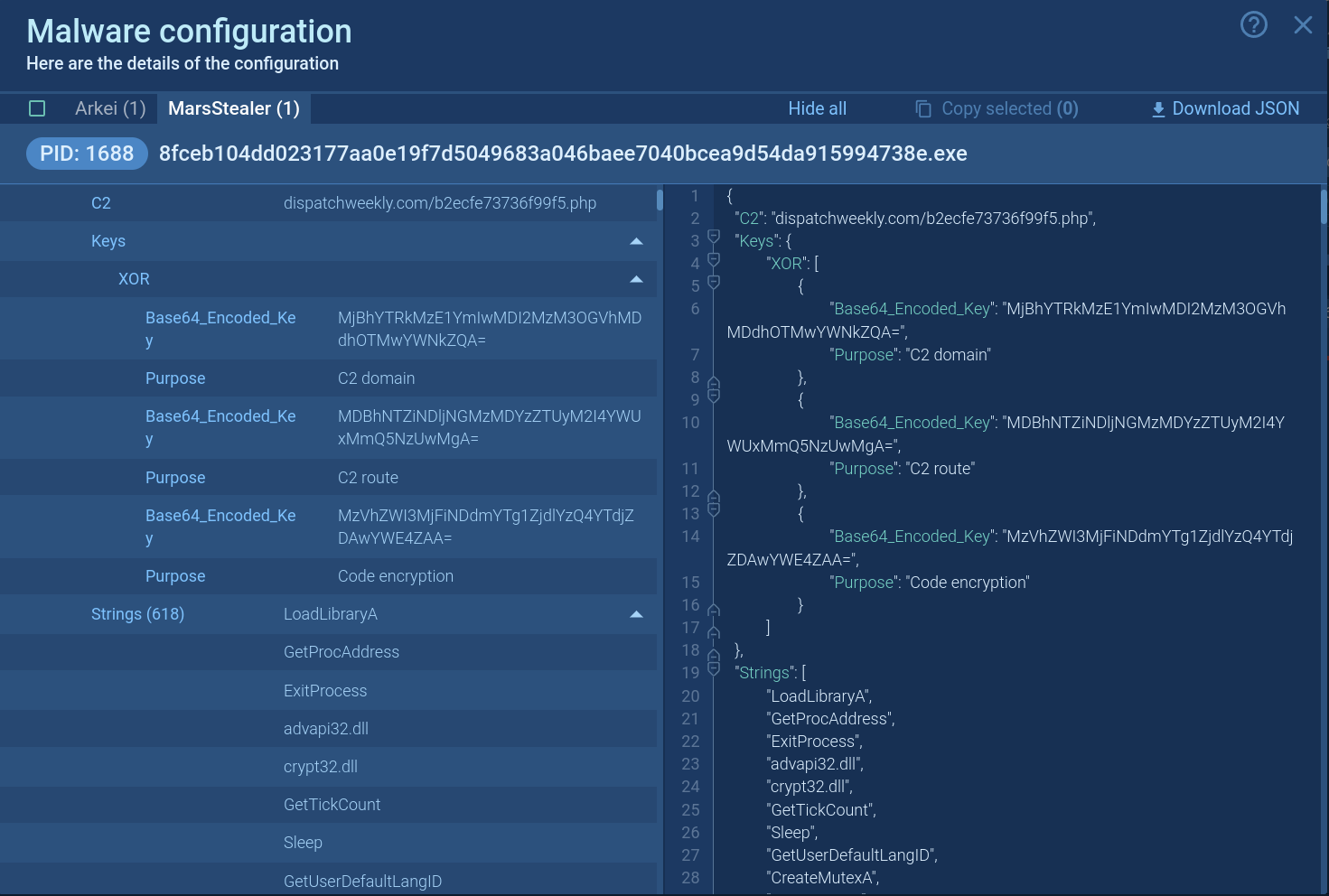
Mars config shown in ANY.RUN Mars Stealer's configuration demonstrated in ANY.RUN

Mars Stealer malware distribution methods

When it comes to distribution methods, a typical attack in the case of Mars Stealer starts from spam campaigns or fake websites advertising legitimate software. For instance, in 2022, one of the campaigns to distribute Mars Stealer used a website promoting Atomic Wallet, a popular cryptocurrency wallet. After clicking on the “download” button on the website, users would receive a .zip file which contains a sample of Mars Stealer.

The malware was also commonly dropped by loaders, malicious software designed specifically for spreading different malware families on devices they manage to infect. One of the examples here is PrivateLoader.

Conclusion

With malware infections being at an all time high, it becomes important to stay vigilant and exercise caution when encountering any suspicious emails, websites, or software downloads to avoid falling victim to Mars Stealer or similar malware threats, as well as to maintain protection of your infrastructure.

ANY.RUN, a cloud-based sandbox, offers accurate threat detection, along with detailed reports on their technical characteristics. It lets you scan any suspicious file and check potentially malicious URLs to ensure informed decision-making and timely removal of any traces of the malware.

Try ANY.RUN for free – register now!
HAVE A LOOK AT

GREENBLOOD screenshot
GREENBLOOD
greenblood
GREENBLOOD is a Go-based ransomware that uses concurrent ChaCha8 encryption to lock entire Windows environments in under a minute while systematically destroying backups, disabling defenses, and threatening double extortion through a Tor-based data leak site.
Read More
Pay2Key screenshot
Pay2Key is a ransomware strain primarily written in C++ for Windows (with recent Linux variants), attributed to Iranian-linked actors, notably the Fox Kitten APT group (also known as UNC757 or related operations). First observed in late 2020, it employs double-extortion tactics (encrypting files and threatening to leak stolen data) while showing signs of both financial and state-aligned motivations. It has resurfaced in campaigns targeting Western organizations, including rapid encryption attacks on healthcare.
Read More
Jigsaw screenshot
Jigsaw
jigsaw
The Jigsaw ransomware, initially detected in 2016, encrypts files on compromised systems and requires a ransom payment in Bitcoin. If the ransom is not paid, the malware starts deleting files, increasing the pressure on victims to comply. Its source code is publicly accessible, allowing various threat actors to customize and repurpose the malware for different objectives.
Read More
WannaCry screenshot
WannaCry
wannacry ransomware
WannaCry is a famous Ransomware that utilizes the EternalBlue exploit. This malware is known for infecting at least 200,000 computers worldwide and it continues to be an active and dangerous threat.
Read More
Miolab Stealer screenshot
Miolab Stealer is a macOS malware threat designed to steal user credentials and sensitive files without raising immediate suspicion. It relies on fake system prompts and legitimate built-in tools to make malicious actions look routine. Instead of causing obvious disruption, it quietly collects valuable data and prepares it for exfiltration from the device. By blending deception with trusted macOS behavior, it increases the chance that the attack will go unnoticed in its early stages. This makes early behavioral detection critical before the theft of credentials and files is complete.
Read More
Akira Ransomware screenshot
Akira Ransomware emerged in March 2023 and compromised over 250 organizations by January 2024 with approximately $42 million in ransom payments. It employs double extortion tactics exfiltrating data before encryption and threatening to publish it on a dedicated website.
Read More