Black friday Up to 3 extra licenses FOR FREE + Special offer for TI LOOKUP Get it now
Webinar
February 26
Better SOC with Interactive Sandbox Practical Use Cases
Register now
23
Global rank
21 infographic chevron month
Month rank
25 infographic chevron week
Week rank
0
IOCs

WannaCry is a famous Ransomware that utilizes the EternalBlue exploit. This malware is known for infecting at least 200,000 computers worldwide and it continues to be an active and dangerous threat.

Ransomware
Type
Likely North Korea
Origin
12 May, 2017
First seen
18 August, 2026
Last seen
Also known as
WCry
WanaCryptor

How to analyze WannaCry with ANY.RUN

Type
Likely North Korea
Origin
12 May, 2017
First seen
18 August, 2026
Last seen

IOCs

IP addresses
48.192.1.64
23.52.181.141
20.190.159.73
172.211.123.248
48.209.133.15
172.66.2.5
135.233.95.144
95.100.102.101
74.178.76.54
2.16.241.223
23.11.41.157
48.209.138.189
2.16.164.32
131.253.33.203
40.126.31.3
88.221.169.152
184.86.251.22
57.153.246.3
23.53.40.178
20.59.87.227
Hashes
72f20024b2f69b45a1391f0a6474e9f6349625ce329f5444aec7401fe31f8de1
4a468603fdcb7a2eb5770705898cf9ef37aade532a7964642ecd705a74794b79
402751fa49e0cb68fe052cb3db87b05e71c1d950984d339940cf6b29409f2a7c
9bd38110e6523547aed50617ddc77d0920d408faeed2b7a21ab163fda22177bc
552aa0f82f37c9601114974228d4fc54f7434fe3ae7a276ef1ae98a0f608f1d0
2adc900fafa9938d85ce53cb793271f37af40cf499bcc454f44975db533f0b61
a75bb44284b9db8d702692f84909a7e23f21141866adf3db888042e9109a1cb6
055c7760512c98c8d51e4427227fe2a7ea3b34ee63178fe78631fa8aa6d15622
a0356696877f2d94d645ae2df6ce6b370bd5c0d6db3d36def44e714525de0536
49f2c739e7d9745c0834dc817a71bf6676ccc24a4c28dcddf8844093aab3df07
e13cc9b13aa5074dc45d50379eceb17ee39a0c2531ab617d93800fe236758ca9
e18fdd912dfe5b45776e68d578c3af3547886cf1353d7086c8bee037436dff4b
23e5e738aad10fb8ef89aa0285269aff728070080158fd3e7792fe9ed47c51f4
bd9f4b3aedf4f81f37ec0a028aabcb0e9a900e6b4de04e9271c8db81432e2a66
d8489f8c16318e524b45de8b35d7e2c3cd8ed4821c136f12f5ef3c9fc3321324
40b37e7b80cf678d7dd302aaf41b88135ade6ddf44d89bdba19cf171564444bd
845d0e178aeebd6c7e2a2e9697b2bf6cf02028c50c288b3ba88fe2918ea2834a
70c0f32ed379ae899e5ac975e20bbbacd295cf7cd50c36174d2602420c770ac1
02932052fafe97e6acaaf9f391738a3a826f5434b1a013abbfa7a6c1ade1e078
02befd86643a4f4a40116c2ad0dce064a070e17512f989c3b88b0df0fc3a905f
Domains
settings-win.data.microsoft.com
activation-v2.sls.microsoft.com
slscr.update.microsoft.com
google.com
client.wns.windows.com
ocsp.digicert.com
fe3cr.delivery.mp.microsoft.com
crl.microsoft.com
login.live.com
www.microsoft.com
go.microsoft.com
www.bing.com
oneocsp.microsoft.com
messaging.engagement.office.com
ecs.office.com
roaming.svc.cloud.microsoft
omex.cdn.office.net
metadata.templates.cdn.office.net
createcatalog.public.onecdn.static.microsoft
officeclient.microsoft.com
URLs
https://settings-win.data.microsoft.com/settings/v3.0/wsd/waasassessment?os=windows&osver=10.0.19041.1.amd64fre.vb_release.191206-&ring=retail&sku=48&deviceclass=windows.desktop&locale=en-us&deviceid=bad99146-31d3-4ec6-a1a4-be76f32ba5d4&flightring=retail&telemetrylevel=1&hidovergattreg=c%3a%5cwindows%5csystem32%5cdriverstore%5cfilerepository%5chidbthle.inf_amd64_9610b4821fdf82a5%5cmicrosoft.bluetooth.profiles.hidovergatt.dll&appver=10.0&processoridentifier=amd64%20family%2023%20model%201%20stepping%202&oemmodel=dell&updateoffereddays=4294967295&processormanufacturer=authenticamd&installdate=1661339444&oemmodelbaseboard=&branchreadinesslevel=cb&oemsubmodel=j5cr&isclouddomainjoined=0&deferfeatureupdateperiodindays=30&isdeviceretaildemo=0&flightingbranchname=&osuilocale=en-us&devicefamily=windows.desktop&wuclientver=10.0.19041.3996&uninstallactive=1&isflightingenabled=0&osskuid=48&processorclockspeed=3094&totalphysicalram=6144&securebootcapable=0&app=waasassessment&processorcores=6&currentbranch=vb_release&installlanguage=en-us&deferqualityupdateperiodindays=0&servicingbranch=cb&oemname_uncleaned=dell&tpmversion=0&primarydisktotalcapacity=262144&installationtype=client&attrdataver=186&processormodel=amd%20ryzen%205%203500%206-core%20processor&isedgewithchromiuminstalled=1&osversion=10.0.19045.4046&ismdmenrolled=0&activationchannel=retail&honorwufbdeferrals=1&firmwareversion=a.40&trendinstalledkey=1&osarchitecture=amd64&defaultuserregion=244&updatemanagementgroup=2
http://crl.microsoft.com/pki/crl/products/microoceraut2011_2011_03_22.crl
http://www.microsoft.com/pkiops/crl/micsecserca2011_2011-10-18.crl
https://go.microsoft.com/fwlink/?linkid=2257403&clcid=0x409
https://settings-win.data.microsoft.com/settings/v3.0/onesettings/client?osversionfull=10.0.19045.4046.amd64fre.vb_release.191206-1406&localdeviceid=s%3abad99146-31d3-4ec6-a1a4-be76f32ba5d4&flightring=retail&attrdataver=186&osuilocale=en-us&osskuid=48&app=wosc&appver=&isflightingenabled=0&telemetrylevel=1&devicefamily=windows.desktop
https://login.live.com/rst2.srf
https://login.live.com/ppsecure/deviceaddcredential.srf
http://ocsp.digicert.com/mfewtzbnmeswstajbgurdgmcgguabbq50otx%2fh0ztl%2bz8sipi7wewvxdlqqutijuibiv5unu5g%2f6%2brks7qyxjzkceaz1vqyrvgl0erhqlcpm8gy%3d
https://settings-win.data.microsoft.com/settings/v3.0/flightsettings/fsservice?processorclockspeed=3094&isretailos=1&oemmanufacturername=dell&flightingpolicyvalue=3&enablepreviewbuilds=4294967295&osversionfull=10.0.19045.4046.amd64fre.vb_release.191206-1406&managepreviewbuilds=3&branchreadinesslevelsource=0&attrdataver=186&processorcores=6&branchreadinesslevelraw=16&totalphysicalram=6144&tpmversion=0&oemmodelnumber=dell&systemvolumetotalcapacity=260281&deviceid=s%3abad99146-31d3-4ec6-a1a4-be76f32ba5d4&app=fss&appver=10.0&smartactivehoursstate=1&activehoursstart=20&securebootcapable=0&activehoursend=13&devicefamily=windows.desktop
https://settings-win.data.microsoft.com/settings/v3.0/wsd/muse?processorclockspeed=3094&flightids=&updateoffereddays=4294967295&branchreadinesslevel=cb&oemmanufacturername=dell&isclouddomainjoined=0&processoridentifier=amd64%20family%2023%20model%201%20stepping%202&sku=48&activationchannel=retail&attrdataver=186&ismdmenrolled=0&processorcores=6&processormodel=amd%20ryzen%205%203500%206-core%20processor&totalphysicalram=6144&primarydisktype=4294967295&flightingbranchname=&chassistypeid=1&oemmodelnumber=dell&systemvolumetotalcapacity=260281&sampleid=95271487&deviceclass=windows.desktop&app=muse&disabledualscan=0&appver=10.0&oemsubmodel=j5cr&locale=en-us&isalwaysonalwaysconnectedcapable=0&ms=0&defaultuserregion=244&updateserviceurl=http%3a%2f%2fneverupdatewindows10.com&osver=10.0.19045.4046.amd64fre.vb_release.191206-1406&os=windows&deviceid=s%3abad99146-31d3-4ec6-a1a4-be76f32ba5d4&deferqualityupdateperiodindays=0&ring=retail&deferfeatureupdateperiodindays=30
https://slscr.update.microsoft.com/sls/%7b522d76a4-93e1-47f8-b8ce-07c937ad1a1e%7d/x64/10.0.19045.4046/0?ch=686&l=en-us&p=&pt=0x30&wua=10.0.19041.3996&mk=dell&md=dell
https://fe3cr.delivery.mp.microsoft.com/clientwebservice/ping
http://www.microsoft.com/pkiops/crl/microsoft%20ecc%20update%20secure%20server%20ca%202.1.crl
https://slscr.update.microsoft.com/sls/ping
https://slscr.update.microsoft.com/sls/%7be7a50285-d08d-499d-9ff8-180fdc2332bc%7d/x64/10.0.19045.4046/0?ch=686&l=en-us&p=&pt=0x30&wua=10.0.19041.3996&mk=dell&md=dell
https://settings-win.data.microsoft.com/settings/v3.0/wsd/updatehealthtools?os=windows&osver=10.0.19041.1.amd64fre.vb_release.191206-&sku=48&deviceclass=windows.desktop&locale=en-us&deviceid=s:bad99146-31d3-4ec6-a1a4-be76f32ba5d4&sampleid=s:95271487&appver=10.0.19041.3626&flightring=retail&telemetrylevel=1&hidovergattreg=c%3a%5cwindows%5csystem32%5cdriverstore%5cfilerepository%5chidbthle.inf_amd64_9610b4821fdf82a5%5cmicrosoft.bluetooth.profiles.hidovergatt.dll&appver=&processoridentifier=amd64%20family%2023%20model%201%20stepping%202&oemmodel=dell&updateoffereddays=4294967295&processormanufacturer=authenticamd&installdate=1661339444&oemmodelbaseboard=&branchreadinesslevel=cb&oemsubmodel=j5cr&isclouddomainjoined=0&deferfeatureupdateperiodindays=30&isdeviceretaildemo=0&flightingbranchname=&osuilocale=en-us&devicefamily=windows.desktop&wuclientver=10.0.19041.3996&uninstallactive=1&isflightingenabled=0&osskuid=48&processorclockspeed=3094&totalphysicalram=6144&securebootcapable=0&app=sedimentpack&processorcores=6&currentbranch=vb_release&installlanguage=en-us&deferqualityupdateperiodindays=0&oemname_uncleaned=dell&tpmversion=0&primarydisktotalcapacity=262144&installationtype=client&attrdataver=186&processormodel=amd%20ryzen%205%203500%206-core%20processor&isedgewithchromiuminstalled=1&osversion=10.0.19045.4046&ismdmenrolled=0&activationchannel=retail&firmwareversion=a.40&trendinstalledkey=1&osarchitecture=amd64&defaultuserregion=244&updatemanagementgroup=2
http://ocsp.digicert.com/mfewtzbnmeswstajbgurdgmcgguabbtrjrydryt%2bapf3gspypfhbxr5xtqqus9tippmhxdiunkhmewnpyim8s8yceajtxtab8my1oj8mfwpz%2f7y%3d
http://oneocsp.microsoft.com/ocsp/mfqwujbqme4wtdajbgurdgmcgguabbq3l3%2f%2fa6adk8nray2gxzvayrhg4aqub6t%2b2v%2bxq3lso2d33ojhnyhhqoucezmaaaagb6jmmcovb6saaaaaaay%3d
https://www.bing.com/threshold/xls.aspx?t=5&dl=1&f=9&wsbc=1
https://settings-win.data.microsoft.com/settings/v3.0/wsd/waasassessment?os=windows&osver=10.0.19041.1.amd64fre.vb_release.191206-&ring=retail&sku=48&deviceclass=windows.desktop&locale=en-us&deviceid=bad99146-31d3-4ec6-a1a4-be76f32ba5d4&flightring=retail&telemetrylevel=1&hidovergattreg=c%3a%5cwindows%5csystem32%5cdriverstore%5cfilerepository%5chidbthle.inf_amd64_9610b4821fdf82a5%5cmicrosoft.bluetooth.profiles.hidovergatt.dll&appver=10.0&processoridentifier=amd64%20family%2023%20model%201%20stepping%202&oemmodel=dell&updateoffereddays=4294967295&processormanufacturer=authenticamd&installdate=1661339444&oemmodelbaseboard=&branchreadinesslevel=cb&oemsubmodel=j5cr&isclouddomainjoined=0&deferfeatureupdateperiodindays=30&isdeviceretaildemo=0&flightingbranchname=&osuilocale=en-us&devicefamily=windows.desktop&wuclientver=10.0.19041.3996&uninstallactive=1&isflightingenabled=0&osskuid=48&processorclockspeed=3094&totalphysicalram=6144&securebootcapable=0&app=waasassessment&processorcores=6&currentbranch=vb_release&installlanguage=en-us&deferqualityupdateperiodindays=0&servicingbranch=cb&oemname_uncleaned=dell&tpmversion=0&primarydisktotalcapacity=262144&installationtype=client&attrdataver=186&processormodel=amd%20ryzen%205%203500%206-core%20processor&isedgewithchromiuminstalled=1&osversion=10.0.19045.4046&ismdmenrolled=0&activationchannel=retail&honorwufbdeferrals=0&firmwareversion=a.40&trendinstalledkey=1&osarchitecture=amd64&defaultuserregion=244&updatemanagementgroup=2
Last Seen at
Last Seen at

Recent blog posts

post image
Mirage2FA Hijacks Companies’ Microsoft 365 Se...
watchers 379
comments 0
post image
Intelligence-Driven SOC: Modernizing Threat M...
watchers 11437
comments 0
post image
Supply Chain Security: How ANY.RUN Helps US a...
watchers 6548
comments 0

What is WCry ransomware?

WannaCry, sometimes also called WCry or WanaCryptor is ransomware malware, meaning that it encrypts files of its victims and demands a payment to restore the stolen information, usually in bitcoin with ransom amounts ranging from $300 to $600 equivalents.

The virus can be described as ransomware like Dharma or Ryuk but with worm functionality, since it is capable of spreading itself within infected networks using the EternalBlue exploit. Additionally, the virus uses DoublePulsar exploit to upload and execute a copy of itself to a new machine.

Once WannaCry makes its way into a target computer, it begins its malicious activity by checking for a hardcoded kill switch domain - either fferfsodp9ifjaposdfjhgosurijfaewrwergwea[.]com or iuqerfsodp9ifjaposdfjhgosurijfaewrwergwea[.]com. In the event, if one is found, the malware stops the execution. However, if a kill switch domain isn’t found, the ransomware encrypts files on the machine, following which an attempt to exploit the SMB vulnerability takes place. This is done in an effort to spread the virus over to other random PCs and all those connected to a local network. After encryption is completed, a ransom note is displayed to the user and the attackers demand $300 to be paid in a 3-day timespan. If the victim resists the ransom amount rises to $600 to be paid in 7 days. The payments are directed to multiple hardcoded bitcoin addresses. Typical for a cryptocurrency, anybody can check their balances and transaction history but the true owner of such a wallet can not be traced.

General description of WannaCry

The first time WannaCry malware was seen in the wild was as a part of a devastating worldwide attack that took place in May 2017. The attack utilized an EternalBlue exploit, which was believed to have been developed by the American NSA and leaked by a cybergang known under the allies “The Shadow Brokers”.

The exploit leveraged a vulnerability in the Windows operating systems and while a patch fixing the issue was released quickly by the company, many individuals and organizations who didn’t promptly update their computers became victims of this attack.

By some broad estimations, over 200,000 computers worldwide were infected by WannaCry within those few days that the attack was ongoing. A fix of the EternalBlue exploit along with the discovery of the “kill switch” that allowed to stop the execution of the malware were the two main contributions that helped to slow down this malicious campaign. However, by the time the attack came to an end total damage amounted to billions of dollars, and victims from over 150 countries were affected.

A campaign of such scale raised international investigation of the highest level aimed to find out who was behind the outbreak. During WannaCry hack analysis experts investigated the ransom notes to find out that they were most likely written by hand and the writers seemed to be fluent in Chinese and English, as was suggested by the linguistics analysis. Further investigation suggested that the native language of the writer was Chinese since two versions of ransom note were composed in this language - one in Simplified and one in Traditional Chinese. Furthermore, some typos in the notes lead researchers to believe that a Chinese input system was used for typing during WannaCry cyber attack, as mistakes like those present could not have been easily made using any other form of input.

It should be noted, that in total the ransom note was written in 28 languages including both Chinese variations. However, for most of those languages, a machine translation was used.

The FBI then uncovered that Hangul fonts were installed on the machine that was used to compose the ransom notes. Hangul is an alphabet and a writing system used in the South as well as in North Korea. Further analysis of the language files metadata displayed that the computer was set to a Korean Timezone.

Upon further WannaCry ransomware attack analysis, security researchers from Google, Kaspersky Lab, and Symantec concluded that the code of WCry exhibited similarities to other malware used in the campaigns against Sony Pictures and a Bangladesh bank. Those attacks were carried out by a so-called Lazarus Group, members of which were linked to North Korea.

Of course, this evidence was not conclusive as other groups could have simply reused some of the code produced by the Lazarus Group. What’s more, the use of such code could have been intentional in order to mislead the investigators and put the blame on other cybercriminals.

However, a liked memo from NSA as well as findings made by UK's National Cyber Security Centre also pointed at North Korea as the country from which the attack originated. The United States Government subsequently proceeded to formally declare North Korea to be the attack origin.

In foresight, despite the fact that the WannaCry attack had a truly unprecedented scale, its impact is considered relatively low, compared to other ransomware. The aftermath could have been much worse if it was not for the discovery of the kill switch. Furthermore, the virus could have been targeted at high-level infrastructures like transport control systems and nuclear power plants. Had this been the case, some experts estimate possible losses in excess of hundreds of millions of dollars.

Talking about the actual WannaCry analysis - it comes in the form of a dropper that holds various components as a ZIP archive which is protected by a password. This archive is being unpacked during the execution using a hardcoded password and dropped into a directory from which it was executed.

WCry ransomware uses two encryption methods during its execution: RSA and AES-128-CBC. To confuse the researchers the encryption scenario that is contained in a t.wnry file is actually encrypted in exactly the same way that the malware uses to encrypt data on an infected machine. A custom loader is used to load the module into memory, so the unencrypted version of the file never has to be recorded on the victim’s hard drive.

Upon the start of the execution process, the malware uses an RSA key to unpack the t.wnry file and decrypt it. Then a new RSA key will be generated and sent to a C&C server, while a duplicate of a public key is being saved on the infected machine.

This is where the malware starts to encrypt files – the virus searches the infected machine for files with supported extensions. Then, a 128 bit AES key is created per every single file that was selected for encryption and encrypted using the RSA key created earlier. RSA-encrypted AES key is placed in a header of an encrypted file. After this, the malware uses the AES key to encrypt data in the file.

The encryption is performed in such a way that it is virtually impossible to restore the lost data without access to the private key, that is stored in the control server. This means that for a victim the only way to regain access to their information is to fulfill the ransom demand, made by the attackers.

For persistence, WCry writes itself in the autorun keys in the registry and creates a couple of services.

WannaCry malware analysis

A video simulation recorded on ANY.RUN allows us to better understand what is WannaCry ransomware and examine the lifecycle of WannaCry.
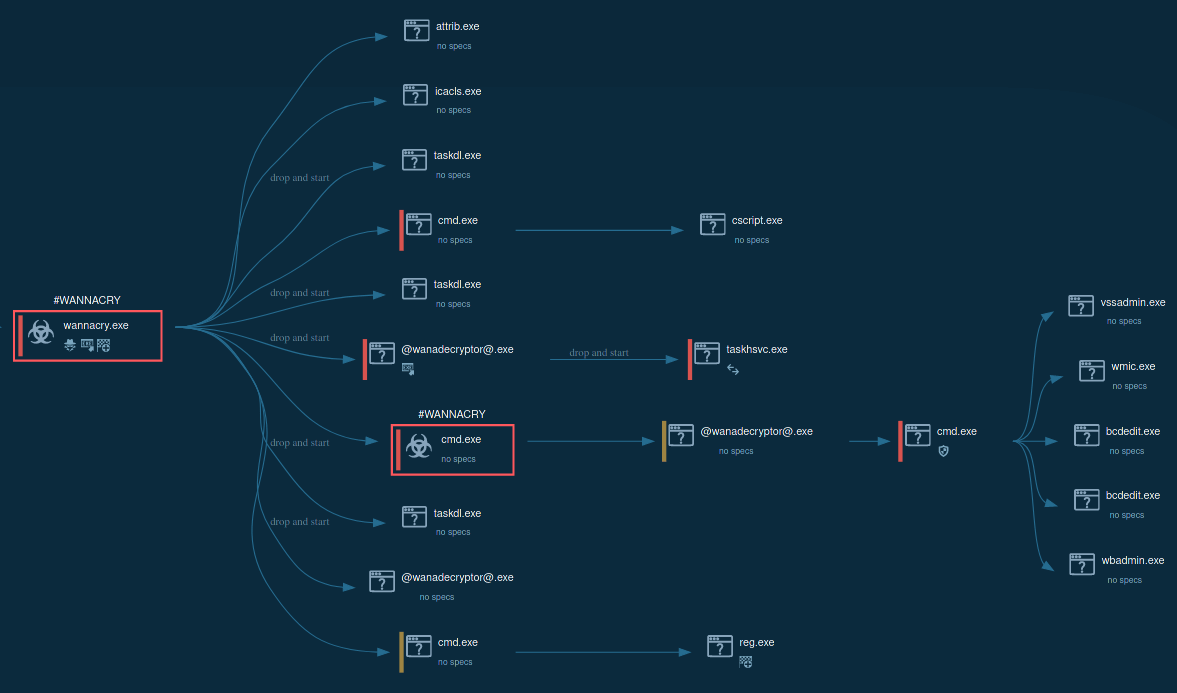
wannacry execution process graph

Figure 1: Process graph generated by ANY.RUN allows us to see the main processes of WannaCry execution.
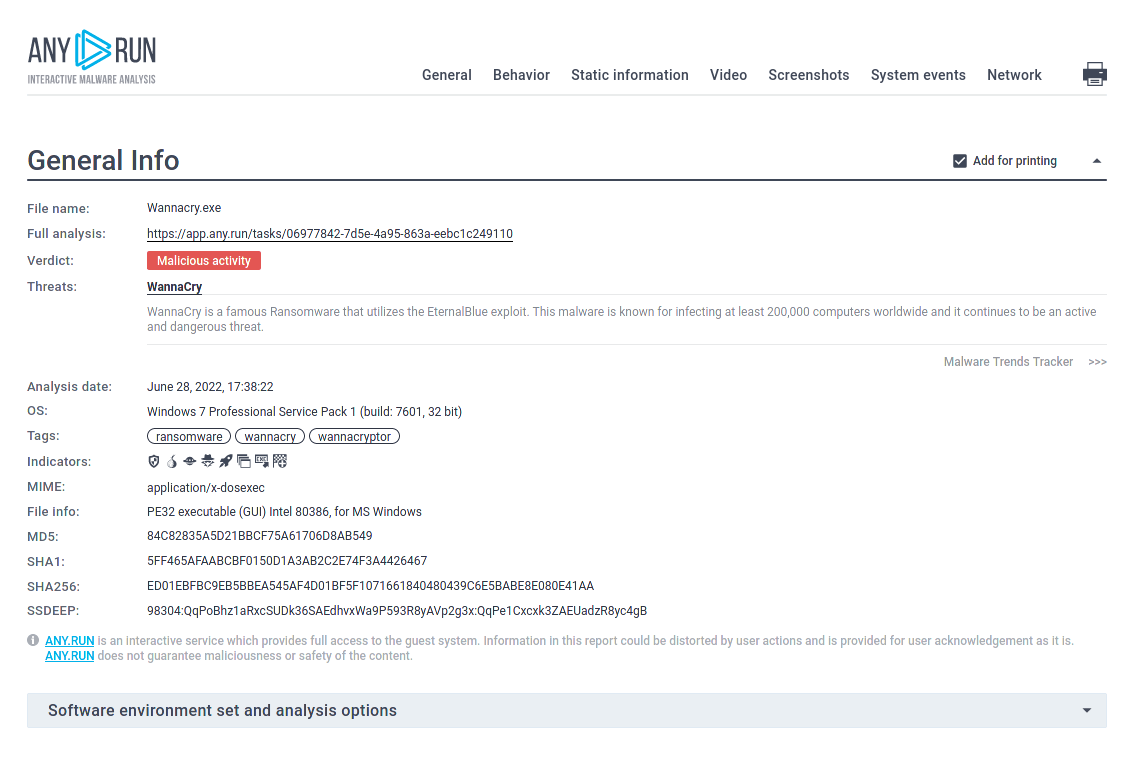
text report of the wannacry analysis

Figure 2: Displays the customizable text report generated by ANY.RUN.

Get started today for free

Analyze malware and phishing in a fully-interactive sandbox

Create free account

How does WCry infect?

Besides being distributed by malicious spam campaigns, ransomware uses a more interesting way to infect devices - it utilizes an operating system vulnerability as the initial attack vector. Once the malware successfully leverages an exploit and makes its way into a machine, it will scan the IP addresses in an attempt to infect connected devices through the SMB vulnerability on port 445/TCP. This vulnerability has CVE ID 2017-0144 and is also known as MS17-010 EternalBlue.

All devices in a local network exhibiting potential vulnerability will also be infected.

WannaCry ransomware execution process

First of all, after running, WCry sends an HTTP GET request to hardcoded domains and stops execution if the request is successful. Although the WannaCry execution process is pretty straightforward, it does not just encrypt files on the infected machine, but it's also trying to infect as many nearby machines as it can. To do so, the ransomware scans all machines with port 445 being open and if the connection is made, tries to exploit the SMBv1 vulnerability (EternalBlue). On the local system, WannaCry executable file extracts and installs binary and configuration files from its resource section.
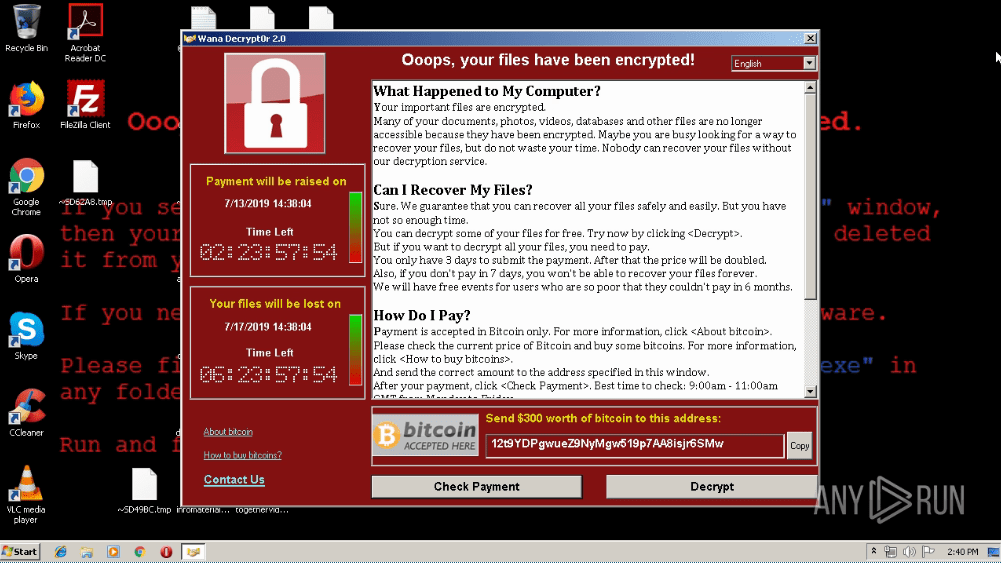
workstation desktop after wannacry infection

Figure 3: A Desktop of a system infected by WannaCry

It also hides the extracted directory, modifies security descriptors, creates an encryption key, deletes shadow copies, and so on. After all these steps, WannaCry encrypts the files of the user and sets the wallpaper to a ransom note. In addition, a @WanaDecryptor@.exe executable file is being started to provide information about the countdown and payment method to a victim.

Use ANY.RUN free for 14 days

Try the full power of interactive analysis

Start your free trial

Prevention of WCry attacks

In order to prevent potential WannaCry attacks, users should install security patches created by Microsoft in response to the original incident. Today, early versions of WCry won't work because their killswitch is still active.

The patch code for this security update is MS-17-010 and the update is available even for Windows XP; it was the first update to this operating system issued by Microsoft in 3 years.

How to get more WannyCry ransomware data using ANY.RUN?

Since crooks behind WCry offer decryption of three images for free you can use the interactivity of ANY.RUN to take additional steps in your analysis. Open the website specified in a ransom note in the browser and follow all steps to decrypt images to get a bigger picture of a ransomware infection process.
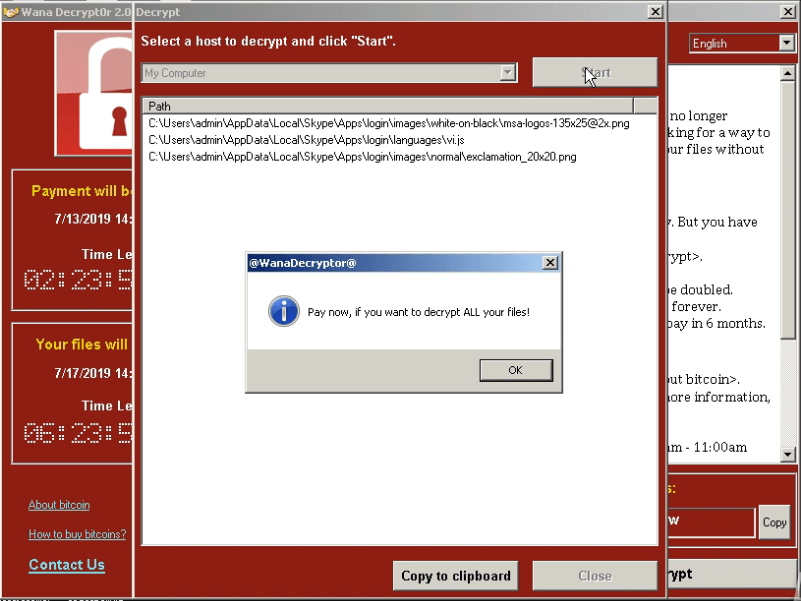
wannacry ransom note Figure 4: Wannacry ransom note

Conclusion

WannaCry ransomware is undoubtedly one of the most destructive malware ever used by cyberattacks. The first malicious campaign utilizing this dangerous virus had a truly unprecedented scale.

Thankfully, due to outstanding work done by cybersecurity professionals, the attack was contained in just a few days by finding an effective kill switch and patching the vulnerability in the Microsoft operating systems that the ransomware was targeting. However, even despite such quick reaction times made by cybersecurity professionals all around the world, billions of dollars were lost by victims all across the world.

To prevent devastating cyber attacks such as the one performed using the WannaCry virus, researchers should learn as much as possible about the existing malware samples and analyze their code. This task is greatly simplified with the use of interactive sandboxes like ANY.RUN, which allows users to influence the simulation in real-time in order to get the best results.

Create your free ANY.RUN account to analyze malware and phishing without limits!
HAVE A LOOK AT

DoubleTrouble screenshot
DoubleTrouble
doubletrouble
DoubleTrouble is a new-generation Android malware designed to quietly infiltrate mobile devices, harvest sensitive data, hijack financial operations, and maintain long-term persistence. Unlike commodity Android trojans, it blends advanced evasion, dual-stage infection, and dynamic payload updates, making it a rising mobile threat for both consumers and organizations.
Read More
MicroStealer screenshot
MicroStealer
microstealer
MicroStealer is a rapidly emerging infostealer first prominently observed in late 2025. It specializes in stealing browser credentials, active session data, screenshots, cryptocurrency wallets, and system information. It spreads quickly with low detection rates thanks to a sophisticated multi-stage delivery chain and exfiltrates data via Discord webhooks and attacker-controlled servers.
Read More
Ransomware screenshot
Ransomware
ransomware
Ransomware is a type of malicious software that locks users out of their system or data using different methods to force them to pay a ransom. Most often, such programs encrypt files on an infected machine and demand a fee to be paid in exchange for the decryption key. Additionally, such programs can be used to steal sensitive information from the compromised computer and even conduct DDoS attacks against affected organizations to pressure them into paying.
Read More
Salvador Stealer screenshot
Salvador Stealer
salvador
Salvador Stealer is a powerful, information-stealing Android malware designed to silently infiltrate systems, extract sensitive data, and exfiltrate it to cybercriminals. Often sold on underground forums, it is part of the growing ecosystem of “stealers-as-a-service” (SaaS) tools that target individuals and organizations alike.
Read More
GuLoader screenshot
GuLoader
guloader
GuLoader is an advanced downloader written in shellcode. It’s used by criminals to distribute other malware, notably trojans, on a large scale. It’s infamous for using anti-detection and anti-analysis capabilities.
Read More
Phorpiex screenshot
Phorpiex
phorpiex
Phorpiex is a malicious software that has been a significant threat in the cybersecurity landscape since 2016. It is a modular malware known for its ability to maintain an extensive botnet. Unlike other botnets, Phorpiex does not concentrate on DDoS attacks. Instead, it has been involved in numerous large-scale spam email campaigns and the distribution of other malicious payloads, such as LockBit.
Read More