Black friday Up to 3 extra licenses FOR FREE + Special offer for TI LOOKUP Get it now
Webinar
February 26
Better SOC with Interactive Sandbox Practical Use Cases
Register now
121
Global rank
115 infographic chevron month
Month rank
145 infographic chevron week
Week rank
0
IOCs

Maze is ransomware — a malware type that encrypts the victim’s files and restores the data in exchange for a ransom payment. One of the most distinguishable features of Maze is that it is one of the first malware of the kind to publicly release stolen data.

Ransomware
Type
Unknown
Origin
29 May, 2019
First seen
9 August, 2026
Last seen
Also known as
ChaCha

How to analyze Maze with ANY.RUN

Type
Unknown
Origin
29 May, 2019
First seen
9 August, 2026
Last seen

IOCs

IP addresses
23.52.181.141
2.21.20.137
20.190.160.67
57.153.246.3
20.190.160.2
74.178.240.61
23.11.40.157
48.209.138.168
74.178.240.51
184.86.251.14
23.59.18.102
184.86.251.4
92.63.8.47
135.236.137.147
48.209.6.48
172.211.123.249
20.190.160.130
135.236.137.174
2.23.246.9
23.52.181.212
Hashes
e8a091a84dd2ea7ee429135ff48e9f48f7787637ccb79f6c3eb42f34588bc684
5470f0644589685000154cb7d3f60280acb16e39ca961cce2c016078b303bc1b
58fb52a127eac78bf17bcd3edc573346296244b2e482aa00ceeb99a39155a231
7eeff03f5823291d91a7d94f694141be43287611edee4d0e2bd7dc40321e3d04
1c251a869e25f19e2d01c665ee5e80d926d8e505614d94dc07e5e1fa2c31bd2d
3fe977bb42bf0ca4cb587060cef64a8b0d6f2ebe69ba5f8120ba38cf03fd1944
b3dba0001ae0c7e681e9c60919774cdfdcd2a160224667c47d57f3c122c28a1b
3e74c54076ff96ad8d85765643d9afccef44c75a6c0148e472e538437bfff65d
9c90895ba506b79b9295f88243b9f8b6db4e12102391306e37ba63a380f4fdce
7602aa5b7a23e077fa83fa58623c8bd6ce009dc80b3cd455d820d04ed07d09f8
ac5635896eef2447b03b7415b697aaadf8eb8a708d95c8a11fafc966f0f4a489
67043c7a5c3fcd4567c2f8c292ed22424cded4f71e549b91e78b6e1efc37bb60
bbc3f569cb3740306c0b023e778894ced7421a0c7bc4cf7df5e4e530e291932c
24b4e08fe4c7afb4623fda32d59f3d10e495368ecb9caedc9f1410df990c11ad
0d3d0d8ed4eddabc26f640336c0cd83e756542965b68dc1a9d7633c24cabda17
c57d7985865afd28d72015f79e01591270a2f8dd565d53c38dda15cf483ec7ce
9e282671903cab7effd11509fef4f0bcc300b6a16256dfa18fce1fb5bb13ec01
320559d7ec6fe06d295132cfb4d3e7f842eb8bdcd38da5958b696f6351413556
da123cc94734b2d82bc08dc0c24eda41fcb1b45e4517a99f2906d3da89e22acb
6a38df3dc60325d35d2a446372275c32e16bf5b4720a04a28de8956d66dbfbb1
Domains
fe3cr.delivery.mp.microsoft.com
crl.microsoft.com
google.com
www.microsoft.com
login.live.com
client.wns.windows.com
slscr.update.microsoft.com
www.bing.com
go.microsoft.com
licensing.mp.microsoft.com
ocsp.digicert.com
settings-win.data.microsoft.com
msedge.b.tlu.dl.delivery.mp.microsoft.com
download.cyberlearn.academy
files-ld.s3.us-east-2.amazonaws.com
edge.microsoft.com
edge-mobile-static.azureedge.net
previews.123rf.com
edge-consumer-static.azureedge.net
nexusrules.officeapps.live.com
URLs
https://go.microsoft.com/fwlink/?linkid=2257403&clcid=0x409
https://login.live.com/rst2.srf
https://settings-win.data.microsoft.com/settings/v3.0/onesettings/client?osversionfull=10.0.19045.4046.amd64fre.vb_release.191206-1406&localdeviceid=s%3abad99146-31d3-4ec6-a1a4-be76f32ba5d4&flightring=retail&attrdataver=186&osuilocale=en-us&osskuid=48&app=wosc&appver=&isflightingenabled=0&telemetrylevel=1&devicefamily=windows.desktop
https://login.live.com/ppsecure/deviceaddcredential.srf
http://ocsp.digicert.com/mfewtzbnmeswstajbgurdgmcgguabbq50otx%2fh0ztl%2bz8sipi7wewvxdlqqutijuibiv5unu5g%2f6%2brks7qyxjzkceaz1vqyrvgl0erhqlcpm8gy%3d
http://crl.microsoft.com/pki/crl/products/microoceraut2011_2011_03_22.crl
http://www.microsoft.com/pkiops/crl/micsecserca2011_2011-10-18.crl
https://settings-win.data.microsoft.com/settings/v3.0/wsd/waasassessment?os=windows&osver=10.0.19041.1.amd64fre.vb_release.191206-&ring=retail&sku=48&deviceclass=windows.desktop&locale=en-us&deviceid=bad99146-31d3-4ec6-a1a4-be76f32ba5d4&flightring=retail&telemetrylevel=1&hidovergattreg=c%3a%5cwindows%5csystem32%5cdriverstore%5cfilerepository%5chidbthle.inf_amd64_9610b4821fdf82a5%5cmicrosoft.bluetooth.profiles.hidovergatt.dll&appver=10.0&processoridentifier=amd64%20family%2023%20model%201%20stepping%202&oemmodel=dell&updateoffereddays=4294967295&processormanufacturer=authenticamd&installdate=1661339444&oemmodelbaseboard=&branchreadinesslevel=cb&oemsubmodel=j5cr&isclouddomainjoined=0&deferfeatureupdateperiodindays=30&isdeviceretaildemo=0&flightingbranchname=&osuilocale=en-us&devicefamily=windows.desktop&wuclientver=10.0.19041.3996&uninstallactive=1&isflightingenabled=0&osskuid=48&processorclockspeed=3094&totalphysicalram=6144&securebootcapable=0&app=waasassessment&processorcores=6&currentbranch=vb_release&installlanguage=en-us&deferqualityupdateperiodindays=0&servicingbranch=cb&oemname_uncleaned=dell&tpmversion=0&primarydisktotalcapacity=262144&installationtype=client&attrdataver=186&processormodel=amd%20ryzen%205%203500%206-core%20processor&isedgewithchromiuminstalled=1&osversion=10.0.19045.4046&ismdmenrolled=0&activationchannel=retail&honorwufbdeferrals=1&firmwareversion=a.40&trendinstalledkey=1&osarchitecture=amd64&defaultuserregion=244&updatemanagementgroup=2
https://settings-win.data.microsoft.com/settings/v3.0/wsd/waasassessment?os=windows&osver=10.0.19041.1.amd64fre.vb_release.191206-&ring=retail&sku=48&deviceclass=windows.desktop&locale=en-us&deviceid=bad99146-31d3-4ec6-a1a4-be76f32ba5d4&flightring=retail&telemetrylevel=1&hidovergattreg=c%3a%5cwindows%5csystem32%5cdriverstore%5cfilerepository%5chidbthle.inf_amd64_9610b4821fdf82a5%5cmicrosoft.bluetooth.profiles.hidovergatt.dll&appver=10.0&processoridentifier=amd64%20family%2023%20model%201%20stepping%202&oemmodel=dell&updateoffereddays=4294967295&processormanufacturer=authenticamd&installdate=1661339444&oemmodelbaseboard=&branchreadinesslevel=cb&oemsubmodel=j5cr&isclouddomainjoined=0&deferfeatureupdateperiodindays=30&isdeviceretaildemo=0&flightingbranchname=&osuilocale=en-us&devicefamily=windows.desktop&wuclientver=10.0.19041.3996&uninstallactive=1&isflightingenabled=0&osskuid=48&processorclockspeed=3094&totalphysicalram=6144&securebootcapable=0&app=waasassessment&processorcores=6&currentbranch=vb_release&installlanguage=en-us&deferqualityupdateperiodindays=0&servicingbranch=cb&oemname_uncleaned=dell&tpmversion=0&primarydisktotalcapacity=262144&installationtype=client&attrdataver=186&processormodel=amd%20ryzen%205%203500%206-core%20processor&isedgewithchromiuminstalled=1&osversion=10.0.19045.4046&ismdmenrolled=0&activationchannel=retail&honorwufbdeferrals=0&firmwareversion=a.40&trendinstalledkey=1&osarchitecture=amd64&defaultuserregion=244&updatemanagementgroup=2
https://settings-win.data.microsoft.com/settings/v3.0/flightsettings/fsservice?processorclockspeed=3094&isretailos=1&oemmanufacturername=dell&flightingpolicyvalue=3&enablepreviewbuilds=4294967295&osversionfull=10.0.19045.4046.amd64fre.vb_release.191206-1406&managepreviewbuilds=3&branchreadinesslevelsource=0&attrdataver=186&processorcores=6&branchreadinesslevelraw=16&totalphysicalram=6144&tpmversion=0&oemmodelnumber=dell&systemvolumetotalcapacity=260281&deviceid=s%3abad99146-31d3-4ec6-a1a4-be76f32ba5d4&app=fss&appver=10.0&smartactivehoursstate=1&activehoursstart=20&securebootcapable=0&activehoursend=13&devicefamily=windows.desktop
https://settings-win.data.microsoft.com/settings/v3.0/waas/featuremanagement?isclouddomainjoined=0&processoridentifier=amd64%20family%2023%20model%201%20stepping%202&currentbranch=vb_release&accountfirstchar=&activationchannel=retail&oemmodel=dell&flightring=retail&attrdataver=186&installlanguage=en-us&osuilocale=en-us&webexperience=1&flightingbranchname=&chassistypeid=1&osskuid=48&app=cdm&installdate=1661339444&appver=&osarchitecture=amd64&defaultuserregion=244&telemetrylevel=1&osversion=10.0.19045.4046&devicefamily=windows.desktop
https://settings-win.data.microsoft.com/settings/v3.0/wsd/muse?processorclockspeed=3094&flightids=&updateoffereddays=4294967295&branchreadinesslevel=cb&oemmanufacturername=dell&isclouddomainjoined=0&processoridentifier=amd64%20family%2023%20model%201%20stepping%202&sku=48&activationchannel=retail&attrdataver=186&ismdmenrolled=0&processorcores=6&processormodel=amd%20ryzen%205%203500%206-core%20processor&totalphysicalram=6144&primarydisktype=4294967295&flightingbranchname=&chassistypeid=1&oemmodelnumber=dell&systemvolumetotalcapacity=260281&sampleid=95271487&deviceclass=windows.desktop&app=muse&disabledualscan=0&appver=10.0&oemsubmodel=j5cr&locale=en-us&isalwaysonalwaysconnectedcapable=0&ms=0&defaultuserregion=244&updateserviceurl=http%3a%2f%2fneverupdatewindows10.com&osver=10.0.19045.4046.amd64fre.vb_release.191206-1406&os=windows&deviceid=s%3abad99146-31d3-4ec6-a1a4-be76f32ba5d4&deferqualityupdateperiodindays=0&ring=retail&deferfeatureupdateperiodindays=30
https://licensing.mp.microsoft.com/v7.0/licenses/content
http://www.microsoft.com/pkiops/crl/microsoft%20ecc%20update%20secure%20server%20ca%202.1.crl
https://slscr.update.microsoft.com/sls/%7b522d76a4-93e1-47f8-b8ce-07c937ad1a1e%7d/x64/10.0.19045.4046/0?ch=686&l=en-us&p=&pt=0x30&wua=10.0.19041.3996&mk=dell&md=dell
https://settings-win.data.microsoft.com/settings/v3.0/wsd/updatehealthtools?os=windows&osver=10.0.19041.1.amd64fre.vb_release.191206-&sku=48&deviceclass=windows.desktop&locale=en-us&deviceid=s:bad99146-31d3-4ec6-a1a4-be76f32ba5d4&sampleid=s:95271487&appver=10.0.19041.3626&flightring=retail&telemetrylevel=1&hidovergattreg=c%3a%5cwindows%5csystem32%5cdriverstore%5cfilerepository%5chidbthle.inf_amd64_9610b4821fdf82a5%5cmicrosoft.bluetooth.profiles.hidovergatt.dll&appver=&processoridentifier=amd64%20family%2023%20model%201%20stepping%202&oemmodel=dell&updateoffereddays=4294967295&processormanufacturer=authenticamd&installdate=1661339444&oemmodelbaseboard=&branchreadinesslevel=cb&oemsubmodel=j5cr&isclouddomainjoined=0&deferfeatureupdateperiodindays=30&isdeviceretaildemo=0&flightingbranchname=&osuilocale=en-us&devicefamily=windows.desktop&wuclientver=10.0.19041.3996&uninstallactive=1&isflightingenabled=0&osskuid=48&processorclockspeed=3094&totalphysicalram=6144&securebootcapable=0&app=sedimentpack&processorcores=6&currentbranch=vb_release&installlanguage=en-us&deferqualityupdateperiodindays=0&oemname_uncleaned=dell&tpmversion=0&primarydisktotalcapacity=262144&installationtype=client&attrdataver=186&processormodel=amd%20ryzen%205%203500%206-core%20processor&isedgewithchromiuminstalled=1&osversion=10.0.19045.4046&ismdmenrolled=0&activationchannel=retail&firmwareversion=a.40&trendinstalledkey=1&osarchitecture=amd64&defaultuserregion=244&updatemanagementgroup=2
https://fe3cr.delivery.mp.microsoft.com/clientwebservice/ping
https://slscr.update.microsoft.com/sls/ping
https://slscr.update.microsoft.com/sls/%7be7a50285-d08d-499d-9ff8-180fdc2332bc%7d/x64/10.0.19045.4046/0?ch=686&l=en-us&p=&pt=0x30&wua=10.0.19041.3996&mk=dell&md=dell
http://www.microsoft.com/pkiops/crl/microsoft%20ecc%20product%20root%20certificate%20authority%202018.crl
Last Seen at

Recent blog posts

post image
US Finance Under Phishing Pressure: What the...
watchers 2536
comments 0
post image
A Single Canadian Tax Lure Spread into a 46-C...
watchers 7351
comments 0
post image
North Korean IT Workers Scheme: Detection IOC...
watchers 10494
comments 0

What is Maze malware?

Maze, also called ChaCha, is ransomware — a malicious program that encrypts files of the victim and demands a ransom in exchange for a decryption key that restores information. A defining feature of Maze is that it publically releases sensitive files to the public unless the ransom is paid.

Maze ransomware has been operating actively since 2019 and, unfortunately, the attack volume from this malware has been on a steady rise since that time.

General description of Maze ransomware

It’s not a new strategy among ransomware operators to issue threats about making sensitive data public unless the victim gives in to the demands of the criminals. However, before the occurrence of Maze, most of these threats remained largely idle. They served as a psychological weapon, helping threat actors to strongarm victims into paying.

However, the situation changed drastically with Maze.

In November 2019, the group behind Maze managed to infiltrate Allied Universal: one of the leading private security companies in the US. The cyber gang claimed that they have gained complete control of the Allied network and threatened to make the data public unless the company paid up.

Allied Universal decided to ignore the demands. In reply, hackers behind the virus first contacted a well-known computer help site, asking them to publish a story about the attack to serve as a public warning. When the website declined, the Maze gang uploaded 700MB worth of sensitive information on an underground forum. The data included lists of active users, email certificates, encryption keys, and more.

In another Maze ransomware attack, 2GB of files belonging to the City of Pensacola were made public. The attack severely damaged the computer network of Pensacola, forcing it to temporarily shut down the network. As per the data breach, the virus's actors declared that the information was leaked as evidence, showing how deeply they managed to infiltrate the network.

This is a very important point about Maze. Researchers should note that largely after Maze’s occurrence ransomware attacks can be considered data breaches, as more and more ransomware strains gain the ability to infiltrate networks and perform data-stealing activities before encrypting the files.

Furthermore, with the case of Maze, even backups are not safe. Actually, sometimes they become a week point. Maze creators revealed that after infecting the initial endpoint, their ransomware targets cloud backups by laterally spreading through the network and stealing needed credentials. This is useful for threat actors not only because it allows deleting the backup before encryption, but also because that backup most likely contains the most valuable data.

Unfortunately, this tactic has proved effective as at least one company fell victim to it and lost its backups. Of course, an incident like this can only happen if backup credentials are stored in the compromised network, thus correct backup configuration is incredibly important.

It should also be noted that the virus uses several advanced code obfuscation techniques that make static analysis very complicated. Threat actors behind the virus evidently stay on top of the progress done by security researchers on their malware. They contact cybersecurity media and like to tease industry professionals and play cat and mouse.

Maze malware analysis

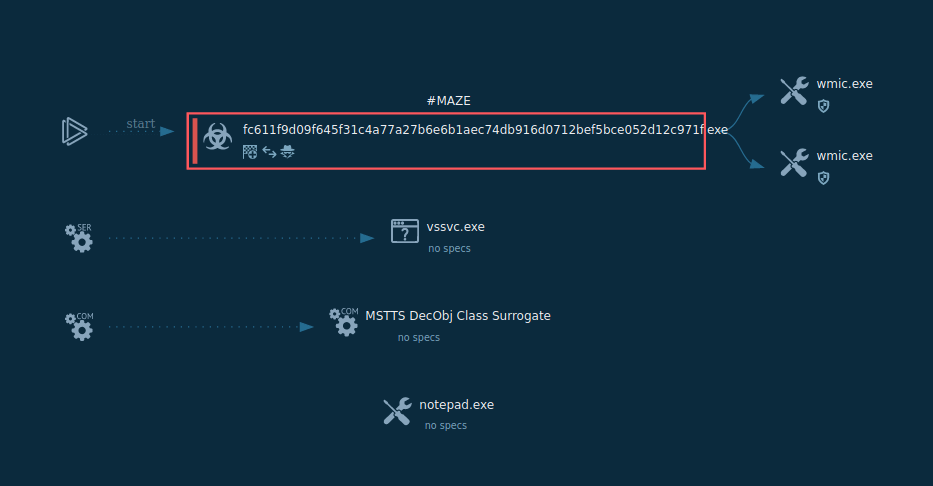
In this video recorded in the ANY.RUN interactive malware hunting service we can view how the Maze execution unfolds.
maze_ransomware_process_graph

Figure 1: Shows the graph of processes created by the ANY.RUN interactive malware analysis service
maze_ransomware_note

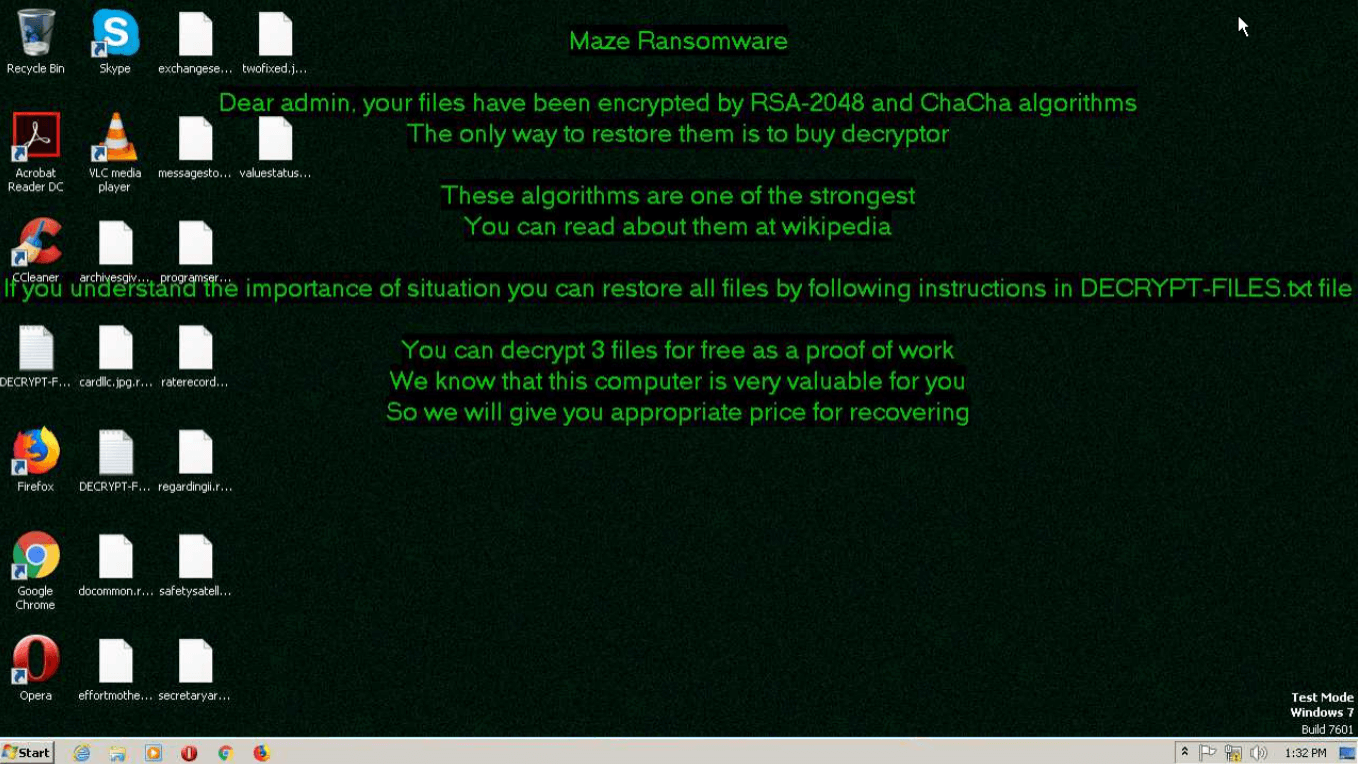
Figure 2: Wallpapers with ransom message set by Maze

Maze execution process

The execution process of Maze is kind of typical for this type of malware, for example Phobos or Sodinokibi. After the executable file makes its way into an infected system and runs, the main malicious activity begins. After the start of execution, the ransomware deletes shadow copies. After it encrypts all targeted files, Maze drops a ransom note on the desktop. It also often changes the wallpaper to its own with a ransom text.

Notably, just like Sodinokibi aka REvil ransomware, this family has a similar infrastructure — websites with "tech support", information about cryptocurrency and ways to buy it, trial decryption, and chat. Crooks behind the Maze ransomware are also kind of cocky and post links to the information about their successful attacks on their website.

Maze ransomware distribution

Maze is distributed using several different ways. It has utilized the Spelevo and Fallout exploit kits and one of the vulnerabilities that Maze is targeting is the CVE-2018-15982 vulnerability in Flash Player. It is also worth noting that in the case of the Fallout kit, the users were redirected to the exploit from a fake cryptocurrency trading platform.

Another observed attack vector is via email spam campaigns containing a Microsoft Office document with a malicious macro.

How to detect Maze malware?

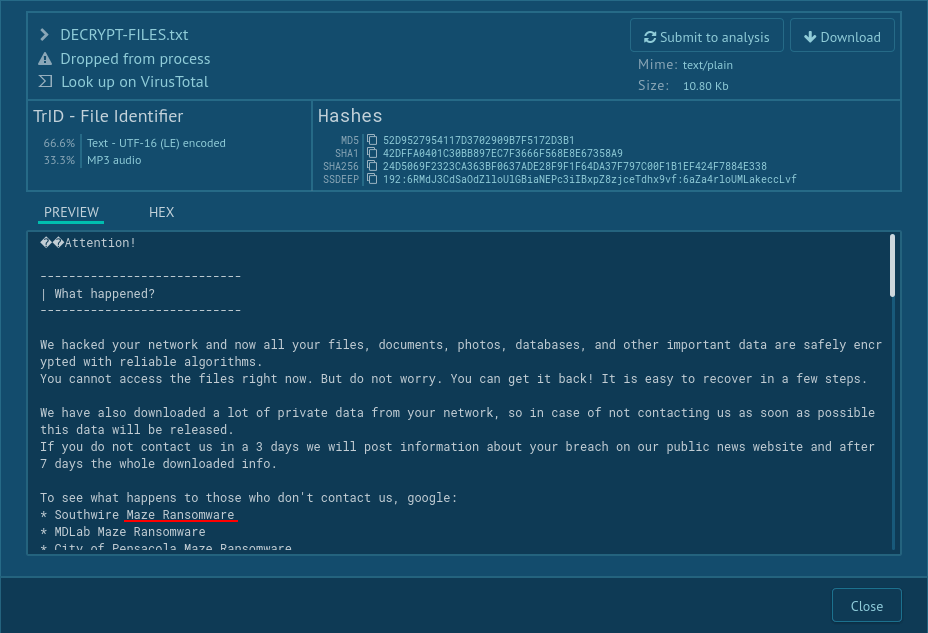
Maze ransomware can be detected by many different activities — sometimes it creates certain files or it can be detected by Suricata network threats. The most common is the Maze ransom note — not only does it have similarities with notes from other tasks, but it also contains self-defining strings: maze ransomware, mazedecrypt, and maze key.

Analysts can take a look at these notes by using ANY.RUN Static Discovering. Click on the "Files modification" tab, then find the file with the name such as " DECRYPT-FILES.txt". To take a look inside this file just click on it.

If you find word combinations such as "maze ransomware", "mazedecrypt" and "maze key", then be sure this sample is Maze ransomware.
how_to_detect_maze_ransomware

Figure 3: How to detect Maze ransomware by its ransom note?

Conclusion

Maze is a significant threat to organizations and private users. This virus not only encrypts information but also strong-arms the victims into paying the ransom, threatening to release sensitive information. Unfortunately, Maze launched a little bit of a trend among threat actors and more and more ransomware in the wild is starting to exhibit similar behavior.

The situation is further complicated by advanced code obfuscation techniques that the Maze features, making the static analysis process quite difficult. Thankfully, interactive malware analysis services like ANY.RUN allows to carry out dynamic analysis almost as quickly and easily as static, giving researchers a chance to collect invaluable information about this ransomware.
P.S.

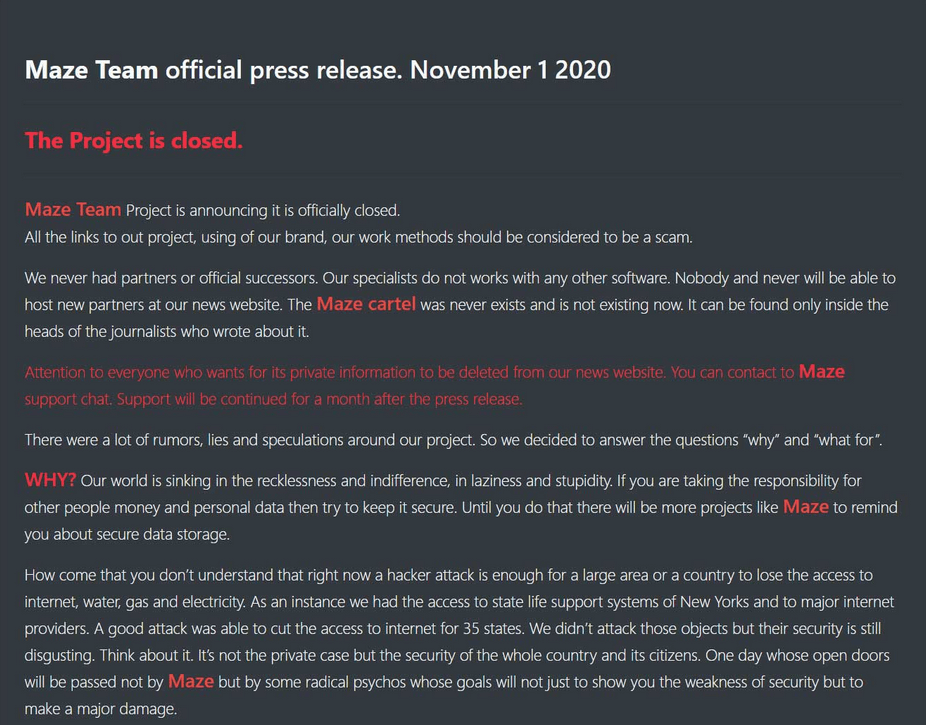
maze team press release screenshot Figure 4: Screenshot of the Maze team press release

On the 1st November 2020, the "team" behind the Maze ransomware published their pretentious press release about the end of the "project" and it has shut down its operations. Unlike some other groups behind ransomware, they haven't published the encryption keys.

HAVE A LOOK AT

Razr screenshot
Razr
razr
Razr is a destructive ransomware that infiltrates systems to encrypt files, rendering them inaccessible to users. It appends the ".razr" extension to the encrypted files and drops a ransom note, typically named "README.txt," instructing victims on how to pay the ransom to obtain the decryption key. The malware often spreads through phishing emails with malicious attachments or by exploiting vulnerabilities in software and operating systems. Razr employs strong encryption algorithms, making it challenging to decrypt files without the attackers' key.
Read More
ValleyRAT screenshot
ValleyRAT
valleyrat
ValleyRAT is a classic remote access trojan first documented in 2023, targeting mainly Windows systems. It is used by threat actors to gain persistent access to infected devices, steal data, and control compromised machines. ValleyRAT is notable for its relatively advanced evasion techniques and its connections to a prominent Chinese APT group.
Read More
RondoDox screenshot
RondoDox
rondodox
RondoDox is an emerging Linux-based botnet malware that exploits dozens of known vulnerabilities in internet-facing devices like routers, DVRs, and web servers to build massive networks for DDoS attacks, cryptomining, and data exfiltration. First spotted in mid-2025, its "exploit shotgun" tactic (firing multiple payloads at once) has made it a rapid escalator in the IoT threat landscape, compromising unpatched edge devices worldwide.
Read More
DarkComet screenshot
DarkComet
darkcomet rat darkcomet rat
DarkComet RAT is a malicious program designed to remotely control or administer a victim's computer, steal private data and spy on the victim.
Read More
DragonForce screenshot
DragonForce
dragonforce
DragonForce is a ransomware strain operating under the Ransomware-as-a-Service (RaaS) model. First reported in December 2023, it encrypts files with ChaCha8, renames them with random strings, and appends “.dragonforce_encrypted.” By disabling backups, wiping recovery, and spreading across SMB shares, DragonForce maximizes damage and pressures victims into multimillion-dollar ransom negotiations. It has targeted manufacturing, construction, IT, healthcare, and retail sectors worldwide, making it a severe threat to modern enterprises.
Read More
Pay2Key screenshot
Pay2Key is a ransomware strain primarily written in C++ for Windows (with recent Linux variants), attributed to Iranian-linked actors, notably the Fox Kitten APT group (also known as UNC757 or related operations). First observed in late 2020, it employs double-extortion tactics (encrypting files and threatening to leak stolen data) while showing signs of both financial and state-aligned motivations. It has resurfaced in campaigns targeting Western organizations, including rapid encryption attacks on healthcare.
Read More