Neptune RAT
- 89
- Global rank
- 93
- Month rank
- 118
- Week rank
Neptune RAT is a Visual Basic .NET remote access trojan that gives attackers full control over infected Windows machines while stealing credentials from 270+ applications, hijacking cryptocurrency transactions, spying on victims in real time, and, in its most destructive mode, wiping the operating system entirely. Marketed openly on GitHub, Telegram, and YouTube as the "Most Advanced RAT," it is distributed under a malware-as-a-service model.
- RAT
- Type
- Unknown
- Origin
- 1 February, 2025
- First seen
- 17 October, 2026
- Last seen
How to analyze Neptune RAT with ANY.RUN
IOCs
IP addresses
- 23.59.18.102
- 107.172.232.84
- 150.171.109.101
- 20.190.160.14
- 23.11.40.157
- 172.211.123.250
- 48.209.133.15
- 2.21.239.138
- 74.179.77.204
- 2.16.204.161
- 48.192.1.65
- 131.253.33.203
- 74.178.240.51
- 2.23.246.101
- 204.79.197.203
- 74.178.240.61
- 40.126.31.2
- 92.123.104.31
- 23.52.181.212
- 135.233.95.135
Hashes
- 3d8c31a68e3fab61212af7ebb3024c5ab079cd205a9297333824f342113b6058
- d3f198b8bd0894ed9aa6553aa290660b71b71cfd7d6fa84005fe169e1e1ac11e
- f56d00a25b8a17a5580f2c7e87f84900c4341b92688c7ecb97d16d1f7872d93f
- 96ad1146eb96877eab5942ae0736b82d8b5e2039a80d3d6932665c1a4c87dcf7
- bd2cc2f1f25b5f520a87068475247dd5611ab9f199ed3264983d720e016acf66
- e2c2da27bf6e2c2f8d076b9a95419a249754dc51ce6a4940c80b4af6ec9472e1
- 9d86ea12e0643cd79f6f97202716d6e7b2a0f2dc81b9255719bb5ca7aaeebd12
- d99aaa09108e56886ab53484575db5b11f400a8a6461d32adf630935ccd4b4d9
- db0df14a9b2b7d568ebc94061b87e76fa4b50fb0ff9c9c3c5dd0de253a26ee43
- 4b9d687ac625690fd026ed4b236dad1cac90ef69e7ad256cc42766a065b50026
- b029393ea7b7cf644fb1c9f984f57c1980077562ee2e15d0ffd049c4c48098d3
- 88856962cef670c087eda4e07d8f78465beeabb6143b96bd90f884a80af925b4
- 7ebc652a4b5b43608f61ac1057c51ec2ec1c8e33bbeb130794e15af72beb42e8
- a45e345556901cd98b9bf8700b2a263f1da2b2e53dbdf69b9e6cfab6e0bd3464
- 5ad8f52071d25165e7e68064ab194ec27a074a3846149ed0689af23e7f7f2d00
- 6783e0a9fea5beb9ff2bff02264784e42e5890f89da6c0395f6325591c823fbb
- f09a1312cd41aadc809249dc3a6f5d5318266b40fd74b9e714571419810131de
- 73671d1ba8a835e74033f7e62afb9371c98f01efdd760a2d7093abbfcab7fafa
- d719c6796022f1e7c94a3208b6a488191e83c135067b6640dc5f7fcb872604e8
- 77db69049c1c45d24a5aa88ad5cefaff181a882ff42173f5fed02ab146a37f0e
Domains
- oneocsp.microsoft.com
- client.wns.windows.com
- activation-v2.sls.microsoft.com
- ocsp.digicert.com
- th.bing.com
- ecs.office.com
- fe3cr.delivery.mp.microsoft.com
- settings-win.data.microsoft.com
- slscr.update.microsoft.com
- www.bing.com
- www.microsoft.com
- crl.microsoft.com
- apostlejob3.duckdns.org
- google.com
- self.events.data.microsoft.com
- login.live.com
- nexusrules.officeapps.live.com
- messaging.lifecycle.office.com
- watson.events.data.microsoft.com
- officeclient.microsoft.com
URLs
- http://crl.microsoft.com/pki/crl/products/microoceraut2011_2011_03_22.crl
- http://www.microsoft.com/pkiops/crl/microsoft%20secure%20server%20ca%202026.crl
- http://ocsp.digicert.com/mfewtzbnmeswstajbgurdgmcgguabbtrjrydryt%2bapf3gspypfhbxr5xtqqus9tippmhxdiunkhmewnpyim8s8yceajtxtab8my1oj8mfwpz%2f7y%3d
- http://oneocsp.microsoft.com/ocsp/mfqwujbqme4wtdajbgurdgmcgguabbq3l3%2f%2fa6adk8nray2gxzvayrhg4aqub6t%2b2v%2bxq3lso2d33ojhnyhhqoucezmaaaafuwohyjguzpcaaaaaaau%3d
- http://ocsp.digicert.com/mfewtzbnmeswstajbgurdgmcgguabbq50otx%2fh0ztl%2bz8sipi7wewvxdlqqutijuibiv5unu5g%2f6%2brks7qyxjzkceaz1vqyrvgl0erhqlcpm8gy%3d
- https://login.live.com/rst2.srf
- https://login.live.com/ppsecure/deviceaddcredential.srf
- https://th.bing.com/th?id=odswg.iotdlocalicon&w=16&h=16&c=1&rs=1&p=0
- http://www.microsoft.com/pkiops/crl/microsoft%20ecc%20update%20secure%20server%20ca%202.1.crl
- https://slscr.update.microsoft.com/sls/%7b522d76a4-93e1-47f8-b8ce-07c937ad1a1e%7d/x64/10.0.19045.4046/0?ch=686&l=en-us&p=&pt=0x30&wua=10.0.19041.3996&mk=dell&md=dell
- https://fe3cr.delivery.mp.microsoft.com/clientwebservice/ping
- https://slscr.update.microsoft.com/sls/ping
- https://slscr.update.microsoft.com/sls/%7be7a50285-d08d-499d-9ff8-180fdc2332bc%7d/x64/10.0.19045.4046/0?ch=686&l=en-us&p=&pt=0x30&wua=10.0.19041.3996&mk=dell&md=dell
- https://activation-v2.sls.microsoft.com/slactivateproduct/slactivateproduct.asmx?configextension=retail
- https://www.bing.com/dsb/search?dsbmr=1&format=dsbjson&client=windowsminiserp&dsbschemaversion=1.1&dsbminiserp=1&q=q&cc=us&setlang=en-us&clientdatetime=10%2f17%2f2026%2c%2012%3a50%3a14%20pm
- https://www.bing.com/threshold/xls.aspx?t=5&dl=1&f=9&wsbc=1
- https://www.bing.com/th?id=odswg.bc915bc7-54ac-40bb-b658-a29fe465c2f7&pid=dsb
- https://www.bing.com/dsb/search?dsbmr=1&format=dsbjson&client=windowsminiserp&dsbschemaversion=1.1&dsbminiserp=1&q=q&cc=us&setlang=en-us&clientdatetime=10%2f8%2f2026%2c%208%3a35%3a47%20am
- https://www.bing.com/th?id=odswg.dd482747-0b27-423b-a458-0ac58ffc4b0e&pid=dsb
- https://settings-win.data.microsoft.com/settings/v3.0/flightsettings/fsservice?processorclockspeed=3094&isretailos=1&oemmanufacturername=dell&flightingpolicyvalue=3&enablepreviewbuilds=4294967295&osversionfull=10.0.19045.4046.amd64fre.vb_release.191206-1406&managepreviewbuilds=3&branchreadinesslevelsource=0&attrdataver=186&processorcores=6&branchreadinesslevelraw=16&totalphysicalram=6144&tpmversion=0&oemmodelnumber=dell&systemvolumetotalcapacity=260281&deviceid=s%3abad99146-31d3-4ec6-a1a4-be76f32ba5d4&app=fss&appver=10.0&smartactivehoursstate=1&activehoursstart=20&securebootcapable=0&activehoursend=13&devicefamily=windows.desktop
Last seen at
Inside Neptune RAT: How This Multi-Function Malware Steals Credentials, Evades Detection, and Enables Enterprise Attacks
Key Takeaways
- Neptune RAT combines remote access, credential theft, a cryptocurrency clipper, live surveillance, and destructive capability in a single, actively developed malware-as-a-service package.
- It is openly distributed through mainstream platforms — GitHub, Telegram, and YouTube — making it accessible to a broad and unpredictable population of attackers.
- Infection relies on social engineering and PowerShell-based delivery (irm | iex) rather than software exploits, making user awareness and script controls essential defenses.
- Neptune persists through Registry Run keys and Scheduled Tasks and disables installed antivirus software to extend its presence undetected.
- Its credential-theft module targets 270+ applications, including Chromium-based browsers, giving attackers a direct path to VPNs, email, and SaaS platforms.
- SMBs, financial and crypto-related organizations, and businesses with weak PowerShell governance face the highest relative exposure to Neptune's opportunistic distribution model.
- Security teams can use ANY.RUN's Threat Intelligence Lookup to instantly pivot from a single Neptune indicator to full behavioral context, and ANY.RUN's Threat Intelligence Feeds to block known Neptune infrastructure at the perimeter before the malware can call home.
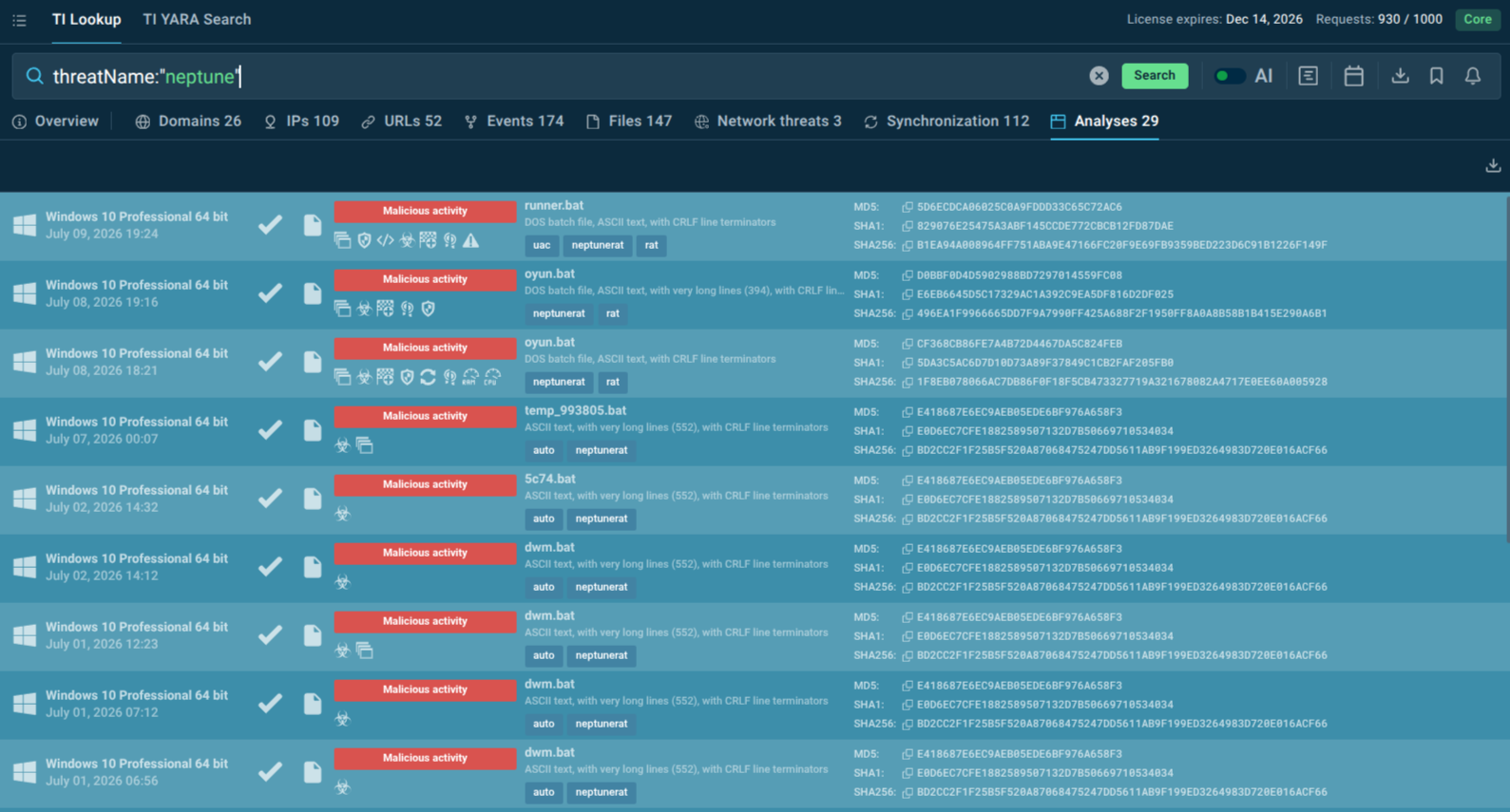 Neptune sample analyses in ANY.RUN Sandbox found via TI Lookup_
What is Neptune RAT Malware?
Neptune RAT first surfaced in early 2025 and quickly drew attention from threat intelligence teams for combining, in a single package, capabilities that are usually spread across several specialized malware families. Written in obfuscated VB.NET, it functions simultaneously as a remote access trojan, an information stealer, a cryptocurrency clipper, a surveillance tool, and — in some builds — a data-destruction utility with ransomware-like behavior.
What sets Neptune apart from the long list of commodity RATs is not any single feature but its packaging and distribution model. Its developers, operating under the "FreeMasonry" banner, promote it publicly as a red-teaming and "educational" tool while simultaneously selling access on Telegram and hinting at a more powerful, paywalled version. Researchers at CYFIRMA and other firms have rejected that framing, pointing to Neptune's anti-analysis techniques, Arabic-character string obfuscation, virtual machine detection, antivirus-disabling routines, and destructive payloads as clear evidence of malicious intent regardless of the stated purpose.
Neptune is delivered through PowerShell one-liners (irm | iex) that fetch and execute a Base64-encoded batch script and payload, frequently hosted on file-sharing services like catbox.moe. Once running, it establishes persistence through Registry Run keys and Scheduled Tasks, disables installed antivirus products, and opens a channel back to the attacker for live desktop monitoring, file exfiltration, credential theft, and remote command execution. The combination of low barrier to entry, broad distribution across mainstream platforms, and a wide feature set has made it a threat that security teams cannot dismiss as "just another RAT."
Because Neptune functions as a multi-purpose attack platform rather than a single-purpose malware family, it can support every stage of an intrusion, from initial compromise and credential theft to lateral movement, data exfiltration, ransomware deployment, and system sabotage.
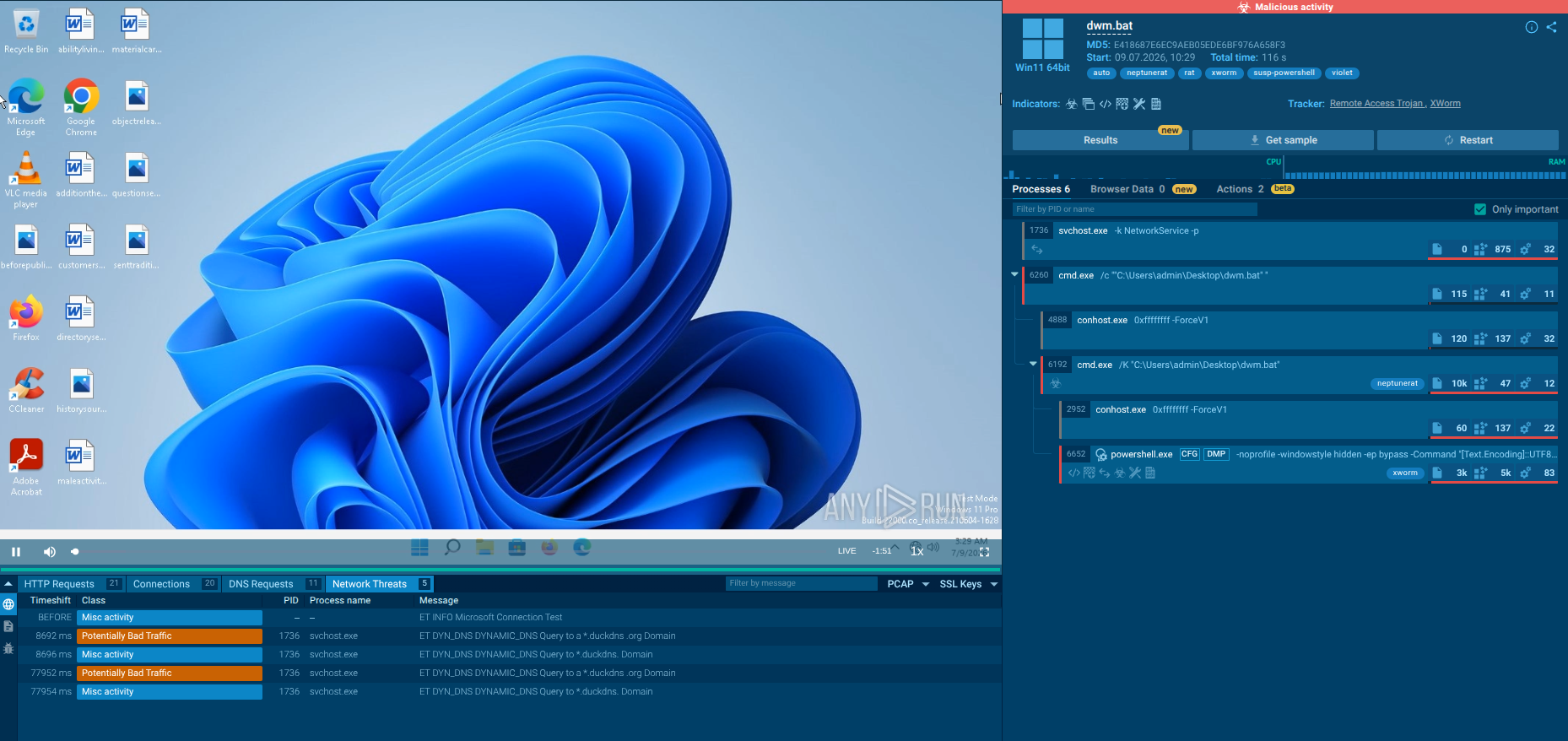
View Neptune RAT sample analysis in ANY.RUN Sandbox
How Neptune RAT Threatens Businesses and Organizations
For organizations, Neptune RAT is not a nuisance-grade infostealer — it is a multi-stage business risk generator:
- Full remote control of endpoints. Once installed, attackers can operate the compromised machine as if sitting in front of it, enabling lateral movement, internal reconnaissance, and staging for follow-on attacks.
- Mass credential exfiltration. With the ability to pull stored credentials from 270+ applications, including Chromium-based browsers, Neptune can hand attackers a direct path into VPNs, email, SaaS platforms, and internal admin panels — turning one infected laptop into a foothold across the wider corporate environment.
- Financial fraud via crypto clippers. Any cryptocurrency payment initiated from an infected machine risks being silently redirected to an attacker-controlled wallet, a direct and often irreversible financial loss.
- Data destruction and business disruption. Neptune's system-destruction capability can render endpoints or servers unusable, creating outages that mirror the operational impact of a ransomware attack — without necessarily involving a ransom negotiation at all.
- Covert surveillance. Live desktop monitoring lets attackers observe sensitive workflows, internal communications, and confidential business data in real time, ahead of a larger extortion or data-theft campaign.
- Low cost of entry for attackers. Because Neptune is offered as malware-as-a-service to a broad pool of less-skilled operators, organizations face a wider and less predictable base of potential attackers than they would with a single closed threat actor group.
Victimology: Who Is Most at Risk?
Neptune RAT does not appear to target a specific vertical the way some espionage-driven malware does; its MaaS distribution model makes it opportunistic by design. That said, several sectors and organizational profiles carry elevated exposure:
- Small and mid-sized businesses (SMBs). Limited security tooling, smaller SOC teams, and less mature endpoint monitoring make SMBs more likely to miss the PowerShell-based delivery chain and less likely to catch persistence mechanisms early.
- Financial services and fintech. The built-in crypto clipper and broad credential-harvesting capability make organizations that handle cryptocurrency transactions or financial credentials a natural high-value target.
- Individual crypto holders and crypto-adjacent businesses. Given Neptune's clipper functionality is purpose-built around wallet address substitution, exchanges, trading desks, and crypto-native companies face direct financial exposure.
- Content creators, gamers, and tech-adjacent communities. Because Neptune spreads via YouTube tutorials, "free tool" GitHub repositories, and Telegram channels, users and businesses whose staff frequent these platforms for research or content are at elevated risk of drive-by installation through social engineering.
- Organizations with weak PowerShell governance. Since delivery hinges on unrestricted execution of irm | iex commands, any environment without PowerShell execution policy controls, script block logging, or endpoint detection tuned to this pattern is more exposed.
- Managed service providers (MSPs) and IT resellers. A single infected technician machine with broad client access can turn Neptune into a supply-chain-style incident affecting multiple downstream customers.
The Evolution of Neptune RAT and Notable Activity
Neptune RAT's public timeline reflects a rapid, iterative development cycle typical of actively maintained MaaS tooling:
- Early 2025 — Initial discovery. Neptune RAT is identified in the wild, distributed as a heavily obfuscated VB.NET executable and promoted on GitHub, Telegram, and YouTube under the "Most Advanced RAT" tagline.
- Version with direct PowerShell builder integration. A subsequent version adds the ability to generate ready-to-use irm | iex PowerShell one-liners directly from the malware's builder interface, lowering the technical bar for operators to weaponize and deploy it.
- Expanded credential-theft scope. Later builds extend password-stealing coverage to 270+ applications and introduce a dedicated Chromium-targeting stealer component (internally referenced as "Chromium.dll" in analyzed samples) capable of decrypting stored browser credentials across Chrome, Brave, Opera, and other Chromium-based browsers.
- Destructive capability added. A version emerges with the ability to corrupt or destroy the Windows operating system on the victim machine, moving Neptune from "espionage/theft tool" into territory that overlaps with wiper and ransomware-class malware.
- Source-unavailable release. In a departure from earlier open distribution, the developer releases a version without accompanying source code, deliberately increasing obfuscation to complicate researcher analysis while continuing sales through the same channels.
- Ongoing "paywalled" tier. Public statements from the malware's developers reference a more advanced, non-public version available for a fee, suggesting Neptune continues to be actively developed and monetized as a tiered commercial product rather than a one-off release.
Because Neptune is distributed through open platforms rather than a single closed criminal infrastructure, individual "notable attacks" are harder to attribute to named victims than with a targeted APT campaign — the more accurate picture is one of continuous, broad-based opportunistic infection driven by its accessibility to a large population of less-sophisticated operators.
How Neptune RAT Gets Into Systems and Spreads
Neptune's infection chain relies on social engineering and trusted-platform abuse rather than exploiting software vulnerabilities:
- 1. Lure and distribution. Neptune is promoted through YouTube videos (often disguised as "free tool," "game cheat," or "crack" tutorials), GitHub repositories, and Telegram channels, all platforms that carry inherent user trust.
- 2. Delivery mechanism. Victims are guided to run a PowerShell command using irm (Invoke-RestMethod) to download a script and iex (Invoke-Expression) to execute it directly in memory — a technique that avoids writing an obvious executable to disk before execution begins.
- 3. Payload staging. The PowerShell command retrieves a Base64-encoded batch script and the Neptune payload, frequently hosted on file-sharing services such as catbox.moe, and drops the decoded components into the AppData folder.
- 4. Execution and callback. Once executed, the payload establishes a connection back to the attacker's command-and-control infrastructure, completing the initial compromise. Persistence. Neptune secures long-term presence by writing Registry Run key entries and creating Scheduled Tasks, ensuring it survives reboots without requiring repeated user interaction.
- 5. Defense evasion. The malware disables installed antivirus software and, in some variants, deletes artifacts of its own activity to hinder incident response and forensic reconstruction.
- **6. Lateral risk. While Neptune itself is primarily an endpoint-level threat, harvested credentials (VPN, email, SaaS, admin panels) can be reused by attackers to pivot further into an organization's network.
How Neptune RAT Malware Functions
Neptune's functionality is best understood as a set of coordinated modules operating under one RAT framework:
- Obfuscation and anti-analysis. Executables show high entropy in their code sections, use a custom string heap to store sensitive strings and decryption keys, and substitute original strings with Arabic characters, all aimed at frustrating static analysis. Built-in virtual machine detection lets the malware alter or halt its behavior when it suspects it is running inside a sandbox.
- Persistence layer. Registry modifications and Scheduled Task creation keep Neptune running across reboots without further user action.
- Credential theft module. A dedicated stealer component targets Chromium-based browsers (Chrome, Brave, Opera, and others), extracting encrypted credential stores from local application data, decrypting them, and exfiltrating the results. Overall password-theft coverage spans 270+ applications.
- Cryptocurrency clipper. Neptune monitors the system clipboard using regex pattern matching to detect copied cryptocurrency wallet addresses. When a match is found, it silently substitutes the attacker's wallet address of the matching type, redirecting funds at the moment a victim completes a transaction.
- Live desktop monitoring. Remote surveillance capability allows operators to watch victim activity in real time, extending Neptune's reach well beyond one-time data theft.
- Antivirus disablement. Built-in routines disable installed security software, reducing the chance that later stages of the attack, or follow-on payloads, are detected and blocked.
- Destructive/ransomware capability. Certain builds include functionality to corrupt or destroy the Windows operating system, giving Neptune's operators an option to cause outright system failure rather than, or in addition to, quiet data theft.
- Command-and-control communication. Neptune communicates with attacker infrastructure over standard web protocols, and its PowerShell-based delivery chain (using irm/iex) allows operators to update or redeploy payloads with minimal friction.
View the attack chain in ANY.RUN Interactive Sandbox:
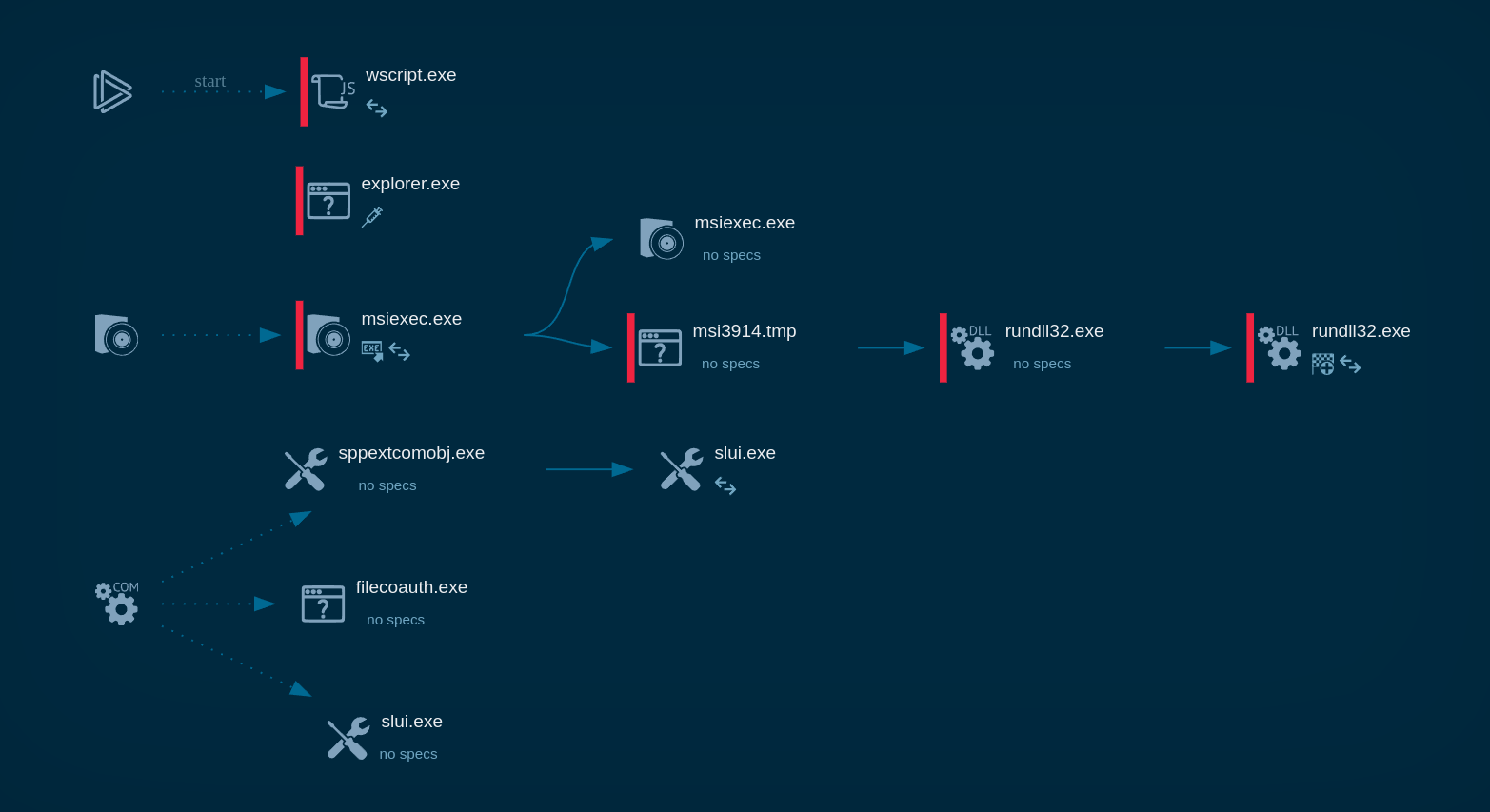
The analyzed sample of Neptune RAT, after launching the BAT file, initiates the execution of a PowerShell script. The script runs in hidden mode and bypasses script execution restrictions, which allows the malicious code to execute without noticeable user interaction. This approach is used to mask the initial activity, reduce the likelihood of detection, and prepare for the execution of the next stage of malicious logic.
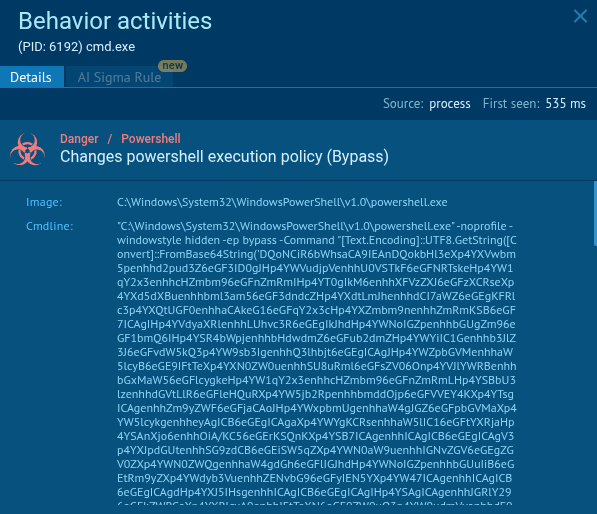
Additionally, the command is transmitted in encoded form and is only revealed during execution, which complicates static analysis and hides the contents of the subsequent script.
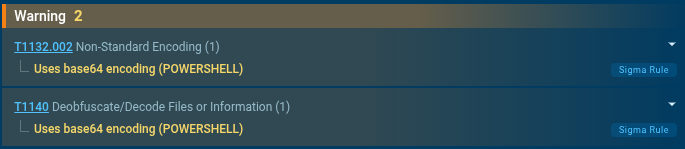
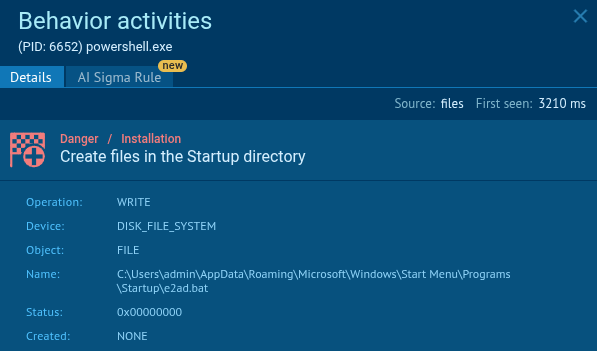
Next, the sample creates a BAT file in the user’s Windows autostart directory. This mechanism is used for persistence in the system: the contents of this directory are automatically launched upon the user’s subsequent login. Thus, the malicious program ensures repeated execution after a reboot or re-authentication of the user.
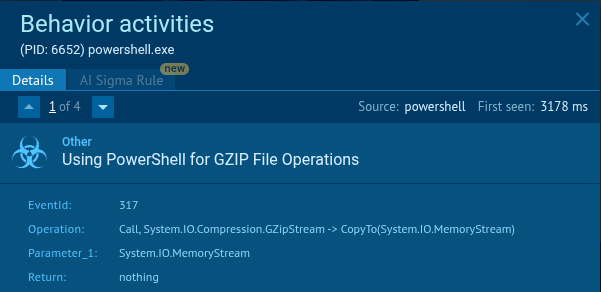
Furthermore, in the behavior of the PowerShell script, the use of symmetric AES encryption is observed. The script sets a key and initialization vector, after which it uses them to process embedded data.


Additionally, operations with GZIP are observed, indicating another layer of payload packing.
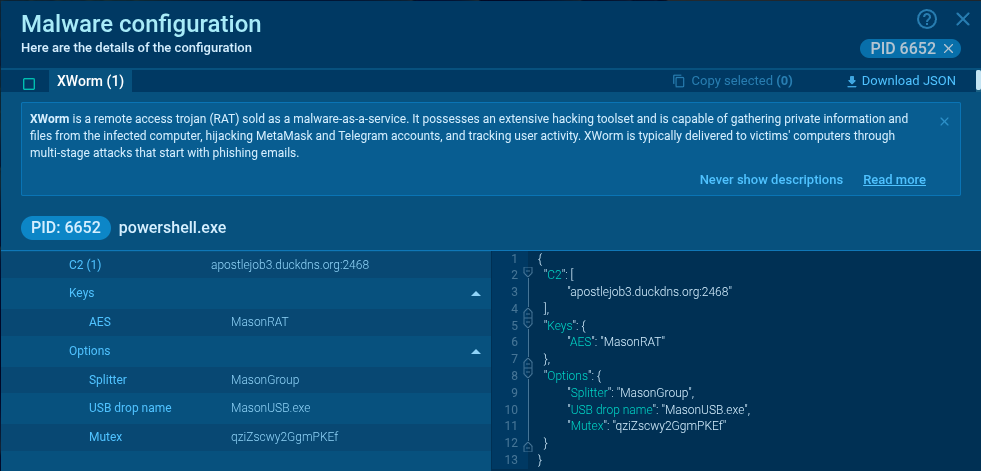
On the network side, the sample uses a TCP connection to the C2 server via the domain: apostlejob3[.]duckdns[.]org:2468.

Also, in the analysis, successful extraction of the sample’s configuration can be seen. It specifies the C2 server and additional information about the malware’s contents.
How Businesses Can Use ANY.RUN’s Threat Intelligence Solutions Against Neptune RAT
Because Neptune relies heavily on a recognizable delivery pattern — public-platform lures, PowerShell one-liners, catbox.moe-style payload hosting, and a consistent persistence and evasion toolkit — organizations have a real opportunity to detect it before impact, provided they have visibility into both the behavioral pattern and the current indicator landscape.
ANY.RUN Threat Intelligence Lookup lets analysts pivot from a single known Neptune indicator — a suspicious hash, a catbox[.]moe URL, a C2 domain, a registry key used for persistence, or a PowerShell command pattern — to the full corresponding sandbox session, instantly surfacing related samples, associated infrastructure, and behavioral context drawn from millions of public analyses. When a SOC analyst spots a PowerShell command using irm | iex in an alert, TI Lookup can confirm within minutes whether it matches known Neptune activity rather than requiring a full manual investigation, cutting triage time significantly and reducing unnecessary escalations from Tier 1 to Tier 2.
ANY.RUN Threat Intelligence Feeds deliver continuously updated streams of malicious IPs, domains, and URLs sourced from real-world sandbox detonations across a global analyst community. Ingested into a SIEM, SOAR, IDS/IPS, or firewall, these feeds allow organizations to block known Neptune C2 infrastructure and payload-hosting domains at the perimeter — stopping the malware before its PowerShell stager can even complete a callback, rather than relying solely on after-the-fact endpoint detection.
Used together, TI Lookup and TI Feeds give security teams both the forward-looking blocking layer (Feeds) and the investigative depth (Lookup) needed to handle a fast-evolving, opportunistically distributed threat like Neptune, where new samples, hashes, and hosting domains appear continuously across GitHub, Telegram, and YouTube.
Beyond threat intelligence, organizations should combine several additional layers of defense:
- PowerShell hardening. Enforce constrained language mode, enable script block logging, and restrict or monitor Invoke-RestMethod/Invoke-Expression usage across endpoints. Application and script controls. Use application allowlisting to prevent unauthorized executables and scripts from running, particularly from AppData and other user-writable directories.
- Endpoint detection and response (EDR). Deploy EDR tuned to detect Registry Run key modifications, unusual Scheduled Task creation, and antivirus-tampering behavior.
- Interactive sandbox analysis. Detonate suspicious downloads and PowerShell payloads in an interactive sandbox such as ANY.RUN's Interactive Sandbox to observe real behavior, including sandbox-evasion attempts, before they reach production systems.
- Employee awareness training. Educate staff on the risks of running commands or downloading "free tools," cracks, or cheats from YouTube, GitHub, and Telegram sources.
- Credential hygiene. Enforce multi-factor authentication across VPN, email, and SaaS platforms so that stolen browser credentials alone are insufficient for an attacker to pivot further into the network.
- Backup and recovery planning. Maintain offline or immutable backups to ensure Neptune's destructive capability cannot translate into permanent data loss.
Conclusion
Neptune RAT illustrates how much damage a single, actively maintained malware-as-a-service package can now cause once it combines remote access, credential theft, financial fraud, surveillance, and destructive capability in one accessible tool. Its reliance on mainstream platforms for distribution and a recognizable PowerShell-based delivery chain means it is neither invisible nor unstoppable — but it does demand that organizations pair strong technical controls with continuously updated, real-world threat intelligence. Treating Neptune as "just another RAT" risks underestimating both its reach and its potential for outright business disruption.
Trial TI Lookup to start gathering actionable threat intelligence on the malware that threatens your business sector and region: just sign up to ANY.RUN.
Other malware & phishing threats
 LatrodectusLatrodectus is a malicious loader that is used by threat actors to gain a foothold on compromised devices and deploy additional malware. It has been associated with the IcedID trojan and has been used by APT groups in targeted attacks. The malware can gather system information, launch executables, and detect sandbox environments. It uses encryption and obfuscation to evade detection and can establish persistence on the infected device.
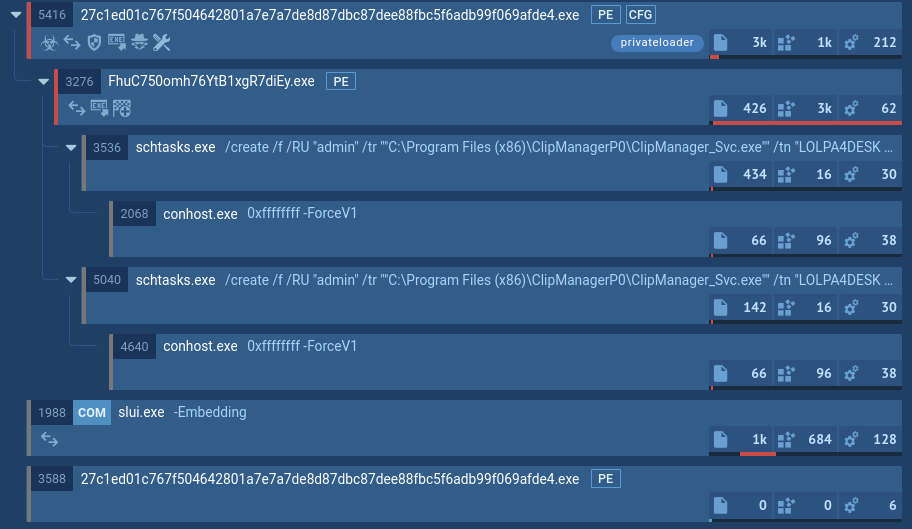 LoaderA loader is malicious software that infiltrates devices to deliver malicious payloads. This malware is capable of infecting victims’ computers, analyzing their system information, and installing other types of threats, such as trojans or stealers. Criminals usually deliver loaders through phishing emails and links by relying on social engineering to trick users into downloading and running their executables. Loaders employ advanced evasion and persistence tactics to avoid detection.
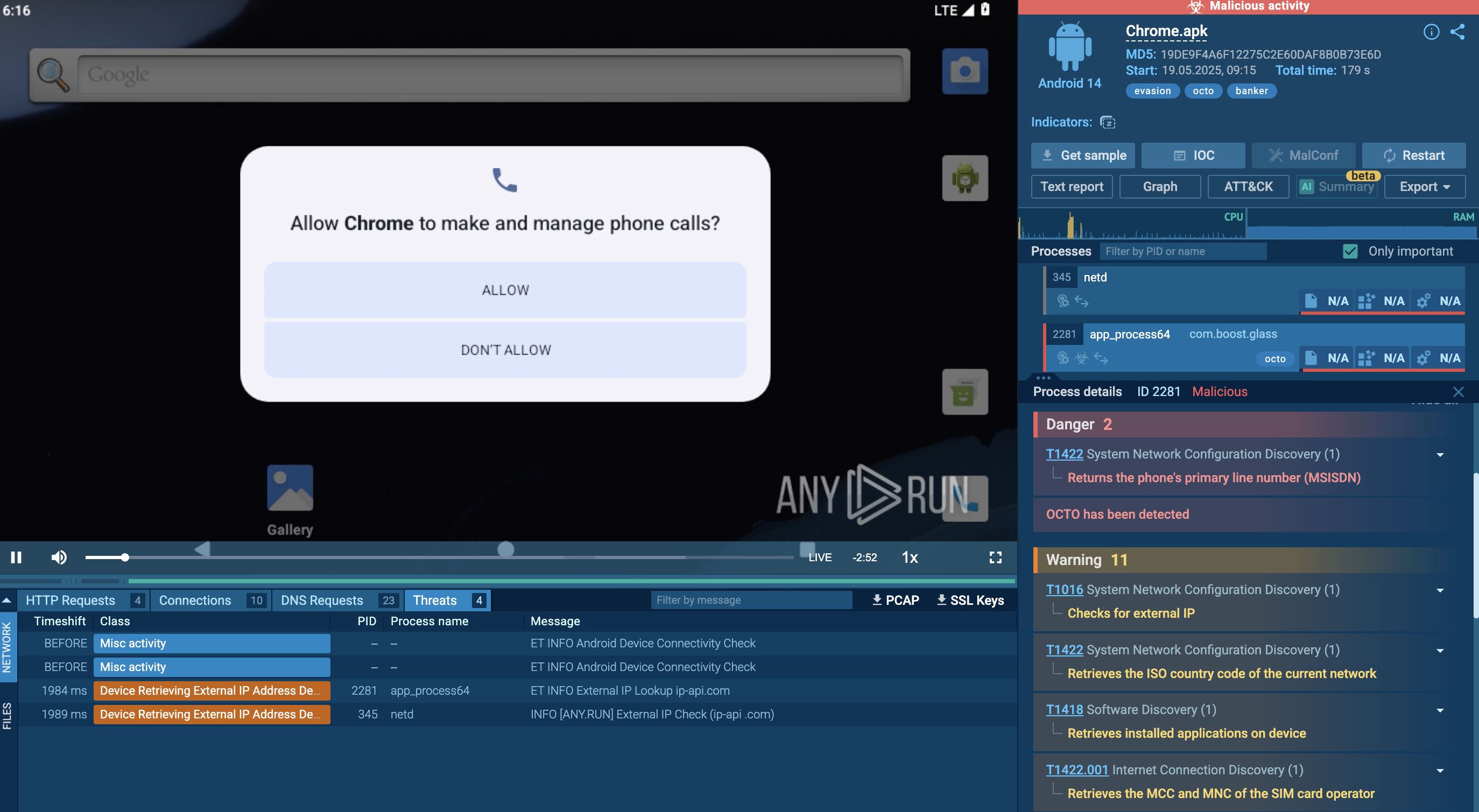 OctoOcto malware, also known as ExobotCompact or Coper, is a sophisticated Android banking trojan that has evolved from earlier malware family Exobot. It poses a significant threat to financial institutions, mobile users, and enterprise networks.
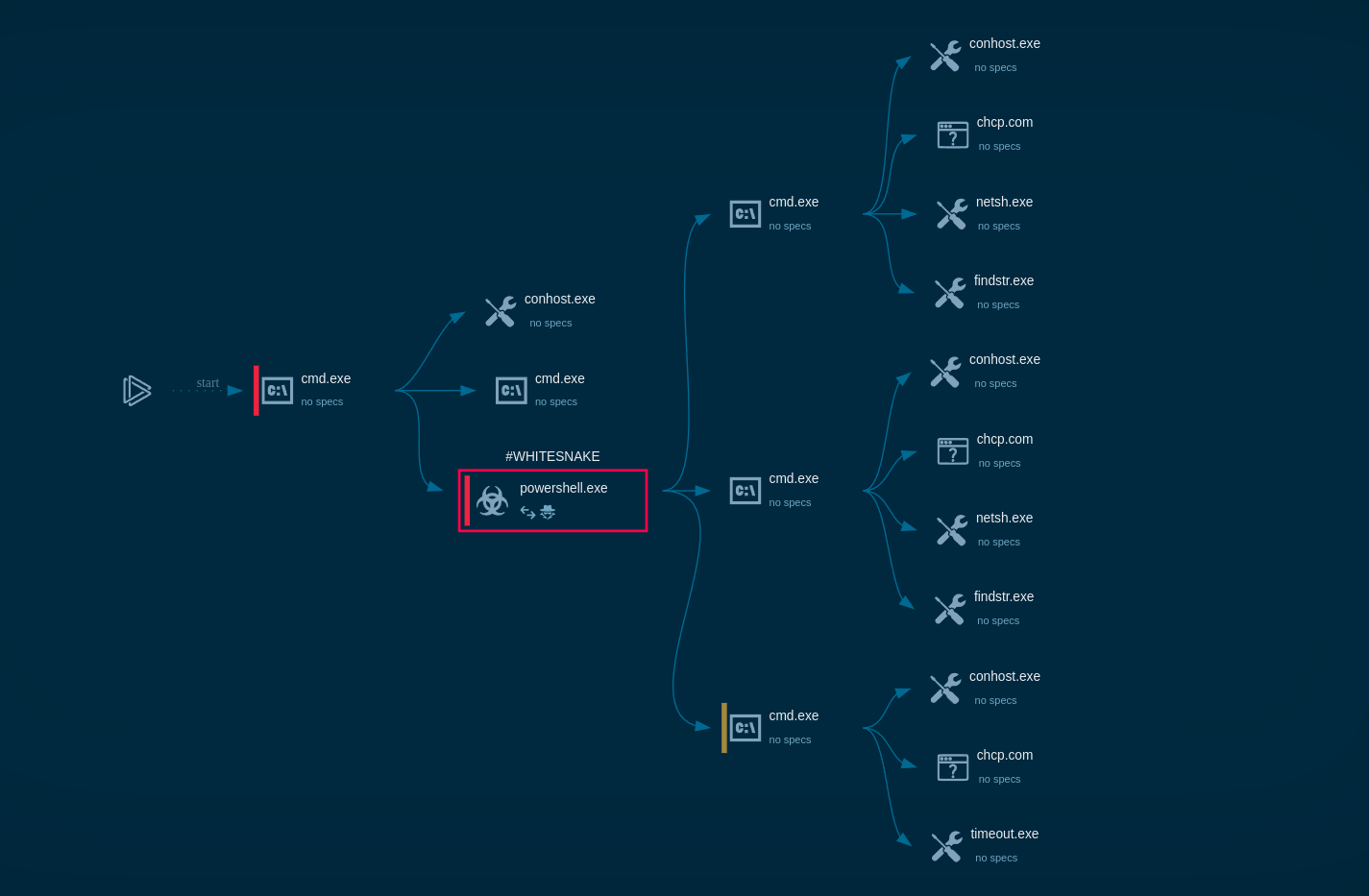 WhiteSnakeWhiteSnake is a stealer with advanced remote access capabilities. The attackers using this malicious software can control infected computers and carry out different malicious activities, including stealing sensitive files and data, recording audio, and logging keystrokes. WhiteSnake is sold on underground forums and often spreads through phishing emails.
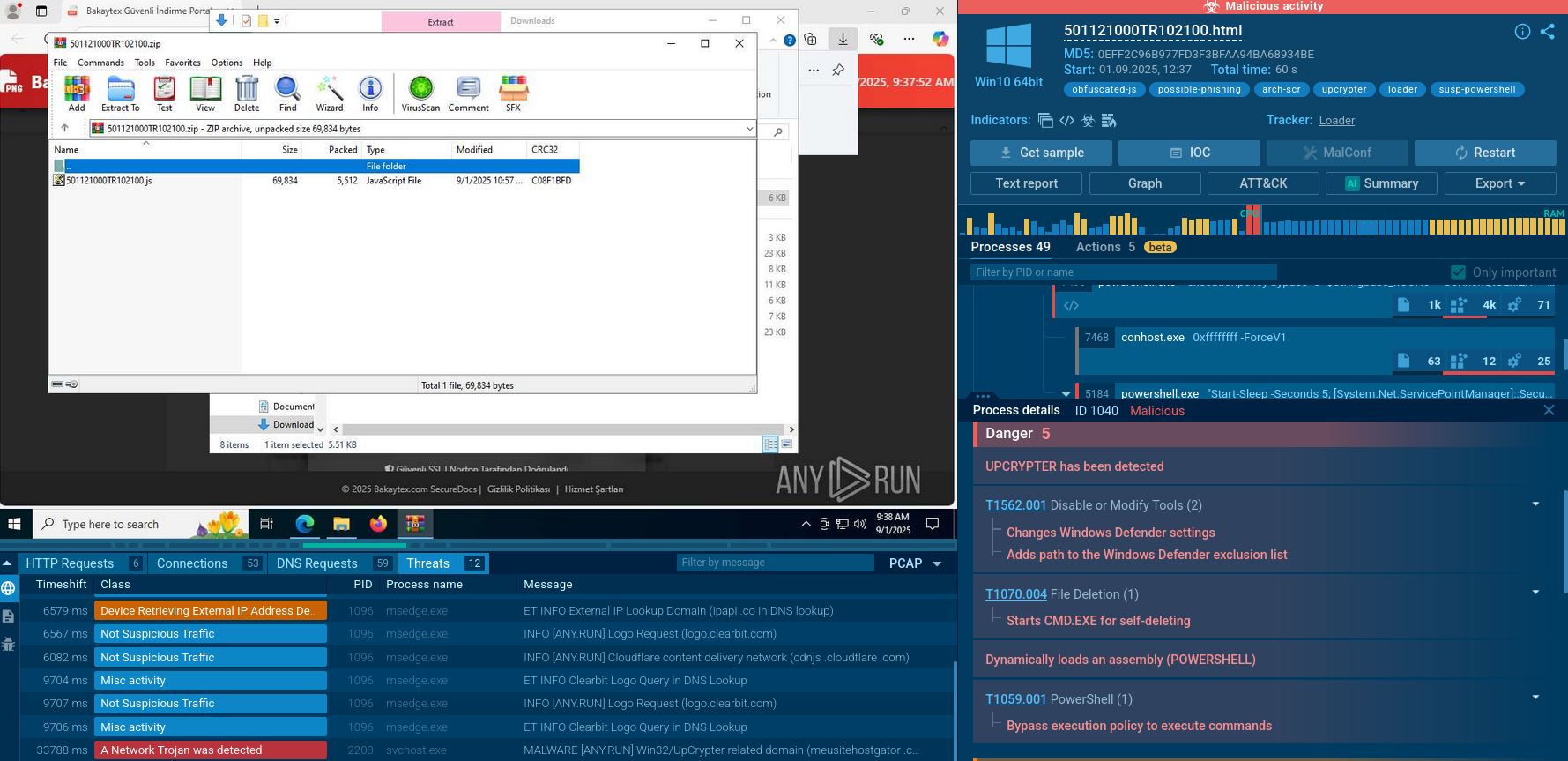 UpCrypterUpCrypter is a sophisticated malware loader that functions as a delivery mechanism for remote access tools. Distributed through global phishing campaigns targeting Windows systems, this actively maintained tool serves as the central framework for deploying various RATs including PureHVNC, DCRat, and Babylon RAT, enabling attackers to establish persistent remote control over compromised systems.
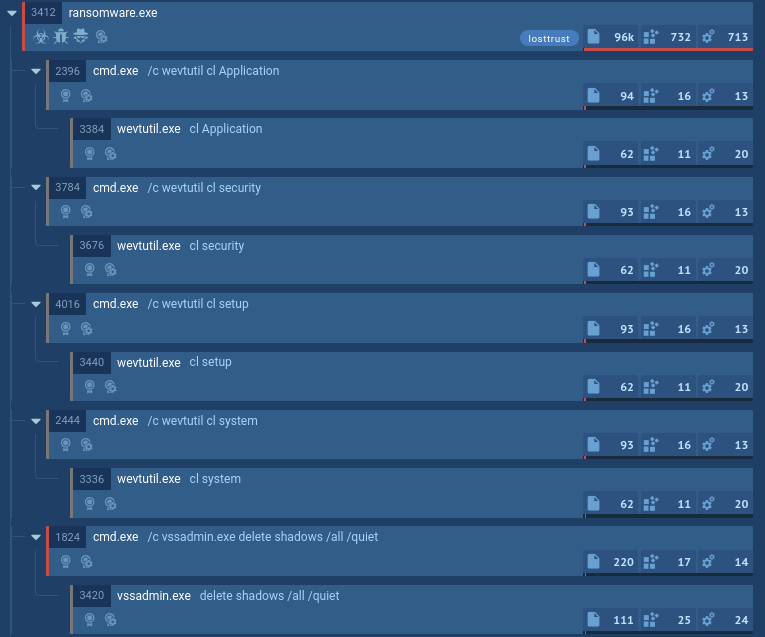 LostTrustLostTrust is a ransomware that has been active since March 2023. It is a multi-extortion malware, meaning that it not only encrypts data on the compromised system and demands a ransom, but also exfiltrates some of the critical files to the attacker. The criminals publish the stolen data on a special website, where dozens of companies are listed as victims of the malware.