
Recent posts


US SOC teams are under pressure to detect and contain threats faster, but the real challenge is often not a lack of security solutions. It’s the growing amount of alerts, fragmented investigation data, evasive attack techniques, and the time analysts spend connecting the dots.
As attacks become harder to validate and easier to hide inside legitimate services and workflows, SOC processes start to show their limits. Below, we look at five critical pain points affecting modern US SOCs and practical ways to address them.
What Modern SOC Teams Are Up Against
Recent industry research shows how much pressure security operations teams are under.
According to the 2026 Creating a Modern and Mature Security Operations Center Report from Optiv, Palo Alto Networks, and Ponemon Institute, 52% of organizations reported an increase in alert and incident volumes, while 46% cited insufficient staffing. The same research found that 36% of alerts and incidents are still investigated manually.
The 2026 SANS SOC Survey points to another major challenge: 24% of cyber leaders identified lack of enterprise-wide visibility as the biggest barrier to SOC effectiveness.
Together, these findings show that modern SOCs are not only dealing with more activity, but also with limited analyst capacity, fragmented visibility, and investigation processes that still require too much manual work.
1. Too Many Alerts Still Require Too Much Analyst Work
Growing alert volume is only part of the problem. The bigger issue is how much analyst time is still required to understand whether an alert represents a real threat.
According to the research from Optiv and Palo Alto Networks, SOCs manage an average of 2,566 alerts and incidents per day, while 36% of alerts and incidents are still investigated manually.
For Tier 1 analysts, this often means spending valuable time collecting evidence from different sources, checking suspicious files or URLs, reconstructing execution chains, and deciding whether a case should be escalated. When this work is repeated across hundreds or thousands of alerts, even relatively simple investigations can create bottlenecks.
How to Solve It
The goal should be to reduce the amount of manual work required to reach a confident verdict.
With ANY.RUN’s Interactive Sandbox, analysts can safely interact with suspicious files, links, and phishing pages inside an isolated environment. They can click through pages, open files, follow redirects, and observe how the attack behaves without putting corporate systems at risk. This gives analysts more confidence in what they are seeing and helps them understand the real attack flow.
See how a recent complex attack targeting US is analyzed inside ANY.RUN sandbox:
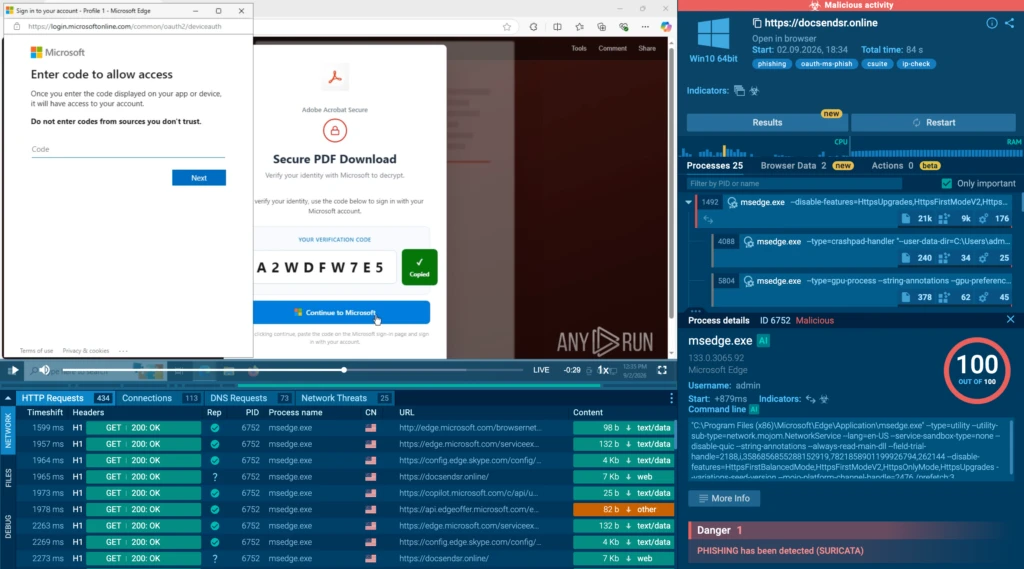
Automated Interactivity can perform many of these actions automatically, keeping multi-stage attacks moving even when they require clicks, file launches, or other user interaction.
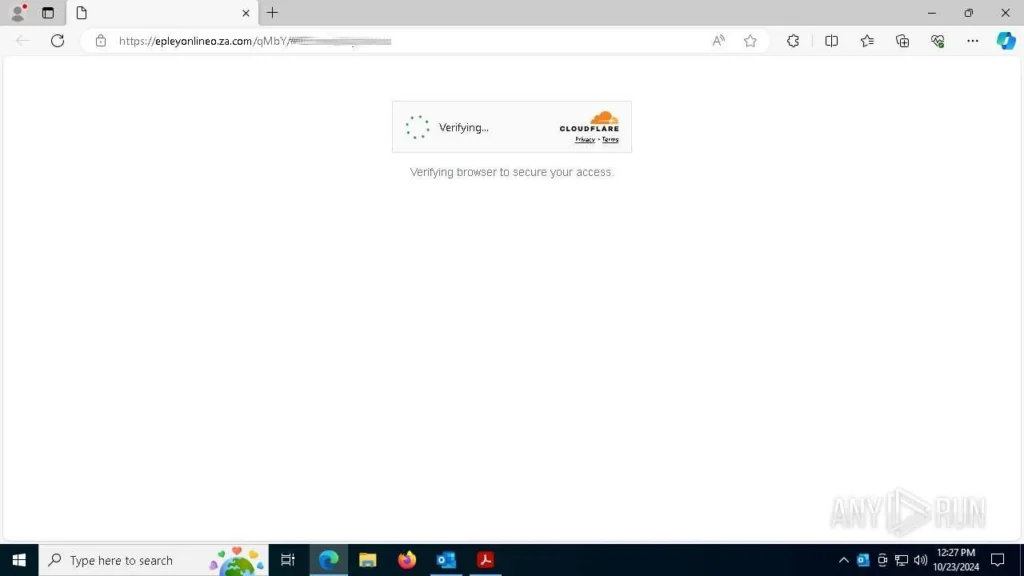
As a result, Tier 1 analysts can reach a verdict with less repetitive manual work and escalate only the cases that genuinely need deeper investigation.
For SOC teams using ANY.RUN, this approach can help cut Tier 1 investigation time by 20% and reduce Tier 1-to-Tier 2 escalations by 30%.
2. Analysts Still Have to Reconstruct Attacks Across Too Many Security Solutions
As SOC environments grow, security technologies that work well for one task can still create friction across the wider investigation process.
A single incident may require an analyst to validate a suspicious file or URL, inspect its behavior, check related infrastructure, enrich the findings with threat intelligence, share the evidence with teammates, and then pass the result into SIEM, SOAR, or another response system. When each step happens in a separate platform, context can be lost between stages, and the same evidence may need to be collected more than once.
For modern SOCs, this creates a need for an enterprise-grade security analysis environment that supports the investigation process as a whole.
How to Solve It
An enterprise-grade solution should help analysts move through the investigation without constantly rebuilding context.
With ANY.RUN, the process can start with analyzing a suspicious file or URL in the Interactive Sandbox. Analysts can see what happens during execution and collect the behavioral evidence and indicators generated by the attack.
From there, Threat Intelligence Lookup can help expand the investigation around related domains, IPs, URLs, files, and previous malicious activity. Threat Intelligence Feeds then deliver fresh indicators into the broader security stack, helping teams use what they learn from active threats for detection and hunting beyond a single case.
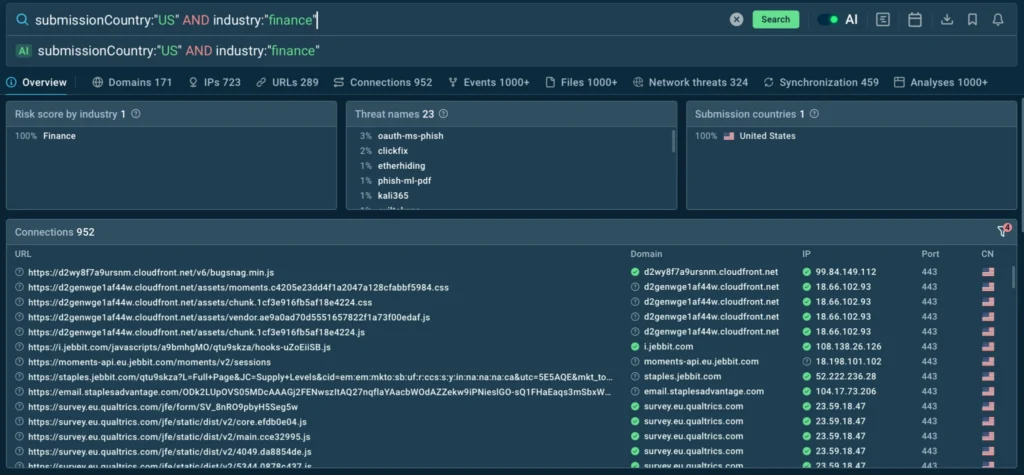
The findings can also be shared across the team and passed into SIEM, SOAR, and other security systems for response.
For larger SOC teams, capabilities such as private team environments, role-based access, SSO, and integrations across SIEM, SOAR, and threat intelligence systems help keep this process controlled and consistent as the number of analysts and investigations grows.
3. Phishing Creates Dangerous Visibility Gaps
Phishing remains both a high-volume and high-impact SOC problem.
According to ANY.RUN’s 2026 data, phishing exposure reaches 73.4% in finance and 72.2% in manufacturing. In the US, the financial impact is equally significant: the FBI’s 2025 Internet Crime Report recorded 191,561 phishing and spoofing complaints, while Business Email Compromise generated around $3.05 billion in reported losses.
The challenge for SOC teams is no longer simply spotting a suspicious email or URL. Modern phishing campaigns increasingly use fake CAPTCHAs, browser fingerprinting, multi-stage redirects, QR codes, geofencing, and legitimate authentication flows to control who reaches the malicious content and when.
These techniques can make phishing harder to reproduce and investigate consistently, especially when page behavior changes based on browser, location, session, or user interaction. That can delay confirmation of credential theft, token abuse, redirects, or payload delivery.
How to Solve It
SOC teams need visibility into the full browser interaction, not just the URL itself.
In-Browser Data Inspection helps expose what happens inside the browser, including redirects, requests, page activity, and other behavior that may remain hidden during a basic URL check.
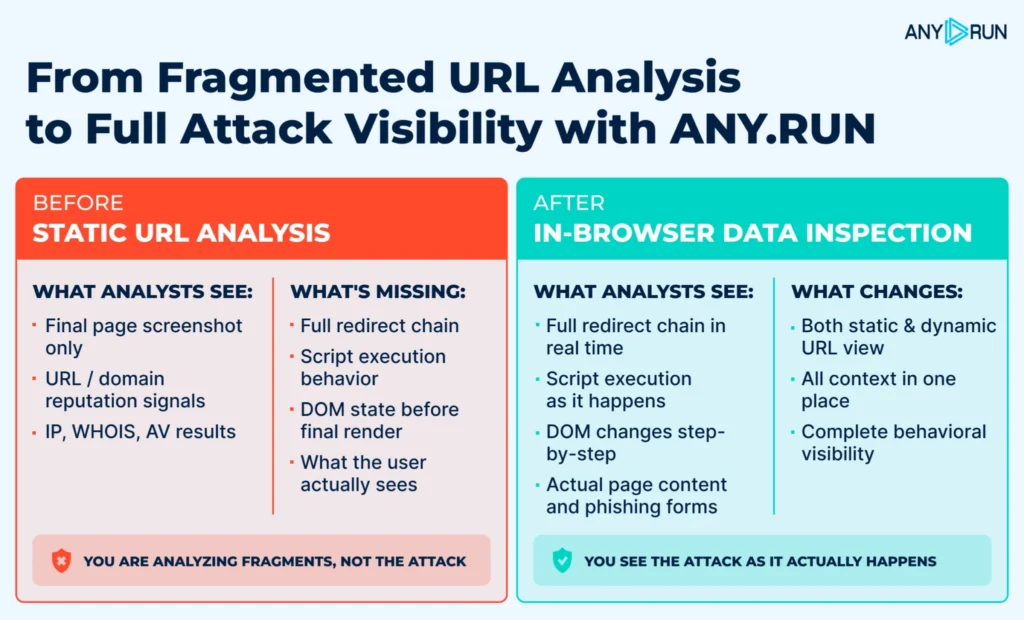
Another blind spot is encrypted web traffic. Automatic SSL Decryption allows the sandbox to inspect activity inside HTTPS sessions, helping reveal credential harvesting, redirect chains, token theft, and other malicious behavior that may otherwise look like normal web traffic.
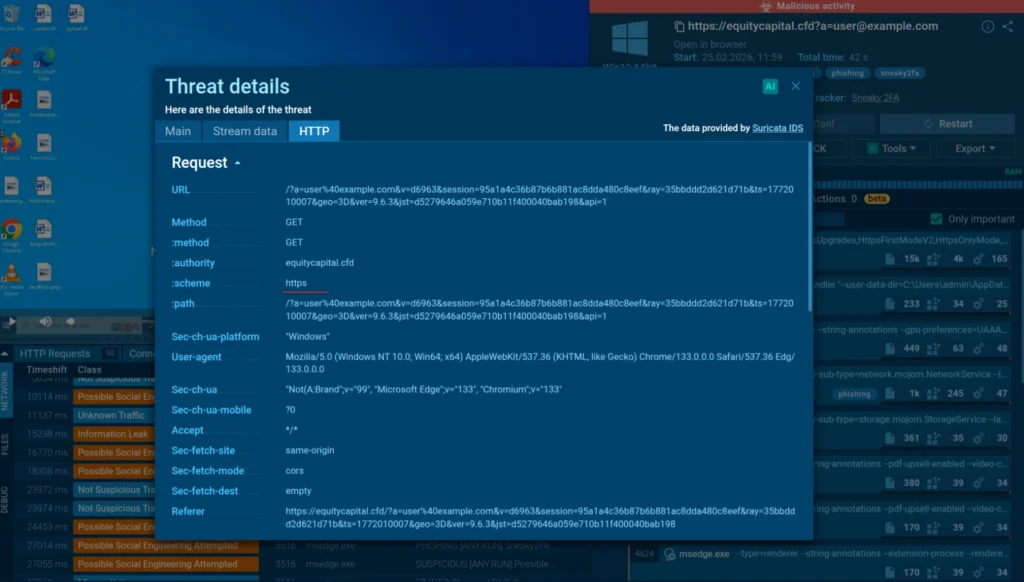
Together, these capabilities give analysts a clearer view of what happens after the initial click, helping them confirm malicious activity earlier and respond with stronger evidence.
4. Security Coverage Doesn’t Always Keep Up with the Environment
Most enterprise environments now span Windows, macOS, Linux, cloud systems, and mobile devices.
The problem is that SOC coverage is not always equally strong across all of them. A team may have solid visibility into Windows activity, but much less confidence when the same attack reaches a Linux server, a developer’s Mac, or another part of the environment.
This matters because attackers can adapt the same campaign to different operating systems. The payload, execution method, and artifacts may change, even when the infrastructure and intent stay the same.
For SOC leaders, that creates a simple risk: the business can expand into new environments faster than security coverage expands with it.
How to Solve It
SOC teams need investigation capabilities that work across the environments they are responsible for.
ANY.RUN supports analysis on Windows, Linux, macOS, and Android, so analysts can investigate a suspicious file or activity in the environment it was built to target.
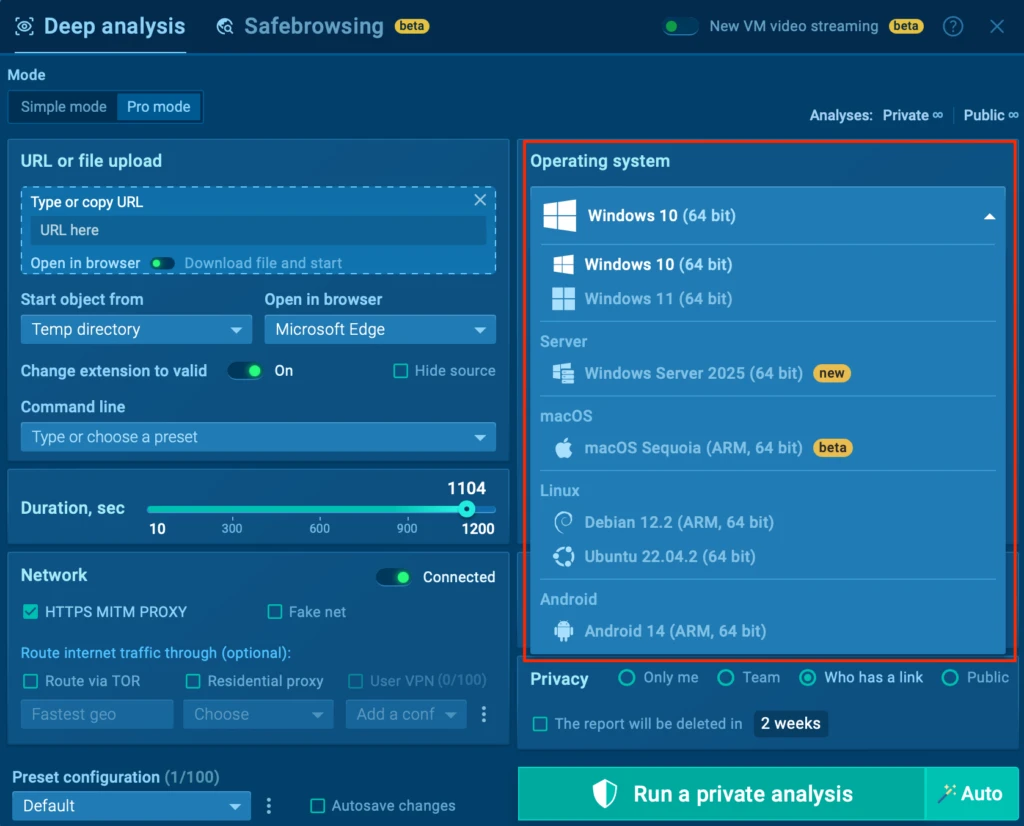
This helps teams see platform-specific behavior while still identifying shared infrastructure, indicators, and attack patterns across the same campaign.
For decision makers, the goal is straightforward: reduce the chance that a new platform becomes the part of the environment attackers can use with less resistance.
5. Investigation Results Don’t Always Translate into Action
A good investigation is only useful if the result can be understood and acted on by the next person in the process.
In many SOC workflows, analysts still spend time turning technical findings into something another team can use: an escalation note for Tier 2, evidence for incident response, details for threat hunting, or a summary that security leaders can review.
When reporting is inconsistent or too manual, important context can be lost between teams. That can lead to repeated analysis, slower handoffs, and less confidence in the final decision.
How to Solve It
SOC teams need investigation results that are ready to share and act on.
With ANY.RUN’s Tier 1 report, analysts get a structured summary of the investigation that highlights the verdict, key findings, and recommended next steps. Instead of manually rewriting what happened, Tier 1 analysts can pass forward a clear report with the context another analyst needs to understand the case quickly.
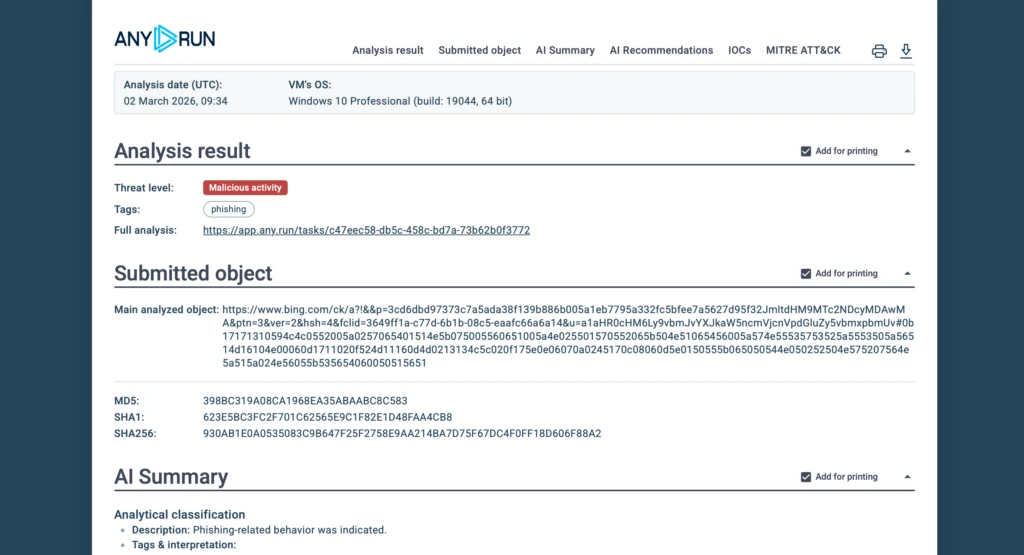
The report can also include the technical evidence behind the decision, such as observed behavior, IOCs, network activity, and process details, so Tier 2 or incident response teams do not have to rebuild the investigation from scratch.
This creates a cleaner handoff from investigation to response, with less time spent documenting findings and a lower risk of important context being lost between teams.
Conclusion
Modern US SOCs are not short on security technology. The bigger challenge is making investigations faster, more connected, and easier to act on.
Alert overload, fragmented workflows, evasive phishing, uneven coverage across environments, and weak investigation handoffs all create delays at different stages of the SOC process.
Addressing these gaps requires more than improving one step in isolation. SOC teams need a workflow that helps analysts investigate threats safely, understand the full attack context, work across different environments, and turn findings into clear next actions.
With ANY.RUN, teams can connect these stages more closely and reduce the amount of manual work required to move from an alert to a confident response.
About ANY.RUN
ANY.RUN provides interactive malware analysis and threat intelligence solutions used by 700,000+ cybersecurity professionals across 16,000+ organizations worldwide, including 64% of the Fortune 500.
Its Interactive Sandbox helps SOC teams safely investigate suspicious files, URLs, phishing pages, and malware while watching the attack unfold in real time. Analysts can inspect browser activity, decrypted network traffic, processes, redirects, and other behavior to validate threats faster and collect evidence for response.
ANY.RUN’s Threat Intelligence Lookup turns data from real-world sandbox investigations into context for threat hunting, detection, and incident response. Analysts can pivot from individual indicators to related infrastructure and activity, while Threat Intelligence Feeds continuously deliver newly observed IOCs into existing security systems.



0 comments