Black friday Up to 3 extra licenses FOR FREE + Special offer for TI LOOKUP Get it now
Webinar
February 26
Better SOC with Interactive Sandbox Practical Use Cases
Register now
153
Global rank
152 infographic chevron month
Month rank
114 infographic chevron week
Week rank
0
IOCs

Ursnif is a banking Trojan that usually infects corporate victims. It is based on an old malware but was substantially updated over the years and became quite powerful. Today Ursnif is one of the most widely spread banking Trojans in the world.

Trojan
Type
Unknown
Origin
1 January, 2014
First seen
25 August, 2026
Last seen
Also known as
Gozi
Dreambot
ISFB

How to analyze Ursnif with ANY.RUN

Type
Unknown
Origin
1 January, 2014
First seen
25 August, 2026
Last seen

IOCs

IP addresses
23.52.181.212
48.192.1.65
48.209.133.15
88.221.169.205
2.18.27.9
23.11.41.157
40.126.31.2
74.179.77.204
184.86.251.19
20.59.87.227
88.221.169.152
74.178.76.54
34.41.139.193
48.209.138.168
95.215.111.125
162.159.142.9
23.216.77.20
131.253.33.203
184.86.251.27
184.86.251.12
Hashes
a2a38db86364bbb19b3f72231ff0181c173734644cecfe6d8f9a6c5dd5a918a5
8a4a37687e67a09da307a31c0a043a7a90888e44398876a3a3a17287ea508cf0
d2c0fe34139ca5d212475c510bae0b33d94018ebd7037920eaa6ba74ef9f4c85
33a1b94236340e0627a3265170fb2029d8f56b5f789d25e9dfdb8b27b70f0bd1
382bcf6fe1ea72ee896f4fddb0c4df9bad575bfca9dd873859fbf76f877af0bd
ff35f12ce23f53cfe85a4c38f660ec58814a0c9ed4efde37f27dfe70331ad7f8
440c297bcaa0e4ca3d84281d524b8351ad1ea2b5aabb22795db824a356cd54bd
d67049ca009069149d59cc8d7c2a32e086d566ea9c154cdfcfe935f8f82266e7
0be7bc8d8e8fd902d1548ec768f9a78e3269e08def8f772510f7785e66bf5251
093452239d0e2e43b06b9d5cd8ac735c26449e340e001f87904765bb30e2293e
d583ba6a213df4d57eb82892e8fe21f3e87028ea622378c7e04eed4bd8f8f4aa
b7680376ae9b18b3b2f3c637295827f5e7267afa26533816cde641a9ced41720
79761dcc2b6a2e60d9c7b2709449745df1be1d7ce8ef1e4b135993841ca8e9af
d178d5b2096bae737b9aee9f063c42825feea733ee4fd7043ce754039bf1a6ef
4c50ff0945136ff0f79eb75ee7d5c86025282ab519488f692ffc267873160bb6
4c3676eda12372b5f3f7910f5515f64faf6d62a4069e1cf49d8c3f35cbd8d890
2676e0b67ebbaf14c31bbc25a9e9f80c7b304b18c5b6a3b68f23c25c64defd4d
374166ad98a2941f54fef9f5453023cd830f653d718dfa516f5d11ac1e04ddfe
44ca0c5063108c65eec4dbe4a16e4b36c0283657957e7b8be48c30b44227cb8d
5ae50818fa995d7618e5c0d4a17a2314ec981d37408b00ef52f6d2a9f0493911
Domains
dicaplitr.com
fe3cr.delivery.mp.microsoft.com
th.bing.com
settings-win.data.microsoft.com
slscr.update.microsoft.com
crl.microsoft.com
www.bing.com
self.events.data.microsoft.com
nexusrules.officeapps.live.com
go.microsoft.com
login.live.com
activation-v2.sls.microsoft.com
www.microsoft.com
google.com
ocsp.digicert.com
oneocsp.microsoft.com
client.wns.windows.com
www.yahoo.com
yahoo.com
dns.msftncsi.com
URLs
http://ocsp.digicert.com/mfewtzbnmeswstajbgurdgmcgguabbq50otx%2fh0ztl%2bz8sipi7wewvxdlqqutijuibiv5unu5g%2f6%2brks7qyxjzkceaz1vqyrvgl0erhqlcpm8gy%3d
https://go.microsoft.com/fwlink/?linkid=2257403&clcid=0x409
https://login.live.com/ppsecure/deviceaddcredential.srf
https://settings-win.data.microsoft.com/settings/v3.0/wsd/waasassessment?os=windows&osver=10.0.19041.1.amd64fre.vb_release.191206-&ring=retail&sku=48&deviceclass=windows.desktop&locale=en-us&deviceid=bad99146-31d3-4ec6-a1a4-be76f32ba5d4&flightring=retail&telemetrylevel=1&hidovergattreg=c%3a%5cwindows%5csystem32%5cdriverstore%5cfilerepository%5chidbthle.inf_amd64_9610b4821fdf82a5%5cmicrosoft.bluetooth.profiles.hidovergatt.dll&appver=10.0&processoridentifier=amd64%20family%2023%20model%201%20stepping%202&oemmodel=dell&updateoffereddays=4294967295&processormanufacturer=authenticamd&installdate=1661339444&oemmodelbaseboard=&branchreadinesslevel=cb&oemsubmodel=j5cr&isclouddomainjoined=0&deferfeatureupdateperiodindays=30&isdeviceretaildemo=0&flightingbranchname=&osuilocale=en-us&devicefamily=windows.desktop&wuclientver=10.0.19041.3996&uninstallactive=1&isflightingenabled=0&osskuid=48&processorclockspeed=3094&totalphysicalram=6144&securebootcapable=0&app=waasassessment&processorcores=6&currentbranch=vb_release&installlanguage=en-us&deferqualityupdateperiodindays=0&servicingbranch=cb&oemname_uncleaned=dell&tpmversion=0&primarydisktotalcapacity=262144&installationtype=client&attrdataver=186&processormodel=amd%20ryzen%205%203500%206-core%20processor&isedgewithchromiuminstalled=1&osversion=10.0.19045.4046&ismdmenrolled=0&activationchannel=retail&honorwufbdeferrals=1&firmwareversion=a.40&trendinstalledkey=1&osarchitecture=amd64&defaultuserregion=244&updatemanagementgroup=2
http://crl.microsoft.com/pki/crl/products/microoceraut2011_2011_03_22.crl
http://www.microsoft.com/pkiops/crl/micsecserca2011_2011-10-18.crl
https://settings-win.data.microsoft.com/settings/v3.0/onesettings/client?osversionfull=10.0.19045.4046.amd64fre.vb_release.191206-1406&localdeviceid=s%3abad99146-31d3-4ec6-a1a4-be76f32ba5d4&flightring=retail&attrdataver=186&osuilocale=en-us&osskuid=48&app=wosc&appver=&isflightingenabled=0&telemetrylevel=1&devicefamily=windows.desktop
https://settings-win.data.microsoft.com/settings/v3.0/flightsettings/fsservice?processorclockspeed=3094&isretailos=1&oemmanufacturername=dell&flightingpolicyvalue=3&enablepreviewbuilds=4294967295&osversionfull=10.0.19045.4046.amd64fre.vb_release.191206-1406&managepreviewbuilds=3&branchreadinesslevelsource=0&attrdataver=186&processorcores=6&branchreadinesslevelraw=16&totalphysicalram=6144&tpmversion=0&oemmodelnumber=dell&systemvolumetotalcapacity=260281&deviceid=s%3abad99146-31d3-4ec6-a1a4-be76f32ba5d4&app=fss&appver=10.0&smartactivehoursstate=1&activehoursstart=20&securebootcapable=0&activehoursend=13&devicefamily=windows.desktop
https://settings-win.data.microsoft.com/settings/v3.0/wsd/muse?processorclockspeed=3094&flightids=&updateoffereddays=4294967295&branchreadinesslevel=cb&oemmanufacturername=dell&isclouddomainjoined=0&processoridentifier=amd64%20family%2023%20model%201%20stepping%202&sku=48&activationchannel=retail&attrdataver=186&ismdmenrolled=0&processorcores=6&processormodel=amd%20ryzen%205%203500%206-core%20processor&totalphysicalram=6144&primarydisktype=4294967295&flightingbranchname=&chassistypeid=1&oemmodelnumber=dell&systemvolumetotalcapacity=260281&sampleid=95271487&deviceclass=windows.desktop&app=muse&disabledualscan=0&appver=10.0&oemsubmodel=j5cr&locale=en-us&isalwaysonalwaysconnectedcapable=0&ms=0&defaultuserregion=244&updateserviceurl=http%3a%2f%2fneverupdatewindows10.com&osver=10.0.19045.4046.amd64fre.vb_release.191206-1406&os=windows&deviceid=s%3abad99146-31d3-4ec6-a1a4-be76f32ba5d4&deferqualityupdateperiodindays=0&ring=retail&deferfeatureupdateperiodindays=30
https://slscr.update.microsoft.com/sls/%7b522d76a4-93e1-47f8-b8ce-07c937ad1a1e%7d/x64/10.0.19045.4046/0?ch=686&l=en-us&p=&pt=0x30&wua=10.0.19041.3996&mk=dell&md=dell
http://www.microsoft.com/pkiops/crl/microsoft%20ecc%20update%20secure%20server%20ca%202.1.crl
https://fe3cr.delivery.mp.microsoft.com/clientwebservice/ping
https://slscr.update.microsoft.com/sls/ping
https://slscr.update.microsoft.com/sls/%7be7a50285-d08d-499d-9ff8-180fdc2332bc%7d/x64/10.0.19045.4046/0?ch=686&l=en-us&p=&pt=0x30&wua=10.0.19041.3996&mk=dell&md=dell
https://login.live.com/rst2.srf
https://settings-win.data.microsoft.com/settings/v3.0/wsd/updatehealthtools?os=windows&osver=10.0.19041.1.amd64fre.vb_release.191206-&sku=48&deviceclass=windows.desktop&locale=en-us&deviceid=s:bad99146-31d3-4ec6-a1a4-be76f32ba5d4&sampleid=s:95271487&appver=10.0.19041.3626&flightring=retail&telemetrylevel=1&hidovergattreg=c%3a%5cwindows%5csystem32%5cdriverstore%5cfilerepository%5chidbthle.inf_amd64_9610b4821fdf82a5%5cmicrosoft.bluetooth.profiles.hidovergatt.dll&appver=&processoridentifier=amd64%20family%2023%20model%201%20stepping%202&oemmodel=dell&updateoffereddays=4294967295&processormanufacturer=authenticamd&installdate=1661339444&oemmodelbaseboard=&branchreadinesslevel=cb&oemsubmodel=j5cr&isclouddomainjoined=0&deferfeatureupdateperiodindays=30&isdeviceretaildemo=0&flightingbranchname=&osuilocale=en-us&devicefamily=windows.desktop&wuclientver=10.0.19041.3996&uninstallactive=1&isflightingenabled=0&osskuid=48&processorclockspeed=3094&totalphysicalram=6144&securebootcapable=0&app=sedimentpack&processorcores=6&currentbranch=vb_release&installlanguage=en-us&deferqualityupdateperiodindays=0&oemname_uncleaned=dell&tpmversion=0&primarydisktotalcapacity=262144&installationtype=client&attrdataver=186&processormodel=amd%20ryzen%205%203500%206-core%20processor&isedgewithchromiuminstalled=1&osversion=10.0.19045.4046&ismdmenrolled=0&activationchannel=retail&firmwareversion=a.40&trendinstalledkey=1&osarchitecture=amd64&defaultuserregion=244&updatemanagementgroup=2
http://dicaplitr.com/images/7jke6gfp8sii3wdkwtk/fjculb3tnnnwwgindd3hct/lggawo4bomo3u/92yjlvky/ec_2fs6mqiagopsmzq2vw3j/3gtbnxhfv0/t8iixorg_2fpo3rci/fa79n9zjyp2e/iuu4ueznvcn/eikc6tdbsicy/kgqpnbq.gif
https://www.bing.com/manifest/threshold.appcache
https://www.bing.com/dsb/search?dsbmr=1&format=dsbjson&client=windowsminiserp&dsbschemaversion=1.1&dsbminiserp=1&q=q&cc=us&setlang=en-us&clientdatetime=8%2f25%2f2026%2c%2012%3a43%3a21%20am
https://www.bing.com/dsb/scenario?name=trendingsearchwithcache&cc=us&setlang=en-us
Last Seen at

Recent blog posts

post image
US Finance Under Phishing Pressure: What the...
watchers 3153
comments 0
post image
A Single Canadian Tax Lure Spread into a 46-C...
watchers 8509
comments 0
post image
North Korean IT Workers Scheme: Detection IOC...
watchers 11265
comments 0

What is Ursnif malware?

Ursnif, also known as Gozi, is one of the most widely spread banking trojans – it is aimed at stealing banking credentials and usually targets corporate victims. Some security solutions can detect it as Win32 Ursnif, Trojan Ursnif or Win32 spy.

As for the Gozi malware basics, the trojan was developed based on the fairly old Gozi-ISFB trojan, after its code got leaked in 2014. Since then, Ursnif has been evolving and becoming more powerful, which lead it to become one of the top used banking trojans today.

General description of Ursnif trojan and Gozi malware explanation

Ursnif Trojan is a dangerous malware that can collect the system activity of the victims, record keystrokes, and keep track of network traffic and browser activity. The malware stores the data in an archive before sending it to the C2.

The malware uses malicious Microsoft Office documents to get into the users’ machine and requires macros to be activated. Once opened, the document will prompt the user to enable macros. If the user plays along with the instruction, the malware drops a VB script into the temp directory of the current user, upon which it is automatically decoded, and the malicious payload is downloaded.

According to the analysis, in some versions, the Gozi malware operates via a macro that is programmed to check the country using the Application. International MS Office property. If the result does not correspond to a list of pre-selected countries, the malware terminates its execution.

Interestingly, the malware terminates execution if it detects that it’s being launched on a virtual machine. Hackers implement this precaution technique in order to complicate the analysis process and, hopefully, prevent the effective development of countermeasures.

Ursnif malware analysis

A video is available at ANY.RUN malware analysis service allows us to see a simulation of the malware execution in a lot of detail. YOu can also investigate other malware like Hawkeye or Raccoon.
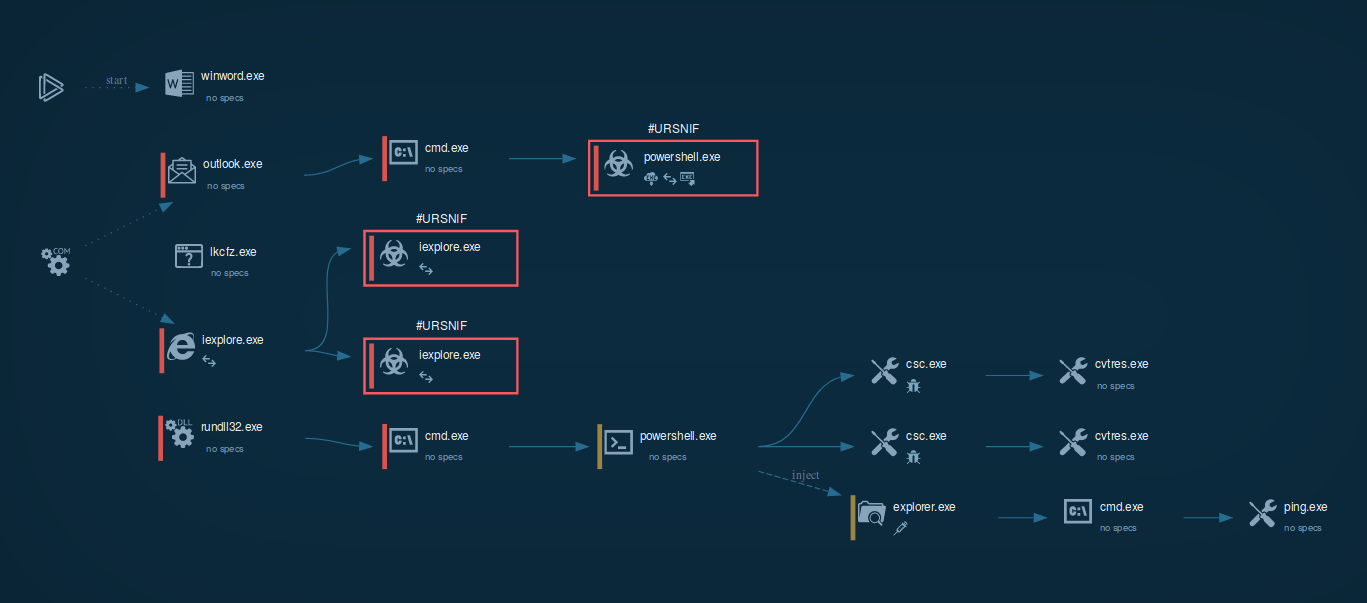
ursnif gozi dreambot execution graph Figure 1: A visual process graph generated by ANY.RUN shows the lifecycle of Urnsnif

How to avoid infection by Ursnif?

The best way to stay safe from Ursnif is to keep the macros turned off and not turn them on if prompted by a Microsoft Office file downloaded from an untrustworthy source, such as an email from the unknown sender. In addition, following good techniques of staying safe online such as not downloading files from suspicious emails, is another great way to avoid infection.

Ursnif execution process

In the case of our simulation, the execution of the malware starts when the user opens a Word or Excel file and enables the macro. Ursnif uses the browser's COM object to connect to its C2 server and receive additional data.

Based on the analysis, Ursnif trojan uses exploits to start legitimate software like Outlook, which in turn launches cmd.exe only to spawn a PowerShell script. If a strike is directed at select countries, the malware checks where the victim is from during this stage. Then, the PowerShell script downloads and executes the final payload, which is Ursnif itself. Lastly, the loader starts malicious activities and injects its code into the explorer.exe process.

After installation, the malware will try to inject into an active explorer.exe process to establish persistence. If the injection fails, Ursnif will launch a new svchost.exe process and will inject itself instead. this technique appears to be a useful pointer for detection. After that, Ursnif will hook the APIs of common web browsers such as Chrome, Opera, Internet Explorer, and Firefox. The loader uses the browsers' COM object to communicate to its C2 server. Then, the malware will begin monitoring web activity and steal the payment information as soon as the victim visits a banking or a payment webpage. Then Ursnif sends collected data to a C2 server via the IE COM object.

Communication with C&C

In order to prevent domain name disclosure, the malware generates the domain names locally using the technique of the Domain Generation Algorithm (DGA) instead of them being hardcoded. Uniquely, the malware gathers information for domain name generation in the DGA process by taking bits of text from popular websites. If you decrypt the URL in the script, you may get the data sent to the C2 server.

The malware is also known to be able to execute commands received from the control server.

How to detect Ursnif using ANY.RUN?

Ursnif uses COM objects to execute the malware's payload, and usually, it runs multiple iexplorer.exe processes. The loader creates a COM object that is a hidden API function. Knowing this information, take a look at the process tree after a while during execution, and determine either sample is Ursnif or not. Check the script to find out if a suspicious URL corresponds to malware activity.
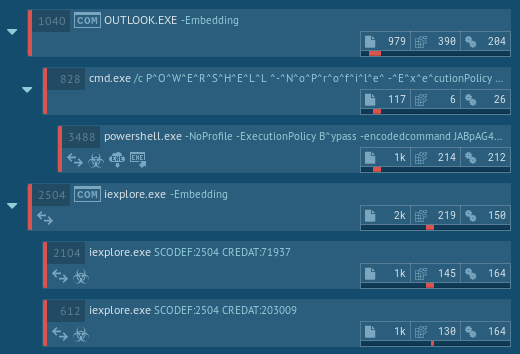
ursnif process tree Figure 2: Ursnif process tree

Conclusion

Based on the source code of another malware that is already almost a decade old, Ursnif is a prime example of the fact that “old” does not mean ineffective when it comes to trojans.

On the contrary, despite its age, this malware is capable of launching devastating cyber attacks and managed to become one of the most popular banking trojans in the world. In addition to its powerful trojan functionality, the loader takes active actions to prevent researchers from studying it. Thankfully, malware hunting services like ANY.RUN allows researchers to study this malware in-depth and respond with appropriate countermeasures.
HAVE A LOOK AT

Agent Tesla screenshot
Agent Tesla
agenttesla trojan rat stealer
Agent Tesla is spyware that collects information about the actions of its victims by recording keystrokes and user interactions. It is falsely marketed as a legitimate software on the dedicated website where this malware is sold.
Read More
DarkComet screenshot
DarkComet
darkcomet rat darkcomet rat
DarkComet RAT is a malicious program designed to remotely control or administer a victim's computer, steal private data and spy on the victim.
Read More
Spyware screenshot
Spyware
spyware
Spyware is a stealth form of malware whose primary objective is to gather sensitive information, such as personal data, login credentials, and financial details, by monitoring user activities and exploiting system vulnerabilities. Spyware operates secretly in the background, evading detection while transmitting collected data to cybercriminals, who can then use it for malicious purposes like identity theft, financial fraud, or espionage.
Read More
Fog Ransomware screenshot
Fog is a ransomware strain that locks and steals sensitive information both on Windows and Linux endpoints. The medial ransom demand is $220,000. The medial payment is $100,000. First spotted in the spring of 2024, it was used to attack educational organizations in the USA, later expanding on other sectors and countries. Main distribution method — compromised VPN credentials.
Read More
Cephalus screenshot
Cephalus
cephalus
Cephalus is a targeted ransomware threat discovered in 2025. It’s known for infiltrating organizations that deal with sensitive data through compromised RDP access. It leverages DLL sideloading with a legitimate SentinelOne executable. Cephalus is able to exfiltrate data and destroy backup options. Its payload is also tailored to each victim, which makes identification and mitigation more complex.
Read More
GuLoader screenshot
GuLoader
guloader
GuLoader is an advanced downloader written in shellcode. It’s used by criminals to distribute other malware, notably trojans, on a large scale. It’s infamous for using anti-detection and anti-analysis capabilities.
Read More