Black friday Up to 3 extra licenses FOR FREE + Special offer for TI LOOKUP Get it now
Webinar
February 26
Better SOC with Interactive Sandbox Practical Use Cases
Register now

Bluesky

140
Global rank
120 infographic chevron month
Month rank
158 infographic chevron week
Week rank
0
IOCs

BlueSky ransomware, first identified in June 2022, shares code similarities with other well-known ransomware families like Conti and Babuk. It primarily spreads via phishing emails and malicious links and can propagate through networks using SMB protocols. BlueSky uses advanced evasion techniques, such as hiding its processes from debuggers via the NtSetInformationThread API, making it difficult for analysts to detect and mitigate its attacks.

Ransomware
Type
Unknown
Origin
1 May, 2022
First seen
25 June, 2026
Last seen

How to analyze Bluesky with ANY.RUN

Type
Unknown
Origin
1 May, 2022
First seen
25 June, 2026
Last seen

IOCs

Last Seen at

Recent blog posts

post image
Safeguarding 200M Users: How ChongLuaDao Scal...
watchers 4069
comments 0
post image
Major Cyber Attacks in July 2026: US and EU O...
watchers 7597
comments 0
post image
Threat Coverage Digest: New TI Report, Threat...
watchers 13208
comments 0

What is BlueSky ransomware?

BlueSky ransomware is a strain of malicious software that encrypts files on a victim's system, rendering them inaccessible until a ransom is paid. First detected in June 2022, it shares similarities with other notorious ransomware families like Conti and Babuk.

BlueSky spreads through methods such as phishing emails, malicious links, and network protocols like SMB (port 445 TCP). Once inside a system, it uses advanced evasion techniques, such as hiding threads from debuggers, to avoid detection. It targets both files and processes, encrypting files with RSA encryption and adding the ".bluesky" extension to them while maintaining operational stability by avoiding critical system processes.

Get started today for free

Analyze malware and phishing in a fully-interactive sandbox

Create free account

BlueSky ransomware technical details

BlueSky ransomware encrypts files on the infected system, spreads through network shares, and uses advanced evasion techniques to avoid detection.

The primary functionalities of BlueSky ransomware include:

  • Uses RSA encryption to lock files and adds a ".bluesky" extension to the affected files.
  • Avoids system-critical processes while terminating secondary ones to optimize encryption without causing a system crash.
  • Utilizes advanced anti-debugging techniques such as hiding threads from debuggers through the NtSetInformationThread API.
  • Writes specific registry keys, including x25519_pub and RECOVERYBLOB, which are essential for the encryption and decryption process.
  • Uses multi-threading to efficiently handle file encryption tasks, targeting both local files and network shares through SMB.

BlueSky ransomware execution process

To see how BlueSky operates, let’s upload its sample to the ANY.RUN sandbox.

BlueSky ransomware specifically targets files and processes for encryption. However, it strategically avoids critical system processes to prevent system crashes that could halt the encryption process prematurely. This selective targeting allows it to continue encrypting files while the system remains operational.

Encrypted files are marked with the “.bluesky” extension, and a ransom note is left in the directories containing the encrypted files.
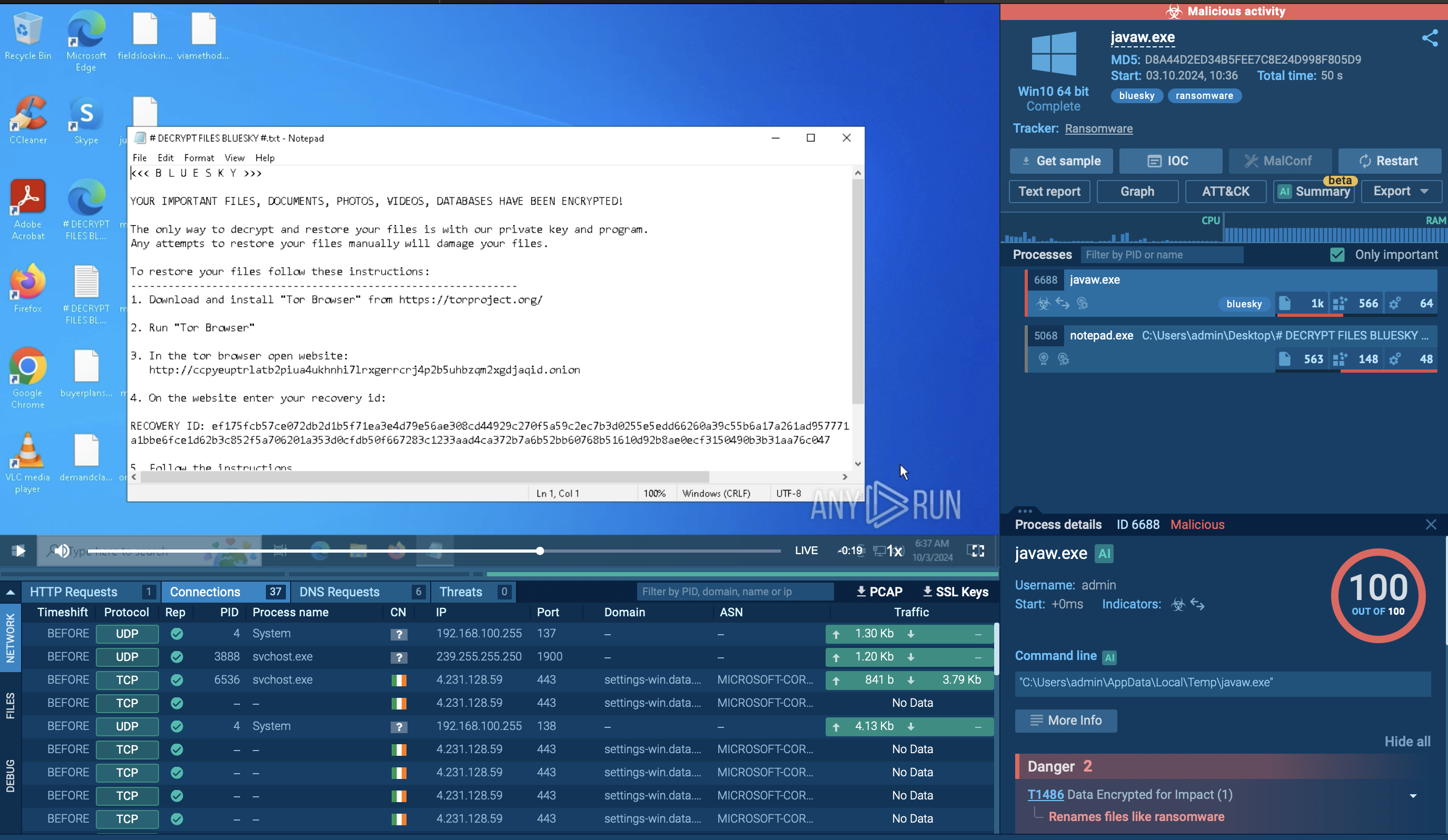
Bluesky in ANY.RUN sandbox BlueSky ransom note displayed in ANY.RUN’s sandbox

Before the encryption takes place, the ransomware writes critical information to the system’s registry, such as x25519_pub and RECOVERYBLOB. These are used by the attackers to potentially decrypt files if the ransom is paid.
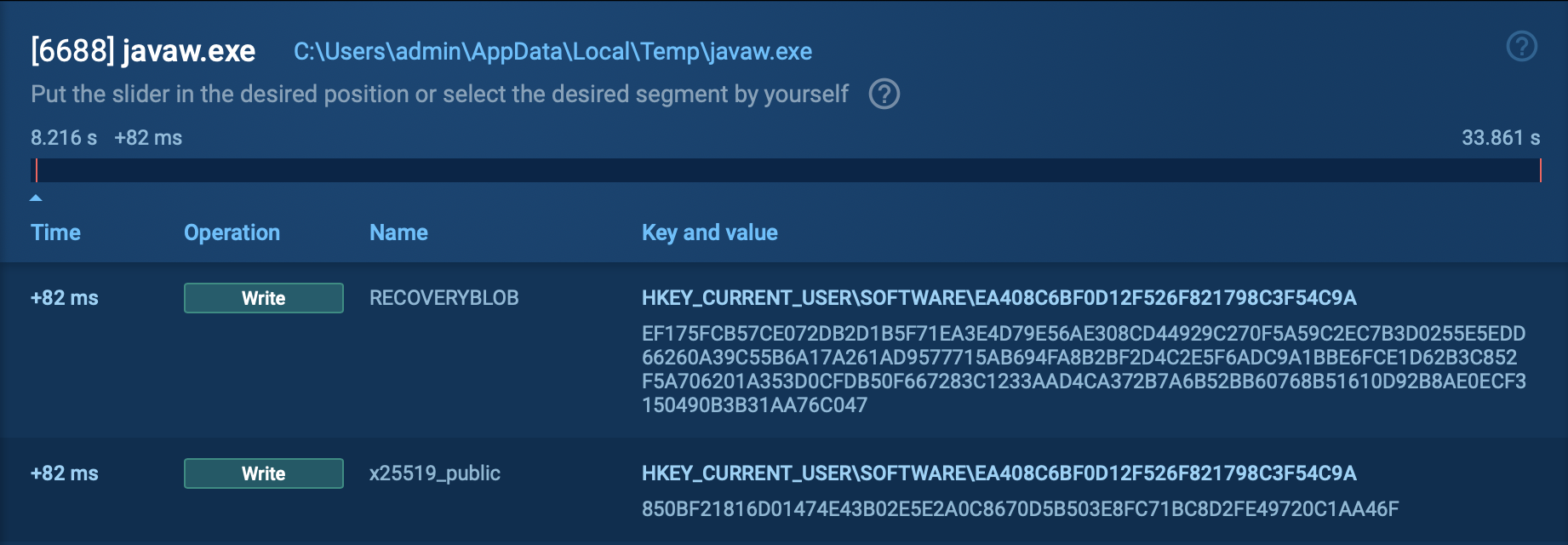
Bluesky registry manipulation Registry changes displayed by the ANY.RUN’s sandbox

One of BlueSky’s key features is its evasion tactics. It hides execution threads from debuggers using the NtSetInformationThread API, making it difficult for analysts and security tools to track its behavior in real-time. This advanced anti-debugging capability ensures that the malware can run stealthily in a compromised environment, minimizing the chances of detection.

Use ANY.RUN free for 14 days

Try the full power of interactive analysis

Start your free trial

BlueSky ransomware distribution methods

Similar to other malware families like AsyncRAT and Lumma Stealer, BlueSky ransomware is distributed through a variety of methods, making it a versatile and dangerous threat. Here are the primary distribution methods:

  • Phishing emails: Delivered via emails containing malicious attachments or links that prompt users to download and execute ransomware.
  • SMB protocol (Server Message Block): Spreads across networks using SMB (Port 445 TCP), which makes it possible to infect multiple machines.
  • Trojanized software: Embedded in cracked or pirated software, which users unknowingly download from unreliable sources.
  • Malicious links: Spread through phishing websites or compromised legitimate sites, directing users to download the malware.

Gathering Threat Intelligence on BlueSky Ransomware

To gather up-to-date intelligence on BlueSky ransomware, use Threat Intelligence Lookup.

This service gives you access to a vast database of threat data, built on millions of malware analysis sessions conducted in the ANY.RUN sandbox. It allows you to search using over 40 parameters, such as IPs, file names, domains, and process artifacts. Bluesky lookup search Search query for Bluesky in ANY.RUN’s Threat Intelligence Lookup
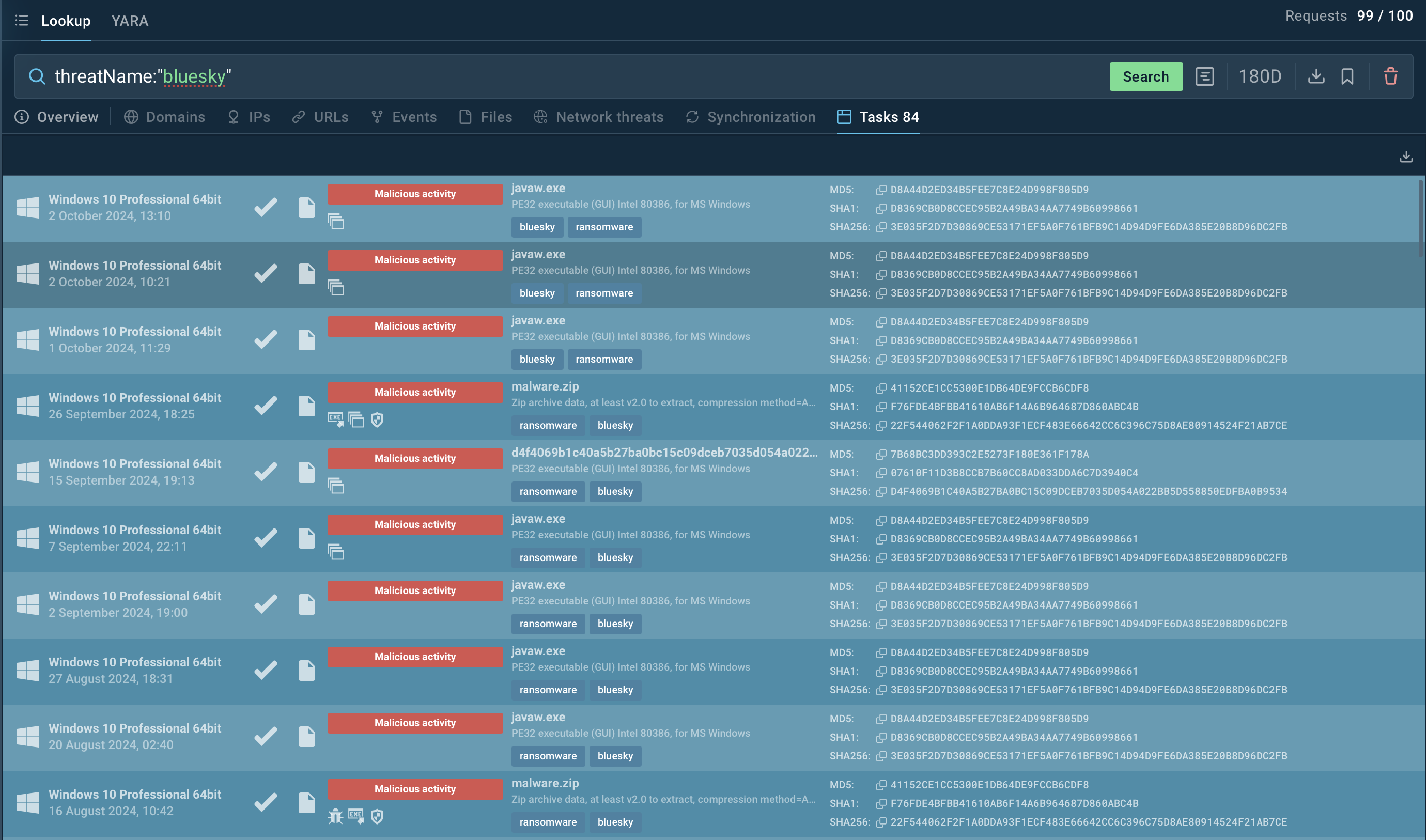
Searching for BlueSky-related terms, such as threatName:"BlueSky", in TI Lookup brings up results related to this ransomware, including associated samples, network activity, and command-and-control (C2) communication.

Test the capabilities of Threat Intelligence Lookup and the ANY.RUN sandbox.

Conclusion

BlueSky ransomware is a dangerous threat due to its file encryption, network propagation, and advanced evasion techniques. To combat this, it's essential to use tools like ANY.RUN and proactively analyze suspicious files before they cause damage. ANY.RUN provides a real-time malware analysis platform, allowing users to safely investigate and understand malware behavior, while delivering detailed reports for actionable insights.

Sign up for a free ANY.RUN account today to start analyzing threats like BlueSky.
HAVE A LOOK AT

StrelaStealer screenshot
StrelaStealer
strela
StrelaStealer is a malware that targets email clients to steal login credentials, sending them back to the attacker’s command-and-control server. Since its emergence in 2022, it has been involved in numerous large-scale email campaigns, primarily affecting organizations in the EU and U.S. The malware’s tactics continue to evolve, with attackers frequently changing attachment file formats and updating the DLL payload to evade detection.
Read More
BlindEagle screenshot
BlindEagle
blindeagle
BlindEagle is a cyber threat actor primarily associated with espionage and credential theft campaigns targeting organizations in Latin America, especially Colombia. Active since at least 2018, the group relies heavily on phishing, remote access trojans (RATs), PowerShell scripts, and social engineering to infiltrate systems and maintain persistence. BlindEagle is known for continuously evolving its delivery mechanisms and malware stack to bypass detection and compromise high-value targets.
Read More
Moonrise screenshot
Moonrise
moonrise
Moonrise RAT is a newly discovered Go-based remote access trojan with zero detections at launch, featuring credential theft, keylogging, webcam access, clipboard hijacking, and UAC bypass.
Read More
Pay2Key screenshot
Pay2Key is a ransomware strain primarily written in C++ for Windows (with recent Linux variants), attributed to Iranian-linked actors, notably the Fox Kitten APT group (also known as UNC757 or related operations). First observed in late 2020, it employs double-extortion tactics (encrypting files and threatening to leak stolen data) while showing signs of both financial and state-aligned motivations. It has resurfaced in campaigns targeting Western organizations, including rapid encryption attacks on healthcare.
Read More
PureCrypter screenshot
PureCrypter
purecrypter
First identified in March 2021, PureCrypter is a .NET-based loader that employs obfuscation techniques, such as SmartAssembly, to evade detection. It has been used to distribute malware families including AgentTesla, RedLine Stealer, and SnakeKeylogger. The malware is typically delivered through phishing campaigns and malicious downloads, often masquerading as legitimate files with extensions like .mp4 or .pdf. PureCrypter utilizes encryption and compression to conceal its payloads and can inject malicious code into legitimate processes to maintain persistence on the infected system.
Read More
Mispadu screenshot
Mispadu is a Windows banking trojan known for targeting online banking credentials, cryptocurrency wallets, and sensitive financial information. First identified in Latin America, the malware has continuously evolved with improved evasion techniques, phishing campaigns, and credential theft capabilities. Its reliance on social engineering rather than software vulnerabilities makes it an enduring threat to organizations whose employees interact with financial services online.
Read More