Black friday Up to 3 extra licenses FOR FREE + Special offer for TI LOOKUP Get it now
Webinar
February 26
Better SOC with Interactive Sandbox Practical Use Cases
Register now
28
Global rank
23 infographic chevron month
Month rank
26 infographic chevron week
Week rank

NanoCore is a Remote Access Trojan or RAT. This malware is highly customizable with plugins which allow attackers to tailor its functionality to their needs. Nanocore is created with the .NET framework and it’s available for purchase for just $25 from its “official” website.

Trojan
Type
USA
Origin
1 January, 2013
First seen
7 October, 2026
Last seen

How to analyze Nanocore with ANY.RUN

Type
USA
Origin
1 January, 2013
First seen
7 October, 2026
Last seen

IOCs

IP addresses
8.8.8.8
172.67.157.175
48.209.138.189
104.21.14.34
23.11.41.157
204.79.197.203
20.190.160.130
92.123.104.50
74.178.76.128
172.211.123.250
135.232.92.97
23.207.210.139
2.23.246.101
2.21.20.138
48.192.1.65
74.178.240.61
8.8.4.4
40.126.31.128
2.20.142.162
188.114.96.3
Hashes
287f7b4372926ff59bb9a14bdfc00ad63f92af8efdb2e14f6f6baf31878fd44e
9a30667f8a16794f3a5c4301bc1208356a3b9104dd2e3bbacbfe7ca62d05289e
2c55e09bcd73eb2cbb880eb20568f1e23154fe10cd3da4be11a97edca2da80ff
c75d24733eb4d9dbc419e1d744d9b3a2a01ec4e3fbe3ce4c6d49fd3a5c573de1
75135ad0ea5b8b7e1c6810a70ae4cdc20696367fafa4629ec2f0d9f5ec58839e
26ceb2d8140b75de7617d22572b34b2c9bba7d5e1060e8cdbc8f498d5e581d21
04c996c64955afc87a47c78e7651c36a87582a9719f387d1644a0112f7a9e2e9
382c5ae1308c9492d4ab8a142a5185c22a5ed8e3e0a429eb1c6e9f622d6d5ea8
922d7e9c60bc9a11b09762f59504c0ce441b37e371d855836c59743eee4cc6d2
db0df14a9b2b7d568ebc94061b87e76fa4b50fb0ff9c9c3c5dd0de253a26ee43
d99aaa09108e56886ab53484575db5b11f400a8a6461d32adf630935ccd4b4d9
7f84f40a6e976507c380ebb4789bcd97be173c0638e9a4ba819fd79456579d32
bb1559b8828e27471c9340e5216273f52d28a2b5587b76bad87b2e27c30fa1b9
83ad6ea5c240002d70a2fa3df1f50a91d87dcc5cc157e71a3c845748fbe61ef3
249f9b2d0bcc0bc429688c27e3d97caea3367075501f7c5fb1c5e32508302a0d
6769483c34fb3974aa669f4d720e119bc8860898f2ce0ba5f603e206924561bb
2db64c306990fcb7d301ebfd1daf991a52b6f17db19293e3d746d5ca06dc1fef
93a4fdade2638e394cc23ea12fc075a4d736d491da0c495924cbd59688a2e7f0
4253924748c50933d3a12389a33dad809a25d00bcb457b58a5aa4f9f01a9dbab
fc613073a5bffa1cd89a58565e6c36dd39c564ec18ff8fac072d80de4fa4fecc
Domains
login.live.com
th.bing.com
fe3cr.delivery.mp.microsoft.com
crl.microsoft.com
client.wns.windows.com
settings-win.data.microsoft.com
slscr.update.microsoft.com
oneocsp.microsoft.com
activation-v2.sls.microsoft.com
ocsp.digicert.com
google.com
www.bing.com
ecs.office.com
self.events.data.microsoft.com
www.microsoft.com
malware.shareinspire.me
ip-api.com
go.microsoft.com
nexusrules.officeapps.live.com
watson.events.data.microsoft.com
URLs
http://ocsp.digicert.com/mfewtzbnmeswstajbgurdgmcgguabbq50otx%2fh0ztl%2bz8sipi7wewvxdlqqutijuibiv5unu5g%2f6%2brks7qyxjzkceaz1vqyrvgl0erhqlcpm8gy%3d
http://crl.microsoft.com/pki/crl/products/microoceraut2011_2011_03_22.crl
http://ocsp.digicert.com/mfewtzbnmeswstajbgurdgmcgguabbtrjrydryt%2bapf3gspypfhbxr5xtqqus9tippmhxdiunkhmewnpyim8s8yceajtxtab8my1oj8mfwpz%2f7y%3d
http://oneocsp.microsoft.com/ocsp/mfqwujbqme4wtdajbgurdgmcgguabbq3l3%2f%2fa6adk8nray2gxzvayrhg4aqub6t%2b2v%2bxq3lso2d33ojhnyhhqoucezmaaaafuwohyjguzpcaaaaaaau%3d
https://settings-win.data.microsoft.com/settings/v3.0/flightsettings/fsservice?processorclockspeed=3094&isretailos=1&oemmanufacturername=dell&flightingpolicyvalue=3&enablepreviewbuilds=4294967295&osversionfull=10.0.19045.4046.amd64fre.vb_release.191206-1406&managepreviewbuilds=3&branchreadinesslevelsource=0&attrdataver=186&processorcores=6&branchreadinesslevelraw=16&totalphysicalram=6144&tpmversion=0&oemmodelnumber=dell&systemvolumetotalcapacity=260281&deviceid=s%3abad99146-31d3-4ec6-a1a4-be76f32ba5d4&app=fss&appver=10.0&smartactivehoursstate=1&activehoursstart=20&securebootcapable=0&activehoursend=13&devicefamily=windows.desktop
https://settings-win.data.microsoft.com/settings/v3.0/wsd/waasassessment?os=windows&osver=10.0.19041.1.amd64fre.vb_release.191206-&ring=retail&sku=48&deviceclass=windows.desktop&locale=en-us&deviceid=bad99146-31d3-4ec6-a1a4-be76f32ba5d4&flightring=retail&telemetrylevel=1&hidovergattreg=c%3a%5cwindows%5csystem32%5cdriverstore%5cfilerepository%5chidbthle.inf_amd64_9610b4821fdf82a5%5cmicrosoft.bluetooth.profiles.hidovergatt.dll&appver=10.0&processoridentifier=amd64%20family%2023%20model%201%20stepping%202&oemmodel=dell&updateoffereddays=4294967295&processormanufacturer=authenticamd&installdate=1661339444&oemmodelbaseboard=&branchreadinesslevel=cb&oemsubmodel=j5cr&isclouddomainjoined=0&deferfeatureupdateperiodindays=30&isdeviceretaildemo=0&flightingbranchname=&osuilocale=en-us&devicefamily=windows.desktop&wuclientver=10.0.19041.3996&uninstallactive=1&isflightingenabled=0&osskuid=48&processorclockspeed=3094&totalphysicalram=6144&securebootcapable=0&app=waasassessment&processorcores=6&currentbranch=vb_release&installlanguage=en-us&deferqualityupdateperiodindays=0&servicingbranch=cb&oemname_uncleaned=dell&tpmversion=0&primarydisktotalcapacity=262144&installationtype=client&attrdataver=186&processormodel=amd%20ryzen%205%203500%206-core%20processor&isedgewithchromiuminstalled=1&osversion=10.0.19045.4046&ismdmenrolled=0&activationchannel=retail&honorwufbdeferrals=0&firmwareversion=a.40&trendinstalledkey=1&osarchitecture=amd64&defaultuserregion=244&updatemanagementgroup=2
http://www.microsoft.com/pkiops/crl/microsoft%20ecc%20update%20secure%20server%20ca%202.1.crl
https://slscr.update.microsoft.com/sls/%7b522d76a4-93e1-47f8-b8ce-07c937ad1a1e%7d/x64/10.0.19045.4046/0?ch=686&l=en-us&p=&pt=0x30&wua=10.0.19041.3996&mk=dell&md=dell
https://fe3cr.delivery.mp.microsoft.com/clientwebservice/ping
https://slscr.update.microsoft.com/sls/ping
https://slscr.update.microsoft.com/sls/%7be7a50285-d08d-499d-9ff8-180fdc2332bc%7d/x64/10.0.19045.4046/0?ch=686&l=en-us&p=&pt=0x30&wua=10.0.19041.3996&mk=dell&md=dell
https://activation-v2.sls.microsoft.com/slactivateproduct/slactivateproduct.asmx?configextension=retail
https://login.live.com/ppsecure/deviceaddcredential.srf
https://settings-win.data.microsoft.com/settings/v3.0/wsd/waasassessment?os=windows&osver=10.0.19041.1.amd64fre.vb_release.191206-&ring=retail&sku=48&deviceclass=windows.desktop&locale=en-us&deviceid=bad99146-31d3-4ec6-a1a4-be76f32ba5d4&flightring=retail&telemetrylevel=1&hidovergattreg=c%3a%5cwindows%5csystem32%5cdriverstore%5cfilerepository%5chidbthle.inf_amd64_9610b4821fdf82a5%5cmicrosoft.bluetooth.profiles.hidovergatt.dll&appver=10.0&processoridentifier=amd64%20family%2023%20model%201%20stepping%202&oemmodel=dell&updateoffereddays=4294967295&processormanufacturer=authenticamd&installdate=1661339444&oemmodelbaseboard=&branchreadinesslevel=cb&oemsubmodel=j5cr&isclouddomainjoined=0&deferfeatureupdateperiodindays=30&isdeviceretaildemo=0&flightingbranchname=&osuilocale=en-us&devicefamily=windows.desktop&wuclientver=10.0.19041.3996&uninstallactive=1&isflightingenabled=0&osskuid=48&processorclockspeed=3094&totalphysicalram=6144&securebootcapable=0&app=waasassessment&processorcores=6&currentbranch=vb_release&installlanguage=en-us&deferqualityupdateperiodindays=0&servicingbranch=cb&oemname_uncleaned=dell&tpmversion=0&primarydisktotalcapacity=262144&installationtype=client&attrdataver=186&processormodel=amd%20ryzen%205%203500%206-core%20processor&isedgewithchromiuminstalled=1&osversion=10.0.19045.4046&ismdmenrolled=0&activationchannel=retail&honorwufbdeferrals=1&firmwareversion=a.40&trendinstalledkey=1&osarchitecture=amd64&defaultuserregion=244&updatemanagementgroup=2
https://login.live.com/rst2.srf
https://th.bing.com/th?id=odswg.iotdlocalicon&w=16&h=16&c=1&rs=1&p=0
http://www.microsoft.com/pkiops/crl/microsoft%20ecc%20product%20root%20certificate%20authority%202018.crl
http://ip-api.com/json?fields=status,isp,org,hosting,proxy
http://www.microsoft.com/pkiops/crl/microsoft%20secure%20server%20ca%202026.crl
https://go.microsoft.com/fwlink/?linkid=2257403&clcid=0x409
Last Seen at

Recent blog posts

post image
5 Critical Pain Points of Modern US SOCs and...
watchers 1648
comments 0
post image
IronChain Ransomware Threatens Businesses wit...
watchers 3378
comments 0
post image
Threat Coverage Digest: New Malware Reports a...
watchers 10879
comments 0

What is NanoCore malware?

NanoCore is a Remote Access Trojan or RAT. This malware is highly customizable with plugins that allow attackers to tailor its functionality to their needs. Nanocore is created with the .NET framework and it’s available for purchase for just $25 from its “official” website.

This malware was recorded in the wild for the first time in 2013. Since then it has become extremely popular. It is now used in attacks all around the world. As a modular malware, the functionality of the NanoCore backdoor can be greatly expanded with plugins. This makes an already dangerous RAT potentially even more destructive for the company's cybersecurity.

Distributed on its own website with 24/7 technical support for just $25 with all official plugins included, the malware can also be downloaded from hacking forums where its "cracked" version has been leaked multiple times, making it an extremely accessible trojan to set up and use. Unfortunately, the accessibility, ease of use, and a bunch of information on NanoCore are still contributing to its growing popularity. It’s not completely certain whether the malware was being developed as a commercial program for institutions, or the creator had a goal to create malicious software from the beginning, Regardless, NanoCore author, Taylor Huddleston was tracked down and arrested by the FBI.

General Information about NanoCore RAT

According to the analysis, NanoCore’s first beta appeared in 2013. The latest version of the malware is being openly sold on its own website NANOCORE_dot_io. Unfortunately, this helped ensure the high popularity of the malware. Today NanoCore RAT targets victims worldwide. However, the majority of attacks are taking place in the US.

One of the key characteristics of this RAT is that technically savvy attackers are able to greatly expand the functionality of the malware, fine-tuning it to suit their needs, for instance, by adding screen locker functionality to the virus. Some essential plugins are already provided with the purchase bundle on the “official” website. Other even more sophisticated ones are being developed by the community of cybercriminals, that has formed around NanoCore.

For crooks that don’t want to engage in fiddling with plugins, NanoCore provides a straightforward user interface It allows even novice criminals to launch potentially destructive malicious campaigns. Thus further contributing to the popularity of the malware.

Interactive analysis of NanoCore

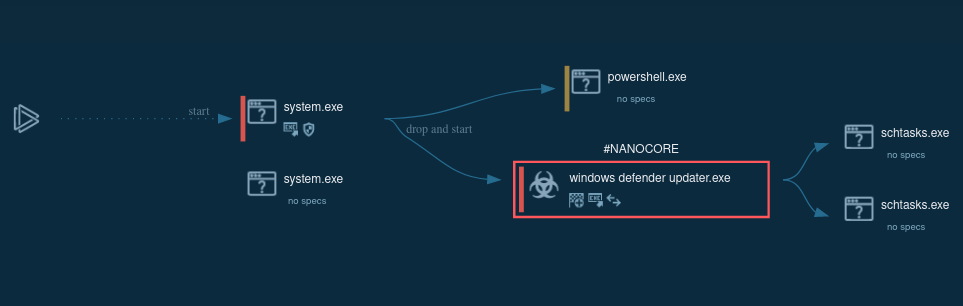
A video of the execution process provided by ANY.RUN malware hunting service allows us to perform the analysis of the lifecycle of the trojan or other malware such as WSHRAT or Vidar. We can watch NanoCore behavior as well as all processes as they unfold in a secure online environment.
nanocore execution process graph

Figure 1: A visual graph of NanoCore execution processes generated by ANY.RUN

How does NanoCore spread?

NanoCore RAT is distributed using multiple methods. However, the most commonly used is spam email campaigns. They trick users into downloading malicious documents, often presented as price lists or purchase orders.

The emails sometimes contain malicious attachments with .img or .iso extension. The large size of these files makes it difficult to scan them. Some versions of malware are also spread by a ZIP file which evades secure email gateways. Several file structure works here: one file script will download the payload while the rest are decoys that ensure the malicious content goes unnoticed by the system's security.

PowerPoint files acquire the same scenario as the infection chain takes place over multiple stages before the final payload is executed.

NanoCore RAT execution process

NanoCore is delivered to the victim’s PC using the AutoIt program. Not unlike Agent Tesla malware, which is somewhat typical for this type of RATs. Typically, NanoCore is spread using Microsoft Word documents. Infected files contain an embedded executable file or an exploit.

According to the RAT analysis, once the script file is opened an embedded macros download an executable script file and rename it. The downloaded executable file runs itself and creates a child process. The malware is able to use Regsvcs and Regasm to proxy the code execution through a trusted Windows utility.
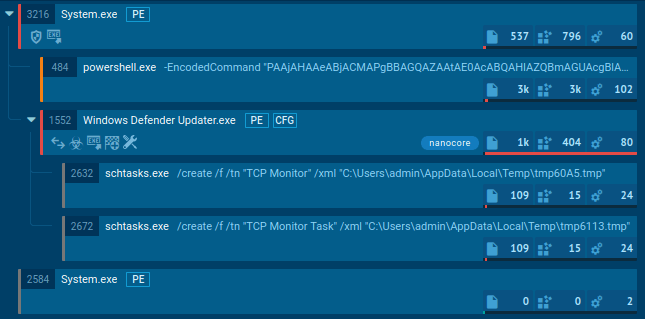
nanocore execution process tree

Figure 2: A process tree of NanoCore execution processes generated by ANY.RUN

How to detect NanoCore malware using ANY.RUN?

You can identify whether you are dealing with a sample of NanoCore RAT or not by a quick analysis of the files and scripts created by the malware. Most often NanoCore injects into three processes RegSvcs.exe, RegAsm.exe, and MSBuild.exe.

Open "Advanced details of process" for these processes and look at the "Modified files" tab in the "Events" section. If a file named "run.dat" was created by one of these processes and placed in the %Root%:\Users\username\AppData\Roaming[GUID] folder, you can be sure that the malware you are observing is, in fact, NanoCore trojan.
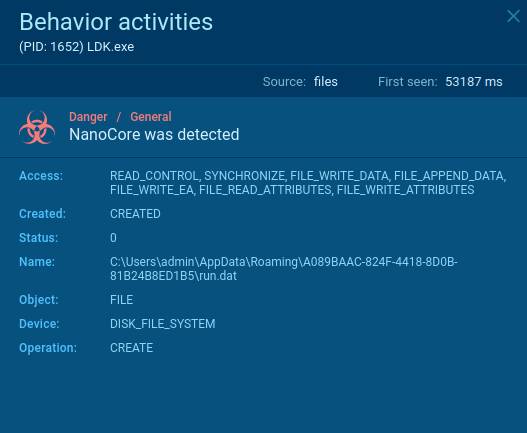
file created by nanocore Figure 3: File created by Nanocore

Conclusion

Thanks to accessibility, ease of use, customization, and plenty of information, the popularity of NanoCore escalated making it one of the most widespread RATs in the world. Even though NanoCores’ creator has been arrested by officials, due to the appearance of several cracked versions, NanoCore is still openly available on hacker forums.

Often, it can be acquired for free, allowing anybody to set up attacks. The popularity of the malware is further aided by the fact that one does not need much programming knowledge to use this Trojan, as it comes equipped with a user-friendly interface. At the same time, very sophisticated and destructive attacks can be carried out with NanoCore RAT by skillful hackers, since its malicious capabilities can be extended with custom plugins. Thankfully, modern analysis tools such as ANY.RUN allow researchers to examine malware in detail, learn about its behavior patterns and set up an appropriate cybersecurity response.
HAVE A LOOK AT

Cerber screenshot
Cerber
cerber
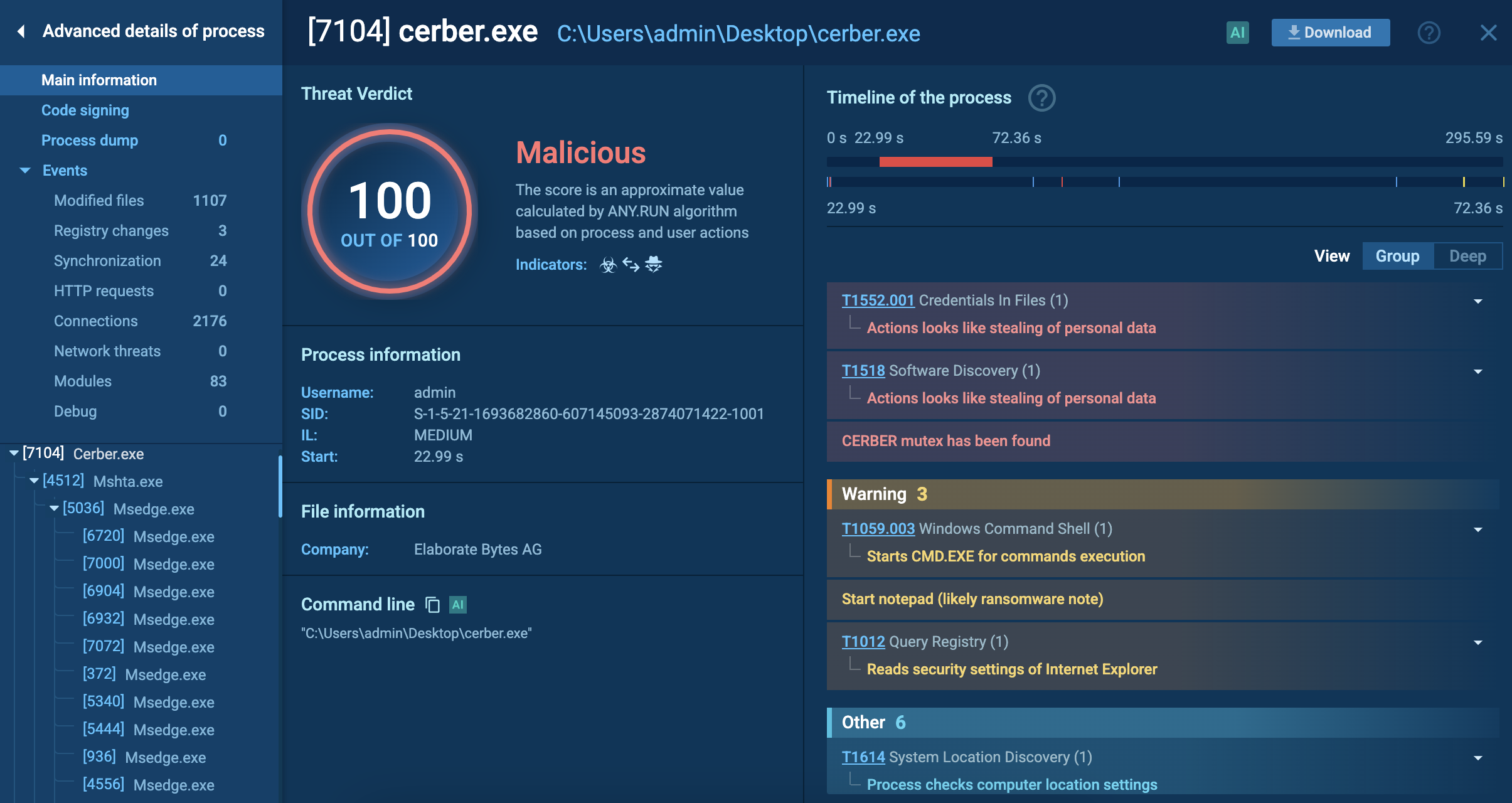
Cerber is a Ransomware-as-a-Service (RaaS) that appeared in 2016, spread quickly and has been evolving since. It became well-known for its file encryption, offline capabilities, and sophisticated evasion techniques. It primarily targets enterprises, financial institutions, and government entities, encrypting their data and demanding ransom payments in Bitcoin. It also targets everyday users encrypting personal files (photos, documents) with the risk of their permanent loss.
Read More
Pay2Key screenshot
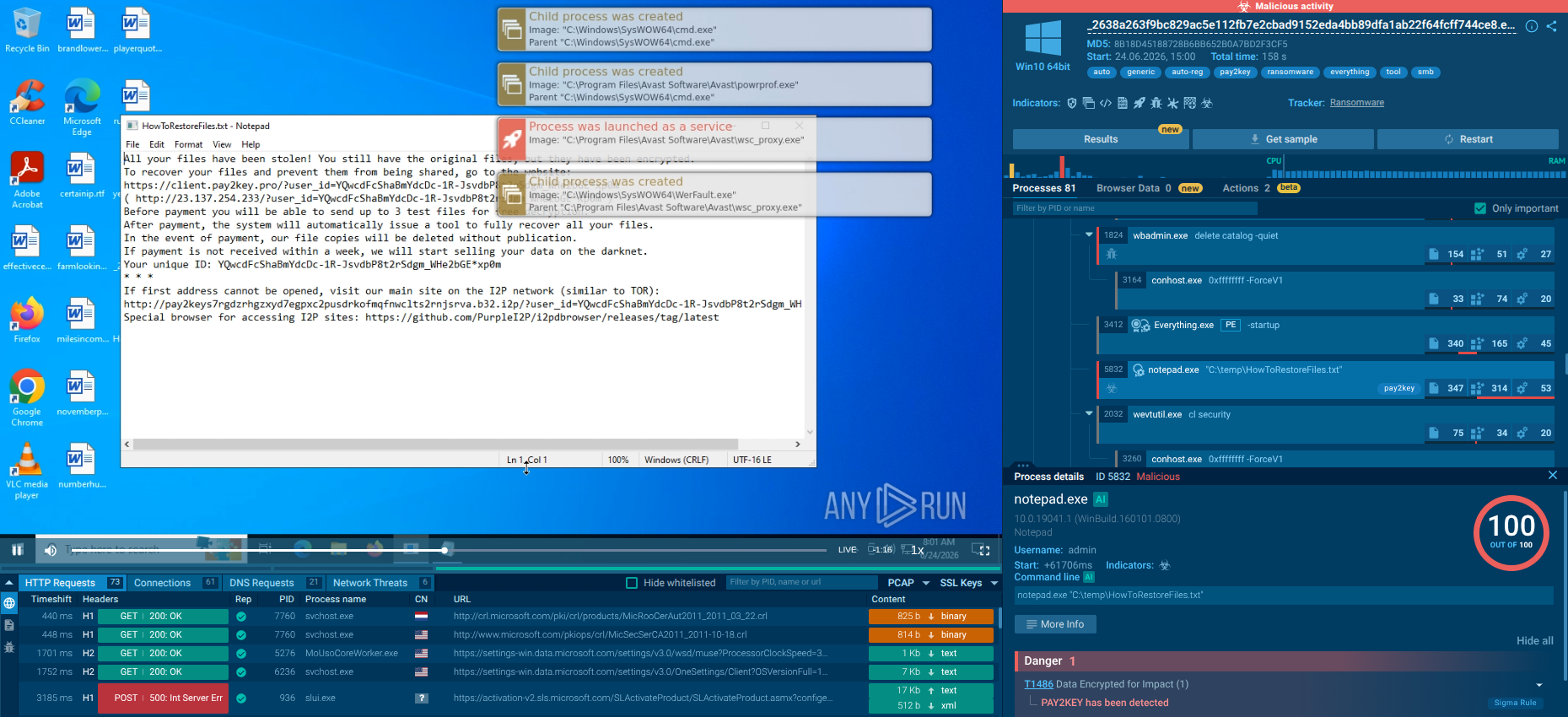
Pay2Key is a ransomware strain primarily written in C++ for Windows (with recent Linux variants), attributed to Iranian-linked actors, notably the Fox Kitten APT group (also known as UNC757 or related operations). First observed in late 2020, it employs double-extortion tactics (encrypting files and threatening to leak stolen data) while showing signs of both financial and state-aligned motivations. It has resurfaced in campaigns targeting Western organizations, including rapid encryption attacks on healthcare.
Read More
SolarisLoader screenshot
SolarisLoader
solaris
SolarisLoader is a malware loader designed to neutralize security infrastructure before deploying high-risk secondary payloads. It utilizes a "Bring Your Own Vulnerable Driver" technique to gain kernel-level access and terminate antivirus processes. To remain undetected, the malware patches internal Windows monitoring interfaces and isolates the machine from security updates. Finally, it establishes a resilient three-layer persistence mechanism involving scheduled tasks, registry backups, and a watchdog component.
Read More
ValleyRAT screenshot
ValleyRAT
valleyrat
ValleyRAT is a classic remote access trojan first documented in 2023, targeting mainly Windows systems. It is used by threat actors to gain persistent access to infected devices, steal data, and control compromised machines. ValleyRAT is notable for its relatively advanced evasion techniques and its connections to a prominent Chinese APT group.
Read More
FlowerStorm screenshot
FlowerStorm
flowerstorm
FlowerStorm is a phishing-as-a-service (PhaaS) platform used by cybercriminals to steal Microsoft 365 credentials and bypass multi-factor authentication (MFA) protections through adversary-in-the-middle (AiTM) attacks. Emerging after the disruption of Rockstar2FA in late 2024, FlowerStorm rapidly gained popularity among attackers targeting enterprises across North America and Europe.
Read More
Xeno RAT screenshot
Xeno RAT
xenorat
Xeno RAT is an open-source malware mainly distributed through drive-by downloads. The core capabilities of this threat include remote control, keystroke logging, webcam and microphone access. Equipped with advanced utilities, such as Hidden Virtual Network Computing and Socks5 reverse proxy, Xeno RAT is most frequently used in attacks against individual users.
Read More