Black friday Up to 3 extra licenses FOR FREE + Special offer for TI LOOKUP Get it now
Webinar
February 26
Better SOC with Interactive Sandbox Practical Use Cases
Register now

STRRAT

86
Global rank
50 infographic chevron month
Month rank
59 infographic chevron week
Week rank

STRRAT is a type of malicious software known as a remote access trojan (RAT). It gives attackers the ability to gain full control over a victim's computer system, enabling them to steal confidential information, spy on their activities, and drop other malware. STRRAT has been in operation since 2020 and is regularly updated to increase its complexity and make it more difficult to detect.

RAT
Type
Unknown
Origin
1 June, 2020
First seen
15 September, 2026
Last seen

How to analyze STRRAT with ANY.RUN

RAT
Type
Unknown
Origin
1 June, 2020
First seen
15 September, 2026
Last seen

IOCs

IP addresses
107.174.192.179
150.171.28.11
118.194.235.187
208.95.112.1
188.114.96.3
149.154.167.99
104.18.23.222
2.16.204.161
142.251.155.119
142.251.20.132
139.99.85.213
74.178.240.51
154.91.34.165
104.26.12.64
142.250.154.97
172.217.117.4
154.23.184.57
98.177.107.142
23.59.18.102
142.251.14.95
Hashes
704d28223a4320a853df4a19d48c7015cf79d56a5317cc3475b6305fa43dcc05
8f05bafd61f29998ca102b333f853628502d4e45d53cff41148d6dd15f011792
81970dbe581373d14fbd451ac4b3f96e5f69b79645f1ee1ca715cff3af0bf20d
d7446e2f307027c9bda2a92d1df1c13c376581372f6ae8708f4d5baccb2e6813
cd2c00ce027687ce4a8bdc967f26a8ab82f651c9becd703658ba282ec49702bd
9efa735bbf7b61c3f94281e925ee48ce4cc659d267c0255d54e4700f4404eec0
73526ddb1d23d595680badd6bd87f5dd82869606a7cf7e8707758d48d848257e
c5011367a4453096122fe72bb89f2940293cb61e973522ff140cdfe05227b1f3
f3a7e5e59e883a3ef6c99967766a546d55dd7a767fadb9f4d433cedf0555e992
11acf49eb9f3cb68fa7a3bb8568cef2eb0f125700c8edcbcd108b5810761770f
2487221a75a52b4f8aa6d2e62f1c0a55a5cd5240b1cb7aafa66fbb2042590b06
057784451e3442f381f6a8af931a7050f88d19bda6bc939d37607532a353da1c
e7f8eae310e8ace3b3b0be3bb145ec8c2bbcaa66c9337218dc4cbef633374f95
c13743567fcfc4fa77b66e79447edab2d1ecc97d4da32b655d92ae90968f2b0b
7c0719b9b312a531cf41cd08affacceef6de084619808238fec0f0247955f26e
bffbebedccb4bfd8e849bb3b577eaf0bc821bd45be29905017e667034e5b25be
9d6ee11f048b734a4edf01acda39d1390b0e1e88756919991c242073723b9c21
5ac3e308c8bef5ed42463929a1be5f519f56a0785fd8c2aed6f85073cc5f98fc
5e9df6d39b25455a16f0b33e0bfe3f4558cf449b0e4b121d258deee9a5ed5916
2eb6170c3750cc48f0083dafb915de81ec9d89877b83a6f574a7bb50cbf41dbc
Domains
tpc.googlesyndication.com
api.edgeoffer.microsoft.com
fe3cr.delivery.mp.microsoft.com
settings-win.data.microsoft.com
static.admaster.cc
msedge.b.tlu.dl.delivery.mp.microsoft.com
identitytoolkit.googleapis.com
lh3.googleusercontent.com
must-directed.gl.at.ply.gg
api.telegram.org
edge.microsoft.com
googleads.g.doubleclick.net
activation-v2.sls.microsoft.com
bucket-cf-weur-a.uploadnow.io
nexusrules.officeapps.live.com
www.bing.com
api.pcloud.com
client.wns.windows.com
slscr.update.microsoft.com
edge-consumer-static.azureedge.net
URLs
http://crl.microsoft.com/pki/crl/products/microoceraut2011_2011_03_22.crl
http://www.microsoft.com/pkiops/crl/micsecserca2011_2011-10-18.crl
http://edge.microsoft.com/browsernetworktime/time/1/current?cup2key=2:wre-eutrtw_lzyylfryn5gipqsah5d90nzfi4jwh-im&cup2hreq=e3b0c44298fc1c149afbf4c8996fb92427ae41e4649b934ca495991b7852b855
https://uploadnow.io/f/0bcds7g
https://config.edge.skype.com/config/v1/edge/133.0.3065.92?clientid=4489578223053569932&agents=edge%2cedgeconfig%2cedgeservices%2cedgefirstrun%2cedgefirstrunconfig&osname=win&client=edge&channel=stable&scpfre=0&osarch=x86_64&osver=10.0.19045&wu=1&devicefamily=desktop&uma=0&sessionid=72&mngd=0&installdate=1661339457&edu=0&soobedate=1504771245&bphint=2&fg=1&lbfgdate=1766137499&lafgdate=0
https://edge.microsoft.com/serviceexperimentation/v3/?osname=win&channel=stable&osver=10.0.19045&devicefamily=desktop&installdate=1661339457&clientversion=133.0.3065.92&experimentationmode=2&scpguard=0&scpfull=0&scpver=0
https://copilot.microsoft.com/c/api/user/eligibility
https://uploadnow.io/en/share?utm_source=0bcds7g
https://cdn.uploadnow.io/_next/static/css/df97d9751ec3abda.css
https://cdn.uploadnow.io/_next/static/css/cda03e3a1ab65c17.css
https://cdn.uploadnow.io/_next/static/css/ae110469aab9e883.css
https://cdn.uploadnow.io/_next/static/css/5ded0d5ca9ecc5c1.css
https://cdn.uploadnow.io/_next/static/chunks/webpack-541c27ed8494cc3b.js
https://cdn.uploadnow.io/_next/static/chunks/framework-b6335179e7eea00c.js
https://cdn.uploadnow.io/_next/static/chunks/main-86f0684c1b20f38d.js
https://cdn.uploadnow.io/_next/static/chunks/pages/_app-a7a0c0b843b84887.js
https://cdn.uploadnow.io/_next/static/chunks/62867-950590631f5ceb03.js
https://cdn.uploadnow.io/_next/static/chunks/38993-a4121c3c0d1b9d33.js
https://cdn.uploadnow.io/_next/static/chunks/41480-7aa8c357827879bd.js
https://cdn.uploadnow.io/_next/static/chunks/3816-6a0007c41b67cb89.js
Last Seen at
Last Seen at

Recent blog posts

post image
How MSSPs Can Prove Their Value When “Nothing...
watchers 2564
comments 0
post image
Enterprise Threat Intelligence Buying Guide:...
watchers 2932
comments 0
post image
ANY.RUN & SentinelOne: One Workspace, Ins...
watchers 4471
comments 0

What is STRRAT malware?

STRRAT is a Java-based malware that has been active since at least mid-2020. It is intended for a number of malicious purposes, including exfiltrating data from users’ browsers and email clients, keylogging, stealing files, as well as dropping additional malware. The creators of STRRAT are unknown, yet the continued evolution of the malware suggests that the developers behind it are constantly working to improve its capabilities.

The use of Java, a language that has largely lost its popularity over the past decade, does not prevent STRRAT from infecting numerous machines across the globe every year. Although the early versions of the malware required the presence of Java Runtime Environment (JRE) on the victim’s computer, the newer ones can do without it. Instead, they scan the system and install the JRE software downloaded from one of the remote servers.

While STRRAT continues to be distributed using simple .jar files, there are also instances of weaponized .pdfs and .xlsbs. Some attackers also use the polyglot technique to spread the malware (CVE-2020-1464). Specifically, they can combine two file formats (e.g., .msi and .jar) to circumvent security systems. Such files are usually sent as attachments to emails disguised as legitimate documents, including receipts and invoices, as part of spam or phishing campaigns.

Use ANY.RUN free for 14 days

Try the full power of interactive analysis

Start your free trial

Technical details of the STRRAT malicious software

Similar to other remote access trojans, such as XWorm and AsyncRAT, STRRAT enables criminals to engage in:

  • Remote control: The malware lets its operators access the PC of their victim, view the screen of the device, and even reboot it.
  • Data theft: It can be used to gather sensitive data, including passwords, credit card information, and browser history.
  • File management: The program has the capacity to extract files from different directories. It can also upload, delete, and open files.
  • Malware installation: STRRAT can drop other malicious software.
  • Webcam and microphone recording: The spying capabilities of the malware make it possible for attackers to record users’ conversations and take photos.
  • Keylogging: It can transmit all the keystrokes detected on the infected machine to its C2C server. Alternatively, it can record the information in an offline mode and transfer it once the connection is established again.

Additionally, it can act as a reverse proxy server for attackers, listen for incoming RDP connections, as well as execute cmd and PowerShell commands. The malware can download and install new updates from a remote server, allowing it to receive the latest features and capabilities, and to evade detection by antivirus software.

Another notable feature of STRRAT is its “crimson” module, which makes an attempt at encrypting victims’ files by adding the .crimson extension to them. Yet, by manually removing this extension, users can once again access their files. Basically, STRRAT poorly imitates the behavior of full-scale ransomware, such as WannaCry.

In terms of obfuscation, the latest version of the malware, namely the 1.6 one, employs two commercial obfuscators, Zelix KlassMaster (ZKM) and Allatori. One of the ways that STRRAT achieves persistence is by creating a scheduled task, masked under the name of a legitimate process such as "Skype.exe." In addition to creating a scheduled task, STRRAT also changes the autorun value and writes itself into the startup menu. This ensures that the malware will launch again after the operating system is rebooted.

STRRAT is capable of easily gaining elevated privileges on the system, which gives more power to the attacker. You can learn more about the techniques used by STRRAT by reading the article STRRAT: Malware Analysis of a JAR archive.

Execution process of STRRAT

To get a better understanding of the techniques used by the malware and collect its IOCs, STRRAT can be uploaded to the ANY.RUN interactive sandbox.

Upon execution, STRRAT drops DLL files onto the disk and initiates a persistent task that runs every 30 minutes via the task scheduler. This task spawns a new process that generates WMI queries for system information. The malware then starts a benign Windows application that serves as a launchpad for an embedded malicious payload, in this case, Formbook.

Read a detailed analysis of STRRAT in our blog.
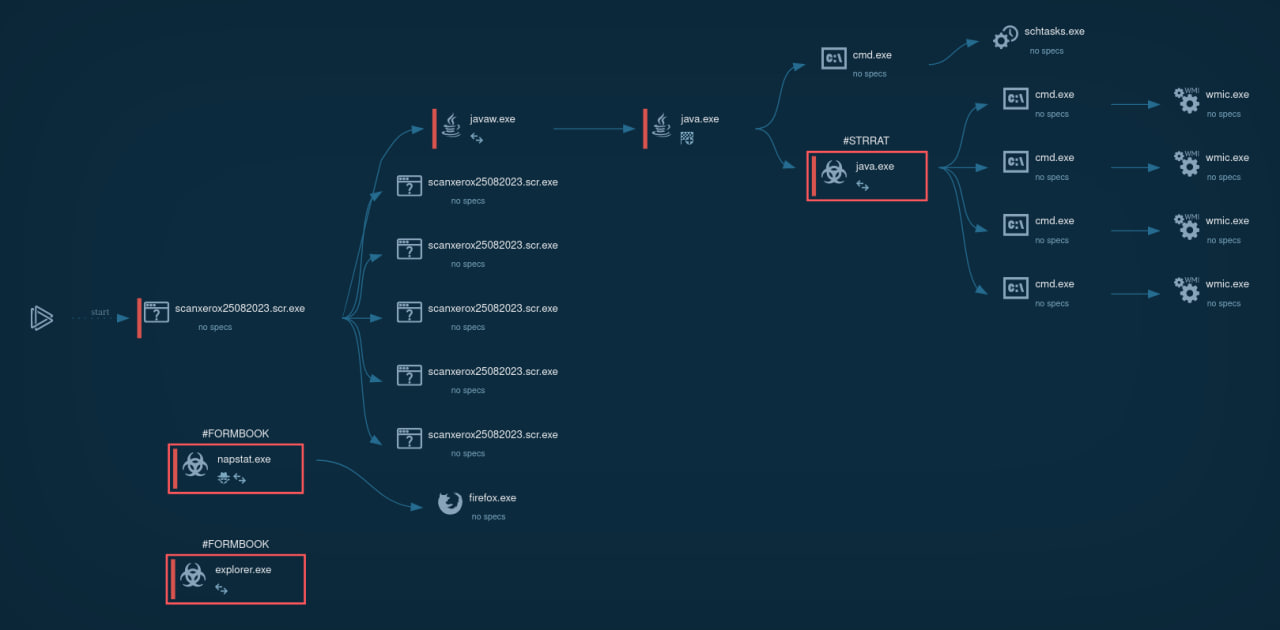
STRRAT process tree STRRAT's process tree

Distribution methods of the STRRAT malware

Phishing email campaigns remain the go-to method for threat actors to launch attacks using STRRAT against victims. Such emails typically mimic the branding and logos of trusted organizations, making them appear legitimate.

For instance, one of the documented cases related to STRRAT involved a fake email from the MAERSK shipping company. By unknowingly downloading and opening files attached to these emails, victims can kick off a chain reaction resulting in attackers gaining full control over their computers.

Conclusion

The STRRAT malware has proven to be a persistent challenge over the past 3 years. Individual users and SMEs are the groups primarily targeted by threat actors who use this malware. This puts an emphasis on the importance of having a reliable and fast tool like ANY.RUN for scanning suspicious links and files. The service generates comprehensive reports on the behavior of any sample in seconds and provides a conclusive verdict on whether a certain file or URL is malicious or not.

Try ANY.RUN for free – request a demo!.
HAVE A LOOK AT

Cerber screenshot
Cerber
cerber
Cerber is a Ransomware-as-a-Service (RaaS) that appeared in 2016, spread quickly and has been evolving since. It became well-known for its file encryption, offline capabilities, and sophisticated evasion techniques. It primarily targets enterprises, financial institutions, and government entities, encrypting their data and demanding ransom payments in Bitcoin. It also targets everyday users encrypting personal files (photos, documents) with the risk of their permanent loss.
Read More
Pay2Key screenshot
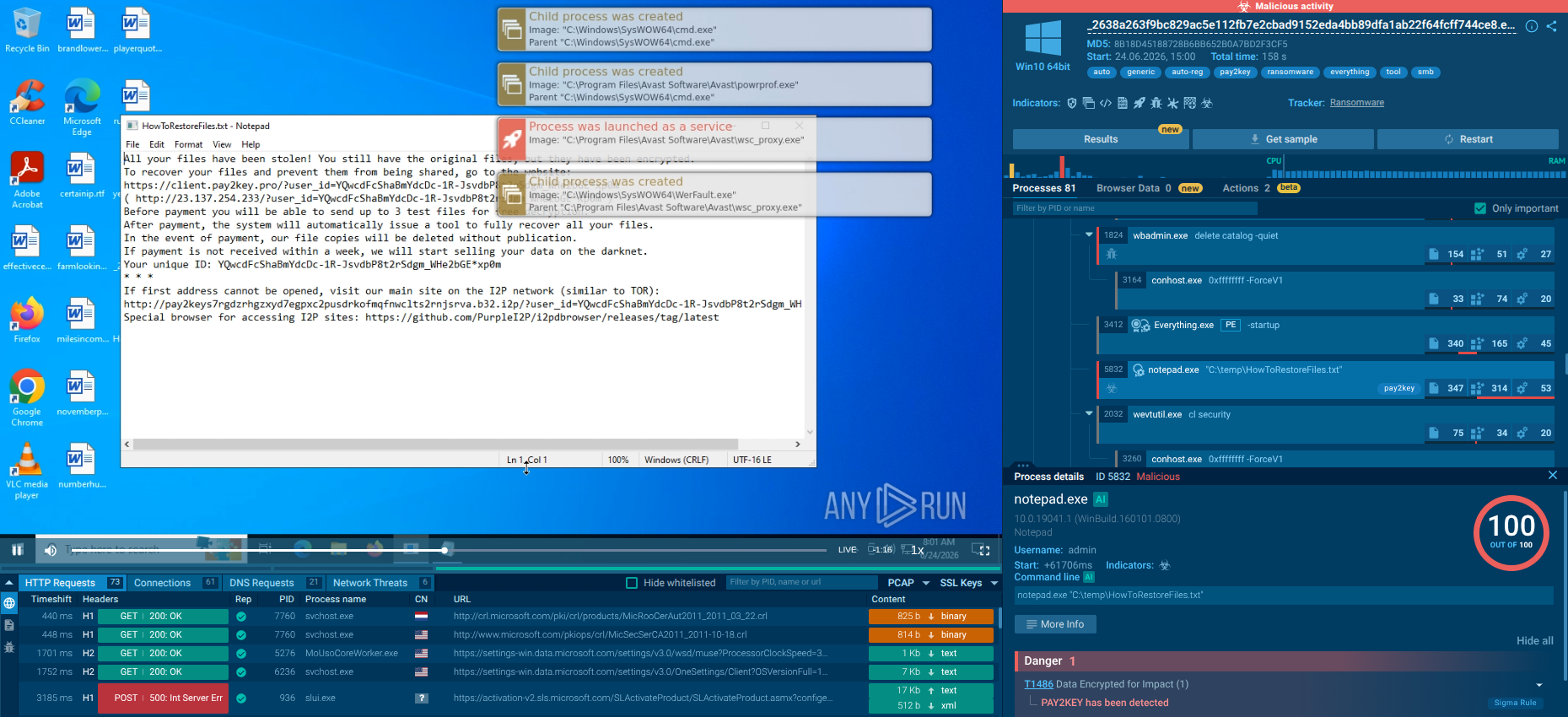
Pay2Key is a ransomware strain primarily written in C++ for Windows (with recent Linux variants), attributed to Iranian-linked actors, notably the Fox Kitten APT group (also known as UNC757 or related operations). First observed in late 2020, it employs double-extortion tactics (encrypting files and threatening to leak stolen data) while showing signs of both financial and state-aligned motivations. It has resurfaced in campaigns targeting Western organizations, including rapid encryption attacks on healthcare.
Read More
SolarisLoader screenshot
SolarisLoader
solaris
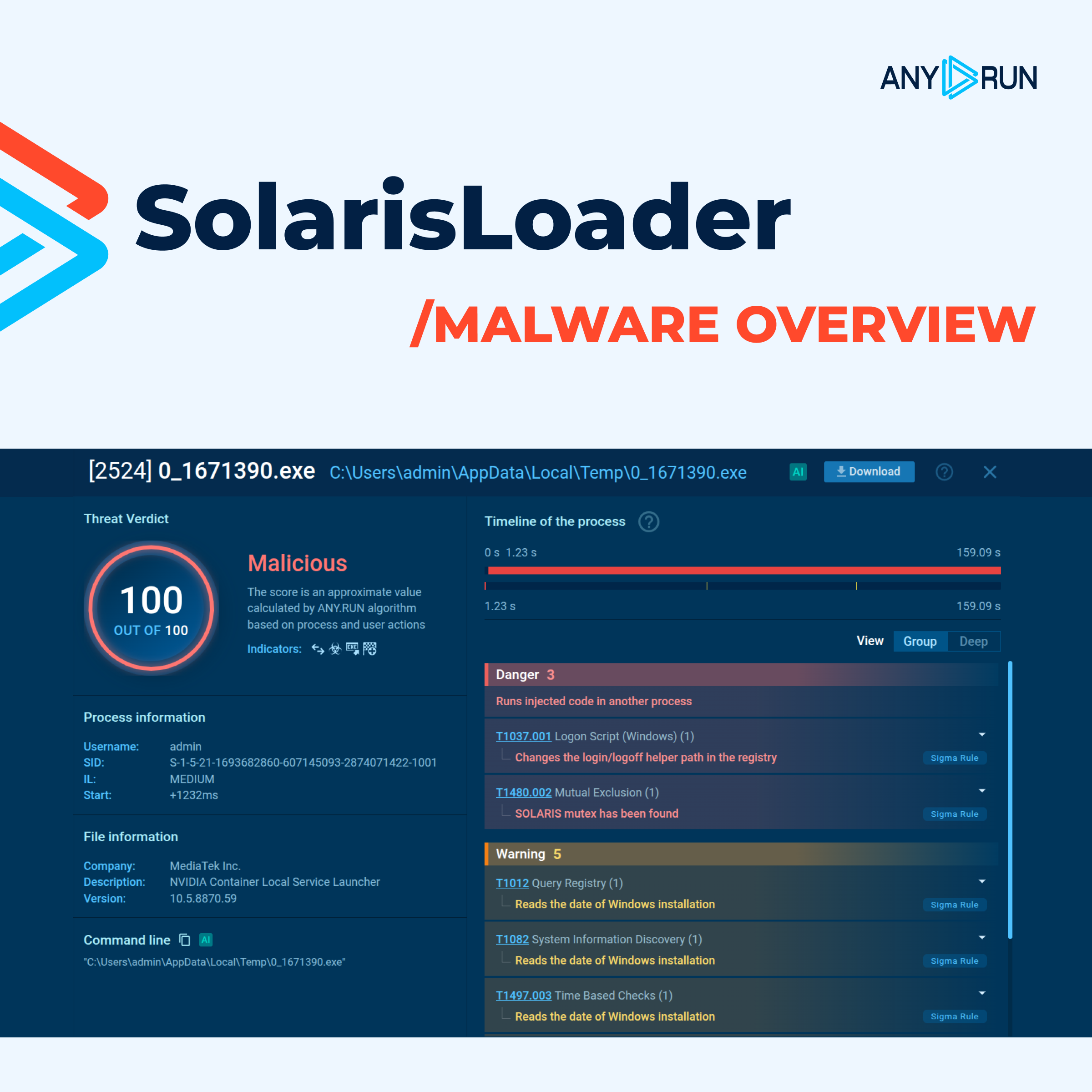
SolarisLoader is a malware loader designed to neutralize security infrastructure before deploying high-risk secondary payloads. It utilizes a "Bring Your Own Vulnerable Driver" technique to gain kernel-level access and terminate antivirus processes. To remain undetected, the malware patches internal Windows monitoring interfaces and isolates the machine from security updates. Finally, it establishes a resilient three-layer persistence mechanism involving scheduled tasks, registry backups, and a watchdog component.
Read More
ValleyRAT screenshot
ValleyRAT
valleyrat
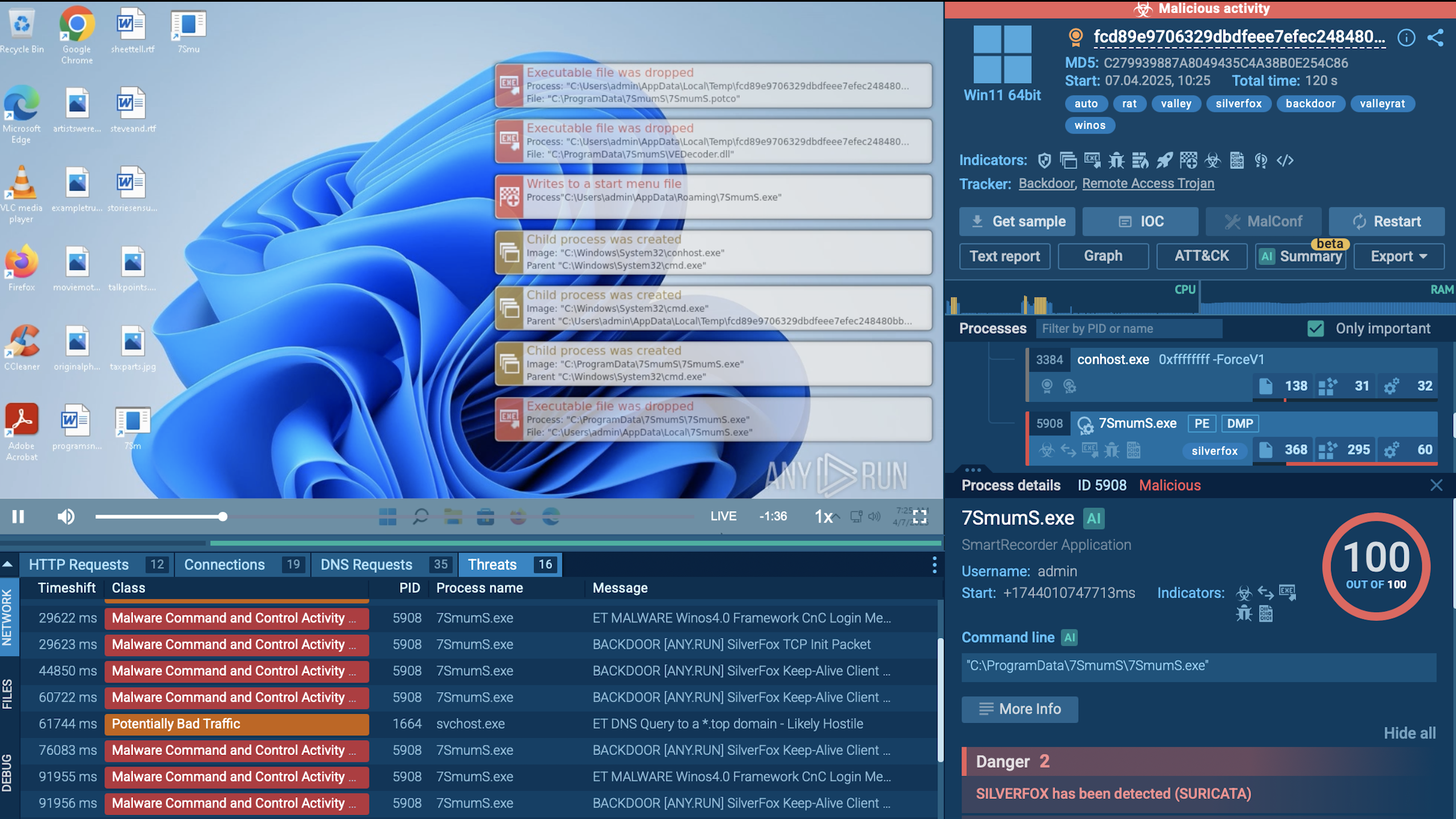
ValleyRAT is a classic remote access trojan first documented in 2023, targeting mainly Windows systems. It is used by threat actors to gain persistent access to infected devices, steal data, and control compromised machines. ValleyRAT is notable for its relatively advanced evasion techniques and its connections to a prominent Chinese APT group.
Read More
FlowerStorm screenshot
FlowerStorm
flowerstorm
FlowerStorm is a phishing-as-a-service (PhaaS) platform used by cybercriminals to steal Microsoft 365 credentials and bypass multi-factor authentication (MFA) protections through adversary-in-the-middle (AiTM) attacks. Emerging after the disruption of Rockstar2FA in late 2024, FlowerStorm rapidly gained popularity among attackers targeting enterprises across North America and Europe.
Read More
Xeno RAT screenshot
Xeno RAT
xenorat
Xeno RAT is an open-source malware mainly distributed through drive-by downloads. The core capabilities of this threat include remote control, keystroke logging, webcam and microphone access. Equipped with advanced utilities, such as Hidden Virtual Network Computing and Socks5 reverse proxy, Xeno RAT is most frequently used in attacks against individual users.
Read More