Black friday Up to 3 extra licenses FOR FREE + Special offer for TI LOOKUP Get it now
Webinar
February 26
Better SOC with Interactive Sandbox Practical Use Cases
Register now
135
Global rank
116 infographic chevron month
Month rank
128 infographic chevron week
Week rank

REvil, also called Sodinokibi, is a notorious ransomware strain known for its use of sophisticated encryption techniques, high-profile targeted attacks, and connections to GandCrab.

Ransomware
Type
ex-USSR
Origin
1 April, 2019
First seen
27 September, 2026
Last seen
Also known as
Sodinokibi
Sodin

How to analyze REvil with ANY.RUN

Type
ex-USSR
Origin
1 April, 2019
First seen
27 September, 2026
Last seen

IOCs

IP addresses
188.213.19.166
2.23.246.9
15.235.58.249
217.160.0.208
23.3.89.105
48.209.138.168
2.21.20.144
82.98.154.79
91.185.184.170
195.3.195.201
128.24.231.64
23.227.38.32
217.160.0.87
176.126.63.84
54.243.117.197
162.241.217.186
37.9.175.133
217.64.195.176
5.180.184.153
146.190.235.209
Hashes
2e8deb28946a6b41ccb927eaa43bbaa78ea82cef39a40638f2e5afa8e90e73ca
dd8b9b9c18b2c80e19165a97ecfc91844c9e143edd95b292e575718c8f2c63c4
9e17cb15dd75bbbd5dbb984eda674863c3b10ab72613cf8a39a00c3e11a8492a
80c3fe2ae1062abf56456f52518bd670f9ec3917b7f85e152b347ac6b6faf880
55f7d9e99b8e2d4e0e193b2f0275501e6d9c1ebd29cadbea6a0da48a8587e3e0
15e40b7505638458ba96afeff3c087c89ab32b29bb58c4b4458227bf62476e8f
08b831f3c9df829a2d9b31fcece2e180274585e941b177c3cdb7bd3a1521895b
f0d96c7fa745dda1ba1f21d853565a953bd5e6d395ba649ca295a13c73d24970
b8a9925245e6eaf489da074b0c8f2a737dfe4b6163ef0d0d45875936686f2451
6a226c92895b3832d52d052a9a13ec8f38a1bf963ecc21a21b6e246c70465bec
fb95b3e67be9f55c483c3aed4ac48cf11ab9d61ec5e325cfbf36d7aa54457f93
a45bef127e30d8c153f8cff256b81e129f61602d05002936247cd80e43c437a5
5cff1bf86358e9bcb5f0fd4e86f13cad0cd26ed157a5fb120621daa91c1630e0
e821ada90d34398947610d274484bc1956ca67f07806f6776ca0778b3c992489
543939ebecac0a1bbe900263f2e6ec676f6e66d4d5cb4a5d7f4167b16d5cb25f
b331f1b058dd722b453ec0f4f8668f26ab8b9caae4a42532ccadb5b0921d4514
ece60aea64005cc78fb05d3d158b30ad6f34e0088cb28c802f01b8374d089dd1
15e2f4a1c9d782bf255ad60fecf303b20139908ed4946ebcff49536357c5d2b1
c2beae9536399c6c554cee8774eb26caf065701ebdf1b38ea6159c1d6470ba9e
5d2a3ff7777702e48382a261c21ad7becee926ed22d5c72d383f789cc0c638a1
Domains
slscr.update.microsoft.com
welovecustomers.fr
arearugcleaningnyc.com
slidesigma.com
irizar.com
www.cathysimmons.co.uk
patassociation.com
sveneulberg.de
cathysimmons.co.uk
lovcase.com
alharsunindo.com
csaballoons.com
unislaw-narty.pl
go.microsoft.com
www.anleggsregisteret.no
citiscapes-art.com
smartmind.net
login.live.com
scotlandsroute66.co.uk
alltagsrassismus-entknoten.de
URLs
http://crl.microsoft.com/pki/crl/products/microoceraut2011_2011_03_22.crl
http://www.microsoft.com/pkiops/crl/microsoft%20secure%20server%20ca%202026.crl
https://settings-win.data.microsoft.com/settings/v3.0/wsd/waasassessment?os=windows&osver=10.0.19041.1.amd64fre.vb_release.191206-&ring=retail&sku=48&deviceclass=windows.desktop&locale=en-us&deviceid=bad99146-31d3-4ec6-a1a4-be76f32ba5d4&flightring=retail&telemetrylevel=1&hidovergattreg=c%3a%5cwindows%5csystem32%5cdriverstore%5cfilerepository%5chidbthle.inf_amd64_9610b4821fdf82a5%5cmicrosoft.bluetooth.profiles.hidovergatt.dll&appver=10.0&processoridentifier=amd64%20family%2023%20model%201%20stepping%202&oemmodel=dell&updateoffereddays=4294967295&processormanufacturer=authenticamd&installdate=1661339444&oemmodelbaseboard=&branchreadinesslevel=cb&oemsubmodel=j5cr&isclouddomainjoined=0&deferfeatureupdateperiodindays=30&isdeviceretaildemo=0&flightingbranchname=&osuilocale=en-us&devicefamily=windows.desktop&wuclientver=10.0.19041.3996&uninstallactive=1&isflightingenabled=0&osskuid=48&processorclockspeed=3094&totalphysicalram=6144&securebootcapable=0&app=waasassessment&processorcores=6&currentbranch=vb_release&installlanguage=en-us&deferqualityupdateperiodindays=0&servicingbranch=cb&oemname_uncleaned=dell&tpmversion=0&primarydisktotalcapacity=262144&installationtype=client&attrdataver=186&processormodel=amd%20ryzen%205%203500%206-core%20processor&isedgewithchromiuminstalled=1&osversion=10.0.19045.4046&ismdmenrolled=0&activationchannel=retail&honorwufbdeferrals=1&firmwareversion=a.40&trendinstalledkey=1&osarchitecture=amd64&defaultuserregion=244&updatemanagementgroup=2
https://settings-win.data.microsoft.com/settings/v3.0/wsd/updatehealthtools?os=windows&osver=10.0.19041.1.amd64fre.vb_release.191206-&sku=48&deviceclass=windows.desktop&locale=en-us&deviceid=s:bad99146-31d3-4ec6-a1a4-be76f32ba5d4&sampleid=s:95271487&appver=10.0.19041.3626&flightring=retail&telemetrylevel=1&hidovergattreg=c%3a%5cwindows%5csystem32%5cdriverstore%5cfilerepository%5chidbthle.inf_amd64_9610b4821fdf82a5%5cmicrosoft.bluetooth.profiles.hidovergatt.dll&appver=&processoridentifier=amd64%20family%2023%20model%201%20stepping%202&oemmodel=dell&updateoffereddays=4294967295&processormanufacturer=authenticamd&installdate=1661339444&oemmodelbaseboard=&branchreadinesslevel=cb&oemsubmodel=j5cr&isclouddomainjoined=0&deferfeatureupdateperiodindays=30&isdeviceretaildemo=0&flightingbranchname=&osuilocale=en-us&devicefamily=windows.desktop&wuclientver=10.0.19041.3996&uninstallactive=1&isflightingenabled=0&osskuid=48&processorclockspeed=3094&totalphysicalram=6144&securebootcapable=0&app=sedimentpack&processorcores=6&currentbranch=vb_release&installlanguage=en-us&deferqualityupdateperiodindays=0&oemname_uncleaned=dell&tpmversion=0&primarydisktotalcapacity=262144&installationtype=client&attrdataver=186&processormodel=amd%20ryzen%205%203500%206-core%20processor&isedgewithchromiuminstalled=1&osversion=10.0.19045.4046&ismdmenrolled=0&activationchannel=retail&firmwareversion=a.40&trendinstalledkey=1&osarchitecture=amd64&defaultuserregion=244&updatemanagementgroup=2
https://go.microsoft.com/fwlink/?linkid=2257403&clcid=0x409
https://craftingalegacy.com/include/pics/voab.gif
https://g2mediainc.com/wp-content/temp/lnkx.gif
https://brinkdoepke.eu/include/assets/gqsbicsucp.png
https://vipcarrental.ae/admin/pictures/oxgiuxja.gif
https://autoteamlast.de/static/images/pewkjrlstvej.png
https://slscr.update.microsoft.com/sls/%7b522d76a4-93e1-47f8-b8ce-07c937ad1a1e%7d/x64/10.0.19045.4046/0?ch=686&l=en-us&p=&pt=0x30&wua=10.0.19041.3996&mk=dell&md=dell
http://www.microsoft.com/pkiops/crl/microsoft%20ecc%20update%20secure%20server%20ca%202.1.crl
https://fe3cr.delivery.mp.microsoft.com/clientwebservice/ping
http://www.microsoft.com/pkiops/crl/microsoft%20time-stamp%20pca%202010(1).crl
http://www.microsoft.com/pkiops/crl/microsoft%20update%20signing%20ca%202.2.crl
http://crl.microsoft.com/pki/crl/products/microoceraut_2010-06-23.crl
http://www.microsoft.com/pkiops/crl/micsecserca2011_2011-10-18.crl
https://slscr.update.microsoft.com/sls/ping
https://slscr.update.microsoft.com/sls/%7be7a50285-d08d-499d-9ff8-180fdc2332bc%7d/x64/10.0.19045.4046/0?ch=686&l=en-us&p=&pt=0x30&wua=10.0.19041.3996&mk=dell&md=dell
https://ronaldhendriks.nl/uploads/tmp/bnbmlxlkut.gif
Last Seen at

Recent blog posts

post image
5 Critical Pain Points of Modern US SOCs and...
watchers 1648
comments 0
post image
IronChain Ransomware Threatens Businesses wit...
watchers 3378
comments 0
post image
Threat Coverage Digest: New Malware Reports a...
watchers 10879
comments 0

What is REvil ransomware?

REvil, also known as Sodinokibi, is a ransomware strain that emerged in 2019. This malicious software encrypts the victim's files and demands a ransom payment, typically in the form of cryptocurrency, to restore access to the encrypted data.

Believed to have originated from a cybercriminal group based in a former USSR country, REvil gained notoriety in the ransomware landscape due to its high-profile attacks on businesses, governments, and organizations worldwide.

The group behind REvil operates on a ransomware-as-a-service (RaaS) model, in which they develop the malware and manage the infrastructure, while affiliates responsible for distributing the ransomware receive a percentage of the ransom payments.

This ransomware is notorious for its bold attacks, which include, but are not limited to:

  • Grubman Shire Meiselas & Sacks attack (May 2020): REvil targeted a high-profile law firm, claiming to have stolen sensitive data and demanding a ransom of $42 million.
  • JBS S.A. attack (May 2021): JBS S.A. was forced to temporarily shut down all of its meat processing plants across the US and paid an $11 million ransom.
  • Kaseya attack July (2021): REvil exploited a vulnerability in the Kaseya VSA software, affecting multiple managed service providers (MSPs) and their customers. It is estimated that around 1,500 organizations were impacted, with the attackers demanding a $70 million ransom.

Numerous incidents caused by REvil led to significant supply chain disruptions, placing the gang in the crosshairs of international law enforcement. The infamous operation was eventually shut down due to an international law enforcement operation called GoldDust. The gang was reportedly dismantled in January 2022. However, some researchers believe that the malware family may resurface under a different name.

REvil ransomware origin

REvil is believed to be a successor to another notorious ransomware—GandCrab. Connections between REvil and GandCrab can be drawn from similarities in their operations and technical aspects. GandCrab, a ransomware strain that operated from January 2018 until its developers claimed to have "retired" in June 2019, boasted millions of dollars in profits. Shortly after GandCrab's supposed retirement, REvil emerged and rapidly gained prominence in the ransomware landscape.

Several reasons lead researchers to believe that the two crews are closely connected or even are the same crew:

Code and functionality similarities exist between GandCrab and REvil. Both strains employ similar methods to evade detection and achieve persistence in the infected system. Additionally, the ransom notes left by REvil bear a resemblance to those left by GandCrab in terms of language and structure.

Both GandCrab and REvil operated on a RaaS model and utilized similar affiliate programs. In these programs, the ransomware developers provide the infrastructure and receive a share of the ransom payments, while affiliates are responsible for distributing the malware.

REvil's code and ransom note compositions also share similarities with another active ransomware gang—DarkSide. This may suggest that the latter is an offshoot or a partner of the former, especially considering that REvil's code isn't publicly available.

REvil ransomware technical analysis

A recent variant of REvil employs a Safeboot routine to bypass security solutions that do not operate in Safemode. The ransomware also uses DLL sideloading to evade detection by running under the context of legitimate files or processes. In the Kaseya supply chain compromise, PowerShell commands were observed disabling Windows Defender.

SharpSploit, an attack framework with credential access capabilities using the Mimikatz module, has been observed in recent REvil campaigns. The gathered information is sent back to the threat actors using various methods, including the installation of FileZilla or third-party sync tools like MegaSync, FreeFileSync, and Rclone (64-bit).

REvil communicates with its command and control (C&C) infrastructure by generating pseudorandom URLs based on a fixed format. The URLs follow the pattern "https://{Domain}/{String 1}/{String 2}/{random characters}.{String 3}", with domain and strings extracted from the configuration file.

The encryption process has remained largely consistent since REvil's inception. The ransomware attempts to escalate privileges using exploits or token impersonation and creates a mutex. It then decrypts its JSON configuration file using the RC4 function to determine the subsequent routines. The configuration file contains various parameters, including public encryption keys, campaign IDs, whitelisted directories, and domains to contact after encryption.

Interestingly, REvil uses Elliptic Curve Diffie-Hellman (ECDH) is an asymmetric key exchange protocol that allows two parties to securely exchange cryptographic keys over a public channel. REvil uses ECDH to protect the Salsa20 or AES keys that were used to encrypt individual files, making its encryption algorithm practically uncrackable.

Analyzing REvil ransomware in ANY.RUN

ANY.RUN's cloud interactive sandbox allows you to effortlessly analyze REvil samples. Our platform automatically gathers and presents the execution data in easy-to-read formats, collecting artifacts and IOCs in real time.

ANY.RUN provides the ability to watch the REvil in action and perform the ransomware analysis via an interactive virtual sandbox simulation.
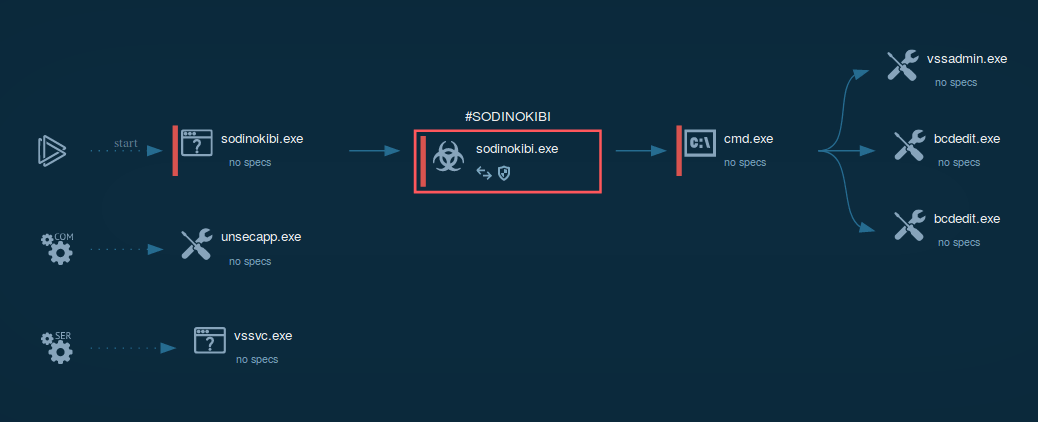
sodiokibi execution process graph Figure 1: illustrates the processes launched by REvil during its life cycle.

Through time, the "team" behind Revil\Sodinokibi changed the ransomware in a way to avoid detection. The earliest versions of it were easily detected by checking of creation of particular keys in the registry. After they got rid of this, there were still detection based on the similarity of ransom notes dropped inside the infected system. From the beginning, detection by Yara rules was possible.

Get started today for free

Analyze malware and phishing in a fully-interactive sandbox

Create free account

It was known that crooks behind REvil offered the decryption of three images for free. When the malware was active, you could use the interactivity of ANY.RUN to take additional steps in the analysis:
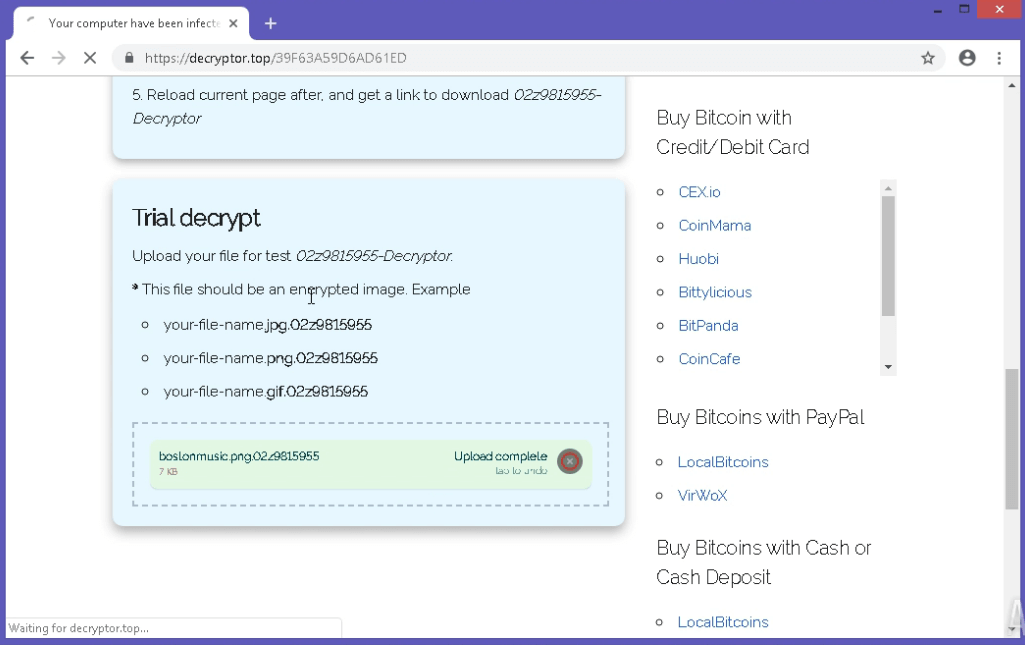
  • Open the website specified in a ransom note in the browser
  • Follow all steps to decrypt images to get a bigger picture of a ransomware infection process.

Sodinokibi payment website Figure 3: REvil payment website

REvil ransomware execution

REvil won't run malicious activity on systems where UI and keyboard languages are set to a specific value, such as Russian, Ukrainian, and 18 others. Although Sodinokibi is a "qualitative" type of malware, its execution, and system infection process, in general, is quite straightforward and similar to other ransomware - it decrypts files, erases shadow copies, and places ransom notes across the file system.

The process tree also doesn't look very exciting because all main activities are provided by a single executable. For all infected files, the ransomware changes extensions to generated. The added extension is the same as an ID which is unique and made by combining the hash of the value given by CPUID instruction and the volume serial number.

It should be noted that REvil will also try to encrypt files on network shares. After completion of the decryption process, the ransomware sets the background wallpaper to a ransom message.
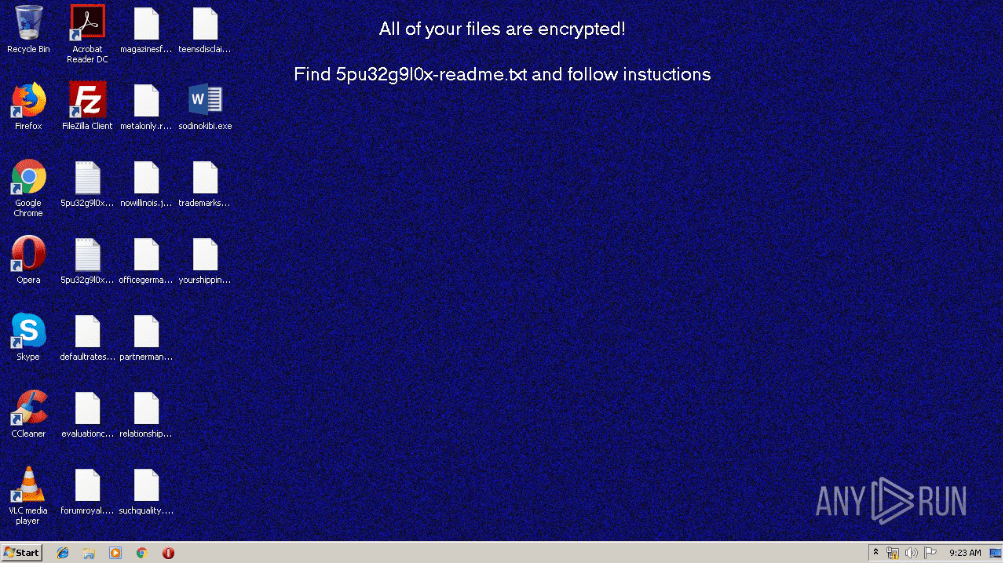
workstation desktop after Sodinokibi infection Figure 2: Wallpapers with ransom message set by REvil

Interestingly, the authors of Sodinokibi created a high-quality website available at the domain decryptor.top, where victims can use a trial decryptor and have the opportunity to decrypt three images for free. Besides the decryption function, this website provides information such as the countdown (after time runs out, the ransom amount will be set to 5 000 dollars), instructions on how to buy bitcoins, and where to send them as well as information about the decryption process. If decryptor.top is not available, there is a possibility for victims to visit its .onion clone through the Tor web browser.

REvil ransomware distribution

REvil and its affiliates are known for highly-targeted attacks, and the infiltration vector can be tailored to suit the victim. Over time, this has led to a wide variety of distribution methods employed by this ransomware.

REvil can arrive through spear phishing emails containing an infected Microsoft Office or PDF document. Social engineering techniques are then used to trick the victim into downloading the payload and executing it by running a malicious script or macro. REvil can also be dropped by other malware, such as Qakbot and IcedID.

Another popular distribution method involves exploit kits. The use of the following exploits has been recorded:

  • CVE-2018-13379
  • CVE-2019-2725
  • CVE-2019-11510
  • CVE-2021-30116

Attackers may also attempt to gain access to a target network by brute-forcing Remote Desktop Protocol (RDP) credentials. And in the Kaseya VSA attack, the group exploited a zero-day vulnerability to compromise vulnerable VSA servers and distribute the ransomware to MSPs and their clients.

Following the initial infiltration, REvil likes to move laterally within the network to maximize the impact of the attack. For example, the adversary may attempt to extract user credentials from the infected system by dumping password hashes or using tools like Mimikatz to extract plaintext passwords from memory.

Lateral movement helps REvil to maximize the attack surface and exacerbate damages caused, giving it more leverage to demand a high ransom amount — often in the millions of US dollars.

Conclusion

Although REvil — one of the most high-profile ransomware operations in history — was allegedly squashed in a massive international law enforcement operation, the crew has a history of pulling temporary disappearance acts and is likely to come back again.

This might be the perfect time to study this threat, regroup, and prepare — because if and when REvil comes back, the new name might be different, but much of the code, techniques, and tactics employed will be the same.

Interested in more ransomware analysis like this one? Check out our breakdown of WannaCry ransomware — perhaps the only other malware that beats REvil in notoriety.

Or check out our analysis of IcedID— a malware that is known to drop REvil in some campaigns. By understanding the methods and strategies used by these notorious ransomware strains, you can better prepare your organization for potential future attacks and bolster your cybersecurity defenses.
HAVE A LOOK AT

GootLoader screenshot
GootLoader
gootloader
GootLoader is an initial-access-as-a-service malware that operates by delivering the GootKit banking trojan and other malicious payloads. It utilizes techniques such as fileless execution and process injection to avoid detection. The malware is often distributed through SEO poisoning and compromised websites, deceiving users into downloading infected files.
Read More
Makop Ransomware screenshot
Makop is a Phobos-derived Ransomware-as-a-Service model that predominantly targets exposed and vulnerable RDP endpoints. Rather than executing as a standalone automated threat, human operators manually navigate the compromised network to escalate privileges, map assets, and disable active defense solutions before deploying the payload.
Read More
Lynx screenshot
Lynx
lynx
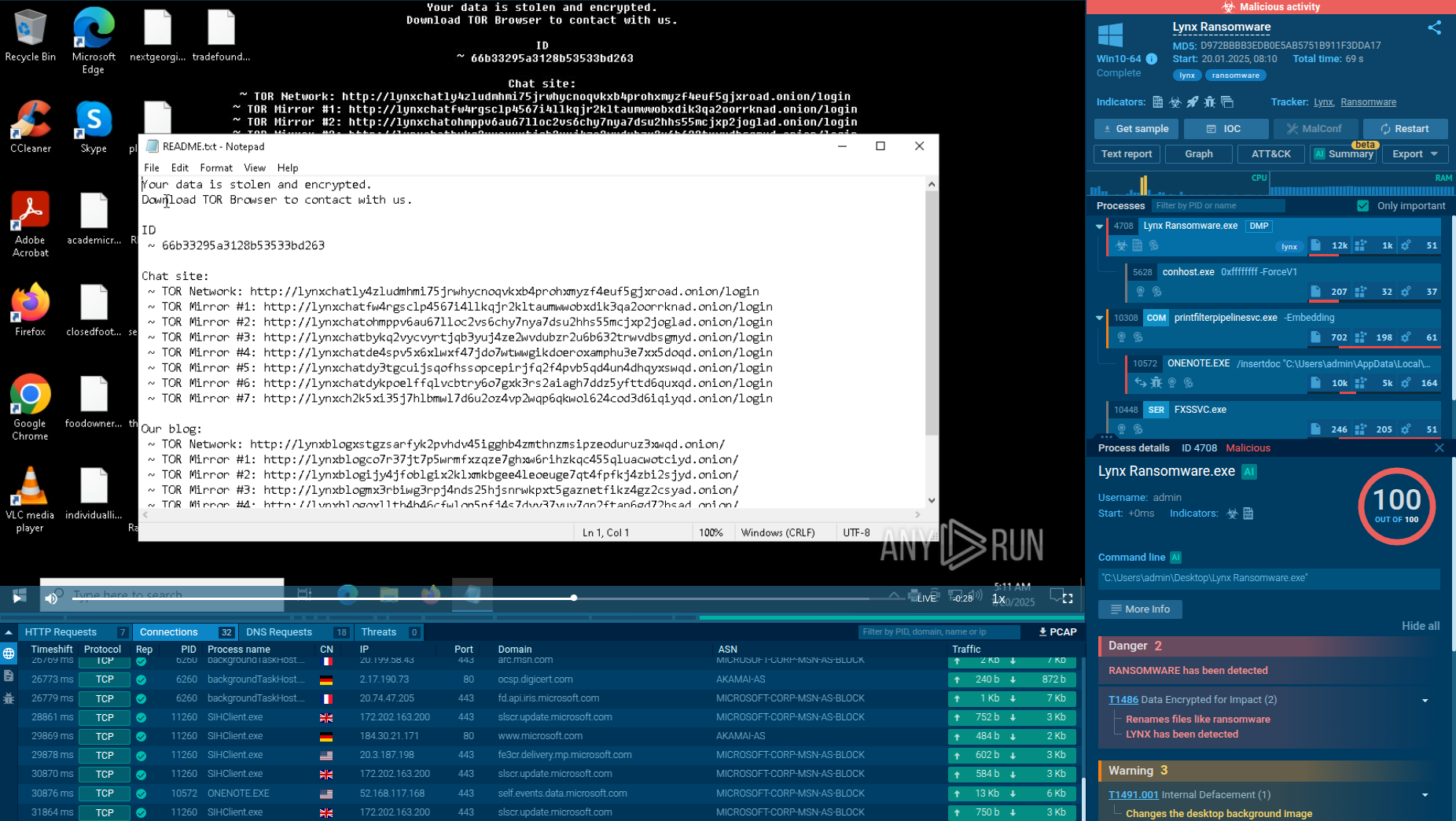
Lynx is a double extortion ransomware: attackers encrypt important and sensitive data and demand a ransom for decryption simultaneously threatening to publish or sell the data. Active since mid-2024. Among techniques are terminating processes and services, privilege escalation, deleting shadow copies. Distribution by phishing, malvertising, exploiting vulnerabilities.
Read More
Black Basta screenshot
Black Basta
blackbasta
Black Basta is a ransomware-as-a-service operated by Storm-1811. It emerged in 2022 and uses double extortion tactics, encrypting data and stealing it for ransom. The malware often gains access through spear-phishing and uses tools like QakBot and Cobalt Strike. It's known for exploiting system vulnerabilities and using advanced obfuscation techniques.
Read More
Jigsaw screenshot
Jigsaw
jigsaw
The Jigsaw ransomware, initially detected in 2016, encrypts files on compromised systems and requires a ransom payment in Bitcoin. If the ransom is not paid, the malware starts deleting files, increasing the pressure on victims to comply. Its source code is publicly accessible, allowing various threat actors to customize and repurpose the malware for different objectives.
Read More
BQTLock screenshot
BQTLock
bqtlock baqiyatlock
BQTLock is a ransomware-as-a-service (RaaS) malware family that emerged in 2025 and quickly gained attention due to its combination of file encryption, credential theft, and data exfiltration. BQTLock encrypts files using a hybrid AES-256 and RSA-4096 encryption scheme, demands payment in Monero cryptocurrency, and performs data theft and system reconnaissance.
Read More