Black friday Up to 3 extra licenses FOR FREE + Special offer for TI LOOKUP Get it now
Webinar
February 26
Better SOC with Interactive Sandbox Practical Use Cases
Register now

Lynx

176
Global rank
145 infographic chevron month
Month rank
130 infographic chevron week
Week rank
0
IOCs

Lynx is a double extortion ransomware: attackers encrypt important and sensitive data and demand a ransom for decryption simultaneously threatening to publish or sell the data. Active since mid-2024. Among techniques are terminating processes and services, privilege escalation, deleting shadow copies. Distribution by phishing, malvertising, exploiting vulnerabilities.

Ransomware
Type
Unknown
Origin
29 July, 2024
First seen
22 August, 2026
Last seen

How to analyze Lynx with ANY.RUN

Type
Unknown
Origin
29 July, 2024
First seen
22 August, 2026
Last seen

IOCs

IP addresses
20.190.159.23
48.192.1.65
48.209.6.48
23.195.250.165
172.211.123.248
20.165.94.63
48.209.138.168
184.86.251.7
135.236.137.147
204.79.197.203
104.109.250.98
40.126.32.133
104.85.1.163
23.11.40.157
40.126.31.1
135.232.92.97
23.52.181.141
52.123.129.14
20.184.175.17
48.209.138.189
Hashes
de2f256064a0af797747c2b97505dc0b9f3df0de4f489eac731c23ae9ca9cc31
74441313bb1fb62500484443c4937e90d4e335351a4fcd12a9ac48448500e33e
4094d158e3b0581ba433a46d0dce62f99d8c0fd1b50bb4d0517ddc0a4a1fde24
99653a38c445ae1d4c373ee672339fd47fd098e0d0ada5f0be70e3b2bf711d38
7ebc652a4b5b43608f61ac1057c51ec2ec1c8e33bbeb130794e15af72beb42e8
bda9df3591bf7f67d4b31d23cffdcf927da6f00ae1b393f07aea69ba1c4344bc
4eabb8a700b57032952a8ae8353b400d14a688690f92f15f9b84520e016cf5c7
e0c0a5a360482b5c5ded8fad5706c4c66f215f527851ad87b31380ef6060696e
77db69049c1c45d24a5aa88ad5cefaff181a882ff42173f5fed02ab146a37f0e
21e0abde9acc9c7d9394906163ef0d3dfebacbe2b343485c1c0f1c375bcf4fe2
5c9435f0ca0cdefc50ddd6575b6c0a01370a9850059e38f747411fdf6e5b2d13
256f70c1bf63be93bd3b2db066cf330dc0a18d77d95bcfdcc99d56bc46298623
c0199e65034d9471c2deab213ac12c01c0b7ef250204369bcdd60e23be9c5f59
aa1f0c1abcdf7c3c2aae3ac0d78582e5a521627da46370e38333ccbeaf33efc2
210e9c7daabceedc61704c65cf558ec338f1127a90bea2c26d590f973f2cd37e
b701774dae95871372ec5d79b46d80cb7dc755cc3085f5d75f3f67b25dbaa85c
fc427ffc5c8a1720f0d5ce2d067e90322367b85ea7331b10ed035d56ff52ea94
99b5702c7b724a9d9db70607885e27aefeaf1971737a6da8485a7371eaa425a3
d425adf22e07c26a4274467324293abca2d690a5b4af7ce50f52cf1516b550bc
ad4d099f932815dda0e3b92b78f16e413d65d099dc5def0fe6744ed2a2d32f5d
Domains
ocsp.digicert.com
licensing.mp.microsoft.com
oneocsp.microsoft.com
slscr.update.microsoft.com
google.com
self.events.data.microsoft.com
ecs.office.com
officeclient.microsoft.com
activation-v2.sls.microsoft.com
go.microsoft.com
crl.microsoft.com
settings-win.data.microsoft.com
fe3cr.delivery.mp.microsoft.com
www.microsoft.com
nexusrules.officeapps.live.com
www.bing.com
client.wns.windows.com
login.live.com
roaming.svc.cloud.microsoft
URLs
https://go.microsoft.com/fwlink/?linkid=2257403&clcid=0x409
https://login.live.com/rst2.srf
https://settings-win.data.microsoft.com/settings/v3.0/onesettings/client?osversionfull=10.0.19045.4046.amd64fre.vb_release.191206-1406&localdeviceid=s%3abad99146-31d3-4ec6-a1a4-be76f32ba5d4&flightring=retail&attrdataver=186&osuilocale=en-us&osskuid=48&app=wosc&appver=&isflightingenabled=0&telemetrylevel=1&devicefamily=windows.desktop
https://login.live.com/ppsecure/deviceaddcredential.srf
http://ocsp.digicert.com/mfewtzbnmeswstajbgurdgmcgguabbq50otx%2fh0ztl%2bz8sipi7wewvxdlqqutijuibiv5unu5g%2f6%2brks7qyxjzkceaz1vqyrvgl0erhqlcpm8gy%3d
http://crl.microsoft.com/pki/crl/products/microoceraut2011_2011_03_22.crl
http://www.microsoft.com/pkiops/crl/micsecserca2011_2011-10-18.crl
https://settings-win.data.microsoft.com/settings/v3.0/wsd/waasassessment?os=windows&osver=10.0.19041.1.amd64fre.vb_release.191206-&ring=retail&sku=48&deviceclass=windows.desktop&locale=en-us&deviceid=bad99146-31d3-4ec6-a1a4-be76f32ba5d4&flightring=retail&telemetrylevel=1&hidovergattreg=c%3a%5cwindows%5csystem32%5cdriverstore%5cfilerepository%5chidbthle.inf_amd64_9610b4821fdf82a5%5cmicrosoft.bluetooth.profiles.hidovergatt.dll&appver=10.0&processoridentifier=amd64%20family%2023%20model%201%20stepping%202&oemmodel=dell&updateoffereddays=4294967295&processormanufacturer=authenticamd&installdate=1661339444&oemmodelbaseboard=&branchreadinesslevel=cb&oemsubmodel=j5cr&isclouddomainjoined=0&deferfeatureupdateperiodindays=30&isdeviceretaildemo=0&flightingbranchname=&osuilocale=en-us&devicefamily=windows.desktop&wuclientver=10.0.19041.3996&uninstallactive=1&isflightingenabled=0&osskuid=48&processorclockspeed=3094&totalphysicalram=6144&securebootcapable=0&app=waasassessment&processorcores=6&currentbranch=vb_release&installlanguage=en-us&deferqualityupdateperiodindays=0&servicingbranch=cb&oemname_uncleaned=dell&tpmversion=0&primarydisktotalcapacity=262144&installationtype=client&attrdataver=186&processormodel=amd%20ryzen%205%203500%206-core%20processor&isedgewithchromiuminstalled=1&osversion=10.0.19045.4046&ismdmenrolled=0&activationchannel=retail&honorwufbdeferrals=1&firmwareversion=a.40&trendinstalledkey=1&osarchitecture=amd64&defaultuserregion=244&updatemanagementgroup=2
https://settings-win.data.microsoft.com/settings/v3.0/flightsettings/fsservice?processorclockspeed=3094&isretailos=1&oemmanufacturername=dell&flightingpolicyvalue=3&enablepreviewbuilds=4294967295&osversionfull=10.0.19045.4046.amd64fre.vb_release.191206-1406&managepreviewbuilds=3&branchreadinesslevelsource=0&attrdataver=186&processorcores=6&branchreadinesslevelraw=16&totalphysicalram=6144&tpmversion=0&oemmodelnumber=dell&systemvolumetotalcapacity=260281&deviceid=s%3abad99146-31d3-4ec6-a1a4-be76f32ba5d4&app=fss&appver=10.0&smartactivehoursstate=1&activehoursstart=20&securebootcapable=0&activehoursend=13&devicefamily=windows.desktop
https://settings-win.data.microsoft.com/settings/v3.0/wsd/waasassessment?os=windows&osver=10.0.19041.1.amd64fre.vb_release.191206-&ring=retail&sku=48&deviceclass=windows.desktop&locale=en-us&deviceid=bad99146-31d3-4ec6-a1a4-be76f32ba5d4&flightring=retail&telemetrylevel=1&hidovergattreg=c%3a%5cwindows%5csystem32%5cdriverstore%5cfilerepository%5chidbthle.inf_amd64_9610b4821fdf82a5%5cmicrosoft.bluetooth.profiles.hidovergatt.dll&appver=10.0&processoridentifier=amd64%20family%2023%20model%201%20stepping%202&oemmodel=dell&updateoffereddays=4294967295&processormanufacturer=authenticamd&installdate=1661339444&oemmodelbaseboard=&branchreadinesslevel=cb&oemsubmodel=j5cr&isclouddomainjoined=0&deferfeatureupdateperiodindays=30&isdeviceretaildemo=0&flightingbranchname=&osuilocale=en-us&devicefamily=windows.desktop&wuclientver=10.0.19041.3996&uninstallactive=1&isflightingenabled=0&osskuid=48&processorclockspeed=3094&totalphysicalram=6144&securebootcapable=0&app=waasassessment&processorcores=6&currentbranch=vb_release&installlanguage=en-us&deferqualityupdateperiodindays=0&servicingbranch=cb&oemname_uncleaned=dell&tpmversion=0&primarydisktotalcapacity=262144&installationtype=client&attrdataver=186&processormodel=amd%20ryzen%205%203500%206-core%20processor&isedgewithchromiuminstalled=1&osversion=10.0.19045.4046&ismdmenrolled=0&activationchannel=retail&honorwufbdeferrals=0&firmwareversion=a.40&trendinstalledkey=1&osarchitecture=amd64&defaultuserregion=244&updatemanagementgroup=2
https://settings-win.data.microsoft.com/settings/v3.0/wsd/muse?processorclockspeed=3094&flightids=&updateoffereddays=4294967295&branchreadinesslevel=cb&oemmanufacturername=dell&isclouddomainjoined=0&processoridentifier=amd64%20family%2023%20model%201%20stepping%202&sku=48&activationchannel=retail&attrdataver=186&ismdmenrolled=0&processorcores=6&processormodel=amd%20ryzen%205%203500%206-core%20processor&totalphysicalram=6144&primarydisktype=4294967295&flightingbranchname=&chassistypeid=1&oemmodelnumber=dell&systemvolumetotalcapacity=260281&sampleid=95271487&deviceclass=windows.desktop&app=muse&disabledualscan=0&appver=10.0&oemsubmodel=j5cr&locale=en-us&isalwaysonalwaysconnectedcapable=0&ms=0&defaultuserregion=244&updateserviceurl=http%3a%2f%2fneverupdatewindows10.com&osver=10.0.19045.4046.amd64fre.vb_release.191206-1406&os=windows&deviceid=s%3abad99146-31d3-4ec6-a1a4-be76f32ba5d4&deferqualityupdateperiodindays=0&ring=retail&deferfeatureupdateperiodindays=30
https://settings-win.data.microsoft.com/settings/v3.0/waas/featuremanagement?isclouddomainjoined=0&processoridentifier=amd64%20family%2023%20model%201%20stepping%202&currentbranch=vb_release&accountfirstchar=&activationchannel=retail&oemmodel=dell&flightring=retail&attrdataver=186&installlanguage=en-us&osuilocale=en-us&webexperience=1&flightingbranchname=&chassistypeid=1&osskuid=48&app=cdm&installdate=1661339444&appver=&osarchitecture=amd64&defaultuserregion=244&telemetrylevel=1&osversion=10.0.19045.4046&devicefamily=windows.desktop
https://settings-win.data.microsoft.com/settings/v3.0/wsd/updatehealthtools?os=windows&osver=10.0.19041.1.amd64fre.vb_release.191206-&sku=48&deviceclass=windows.desktop&locale=en-us&deviceid=s:bad99146-31d3-4ec6-a1a4-be76f32ba5d4&sampleid=s:95271487&appver=10.0.19041.3626&flightring=retail&telemetrylevel=1&hidovergattreg=c%3a%5cwindows%5csystem32%5cdriverstore%5cfilerepository%5chidbthle.inf_amd64_9610b4821fdf82a5%5cmicrosoft.bluetooth.profiles.hidovergatt.dll&appver=&processoridentifier=amd64%20family%2023%20model%201%20stepping%202&oemmodel=dell&updateoffereddays=4294967295&processormanufacturer=authenticamd&installdate=1661339444&oemmodelbaseboard=&branchreadinesslevel=cb&oemsubmodel=j5cr&isclouddomainjoined=0&deferfeatureupdateperiodindays=30&isdeviceretaildemo=0&flightingbranchname=&osuilocale=en-us&devicefamily=windows.desktop&wuclientver=10.0.19041.3996&uninstallactive=1&isflightingenabled=0&osskuid=48&processorclockspeed=3094&totalphysicalram=6144&securebootcapable=0&app=sedimentpack&processorcores=6&currentbranch=vb_release&installlanguage=en-us&deferqualityupdateperiodindays=0&oemname_uncleaned=dell&tpmversion=0&primarydisktotalcapacity=262144&installationtype=client&attrdataver=186&processormodel=amd%20ryzen%205%203500%206-core%20processor&isedgewithchromiuminstalled=1&osversion=10.0.19045.4046&ismdmenrolled=0&activationchannel=retail&firmwareversion=a.40&trendinstalledkey=1&osarchitecture=amd64&defaultuserregion=244&updatemanagementgroup=2
https://licensing.mp.microsoft.com/v7.0/licenses/content
https://slscr.update.microsoft.com/sls/%7b522d76a4-93e1-47f8-b8ce-07c937ad1a1e%7d/x64/10.0.19045.4046/0?ch=686&l=en-us&p=&pt=0x30&wua=10.0.19041.3996&mk=dell&md=dell
http://www.microsoft.com/pkiops/crl/microsoft%20ecc%20update%20secure%20server%20ca%202.1.crl
https://fe3cr.delivery.mp.microsoft.com/clientwebservice/ping
https://slscr.update.microsoft.com/sls/ping
https://slscr.update.microsoft.com/sls/%7be7a50285-d08d-499d-9ff8-180fdc2332bc%7d/x64/10.0.19045.4046/0?ch=686&l=en-us&p=&pt=0x30&wua=10.0.19041.3996&mk=dell&md=dell
https://www.bing.com/threshold/xls.aspx?t=5&dl=1&f=9&wsbc=1
Last Seen at
Last Seen at

Recent blog posts

post image
US Finance Under Phishing Pressure: What the...
watchers 2622
comments 0
post image
A Single Canadian Tax Lure Spread into a 46-C...
watchers 7524
comments 0
post image
North Korean IT Workers Scheme: Detection IOC...
watchers 10603
comments 0

What is Lynx malware?

Lynx is a ransomware-as-a-Service (RaaS) with both single and double extortion strategies. It can encrypt files and exfiltrate sensitive data with the threat of further publishing it unless a ransom is paid. Files are encrypted with a ‘.lynx’ extension, backup files like shadow copies get deleted to prevent recovery.

Presumably descendant of INC ransomware (is based on its sold source code), it emerged in July, 2024.

Lynx encrypts files using AES-128 in CTR mode and Curve25519 Donna encryption algorithms. It uses the Restart Manager API “RstrtMgr” to encrypt files that are currently in use or locked by other applications.

It prints a ransom note on any printer connected to the compromised system.
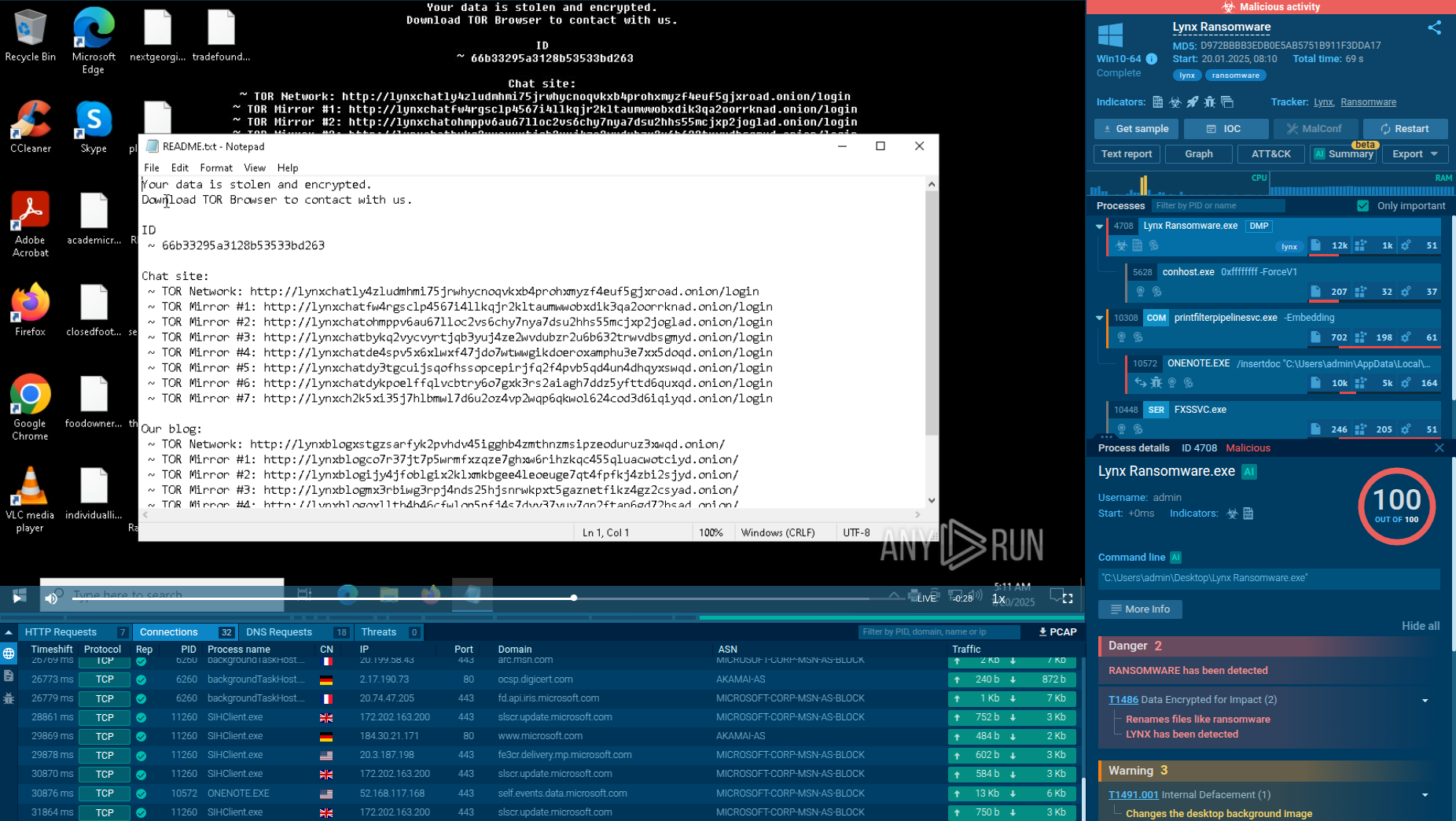
Lynx ransomware inside ANY.RUN Sandbox Lynx ransom note opened inside the ANY.RUN sandbox

Distributed via targeted pishing email campaigns, software vulnerabilities, infected ads and websites, it evades detection and analysis by a number of techniques. Lynx is customizable and can deliver additional payload.

Get started today for free

Analyze malware and phishing in a fully-interactive sandbox

Create free account

Lynx malware technical details

  • By default, aims to encrypt all the files in the infected system including network shares and drives. Customized as RaaS, can focus on specific folders or file types.
  • Sensitive data gets exfiltrated via encrypted channels, such as HTTPS or custom protocols. Besides files, Lynx can steal credentials and screenshots.
  • Deletes shadow copies used to restore data.
  • Attempts to kill system processes and services using methods like the RestartManager. Specifically targets services that prevent encryption and facilitate backup.
  • Exploits vulnerabilities to escalate privileges within the targeted system.
  • Maintains communication with a C2 server, uses domain generation algorithms (DGA) to ensure reliable connections.
  • Can deliver malware payload, such as ransomware or wipers, or act as a backdoor for subsequent attacks.
  • Employs a number of advanced evasion mechanisms: code obfuscation, polymorphism, using stolen credentials to access system entities.
  • Detects VMs, sandboxes, delays execution or modifies behavior to avoid analysis tools.
  • Operates in-memory without writing files to the disk, reducing the chance of detection.

Lynx execution process

Lynx ransomware is a sophisticated malware variant renowned for its aggressive tactics and operational efficiency. Thanks to ANY.RUN's Interactive Sandbox, we can observe the malware's entire execution chain in a safe virtual environment.

Upon launching, Lynx parses any command-line arguments that dictate its behavior; if no arguments are provided, it defaults to encrypting all files on the system.
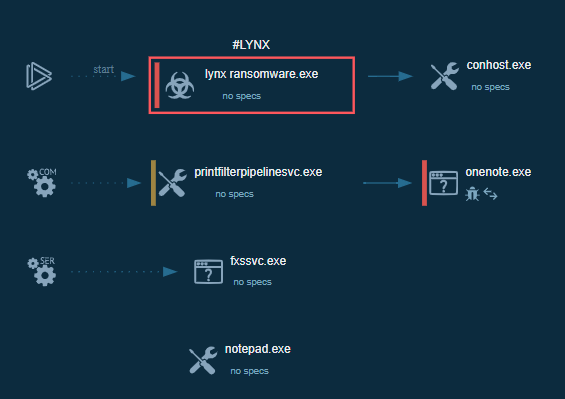
Lynx graph inside ANY.RUN Sandbox Lynx process graph displayed in the ANY.RUN sandbox

One of Lynx’s first actions is to terminate processes that could interfere with the encryption. It specifically targets backup and database-related applications — such as SQL, Veeam, Backup, Exchange, Java, and even Notepad — and iterates through these on its target list to stop them.

With potential obstacles removed, Lynx enumerates directories to identify files for encryption. To broaden its reach, it can mount hidden drives and network shares. It also hinders recovery efforts by deleting shadow copies and backup partitions, making it significantly more difficult for victims to restore data without paying the ransom.
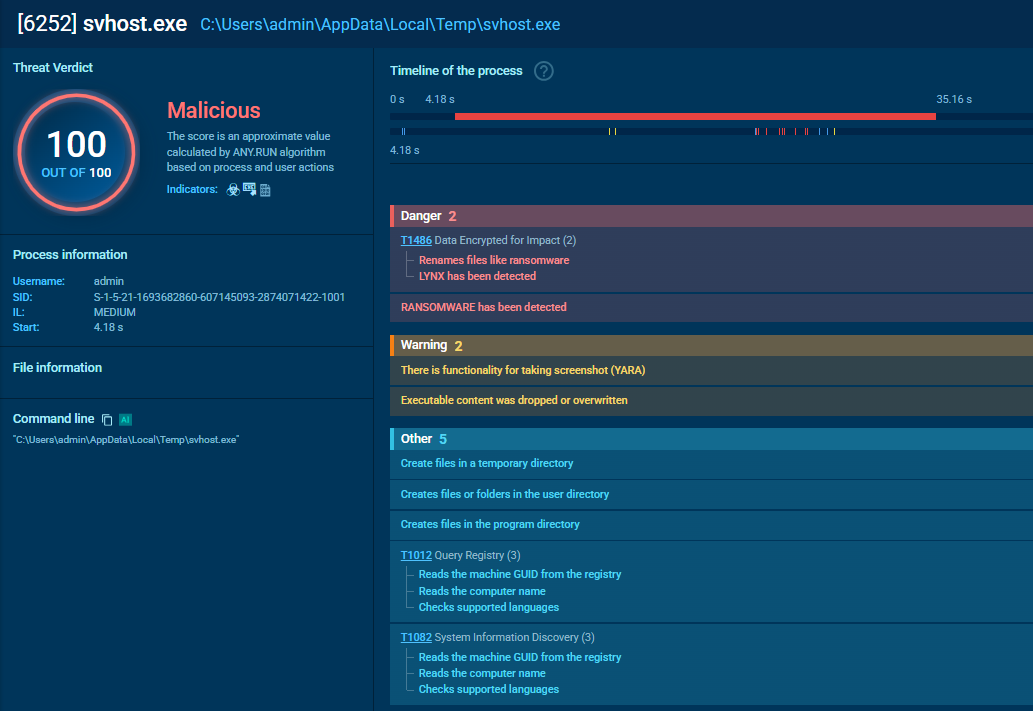
Lynx process inside ANY.RUN Sandbox Lynx malicious process analysis in the ANY.RUN sandbox

The malware uses robust encryption techniques, generating unique keys for each file, and appends the .lynx extension to all encrypted files. It can encrypt mounted drives, shared folders, and specified network resources.

After the encryption phase, Lynx delivers a ransom note on the victim’s desktop by changing the wallpaper, dropping a text file containing the ransom note, and placing an XPS file with the same message. This note typically provides a link to a dark web portal for paying the ransom and communicating with the attackers. Furthermore, Lynx employs “double extortion,” threatening to leak sensitive data if the ransom is not paid. This tactic amplifies pressure on victims, making Lynx a particularly formidable threat.

Use ANY.RUN free for 14 days

Try the full power of interactive analysis

Start your free trial

Collect Cyber Threat Intelligence on Lynx

Use Threat Intelligence Lookup from ANY.RUN to study IOCs and TTPs associated with Lynx and enforce your security framework against it. Search within a database of millions of malware analyses done in the ANY.RUN sandbox.

With over 40 customizable search parameters, including IPs, domains, file names, and process artifacts, you can gather relevant data for further proactive measures.
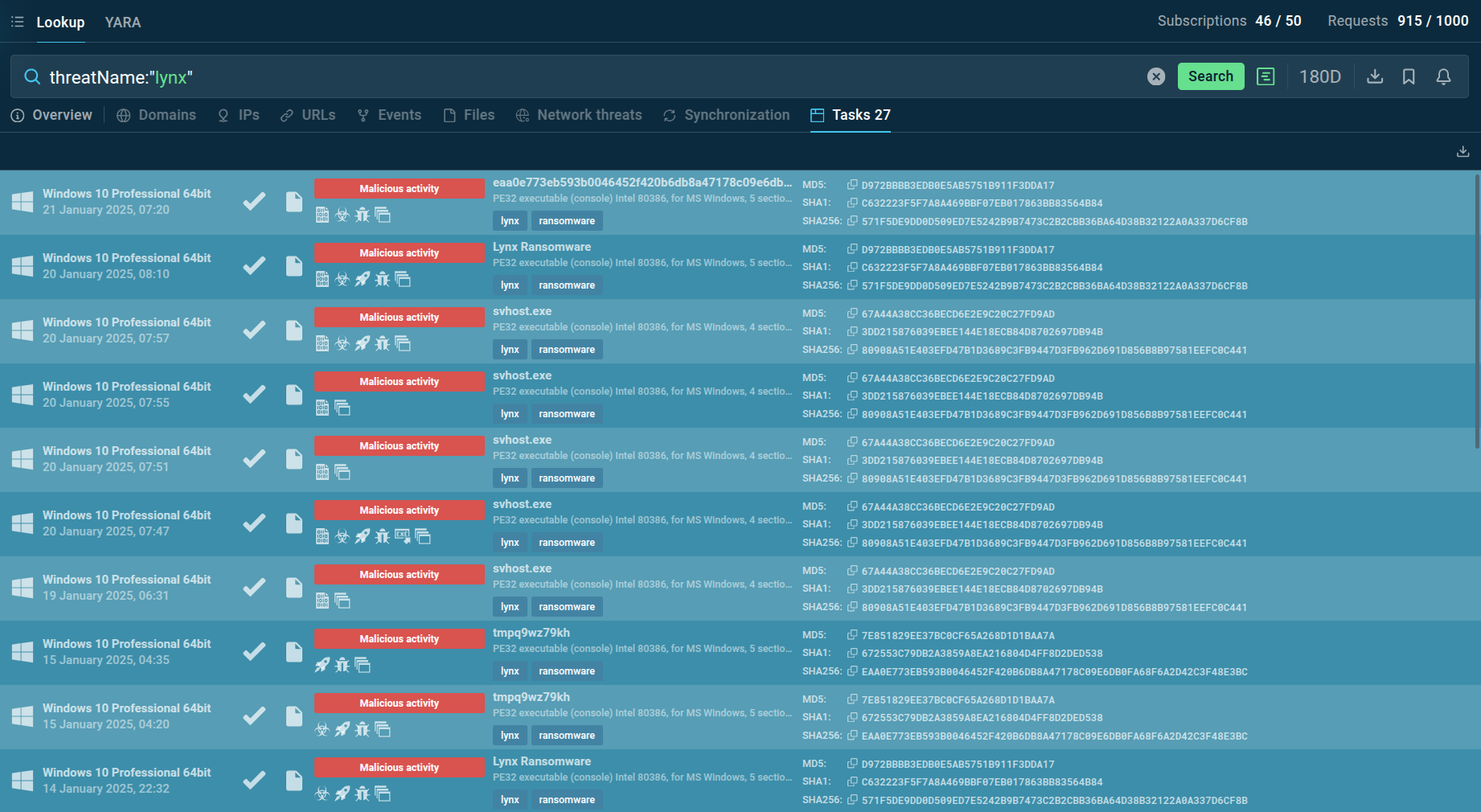
Lynx results in ANY.RUN TI Lookup ANY.RUN’s sandbox sessions with Lynx found via Threat Intelligence Lookup

You can search directly by the threat name or use related clues like hash values or network connections. By entering a query like threatName:"lynx", you'll get a list of sandbox reports featuring the most recent analyses of Lynx samples. You can navigate to each report and explore it in detail to understand the malware's behavior and collect crucial threat intelligence.

Integrate ANY.RUN’s threat intelligence solutions in your company

Contact us

Lynx malware distribution methods

  • Spear-phishing email campaigns. Emails are crafted to appear legitimate and typically contain malicious attachments (e.g., Word documents, PDFs) or links to compromised websites.
  • Exploiting vulnerabilities in unpatched software (operating systems, browsers, other applications), in popular document formats (e.g., macros in Microsoft Office files).
  • Malvertising: code embedded in malicious ads on legitimate websites redirects victims to exploit kits.
  • Supply Chain Attacks: compromises third-party software or libraries, distributing itself as part of trusted applications.

Conclusion

Lynx is a highly dangerous piece of ransomware aimed both at encrypting data and stealing it to do the most damage to the victim’s operations and reputation.

By default, Lynx is set to encrypt every file on the system. But as a RaaS, it is customizable via command-line arguments to precisely select files and directories to target.

It exploits various entry points into targeted networks and uses a number of anti-malware evasion techniques. Nevertheless, sophisticated tools like ANY.RUN’s Interactive Sandbox and Threat Intelligence Lookup successfully withstand Lynx’s defenses and allow security teams to study its behavior, get ready to detect it and protect against it.

Sign up for a free ANY.RUN account to strengthen your security posture!
HAVE A LOOK AT

RedLine screenshot
RedLine
redline stealer redline stealer malware
RedLine Stealer is a malicious program that collects users’ confidential data from browsers, systems, and installed software. It also infects operating systems with other malware.
Read More
GREENBLOOD screenshot
GREENBLOOD
greenblood
GREENBLOOD is a Go-based ransomware that uses concurrent ChaCha8 encryption to lock entire Windows environments in under a minute while systematically destroying backups, disabling defenses, and threatening double extortion through a Tor-based data leak site.
Read More
NetSupport RAT screenshot
NetSupport RAT
netsupport
NetSupport RAT is a malicious adaptation of the legitimate NetSupport Manager, a remote access tool used for IT support, which cybercriminals exploit to gain unauthorized control over systems. It has gained significant traction due to its sophisticated evasion techniques, widespread distribution campaigns, and the challenge it poses to security professionals who must distinguish between legitimate and malicious uses of the underlying software.
Read More
HijackLoader screenshot
HijackLoader
hijackloader
HijackLoader is a modular malware acting as a vehicle for distributing different types of malicious software on compromised systems. It gained prominence during the summer of 2023 and has since been used in multiple attacks against organizations from various sectors, including hospitality businesses.
Read More
EvilTokens screenshot
EvilTokens
eviltokens
EvilTokens is a phishing-as-a-service (PhaaS) toolkit that emerged in mid-February 2026. It automates device code phishing attacks against Microsoft 365 and Entra ID environments. Unlike traditional credential-harvesting phishing, EvilTokens tricks users into completing legitimate authentication on Microsoft's own login pages, resulting in the issuance of valid OAuth access and refresh tokens directly to the attacker, effectively bypassing MFA without stealing passwords.
Read More
Kali365 screenshot
Kali365 is an emerging Phishing-as-a-Service (PhaaS) platform that targets Microsoft 365 environments by stealing OAuth authentication tokens instead of passwords. First observed in April 2026, the service enables even low-skilled threat actors to bypass multi-factor authentication (MFA), gain persistent access to corporate cloud accounts, and compromise business communications, files, and collaboration platforms. Kali365 represents a shift from traditional credential theft toward session hijacking and token abuse, making it a significant threat to organizations that rely on Microsoft 365.
Read More