Pulsar RAT
- 59
- Global rank
- 65
- Month rank
- 82
- Week rank
Pulsar RAT is a derivative of Quasar RAT with extensive functionality including keylogging, cryptocurrency wallet clipping, credential theft, file management, remote shell execution, and data exfiltration capabilities. As a modular, open-source remote administration tool designed for Windows systems, Pulsar introduces significant enhancements over its predecessor.
- RAT
- Type
- Unknown
- Origin
- 1 April, 2025
- First seen
- 27 October, 2026
- Last seen
How to analyze Pulsar RAT with ANY.RUN
IOCs
IP addresses
- 23.207.210.139
- 23.11.40.157
- 95.101.23.81
- 23.52.181.212
- 20.190.159.68
- 185.19.40.250
- 48.192.1.64
- 74.178.240.51
- 20.190.159.23
- 74.178.76.128
- 95.101.23.67
- 150.171.109.99
- 57.153.246.3
- 20.59.87.226
- 204.79.197.203
- 172.211.123.249
- 2.27.244.183
- 20.59.87.225
- 69.67.170.170
- 135.232.92.97
Hashes
- d190887c4d0d3653a79252bd757fee12c2bcf50c4783ff4658af62f05487983c
- d99e62445a7ba0081ad5c10b5baa1f88512b170718c61fbe60e87d6d9a2e45ba
- 69ec2114f6d28901b70191f292cb85939ae7c449c9e3260973729ac6731a0ac3
- e4e2168cd3e71292b0f4043c1bc09afddddd7b23d2f36a683b6d0eeb9ca0de61
- f897dec4340040c5adaa665b6f388e635c2551e0c0eada6bff53d0a21a7410a5
- b1abf0ce2446dd005e23c00c54eb6f3db7cff4875d2dde7472b7e91537c21bab
- ab281bf0b450c5a6f969eccebdd149b8df2c407c5a1e4f417c7ef81bf330483a
- 8c7db90d0f6a9a9a1e65ea933c187fae86bb5db1927911de196a354917c943ec
- f29015ec6f3cf16e8f66ea71ffed9dc9c967d3159d6752b963adf871395ee0e5
- 40937f5f84a6a503fe784c179383a515fea5a8aaf9dc35557a8ae3557a405d8b
- 5d894d283bac35c494fb2850a444312c1c985b4846bc4c9777a665067bd342ba
- f163afdcccca37df298bf4180376c007b2476bcf5cb933700a5e393584cb61fb
- e633220803fb2eb3c97bf65c06fc39110561685557bc81c4d5b374972c0947f6
- fedb457db0957ffdc31bbe6c667546101c4a2307dc6f70bb9ae5b197edc9c45c
- f49b515eedeed1abe391bc32f15ce43d3582cb6c41ff944fa9c79f476d5824ba
- 139b3ceb8c623162046a1cabbe5513d081120fa0416d7bea990373f5763259b7
- 3914c5fae441a3b0dbf87516daed7a0c820e8a8bf18eacfe7064be46736626de
- c8203b0b11a56a370c6110ab64d56ef398d849ae1bba335922d44a4cfc819625
- 3c368712733c318789f151dd2eeb23680ce8fff0b910035af1bdb04eb3db675c
- 84924dda4268405ae8005a086b7945f4b83cc8144c0990a406f41ceedd6594ea
Domains
- oneocsp.microsoft.com
- self.events.data.microsoft.com
- google.com
- www.microsoft.com
- dns.msftncsi.com
- settings-win.data.microsoft.com
- login.live.com
- slscr.update.microsoft.com
- fe3cr.delivery.mp.microsoft.com
- activation-v2.sls.microsoft.com
- th.bing.com
- nexusrules.officeapps.live.com
- ecs.office.com
- crl.microsoft.com
- client.wns.windows.com
- ocsp.digicert.com
- mrmarmok.life
- c.pki.goog
- deno.com
- deno.land
URLs
- http://crl.microsoft.com/pki/crl/products/microoceraut2011_2011_03_22.crl
- http://www.microsoft.com/pkiops/crl/microsoft%20secure%20server%20ca%202026.crl
- https://settings-win.data.microsoft.com/settings/v3.0/wsd/updatehealthtools?os=windows&osver=10.0.19041.1.amd64fre.vb_release.191206-&sku=48&deviceclass=windows.desktop&locale=en-us&deviceid=s:bad99146-31d3-4ec6-a1a4-be76f32ba5d4&sampleid=s:95271487&appver=10.0.19041.3626&flightring=retail&telemetrylevel=1&hidovergattreg=c%3a%5cwindows%5csystem32%5cdriverstore%5cfilerepository%5chidbthle.inf_amd64_9610b4821fdf82a5%5cmicrosoft.bluetooth.profiles.hidovergatt.dll&appver=&processoridentifier=amd64%20family%2023%20model%201%20stepping%202&oemmodel=dell&updateoffereddays=4294967295&processormanufacturer=authenticamd&installdate=1661339444&oemmodelbaseboard=&branchreadinesslevel=cb&oemsubmodel=j5cr&isclouddomainjoined=0&deferfeatureupdateperiodindays=30&isdeviceretaildemo=0&flightingbranchname=&osuilocale=en-us&devicefamily=windows.desktop&wuclientver=10.0.19041.3996&uninstallactive=1&isflightingenabled=0&osskuid=48&processorclockspeed=3094&totalphysicalram=6144&securebootcapable=0&app=sedimentpack&processorcores=6¤tbranch=vb_release&installlanguage=en-us&deferqualityupdateperiodindays=0&oemname_uncleaned=dell&tpmversion=0&primarydisktotalcapacity=262144&installationtype=client&attrdataver=186&processormodel=amd%20ryzen%205%203500%206-core%20processor&isedgewithchromiuminstalled=1&osversion=10.0.19045.4046&ismdmenrolled=0&activationchannel=retail&firmwareversion=a.40&trendinstalledkey=1&osarchitecture=amd64&defaultuserregion=244&updatemanagementgroup=2
- http://ocsp.digicert.com/mfewtzbnmeswstajbgurdgmcgguabbtrjrydryt%2bapf3gspypfhbxr5xtqqus9tippmhxdiunkhmewnpyim8s8yceajtxtab8my1oj8mfwpz%2f7y%3d
- http://oneocsp.microsoft.com/ocsp/mfqwujbqme4wtdajbgurdgmcgguabbq3l3%2f%2fa6adk8nray2gxzvayrhg4aqub6t%2b2v%2bxq3lso2d33ojhnyhhqoucezmaaaafuwohyjguzpcaaaaaaau%3d
- http://ocsp.digicert.com/mfewtzbnmeswstajbgurdgmcgguabbq50otx%2fh0ztl%2bz8sipi7wewvxdlqqutijuibiv5unu5g%2f6%2brks7qyxjzkceaz1vqyrvgl0erhqlcpm8gy%3d
- https://www.bing.com/dsb/search?dsbmr=1&format=dsbjson&client=windowsminiserp&dsbschemaversion=1.1&dsbminiserp=1&q=q&cc=us&setlang=en-us&clientdatetime=10%2f27%2f2026%2c%204%3a38%3a38%20am
- https://www.bing.com/threshold/xls.aspx?t=5&dl=1&f=9&wsbc=1
- https://www.bing.com/th?id=odswg.0ded7b4d-05d1-44be-9dd7-5902bd27a36d&pid=dsb
- https://www.bing.com/th?id=odswg.29d922f0-005d-4143-993d-fb16686b9f92&pid=dsb
- https://login.live.com/rst2.srf
- https://login.live.com/ppsecure/deviceaddcredential.srf
- https://th.bing.com/th?id=odswg.iotdlocalicon&w=16&h=16&c=1&rs=1&p=0
- http://www.microsoft.com/pkiops/crl/microsoft%20ecc%20update%20secure%20server%20ca%202.1.crl
- https://slscr.update.microsoft.com/sls/%7b522d76a4-93e1-47f8-b8ce-07c937ad1a1e%7d/x64/10.0.19045.4046/0?ch=686&l=en-us&p=&pt=0x30&wua=10.0.19041.3996&mk=dell&md=dell
- https://fe3cr.delivery.mp.microsoft.com/clientwebservice/ping
- https://slscr.update.microsoft.com/sls/ping
- https://slscr.update.microsoft.com/sls/%7be7a50285-d08d-499d-9ff8-180fdc2332bc%7d/x64/10.0.19045.4046/0?ch=686&l=en-us&p=&pt=0x30&wua=10.0.19041.3996&mk=dell&md=dell
- https://activation-v2.sls.microsoft.com/slactivateproduct/slactivateproduct.asmx?configextension=retail
- http://c.pki.goog/we1/kk_ciuiu9y4.crl
Last seen at
Pulsar RAT Exposed: Modular Menace with Clipboard Hijacking and Supply Chain Tricks
Key Takeaways
Pulsar RAT is an evolution of Quasar RAT with enhanced stealth, comprehensive surveillance capabilities including webcam and microphone access, and cryptocurrency wallet clipping.
The malware employs advanced evasion techniques including anti-virtualization checks, anti-debugging protections, memory-only execution, and multi-layered obfuscation.
Supply chain attacks represent a growing distribution vector.
Business impact extends far beyond technical compromise with organizations facing intellectual property theft, regulatory violations, operational disruption requiring 200-500 person-hours for remediation, and potential supply chain compromise affecting partners.
Defense requires layered security controls combining EDR platforms, network segmentation, user security awareness training that prevents 60-90% of social engineering attacks.
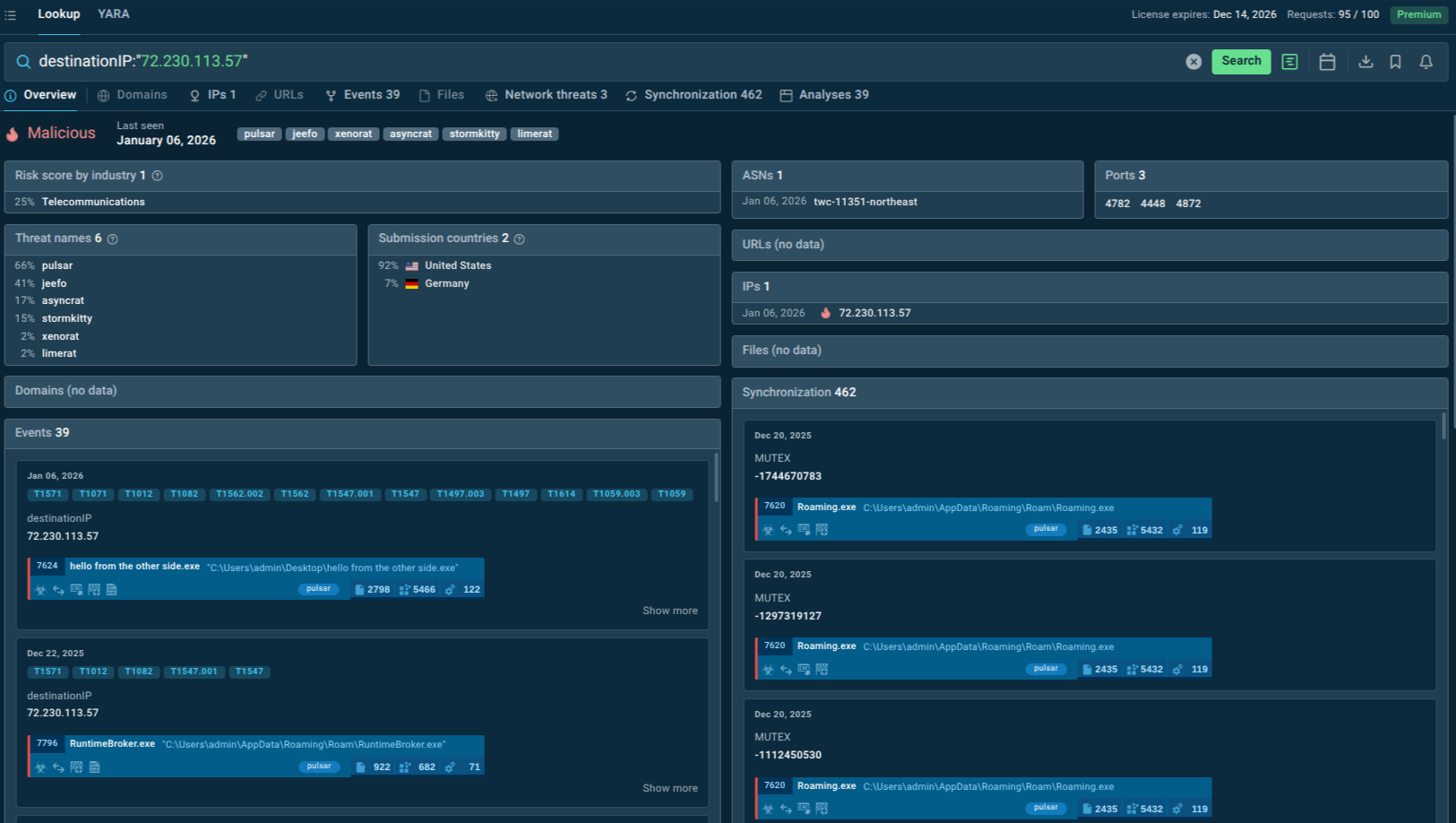
TI Lookup delivers instant threat intelligence enabling security teams to rapidly search for Pulsar RAT indicators across URLs, domains, and IP addresses, retrieving comprehensive intelligence including sample analysis results, network infrastructure, and campaign data.
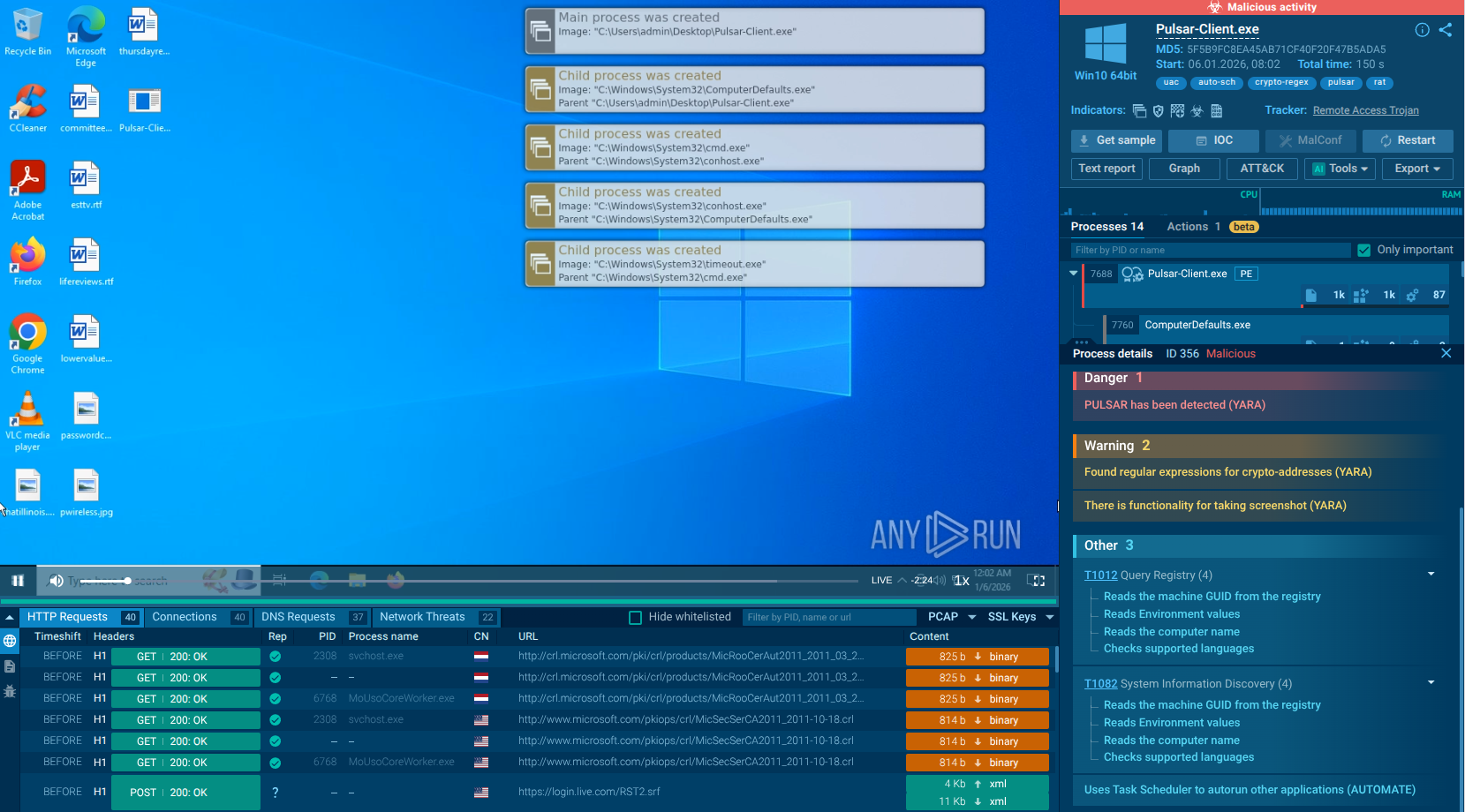
- ANY.RUN's Interactive Sandbox provides deep analysis capabilities for security teams investigating suspicious files, enabling manual interaction with samples to trigger specific behaviors and explore malware functionality that automated analysis might miss.
What is Pulsar RAT Malware?
Pulsar RAT represents an evolved fork of the popular open-source Quasar RAT, enhancing its predecessor with additional features and improved stealth. Developed as a modular .NET-based tool, it offers comprehensive remote administration capabilities that can be legitimately used for IT management but are frequently abused by cybercriminals for unauthorized access, espionage, and data theft.
Key enhancements include TLS-encrypted communications, hidden virtual network computing (HVNC) for stealthy remote desktop access, reverse proxy support, and a plugin system for customization. It incorporates specialized modules for credential harvesting (known as Kematian Grabber), cryptocurrency clipboard hijacking, and even "FunStuff" features like screen distortions or fake BSOD triggers.
Pulsar stands out for its robust anti-analysis techniques, making it challenging for security tools to detect and analyze. The malware employs robust anti-virtualization and anti-debugging techniques, code injection capabilities, and built-in obfuscation and packing mechanisms specifically designed to evade detection by security solutions. Its modular design allows for seamless plugin additions, enabling operators to customize functionality for specific campaign objectives.
The tool even includes creative modules labeled "FunStuff" that enable operations like GDI effects, blue screen of death triggers, mouse swapping, and taskbar hiding, showcasing versatility that extends beyond conventional remote administration applications.
First observed in the wild around 2025, Pulsar has been deployed in targeted campaigns, including supply chain attacks, demonstrating its adaptability in the hands of threat actors.
Pulsar RAT Victimology
Pulsar RAT primarily targets Windows users and organizations across various sectors. Known incidents, such as the malicious npm package campaign, suggest a focus on software developers and tech-savvy individuals who install third-party libraries. However, as a versatile RAT, it can affect businesses of all sizes, particularly those with remote workforces or weak endpoint security.
Victims often include small-to-medium enterprises lacking advanced EDR solutions, as well as individual users exposed through phishing or malicious downloads. There is no strong evidence of nation-state targeting, but its data theft features make it appealing for financially motivated attackers seeking credentials, cryptocurrencies, or sensitive corporate data.
What Are Examples of the Most Successful Pulsar RAT Attacks?
This RAT is relatively new, so large-scale campaigns are limited, but notable incidents include:
2025 npm Supply Chain Attack: Malicious packages "solders" and "@mediawave/lib" (published by "codewizguru") used extreme obfuscation and steganography to infect developers installing the libraries, achieving hundreds of weekly downloads before detection.
Multi-RAT Deployments: Samples linked to open directories dropping Pulsar alongside Quasar, NjRAT, and XWorm, indicating opportunistic or targeted infections.
No massive breaches publicly attributed yet, but its features suggest potential use in credential theft or precursor to ransomware.
How Pulsar RAT Infiltrates and Functions
Initial access typically occurs through social engineering or supply chain compromises:
- Malicious Downloads: Phishing emails with laced attachments or links.
- Supply Chain Attacks: Notably, the 2025 "solders" npm package campaign used 7+ layers of obfuscation (Unicode variables, hex encoding, Base64, steganography in PNG images) to deliver the payload automatically via postinstall scripts.
- Cracked Software or Pirated Tools: Common distribution vector for RATs like this.
Once inside, it persists via startup entries or scheduled tasks but focuses on stealth rather than worm-like spreading. Lateral movement relies on attacker commands (e.g., via proxy).
Pulsar operates via a client-server model. The client (stub) on the victim machine connects to the attacker's C2 server using encrypted channels (TLS).
The malware retrieves C2 configuration from public paste sites like Pastebin, decrypts the configuration using embedded keys to obtain the C2 server IP or domain, then establishes a BCrypt-encrypted connection using the MessagePack binary protocol for command transmission.
The MessagePack binary protocol enables efficient command serialization and deserialization, allowing attackers to send complex instructions and receive detailed responses about system state.
The malware incorporates multiple evasion techniques to avoid detection during security analysis. Anti-virtualization checks inspect disk labels for strings common in virtual machines like "QEMU HARDDISK." If such indicators are present, execution stops immediately, ensuring the payload avoids sandbox analysis tools.
Code injection capabilities allow the malware to execute within legitimate processes, making detection based on process names ineffective.
Advanced deployment methods load the payload directly into memory via .NET reflection without writing files to disk. This fileless approach bypasses disk-based security monitoring and reduces forensic visibility, making incident response significantly more challenging.
The plugin-based design allows operators to load additional functionality without recompiling the core malware. Modules can be added or removed based on specific campaign requirements, target environments, or evolving attacker objectives.
Sandbox Analysis of a Pulsar RAT Sample
ANY.RUN’s Interactive Sandbox overcomes Pulsar’s ant-detection and sandbox-evasion mechanics, exposing the full attack chain. For this RAT, the Sandbox can reveal unpacking routines, persistence mechanisms, network communications, and data exfiltration attempts.
View a Pulsar RAT sample analysis
In this sample, a quite simple BAT file is created (C:\Users\admin\AppData\Local\Temp\28c726a0.bat):
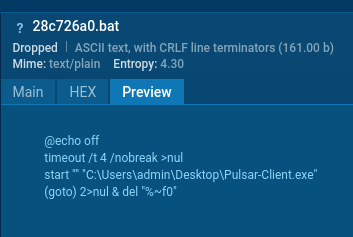
This file is used for UAC bypassing at the next step. The mechanism works as follows:
First, the DelegateExecute value is cleared in the registry key HKEY_CLASSES_ROOT\ms-settings\Shell\Open\command. This is necessary so that when ms-settings is opened, the system does not use the COM handler specified in the DelegateExecute value. In this case, the handler is taken directly from the (Default) value.
Therefore, the next step writes a malicious command into the (Default) value: this command launches a BAT file and then runs the legitimate program computerdefaults.exe.
The full attack chain proceeds as follows:
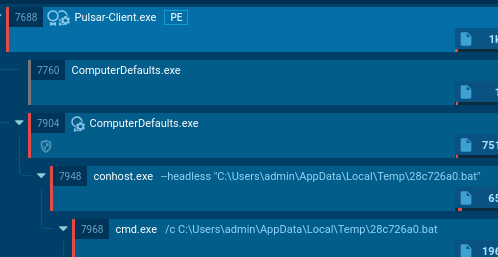
After the attack executes, the modified registry values are cleared to cover tracks.
The BAT file then launches the executable with elevated privileges. This executable, in turn, creates a scheduled task in Task Scheduler. The task is configured to run at every user logon with HIGHEST privileges.
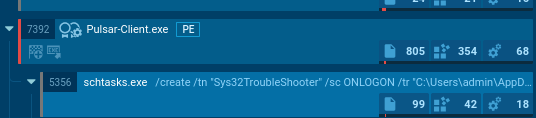
This file is a disguised Pulsar RAT, as confirmed by a YARA rule trigger.
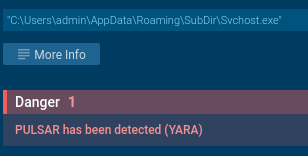
After Pulsar finished collecting system information, execution stopped.
Gathering Threat Intelligence on Pulsar RAT Malware
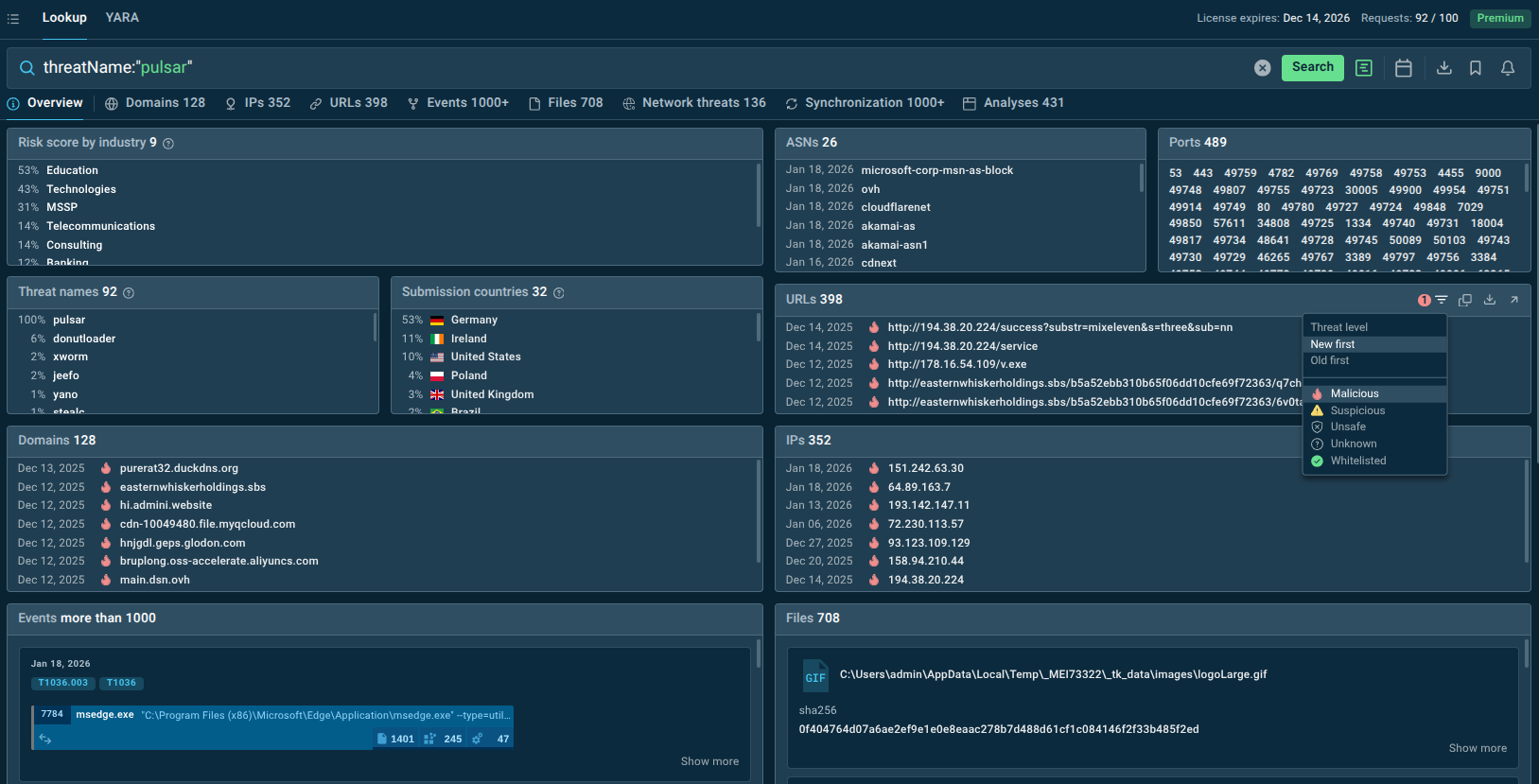
By searching for known Pulsar RAT indicators, security teams retrieve comprehensive intelligence including sample analysis results, network connections, related infrastructure, and historical campaign data. This accelerates investigations by providing immediate context without requiring manual sample collection and analysis.
Start by querying the threat’s name in ANY.RUN’s Threat Intelligence Lookup.
Conclusion
Pulsar RAT is a reminder that quiet threats can be the most dangerous. By prioritizing persistence and access, it enables attackers to move patiently, exploit trust, and maximize long-term impact. Organizations that combine proactive detection, sandbox analysis, and high-quality threat intelligence stand the best chance of uncovering and stopping such intrusions early.
Trial TI Lookup to start gathering actionable threat intelligence on the malware that threatens your business sector and region: just sign up to ANY.RUN.
Other malware & phishing threats
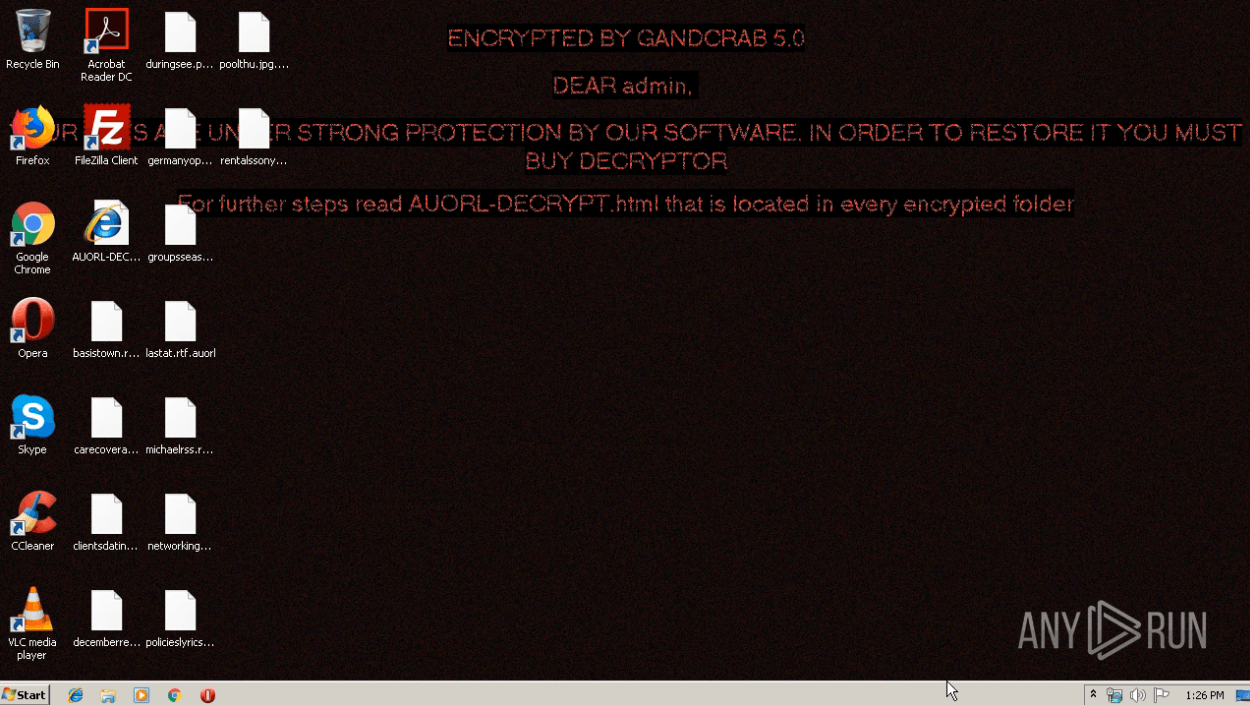 GandCrabGandCrab is probably one of the most famous Ransomware. A Ransomware is a malware that asks the victim to pay money in order to restore access to encrypted files. If the user does not cooperate the files are forever lost.
 PonyPony is a malware with two main functions — stealing information and dropping other viruses with different tasks on infected machines. It has been around since 2011, and it still actively attacks users in Europe and America.
 DCRatDCrat, also known as Dark Crystal RAT, is a remote access trojan (RAT), which was first introduced in 2018. It is a modular malware that can be customized to perform different tasks.
For instance, it can steal passwords, crypto wallet information, hijack Telegram and Steam accounts, and more. Attackers may use a variety of methods to distribute DCrat, but phishing email campaigns are the most common.
DCRatDCrat, also known as Dark Crystal RAT, is a remote access trojan (RAT), which was first introduced in 2018. It is a modular malware that can be customized to perform different tasks.
For instance, it can steal passwords, crypto wallet information, hijack Telegram and Steam accounts, and more. Attackers may use a variety of methods to distribute DCrat, but phishing email campaigns are the most common. SocelarsSocelars is an information-stealing Trojan (often categorized as spyware/stealer) that focuses on collecting sensitive data from Windows systems, with standout reporting around Facebook Ads Manager and session cookie theft.
Unlike “noisy” malware that immediately breaks something, Socelars quietly converts a single infected machine into access: logged-in sessions, business account data, and pathways to monetization.
SocelarsSocelars is an information-stealing Trojan (often categorized as spyware/stealer) that focuses on collecting sensitive data from Windows systems, with standout reporting around Facebook Ads Manager and session cookie theft.
Unlike “noisy” malware that immediately breaks something, Socelars quietly converts a single infected machine into access: logged-in sessions, business account data, and pathways to monetization. RamnitRamnit is a highly modular banking trojan and worm that evolved from a file-infecting virus into a powerful cybercrime tool. It specializes in financial fraud, credential theft, remote access, and malware delivery, being a serious threat to businesses and individuals. First spotted in 2010, Ramnit became popular after the 2014 takedown of the GameOver Zeus botnet, as cybercriminals sought alternatives for banking fraud.
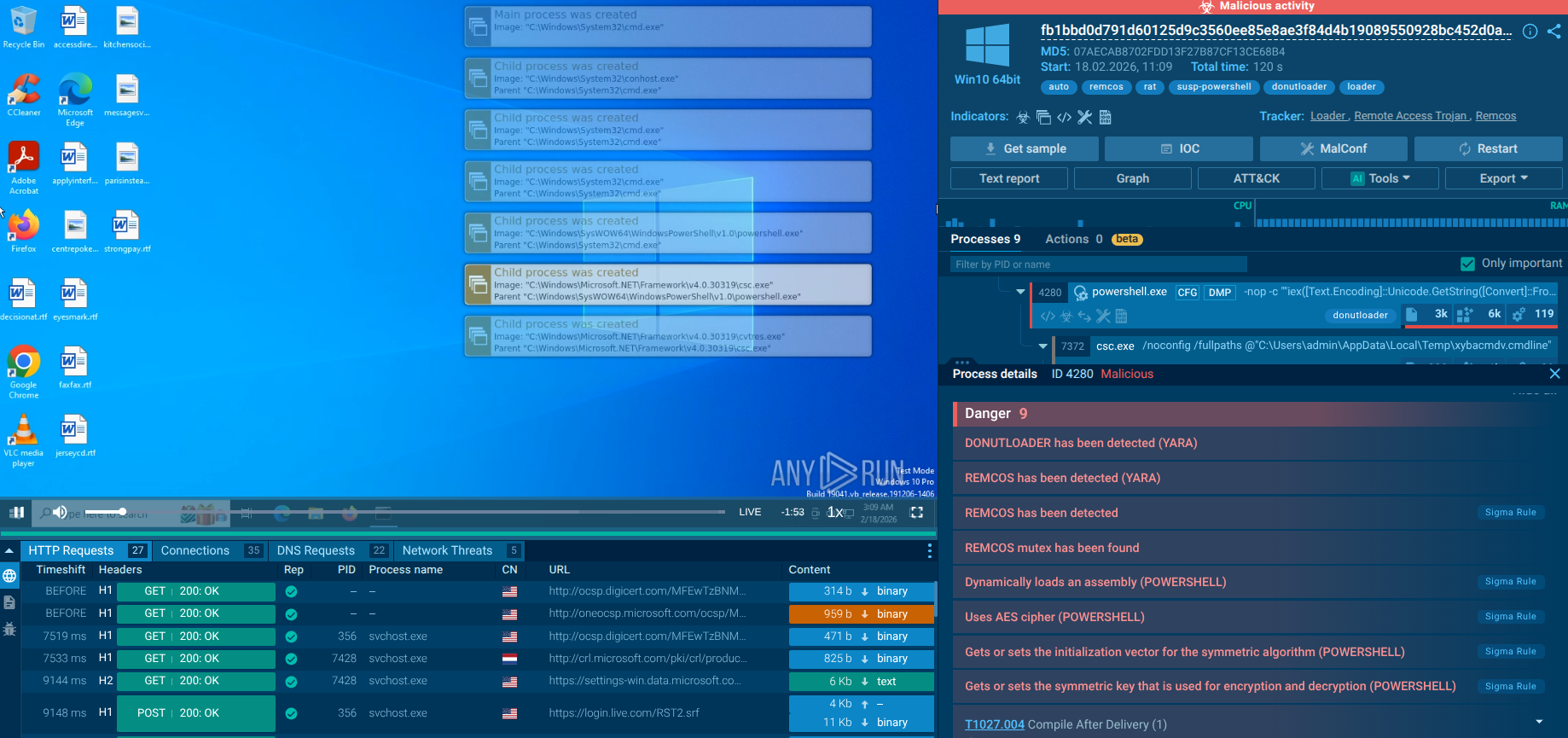 DonutLoaderDonutLoader is a versatile, open-source-based in-memory loader that turns .NET assemblies, executables, DLLs, and scripts into position-independent shellcode for execution entirely in RAM. Originally derived from the popular Donut tool, it enables threat actors to bypass traditional antivirus and EDR solutions by avoiding disk writes and injecting payloads directly into legitimate Windows processes.