Overlord RAT
- 40
- Global rank
- 27
- Month rank
- 33
- Week rank
Overlord RAT is a cross-platform remote access framework with Go-based agents and a TypeScript/Node/Bun server. It supports encrypted WebSocket C2, remote control, persistence, and multiple operating systems, including Windows, Linux, and macOS.
- RAT
- Type
- Unknown
- Origin
- 1 June, 2026
- First seen
- 22 October, 2026
- Last seen
How to analyze Overlord RAT with ANY.RUN
IOCs
IP addresses
- 172.211.123.249
- 20.165.94.63
- 192.178.183.138
- 57.153.246.3
- 150.171.27.11
- 142.251.13.132
- 142.251.14.113
- 150.171.109.106
- 192.178.183.94
- 104.18.23.222
- 142.251.127.94
- 150.171.109.107
- 142.251.127.138
- 142.251.151.7
- 142.251.13.138
- 23.52.181.141
- 150.171.22.17
- 150.171.28.11
- 92.122.215.53
- 20.190.159.73
Hashes
- 499e2611cb738cb367fcbe67ceaf0212ceaf3a0ef2f2863735b9a58cbbf6dfa7
- 0cf098dfe5bbb46fc0132b3cf0c54b06b4d2c8390d847ee2a65d20f9b7480f4c
- 9b32c491d0bfebdca1455f73c3c6f71796d433a39818c06c353da588de650f81
- 2824cf97513dc3ecc261f378bfd595ae95a5997e9d1c63f5731a58b1f8cd54f9
- 64e01bc292ba2ea1699576fcc445367047520ee895e290ccee20c24c9336d8ef
- 7852fce59c67ddf1d6b8b997eaa1adfac004a9f3a91c37295de9223674011fba
- 2445cad863be47bb1c15b57a4960b7b0d01864e63cdfde6395f3b2689dc1444b
- ff702ca753a7e3b75f9d9850cc9343e28e8d60f8005a2c955c8ac2105532b2c9
- af889c1deb6f9248961c2f8ba4307a8206d7163616a5b7455d17cead00068317
- 728d8cbd71263680a4e41399db65b3f2b8175d50ca630afd30643ced9ffe831f
- 22bc37b47ce8a832f39701641dc358357676e9be187a93a4c5d4b016e29238ae
- cc3e9077fcc9bd0dfc5dd3924c6c48b8345f32cee24fccc508c279f45b2abe61
- 14895bf43ce9b76c0ff4f9aef93dbe8bb6ca496894870cf0c007b189e0cef00e
- 7ccc7b17bfe01c3c7dd33eff8f80d0b57fc9b175815e766c9c1c1e893725e20f
- 6c69ce0fe6fab14f1990a320d704fee362c175c00eb6c9224aa6f41108918ca6
- 5f4229d18e5606330146ee13bdf726e10c1e06cbb15368c47f1ae68abe9ce4ba
- ec78ddd4ccf32b5d76ec701a20167c3fbd146d79a505e4fb0421fc1e5cf4aa63
- 41ce6a7b18364efecced0419b42165d4f86c43643bbe1043014d4142cf86186a
- 57f81a5fcbd1fefd6ec3cdd525a85b707b4eead532c1b3092daafd88ee9268ec
- 89082fb05229826bc222f5d22c158235f025f0e6df67ff135a18bd899e13bb8f
Domains
- api.edgeoffer.microsoft.com
- www.bing.com
- fonts.googleapis.com
- drive.usercontent.google.com
- edge.microsoft.com
- xpaywalletcdn.azureedge.net
- ssl.gstatic.com
- clients6.google.com
- youtube.googleapis.com
- drive.google.com
- www.microsoft.com
- nexusrules.officeapps.live.com
- google.com
- msedge.b.tlu.dl.delivery.mp.microsoft.com
- clients2.googleusercontent.com
- go.microsoft.com
- static.edge.microsoftapp.net
- www.gstatic.com
- accounts.google.com
- edge-cloud-resource-static.azureedge.net
URLs
- http://ocsp.digicert.com/mfewtzbnmeswstajbgurdgmcgguabbq50otx%2fh0ztl%2bz8sipi7wewvxdlqqutijuibiv5unu5g%2f6%2brks7qyxjzkceaz1vqyrvgl0erhqlcpm8gy%3d
- http://crl.microsoft.com/pki/crl/products/microoceraut2011_2011_03_22.crl
- http://www.microsoft.com/pkiops/crl/microsoft%20secure%20server%20ca%202026.crl
- http://edge.microsoft.com/browsernetworktime/time/1/current?cup2key=2:frmvrt9dlvtvypapkldoibwno1jcjutzhxkhktg20xa&cup2hreq=e3b0c44298fc1c149afbf4c8996fb92427ae41e4649b934ca495991b7852b855
- http://ocsp.digicert.com/mfewtzbnmeswstajbgurdgmcgguabbtrjrydryt%2bapf3gspypfhbxr5xtqqus9tippmhxdiunkhmewnpyim8s8yceajtxtab8my1oj8mfwpz%2f7y%3d
- http://oneocsp.microsoft.com/ocsp/mfqwujbqme4wtdajbgurdgmcgguabbq3l3%2f%2fa6adk8nray2gxzvayrhg4aqub6t%2b2v%2bxq3lso2d33ojhnyhhqoucezmaaaafuwohyjguzpcaaaaaaau%3d
- https://edge.microsoft.com/serviceexperimentation/v3/?osname=win&channel=stable&osver=10.0.19045&devicefamily=desktop&installdate=1661339457&clientversion=133.0.3065.92&experimentationmode=2&scpguard=0&scpfull=0&scpver=0
- https://copilot.microsoft.com/c/api/user/eligibility
- https://config.edge.skype.com/config/v1/edge/133.0.3065.92?clientid=4489578223053569932&agents=edge%2cedgeconfig%2cedgeservices%2cedgefirstrun%2cedgefirstrunconfig&osname=win&client=edge&channel=stable&scpfre=0&osarch=x86_64&osver=10.0.19045&wu=1&devicefamily=desktop&uma=0&sessionid=72&mngd=0&installdate=1661339457&edu=0&soobedate=1504771245&bphint=2&fg=1&lbfgdate=1766137499&lafgdate=0
- https://drive.google.com/file/d/18x6ug-vtvgpjeuapjvyfo4glbckl1dam/view?usp=sharing
- https://api.edgeoffer.microsoft.com/edgeoffer/pb/experiments?appid=edge-extensions&country=us
- https://www.gstatic.com/_/apps-fileview/_/ss/k=apps-fileview.v.6ii7tuvftoe.l.w.o/am=acaaya/d=0/rs=ao0039scy0evk5mdsx4quyi1i46xnzfdqa
- https://www.gstatic.com/_/apps-fileview/_/js/k=apps-fileview.v.no.ernjrjbphs8.o/am=acaaya/d=1/rs=ao0039ukaj_9zzxhvpezbk4ramy_z0orxw/m=v,wb?wli=v.thrpg_0kbfa.inkloadthreadedwasmmodule.o%3a%3bv.5sezdrb2sqs.inkloadwasmmodule.o%3a%3b
- https://www.gstatic.com/og/_/ss/k=og.asy.z1uyzvitwne.l.w.o/m=adcgm3/excm=/d=1/ed=1/ct=zgms/rs=aa2yrtuqehrsrhumycc2pqvv_zmy6eqa-a
- https://www.gstatic.com/og/_/js/k=og.asy.en_us.llrihbky4gq.2019.o/rt=j/m=_ac,_awd,ada,lldp,qads/exm=/d=1/ed=1/rs=aa2yrtvlez_voyuwmtsdhrmlk1adnvk_vg
- https://www.gstatic.com/feedback/js/help/prod/service/lazy.min.js
- https://fonts.googleapis.com/css2?family=google+material+icons:wght@400;500;700
- https://www.bing.com/bloomfilterfiles/expandeddomainsfilterglobal.json
- https://ssl.gstatic.com/docs/doclist/images/drive_favicon_2026_32dp.png
- https://config.edge.skype.com/config/v1/edge/133.0.3065.92?clientid=4489578223053569932&agents=edgeruntime%2cedgeruntimeconfig%2cedgedomainactions&osname=win&client=edge&channel=stable&scpfre=0&osarch=x86_64&osver=10.0.19045&wu=1&devicefamily=desktop&uma=0&sessionid=72&mngd=0&installdate=1661339457&edu=0&soobedate=1504771245&bphint=2&fg=1&lbfgdate=1792673026&lafgdate=0
Last seen at
Key Takeaways
- Cross-Platform RAT: Overlord RAT is a publicly available cross-platform RAT framework with Go-based agents and a server component built with TypeScript and Node/Bun.
- Remote Access: The framework provides operators with remote access to compromised systems through a centralized C2 infrastructure.
- Encrypted C2: Overlord RAT supports encrypted WebSocket communication using WSS for communication between agents and the C2 server.
- Web-Based Control: Operators can manage connected agents through a web-based interface or Electron client.
- Persistence: Overlord RAT supports mechanisms that can help maintain access to compromised systems beyond the initial execution.
- Masquerading: The framework can employ techniques such as legitimate-looking filenames or system component names to make malicious activity less conspicuous.
- C2 Tunneling: Overlord RAT can use tunneling services such as ngrok as part of its C2 infrastructure, potentially obscuring the underlying server.
- Multi-Platform Support: The framework supports Windows, Linux, and macOS, allowing it to operate across different operating system environments.
- ANY.RUN’s Interactive Sandbox analysis provides visibility into Overlord RAT’s execution behavior, including host discovery, remote communication, and activity performed after the malware becomes active on the system.
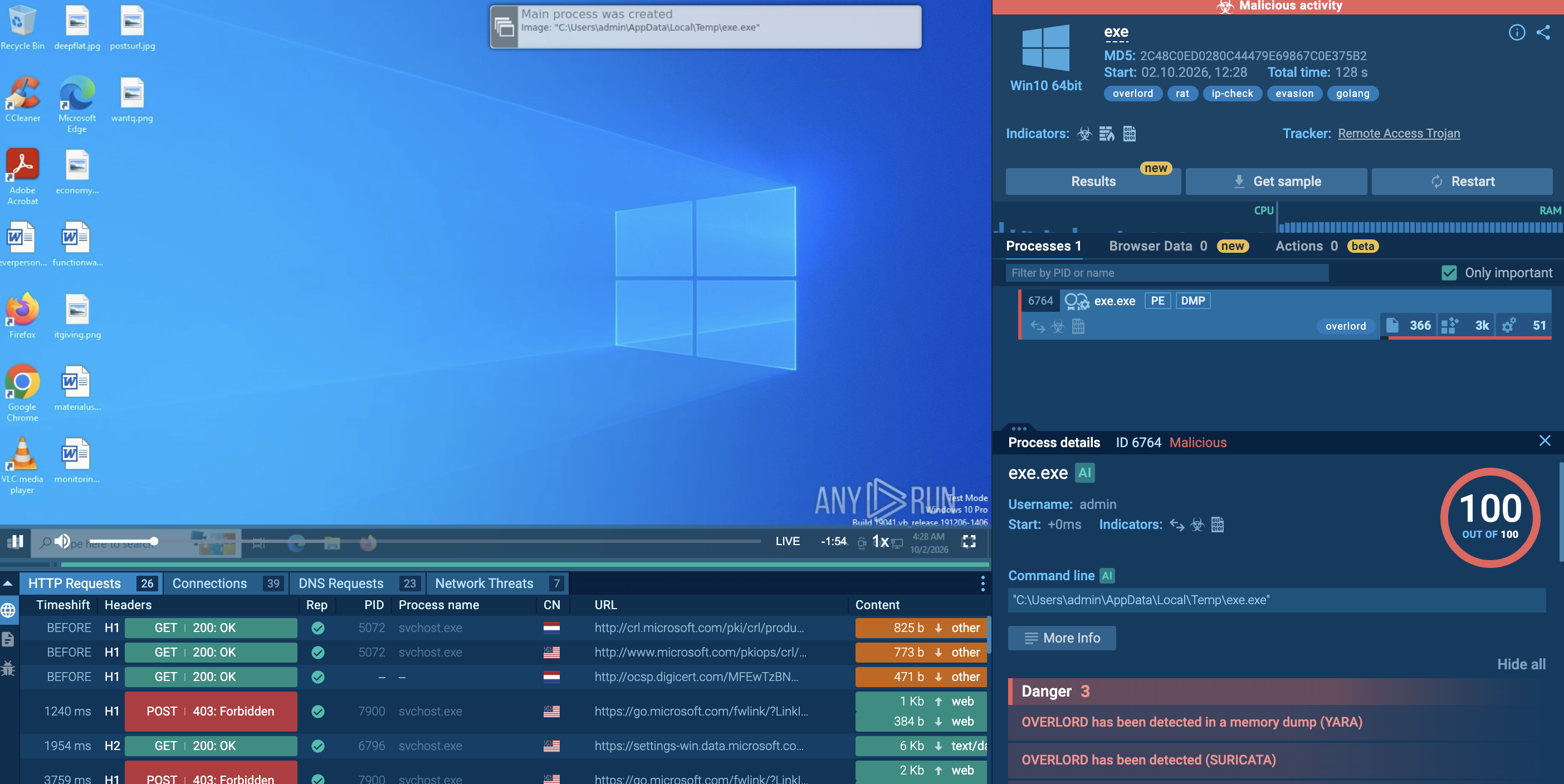
What is Overlord RAT?
Overlord RAT is a publicly available cross-platform remote access trojan (RAT) framework designed to provide remote access to compromised systems.
The framework uses Go-based agents, while its server-side components are implemented using TypeScript with Node.js/Bun. Operators can manage connected agents through a web-based interface or an Electron client.
Communication between agents and the C2 server takes place over encrypted WebSocket connections (WSS), providing a channel for exchanging commands and information.
The framework supports Windows, Linux, and macOS, making it applicable across multiple operating system environments. Its continued development also means that capabilities and implementation details may change between versions.
How Overlord RAT Affects Businesses and Organizations
An Overlord RAT infection can create several risks for organizations, including:
- Unauthorized remote access: The RAT can provide an operator with remote access to a compromised endpoint.
- Persistence: The Windows sample analyzed in this article uses multiple persistence mechanisms to maintain access after execution.
- System masquerading: Names associated with legitimate Windows processes and components can make malicious activity less obvious during an initial investigation.
- C2 exposure: Communication with remote infrastructure provides an external channel through which an operator can control an infected system.
- Infrastructure concealment: The observed use of an ngrok tunnel can make identifying the attacker's underlying infrastructure more difficult.
- Cross-platform exposure: Because the framework supports Windows, Linux, and macOS, organizations using different operating systems may need to account for the framework across multiple environments.
- Follow-on activity: Remote access can provide an operator with an entry point for additional activity on the compromised system.
Victimology: Potential Targets of Overlord RAT
Overlord RAT supports Windows, Linux, and macOS, potentially exposing organizations that operate mixed-OS environments.
The framework is not described as being restricted to a specific industry or sector. Its general-purpose remote-access capabilities can potentially be applied to a broad range of environments.
The impact of an infection can depend on the privileges available to the compromised agent, the system on which it is running, the configuration of the RAT, and the actions performed by the operator.
How Does Overlord RAT Function?
Observing an Overlord RAT sample inside ANY.RUN’s Interactive Sandbox shows that Overlord RAT uses a client-server architecture in which lightweight agents communicate with a central server operated through a web-based or Electron interface.
The agents are written in Go, while the server component uses TypeScript and Node.js/Bun. Communication between agents and the server takes place over encrypted WebSockets (WSS).
The observed Windows sample additionally uses several techniques intended to maintain access and make the malware appear less suspicious.
The general execution flow can be summarized as:
Agent execution → Persistence → Process masquerading → Encrypted C2 communication → Remote control
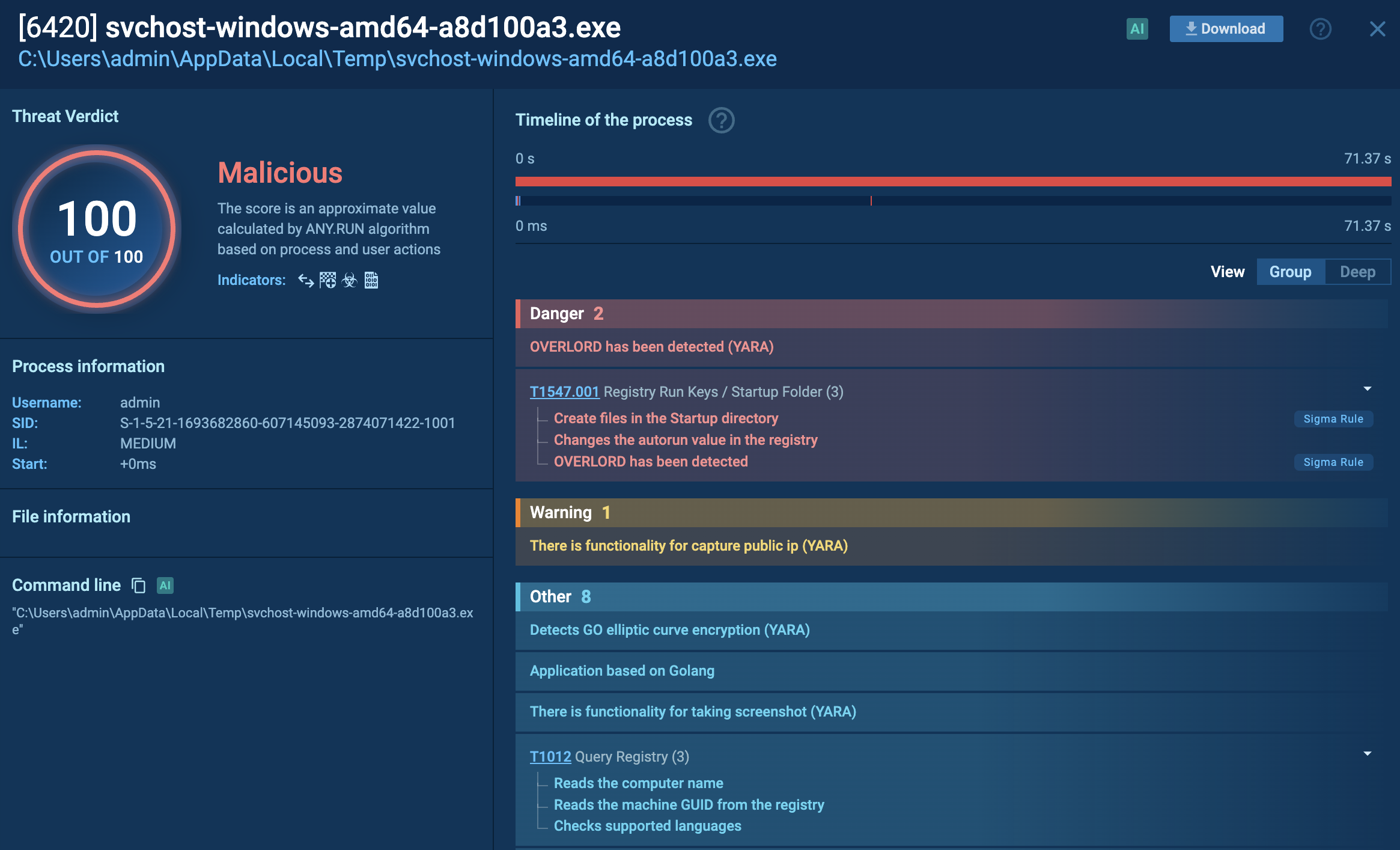
Stage 1: Agent Execution
Overlord RAT operates through an agent deployed to the target system.
The framework supports multiple operating systems, including Windows, Linux, and macOS. The Go-based agent is responsible for establishing communication with the server and carrying out actions received through the C2 channel.
On Windows, the analyzed sample is named: svchost-windows-amd64-a8d100a3.exe
The filename resembles the naming convention used by legitimate Windows system processes, helping the executable blend into the host environment.
Stage 2: Persistence Through Multiple Locations
The analyzed Windows sample establishes persistence using more than one mechanism.
First, the malware copies itself to: AppData\Roaming\Microsoft\DeviceSync\svchost.exe
It also places a copy in the Startup folder, allowing the malicious executable to be launched when the user logs into Windows.
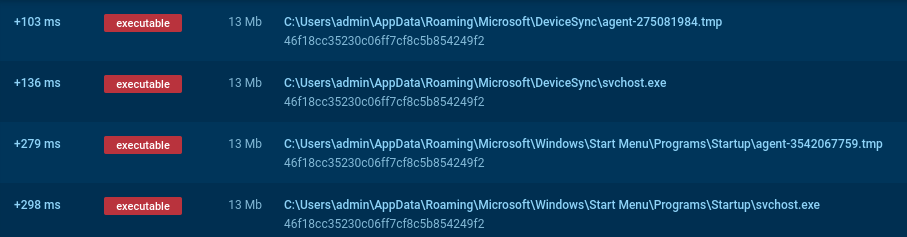
In addition, the sample modifies a Windows Registry autorun key to establish another startup mechanism.
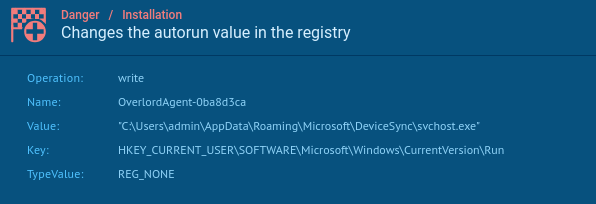
This combination provides redundant persistence, meaning that the malware has multiple ways to regain execution if one mechanism is removed.
Stage 3: Mutex Masquerading
The sample creates a mutex using a name associated with a legitimate Windows component: Global\BFE_Notify_Event_{...}

The use of a name associated with the Windows Base Filtering Engine (BFE) can make the mutex appear less suspicious during analysis and may help the malware avoid standing out among legitimate system objects.
A mutex can also help malware coordinate execution and prevent multiple instances of the same component from running simultaneously.
Stage 4: Encrypted C2 Communication
After establishing itself on the system, the agent communicates with the Overlord server using encrypted WebSocket connections (WSS).
This provides a persistent communication channel through which the agent and server can exchange information and commands.
The framework's server component is implemented using TypeScript and Node.js/Bun, while operators can interact with connected agents through a web panel or Electron client.
Stage 5: C2 Through an Ngrok Tunnel
The analyzed sample communicates with its C2 through an ngrok tunnel.

Ngrok provides a tunnel between the infected system and the remote service, which can obscure the attacker's underlying infrastructure from the victim's network.
For defenders, this means that the visible destination may belong to the tunneling service rather than directly revealing the infrastructure operated by the attacker.
Stage 6: Remote Control
Once the agent establishes its C2 connection, the framework provides the operator with a mechanism for remotely managing the compromised host.
Commands can be issued through the framework's control interface and transmitted to connected agents through the C2 channel.
This remote-access capability is the central function of Overlord RAT and distinguishes it from malware designed solely for information collection or payload delivery.
Stage 7: Persistence
Unlike Windows-only RATs, Overlord is designed as a cross-platform framework. Its agents support Windows, Linux, and macOS.
This architecture allows the same broader framework to be deployed across different operating system environments, although specific functionality may depend on the agent and platform.
Understanding Overlord RAT Behavior
The analyzed Windows sample demonstrates several notable behaviors:
- Go-based agent provides the malware's endpoint component.
- Windows process masquerading uses the filename svchost-windows-amd64-a8d100a3.exe.
- Multiple persistence mechanisms place copies in the DeviceSync directory and Startup folder while modifying a Registry autorun key.
- Mutex masquerading uses a name associated with the legitimate Windows BFE component.
- Encrypted WebSocket communication provides the C2 channel between the agent and server.
- Ngrok tunneling is used to route C2 traffic and conceal the underlying infrastructure.
- Web/Electron management provides operators with an interface for controlling connected agents.
- Cross-platform support extends the framework to Windows, Linux, and macOS.
Together, these capabilities allow Overlord RAT to establish a persistent presence, communicate with remote infrastructure, and provide operators with remote access to compromised systems.
How Threat Intelligence Can Help Investigate Overlord RAT
Because Overlord is a developing RAT/framework, samples may differ in configuration, filenames, infrastructure, and implementation. Defenders should therefore combine static indicators with behavioral and network analysis.
ANY.RUN’s Threat Intelligence can help analysts investigate suspicious Overlord activity by connecting samples with associated infrastructure and observable behaviors.
Threat Intelligence Lookup can be used to pivot from a suspicious sample or indicator toward:
- Related Overlord RAT samples
- Associated domains and IP addresses
- C2 infrastructure
- WebSocket or WSS connections
- Persistence mechanisms
- Suspicious Registry modifications
- Startup-folder activity
- Mutex names
- Related processes and files
- Previous sandbox executions
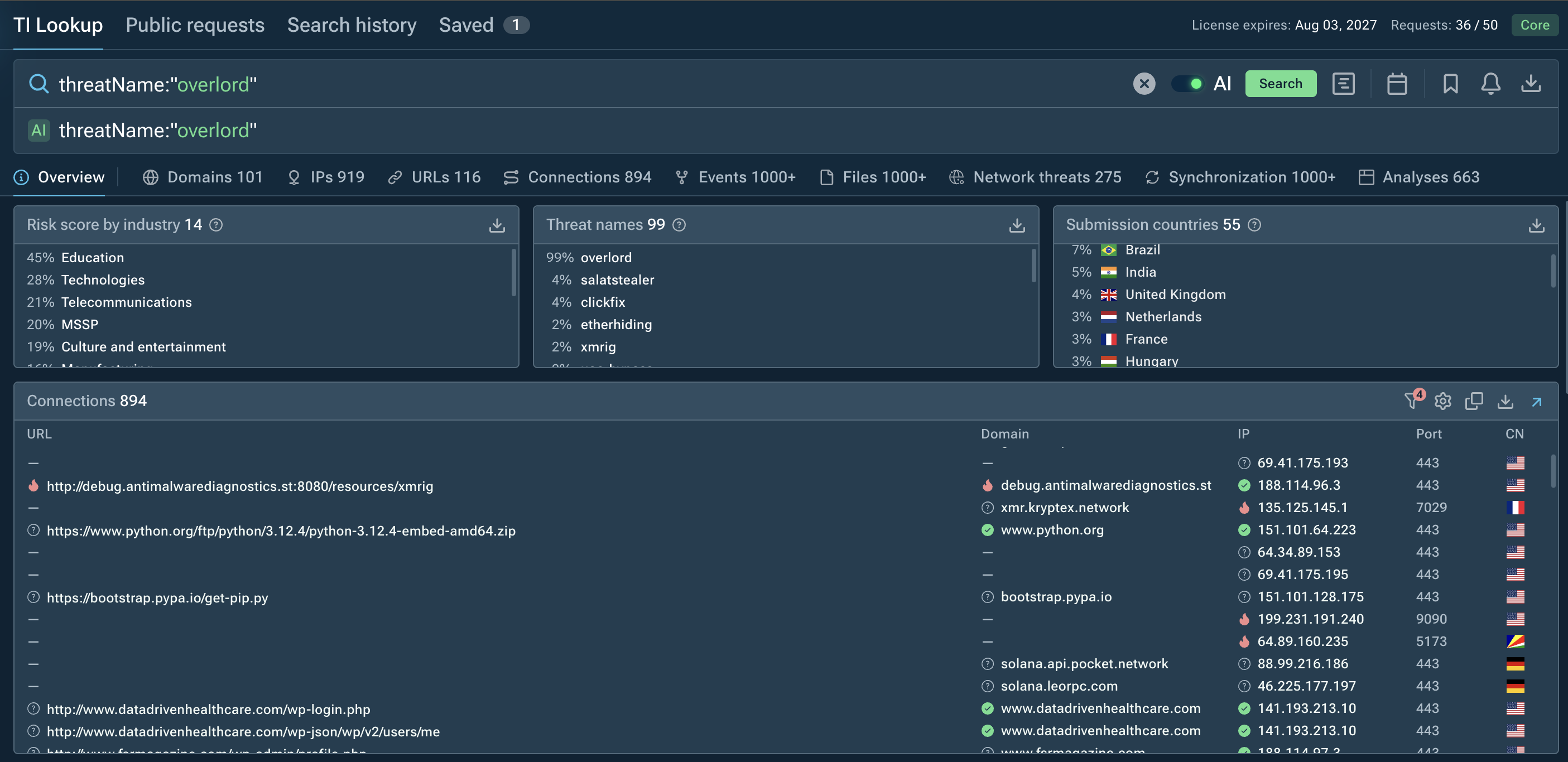
Overlord RAT Detection Indicators
Defenders investigating potential Overlord RAT activity can monitor for:
- Executables using names that resemble legitimate system processes
- Unexpected copies of executables in user Startup locations
- New files under unusual AppData directories
- Registry autorun modifications associated with unknown executables
- Creation of mutexes using names associated with legitimate Windows components
- Unexpected WSS/WebSocket connections from suspicious processes
- Network connections involving ngrok infrastructure
- Persistent outbound connections from newly executed binaries
- Suspicious cross-platform RAT agents appearing on organizational endpoints
These behaviors can provide useful detection opportunities even when filenames, hashes, or C2 destinations change.
Overlord RAT Incident Response
If Overlord RAT is identified on an endpoint, organizations should investigate both the malware and the mechanisms used to maintain remote access.
Recommended actions include:
- Isolate the affected endpoint where appropriate.
- Preserve relevant forensic evidence before removing artifacts.
- Identify the original Overlord agent and any copies created during execution.
- Review Startup-folder contents for suspicious executables.
- Inspect Registry autorun locations for recently added entries.
- Investigate suspicious mutex creation and associated processes.
- Review WSS/WebSocket connections made by the suspected agent.
- Investigate ngrok-related network activity associated with the compromise.
- Search other endpoints for matching filenames, paths, registry entries, or behavioral indicators.
- Review authentication and endpoint telemetry for activity associated with the compromised host.
Because Overlord RAT provides remote access, defenders should also investigate what actions may have been performed while the agent was active.
Conclusion
Overlord RAT is a cross-platform remote access framework built around Go-based agents and a TypeScript/Node/Bun server architecture. Its agents communicate with the C2 infrastructure through encrypted WebSocket connections and can be managed through web or Electron-based interfaces.
The analyzed Windows sample demonstrates several behaviors relevant to defenders, including multiple persistence mechanisms, Windows process masquerading, mutex masquerading, encrypted C2 communication, and ngrok-based tunneling.
Monitoring for suspicious Startup and Registry modifications, unusual AppData executables, masquerading filenames, unexpected WSS connections, and ngrok-related traffic can help organizations identify potential Overlord RAT activity.
Frequently Asked Questions: Overlord RAT
1. What is Overlord RAT?
Overlord RAT is a publicly available cross-platform remote access trojan (RAT) framework designed to provide remote access to compromised systems. Its agents are written in Go, while the server component uses TypeScript with Node.js/Bun.
2. Which operating systems does Overlord RAT support?
Overlord RAT supports Windows, Linux, and macOS, allowing the framework to operate across different operating system environments.
3. How does Overlord RAT communicate with its C2 server?
Overlord RAT supports encrypted WebSocket communication using WSS, allowing agents to exchange commands and information with the C2 server.
4. Does Overlord RAT establish persistence?
Yes. Overlord RAT can use persistence mechanisms to help maintain access to compromised systems after the initial execution. The specific mechanisms may vary depending on the platform and implementation.
5. Can Overlord RAT disguise its activity?
Overlord RAT can employ masquerading techniques, such as using filenames or system object names that resemble legitimate components, to make malicious activity less conspicuous.
6. Does Overlord RAT use a mutex?
Overlord RAT can create mutexes as part of its execution. Depending on the implementation, mutex names may also be designed to resemble legitimate system components.
7. Can Overlord RAT use tunneling services for C2?
Overlord RAT can use tunneling services such as ngrok as part of its C2 infrastructure. Such services can provide an intermediary between the agent and remote infrastructure.
8. How can interactive sandboxing and threat intelligence help investigate Overlord RAT?
Interactive sandboxing allows analysts to examine Overlord RAT's execution, persistence, process activity, and network communications.
Threat intelligence can then help connect observed indicators with related samples, infrastructure, and other activity.
Other malware & phishing threats
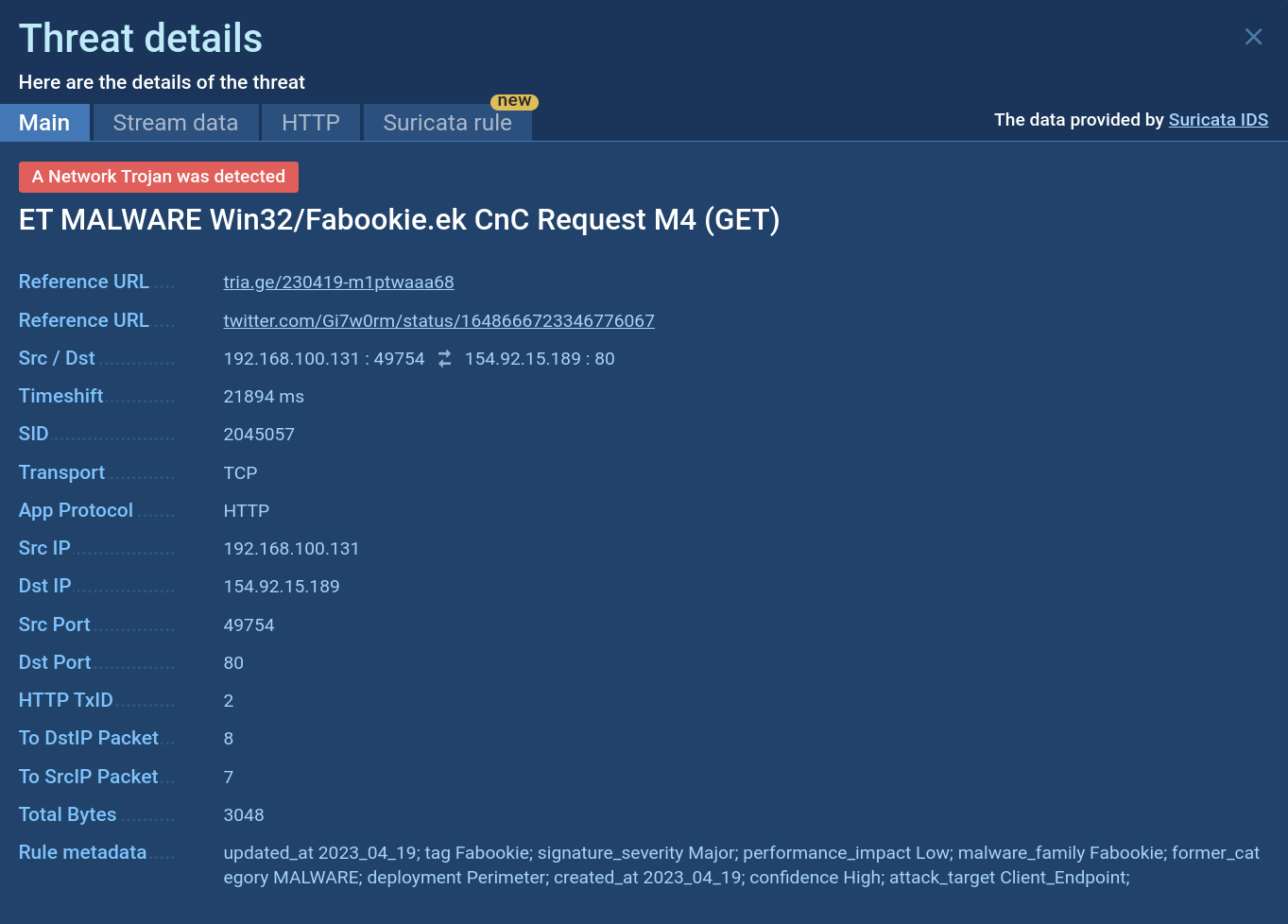 FabookieFabookie is an infostealer malware that was first observed as early as October 2021. The threat is known for targeting account credentials of Facebook users. The collected information is then sold by the attackers to other criminals. Fabookie is often distributed via loaders such as SmokeLoader.
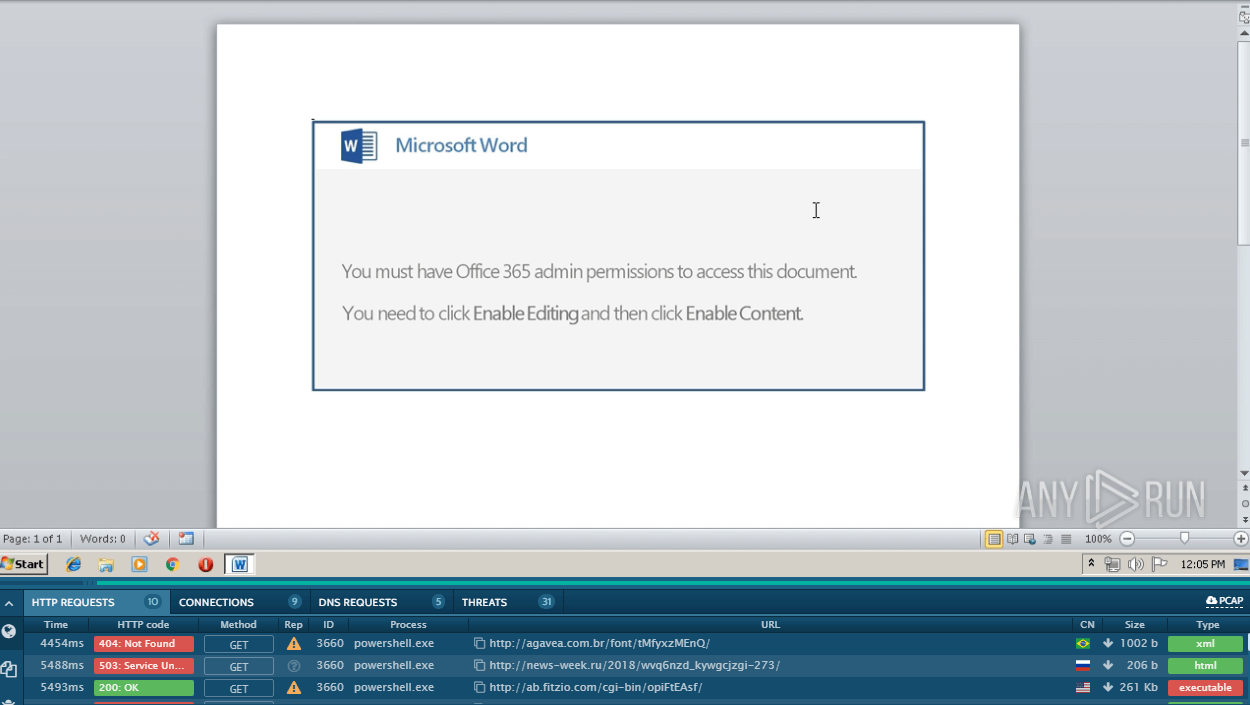 EmotetEmotet is one of the most dangerous trojans ever created. Over the course of its lifetime, it was upgraded to become a very destructive malware. It targets mostly corporate victims but even private users get infected in mass spam email campaigns.
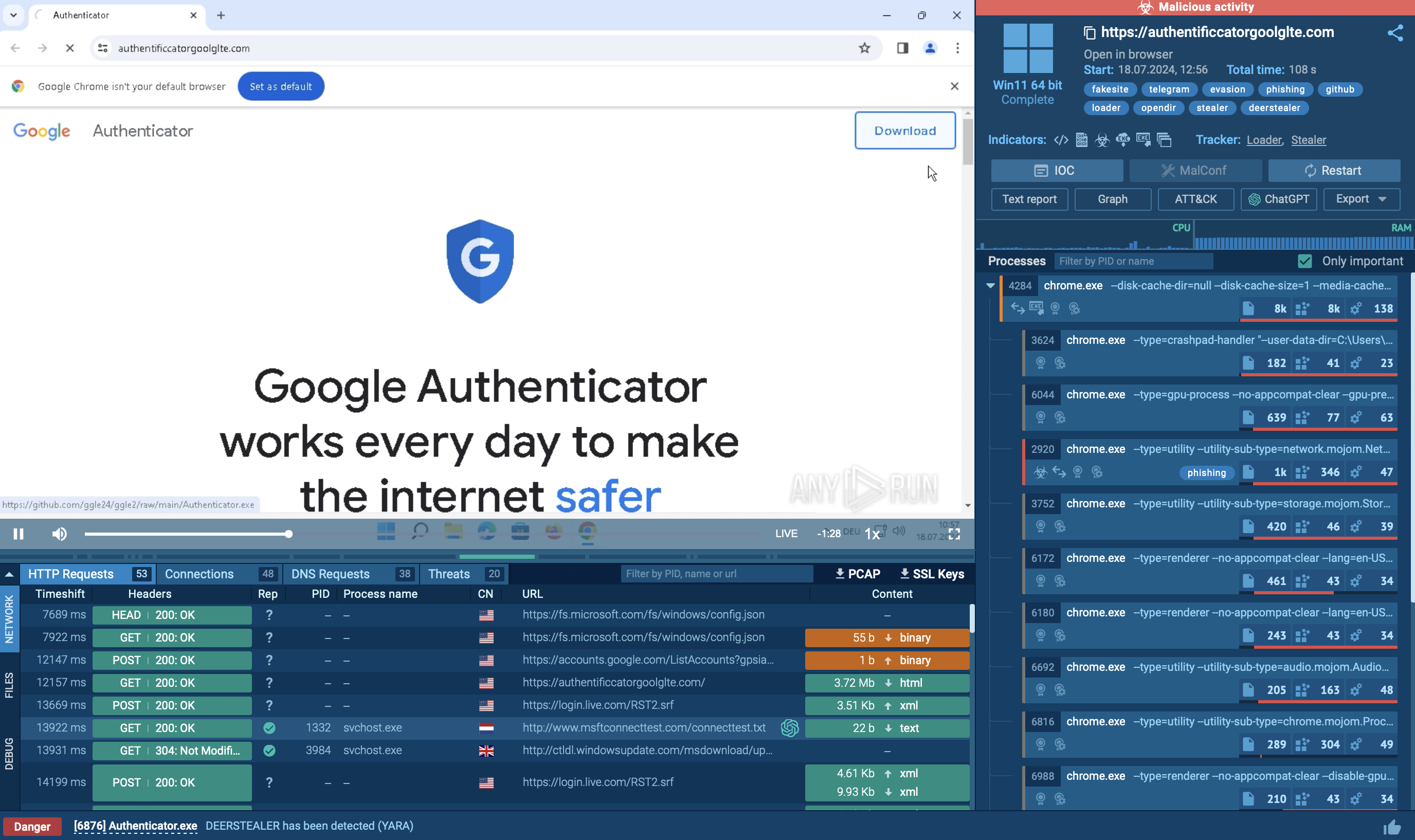 DeerStealerDeerStealer is an information-stealing malware discovered in 2024 by ANY.RUN, primarily targeting sensitive data such as login credentials, browser history, and cryptocurrency wallet details. It is often distributed through phishing campaigns and fake Google ads that mimic legitimate platforms like Google Authenticator. Once installed, it exfiltrates the stolen data to a remote command and control (C2) server. DeerStealer’s ability to disguise itself as legitimate downloads makes it particularly dangerous for unsuspecting users.
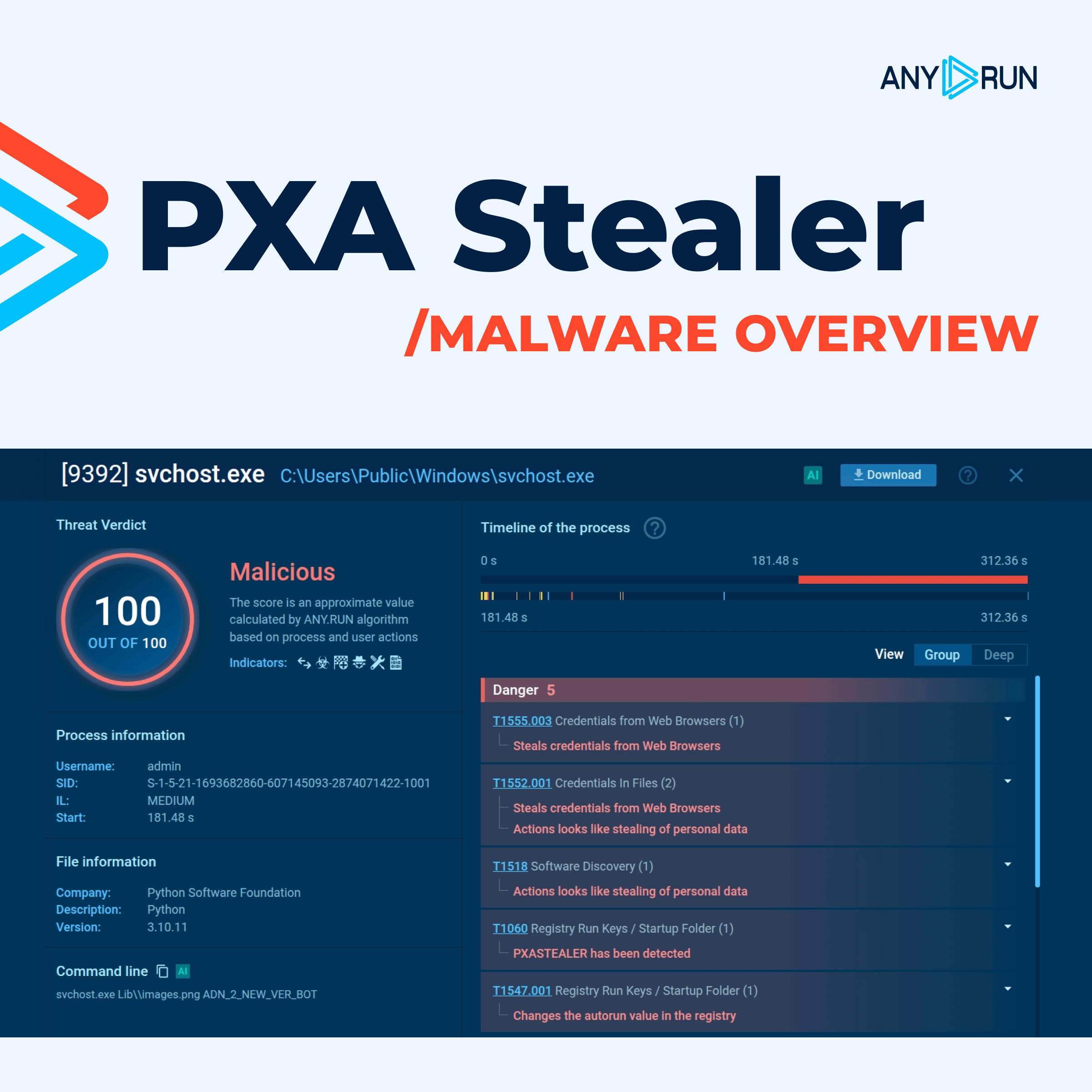 PXA StealerPXA Stealer is an information-stealing malware that targets individuals and organizations in 60+ countries. It spreads via phishing, archives, and fake software updates. DLL sideloading, decoy documents, and obfuscation help it evade security tools. Exfiltrated data is exfiltrated and monetized through underground marketplaces.
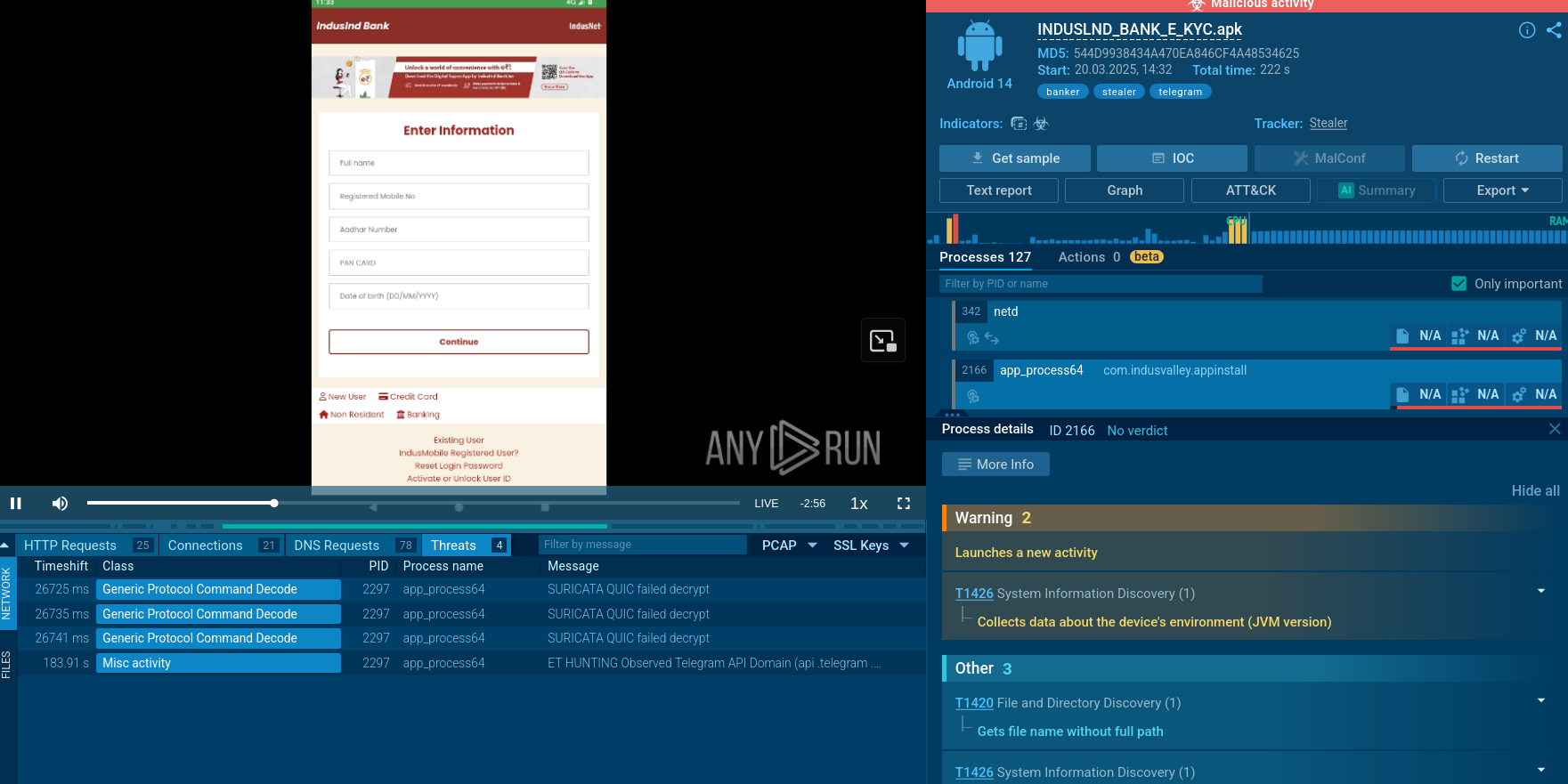 Salvador StealerSalvador Stealer is a powerful, information-stealing Android malware designed to silently infiltrate systems, extract sensitive data, and exfiltrate it to cybercriminals. Often sold on underground forums, it is part of the growing ecosystem of “stealers-as-a-service” (SaaS) tools that target individuals and organizations alike.
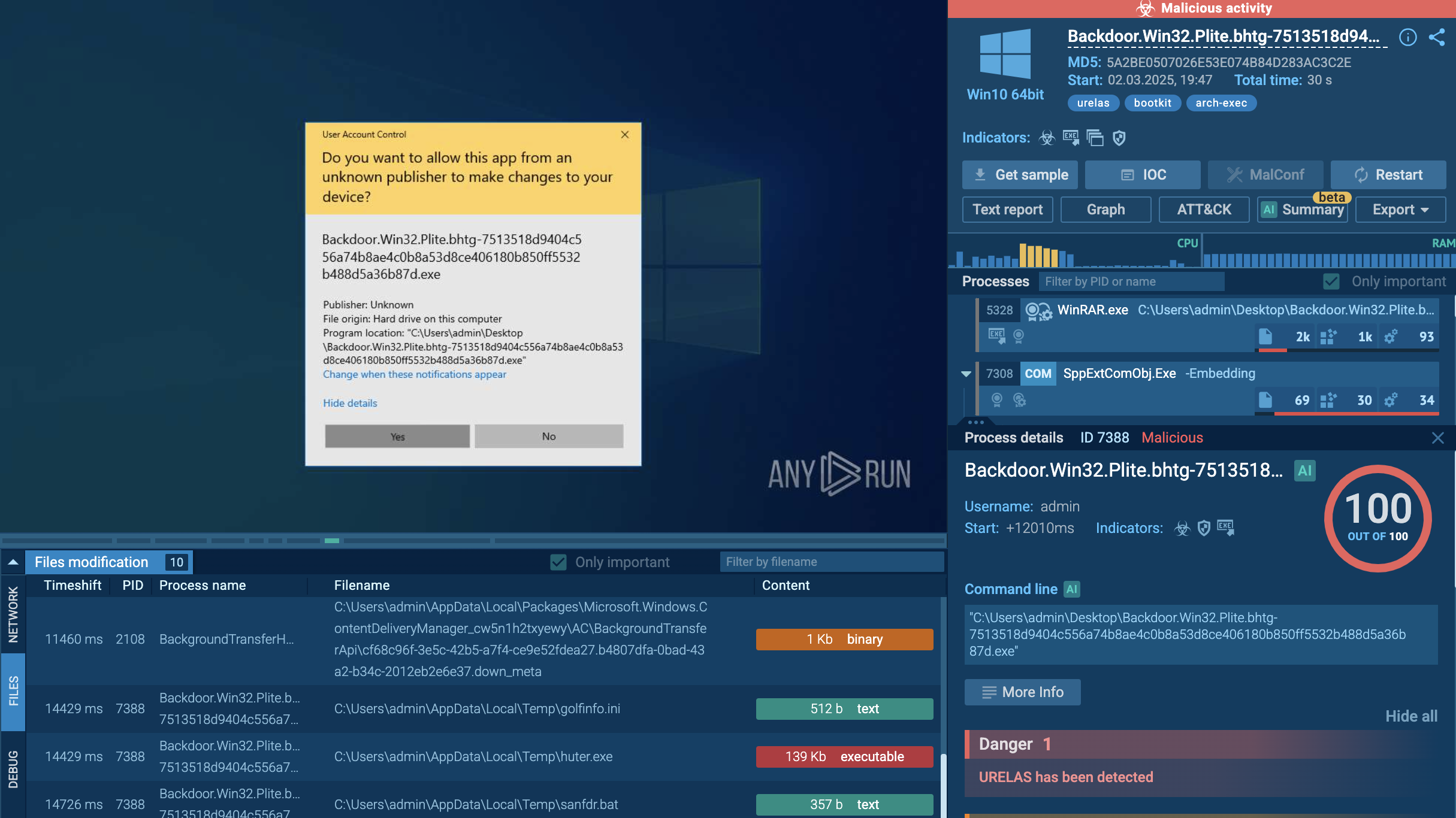 RootkitA rootkit is a type of malicious software designed to provide unauthorized administrative-level access to a computer or network while concealing its presence. Rootkits are tools used by cybercriminals to hide their activities, including keyloggers, spyware, and other malware, often enabling long-term system exploitation.