Black friday Up to 3 extra licenses FOR FREE + Special offer for TI LOOKUP Get it now
Webinar
February 26
Better SOC with Interactive Sandbox Practical Use Cases
Register now
20
Global rank
33 infographic chevron month
Month rank
49 infographic chevron week
Week rank
0
IOCs

Quasar is a very popular RAT in the world thanks to its code being available in open-source. This malware can be used to control the victim’s computer remotely.

RAT
Type
Unknown
Origin
1 January, 2015
First seen
31 August, 2026
Last seen

How to analyze Quasar RAT with ANY.RUN

RAT
Type
Unknown
Origin
1 January, 2015
First seen
31 August, 2026
Last seen

IOCs

IP addresses
142.251.20.139
62.60.226.185
64.89.163.22
196.251.107.186
104.21.43.241
178.16.52.133
192.162.199.186
178.16.54.109
217.145.226.130
172.66.47.35
103.231.14.104
192.178.183.139
103.45.66.107
185.199.111.133
94.26.90.90
48.209.138.189
62.60.226.232
88.221.169.205
15.204.108.68
183.214.164.143
Hashes
8739c76e681f900923b900c9df0ef75cf421d39cabb54650c4b9ad19b6a76d85
aac73b3148f6d1d7111dbca32099f68d26c644c6813ae1e4f05f6579aa2663fe
2ed27c1421e6928dbe13dbfdb5c59e1045b30341fe7ebe05700006bc5ac572c0
dc58d8ad81cacb0c1ed72e33bff8f23ea40b5252b5bb55d393a0903e6819ae2f
c43668eec4a8d88a5b3a06a84f8846853fe33e54293c2db56899a5a5dfb4d944
c9f9f193409217f73cc976ad078c6f8bf65d3aabcf5fad3e5a47536d47aa6761
28042dd4a92a0033b8f1d419b9e989c5b8e32d1d2d881f5c8251d58ce35b9063
0d7240d074ba544c90df72d5e339978aa2edc19f4a02c0a302718d851b11c384
319cd301cf40be03c00cd086560d4e810e0f6d0dbfdc2d28d6af3522c027cf49
60a172e81a2c07e2006465f8625306e385b4fe57fca02ad5da8af91527ed6de9
b22118c3159d96c061e3e6f668cb26f0c679bb96fccd2c788584d3e2a64c4c35
ba25fefad8a545281ae6f99515926717ebe8c1146805795bedd32041192a0688
bd2c2cf0631d881ed382817afcce2b093f4e412ffb170a719e2762f250abfea4
db0c7e3029fb2a048e7a3e74c9cbf3e8bcec06288b5eafac5aae678d8663bffc
388a796580234efc95f3b1c70ad4cb44bfddc7ba0f9203bf4902b9929b136f95
eff52743773eb550fcc6ce3efc37c85724502233b6b002a35496d828bd7b280a
70211a3f90376bbc61f49c22a63075d1d4ddd53f0aefa976216c46e6ba39a9f4
4259e53d48a3fed947f561ff04c7f94446bedd64c87f52400b2cb47a77666aaa
5ae7c0972fd4e4c4ae14c0103602ca854377fefcbccd86fa68cfc5a6d1f99f60
282696487ea5dc781788d5d8477b977f72b7c70f201c2af0cfe7e1a9fd8d749a
Domains
pardu.pages.dev
www.microsoft.com
refaccionesalma.com.mx
safebrowsingohttpgateway.googleapis.com
github.com
themaintechnician.us
m.meta-dm.com
fe3cr.delivery.mp.microsoft.com
safeuploadz.com
release-assets.githubusercontent.com
shadowroute.io
processhacker.sourceforge.net
crl.sectigo.com
funneldiy.com
mainhold.duckdns.org
baolongwes.oss-ap-southeast-1.aliyuncs.com
slscr.update.microsoft.com
status.thawte.com
luizmatoso.com.br
dl.ijinshan.com
URLs
https://go.microsoft.com/fwlink/?linkid=2257403&clcid=0x409
https://login.live.com/rst2.srf
https://login.live.com/ppsecure/deviceaddcredential.srf
http://ocsp.digicert.com/mfewtzbnmeswstajbgurdgmcgguabbq50otx%2fh0ztl%2bz8sipi7wewvxdlqqutijuibiv5unu5g%2f6%2brks7qyxjzkceaz1vqyrvgl0erhqlcpm8gy%3d
https://settings-win.data.microsoft.com/settings/v3.0/wsd/waasassessment?os=windows&osver=10.0.19041.1.amd64fre.vb_release.191206-&ring=retail&sku=48&deviceclass=windows.desktop&locale=en-us&deviceid=bad99146-31d3-4ec6-a1a4-be76f32ba5d4&flightring=retail&telemetrylevel=1&hidovergattreg=c%3a%5cwindows%5csystem32%5cdriverstore%5cfilerepository%5chidbthle.inf_amd64_9610b4821fdf82a5%5cmicrosoft.bluetooth.profiles.hidovergatt.dll&appver=10.0&processoridentifier=amd64%20family%2023%20model%201%20stepping%202&oemmodel=dell&updateoffereddays=4294967295&processormanufacturer=authenticamd&installdate=1661339444&oemmodelbaseboard=&branchreadinesslevel=cb&oemsubmodel=j5cr&isclouddomainjoined=0&deferfeatureupdateperiodindays=30&isdeviceretaildemo=0&flightingbranchname=&osuilocale=en-us&devicefamily=windows.desktop&wuclientver=10.0.19041.3996&uninstallactive=1&isflightingenabled=0&osskuid=48&processorclockspeed=3094&totalphysicalram=6144&securebootcapable=0&app=waasassessment&processorcores=6&currentbranch=vb_release&installlanguage=en-us&deferqualityupdateperiodindays=0&servicingbranch=cb&oemname_uncleaned=dell&tpmversion=0&primarydisktotalcapacity=262144&installationtype=client&attrdataver=186&processormodel=amd%20ryzen%205%203500%206-core%20processor&isedgewithchromiuminstalled=1&osversion=10.0.19045.4046&ismdmenrolled=0&activationchannel=retail&honorwufbdeferrals=0&firmwareversion=a.40&trendinstalledkey=1&osarchitecture=amd64&defaultuserregion=244&updatemanagementgroup=2
http://crl.microsoft.com/pki/crl/products/microoceraut2011_2011_03_22.crl
http://www.microsoft.com/pkiops/crl/micsecserca2011_2011-10-18.crl
https://settings-win.data.microsoft.com/settings/v3.0/onesettings/client?osversionfull=10.0.19045.4046.amd64fre.vb_release.191206-1406&localdeviceid=s%3abad99146-31d3-4ec6-a1a4-be76f32ba5d4&flightring=retail&attrdataver=186&osuilocale=en-us&osskuid=48&app=wosc&appver=&isflightingenabled=0&telemetrylevel=1&devicefamily=windows.desktop
https://settings-win.data.microsoft.com/settings/v3.0/flightsettings/fsservice?processorclockspeed=3094&isretailos=1&oemmanufacturername=dell&flightingpolicyvalue=3&enablepreviewbuilds=4294967295&osversionfull=10.0.19045.4046.amd64fre.vb_release.191206-1406&managepreviewbuilds=3&branchreadinesslevelsource=0&attrdataver=186&processorcores=6&branchreadinesslevelraw=16&totalphysicalram=6144&tpmversion=0&oemmodelnumber=dell&systemvolumetotalcapacity=260281&deviceid=s%3abad99146-31d3-4ec6-a1a4-be76f32ba5d4&app=fss&appver=10.0&smartactivehoursstate=1&activehoursstart=20&securebootcapable=0&activehoursend=13&devicefamily=windows.desktop
https://settings-win.data.microsoft.com/settings/v3.0/wsd/muse?processorclockspeed=3094&flightids=&updateoffereddays=4294967295&branchreadinesslevel=cb&oemmanufacturername=dell&isclouddomainjoined=0&processoridentifier=amd64%20family%2023%20model%201%20stepping%202&sku=48&activationchannel=retail&attrdataver=186&ismdmenrolled=0&processorcores=6&processormodel=amd%20ryzen%205%203500%206-core%20processor&totalphysicalram=6144&primarydisktype=4294967295&flightingbranchname=&chassistypeid=1&oemmodelnumber=dell&systemvolumetotalcapacity=260281&sampleid=95271487&deviceclass=windows.desktop&app=muse&disabledualscan=0&appver=10.0&oemsubmodel=j5cr&locale=en-us&isalwaysonalwaysconnectedcapable=0&ms=0&defaultuserregion=244&updateserviceurl=http%3a%2f%2fneverupdatewindows10.com&osver=10.0.19045.4046.amd64fre.vb_release.191206-1406&os=windows&deviceid=s%3abad99146-31d3-4ec6-a1a4-be76f32ba5d4&deferqualityupdateperiodindays=0&ring=retail&deferfeatureupdateperiodindays=30
https://slscr.update.microsoft.com/sls/%7b522d76a4-93e1-47f8-b8ce-07c937ad1a1e%7d/x64/10.0.19045.4046/0?ch=686&l=en-us&p=&pt=0x30&wua=10.0.19041.3996&mk=dell&md=dell
https://fe3cr.delivery.mp.microsoft.com/clientwebservice/ping
http://www.microsoft.com/pkiops/crl/microsoft%20ecc%20update%20secure%20server%20ca%202.1.crl
https://slscr.update.microsoft.com/sls/ping
https://slscr.update.microsoft.com/sls/%7be7a50285-d08d-499d-9ff8-180fdc2332bc%7d/x64/10.0.19045.4046/0?ch=686&l=en-us&p=&pt=0x30&wua=10.0.19041.3996&mk=dell&md=dell
https://settings-win.data.microsoft.com/settings/v3.0/wsd/updatehealthtools?os=windows&osver=10.0.19041.1.amd64fre.vb_release.191206-&sku=48&deviceclass=windows.desktop&locale=en-us&deviceid=s:bad99146-31d3-4ec6-a1a4-be76f32ba5d4&sampleid=s:95271487&appver=10.0.19041.3626&flightring=retail&telemetrylevel=1&hidovergattreg=c%3a%5cwindows%5csystem32%5cdriverstore%5cfilerepository%5chidbthle.inf_amd64_9610b4821fdf82a5%5cmicrosoft.bluetooth.profiles.hidovergatt.dll&appver=&processoridentifier=amd64%20family%2023%20model%201%20stepping%202&oemmodel=dell&updateoffereddays=4294967295&processormanufacturer=authenticamd&installdate=1661339444&oemmodelbaseboard=&branchreadinesslevel=cb&oemsubmodel=j5cr&isclouddomainjoined=0&deferfeatureupdateperiodindays=30&isdeviceretaildemo=0&flightingbranchname=&osuilocale=en-us&devicefamily=windows.desktop&wuclientver=10.0.19041.3996&uninstallactive=1&isflightingenabled=0&osskuid=48&processorclockspeed=3094&totalphysicalram=6144&securebootcapable=0&app=sedimentpack&processorcores=6&currentbranch=vb_release&installlanguage=en-us&deferqualityupdateperiodindays=0&oemname_uncleaned=dell&tpmversion=0&primarydisktotalcapacity=262144&installationtype=client&attrdataver=186&processormodel=amd%20ryzen%205%203500%206-core%20processor&isedgewithchromiuminstalled=1&osversion=10.0.19045.4046&ismdmenrolled=0&activationchannel=retail&firmwareversion=a.40&trendinstalledkey=1&osarchitecture=amd64&defaultuserregion=244&updatemanagementgroup=2
https://wj32.org/processhacker/update.php
http://processhacker.sourceforge.net/update.php
https://processhacker.sourceforge.net/update.php
https://processhacker.sourceforge.io/update.php
Last Seen at

Recent blog posts

post image
US Finance Under Phishing Pressure: What the...
watchers 4905
comments 0
post image
A Single Canadian Tax Lure Spread into a 46-C...
watchers 11329
comments 0
post image
North Korean IT Workers Scheme: Detection IOC...
watchers 13623
comments 0

What is Quasar RAT?

Quasar is a remote access trojan is used by attackers to take remote control of infected machines. It is written using the .NET programming language and is available to a wide public as an open-source project for Microsoft Windows operating systems, making it a popular RAT featured in many attacks.

General description of Quasar RAT

Quasar RAT was first discovered in 2015 by security researchers, who, at the time, speculated that an in-house development team wrote this RAT after performing the analysis of a sample. However, Quasar is an evolution of an older malware called xRAT, and some of its samples can carry out as many as 16 malicious actions.

Over the course of its lifetime, the malware has been updated several times, improving its overall functionality. The last version of the malware, which the original author developed, is v. 1.3.0.0. It was released in 2016. Since then, several third parties have adapted the RAT and issued their own version, both minor and major, with the last major version being v. 2.0.0.1.

The RAT we are reviewing today consists of two main components – the server-side component and the Quasar client-side component. The server is equipped with a graphical user interface, and it is used for managing connections with the client-side programs. The Quasar client-server architecture is also utilized to build malware samples which are eventually delivered to potential victims. Malware users can select attributes and customize the executable to fit the attacker's needs. The Quasar client and server run on different OSs including all Windows versions.

The functionality of the resulting malware includes remote file management on the infected machine, registry alterations, recording the actions of the victim, establishing remote desktop connections, and more. All of the data including requests are sent to the host server with the user-agent strings.

Get started today for free

Analyze malware and phishing in a fully-interactive sandbox

Create free account

It should be noted that Quasar's execution can unfold completely silently. Thus, once the victim downloads and launches the Quasar client, usually delivered in a document via email, it can stay active for a long period of time, stealing data and giving the hacker control over the infected PC. The malware does generate a process that can be discovered using the Windows Task Manager or a similar application, but active user actions are required to discover Quasar trojan's presence on a machine.

As far as creators of this malware are concerned, the group of people or a person behind the original version of this malware managed to remain anonymous. As a result, the little-known information that we do have does not go beyond the name of the GitHub page author, which states “quasar.”

As evident from the description on the “official” Quasar GitHub page, this malware is presented as a legitimate remote administration program, which is clearly misleading. In fact, Quasar was featured in an attack aimed at the US government early in 2017. Later the same year, another wave of attacks using this malware occurred, targeting the private sector.

Quasar RAT malware analysis

The execution process of this malware can be viewed in a video recorded in the ANY.RUN malware hunting service, allowing to perform analysis of how the contamination process unfolds.
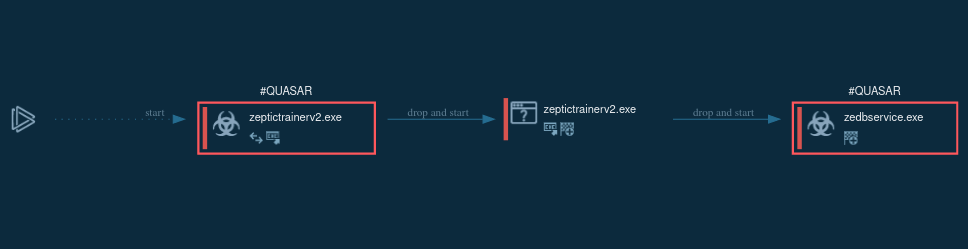
process graph of the quasar stealer execution Figure 1: Displays the lifecycle of Quasar in a visual form, as shown on the graph generated by ANY.RUN.
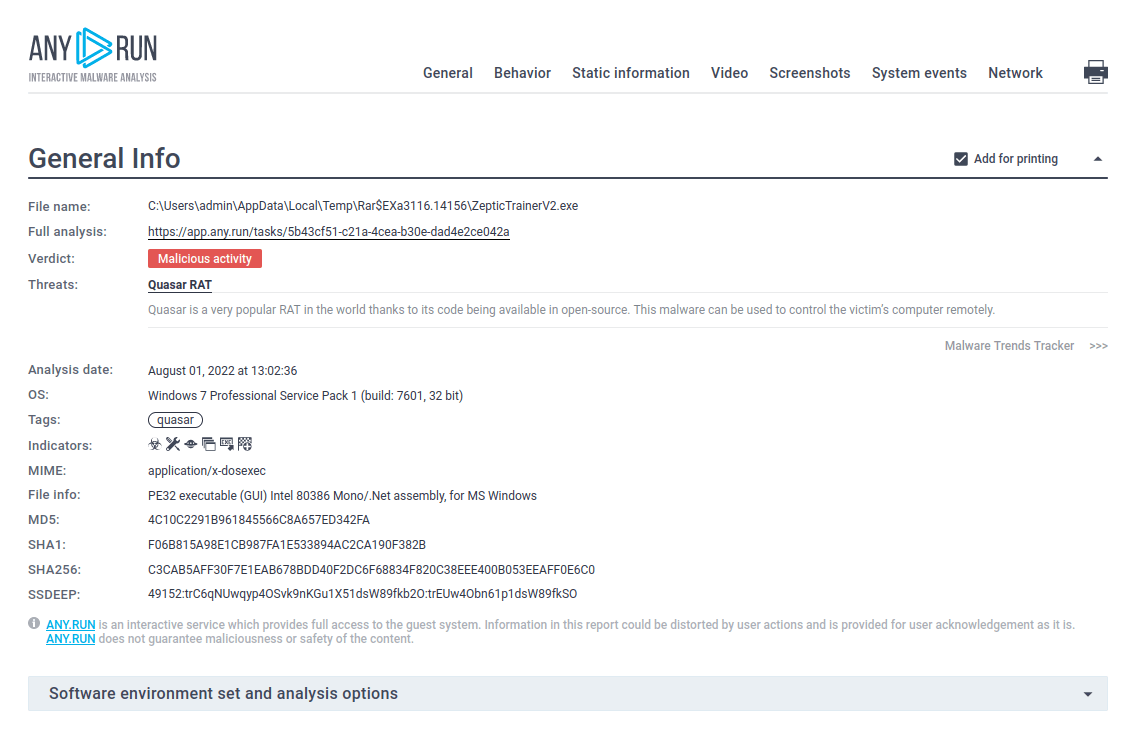
text report of quasar analysis Figure 2: Shows a customizable text report generated by the ANY.RUN malware hunting service.

Quasar RAT execution process

Based on the analysis, Quasar execution is pretty straightforward but can vary in minor details from sample to sample. The RAT's user-agent strings fake various processes such as a browser running on Windows. In the given example, Quasar was dropped from a Microsoft Office file. Then, the dropped file changed the registry value to run with every operating system start, checked for external IP, and copied itself at another location. After all these steps, the malware started the main malicious activity - collecting information about the operating system and waiting for commands from the C2 server. Quasar allows malware users to collect host system data.

How to avoid infection by Quasar?

Quasar trojan writes itself into scheduled tasks and uses registry keys to achieve persistence, allowing the malware the run every time a machine is started. The persistence method is chosen based on user privileges. If the user has admin rights, the malware uses schtasks to create a scheduled task that launches after a user logs on with the highest run level. If admin rights are lacking, then the scheduled task can only go as far as adding a registry value configured in the client builder and added to the current path as the startup program. The best way to avoid infection is for cybersecurity specialists gt to know various user-agent strings that exist in their network, and identify suspicious user-agent strings.

Distribution of Quasar RAT

Like most other RATs, for example Crimson RAT or Orcus RAT, Quasar is distributed in email spam campaigns that carry the malware’s loader. The loader is embedded in a malicious file attachment which usually carries a name designed to trick the user into thinking that they are receiving some sort of a document. Sometimes these files will have a double extension such as docx.exe. Again, this is done to trick the victim into thinking that the attached file is harmless. Of course, once opened, such files start a command prompt rather than Microsoft Office.

How to detect Quasar RAT using ANY.RUN?

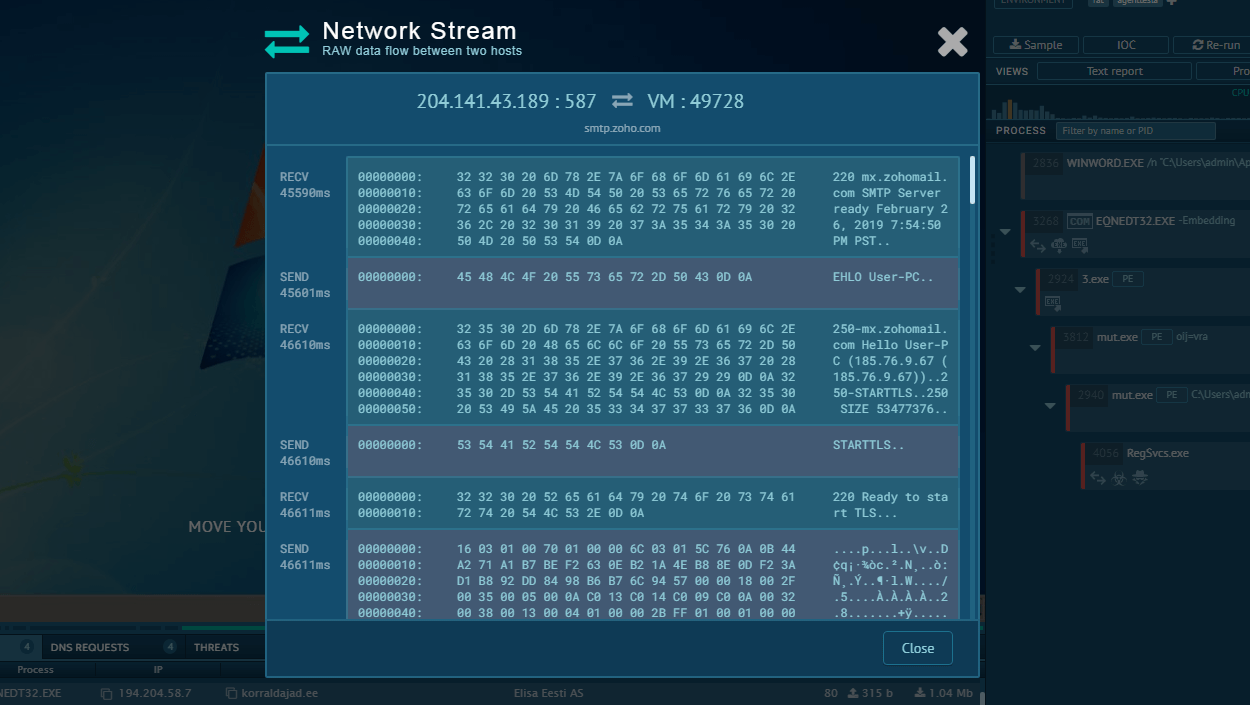
ANY.RUN uses Suricata IDS rule sets, so if malware tries to communicate with C&C servers, it will be detected. To look at what threats were detected, just click on the "Threats" section of the "Network" tab.
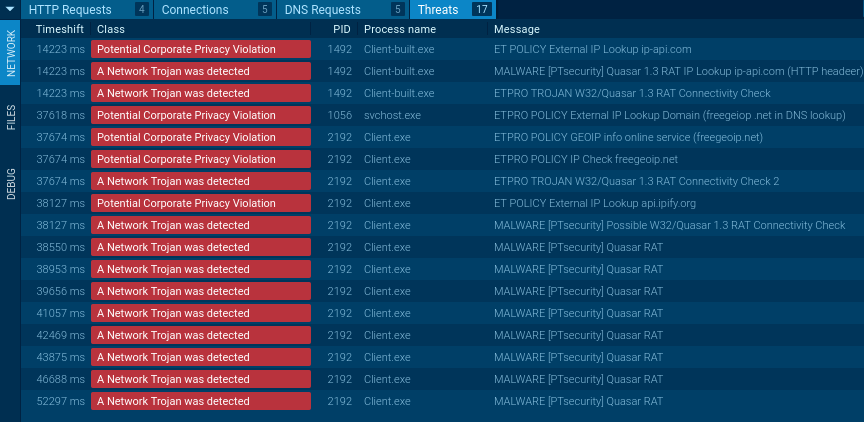
quasar network threats Figure 3: Quasar network threats

Conclusion

Quasar trojan is a powerful open-source malware equipped with a robust persistence mechanism and a complete feature set of malicious capabilities. Being available to anybody with programming knowledge, Quasar became a widely used RAT which was even featured in an attack targeted at the American government.

However, unlike other more advanced Trojans, Quasar RAT does not have extremely sophisticated anti-analysis features, which makes setting up robust cyber-defense an easier task, especially when using malware hunting services like ANY.RUN to simplify and streamline the research process.
HAVE A LOOK AT

CryptoWall screenshot
CryptoWall
cryptowall
CryptoWall is a notorious ransomware family that emerged in early 2014 and rapidly became one of the most destructive cyber threats of its time. This malware encrypts victims' files using strong AES encryption, demands ransom payments in Bitcoin, and has generated hundreds of millions of dollars for cybercriminals.
Read More
Havoc screenshot
Havoc
havoc
Havoc is an advanced post-exploitation framework used by hackers to take control of a system once they've breached it. With Havoc, attackers can run commands remotely, inject malicious processes, and access sensitive data. It's often used in targeted attacks, allowing cybercriminals to stay hidden in a network while stealing information or launching further attacks. Its flexibility and ability to bypass detection make it a serious threat, especially in environments that rely on traditional security tools.
Read More
Rootkit screenshot
Rootkit
rootkit bootkit
A rootkit is a type of malicious software designed to provide unauthorized administrative-level access to a computer or network while concealing its presence. Rootkits are tools used by cybercriminals to hide their activities, including keyloggers, spyware, and other malware, often enabling long-term system exploitation.
Read More
Jigsaw screenshot
Jigsaw
jigsaw
The Jigsaw ransomware, initially detected in 2016, encrypts files on compromised systems and requires a ransom payment in Bitcoin. If the ransom is not paid, the malware starts deleting files, increasing the pressure on victims to comply. Its source code is publicly accessible, allowing various threat actors to customize and repurpose the malware for different objectives.
Read More
DeerStealer screenshot
DeerStealer
deerstealer
DeerStealer is an information-stealing malware discovered in 2024 by ANY.RUN, primarily targeting sensitive data such as login credentials, browser history, and cryptocurrency wallet details. It is often distributed through phishing campaigns and fake Google ads that mimic legitimate platforms like Google Authenticator. Once installed, it exfiltrates the stolen data to a remote command and control (C2) server. DeerStealer’s ability to disguise itself as legitimate downloads makes it particularly dangerous for unsuspecting users.
Read More
Socelars screenshot
Socelars
socelars
Socelars is an information-stealing Trojan (often categorized as spyware/stealer) that focuses on collecting sensitive data from Windows systems, with standout reporting around Facebook Ads Manager and session cookie theft. Unlike “noisy” malware that immediately breaks something, Socelars quietly converts a single infected machine into access: logged-in sessions, business account data, and pathways to monetization.
Read More