Webinar
February 26
Better SOC with Interactive Sandbox
Practical Use Cases

Makop is a Phobos-derived Ransomware-as-a-Service model that predominantly targets exposed and vulnerable RDP endpoints. Rather than executing as a standalone automated threat, human operators manually navigate the compromised network to escalate privileges, map assets, and disable active defense solutions before deploying the payload.
|
Ransomware
Type
:
|
Unknown
Origin
:
|
|
1 February, 2020
First seen
:
|
4 September, 2026
Last seen
:
|
|
Type
:
|
Unknown
Origin
:
|
|
1 February, 2020
First seen
:
|
4 September, 2026
Last seen
:
|

 4611
4611
 0
0
 6582
0
6582
0
 9728
0
9728
0
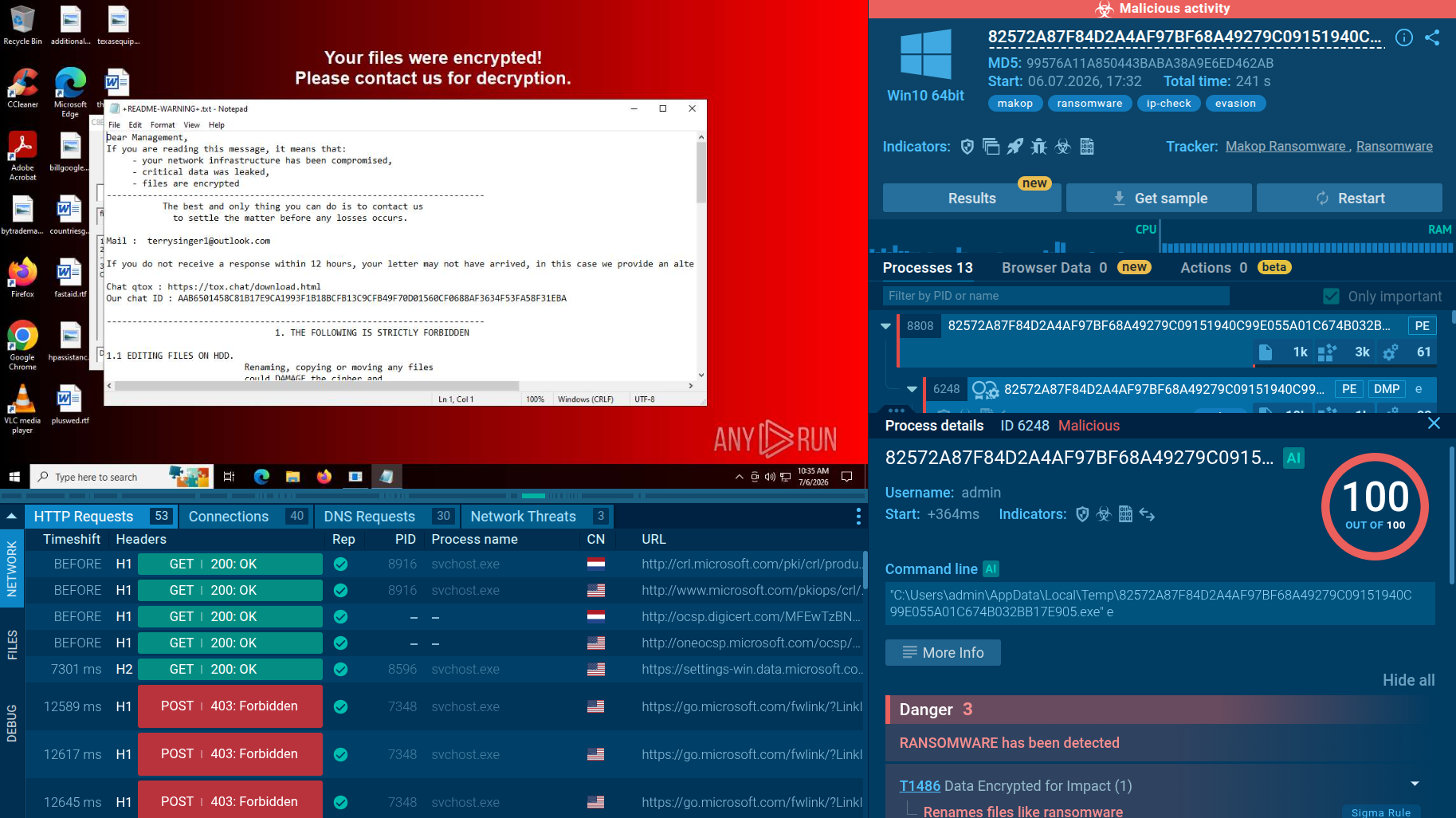 Makop Ransomware analyzed inside ANY.RUN’s Interactive Sandbox
Makop Ransomware is an adaptable encryption threat designed to extort businesses. Originating around 2020 as a variant of the Phobos ransomware family, Makop has updated its methods to match current cyber threats. Instead of acting as a standalone, automated file locker, Makop operates as Ransomware-as-a-Service (RaaS). In this model, core developers maintain the code while independent affiliates launch the attacks, resulting in an average ransom demand of about $15,000 per incident.
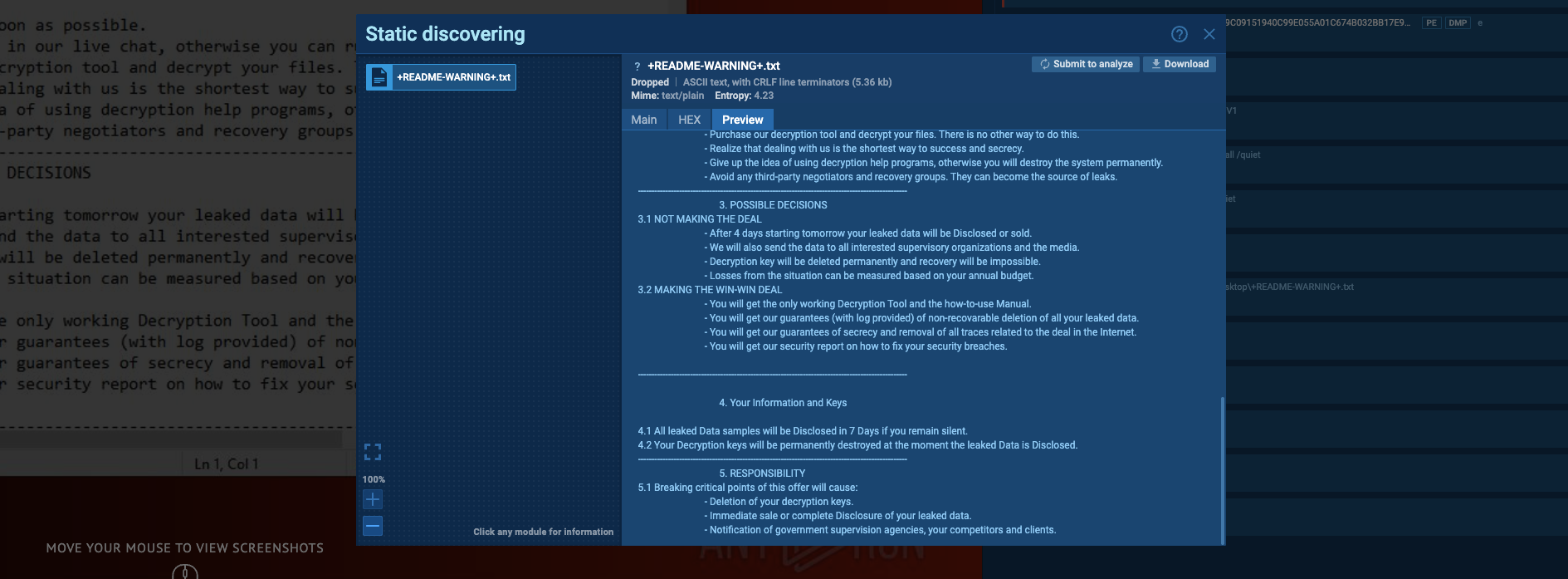 Makop ransomware ransom note shown inside ANY.RUN’s Interactive Sandbox
In terms of operation, Makop has shifted its primary methodology. While early versions relied on basic execution techniques, modern Makop campaigns use human-operated network intrusions. This manual approach means that once initial access is gained, human attackers actively move through the victim's environment. They harvest credentials, locate high-value systems, and disable internal defenses before encrypting any data.
To challenge enterprise security controls, Makop’s delivery methods have also evolved. Security data shows the integration of GuLoader (a downloader active since 2019) to drop secondary Makop payloads. This is an important shift: by using loaders to run defense evasion routines prior to deployment, Makop operators can bypass standard signature-based perimeter security. Combining a standardized RaaS business model with multi-stage attack tactics makes Makop a persistent threat to mid-market and enterprise organizations globally.
For modern enterprises, the primary threat of a Makop ransomware intrusion does not stem from a single, highly advanced exploit. Instead, it relies on the group's ability to systematically disable defenses, harvest internal credentials, and move laterally to maximize operational downtime.
Once inside a network, Makop operators maintain a fallback portfolio of local privilege escalation (LPE) exploits targeting core Windows subsystems (such as BITS, Win32k, and Windows Installers). If one exploit fails or is blocked by an active patch, the attacker cycles to another LPE primitive in their toolkit until administrative control is achieved.
Rather than writing complex custom kernel exploits, threat actors leverage signed, legitimate third-party drivers that contain known memory-access vulnerabilities. By registering these drivers as system services, they gain kernel-level access, allowing them to bypass operating system security boundaries and forcibly terminate Endpoint Detection and Response (EDR) solutions.
In addition to using generic tools to disable built-in Microsoft Defender protections, Makop operators deploy customized software uninstallers. These uninstallers are specifically tailored to silently remove regional security products (such as Quick Heal AV) popular in their primary target countries, demonstrating that the threat group adapts its toolkit based on the security solutions they expect to encounter.
Attackers leverage memory extraction tools to harvest plaintext passwords and authentication tokens directly from Windows memory, while simultaneously using specialized database harvesters to extract credentials stored locally across web browsers, email clients, and system databases.
For discovery and lateral movement, operators combine these stolen credentials with widely used network and port scanners. Because these scanning tools are frequently utilized by legitimate IT administrators, their network mapping activities easily blend into standard daily operational traffic, preventing SOC teams from flagging the pre-encryption reconnaissance phase.
Makop targets organizations opportunistically, focusing on companies where IT security weaknesses make an attack low-cost and easy to execute. A considerable share of its attacks falls on countries in the EU, LATAM, and other regions.
The biggest risk factor for a Makop intrusion is having Remote Desktop Protocol (RDP) services exposed to the public internet without proper protections. Many vulnerable organizations run external RDP on default ports without enforcing Multi-Factor Authentication (MFA) or strict account lockout rules This leaves them open to automated RDP password-guessing and dictionary attacks. Threat actors use standard brute-force tools to crack weak credentials and gain quick access to the internal network.
Ideal targets include organizations that rely only on static, signature-based antivirus, run unpatched legacy systems, or grant widespread local admin rights to users.
Detonating a Makop Ransomware sample inside ANY.RUN’s Interactive Sandbox shows that the runtime behavior of the malware proceeds through five distinct operational phases.
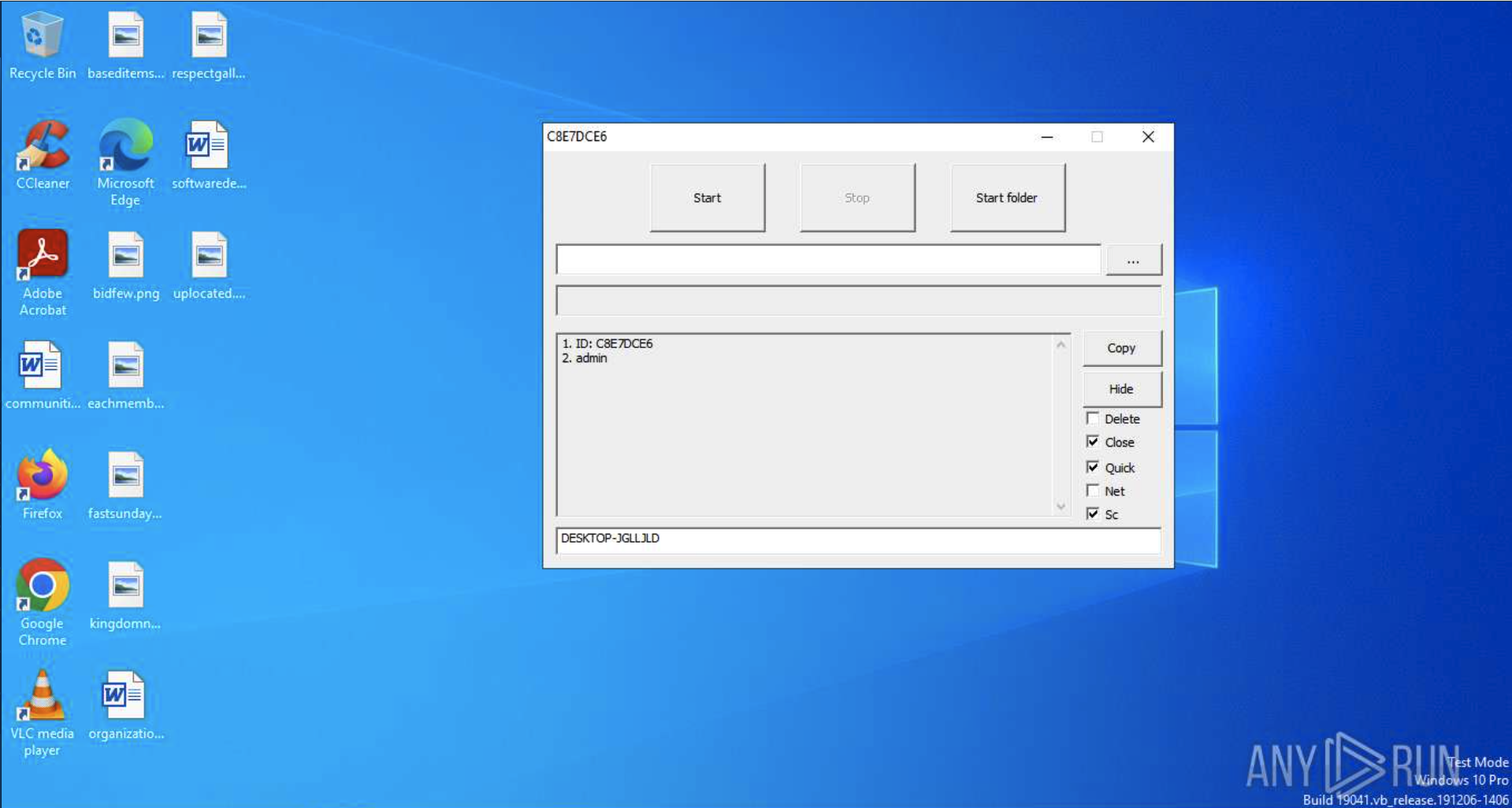 Makop ransomware GUI window running on the Windows desktop
Unlike self-replicating worms, Makop relies on an operator-led intrusion chain.
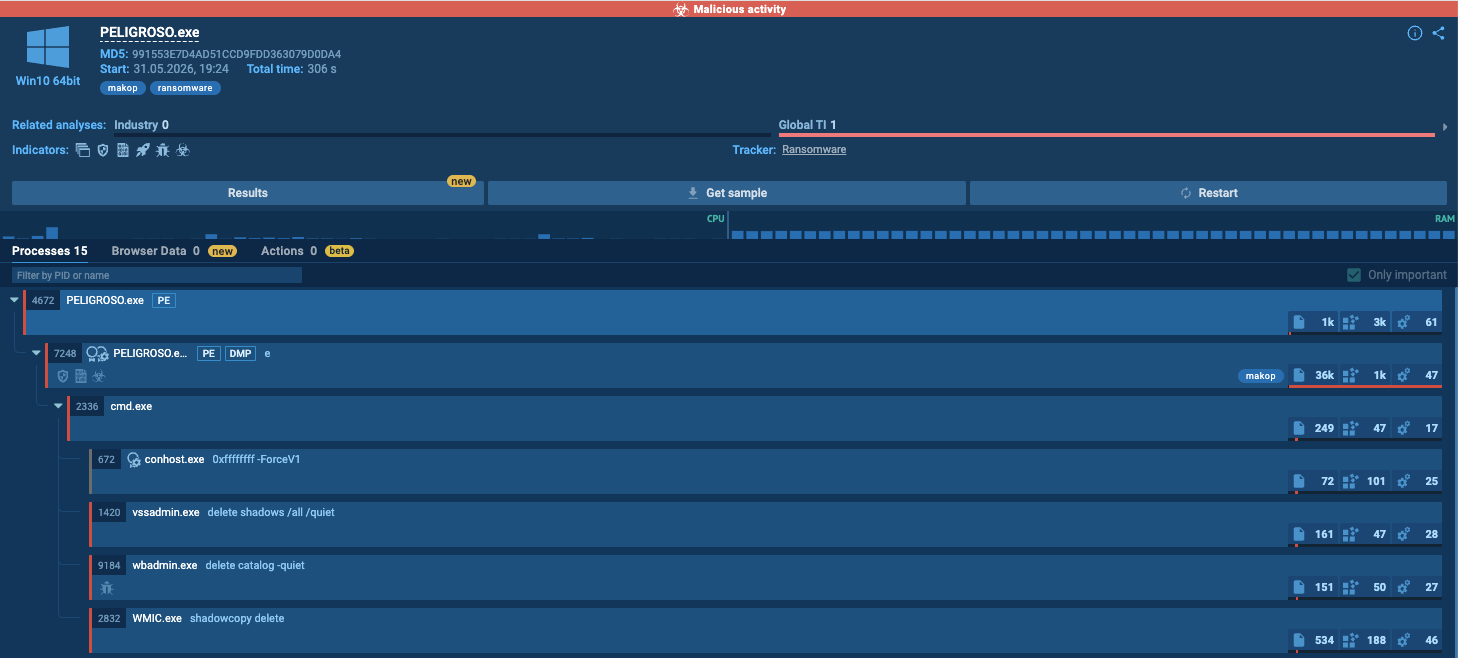 Process tree in ANY.RUN showing system utilities spawned to delete shadow copies
Upon launching the binary, the threat actor uses a local, interactive GUI dashboard to modify execution logic on the fly:
 Files modification log showing encrypted files with .decrypt extension
To prevent administrators from restoring systems without paying, Makop executes background process commands to eliminate backup redundancy:
 Files modification log showing encrypted files with .gines extension
After destroying recovery paths, the ransomware encrypts target files and renames them using a partner-specific template: File_Name.Extension.[8-Character_ID].[Email_Address].[Ransomware_Extension].
Makop ransomware ransom note shown inside ANY.RUN’s Interactive Sandbox
Because Makop uses a RaaS model, contact emails and file extensions vary by affiliate deployment:
After completing the encryption loop, the ransomware executes post-compromise actions to notify the victim and exfiltrate data:
Because Makop operates as an evolving Ransomware-as-a-Service (RaaS) with rotating affiliate infrastructure, contact emails, and appended file extensions, traditional static blocklists are insufficient for long-term protection. Security teams must shift from tracking temporary indicators to identifying durable technical fingerprints and behavioral patterns of the operation. By leveraging ANY.RUN’s Threat Intelligence, organizations can stay ahead of these evolving campaigns.
Threat Intelligence Lookup allows analysts to pivot from a single suspicious artifact to an entire cluster of related malicious activity:
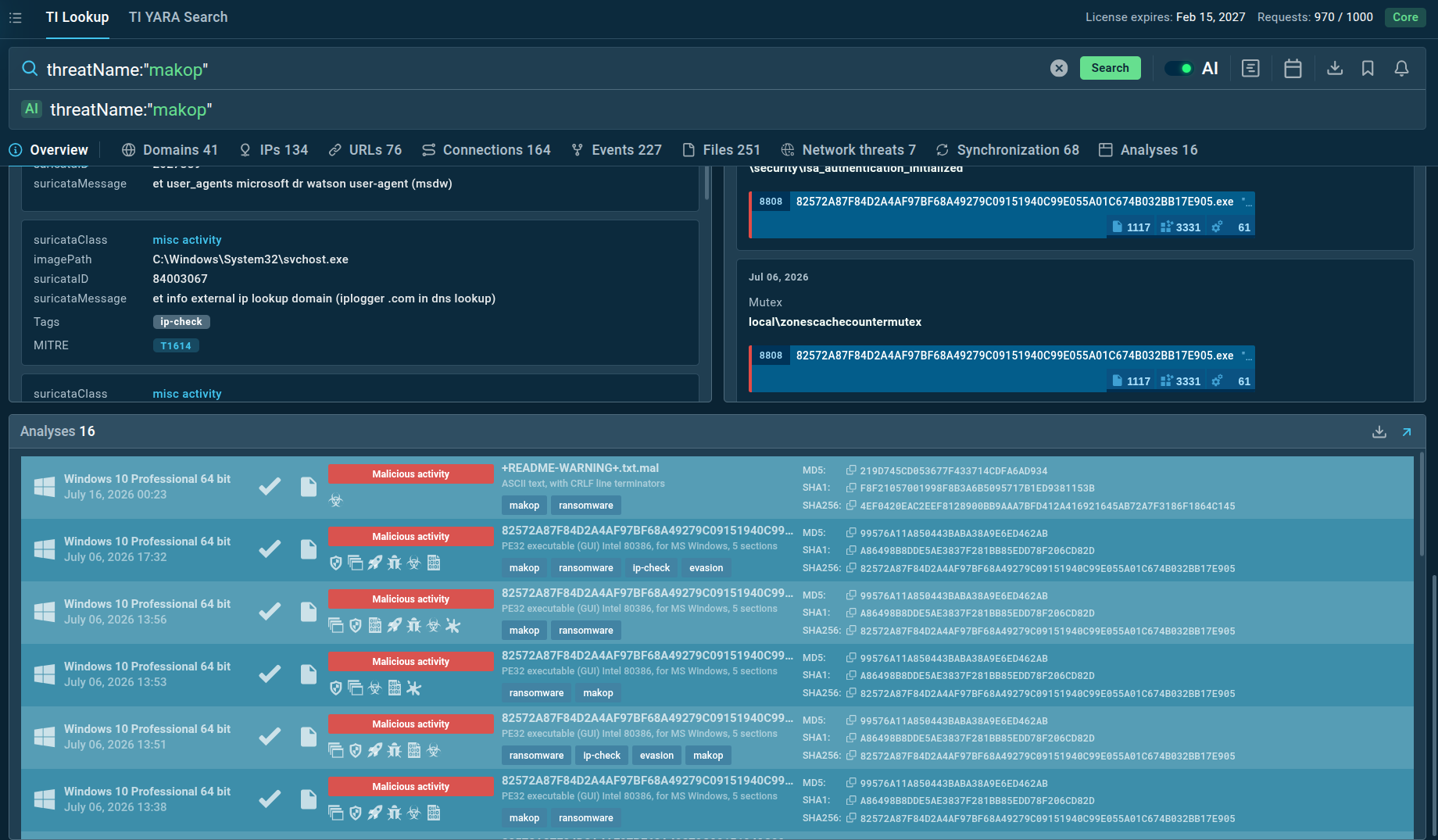 TI Lookup provides SOC teams with actionable intel on Makop Ransomware
Threat Intelligence Lookup provides actionable Makop indicators and TTPs, delivering complete context on the threat. This includes rich intelligence on Makop attacks, such as C2 network indicators, BYOVD vulnerable drivers, dynamic file extensions, as well as full sandbox sessions demonstrating the entire execution cycle from staging to encryption.
For organizations requiring automated, high-speed protection, ANY.RUN’s Threat Intelligence Feeds provide a real-time stream of validated indicators. These feeds deliver a continuous flow of the latest C2 domains, malicious IPs, and payload hashes directly into SIEM, SOAR, and EDR platforms. By integrating these feeds, SOC teams can automatically block emerging malicious infrastructure and detect active intrusions before the final encryption phase occurs.
The ongoing global exploitation of Makop Ransomware proves a critical truth in enterprise cybersecurity: threat actors do not require complex, custom zero-day exploits to inflict devastating operational damage. By leveraging a low-complexity, human-operated intrusion strategy, combining unsecured RDP perimeters with public privilege escalation exploits and legitimate, vulnerable drivers, Makop operators reliably bypass security stacks and execute high-impact corporate extortion.
To counter this threat, organizations must move beyond static signature checks. Defending against RaaS affiliates requires a multi-layered security posture that prioritizes proactive external hardening (such as enforcing multi-factor authentication and strict account lockout rules) alongside aggressive patch management for local privilege escalation (LPE) vulnerabilities.
Makop is a corporate extortion ransomware strain that first appeared around 2020 as an offshoot of the Phobos ransomware family. It is operated under a Ransomware-as-a-Service (RaaS) model, where developers sell the encryptor framework to independent affiliates who execute targeted, human-operated network intrusions. The average extortion demand for a successful Makop compromise is approximately $15,000 USD.
Makop affiliates use a multi-tiered defense-evasion pipeline. To neutralize basic protections, they deploy lightweight tools like Defender Control and Disable Defender to disable Windows Defender. For more advanced endpoint agents, they leverage "Bring Your Own Vulnerable Driver" (BYOVD) tactics, loading signed, legitimate third-party drivers (such as ThrottleStop.sys or hlpdrv.sys) that contain memory-access vulnerabilities to execute kernel-level commands and forcibly terminate EDR agents. Additionally, they abuse legitimate administrative tools (like Process Hacker and IOBitUnlocker) and deploy customized uninstall software to target and remove regional antivirus products.
Because modern Makop attacks are manual, human-guided intrusions, securing administrative rights is a critical step in the lateral movement phase. Makop operators maintain a diverse fallback portfolio of Windows LPE exploits targeting core OS components (such as BITS, Win32k, and Windows Installers). By using exploits with reliable, publicly available Proof-of-Concepts (PoCs), the operators ensure they can consistently escalate local permissions to the SYSTEM level, which is required to load their vulnerable drivers, terminate security agents, and destroy system backup catalogs.
Upon execution, Makop immediately launches a series of background process-tree commands to eliminate all localized recovery redundancy. It utilizes native Windows administrative system utilities to wipe the Windows backup catalog (wbadmin delete catalog -quiet), silently delete all Volume Shadow Copies (vssadmin delete shadows /all /quiet), and ensure any remaining shadow volumes are completely eradicated via Windows Management Instrumentation (wmic shadowcopy delete).
Security teams should monitor their networks for: