Black friday Up to 3 extra licenses FOR FREE + Special offer for TI LOOKUP Get it now
Webinar
February 26
Better SOC with Interactive Sandbox Practical Use Cases
Register now
82
Global rank
162 infographic chevron month
Month rank
137 infographic chevron week
Week rank
0
IOCs

Glupteba is a loader with information-stealing and traffic routing functionality. It is designed primarily to install other viruses on infected PCs but can do much more than that. In addition, it is being constantly updated, making this virus one to watch out for.

Loader
Type
Unknown
Origin
1 January, 2011
First seen
3 June, 2026
Last seen

How to analyze Glupteba with ANY.RUN

Type
Unknown
Origin
1 January, 2011
First seen
3 June, 2026
Last seen

IOCs

IP addresses
144.202.14.107
48.192.1.64
40.126.32.74
185.199.109.133
162.159.133.233
104.21.25.36
48.209.133.15
23.52.181.212
135.232.92.137
45.154.252.116
116.202.84.94
2.16.164.120
172.211.123.248
48.209.138.189
92.123.104.44
91.195.241.232
172.67.222.87
74.178.240.51
77.42.3.118
74.125.250.129
Hashes
b1c321b5e495473a401bd6e6adfe1ec931f8247b1b2646b0e259bff011a0958c
757c647dd89797e5cf86f2a286a8151b1aa9a9f828e5898b0a8d57a5b175d4ad
c3fa59901d56ce8a95a303b22fd119cb94abf4f43c4f6d60a81fd78b7d00fa65
96ad1146eb96877eab5942ae0736b82d8b5e2039a80d3d6932665c1a4c87dcf7
f49b515eedeed1abe391bc32f15ce43d3582cb6c41ff944fa9c79f476d5824ba
d755c30a12acfa528f54541d9eee8cf54faf6fe7cb835dfc43cbb2cf3751c3ff
74bfc1a1f64090bb4c0c7a19b9fe32bb7836465a07dd369ab090d7f915991984
58075b74fb0b18c13ba41e06da879ebaf3131febed248aa15180be7ae5fe2c49
142a4cc96d518e6005b3e3f14c9435ac9e908d4700672f9d8cd12e333830340d
d4f344e36227177a8df20348fae3ad064a8b1b9aebb3a8a08578f3f31f124194
e38dcb2dab4d143baa646d660caeac828e371e6339f0a4870e3deffd1e16577c
772d772cb01940d7d32ea7f09db1e47c93a2636e33f4ed763da249fdf65276b0
baeb8bebf107c8e43c299ab574e23fc3337fc5a937d312302f8d1fc0e979b717
c0124aeb8efd50eae5bb8c1904cee4c67106ea8a60c771cea7893eaa5faf7b21
f632800dc961c46374dba818b8af17f1b770bfcb2d868e5ce10f2151b264ea26
945aced237dd73cef979bd4b6d99e0afa6a69e2c485d91a394aa4b27bb4cf524
5ca6657f540ea0ee30ac0ef6909b2532c8e41557ce68ec6396802155f0fc07c6
b429e25e7813a9e2b90dcec11d9cb5287751246128dd6c76a7349774829c5554
1e146ab127759a07a58c869ea63459fb611607750ea7c023ffe36a56079658c9
8a1c5901c7720bac07a9e73f3513dc451c3eb9ea72c5a280cfc255dd61aaa179
Domains
www.microsoft.com
settings-win.data.microsoft.com
www.bing.com
crl.microsoft.com
yuio.top
raw.githubusercontent.com
google.com
stun2.l.google.com
fe3cr.delivery.mp.microsoft.com
slscr.update.microsoft.com
electrum3.hodlister.co
self.events.data.microsoft.com
tomscryptos.com
client.wns.windows.com
activation-v2.sls.microsoft.com
electrum.emzy.de
electrumx.erbium.eu
vps.hsmiths.com
fortress.qtornado.com
cdn.discordapp.com
URLs
http://crl.microsoft.com/pki/crl/products/microoceraut2011_2011_03_22.crl
http://www.microsoft.com/pkiops/crl/micsecserca2011_2011-10-18.crl
https://activation-v2.sls.microsoft.com/slactivateproduct/slactivateproduct.asmx?configextension=retail
https://slscr.update.microsoft.com/sls/%7b522d76a4-93e1-47f8-b8ce-07c937ad1a1e%7d/x64/10.0.19045.4046/0?ch=686&l=en-us&p=&pt=0x30&wua=10.0.19041.3996&mk=dell&md=dell
http://www.microsoft.com/pkiops/crl/microsoft%20update%20signing%20ca%202.3.crl
http://crl.microsoft.com/pki/crl/products/microoceraut_2010-06-23.crl
http://www.microsoft.com/pkiops/crl/microsoft%20time-stamp%20pca%202010(1).crl
https://login.live.com/rst2.srf
http://www.microsoft.com/pkiops/crl/microsoft%20ecc%20product%20root%20certificate%20authority%202018.crl
http://www.microsoft.com/pkiops/crl/microsoft%20ecc%20update%20signing%20ca%202.3.crl
http://www.microsoft.com/pkiops/crl/microsoft%20update%20signing%20ca%202.2.crl
http://www.microsoft.com/pkiops/crl/microsoft%20ecc%20update%20signing%20ca%202.2.crl
https://login.live.com/ppsecure/deviceaddcredential.srf
https://fe3cr.delivery.mp.microsoft.com/clientwebservice/ping
https://slscr.update.microsoft.com/sls/ping
https://slscr.update.microsoft.com/sls/%7be7a50285-d08d-499d-9ff8-180fdc2332bc%7d/x64/10.0.19045.4046/0?ch=686&l=en-us&p=&pt=0x30&wua=10.0.19041.3996&mk=dell&md=dell
http://www.microsoft.com/pkiops/crl/microsoft%20update%20signing%20ca%202.1.crl
http://www.microsoft.com/pkiops/crl/microsoft%20ecc%20update%20signing%20ca%202.1.crl
https://settings-win.data.microsoft.com/settings/v3.0/wsd/muse?processorclockspeed=3094&flightids=&updateoffereddays=4294967295&branchreadinesslevel=cb&oemmanufacturername=dell&isclouddomainjoined=0&processoridentifier=amd64%20family%2023%20model%201%20stepping%202&sku=48&activationchannel=retail&attrdataver=186&ismdmenrolled=0&processorcores=6&processormodel=amd%20ryzen%205%203500%206-core%20processor&totalphysicalram=6144&primarydisktype=4294967295&flightingbranchname=&chassistypeid=1&oemmodelnumber=dell&systemvolumetotalcapacity=260281&sampleid=95271487&deviceclass=windows.desktop&app=muse&disabledualscan=0&appver=10.0&oemsubmodel=j5cr&locale=en-us&isalwaysonalwaysconnectedcapable=0&ms=0&defaultuserregion=244&updateserviceurl=http%3a%2f%2fneverupdatewindows10.com&osver=10.0.19045.4046.amd64fre.vb_release.191206-1406&os=windows&deviceid=s%3abad99146-31d3-4ec6-a1a4-be76f32ba5d4&deferqualityupdateperiodindays=0&ring=retail&deferfeatureupdateperiodindays=30
https://cdn.discordapp.com/attachments/1087398815188910163/1087399133926674453/lz.zip
Last Seen at

Recent blog posts

post image
Mirage2FA Hijacks Companies’ Microsoft 365 Se...
watchers 195
comments 0
post image
Intelligence-Driven SOC: Modernizing Threat M...
watchers 11403
comments 0
post image
Supply Chain Security: How ANY.RUN Helps US a...
watchers 6519
comments 0

What is Glupteba malware?

Glupteba is a dropper — it is commonly used to install other malware samples on infected machines. Although it was initially thought that Glupteba was developed to be a part of a malicious campaign codenamed Operation Windigo, researchers now believe that it is independent malware.

Although Glupteba trojan classifies as a dropper it has some additional dangerous functions. For example, it has the ability to steal information from infected systems. In addition, it can download a component that is able to control routers and relay traffic.

Furthermore, it seems that this malware is under active development and creators employ dangerous and rarely used techniques to keep their creation active despite various malware removal programs. The reason is probably behind their presumable move to a pay-per-install distribution scheme which means that they must keep the malware relevant to profit from it.

General description of Glupteba dropper

Glupteba malware was first spotted in the wild in 2011 when it was distributed by TDL-4 bootkit among a series of other malware types. The virus went quite for a long time thanks to the malware removal tools until it surfaced again three years later. This time Glupteba was seen in Operation Windigo.

In addition, researchers discovered that command and control domains of Glupteba dropper were hosted on the same machines that powered parts of the Operation Windigo infrastructure. However, the exact connection between Glupteba and Windigo is unclear.

Until recently we didn’t hear much about Glupteba trojan anymore before it surfaced again carrying new, dangerous functionally.

Today, apart from the main dropper functionality Glupteba malware comes with two components: the browsers stealer component and the router exploiter.

The browser stealer comes in two versions that target Chrome, Opera, and the Yandex browser. The malware is capable of stealing cookies and browser history as well as private login credentials.

Then there is the router exploiter component. It exploits the CVE-2018-14847 vulnerability to take control of the routers. This allows attackers to turn compromised routers into SOCKS proxies, which redirect traffic from compromised machines. Thus, infected routers can become relay points for spam distribution and more.

For instance, there is a theory that some of the relayed traffic is part of an attack on Instagram, though it is impossible to tell for sure due to the HTTP encryption.

Malware analysis of Glupteba

The video generated by the ANY.RUN interactive malware hunting service shows the execution process of Glupteba. You can also analyze other malicious objects like Ave Maria and Smoke Loader.
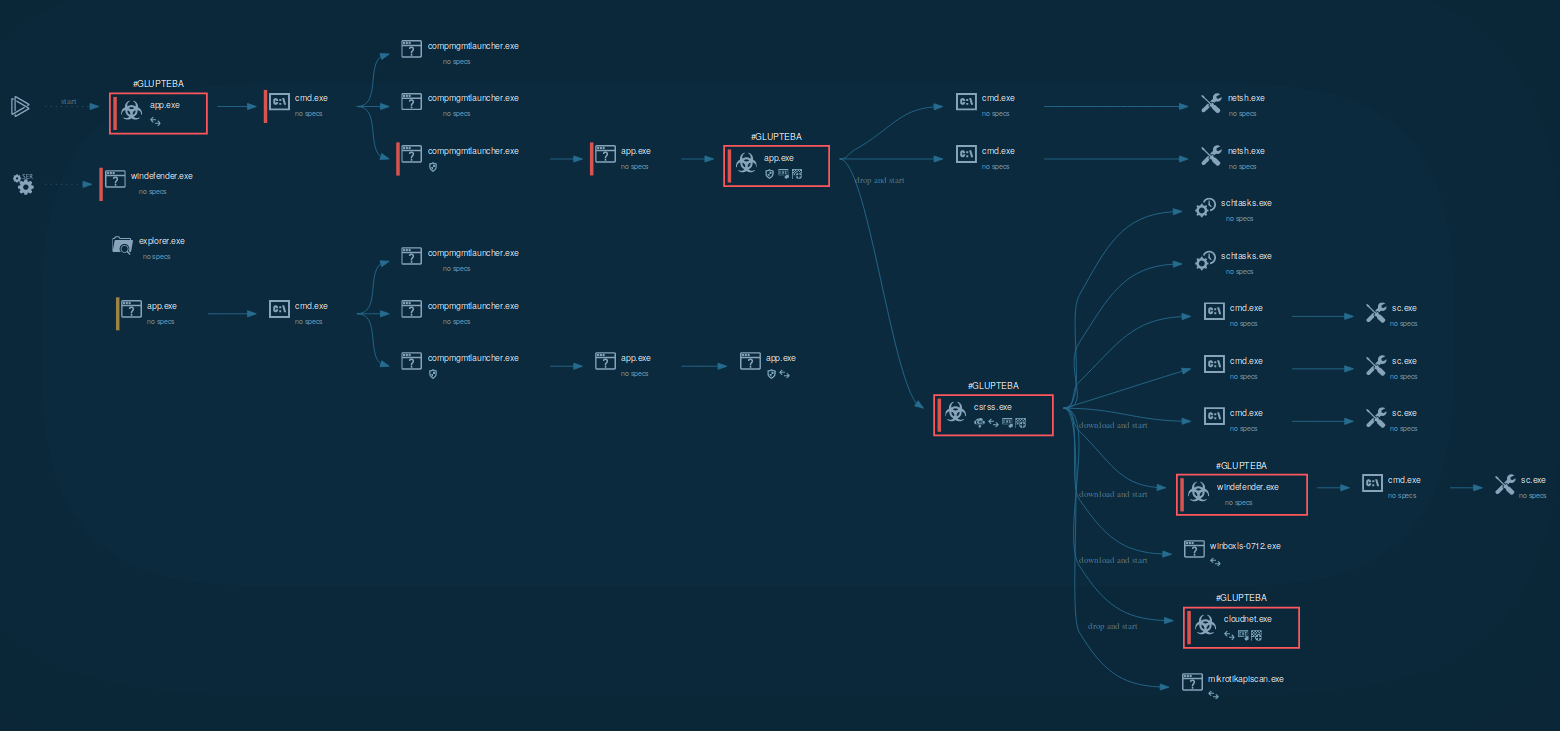
process graph of the glupteba execution Figure 1: This graph generated by the ANY.RUN malware hunting service shows processes started by Glupteba Trojan
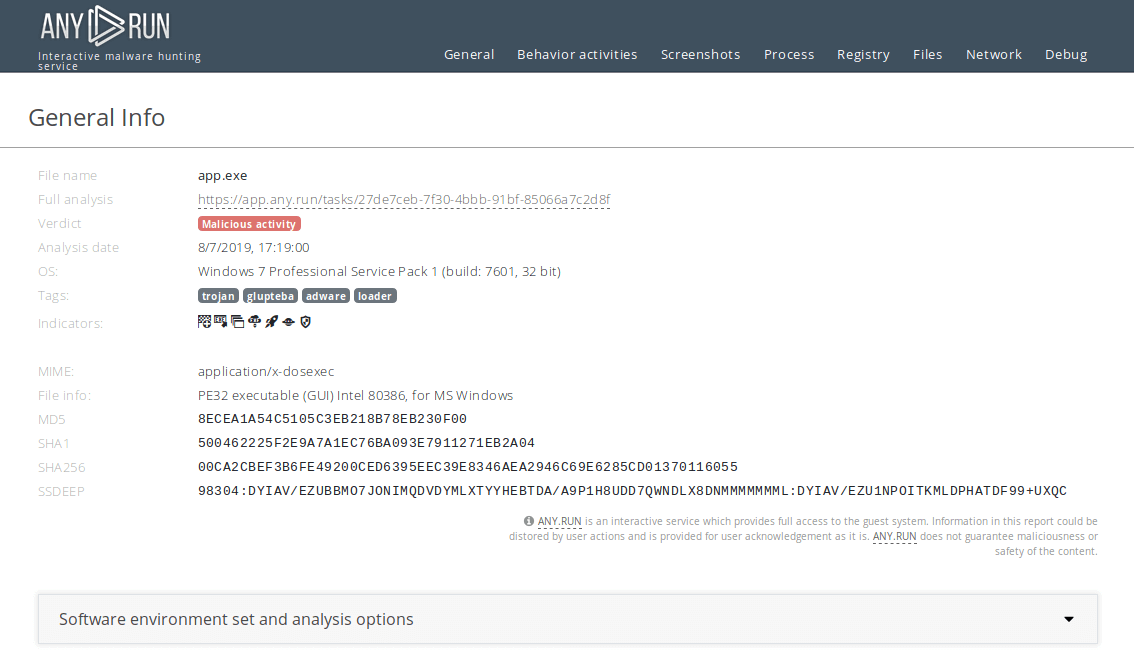
text report of the glupteba analysis Figure 2: A customizable text report created by ANY.RUN

Glupteba trojan execution process

After Glupteba makes its way into the system it's starts CMD.exe process to run CompMgmtLauncher.exe ("Computer Management Snapin Launcher"). The malware uses CompMgmtLauncher.exe to bypass UAC and run itself with administrative privileges. After that, it typically adds itself to autorun in the registry, renames an executable file and copies it to Windows subdirectories. Glupteba also checks the system for anti-malware solutions, adds firewall rules and defender exclusions. In addition to the above, this malware also adds itself to Schedule Tasks to persistence in the infected system. Throughout its lifecycle, Glupteba exchanges packets with the C2 server and has the ability to download other malware.

Glupteba C&C communication

Glupteba has a rather unique trick up its sleeve that involves no other than the Bitcoin blockchain. It can use transactions in the Bitcoin network to receive C&C domains. This function is triggered on schedule or by demand if there is a need.

It enables the attackers to pass new C&C domains to the malware, allowing it to restore operation by reconnecting to a new domain if something happens to the old one.

Glupteba malware distribution

It should be noted that Glupteba has a very wide distribution range. Since 2017 it has been spotted in 180 countries, though almost one-third of the attacks were concentrated in Ukraine, Russia, and Turkey.

In the past, the malware was distributed using the infrastructure provided by Windigo’s, however, currently, it is using its own botnet and employes CsdiMonetize adware. The latter downloads another dropper which, in turn, installs the trojan itself.

How to detect Glupteba using ANY.RUN?

Since Glupteba adds records into the registry, analysts can detect it by looking at registry keys. To do so, choose the process by clicking on it in the process tree of the task then click on the "More info" button. In "Advanced details of process" window switch to the "Registry changes" tab and take a closer look. If the analyzed sample writes a key with the name "UUID" into the key HKEY_CURRENT_USER\Software\Microsoft\TestApp, you are dealing with Glupteba and it's time to get the malware removal program ready.
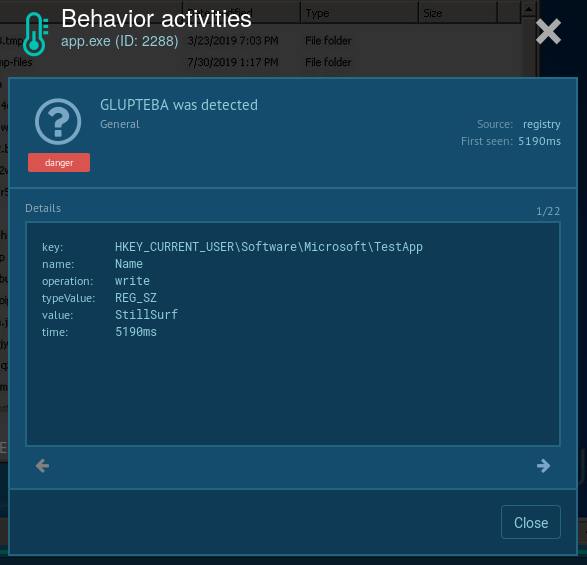
how to detect glupteba Figure 3: Changes Glupteba made in the registry

Conclusion

Glupteba is proving to be a rather dangerous malware that researchers and cybersecurity specialists should not take lightly. Besides its ability to install other malware samples on infected machines, the malware is capable of stealing information from web browser applications. It can also download a component that reroutes traffic by taking control of web-routers.

We also know that this malware uses unique techniques when it comes to C&C communication. And if that was not enough, evidence suggests that it is in active development and attackers seem to be adding more potentially destructive features.

ANY.RUN has prepared a selection of advanced tools that allow to dissect and study a sample of Glupteba in an interactive sandbox environment which gives the researcher an ability to pause the simulation and make corrections at any time. Hopefully, by studying this threat along with many others we will be able to medicate the consensus of future malicious attacks.

HAVE A LOOK AT

ValleyRAT screenshot
ValleyRAT
valleyrat
ValleyRAT is a classic remote access trojan first documented in 2023, targeting mainly Windows systems. It is used by threat actors to gain persistent access to infected devices, steal data, and control compromised machines. ValleyRAT is notable for its relatively advanced evasion techniques and its connections to a prominent Chinese APT group.
Read More
DarkComet screenshot
DarkComet
darkcomet rat darkcomet rat
DarkComet RAT is a malicious program designed to remotely control or administer a victim's computer, steal private data and spy on the victim.
Read More
Cephalus screenshot
Cephalus
cephalus
Cephalus is a targeted ransomware threat discovered in 2025. It’s known for infiltrating organizations that deal with sensitive data through compromised RDP access. It leverages DLL sideloading with a legitimate SentinelOne executable. Cephalus is able to exfiltrate data and destroy backup options. Its payload is also tailored to each victim, which makes identification and mitigation more complex.
Read More
GuLoader screenshot
GuLoader
guloader
GuLoader is an advanced downloader written in shellcode. It’s used by criminals to distribute other malware, notably trojans, on a large scale. It’s infamous for using anti-detection and anti-analysis capabilities.
Read More
MetaStealer screenshot
MetaStealer
metastealer
MetaStealer is an info-stealing malware primarily targeting sensitive data like login credentials, payment details, and browser history. It typically infects systems via phishing emails or malicious downloads and can exfiltrate data to a command and control (C2) server. MetaStealer is known for its stealthy techniques, including evasion and persistence mechanisms, which make it difficult to detect. This malware has been actively used in various cyberattacks, particularly for financial theft and credential harvesting from individuals and organizations.
Read More
Salty 2FA screenshot
Salty 2FA
salty2fa
Salty 2FA is a sophisticated Phishing-as-a-Service (PhaaS) framework tailored to hijack user sessions, steal credentials, and gain unauthorized access to corporate systems. Delivered primarily via targeted emails, this kit employs multi-stage evasion tactics, making it a stealthy tool for cybercriminals aiming at high-value enterprise accounts.
Read More