Black friday Up to 3 extra licenses FOR FREE + Special offer for TI LOOKUP Get it now
Webinar
February 26
Better SOC with Interactive Sandbox Practical Use Cases
Register now

XWorm

6
Global rank
11 infographic chevron month
Month rank
13 infographic chevron week
Week rank
0
IOCs

XWorm is a remote access trojan (RAT) sold as a malware-as-a-service. It possesses an extensive hacking toolset and is capable of gathering private information and files from the infected computer, hijacking MetaMask and Telegram accounts, and tracking user activity. XWorm is typically delivered to victims' computers through multi-stage attacks that start with phishing emails.

RAT
Type
Ex-USSR
Origin
15 July, 2022
First seen
12 August, 2026
Last seen

How to analyze XWorm with ANY.RUN

RAT
Type
Ex-USSR
Origin
15 July, 2022
First seen
12 August, 2026
Last seen

IOCs

IP addresses
20.190.160.2
150.171.28.11
57.153.246.3
142.251.14.101
4.210.24.68
142.251.156.119
172.211.123.250
88.221.169.152
72.246.29.11
142.251.110.94
150.171.109.193
23.11.40.157
104.18.23.222
172.217.113.4
142.251.127.84
142.251.154.119
142.251.20.95
142.251.150.119
23.52.181.141
142.251.20.94
Hashes
de5a6f78116eca62d7fc5ce159d23ae6b889b365a1739ad2cf36f925a140d0cc
b9fa2d52a4ffabb438b56184131b893b04655b01f336066415d4fe839efe64e7
4412319ef944ebcca9581cbacb1d4e1dc614c348d1dfc5d2faaaad863d300209
75da533888189d13fc340d40637b9fc07a3f732e3fcf33ec300f4c7268790a62
907f2709d1d3c8fa26294938f4080bc477e62281c4c50a082c22db0195cda663
22ca9415e294d9c3ec3384b9d08cdaf5164af73b4e4c251559e09e529c843ea6
474d668707f1cb929fef1e3798b71b632e50675bd1a9dceaab90c9587f72f680
3d0361a85adfcd35d0de74135723a75b646965e775188f7dcdd35e3e42db788e
9c70f766d3b84fc2bb298efa37cc9191f28bec336329cc11468cfadbc3b137f4
fb077c966296d02d50ccbf7f761d2a3311a206a784a7496f331c2b0d6ad205c8
f7b24f2eb3d5eb0550527490395d2f61c3d2fe74bb9cb345197dad81b58b5fed
fd4c9fda9cd3f9ae7c962b0ddf37232294d55580e1aa165aa06129b8549389eb
b3ece279943b28c8d855ec86ac1ce53bdfb6a709240d653508764493a75f7518
4ecedb9c1f3dd0d0e3aeb86146561b3d7e58656cbdbed1a39b91737b52ec7f2c
e758273c25fbad804fe884584e2797caefbbd1c2877dfd6f87ab1340cd25252e
3377a873db531113d79919e7a89369a79a602bac6ae09b9864b9378dc285f345
a3eb276fbd19dce2b00db6937578b214b9e33d67487659fe0bf21a86225ece73
a41670d52423ba69c7a65e7e153e7b9994e8dd0370c584bda0714bd61c49c578
54241ebe651a8344235cc47afd274c080abaebc8c3a25afb95d8373b6a5670a2
bbd37d41b7de6f93948fa2437a7699d4c30a3c39e736179702f212cb36a3133c
Domains
www.bing.com
clientservices.googleapis.com
www.microsoft.com
google.com
www.gstatic.com
edge.microsoft.com
ip-api.com
www.google.com
fonts.gstatic.com
translate.googleapis.com
slscr.update.microsoft.com
safebrowsingohttpgateway.googleapis.com
content-autofill.googleapis.com
clients2.google.com
play.google.com
go.microsoft.com
api.edgeoffer.microsoft.com
login.live.com
ogads-pa.clients6.google.com
fe3cr.delivery.mp.microsoft.com
URLs
https://go.microsoft.com/fwlink/?linkid=2257403&clcid=0x409
https://login.live.com/rst2.srf
https://settings-win.data.microsoft.com/settings/v3.0/onesettings/client?osversionfull=10.0.19045.4046.amd64fre.vb_release.191206-1406&localdeviceid=s%3abad99146-31d3-4ec6-a1a4-be76f32ba5d4&flightring=retail&attrdataver=186&osuilocale=en-us&osskuid=48&app=wosc&appver=&isflightingenabled=0&telemetrylevel=1&devicefamily=windows.desktop
https://login.live.com/ppsecure/deviceaddcredential.srf
http://ocsp.digicert.com/mfewtzbnmeswstajbgurdgmcgguabbq50otx%2fh0ztl%2bz8sipi7wewvxdlqqutijuibiv5unu5g%2f6%2brks7qyxjzkceaz1vqyrvgl0erhqlcpm8gy%3d
http://crl.microsoft.com/pki/crl/products/microoceraut2011_2011_03_22.crl
http://www.microsoft.com/pkiops/crl/micsecserca2011_2011-10-18.crl
https://settings-win.data.microsoft.com/settings/v3.0/flightsettings/fsservice?processorclockspeed=3094&isretailos=1&oemmanufacturername=dell&flightingpolicyvalue=3&enablepreviewbuilds=4294967295&osversionfull=10.0.19045.4046.amd64fre.vb_release.191206-1406&managepreviewbuilds=3&branchreadinesslevelsource=0&attrdataver=186&processorcores=6&branchreadinesslevelraw=16&totalphysicalram=6144&tpmversion=0&oemmodelnumber=dell&systemvolumetotalcapacity=260281&deviceid=s%3abad99146-31d3-4ec6-a1a4-be76f32ba5d4&app=fss&appver=10.0&smartactivehoursstate=1&activehoursstart=20&securebootcapable=0&activehoursend=13&devicefamily=windows.desktop
https://settings-win.data.microsoft.com/settings/v3.0/wsd/waasassessment?os=windows&osver=10.0.19041.1.amd64fre.vb_release.191206-&ring=retail&sku=48&deviceclass=windows.desktop&locale=en-us&deviceid=bad99146-31d3-4ec6-a1a4-be76f32ba5d4&flightring=retail&telemetrylevel=1&hidovergattreg=c%3a%5cwindows%5csystem32%5cdriverstore%5cfilerepository%5chidbthle.inf_amd64_9610b4821fdf82a5%5cmicrosoft.bluetooth.profiles.hidovergatt.dll&appver=10.0&processoridentifier=amd64%20family%2023%20model%201%20stepping%202&oemmodel=dell&updateoffereddays=4294967295&processormanufacturer=authenticamd&installdate=1661339444&oemmodelbaseboard=&branchreadinesslevel=cb&oemsubmodel=j5cr&isclouddomainjoined=0&deferfeatureupdateperiodindays=30&isdeviceretaildemo=0&flightingbranchname=&osuilocale=en-us&devicefamily=windows.desktop&wuclientver=10.0.19041.3996&uninstallactive=1&isflightingenabled=0&osskuid=48&processorclockspeed=3094&totalphysicalram=6144&securebootcapable=0&app=waasassessment&processorcores=6&currentbranch=vb_release&installlanguage=en-us&deferqualityupdateperiodindays=0&servicingbranch=cb&oemname_uncleaned=dell&tpmversion=0&primarydisktotalcapacity=262144&installationtype=client&attrdataver=186&processormodel=amd%20ryzen%205%203500%206-core%20processor&isedgewithchromiuminstalled=1&osversion=10.0.19045.4046&ismdmenrolled=0&activationchannel=retail&honorwufbdeferrals=0&firmwareversion=a.40&trendinstalledkey=1&osarchitecture=amd64&defaultuserregion=244&updatemanagementgroup=2
https://settings-win.data.microsoft.com/settings/v3.0/waas/featuremanagement?isclouddomainjoined=0&processoridentifier=amd64%20family%2023%20model%201%20stepping%202&currentbranch=vb_release&accountfirstchar=&activationchannel=retail&oemmodel=dell&flightring=retail&attrdataver=186&installlanguage=en-us&osuilocale=en-us&webexperience=1&flightingbranchname=&chassistypeid=1&osskuid=48&app=cdm&installdate=1661339444&appver=&osarchitecture=amd64&defaultuserregion=244&telemetrylevel=1&osversion=10.0.19045.4046&devicefamily=windows.desktop
https://settings-win.data.microsoft.com/settings/v3.0/wsd/muse?processorclockspeed=3094&flightids=&updateoffereddays=4294967295&branchreadinesslevel=cb&oemmanufacturername=dell&isclouddomainjoined=0&processoridentifier=amd64%20family%2023%20model%201%20stepping%202&sku=48&activationchannel=retail&attrdataver=186&ismdmenrolled=0&processorcores=6&processormodel=amd%20ryzen%205%203500%206-core%20processor&totalphysicalram=6144&primarydisktype=4294967295&flightingbranchname=&chassistypeid=1&oemmodelnumber=dell&systemvolumetotalcapacity=260281&sampleid=95271487&deviceclass=windows.desktop&app=muse&disabledualscan=0&appver=10.0&oemsubmodel=j5cr&locale=en-us&isalwaysonalwaysconnectedcapable=0&ms=0&defaultuserregion=244&updateserviceurl=http%3a%2f%2fneverupdatewindows10.com&osver=10.0.19045.4046.amd64fre.vb_release.191206-1406&os=windows&deviceid=s%3abad99146-31d3-4ec6-a1a4-be76f32ba5d4&deferqualityupdateperiodindays=0&ring=retail&deferfeatureupdateperiodindays=30
https://licensing.mp.microsoft.com/v7.0/licenses/content
https://settings-win.data.microsoft.com/settings/v3.0/wsd/updatehealthtools?os=windows&osver=10.0.19041.1.amd64fre.vb_release.191206-&sku=48&deviceclass=windows.desktop&locale=en-us&deviceid=s:bad99146-31d3-4ec6-a1a4-be76f32ba5d4&sampleid=s:95271487&appver=10.0.19041.3626&flightring=retail&telemetrylevel=1&hidovergattreg=c%3a%5cwindows%5csystem32%5cdriverstore%5cfilerepository%5chidbthle.inf_amd64_9610b4821fdf82a5%5cmicrosoft.bluetooth.profiles.hidovergatt.dll&appver=&processoridentifier=amd64%20family%2023%20model%201%20stepping%202&oemmodel=dell&updateoffereddays=4294967295&processormanufacturer=authenticamd&installdate=1661339444&oemmodelbaseboard=&branchreadinesslevel=cb&oemsubmodel=j5cr&isclouddomainjoined=0&deferfeatureupdateperiodindays=30&isdeviceretaildemo=0&flightingbranchname=&osuilocale=en-us&devicefamily=windows.desktop&wuclientver=10.0.19041.3996&uninstallactive=1&isflightingenabled=0&osskuid=48&processorclockspeed=3094&totalphysicalram=6144&securebootcapable=0&app=sedimentpack&processorcores=6&currentbranch=vb_release&installlanguage=en-us&deferqualityupdateperiodindays=0&oemname_uncleaned=dell&tpmversion=0&primarydisktotalcapacity=262144&installationtype=client&attrdataver=186&processormodel=amd%20ryzen%205%203500%206-core%20processor&isedgewithchromiuminstalled=1&osversion=10.0.19045.4046&ismdmenrolled=0&activationchannel=retail&firmwareversion=a.40&trendinstalledkey=1&osarchitecture=amd64&defaultuserregion=244&updatemanagementgroup=2
https://slscr.update.microsoft.com/sls/%7b522d76a4-93e1-47f8-b8ce-07c937ad1a1e%7d/x64/10.0.19045.4046/0?ch=686&l=en-us&p=&pt=0x30&wua=10.0.19041.3996&mk=dell&md=dell
http://www.microsoft.com/pkiops/crl/microsoft%20ecc%20update%20secure%20server%20ca%202.1.crl
https://fe3cr.delivery.mp.microsoft.com/clientwebservice/ping
https://slscr.update.microsoft.com/sls/ping
https://slscr.update.microsoft.com/sls/%7be7a50285-d08d-499d-9ff8-180fdc2332bc%7d/x64/10.0.19045.4046/0?ch=686&l=en-us&p=&pt=0x30&wua=10.0.19041.3996&mk=dell&md=dell
http://ip-api.com/json/
http://clients2.google.com/time/1/current?cup2key=8:syhhehhiromjso6g-shw98dcfrswhxsm9mxq6uehqme&cup2hreq=e3b0c44298fc1c149afbf4c8996fb92427ae41e4649b934ca495991b7852b855
Last Seen at
Last Seen at

Recent blog posts

post image
Intelligence-Driven SOC: Modernizing Threat M...
watchers 6288
comments 0
post image
Supply Chain Security: How ANY.RUN Helps US a...
watchers 2131
comments 0
post image
Smile, You're on Camera. Part 2: Hiring Lazar...
watchers 28697
comments 0

What is XWorm malware?

XWorm is a remote access trojan (RAT) that gives cybercriminals unauthorized access to a victim's computer. It is a modular malware, meaning that it can be customized to perform a variety of malicious tasks, such as stealing sensitive data and cryptocurrency, launching DDoS attacks, and deploying ransomware. It first came into the spotlight in July 2022 and is believed to have originated in the ex-USSR.

XWorm is sold as a malware-as-a-service (MaaS), which makes it extremely dangerous. It lowers the barrier to entry and opens hacking opportunities to more people. Since its first appearance in the global threat landscape in July 2022, XWorm has gone through several iterations. As of August 2023, the 4.2 version and the 5.0 version were the latest ones available for purchase.

Criminals use multi-stage attacks to deploy XWorm on victims’ computers. For example, an attack might start with a phishing email that contains a malicious Word document attachment. When the document is opened, it will load an .rtf file from an external link. This file will contain an Excel spreadsheet with macros that will execute a PowerShell script, which will then download XWorm onto the computer.

Technical details of the XWorm malicious software

XWorm is developed with the .NET Framework, which makes it a significant threat to Windows systems. The malware is also configurable, offering a wide range of tools for manipulating the infected machine.

Here are some of XWorm’s key capabilities:

  • Encrypted connection: XWorm is capable of maintaining a secure connection with its C&C server, even during poor network conditions.
  • Information gathering: The malware can collect a wide range of information from the infected computer, including credit card numbers, browsing history, bookmarks, downloads, as well as Firefox and Chromium passwords and cookies.
  • Account hijacking: XWorm can hack Discord, Telegram, and MetaMask accounts, as well as get hold of WiFi keys and product keys.
  • User activity tracking: The malware enables attackers to monitor the victim’s activities on their computer by logging their keystrokes, automatically saving webcam images, listening to their microphone, scanning their network connections, and viewing opened windows.
  • Clipboard access: XWorm can retrieve the information that has been copied to the clipboard and replace victims’ crypto wallet credentials with those of the attacker.
  • File management: It can gain control of a computer’s file system to transfer sensitive documents and content to its C2 or download additional malware and run it.

Get started today for free

Analyze malware and phishing in a fully-interactive sandbox

Create free account

In order to bypass User Account Control (UAC), XWorm attempts to get administrator permissions on the infected computer. This allows it to make changes to the system without requiring user consent. To ensure persistence, the malware adds itself to the list of programs that run automatically when the computer starts up by editing the registry.

It is also polymorphic, meaning that the malware’s code regularly transforms itself to throw detection software off course. Although XWorm has a built-in functionality to terminate its execution once it senses that it is launched in a virtualized environment, the ANY.RUN sandbox has no problem identifying the malware.
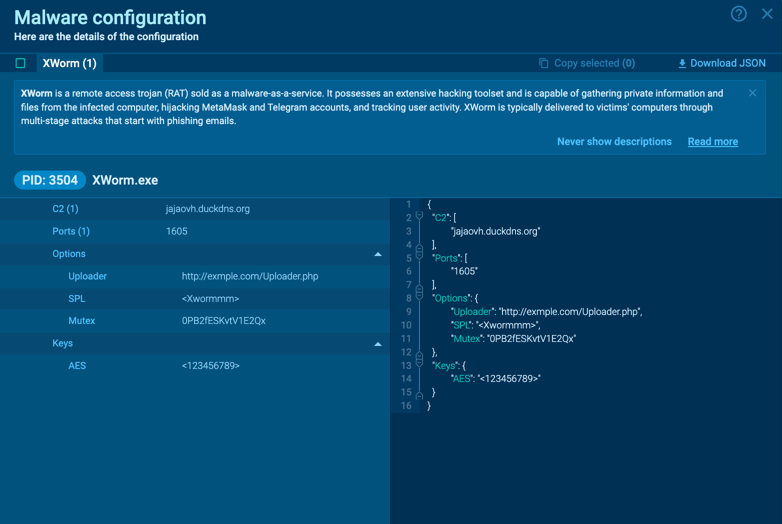
XWorm’s configuration

XWorm’s configuration

Execution process of XWorm

The malicious behavior of XWorm can be easily uncovered by uploading it to the ANY.RUN sandbox. Here is a sample of this malware on the platform.

Immediately upon execution, XWorm drops an executable file into the Startup directory (“C:\Users\admin/AppData\Roaming\Microsoft\Windows\Start Menu\Programs\Startup\XWorm.exe”) and into the Roaming directory (“C:\Users\admin/AppData\Roaming\XWorm.exe”).
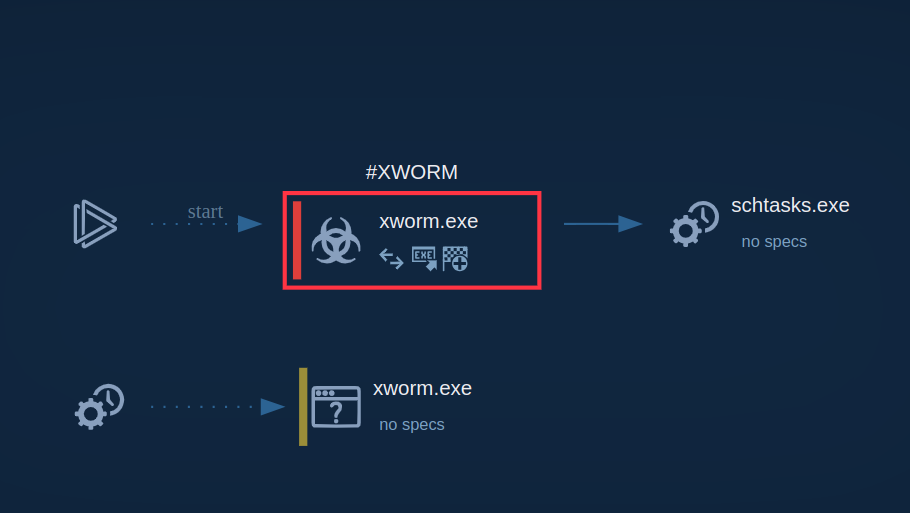
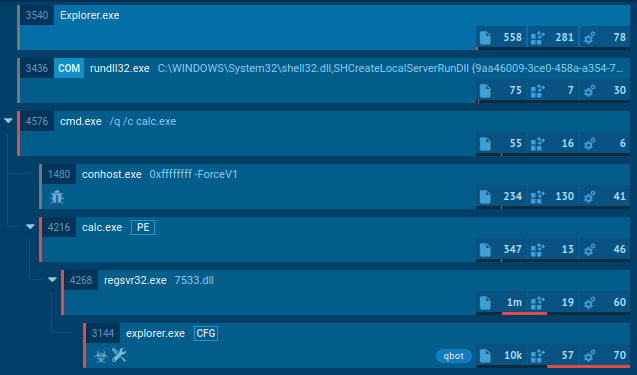
XWorm’s process graph

XWorm’s process graph

For the latter directory, a persistent service is created using the Task Scheduler. Malware checks for an external IP, which we can bypass with ANY.RUN’s Residential Proxy feature. After this, XWorm starts sending beacons to the C&C server, waiting for commands to execute.

Read a detailed analysis of XWorm in our blog.

Use ANY.RUN free for 14 days

Try the full power of interactive analysis

Start your free trial

Distribution methods of the XWorm malware

As with most malware families, email phishing campaigns serve as XWorm’s main gateway to victims’ computers. The attack begins with an email containing an attachment. By exploiting different social engineering techniques, threat actors can persuade a user to download the attached file and open it.

Analysts have observed several file formats used by attackers, including .rtf, .lnk, and .pdf. In most cases, the email attachment itself does not contain any macros and is used primarily to kick off a chain reaction that involves downloading several other files, executing PowerShell scripts, and finally delivering the payload.

Such attacks can be facilitated by specialized tools, such as Freeze[.]rs and SYK Crypter, which are equipped with advanced capabilities for circumventing defense systems to drop a variety of malware families including Remcos RAT, njRAT, and RedLine Stealer.

One of the most recent XWorm attacks targeted businesses in Germany. It involved sending a .docx document to victims with a name that suggested it contained hotel reservation information. Instead of using macros, the file exploited the Follina vulnerability (CVE-2022-30190) to run external malicious files and a PowerShell script, which eventually dropped XWorm.

Conclusion

XWorm retains considerable staying power due to the consistent updates and wide availability, making it a top concern for organizations around the world. To protect your system from this threat, you need to have a stricter approach towards handling any links or files arriving in your inbox from unknown senders.

Instead of downloading documents and opening URLs, you can first analyze them in the ANY.RUN sandbox to quickly understand whether the file is malicious or not. ANY.RUN also provides you with a detailed report about the malware, such as its IOCs and TTPs. This information can be used to protect your organization from future attacks.

Try ANY.RUN for free – request a demo!
HAVE A LOOK AT

Tycoon 2FA screenshot
Tycoon 2FA
tycoon
Tycoon 2FA is a phishing-as-a-service (PhaaS) platform designed to bypass multi-factor authentication (MFA) protections, particularly targeting Microsoft 365 and Gmail accounts. Its advanced evasion techniques and modular architecture make it a significant threat to organizations relying on MFA for security.
Read More
CastleLoader screenshot
CastleLoader
castleloader
CastleLoader is a modern malware loader designed to quietly establish initial access and deliver follow-up payloads such as stealers, RATs, and ransomware. It focuses on stealth, flexibility, and rapid payload rotation, making it an effective tool for financially motivated threat actors and a persistent problem for enterprise defenders.
Read More
BTMOB RAT screenshot
BTMOB RAT
btmob
BTMOB RAT is a remote access Trojan (RAT) designed to give attackers full control over infected devices. It targets Windows and Android endpoints. Its modular structure allows operators to tailor capabilities, making it suitable for espionage, credential theft, financial fraud, and establishing long-term footholds in corporate networks.
Read More
Latrodectus screenshot
Latrodectus
latrodectus
Latrodectus is a malicious loader that is used by threat actors to gain a foothold on compromised devices and deploy additional malware. It has been associated with the IcedID trojan and has been used by APT groups in targeted attacks. The malware can gather system information, launch executables, and detect sandbox environments. It uses encryption and obfuscation to evade detection and can establish persistence on the infected device.
Read More
Greatness screenshot
Greatness is a Phishing-as-a-Service (PhaaS) platform that enables cybercriminals, even those with limited technical skills, to launch sophisticated phishing attacks primarily targeting Microsoft 365 (M365) credentials. It acts as a man-in-the-middle (MitM) proxy, facilitating credential theft and MFA bypass while providing affiliates with easy-to-use tools like attachment builders and Telegram notifications.
Read More
VanHelsing Ransomware screenshot
VanHelsing is a sophisticated ransomware strain that appeared in early 2025, operating via the Ransomware-as-a-Service (RaaS) model and targeting primarily USA and France. It threatens mostly Windows systems but has variants for Linux, BSD, ARM, and ESXi, making it a multi-platform malware. It is also notable for its advanced evasion techniques, double extortion tactics, and rapid evolution.
Read More