Black friday Up to 3 extra licenses FOR FREE + Special offer for TI LOOKUP Get it now
Webinar
February 26
Better SOC with Interactive Sandbox Practical Use Cases
Register now

Pikabot

144
Global rank
73 infographic chevron month
Month rank
42 infographic chevron week
Week rank
0
IOCs

Pikabot is a trojan malware with a focus on loader capabilities. Pikabot is also used for other activities, such as executing commands on the infected system. The earlier versions of the malware made use of extensive code obfuscation to evade detection. Upon infection, it collects system information and sends it to command-and-control servers.

Loader
Type
ex-USSR
Origin
1 February, 2023
First seen
14 August, 2026
Last seen

How to analyze Pikabot with ANY.RUN

Type
ex-USSR
Origin
1 February, 2023
First seen
14 August, 2026
Last seen

IOCs

IP addresses
85.120.255.252
151.101.193.91
178.16.52.160
104.26.4.198
57.153.246.3
130.17.8.71
204.44.69.210
192.159.99.171
27.124.34.73
2.58.56.111
20.50.73.15
192.232.216.135
104.249.10.76
108.178.20.254
178.16.54.109
137.184.35.2
192.162.199.186
104.18.50.34
151.101.65.91
2.27.63.115
Hashes
a8a284f377cb9f21c53e5553234ecb693dc4c2c38f3306b6cde4aead5e05e913
5154e165bd6c2cc0cfbcd8916498c7abab0497923bafcd5cb07673fe8480087d
f096bc366a931fba656bdcd77b24af15a5f29fc53281a727c79f82c608ecfab8
c43668eec4a8d88a5b3a06a84f8846853fe33e54293c2db56899a5a5dfb4d944
a0c9abae18599f0a65fc654ad36251f6330794bea66b718a09d8b297f3e38e87
41c91a9c93d76295746a149dce7ebb3b9ee2cb551d84365fff108e59a61cc304
388a796580234efc95f3b1c70ad4cb44bfddc7ba0f9203bf4902b9929b136f95
eff52743773eb550fcc6ce3efc37c85724502233b6b002a35496d828bd7b280a
dfa4d05fe088c499384485bc2d35990904f99e2295b30fa00e4c84b1541dbf14
bf21a7489a5bbb1e04e6ad11a83e47c958b4da1610a5c272c0d2ddd5822f47d2
f447865e0c75b6c39becab9b9527fcc583def24c18a66cc815a9419f375ddc11
6f7742dfdd371c39048d775f37df3bc2d8d4316c9008e62347b337d64ebed327
d03fa645cde89b4b01f4a2577139fbb7e1392cb91dc26213b3b76419110d8e49
225d669e47eb14d8c969799c92aaef27b66cd984872ea09284e48db46521e651
385ecbb815e394c4247aa125c352f55ebcc9a3fd272bac494b25a31a576aaa1b
cf402d63e608bd15531395eb012882ad407e041d1e9dd663f4ccf92e8cb39ddf
90d687e8abca2bea9d02690057b2da24ffe37767b4e5be5b98b75d59ecf2de4b
c77a4281d412d96755e558d7b9dabe0b752bc6b048202adfff1d32befbf89a68
cda9fb1ddef9cf88bf2986ad19c2885cb424b56a487b5b4c1c2722159e8239d1
f659a2d79e7122c7182dbc7196647887f8a5d8204bbfb231a811f47e33f19bc9
Domains
github.com
content-signature-2.cdn.mozilla.net
pub-be36e3aeb6404712971f081a2837a8fa.r2.dev
ifeanyioluwatobi.wuaze.com
edge.microsoft.com
sunix-technology.com
unitedgs.lovestoblog.com
oneocsp.microsoft.com
accounts.google.com
clients2.google.com
sesaddf.kesug.com
eykrqioydzqaehcektgd.supabase.co
ye.c.lencr.org
sales.ifree.page
ocsp.digicert.com
seasquadshipping.com
vjy888.com
detectportal.firefox.com
deliverymailreport.co.za
slscr.update.microsoft.com
URLs
https://maper.info/26tkr5
http://crl.microsoft.com/pki/crl/products/microoceraut2011_2011_03_22.crl
http://www.microsoft.com/pkiops/crl/micsecserca2011_2011-10-18.crl
https://settings-win.data.microsoft.com/settings/v3.0/wsd/waasassessment?os=windows&osver=10.0.19041.1.amd64fre.vb_release.191206-&ring=retail&sku=48&deviceclass=windows.desktop&locale=en-us&deviceid=bad99146-31d3-4ec6-a1a4-be76f32ba5d4&flightring=retail&telemetrylevel=1&hidovergattreg=c%3a%5cwindows%5csystem32%5cdriverstore%5cfilerepository%5chidbthle.inf_amd64_9610b4821fdf82a5%5cmicrosoft.bluetooth.profiles.hidovergatt.dll&appver=10.0&processoridentifier=amd64%20family%2023%20model%201%20stepping%202&oemmodel=dell&updateoffereddays=4294967295&processormanufacturer=authenticamd&installdate=1661339444&oemmodelbaseboard=&branchreadinesslevel=cb&oemsubmodel=j5cr&isclouddomainjoined=0&deferfeatureupdateperiodindays=30&isdeviceretaildemo=0&flightingbranchname=&osuilocale=en-us&devicefamily=windows.desktop&wuclientver=10.0.19041.3996&uninstallactive=1&isflightingenabled=0&osskuid=48&processorclockspeed=3094&totalphysicalram=6144&securebootcapable=0&app=waasassessment&processorcores=6&currentbranch=vb_release&installlanguage=en-us&deferqualityupdateperiodindays=0&servicingbranch=cb&oemname_uncleaned=dell&tpmversion=0&primarydisktotalcapacity=262144&installationtype=client&attrdataver=186&processormodel=amd%20ryzen%205%203500%206-core%20processor&isedgewithchromiuminstalled=1&osversion=10.0.19045.4046&ismdmenrolled=0&activationchannel=retail&honorwufbdeferrals=0&firmwareversion=a.40&trendinstalledkey=1&osarchitecture=amd64&defaultuserregion=244&updatemanagementgroup=2
https://www.google.com/
https://urlhaus.abuse.ch/downloads/text/
http://217.154.188.255/60/document_picture_0994950005995.jpg/verygoodthingsarecomingentiretimeforbest.hta
http://91.92.242.236/files-129312398/files/file_3481d91a938ab342.exe
http://91.92.242.236/files-129312398/files/file_4f77864d0a6bff5e.exe
http://196.251.107.186/svchost.exe
http://196.251.107.186/3.exe
http://62.60.226.140/files/7782139129/neitqa0.exe
http://91.92.242.236/files-129312398/files/file_b6eb436102b82c86.exe
http://62.60.226.232/1.exe
http://196.251.107.186/2.exe
http://196.251.107.186/4.exe
http://62.60.226.140/files/7559850987/2ultuyw.exe
http://192.162.199.246/pb7ulzhaae3xpsnrevjh5yqqymyibnnf/mkm65cf6qnqeovw9.exe
http://192.162.199.246/pb7ulzhaae3xpsnrevjh5yqqymyibnnf/6eq5gvofrvnmci54.exe
http://lomiva.vu/ja06813kda.png
Last Seen at
Last Seen at

Recent blog posts

post image
Intelligence-Driven SOC: Modernizing Threat M...
watchers 8245
comments 0
post image
Supply Chain Security: How ANY.RUN Helps US a...
watchers 3788
comments 0
post image
Smile, You're on Camera. Part 2: Hiring Lazar...
watchers 37063
comments 0

What is Pikabot malware?

Pikabot, a loader malware, made its first appearance in the cybersecurity realm in February 2023. This malicious software is recognized for its wide array of anti-analysis features and flexible capabilities that have made it a popular choice among many attackers.

The malware functions through two key modules: the loader and the core. The loader initiates the malware's operations, while the core houses its primary functionalities. Pikabot shows signs of continuous evolution, as its latest version appeared in February 2024, exhibiting notable differences from its original builds.

The resemblances between Pikabot and Qakbot have led to assumptions that they could be the work of the same malware developers. Pikabot has also been utilized in campaigns orchestrated by the threat actor TA577, where it was disseminated in conjunction with the DarkGate malware.

Get started today for free

Analyze malware and phishing in a fully-interactive sandbox

Create free account

Pikabot malware technical details

Criminals leverage Pikabot for various harmful activities which include:

  • Executing Commands via cmd.exe: Pikabot can execute commands on the compromised system using the Windows Command Prompt (cmd.exe).
  • Terminating the Current Process: Pikabot has the capability to self-terminate.
  • Injecting and Executing Downloaded Shellcode: The malware can download shellcode from its command-and-control (C2) server and inject it into other running processes.
  • Injecting Downloaded DLL and EXE Files: Pikabot can also download and inject DLL and executable files.

In its earlier iterations, the Pikabot trojan utilized a combination of AES-CBC and RC4 key to encrypt strings. The new version demonstrates a shift towards less complex obfuscation and only occasional use of RC4.

Another notable difference between the early variants of the malware and its newest form is the approach to storing a configuration. While the first builts contained hardcoded configs, the newer iterations tend to download them from the command and control (C2) server.

The Pikabot malware is particularly skilled at evading sandbox detection. One way it does this is by postponing its execution until the sandbox analysis period has expired. The malware also integrates junk code among legitimate instructions to further complicate analysis.

Pikabot uses regex to dynamically generate file names and other data. This lets the malware hide its code and evade detection by security tools that rely on signatures.

Pikabot initiates its operations by registering the compromised host with the C2 servers. This process involves gathering system information and submitting it to the C2 server via an HTTPS POST request. The gathered data encompasses. The data collected by Pikabot is encoded using standard Base64 and then encrypted using AES. The malware collects the following information about the system:

  • Network Information: This includes details about the network connections, IP addresses, etc.
  • User and Group Information: Pikabot collects usernames and other related details.
  • Windows Build Information: The malware gathers data about the Windows operating system installed on the system, including the version and build number.
  • Generic Host Information: This includes various details about the system's hardware and software configuration, such as the amount of available RAM.
  • Additional Host Information: Depending on the commands received from the command-and-control (C2) server, Pikabot can collect extra info about the compromised system, including screenshots.

Pikabot execution process

Let’s upload a sample of Pikabot to the ANY.RUN sandbox to conduct a Pikabot malware analysis sessions and observe its execution process in detail.

Pikabot malware initiates its execution chain by leveraging phishing emails or malicious downloads to infiltrate a system. Once inside, it employs PowerShell scripts or macros to download additional payloads from a remote server.

Pikabot then uses living-off-the-land techniques, such as exploiting legitimate system processes like "ctfmon.exe," to evade detection and maintain persistence. This process, commonly used for language and input services, is hijacked to execute malicious code while appearing benign.

The malware establishes communication with its command-and-control (C2) server, receiving instructions and exfiltrating sensitive data. It can also spread laterally across networks, exploiting vulnerabilities or using stolen credentials.

Throughout its execution, Pikabot employs various obfuscation and evasion techniques to avoid detection by security solutions.
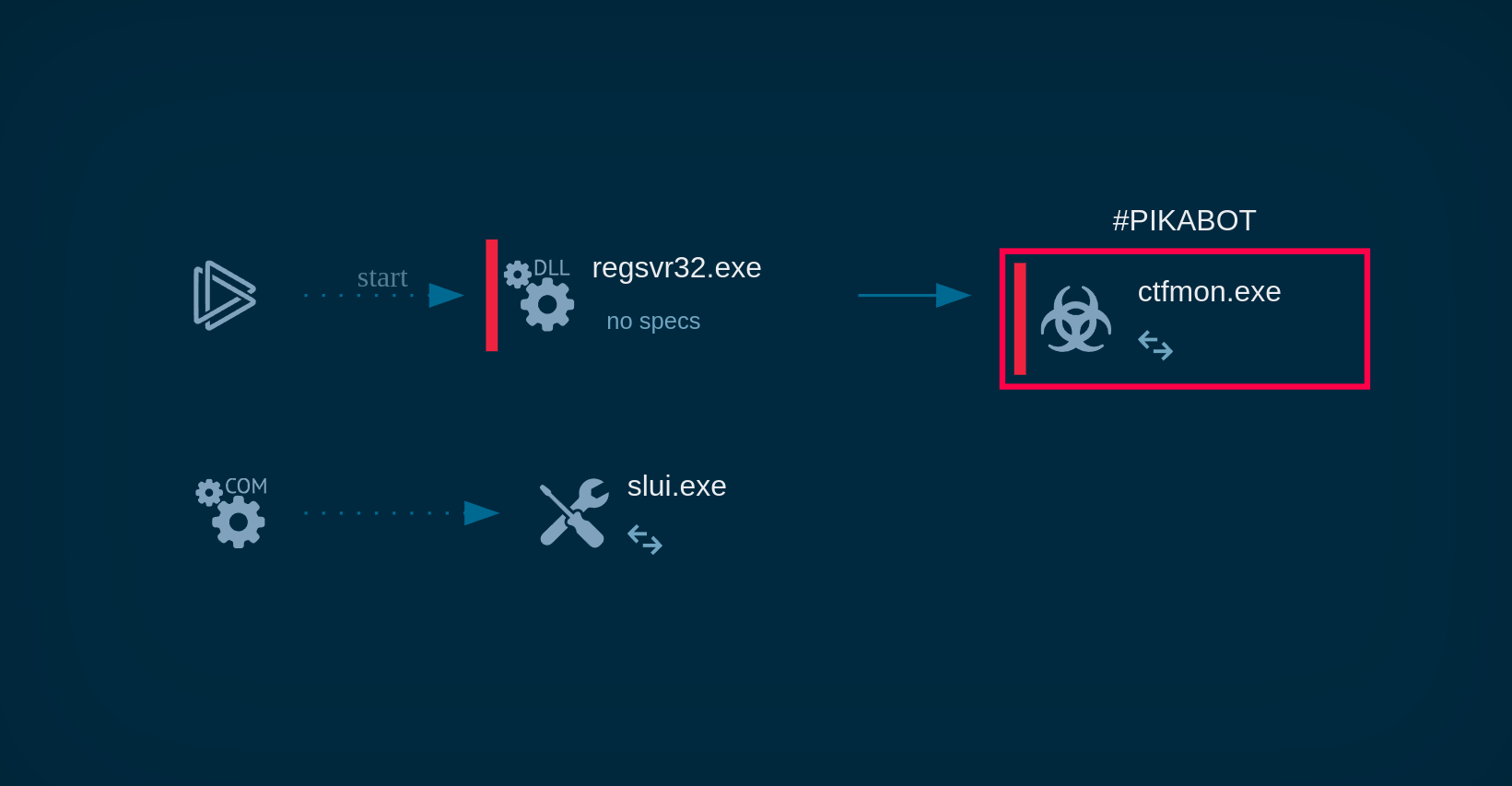
Pikabot process graph in ANY.RUN Pikabot process graph demonstrated in ANY.RUN

Pikabot malware distribution methods

Just as in the case of other widespread malware, such as Remcos and NjRAT, Pikabot has been observed to be distributed primarily via phishing emails. Attackers usually employ multi-stage attacks that begin with an email that ask users to perform certain activities, such as clicking a link or opening a weaponized attachment. From there, the infection begins.

Another notable attack involving Pikabot occurred in 2023 when attackers utilized malvertising. As part of their campaign, they employed Google Ads to promote a fake website with a download link for AnyDesk, a remote desktop software. After running the installer file, the victim’s system became compromised and infected with Pikabot.

Conclusion

Pikabot is a sophisticated trojan malware that has the potential to significantly disrupt the affected infrastructure. Thanks to its anti-analysis features, it can be a challenge for certain security solutions to detect it. Therefore, it is impossible to use reliable solutions that timely implement updates to keep up with the new version of Pikabot.

Use ANY.RUN, a cloud-based sandbox, for analyzing suspicious files and links to identify Pikabot and other malware families. The service lets you gain an in-depth look at the behavior of any malware in a completely safe and secure environment. ANY.RUN generates detailed reports on the analyzed threats that contain all the essential information, including Pikabot IOCs (indicators of compromise) and TTPs, needed for making better security decisions.

Create your ANY.RUN account – it’s free!
HAVE A LOOK AT

ACR Stealer screenshot
ACR Stealer is a modern information-stealing malware designed to harvest sensitive data from infected devices. Like other infostealers, it targets credentials, financial details, browser data, and files, enabling cybercriminals to monetize stolen information through direct fraud or underground market sales.
Read More
ClickFix screenshot
ClickFix is a sophisticated social engineering technique that tricks users into manually executing malicious commands on their devices. It masquerades as a "quick fix" for fake technical issues, CAPTCHA verifications, or error messages, often hijacking the clipboard to paste harmful PowerShell or terminal commands. This user-assisted approach helps it bypass traditional security controls, leading to infostealers like Lumma Stealer, RATs, and other malware.
Read More
Keylogger screenshot
Keylogger
keylogger
A keylogger is a type of spyware that infects a system and has the ability to record every keystroke made on the device. This lets attackers collect personal information of victims, which may include their online banking credentials, as well as personal conversations. The most widespread vector of attack leading to a keylogger infection begins with a phishing email or link. Keylogging is also often present in remote access trojans as part of an extended set of malicious tools.
Read More
Stealc screenshot
Stealc
stealc
Stealc is a stealer malware that targets victims’ sensitive data, which it exfiltrates from browsers, messaging apps, and other software. The malware is equipped with advanced features, including fingerprinting, control panel, evasion mechanisms, string obfuscation, etc. Stealc establishes persistence and communicates with its C2 server through HTTP POST requests.
Read More
Stealer screenshot
Stealer
stealer
Stealers are a group of malicious software that are intended for gaining unauthorized access to users’ information and transferring it to the attacker. The stealer malware category includes various types of programs that focus on their particular kind of data, including files, passwords, and cryptocurrency. Stealers are capable of spying on their targets by recording their keystrokes and taking screenshots. This type of malware is primarily distributed as part of phishing campaigns.
Read More
XRed screenshot
XRed
xred
XRed operates as a stealthy backdoor, enabling cybercriminals to gain unauthorized remote access to infected systems. XRed has gained particular notoriety for its distribution through trojanized legitimate software and hardware drivers, making it exceptionally dangerous due to its ability to masquerade as trusted applications.
Read More