Black friday Up to 3 extra licenses FOR FREE + Special offer for TI LOOKUP Get it now
Webinar
February 26
Better SOC with Interactive Sandbox Practical Use Cases
Register now

KrakenKeylogger

135
Global rank
164 infographic chevron month
Month rank
141 infographic chevron week
Week rank
0
IOCs

Kraken is a trojan malware with infostealing capabilities that was first spotted in May of 2023. The malware can perform a wide range of malicious activities, including logging users’ keystrokes. The data then can be sent to the attacker using several protocols. The operators behind the Kraken stealer usually distribute it via phishing emails.

Trojan
Type
Unknown
Origin
1 May, 2023
First seen
22 February, 2026
Last seen
Also known as
Kraken
Kraken Stealer

How to analyze KrakenKeylogger with ANY.RUN

Type
Unknown
Origin
1 May, 2023
First seen
22 February, 2026
Last seen

IOCs

Hashes
7357f1dc4cc6b7ed24845f6a68defaf560af51e19f9cf31ffc2c008eb539dd39
0b6cd05bee398bac0000e9d7032713ae2de6b85fe1455d6847578e9c5462391f
069395ba2c278a8d5fe946e6414c3b028d04e906a166055c0d88c8ef6baebacf
e92d56612dc90ee84e96acb77d7b9183d8a16843ee0c401cc685442b95780c78
b639e26a0f0354515870ee167ae46fdd9698c2f0d405ad8838e2e024eb282e39
8a6aa9e5d58784428d0b1641e99f024438b20747993039e16b8d262f3f5fd347
080731d99756d9edf59e6d72931b6e1ea342ffa8fd937b5fcefe7d22eb165fe3
4c2f188c6f7658df23a065fb7341744cf68eb1bc4124840956a81da87968030a
7e0ee0e707db426eaf25bd0924631db969bb03dd9b13addffbcc33311a3b9aa7
564154a2e3647318ca40a5ffa68d06b1bd40b606cae1d15985e3d15097b512cd
e1372f8aa31ebbe3ab60d07036ae829a19e3f837b698f38e3469ac3d5f2c4f50
c24c12afb99023a67597cb238e5767f1d410e3a18a3239384179e440f671ba3f
f274cd1d4caf4d3acb888fc435ca2ae3261a4c0634f34e43fd5d46bf8a7059f7
6c4a1f74de712ee096140aba680c37ed6b7cce8c412f1e2defaee84a556c163a
Domains
kraken.nswardh.com
vyprotb.com
onemgat.net
pnispsal.com
mpzohtore.com
pdpocatk.com
smmyuhxlt.cc
yhzjehi.com
URLs
http://ww38.blasze.tk/CN18R3
http://blasze.tk/CN18R3
Last Seen at

Recent blog posts

post image
New SOC-Ready Reporting for Faster Triage, Es...
watchers 2035
comments 0
post image
ANY.RUN & Elastic Security: Bring Threat...
watchers 1257
comments 0
post image
How CISOs Reduce Cyber Risk with MITRE ATT&am...
watchers 4782
comments 0

What is Kraken malware?

Kraken, also known as Kraken Keylogger, is a malware written in .NET (VB) that focuses on exfiltrating sensitive information from the browsers and email clients installed on the compromised system. Some security solutions may mistakenly label it as SnakeKeylogger or MassKeylogger.

Kraken attacks are usually carried out in several stages, starting from a malicious attachment delivered to a victim’s inbox. Although not as widespread as other stealer malware, such as RedLine, Kraken poses a significant threat to users worldwide. However, there is still no information on who created Kraken malware.

Use ANY.RUN free for 14 days

Try the full power of interactive analysis

Start your free trial

Technical details of the Kraken Keylogger malicious software

KrakenKeylogger usually steals:

  • User information: KrakenKeylogger can capture passwords, usernames, and other authentication details from various applications and websites.
  • Screenshots: The malware usually records screenshots once it finishes stealing data from browsers and FTP clients.
  • Keystrokes:The malicious program can also perform keylogging, keeping track of everything typed by the user.

According to the threat analyst 0xToxin’s article, a typical attack involving KrakenKeylogger starts with a spam email, containing a malicious attachment, usually a .zip. Inside the archive, users may find an .lnk that kickstarts the infection process. Once launched, it executes a PowerShell script, which eventually leads to the download of a .NET loader. The loader then deploys a .dll that ultimately drops Kraken on the system.

KrakenKeylogger makes use of code obfuscation and encryption. The malware is also equipped with evasion mechanisms that allow it to circumvent security solutions.

Execution process of Kraken attacks

Analyzing a sample of Kraken in the ANY.RUN sandbox can help us study the entire execution chain of the malware step by step.

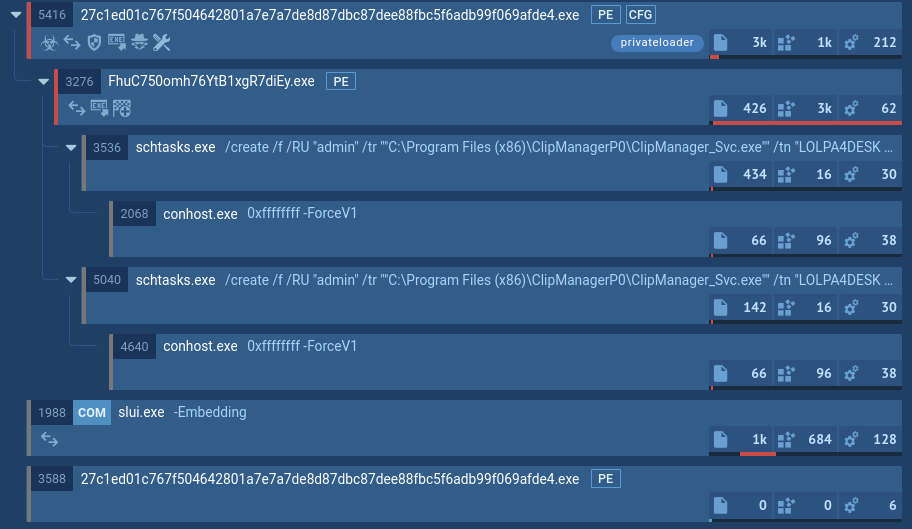
Kraken follows a typical execution chain for this type of malware. The main payload initiates various child processes to carry out multiple actions. In our case, the primary process, Sipariş_28.08.023.exe, initiates the Task Scheduler to perform task scheduling to establish its presence within the infected system.

Additionally, it injects into RegSvcs.exe and launches it to facilitate the primary malicious activity, which includes the theft of credentials from web browsers, personal data, and connection to the C2 server.

As some samples may be geotargeted, we can employ a set of features such as "Locale (OS Language)" and "Residential proxy" to enhance our understanding and countermeasures against the malware.
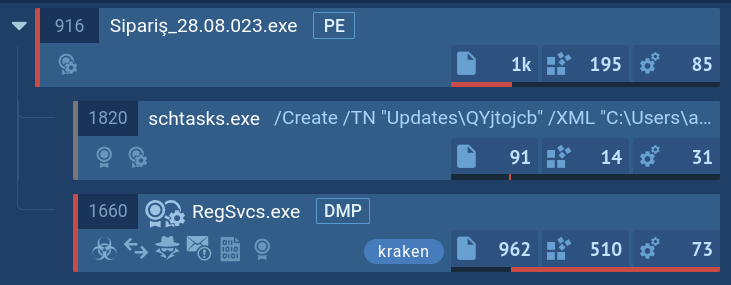
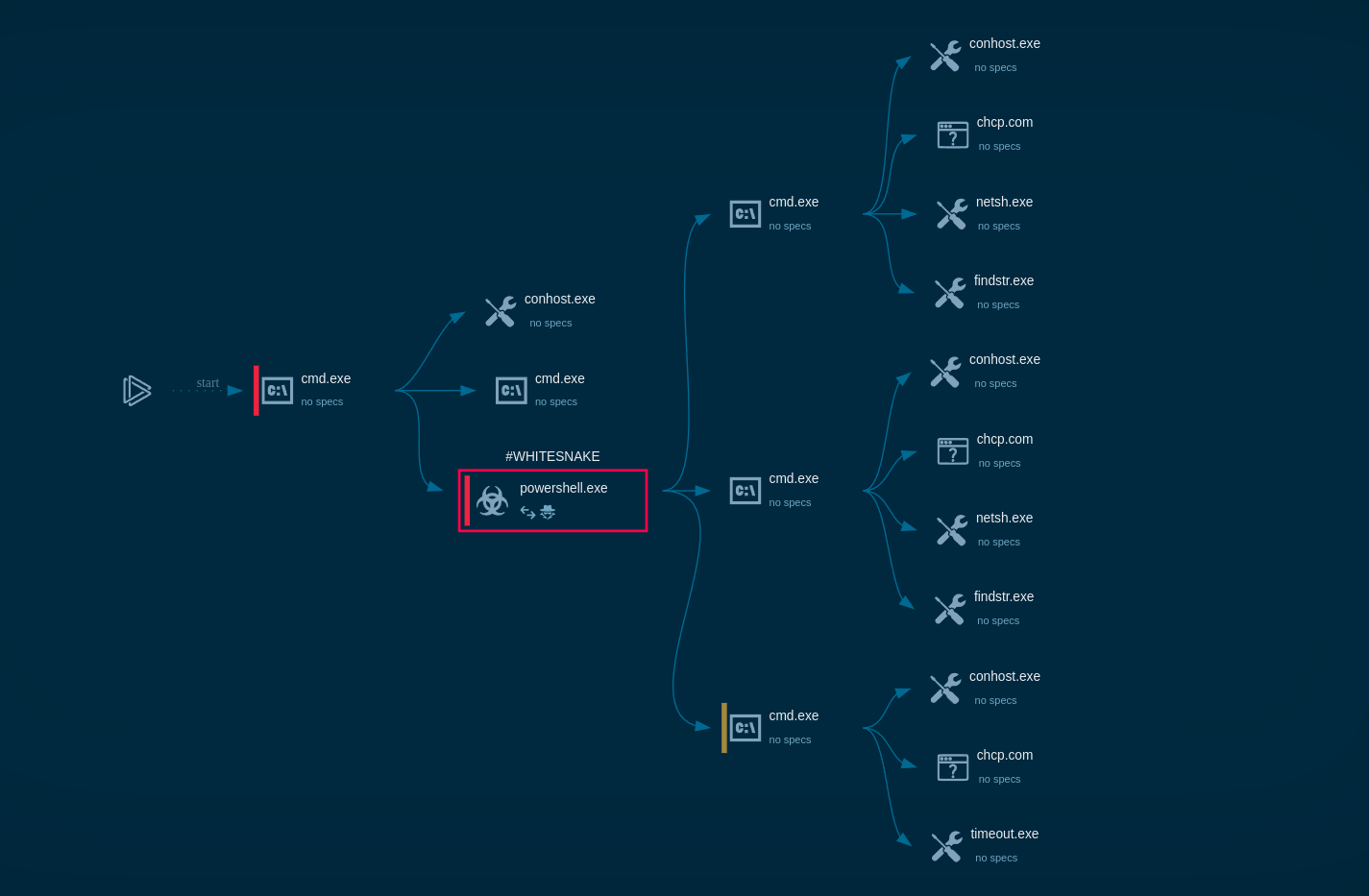
KrakenKeylogger process tree shown in ANY.RUN KrakenKeylogger`s process tree demonstrated in ANY.RUN

Distribution methods of the KrakenKeylogger malware

Phishing emails constitute the primary method of distributing Kraken. Victims usually receive seemingly legitimate messages that employ social engineering to trick them into downloading and opening malicious files attached to these emails. In most cases, criminals choose to address users on behalf of government agencies, as well as businesses.

Conclusion

KrakenKeylogger is a relatively unexplored threat, and the scale of its operation remains unknown. This highlights the need for individuals and organizations to practice proper measures to make sure that they stay protected against attacks. One of the key components of a comprehensive cybersecurity strategy is early detection of any malicious content received via email.

To this end, ANY.RUN can be used, as it allows you to conduct advanced analysis of any suspicious file or link and receive insights on whether it is harmful or not in seconds. The service provides thorough threat reports that contain all the essential information such as indicators of compromise (IOCs), needed for proper prevention and incident response.

Try ANY.RUN for free – request a demo!
HAVE A LOOK AT

Fog Ransomware screenshot
Fog is a ransomware strain that locks and steals sensitive information both on Windows and Linux endpoints. The medial ransom demand is $220,000. The medial payment is $100,000. First spotted in the spring of 2024, it was used to attack educational organizations in the USA, later expanding on other sectors and countries. Main distribution method — compromised VPN credentials.
Read More
Spyware screenshot
Spyware
spyware
Spyware is a stealth form of malware whose primary objective is to gather sensitive information, such as personal data, login credentials, and financial details, by monitoring user activities and exploiting system vulnerabilities. Spyware operates secretly in the background, evading detection while transmitting collected data to cybercriminals, who can then use it for malicious purposes like identity theft, financial fraud, or espionage.
Read More
MetaStealer screenshot
MetaStealer
metastealer
MetaStealer is an info-stealing malware primarily targeting sensitive data like login credentials, payment details, and browser history. It typically infects systems via phishing emails or malicious downloads and can exfiltrate data to a command and control (C2) server. MetaStealer is known for its stealthy techniques, including evasion and persistence mechanisms, which make it difficult to detect. This malware has been actively used in various cyberattacks, particularly for financial theft and credential harvesting from individuals and organizations.
Read More
Cephalus screenshot
Cephalus
cephalus
Cephalus is a targeted ransomware threat discovered in 2025. It’s known for infiltrating organizations that deal with sensitive data through compromised RDP access. It leverages DLL sideloading with a legitimate SentinelOne executable. Cephalus is able to exfiltrate data and destroy backup options. Its payload is also tailored to each victim, which makes identification and mitigation more complex.
Read More
GuLoader screenshot
GuLoader
guloader
GuLoader is an advanced downloader written in shellcode. It’s used by criminals to distribute other malware, notably trojans, on a large scale. It’s infamous for using anti-detection and anti-analysis capabilities.
Read More
Salty 2FA screenshot
Salty 2FA
salty2fa
Salty 2FA is a sophisticated Phishing-as-a-Service (PhaaS) framework tailored to hijack user sessions, steal credentials, and gain unauthorized access to corporate systems. Delivered primarily via targeted emails, this kit employs multi-stage evasion tactics, making it a stealthy tool for cybercriminals aiming at high-value enterprise accounts.
Read More