Black friday Up to 3 extra licenses FOR FREE + Special offer for TI LOOKUP Get it now
Webinar
February 26
Better SOC with Interactive Sandbox Practical Use Cases
Register now
151
Global rank
157 infographic chevron month
Month rank
105 infographic chevron week
Week rank

GandCrab is probably one of the most famous Ransomware. A Ransomware is a malware that asks the victim to pay money in order to restore access to encrypted files. If the user does not cooperate the files are forever lost.

Ransomware
Type
ex-USSR territory
Origin
26 January, 2018
First seen
19 September, 2026
Last seen

How to analyze GandCrab with ANY.RUN

Type
ex-USSR territory
Origin
26 January, 2018
First seen
19 September, 2026
Last seen

IOCs

IP addresses
2.23.246.9
172.211.123.250
48.209.133.15
48.209.6.48
135.233.95.135
20.165.94.63
23.59.18.102
23.216.77.19
48.209.138.168
40.126.32.74
88.221.169.152
23.11.41.157
48.192.1.64
2.16.164.112
95.100.102.101
13.33.187.2
150.171.27.11
185.199.110.133
20.190.160.20
150.171.28.11
Hashes
3d404f04c1dddc8c1938bfa755fd36058552e060fc4b7ef88d2ee04a82268f21
2d585ec73ae76a975632dcc810f156cf1bf4e7cc5547263c9a24614f89d9d4bd
878f32f76b159494f5a39f9321616c6068cdb82e88df89bcc739bbc1ea78e1f9
ff0cb83261b7bb506ab47dd19103e8d902f12496b315c53c004f9d0604823e48
7b8ab07521c24e8ec610611e7e15d2fd39336166db6509885b8500d2a2bbfb14
996e1f714b08e971ec79e3bea686287e66441f043177999a13dbc546d8fe402a
8a8de823d5ed3e12746a62ef169bcf372be0ca44f0a1236abc35df05d96928e1
44071e0fcffb9a9a32e8fa7010bb18dbc41afd0b176f81bf700b15b638a88a51
696e930706b5d391eb8778f73b0627ffc2be7f6c9a3e7659170d9d37fc4a97b5
0a3aaee7ccfb1a64f6d7bcd46657c27cb1f4569ae9e7c03445bd6c6fd013109b
fe1dcd3abfcd6b1655a026e60a05d03a7f71e4b6070f36e6c7e9c4b6f3d3bf1b
8232c450f967d7f2f22c54582f0667f4c033ae62e6d450ff8a35c47486249443
f51a7acfffec56d6751561966d947d3fd199b74528c07dabdcf5fcb33d5b2e85
7852fce59c67ddf1d6b8b997eaa1adfac004a9f3a91c37295de9223674011fba
0f8981b5bb10039061a861aef0da28223174056abe293792039f59dea84201ec
9152349f79b127dd66d276a1dc445d069494636b91fedfe5b6ef1d65ef703a46
9875f54b9288cfefa912bf6ad136eee38c98be9f14fddb72fe66e984b310b28c
49a39696a4d76729cde9aa2c0b17a7a63284cb439f43058a124141f124c68910
8b5a3610bb0275da5de8e4946507b735da58afd78d2b21ec7b47d1826757f12a
510f99c55823413056b386c8781ff96d5903b065eca9c0d1571a5ab40fac3908
Domains
client.wns.windows.com
ecs.office.com
slscr.update.microsoft.com
google.com
settings-win.data.microsoft.com
www.microsoft.com
go.microsoft.com
crl.microsoft.com
nexusrules.officeapps.live.com
self.events.data.microsoft.com
fe3cr.delivery.mp.microsoft.com
ocsp.digicert.com
activation-v2.sls.microsoft.com
login.live.com
copilot.microsoft.com
images.ctfassets.net
avatars.githubusercontent.com
msedge.b.tlu.dl.delivery.mp.microsoft.com
edge-mobile-static.azureedge.net
github-cloud.s3.amazonaws.com
URLs
http://crl.microsoft.com/pki/crl/products/microoceraut2011_2011_03_22.crl
http://www.microsoft.com/pkiops/crl/microsoft%20secure%20server%20ca%202026.crl
https://settings-win.data.microsoft.com/settings/v3.0/wsd/waasassessment?os=windows&osver=10.0.19041.1.amd64fre.vb_release.191206-&ring=retail&sku=48&deviceclass=windows.desktop&locale=en-us&deviceid=bad99146-31d3-4ec6-a1a4-be76f32ba5d4&flightring=retail&telemetrylevel=1&hidovergattreg=c%3a%5cwindows%5csystem32%5cdriverstore%5cfilerepository%5chidbthle.inf_amd64_9610b4821fdf82a5%5cmicrosoft.bluetooth.profiles.hidovergatt.dll&appver=10.0&processoridentifier=amd64%20family%2023%20model%201%20stepping%202&oemmodel=dell&updateoffereddays=4294967295&processormanufacturer=authenticamd&installdate=1661339444&oemmodelbaseboard=&branchreadinesslevel=cb&oemsubmodel=j5cr&isclouddomainjoined=0&deferfeatureupdateperiodindays=30&isdeviceretaildemo=0&flightingbranchname=&osuilocale=en-us&devicefamily=windows.desktop&wuclientver=10.0.19041.3996&uninstallactive=1&isflightingenabled=0&osskuid=48&processorclockspeed=3094&totalphysicalram=6144&securebootcapable=0&app=waasassessment&processorcores=6&currentbranch=vb_release&installlanguage=en-us&deferqualityupdateperiodindays=0&servicingbranch=cb&oemname_uncleaned=dell&tpmversion=0&primarydisktotalcapacity=262144&installationtype=client&attrdataver=186&processormodel=amd%20ryzen%205%203500%206-core%20processor&isedgewithchromiuminstalled=1&osversion=10.0.19045.4046&ismdmenrolled=0&activationchannel=retail&honorwufbdeferrals=0&firmwareversion=a.40&trendinstalledkey=1&osarchitecture=amd64&defaultuserregion=244&updatemanagementgroup=2
https://go.microsoft.com/fwlink/?linkid=2257403&clcid=0x409
https://settings-win.data.microsoft.com/settings/v3.0/wsd/muse?processorclockspeed=3094&flightids=&updateoffereddays=4294967295&branchreadinesslevel=cb&oemmanufacturername=dell&isclouddomainjoined=0&processoridentifier=amd64%20family%2023%20model%201%20stepping%202&sku=48&activationchannel=retail&attrdataver=186&ismdmenrolled=0&processorcores=6&processormodel=amd%20ryzen%205%203500%206-core%20processor&totalphysicalram=6144&primarydisktype=4294967295&flightingbranchname=&chassistypeid=1&oemmodelnumber=dell&systemvolumetotalcapacity=260281&sampleid=95271487&deviceclass=windows.desktop&app=muse&disabledualscan=0&appver=10.0&oemsubmodel=j5cr&locale=en-us&isalwaysonalwaysconnectedcapable=0&ms=0&defaultuserregion=244&updateserviceurl=http%3a%2f%2fneverupdatewindows10.com&osver=10.0.19045.4046.amd64fre.vb_release.191206-1406&os=windows&deviceid=s%3abad99146-31d3-4ec6-a1a4-be76f32ba5d4&deferqualityupdateperiodindays=0&ring=retail&deferfeatureupdateperiodindays=30
https://login.live.com/rst2.srf
https://login.live.com/ppsecure/deviceaddcredential.srf
http://ocsp.digicert.com/mfewtzbnmeswstajbgurdgmcgguabbq50otx%2fh0ztl%2bz8sipi7wewvxdlqqutijuibiv5unu5g%2f6%2brks7qyxjzkceaz1vqyrvgl0erhqlcpm8gy%3d
https://slscr.update.microsoft.com/sls/%7b522d76a4-93e1-47f8-b8ce-07c937ad1a1e%7d/x64/10.0.19045.4046/0?ch=686&l=en-us&p=&pt=0x30&wua=10.0.19041.3996&mk=dell&md=dell
http://www.microsoft.com/pkiops/crl/microsoft%20ecc%20update%20secure%20server%20ca%202.1.crl
https://fe3cr.delivery.mp.microsoft.com/clientwebservice/ping
https://slscr.update.microsoft.com/sls/ping
https://slscr.update.microsoft.com/sls/%7be7a50285-d08d-499d-9ff8-180fdc2332bc%7d/x64/10.0.19045.4046/0?ch=686&l=en-us&p=&pt=0x30&wua=10.0.19041.3996&mk=dell&md=dell
https://settings-win.data.microsoft.com/settings/v3.0/wsd/updatehealthtools?os=windows&osver=10.0.19041.1.amd64fre.vb_release.191206-&sku=48&deviceclass=windows.desktop&locale=en-us&deviceid=s:bad99146-31d3-4ec6-a1a4-be76f32ba5d4&sampleid=s:95271487&appver=10.0.19041.3626&flightring=retail&telemetrylevel=1&hidovergattreg=c%3a%5cwindows%5csystem32%5cdriverstore%5cfilerepository%5chidbthle.inf_amd64_9610b4821fdf82a5%5cmicrosoft.bluetooth.profiles.hidovergatt.dll&appver=&processoridentifier=amd64%20family%2023%20model%201%20stepping%202&oemmodel=dell&updateoffereddays=4294967295&processormanufacturer=authenticamd&installdate=1661339444&oemmodelbaseboard=&branchreadinesslevel=cb&oemsubmodel=j5cr&isclouddomainjoined=0&deferfeatureupdateperiodindays=30&isdeviceretaildemo=0&flightingbranchname=&osuilocale=en-us&devicefamily=windows.desktop&wuclientver=10.0.19041.3996&uninstallactive=1&isflightingenabled=0&osskuid=48&processorclockspeed=3094&totalphysicalram=6144&securebootcapable=0&app=sedimentpack&processorcores=6&currentbranch=vb_release&installlanguage=en-us&deferqualityupdateperiodindays=0&oemname_uncleaned=dell&tpmversion=0&primarydisktotalcapacity=262144&installationtype=client&attrdataver=186&processormodel=amd%20ryzen%205%203500%206-core%20processor&isedgewithchromiuminstalled=1&osversion=10.0.19045.4046&ismdmenrolled=0&activationchannel=retail&firmwareversion=a.40&trendinstalledkey=1&osarchitecture=amd64&defaultuserregion=244&updatemanagementgroup=2
http://www.microsoft.com/pkiops/crl/microsoft%20update%20signing%20ca%202.3.crl
http://www.microsoft.com/pkiops/crl/microsoft%20update%20signing%20ca%202.2.crl
http://crl.microsoft.com/pki/crl/products/microoceraut_2010-06-23.crl
http://www.microsoft.com/pkiops/crl/micsecserca2011_2011-10-18.crl
https://github.com/Pyran1/MalwareDatabase/raw/refs/heads/master/Ransomware/GangCrab/2d585ec73ae76a975632dcc810f156cf1bf4e7cc5547263c9a24614f89d9d4bd.zip
http://edge.microsoft.com/browsernetworktime/time/1/current?cup2key=2:-ggw1ewjbfw8tndllaneks5yihpx_ypn2xrv6xmrvty&cup2hreq=e3b0c44298fc1c149afbf4c8996fb92427ae41e4649b934ca495991b7852b855
Last Seen at

Recent blog posts

post image
How MSSPs Can Prove Their Value When “Nothing...
watchers 3785
comments 0
post image
Enterprise Threat Intelligence Buying Guide:...
watchers 4251
comments 0
post image
ANY.RUN & SentinelOne: One Workspace, Ins...
watchers 5556
comments 0

What is GandCrab ransomware?

GandCrab is a ransomware-type malware, which means that it encrypts files on infected machines and demands a ransom in cryptocurrency to restore the lost data. What’s more, this particular strain is distributed as a Ransomware-As-A-Service, allowing anybody to use this program by purchasing access to a control dashboard.

A unique business model and constant updates of the malware, in turn, helped GandCrab to become one of the most widely spread ransomware of 2018.

General Description of GandCrab

Since its discovery on January 26, 2018, at least 5 versions of GandCrab were created. The authors of the program are extremely active and respond to created countermeasures almost instantly, making GandCrab an elusive malware that continues to terrorize private and corporate victims today.

The last identified version of the malware is 5.1 and it targets users from all over the world with one exception – having originated in an ex-USSR country GandCrab is known to ignore users from X-USSR territories, identifying them by the keyboard or UI language settings. Only Windows operating systems are affected by ransomware.

It should be noted, that the virus is assigned a different name by various antivirus software:

  • Ransom: Win32/GandCrab
  • Trojan.Ransom.GandCrab
  • Win32/Filecoder.GandCrab
  • Ransom.GandCrab
  • Trojan-Ransom.Win32.GandCrypt

Usually infecting users through mail spam or exploit kits, the ransomware redirects victims to a TOR website after the files on a victim’s PC are encrypted. For the newer versions of the malware, the only way of restoring the data is through paying the ransom, the amount of which usually fluctuates between 1000 and 3000 dollars. However, some victims, have reported that they were asked to pay as much as 700,000 USD.

Having a RaaS ( Ransomware-as-a-Service ) business model, GandCrab is distributed by the original creators to “clients”, who then deliver the malware to end victims, asking for a custom ransom amount through one of the unique features of the virus – customizable ransom notes. A percentage of the “revenue” is then shared with the malware authors, once a ransom is secured.

GandCrab malware analysis

ANY.RUN provides the ability to watch the GandCrab program in action in interactive virtual machine simulation. Notably, ANY.RUN simulation can be used to perform the analysis of the stages of the virus life cycle:
  • Infection. A victim downloads and opens infected Microsoft Office file which contains a script programmed to download and start the execution of the virus;
  • Execution and information gathering. After the script has started the execution process, GandCrab collects information about the user. At this stage, the execution of the virus is stopped if a Russian keyboard layout or user interface is detected;
  • The malware checks for the presence of antivirus drivers and stops all processes that involve files that it wants to encrypt;
  • The ransomware decrypts the ransom record held in the binary;
  • Next, a key pair is generated;
  • The virus enumerates file and decryptors;
  • GandCrab proceeds to encrypt the files;
  • The malware establishes communication with the server;
  • After that, the malware will try to delete all shadow copies;
  • Finally, a ransom note is displayed to the user.

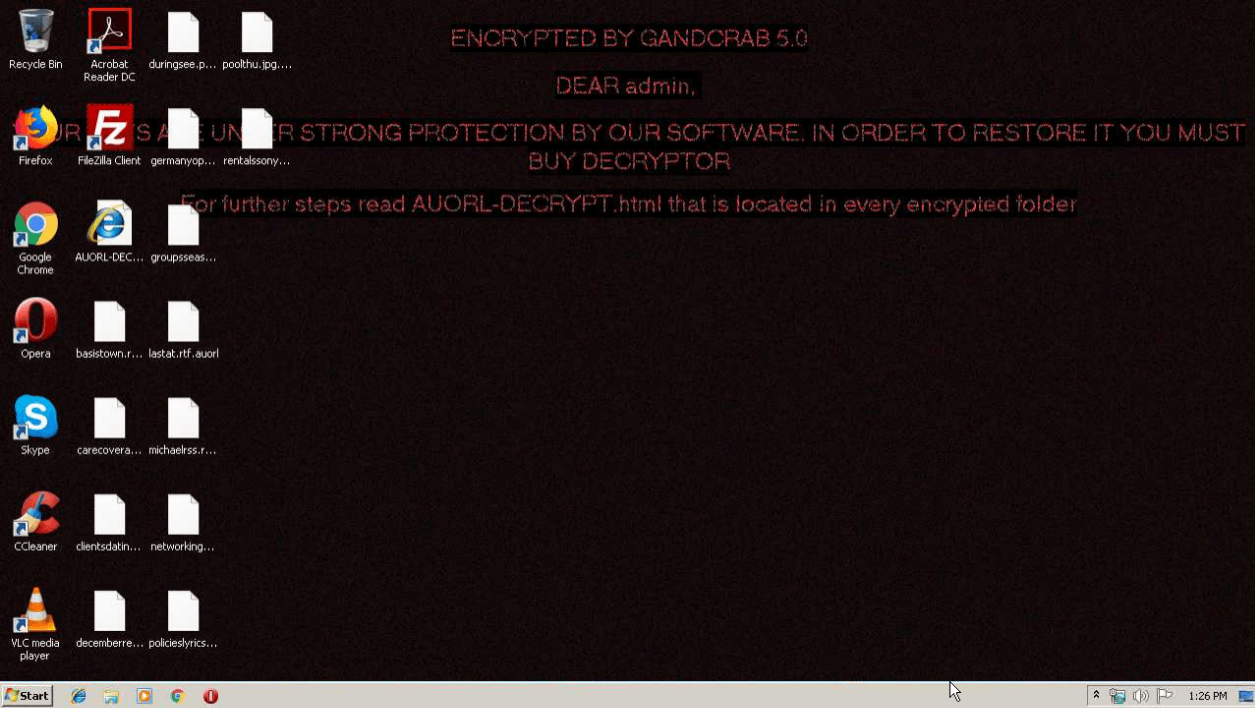
wallpaper after infection by gandcrab ransomware

Figure 1: Some versions of GandCrab are known to change the desktop wallpaper. This function is omitted in version 5.0.
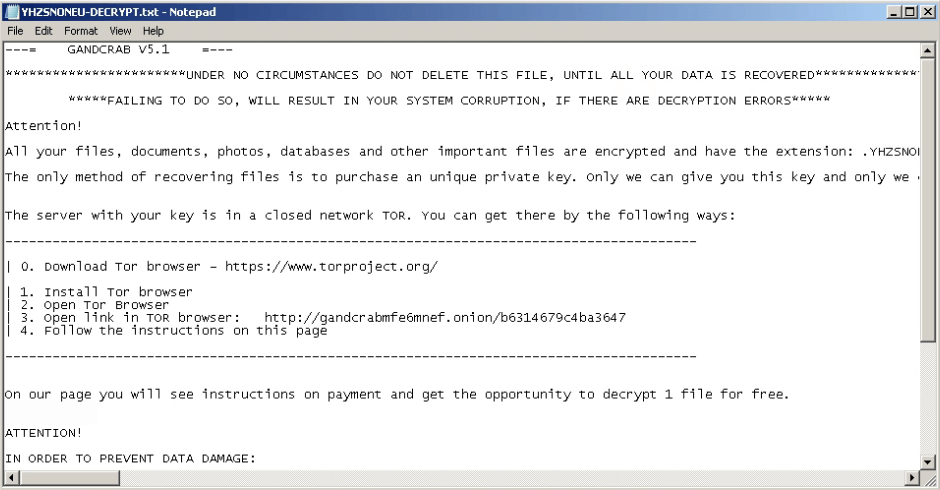
ransomnote displayed by gandcrab v5.1

Figure 2: A ransomware note displayed by GandCrab v5.1

The following contamination processes are launched by the ransomware:

  • Starts CMD.EXE for commands execution
  • Executes PowerShell scripts
  • Downloads executable files from the Internet
  • Connects to CnC server
  • Makes registry changes
  • Runs wmic.exe
  • Executes vssvc.exe
  • Deletes shadow copies
  • Runs NOTEPAD.EXE

The whole contamination process can be seen in a video, displaying the ANY.RUN simulation.
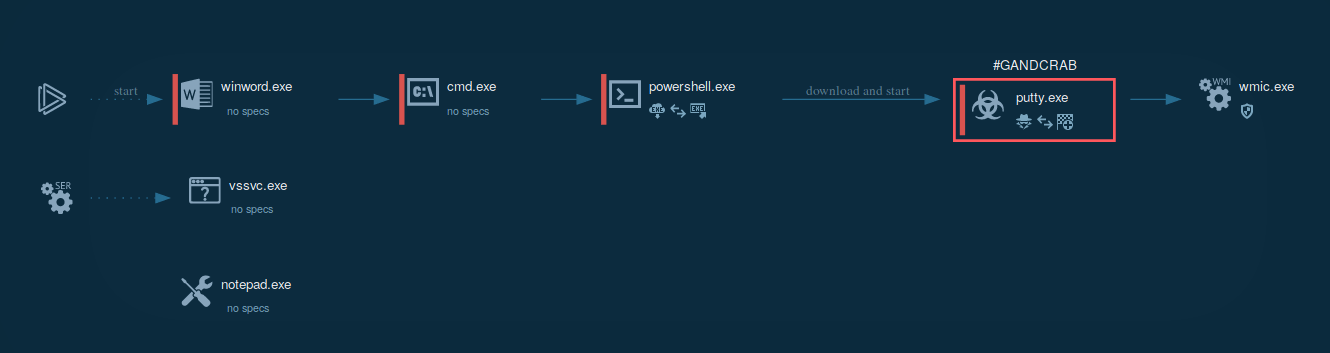
gandcrab execution process graph

Figure 3: Illustrates the processes launched by GandCrab during its life cycle.

To build itself into the system, GandCrab starts with decrypting an extension name record that is held in the binary. By going through logical drives from “a” to “z” the malware separates all drives that are equal to 0x2 and not equal to 0x5, creating and separating thread to enumerate and encrypt all data that is prepared for encryption. After the encryption is complete, the malware uses wmic to erase all shadow copies. As a result, all data remains affected by the program even after a reboot.

The ransomware leaves behind artifacts that can help to recognize the version. Those exist in the form of extensions of encrypted files.

  • Version 1 gives the .gdcb extension
  • Version 2 and 3 give the .crab extension
  • Version 4 gives the .krab extension
  • Version 5 gives a randomized 5 or more letter extension

How to avoid infection by GandCrab?

According to the analysis, creators of GandGrab patch all exploits in the malware code fairly quickly, which makes the development of countermeasures tricky. Upon contamination with on of the latest versions, the only way to restore the lost data is to pay the ransom. Thus, the best way to stay safe is to prevent contamination.

  • By keeping digital copies of important files in multiple places
  • By making sure that the antivirus software is reliable and updated
  • Avoiding digital downloads on suspicious or unknown websites
  • Avoiding opening the attached files in emails, especially those coming from unknown senders.
  • And not paying the ransom if infected.

That said, effective countermeasures do exist for older versions of the ransomware like Troldesh or Nemty, including free decrypters and Killswitches. Most notably, a Killswitch for GandCrab v4.1.2 was developed by a cyber threat analysis and response company Ahnlab. The defensive application exploits the mechanics of GandCrab ransomware by creating a file with the .lock extension, which simulates the files that GandCrab itself generates and uses to check whether the victim's computer is included in the record of previously affected machines to avoid double decryption.

The execution of the ransomware stops upon discovery of .lock file if it is placed in %Application Data% for Windows versions before Windows 7 and in %ProgramData% directory for newer OS versions. Even in cases when the malware has already activated, the killswitch will prevent some of the damage.

Interestingly, in response to the killswitch, the GandCrab authors released an exploit, targeting the Ahnlab antivirus software. The exploit was introduced in version v4.2.1 and v4.3 of the malware but did not cause sufficient harm to the antivirus users.

For versions 1, 4 and up through 5.1 there are free decryption tool from Bitdefender.

Distribution of GandCrab

Based on the analysis, ransomware is known to utilize multiple attack vectors, however, compromised list and spam email campaigns are the most commonly used delivery channels. Being delivered to users in spam emails, GandCrab tricks users into downloading a ZIP archive that contains a script file that triggers the download and execution.

GandCrab execution process and technical malware analysis

An illustration of an execution process can be found below.
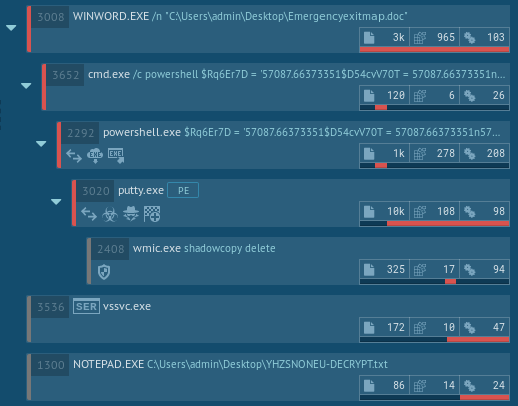
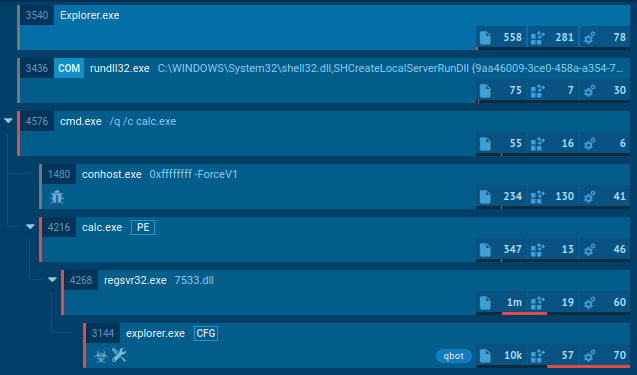
gandcrab execution process tree

Figure 4. Malware analysis of the GandCrab execution process in ANY.RUN

The following behavioural activities are shown in ANY.RUN’s malware analysis report.
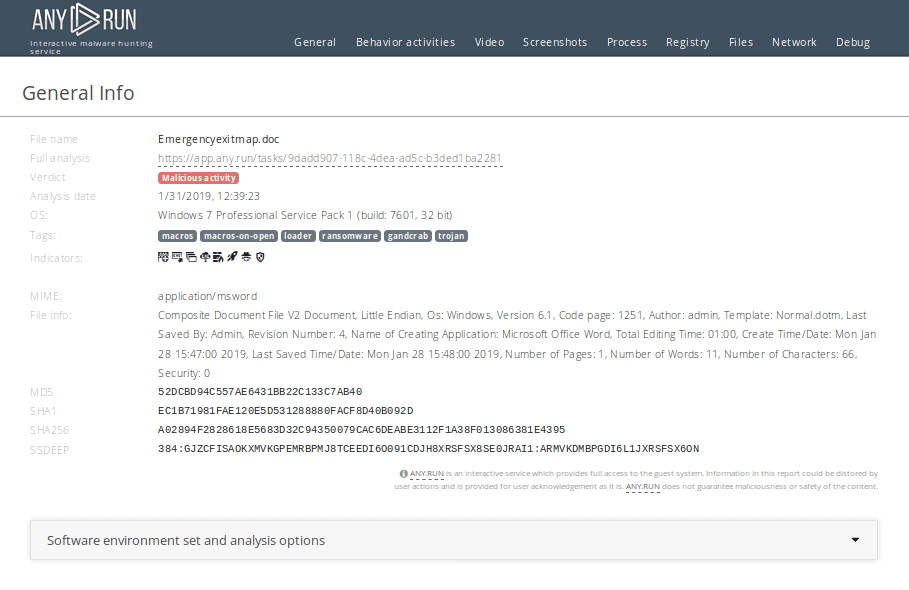
text report of the gandcrab ransomware analysis

Figure 5: A text report created in ANY.RUN

During the execution the malware creates several artifacts that can be viewed in detail in the ANY.RUN simulation.

With file encryption being the main goal of the payload, the malware launches a command line with pre-specified parameters after opening a Microsoft Word file. Startup powershell is then sent as command line parameters, followed by downloading and launching the executable file from the Internet.

How to detect Gandcrab using ANY.RUN?

You can perform malware analysis of files using ANY.RUN's "Static Discovering". Open either "Files" tab in the lower part of the task's window or click on the process and then on the button "More Info" in the appeared window. After that, all you need to do is just click on the file.
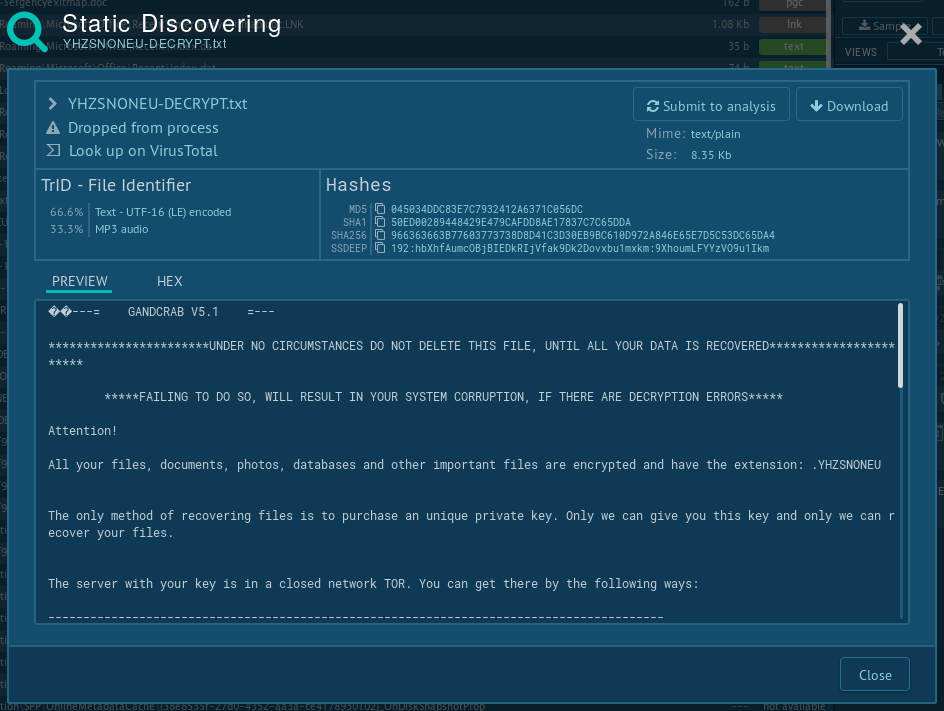
gandcrab ransom note

Figure 6: Gandcrab ransom note

Conclusion

Thanks a unique business model which involves selling the program as a service and defining characteristics like customizable ransom notes, GandCrab’s popularity quickly escalated in 2018, making the virus the most widely spread ransomware of the year.

Unfortunately, the creators proved to be very active and continued to respond quickly to all attempts to create effective countermeasures. While adhering to common practices of staying safe on the internet decreases the probability of getting attacked greatly, running interactive sandbox malware analysis in a service such as ANY.RUN is the best way to ensure personal or corporate safety.

P.S.

On the 1st June 2019 creators of the GandCrab ransomware made a post in which they stating that they have generated more than $2 billion in ransom payments, with average weekly payments of $2.5 million dollars. They also said that they have personally earned $150 million, which they have cashed out and invested in legal business entities. In the same post, they announced about ending of distributing the program within 20 days and that keys will be deleted.
HAVE A LOOK AT

ClickFix screenshot
ClickFix is a sophisticated social engineering technique that tricks users into manually executing malicious commands on their devices. It masquerades as a "quick fix" for fake technical issues, CAPTCHA verifications, or error messages, often hijacking the clipboard to paste harmful PowerShell or terminal commands. This user-assisted approach helps it bypass traditional security controls, leading to infostealers like Lumma Stealer, RATs, and other malware.
Read More
Crocodilus screenshot
Crocodilus
crocodilus
Crocodilus is a highly sophisticated Android banking Trojan that emerged in March 2025, designed for full device takeover. Disguised as legitimate apps, it steals banking credentials, cryptocurrency wallet data, and enables remote control, rapidly evolving into a global threat targeting financial users across Europe, South America, and Asia.
Read More
CryptoWall screenshot
CryptoWall
cryptowall
CryptoWall is a notorious ransomware family that emerged in early 2014 and rapidly became one of the most destructive cyber threats of its time. This malware encrypts victims' files using strong AES encryption, demands ransom payments in Bitcoin, and has generated hundreds of millions of dollars for cybercriminals.
Read More
Cactus Ransomware screenshot
Cactus ransomware-as-a-service (RaaS) was first caught in March 2023 targeting corporate networks. It became known for its self-encrypting payload and double extortion tactics. Cactus primarily targets large enterprises across industries in finance, manufacturing, IT, and healthcare. It is known for using custom encryption techniques, remote access tools, and penetration testing frameworks to maximize damage.
Read More
DragonForce screenshot
DragonForce
dragonforce
DragonForce is a ransomware strain operating under the Ransomware-as-a-Service (RaaS) model. First reported in December 2023, it encrypts files with ChaCha8, renames them with random strings, and appends “.dragonforce_encrypted.” By disabling backups, wiping recovery, and spreading across SMB shares, DragonForce maximizes damage and pressures victims into multimillion-dollar ransom negotiations. It has targeted manufacturing, construction, IT, healthcare, and retail sectors worldwide, making it a severe threat to modern enterprises.
Read More
MassLogger screenshot
MassLogger
masslogger
MassLogger is a credential stealer and keylogger first identified in April 2020. It has been actively used in cyber campaigns to exfiltrate sensitive information from compromised systems. It is designed for easy use by less tech-savvy actors and is prominent for the capability of spreading via USB drives. It targets both individuals and organizations in various industries, mostly in Europe and the USA.
Read More