Black friday Up to 3 extra licenses FOR FREE + Special offer for TI LOOKUP Get it now
Webinar
February 26
Better SOC with Interactive Sandbox Practical Use Cases
Register now

INC Ransomware

119
Global rank
70 infographic chevron month
Month rank
71 infographic chevron week
Week rank
0
IOCs

INC Ransomware is a ransomware-as-a-service (RaaS) spotted in mid-2023. It targets industries like retail, real estate, finance, healthcare, and education, primarily in the U.S. and UK. It encrypts and exfiltrates data demanding a ransom. It employs advanced evasion techniques, destroys backup, and abuses legitimate system tools at all the stages of the kill chain.

Ransomware
Type
Unknown
Origin
1 May, 2023
First seen
18 January, 2026
Last seen

How to analyze INC Ransomware with ANY.RUN

Type
Unknown
Origin
1 May, 2023
First seen
18 January, 2026
Last seen

IOCs

Last Seen at

Recent blog posts

post image
ANY.RUN Sandbox & MISP Integration: Confi...
watchers 343
comments 0
post image
From Forgotten Tool to Powerful Pivot: Using...
watchers 912
comments 0
post image
Malware Trends Report 2025: New Security Risk...
watchers 2763
comments 0

What is INC Ransomware?

INC Ransomware is a ransomware-as-a-service (RaaS) operated by the INC Ransom group that emerged in 2023. In mid-2024, its source code leaked to dark web and became a foundation of Lynx ransomware, the latter often referred to as “rebranding” or a variant of the former. Both employ double extortion, encrypting victims' data and threatening to leak it unless ransoms are paid.

INC Ransomware uses multiple vectors to infiltrate networks, leveraging both technical exploits and social engineering. These include phishing emails with malicious attachments or links to compromised websites, network access credentials acquired from IABs, malvertising and drive-by downloads, software vulnerabilities. INC Ransomware is used in supply chain attacks targeting third-party vendors or service providers to infiltrate larger networks (SolarWinds attack).

Once in the network, it performs privilege escalation using tools like WinPEAS and starts lateral movement using Cobalt Strike, PsExec, Mimikatz, and the like. It exfiltrates data before encrypting it with a strong algorithm (likely AES + RSA) and leaves a ransom note with payment instructions.

INC Ransom’s evasion techniques include: fileless execution, custom packers and obfuscation, delayed execution. Its living-off-the-land tactic implies the use of legitimate tools like PowerShell, WMI, and PsExec to blend in. The malware exploits SystemSettingsAdminFlows.exe to modify registry keys and disable Windows Defender.

Get started today for free

Analyze malware and phishing in a fully-interactive sandbox

Create free account

INC Ransom’s Prominent Features

INC Ransomware possesses significant risks since it:

  • Targets Critical Infrastructure: healthcare, finance, and retail, where disruptions can endanger lives, financial stability, or supply chains. Attacks on vendors (e.g., Toppan Next Tech affecting DBS and Bank of China) amplify impact across multiple organizations.
  • Demands Large Ransom Sums: they often reach millions with INC, Lynx escalating them further.
  • Abuses Legacy Systems: INC exploits unpatched or unsupported software, common in healthcare and industrial sectors.
  • Uses Double Extortion: combining encryption with data leaks increases pressure on victims to pay. Leaked data can lead to regulatory fines (e.g., GDPR, HIPAA) and reputational damage.
  • Acts fast: critical files are encrypted quickly, disrupting operations.

INC Ransom’s Execution Process and Technical Details

Let us follow the execution chain of INC by detonating it in the safe environment of ANY.RUN’s Interactive Sandbox and view the processes and artifacts it inducts.

View the analysis of an INC Ransomware sample.
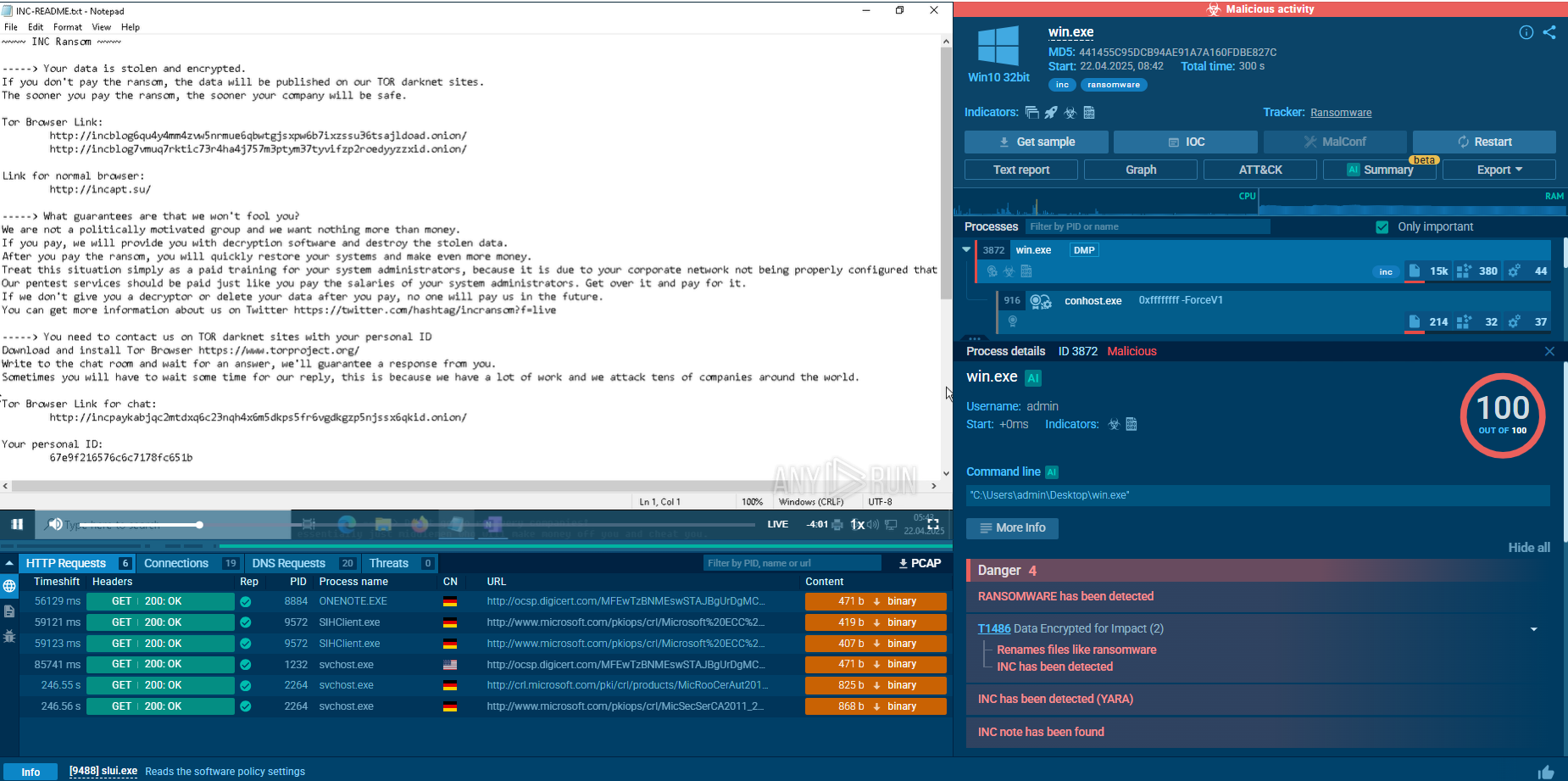
INC Ransomware analysis in ANY.RUN Sandbox INC Ransomware sample in action in ANY.RUN's Interactive Sandbox

INC ransomware typically gains its initial foothold through phishing, exploitation of unpatched vulnerabilities, or credentials bought from Initial Access Brokers. Once inside, the operators run reconnaissance with commercial red-team tools and built-in Windows utilities to map the network and collect additional credentials.

They pivot laterally using living-off-the-land binaries — such as Notepad, WordPad, and others — to review files while blending in with normal activity. Next, they disable or terminate security software, backup agents, and database services via Service Control Manager APIs and custom “security-killer” tools.

Before encryption, INC tests write access by creating and truncating dummy data on target files; if files are locked, it kills the owning processes or escalates privileges to force access. Operators may also archive data with 7-Zip and exfiltrate it to cloud storage, setting the stage for double extortion. The malware then encrypts all local, mounted, and hidden volumes with AES, offering multiple modes that trade speed for thoroughness.

Finally, it drops ransom notes in .txt and .xps formats and replaces the desktop wallpaper with payment instructions and threats to leak stolen data if the ransom is ignored.

Use ANY.RUN free for 14 days

Try the full power of interactive analysis

Start your free trial

What are the best-known INC attacks?

  • British Library (October 2023). One of the first major cultural institutions attacks by INC Ransom. Massive data breach (~500 GB of data leaked, including employee passports, financial records), encryption disrupted online services for weeks.
  • Yakult Australia (December 2023). About a million dollars in Bitcoin were demanded from a major beverage company for stolen corporate data (financial records, employee details).
  • A city government in Germany (March 2024). Citizen services paralyzed (tax, permits, public records); sensitive documents leaked (court cases, personal IDs). Ransom payment refusal led to prolonged recovery.
  • A major oil & gas company in Brazil (April 2024). Operational disruption (delayed shipments, refinery issues); stolen blueprints and contracts leaked. Ransom demand exceeded $5 million.

Gathering Threat Intelligence on INC Ransom

Even when two strains are as closely related as are INC Ransomware and Lynx, you can gather actionable intelligence on them separately using ANY.RUN’s services and analyze their differences and similarities to get a better understanding of malware evolution and to ensure the protection of your own system.

Start with searching by malware’s name via ANY.RUN’s Threat Intelligence Lookup to research more public sample analyses and gather IOCs for tuning your security systems.
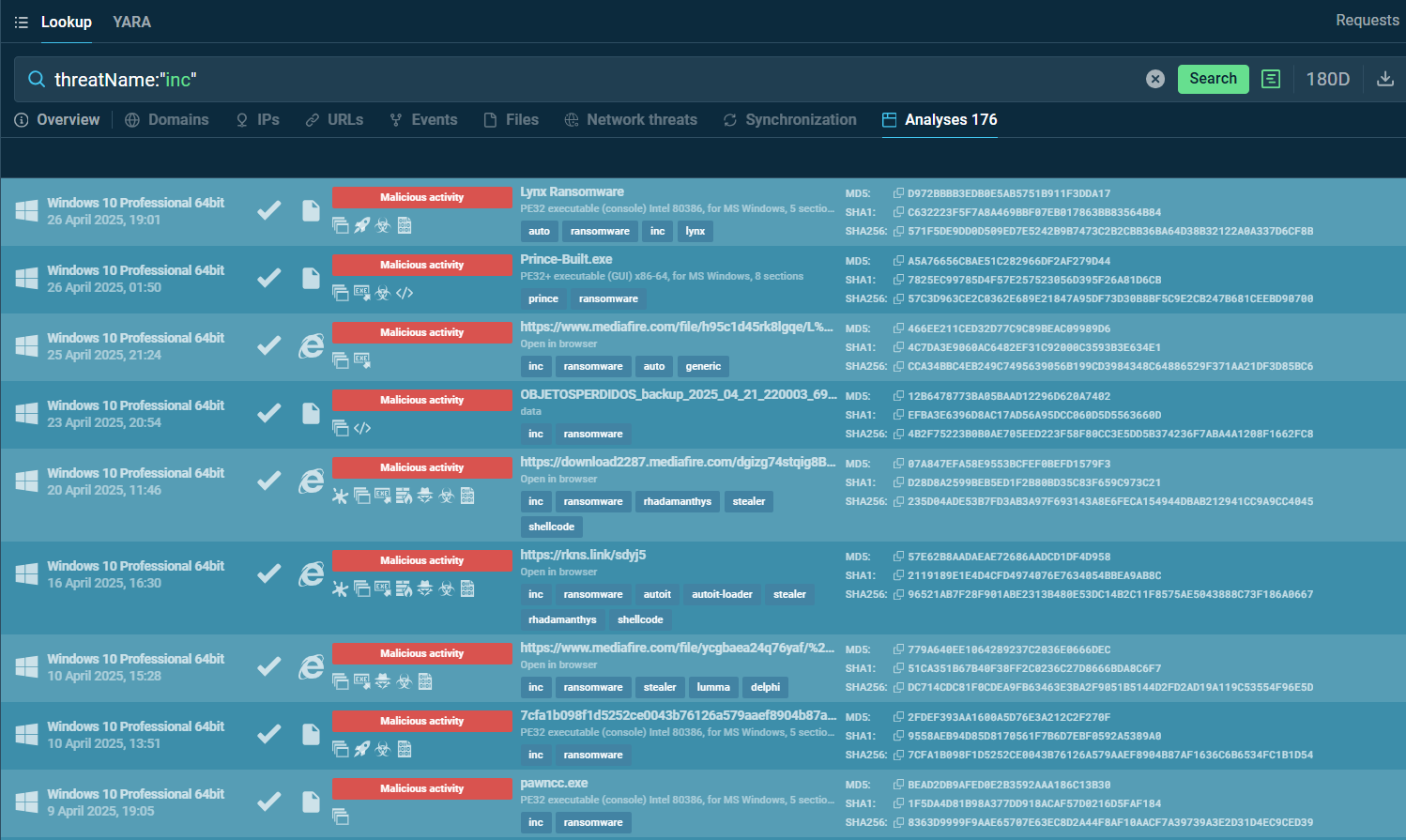
threatName:"INC"

INC Ransomware public analyses Fresh INC samples analyzed in the sandbox

Integrate ANY.RUN’s threat intelligence solutions in your company

Contact us

Conclusion

INC Ransomware is a dangerous RaaS using phishing, exploits, and LOTL techniques to infiltrate networks, evade detection, and turn to double extortion. It’s particularly threatening to healthcare, finance, and retail due to its disruptive potential and high ransom demands. Detection relies on EDR, behavioral analysis, and TI-driven IOCs, while countermeasures include zero-trust, backups, and patching.

Threat intelligence is critical for tracking its evolving TTPs and predicting variants like Lynx. Organizations should prioritize proactive defenses and TI integration to stay ahead of this adaptable threat.

Start with 50 requests in TI Lookup to collect IOCs on INC Ransom
HAVE A LOOK AT

Loader screenshot
Loader
loader downloader
A loader is malicious software that infiltrates devices to deliver malicious payloads. This malware is capable of infecting victims’ computers, analyzing their system information, and installing other types of threats, such as trojans or stealers. Criminals usually deliver loaders through phishing emails and links by relying on social engineering to trick users into downloading and running their executables. Loaders employ advanced evasion and persistence tactics to avoid detection.
Read More
Akira Ransomware screenshot
Akira Ransomware emerged in March 2023 and compromised over 250 organizations by January 2024 with approximately $42 million in ransom payments. It employs double extortion tactics exfiltrating data before encryption and threatening to publish it on a dedicated website.
Read More
MetaStealer screenshot
MetaStealer
metastealer
MetaStealer is an info-stealing malware primarily targeting sensitive data like login credentials, payment details, and browser history. It typically infects systems via phishing emails or malicious downloads and can exfiltrate data to a command and control (C2) server. MetaStealer is known for its stealthy techniques, including evasion and persistence mechanisms, which make it difficult to detect. This malware has been actively used in various cyberattacks, particularly for financial theft and credential harvesting from individuals and organizations.
Read More
Orcus RAT screenshot
Orcus RAT
orcus rat trojan
Orcus is a modular Remote Access Trojan with some unusual functions. This RAT enables attackers to create plugins using a custom development library and offers a robust core feature set that makes it one of the most dangerous malicious programs in its class.
Read More
RondoDox screenshot
RondoDox
rondodox
RondoDox is an emerging Linux-based botnet malware that exploits dozens of known vulnerabilities in internet-facing devices like routers, DVRs, and web servers to build massive networks for DDoS attacks, cryptomining, and data exfiltration. First spotted in mid-2025, its "exploit shotgun" tactic (firing multiple payloads at once) has made it a rapid escalator in the IoT threat landscape, compromising unpatched edge devices worldwide.
Read More
Rootkit screenshot
Rootkit
rootkit bootkit
A rootkit is a type of malicious software designed to provide unauthorized administrative-level access to a computer or network while concealing its presence. Rootkits are tools used by cybercriminals to hide their activities, including keyloggers, spyware, and other malware, often enabling long-term system exploitation.
Read More