



As 2027 approaches, strengthening threat detection and improving SOC efficiency are key priorities for the year ahead. But not all threat intelligence feeds deliver the same value. Some focus on large volumes of indicators of compromise (IOCs), while others provide fresh intelligence from real-world attacks, deeper threat context, or unique indicators that help close detection gaps.
This threat intelligence feeds review 2027 examines 10 commercial and open-source providers, covering their capabilities, intelligence sources, and practical value for security operations. Rather than ranking providers, it offers a neutral overview and key evaluation criteria to help organizations choose the intelligence that best fits their security needs, strengthen detection coverage, and enter the new year with a more efficient SOC.
Key Criteria for Evaluating Threat Intelligence Feeds
For SOC teams, the real value of threat intelligence lies in its impact on daily operations: detecting threats earlier, reducing alert noise, and accelerating investigations. For security decision-makers, the priority is finding intelligence that improves these outcomes without adding unnecessary costs or workload.
The following criteria and evaluation questions can help assess the operational and business value of a threat intelligence feed.
| Evaluation Criteria | Why It Matters | Questions to Ask |
|---|---|---|
| Real-world threat coverage | Intelligence based on observed malicious activity helps strengthen defenses against active malware and phishing campaigns. | Does the feed reflect threats relevant to our industry and environment? Where does the intelligence originate? |
| IOC freshness and update frequency | Timely intelligence supports earlier detection and reduces the risk of relying on outdated indicators. | How quickly are new threats added? How frequently is the feed updated? |
| Unique threat indicators | Additional IOCs can close detection gaps and increase the value of existing security investments. | How much new intelligence does this feed provide beyond our current sources? |
| Threat context and traceability | Supporting evidence helps analysts validate alerts faster, investigate related activity, and make better response decisions. | Can analysts trace an IOC back to its source or supporting investigation? |
| IOC accuracy and relevance | Higher-quality indicators can reduce false positives, unnecessary escalations, and wasted analyst hours. | How are indicators validated? How are outdated or irrelevant IOCs handled? |
| Integration and automated delivery | Compatibility with existing security systems reduces implementation effort and ongoing maintenance costs. | Does the feed support our SIEM, SOAR, and existing workflows through APIs or STIX/TAXII? |
| Coverage across IOC types | Multiple indicator types support broader detection across malware delivery, phishing, and command-and-control activity. | Which IOC types are included, and do they address our main detection gaps? |
| Operational efficiency | Intelligence that requires less manual enrichment can shorten investigation times and help SOC teams handle growing alert volumes. | Will this feed reduce investigation time, manual work, or unnecessary escalations? |
10 Threat Intelligence Feed Providers Reviewed for 2027
Threat intelligence providers differ in the sources they monitor, the types of indicators they deliver, and the security workflows they support. The following reviews cover 10 commercial and open-source solutions, highlighting their intelligence capabilities, practical applications, and considerations for SOC teams.
ANY.RUN Threat Intelligence Feeds
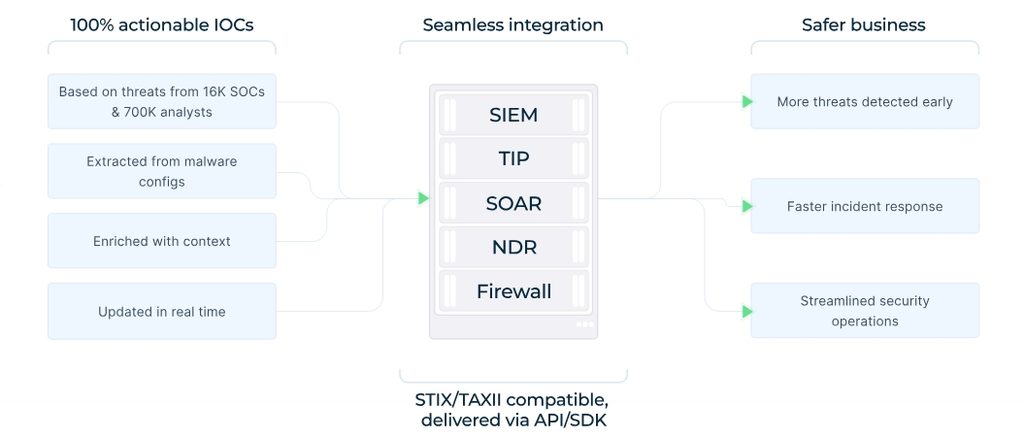
ANY.RUN Threat Intelligence Feeds provide real-time malicious IP addresses, domains, and URLs collected from malware and phishing investigations in its Interactive Sandbox. The intelligence is sourced from a global community of over 700,000 security professionals across 16,000 organizations.
According to ANY.RUN’s internal research, around 30% of unique malicious IOCs discovered during studied customer sandbox investigations were already available in its Threat Intelligence Feeds. For SOC teams, this means some threats can be identified through existing detections before analysts need to investigate them manually, potentially reducing investigation time and improving detection coverage.
Key capabilities:
- Investigation-based intelligence: Fresh indicators extracted from malware and phishing analysis help SOC teams detect malicious infrastructure that may be missing from their existing feeds.
- Threat context: Links to sandbox reports containing behavioral evidence, network connections, and MITRE ATT&CK techniques allow analysts to validate alerts and make response decisions with less manual research.
- Data validation: Indicator filtering is designed to reduce false positives and unnecessary escalations, helping analysts spend more time on actionable threats.
- Automated delivery: STIX/TAXII and API/SDK support enables integration with SIEM, SOAR, TIP, and other security systems, reducing manual data handling and supporting automated detection workflows.
Google Threat Intelligence IOC Stream
Google Threat Intelligence combines information from Google’s security research, Mandiant, and VirusTotal. Its IOC Stream brings together indicators associated with subscribed intelligence collections, tracked threat actors, and YARA hunting rules.
The stream includes files, IP addresses, domains, and URLs, with filtering options to narrow the results. Notifications contain information about their source and may include additional context depending on their origin. The data can also be retrieved through an API for use in threat monitoring and detection workflows.
Recorded Future Threat Intelligence Feeds
Recorded Future offers risk-based threat intelligence lists covering IP addresses, domains, URLs, file hashes, and vulnerabilities. Indicators are assigned risk scores based on predefined rules, providing a structured way to identify potentially malicious activity.
Its intelligence is available through APIs and STIX/TAXII services, with different collections and delivery options depending on the integration. Risk information and associated rules provide additional context for interpreting indicators and assessing their relevance to security operations.
Feedly AI Feeds
Feedly AI Feeds organize information from online publications, security research, and other open-web sources around topics defined by the user. These may include specific threat actors, malware families, vulnerabilities, or attack techniques.
Rather than collecting indicators directly from network activity, Feedly identifies threat-related information within published content. Its AI models can extract IOCs and other technical details from articles and research reports. Extracted indicators can be reviewed and exported in structured formats, including STIX, for further analysis.
CrowdStrike Falcon Adversary Intelligence
CrowdStrike Falcon Adversary Intelligence provides information about threat actors, malware, malicious infrastructure, and associated attack campaigns. Its intelligence includes IOCs, adversary profiles, and research reports based on CrowdStrike’s threat intelligence activities.
The service places technical indicators within the context of known adversaries and their activities. Intelligence can be accessed through the CrowdStrike Falcon environment and supported APIs, with options for using it in external security systems. Available capabilities depend on the subscription.
Group-IB Threat Intelligence Feeds
Group-IB provides threat intelligence covering malware, phishing, malicious infrastructure, and cybercrime activity. Its research includes information gathered through malware analysis, security investigations, and monitoring of cybercriminal operations.
The intelligence includes technical indicators and information about related infrastructure, threat actors, and campaigns. Group-IB also tracks phishing domains, command-and-control infrastructure, and other attacker-controlled resources, providing data relevant to investigations of cybercrime activity.
MalwareBazaar
MalwareBazaar is a malware sample sharing project focused on collecting and cataloging malicious files. Its database contains file hashes, sample names, malware classifications, signatures, and other technical metadata associated with submitted samples.
Researchers can retrieve samples and search the database using file hashes, malware signatures, tags, and file characteristics. The project also provides recent sample information and downloadable malware batches. Its primary focus is file-based malware intelligence rather than general threat actor or campaign reporting.
AlienVault Open Threat Exchange (OTX)
AlienVault Open Threat Exchange (OTX) is a community-driven platform where participants publish and exchange cyber threat information. Its intelligence is organized into Pulses, which group indicators associated with a particular threat, campaign, or research finding.
A Pulse may contain IP addresses, domains, URLs, file hashes, descriptions, and external references. Users can follow contributors, subscribe to Pulses, and access shared intelligence through the OTX API. As the content comes from different contributors, the level of detail and supporting context can vary between submissions.
URLhaus
URLhaus is a threat intelligence project that maintains a database of URLs associated with malware distribution. Its records include information about reported URLs, their status, observation dates, and associated malware payloads when available.
The project focuses on malware distribution rather than other categories of malicious websites, such as credential-phishing pages. Its data is available through downloadable datasets and an API, with information that can be used to examine malware delivery activity.
ThreatFox
ThreatFox collects IOCs associated with malware activity, including command-and-control infrastructure and payload delivery. Submitted indicators can be associated with malware families, threat types, and supporting references.
The project maintains a searchable IOC database and provides several export formats, including JSON, CSV, MISP events, and Suricata rules. Indicators older than six months are excluded from API responses and exports to limit the use of outdated data, although they remain searchable in the web interface.
Combining Threat Intelligence Feeds for Broader Coverage
The 10 providers reviewed above represent different approaches to threat intelligence collection. Some deliver indicators extracted from real-world malware and phishing investigations, while others focus on adversary research, published security findings, or community-contributed threat data. Understanding these differences helps organizations build broader detection coverage around their specific security needs.
Combining commercial and open-source threat intelligence feeds allows SOC teams to benefit from multiple intelligence sources while making better use of existing security investments. The priority is to bring together fresh, relevant, and actionable intelligence that supports earlier threat detection, faster investigations, and more efficient response.
To maximize the value of multiple cyber threat intelligence feeds, organizations should focus on three priorities:
- Expand detection coverage: Combine complementary intelligence sources, prioritizing unique, recently observed IOCs that help identify malicious activity not covered by existing defenses.
- Improve intelligence processing: Use threat intelligence aggregation, IOC deduplication, and automated delivery to organize incoming data, reduce repetitive work, and make relevant indicators available across security operations.
- Maintain intelligence quality: Review IOC freshness, confidence levels, and expiration dates to keep detection data relevant as malicious infrastructure and attack campaigns evolve.
The value of a threat intelligence management strategy lies in measurable operational improvements: stronger detection coverage, fewer unnecessary investigations, faster threat identification, and better returns on security investments.
Final Thoughts
The threat intelligence feeds reviewed for 2027 take different approaches to collecting and delivering cyber threat data, from investigation-based indicators to adversary research and community intelligence.
The deciding factor is not how much intelligence a feed provides, but how effectively that intelligence improves detection and response. Prioritizing fresh, relevant IOCs backed by reliable context helps close detection gaps, reduce unnecessary alerts, and accelerate investigations. Ultimately, the right threat intelligence feeds should help SOC teams detect threats earlier, make faster response decisions, and spend less time on manual analysis.
About ANY.RUN
ANY.RUN helps organizations detect threats earlier, reduce investigation costs, and improve SOC efficiency through a connected approach to malware analysis and threat intelligence. Trusted by over 700,000 security professionals across 16,000+ organizations worldwide, its solutions turn real-world attack investigations into actionable intelligence that strengthens existing defenses.
With Interactive Sandbox, Threat Intelligence Lookup, and Threat Intelligence Feeds working together, security teams can investigate suspicious activity, uncover related threats and attack infrastructure, and bring fresh, investigation-based IOCs into their detection systems. Intelligence gathered from real-world investigations supports earlier detection, while threat context helps analysts validate alerts and respond faster.
This connected approach helps organizations close detection gaps, reduce repetitive investigations, increase SOC productivity, and limit the financial impact of cyberattacks without adding unnecessary workload.
Frequently Asked Questions About Threat Intelligence Feeds
Prioritize fresh, relevant IOCs, reliable threat context, unique detection coverage, and integration capabilities that support faster investigations and more accurate threat detection.
Feeds covering active malware, phishing, and malicious infrastructure should be updated frequently to reflect emerging threats and reduce reliance on outdated indicators.
Commercial feeds may provide proprietary intelligence, additional context, and vendor support, while open-source and community feeds typically offer publicly accessible data focused on specific threat categories.
Track unique IOC coverage, false-positive rates, detection improvements, and investigation time to assess how much operational value a feed adds.
Yes. Combining complementary intelligence sources can expand detection coverage, while IOC deduplication and filtering help manage overlapping indicators and maintain data quality.




0 comments