

Phishing remains a persistent security challenge. Attackers constantly change domains, URLs, and delivery techniques, making static detection rules less effective. For SOC and MSSP teams, identifying a suspicious email is only the beginning: analysts still need to validate threats, uncover related activity, and decide how to respond.
Threat intelligence for phishing detection provides context on malicious infrastructure, suspicious indicators, and emerging campaigns. However, solutions differ in the depth of intelligence they offer, from IOC aggregation to insights into malware behavior and attacker activity.
In this article, we’ll explore how threat intelligence strengthens phishing detection and what SOCs and MSSPs should look for in a solution.
How Threat Intelligence Helps Combat Phishing
A suspicious email might contain a newly registered domain, a compromised website, or a URL that redirects through several pages before reaching a credential-harvesting form. Traditional reputation checks may not reveal enough to determine whether the activity is malicious.
Threat intelligence helps analysts answer practical questions:
- Is this domain, IP, or URL associated with malicious activity?
- Has the indicator appeared in previous investigations?
- Is it connected to a known campaign or malicious infrastructure?
- What evidence supports escalating the alert?
- Can the indicator improve existing detection rules?
For SOC leaders and CISOs, these capabilities also affect operational efficiency, alert prioritization, and security investment decisions. MSSPs face an additional challenge: maintaining consistent investigation quality across multiple customer environments.
The right threat intelligence solution can help turn isolated alerts into actionable security decisions.
10 Threat Intelligence Solutions for Phishing Detection
Threat intelligence solutions differ in their data sources, investigation capabilities, and integration options.
The following cyber threat intelligence vendors offer different approaches to intelligence collection, enrichment, investigation, and operationalization.
1. ANY.RUN: Threat Intelligence Connected to Real-World Investigations
ANY.RUN combines interactive malware analysis with threat intelligence, helping SOC and MSSP teams move from suspicious indicators to an understanding of the threats behind them.
Unlike solutions focused primarily on collecting and correlating external intelligence, ANY.RUN’s TI is closely connected to Interactive Sandbox sessions. Security researchers and analysts investigate suspicious files, URLs, and phishing pages in an interactive environment, generating data about attacker infrastructure, malicious behavior, and attack techniques.
This connection is particularly useful when SOCs and MSSPs need more than a reputation verdict.
Threat Intelligence Lookup: From IOC to Threat Context
ANY.RUN Threat Intelligence Lookup (TI Lookup) helps analysts investigate indicators of compromise (IOCs), indicators of attack (IOAs), and indicators of behavior (IOBs).
Instead of checking an IP address or domain against a reputation database and stopping there, analysts can search for related information across real-world malware and phishing investigations.
TI Lookup supports searches involving:
- URLs, domains, IP addresses, and file hashes
- Processes, command lines, and registry artifacts
- Malware names and related threat activity
- Network indicators and other system artifacts
- MITRE ATT&CK techniques and behavioral patterns
This allows analysts to investigate threats even when they have only a small piece of evidence.
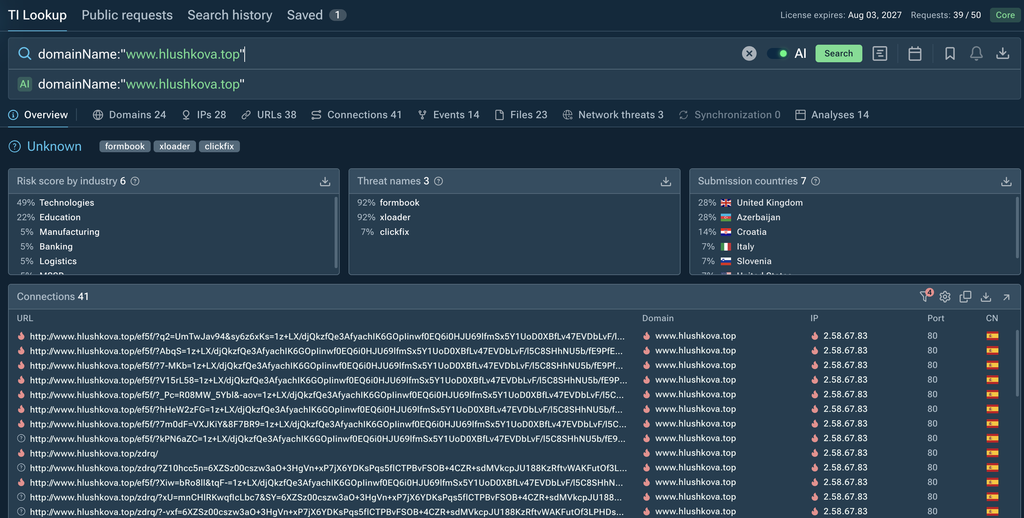
For example, a SOC analyst receives an alert about a suspicious URL found in an employee’s email. The URL itself may be unfamiliar, and traditional reputation sources may not provide enough information.
With TI Lookup, SOCs and MSSPs can search for the indicator, identify related malicious activity, examine associated infrastructure, and access sandbox analyses where the threat was observed.
That changes the investigation from a simple reputation check into a contextual analysis. Triage can validate suspicious activity with stronger evidence, while threat hunters and incident responders can use behavioral artifacts to uncover additional connections and investigate threats that are not immediately recognizable.
For MSSPs, this approach helps analysts investigate unfamiliar indicators across customer environments without repeatedly starting research from scratch.
Related Threat Context: Connecting Sandbox Analysis with TI Lookup
ANY.RUN’s Interactive Sandbox now offers a powerful capability for enterprise users — Related Threat Context, which connects sandbox investigations with Threat Intelligence Lookup.
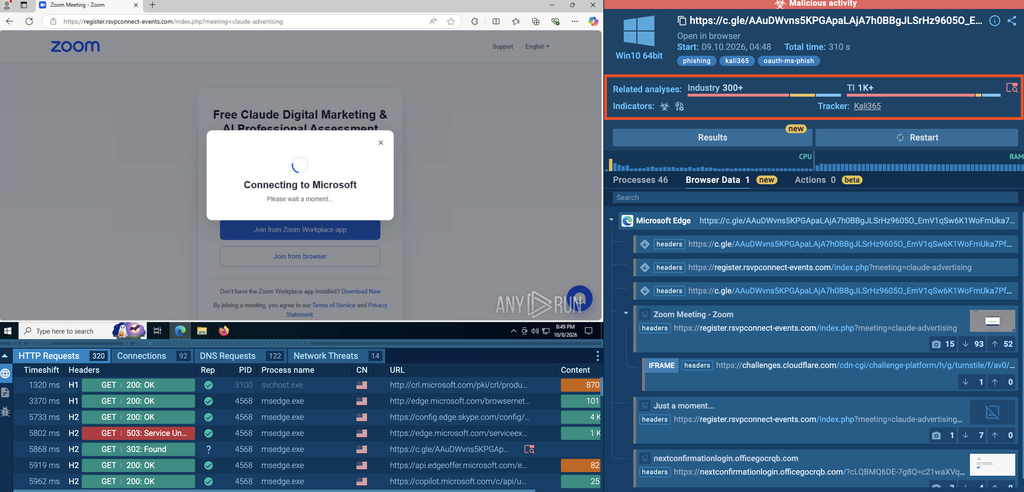
Previously, analysts often had to manually reconstruct the relationships between suspicious indicators, historical investigations, and related threat activity. This could involve opening multiple analyses, searching for indicators separately, and comparing findings across different sources.
Related Threat Context brings relevant information closer to the investigation itself.
When analyzing a suspicious file or URL, analysts can explore related activity, historical context, and industry-related threat information. They can then pivot directly into TI Lookup to investigate additional indicators and uncover broader connections.
Discover how Related Threat Context can accelerate triage in your SOC.
Related Threat Context in ANY.RUN’s Sandbox connects sandbox analysis with relevant intel
This creates a more connected investigation workflow:
- Analyze a suspicious file or URL in the Interactive Sandbox.
- Review Related Threat Context to identify relevant connections and previous activity.
- Open TI Lookup directly from the investigation.
- Search for additional indicators, infrastructure, and related threats.
- Use the findings to validate the incident, enrich detection rules, or support escalation.
The practical benefit is straightforward: analysts spend less time manually assembling context and more time making decisions.
For SOC leaders, this also helps standardize investigations. Junior analysts can access supporting evidence more easily, while experienced analysts can focus on complex cases and detection engineering.
ANY.RUN Threat Intelligence Feeds: Detecting Phishing Threats Earlier
TI Lookup supports investigations after an alert appears. ANY.RUN Threat Intelligence Feeds (TI Feeds) help security teams identify malicious activity earlier.
TI Feeds deliver actionable network indicators, including malicious IP addresses, domains, and URLs identified through real-world sandbox investigations.
Feeds can be integrated into existing security infrastructure, including SIEM, XDR, SOAR, and other threat intelligence solutions. Delivery options include API, SDK, and STIX/TAXII support.
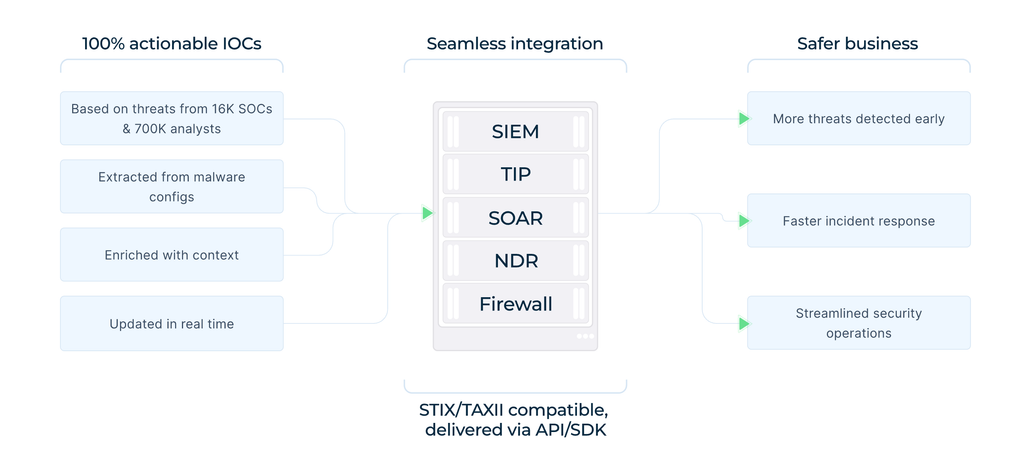
This makes threat intelligence part of everyday detection rather than a resource analysts consult only after an alert.
In addition, internal ANY.RUN’s analysis showed that up to 30% of unique malicious IOCs detected in Interactive Sandbox sessions had already been observed by ANY.RUN and were present in TI Feeds.
This finding illustrates a practical advantage of intelligence feeds: when an IOC appears in organizational telemetry, security infrastructure may be able to match it against TI Feeds before an analyst manually investigates the activity in the Sandbox.
The organization may therefore recognize a known malicious indicator earlier, supporting faster triage and more proactive detection.
For SOC teams, this can reduce repetitive enrichment and help prioritize threats requiring human investigation. For MSSPs, intelligence already available in detection infrastructure can help identify relevant activity across customer environments.
Threat Intelligence Reports
ANY.RUN also publishes Threat Intelligence Reports covering malware families, threat actors, and campaigns.
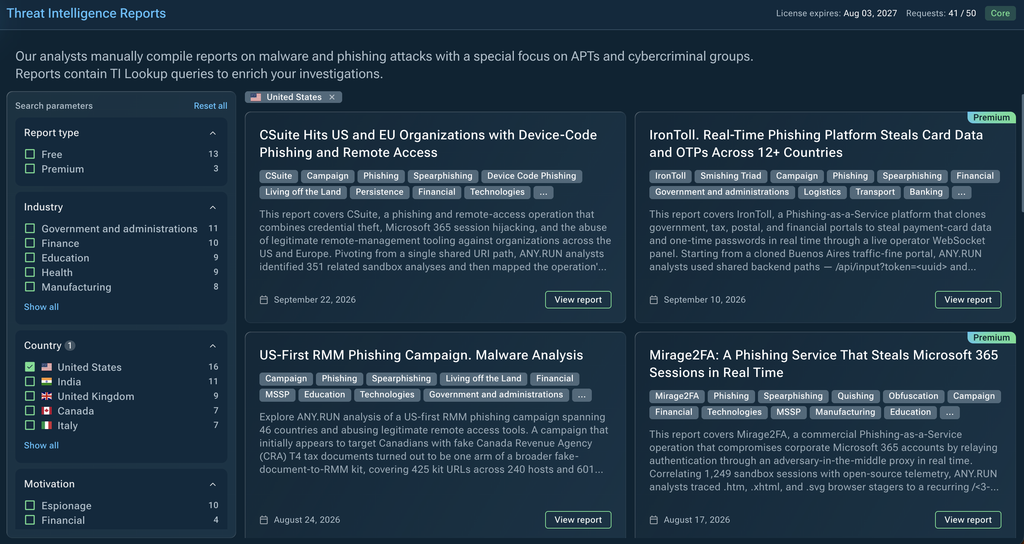
These reports complement IOC-level research with broader insights into attacker techniques and emerging threats.
2. Google Threat Intelligence
Google Threat Intelligence combines Mandiant research, VirusTotal intelligence, and Google’s threat visibility.
It supports threat investigation, intelligence enrichment, and understanding of attacker infrastructure and campaigns. Organizations can use it to contextualize suspicious indicators and strengthen threat-informed security operations.
3. Recorded Future
Recorded Future provides intelligence on cyber threats, attacker infrastructure, vulnerabilities, and digital risk.
The company’s solution aggregates information from multiple sources and helps security teams identify relevant threats, prioritize risks, and support investigations with contextual intelligence.
4. CrowdStrike Falcon Adversary Intelligence
CrowdStrike Falcon Adversary Intelligence provides information about threat actors, campaigns, tactics, and infrastructure.
It supports organizations using the Falcon ecosystem with intelligence that can inform detection, investigation, and threat hunting.
5. Microsoft Defender Threat Intelligence
Microsoft Defender Threat Intelligence provides information about malicious infrastructure, threat actors, and attack campaigns.
The solution can enrich security investigations and support detection and response workflows across Microsoft’s security ecosystem.
6. Cisco Talos Intelligence
Cisco Talos provides threat research, intelligence, and analysis of malicious infrastructure, malware, and emerging attack activity.
The company’s intelligence supports security monitoring, incident response, and detection across Cisco security products and other workflows.
7. ThreatConnect
ThreatConnect is a threat intelligence solution focused on aggregating, analyzing, and operationalizing intelligence from multiple sources.
It helps organizations connect intelligence with security operations, automate workflows, and prioritize relevant indicators.
8. Anomali
Anomali provides threat intelligence management and operationalization capabilities.
The solution helps security teams collect, correlate, enrich, and distribute intelligence to support threat detection, hunting, and response.
9. MISP
MISP is an open-source threat intelligence sharing platform.
It enables organizations and communities to collect, store, correlate, and share threat indicators and associated information. It is often used to support collaborative intelligence and detection workflows.
10. OpenCTI
OpenCTI is an open-source cyber threat intelligence platform designed to structure and connect intelligence data.
It supports the management of threat entities, relationships, indicators, and intelligence sources, helping teams organize information for analysis and operational use.
How to Choose Threat Intelligence for Phishing Detection
A threat intelligence buying guide should start with operational needs, not a capability checklist.
Organizations evaluating an enterprise threat intelligence solution should consider how intelligence will support investigations, detection engineering, and daily SOC operations.
The most relevant threat intelligence solution features include:
First-hand intelligence. Data derived from real malware and phishing investigations can provide useful context beyond traditional reputation sources.
Threat intelligence enrichment. SOCs and MSSPs should be able to enrich IOCs with supporting evidence, related activity, and behavioral context.
Threat intelligence correlation. Connecting indicators, infrastructure, campaigns, and attack techniques helps analysts understand relationships rather than investigate each IOC in isolation.
IOC management. Teams need practical ways to search, investigate, organize, and operationalize indicators.
Integration capabilities. SIEM, XDR, SOAR, API, and STIX/TAXII integration help intelligence fit existing security workflows.
Automation and AI. AI-driven threat intelligence can support data analysis, enrichment, prioritization, and investigation workflows. Emerging agentic AI threat intelligence approaches aim to automate more complex research tasks, although organizations should evaluate accuracy, transparency, and analyst oversight.
Threat coverage. Depending on organizational requirements, dark web monitoring, phishing intelligence, malware analysis, and a digital risk protection platform may complement core CTI capabilities.
Enterprise Threat Intelligence Buying Guide: Questions to Ask Vendors
When evaluating cyber threat intelligence vendors, consider:
- Which threat intelligence data sources are used?
- How fresh and relevant is the intelligence?
- Can analysts pivot from an IOC to supporting evidence?
- Does the platform support IOC enrichment API access?
- How easily can intelligence be integrated into existing security tools?
- Does it support STIX/TAXII integration?
- Can intelligence improve detection across multiple customer environments?
- How does the solution reduce analyst workload?
- What evidence demonstrates its operational value?
The best solution is not necessarily the one with the largest dataset. It is the one that helps your team identify relevant threats, investigate them efficiently, and turn intelligence into better detection.
Conclusion
Threat intelligence is most valuable when it turns scattered indicators into actionable insights. The right solution helps SOCs and MSSPs add context to suspicious activity, prioritize threats, and streamline investigations.
Ultimately, the goal isn’t to collect more data, but to make it actionable, so security teams can detect phishing threats earlier and respond with confidence.
About ANY.RUN
ANY.RUN provides cybersecurity solutions that help SOC and MSSP teams investigate threats, enrich detection, and streamline incident response.
Its ecosystem combines Interactive Sandbox with threat intelligence capabilities, including Threat Intelligence Lookup, Threat Intelligence Feeds, and Threat Intelligence Reports. Together, these tools help analysts investigate suspicious files and URLs, discover connections between indicators and campaigns, and bring intelligence from real-world investigations into security workflows.
More than 16,000 organizations and 700,000 cybersecurity professionals worldwide rely on ANY.RUN. The company is SOC 2 Type II certified, reflecting its commitment to protecting customer data through established security controls.
FAQ: Threat Intelligence for Phishing Detection
Enterprise threat intelligence is the collection, analysis, and operational use of information about cyber threats relevant to an organization’s infrastructure, users, and business risks. It helps security teams understand attackers, malicious infrastructure, and potential attack paths.
Common threat intelligence use cases include phishing detection, IOC enrichment, threat hunting, incident investigation, detection engineering, campaign tracking, and security risk prioritization.
Threat intelligence data sources include malware analysis, phishing investigations, security telemetry, OSINT, commercial intelligence feeds, threat research, and information shared by trusted communities.
Threat intelligence feeds deliver indicators and contextual information about malicious activity. Security teams can integrate them into SIEM, XDR, firewalls, and other tools to identify suspicious activity and enrich alerts.
The threat intelligence lifecycle typically includes planning, collection, processing, analysis, dissemination, and feedback. This process helps organizations turn raw threat data into intelligence that supports security decisions.
A threat intelligence maturity model describes how an organization progresses from basic indicator consumption to structured analysis, intelligence-driven detection, automation, and proactive threat hunting.
Tactical: Indicators and technical details used for detection and response.
Operational: Information about campaigns, attacker activity, and attack methods.
Strategic: High-level insights about threat trends, risks, and their business implications.
Frameworks such as MITRE ATT&CK help structure intelligence around attacker techniques and behaviors. STIX and TAXII support standardized intelligence representation and exchange.
When considering how to choose a threat intelligence platform, evaluate data quality, intelligence enrichment, correlation, integration, automation, threat coverage, and the solution’s ability to support actual SOC workflows.


0 comments