

Under the Digital Operational Resilience Act (DORA), financial entities need to demonstrate how effectively they detect, investigate, and respond to ICT-related incidents. For SOC teams, this means greater pressure to identify threats early, make accurate decisions, and document findings within regulatory deadlines.
What does DORA compliance look like in everyday SOC operations? This guide breaks down 10 key requirements of DORA for SOC teams and the security work behind each.
What Does the Digital Operational Resilience Act (DORA) Mean for SOC Teams?
Applicable since January 17, 2025, the Digital Operational Resilience Act (DORA) establishes a common framework for managing ICT risks and strengthening operational resilience across the EU financial sector.
The regulation covers five main areas:
- ICT risk management
- ICT-related incident management and reporting
- Digital operational resilience testing
- ICT third-party risk management
- Cyber threat intelligence and information sharing (voluntary sharing arrangements)
Much of the work involved in supporting DORA compliance already falls within the scope of SOC operations: continuous monitoring, threat detection, incident investigation, and response.
DORA does not mandate specific security technologies or require a dedicated SOC. Instead, financial entities must implement security measures appropriate to their size, risk profile, and operational complexity.
10 DORA Requirements SOC Teams Need to Put into Practice
What does DORA compliance look like in practice for SOC teams? The following ten regulatory requirements have a direct impact on security operations, shaping how teams monitor infrastructure, investigate threats, respond to incidents, and document their work.
1. Identify, Classify, and Document ICT Assets
Article 8 of DORA requires financial entities to identify, classify, and document their ICT assets, the business functions they support, and their dependencies. This classification and documentation must be reviewed at least annually.
For SOC teams, understanding which assets support critical or important business functions is essential for setting monitoring priorities and assessing the potential impact of security incidents.
To put this requirement into practice, SOC teams should:
- Map security monitoring coverage against ICT asset inventories.
- Identify visibility gaps across endpoints, networks, applications, and cloud environments.
- Prioritize alerts based on asset criticality and potential business impact.
- Adjust detection coverage as ICT infrastructure changes.
Compliance evidence: ICT asset inventories, dependency maps, asset classification records, and detection coverage reports.
2. Implement Logging Procedures and Protect Security Logs
Article 12 of Delegated Regulation (EU) 2024/1774 requires financial entities to establish documented logging procedures, define which events must be recorded and how long logs must be retained, and protect log data against unauthorized access, deletion, and tampering.
Continuous log analysis in SOC operations helps uncover suspicious activity, reconstruct attack timelines, and determine the scope of an incident.
Effective log management involves:
- Collect and correlate logs from identity systems, endpoints, applications, and network infrastructure.
- Use SIEM to centralize security events and support continuous log analysis.
- Monitor logging system failures to prevent gaps in security visibility.
- Synchronize system clocks to ensure accurate incident timelines.
- Maintain auditable security logs with appropriate access controls and retention policies.
Compliance evidence: Logging policies, log retention records, access control records, and logging system health reports.
3. Continuously Monitor ICT Systems and Detect Anomalous Activities
Articles 9 and 10 of DORA require financial entities to continuously monitor ICT systems, promptly detect anomalous activities, and establish alert thresholds that trigger incident response.
Article 23 of Delegated Regulation (EU) 2024/1774 further requires detection mechanisms to account for internal and external cyber threats, including attack scenarios based on threat intelligence.
To strengthen detection capabilities, security teams should:
- Monitor unusual authentication attempts, suspicious process execution, and unauthorized network connections.
- Define alert thresholds according to the criticality of affected assets.
- Incorporate current threat intelligence into detection engineering.
- Regularly test detection rules against emerging attack scenarios.
- Maintain sufficient resources to monitor suspicious activity outside business hours.
Effective anomalous activity monitoring under DORA requires visibility beyond an organization’s own infrastructure. Relying on internal telemetry and outdated threat indicators can leave SOC teams unaware of emerging malicious activity until an attack is already underway.
ANY.RUN’s Threat Intelligence Feeds help close this detection gap by supplying existing security systems with continuously updated, verified malicious IPs, domains, and URLs derived from real-world malware and phishing investigations.
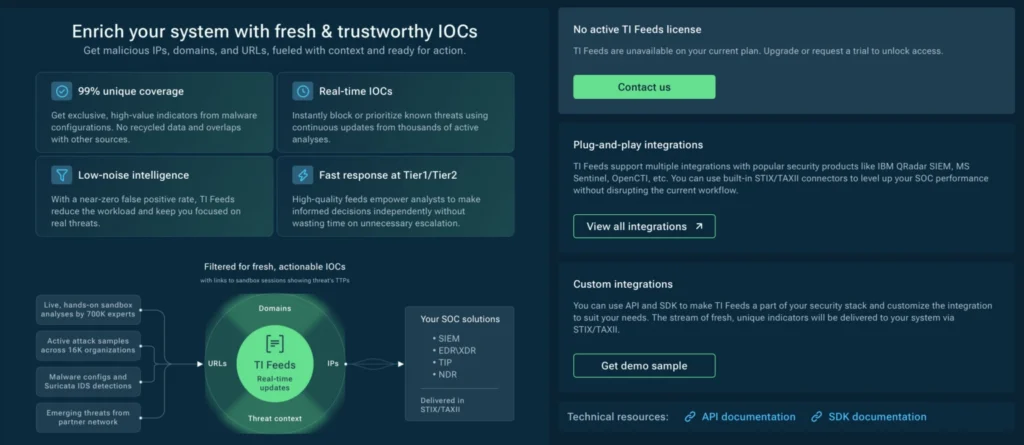
Up to 30% of unique malicious IOCs identified in analyzed sandbox sessions were already available in ANY.RUN’s TI Feeds. By incorporating these indicators into their detection systems, financial entities can identify malicious connections earlier, reduce their exposure to active threats, and limit the risk of disruption to critical financial services.
Compliance evidence: Detection rules, alert thresholds, monitoring records, threat intelligence integration records, and detection testing results.
4. Establish and Implement an ICT-Related Incident Management Process
Article 17 of DORA requires financial entities to establish a documented ICT-related incident management process, assign roles and responsibilities, and define procedures for identifying, tracking, prioritizing, and escalating incidents.
For SOC teams dealing with high alert volumes, the challenge is to distinguish genuine threats from false positives without delaying the investigation of critical incidents.
A well-defined incident management process should include:
- Establish consistent alert triage and threat validation procedures.
- Investigate suspicious files, URLs, and email attachments to determine their malicious intent.
- Define escalation criteria based on incident severity and the criticality of affected services.
- Automate repetitive investigation tasks to reduce alert fatigue.
- Document investigation findings and decisions throughout the incident lifecycle.
Manual investigations can slow down incident management, particularly when attackers use multi-stage execution, CAPTCHAs, redirects, and other evasion techniques.
ANY.RUN’s Interactive Sandbox allows SOC teams to observe malware and phishing behavior in real time, uncover hidden attack stages through Automated Interactivity, and obtain actionable findings for incident assessment.
With AI-powered Tier 1 reports providing threat summaries, key IOCs, and identified TTPs, security teams can make faster triage decisions and reduce unnecessary escalations.
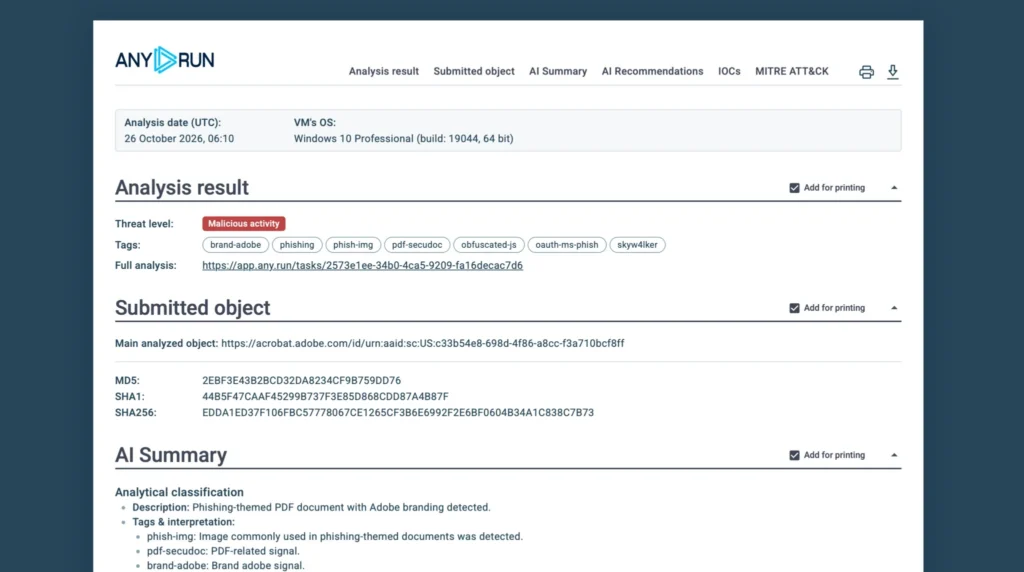
94% of ANY.RUN users report faster triage, while Tier 1 to Tier 2 escalations can be reduced by 30%. For financial entities, this means greater investigation capacity, lower operational costs, and fewer delays in handling potentially critical incidents.
Compliance evidence: Documented incident management procedures, investigation reports, incident records, escalation criteria, and triage decisions.
5. Classify ICT-Related Incidents and Cyber Threats
Article 18 of DORA requires financial entities to classify ICT-related incidents based on their impact and assess the significance of cyber threats. Delegated Regulation (EU) 2024/1772 establishes the criteria and materiality thresholds for these assessments.
For SOC teams, this means going beyond threat validation to establish the scope of a compromise and provide evidence for business impact assessments.
Major ICT incident classification under DORA:
| Classification criterion | Regulatory thresholds or conditions |
|---|---|
| Clients, financial counterparts, and transactions | More than 10% or more than 100,000 clients using the affected service; over 30% of relevant financial counterparts; over 10% of the daily average number or value of transactions; or impact on clients or counterparts identified as relevant |
| Reputational impact | Media coverage, repeated complaints, likely regulatory non-compliance, or likely material loss of clients or financial counterparts |
| Incident duration and downtime | Incident lasting over 24 hours or service downtime exceeding 2 hours for ICT services supporting critical or important functions |
| Geographical spread | Impact in two or more EU Member States |
| Data losses | Data compromise adversely affecting business objectives or regulatory compliance, or qualifying malicious unauthorized access |
| Criticality of services | Impact on ICT systems supporting critical or important functions, regulated financial services, or successful malicious unauthorized access |
| Economic impact | Costs and losses exceeding or likely to exceed €100,000 |
An incident is classified as major when it meets the critical services criterion and either meets the unauthorized access threshold specified in Article 9(5)(b) or satisfies at least two other materiality thresholds.
Cyber threats are assessed separately based on their potential impact, likelihood of materialization, and applicable regulatory thresholds.
SOC teams support these assessments by documenting affected systems, attack behavior, unauthorized access, and potential data compromise.
Compliance evidence: Incident classification records, technical investigation reports, affected asset lists, and documented impact assessments.
6. Report Major ICT-Related Incidents Within Regulatory Deadlines
Article 19 of DORA requires financial entities to report major ICT-related incidents to their competent authorities. Delegated Regulation (EU) 2025/301 establishes reporting deadlines, while Implementing Regulation (EU) 2025/302 specifies reporting formats and procedures.
DORA incident reporting deadlines:
| Reporting stage | Deadline | Information to provide |
|---|---|---|
| Initial notification | Within 4 hours of major incident classification and no later than 24 hours after becoming aware of the incident | Incident description, detection and classification timestamps, and classification criteria |
| Intermediate report | Within 72 hours of submitting the initial notification | Affected systems, incident impact, attack details, recovery measures, and available IOCs |
| Final report | Within one month of submitting the intermediate or latest updated intermediate report | Root causes, incident resolution, actual costs, and financial losses |
If an incident is classified as major more than 24 hours after awareness, the initial notification must be submitted within four hours of classification. Specific provisions also apply to weekends and public holidays.
Meeting DORA incident reporting deadlines requires both fast threat investigations and reliable technical documentation. Every hour spent manually analyzing suspicious artifacts or gathering evidence leaves less time for incident assessment and reporting.
With ANY.RUN’s Interactive Sandbox, SOC teams gain visibility into 90% of attacks within 60 seconds, helping them validate threats and gather technical findings earlier in the investigation.
Automatically generated Tier 1 reports provide structured findings, including threat summaries, recommendations, malware verdicts, key IOCs, and observed TTPs. This reduces manual documentation work and gives compliance teams more time to assess findings and prepare regulatory reports.
Compliance evidence: Incident timelines, technical investigation reports, submitted regulatory reports, and reporting timestamps.
7. Implement ICT Incident Response and Recovery Procedures
Articles 11 and 17 of DORA require financial entities to establish ICT incident response and recovery procedures, contain incidents, and restore affected services. Article 22 of Delegated Regulation (EU) 2024/1774 also requires secure retention of incident-related evidence.
An effective ICT incident response process within the SOC should cover:
| Response stage | SOC activities |
|---|---|
| Containment | Isolate compromised endpoints, block malicious connections, and restrict compromised accounts. |
| Eradication | Remove malicious artifacts, address exploited vulnerabilities, and eliminate persistence mechanisms. |
| Recovery | Support secure service restoration and monitor for renewed malicious activity. |
| Post-incident review | Assess response effectiveness and update runbooks and playbooks. |
Maintaining an audit trail and following chain-of-custody practices helps preserve evidence integrity and accountability.
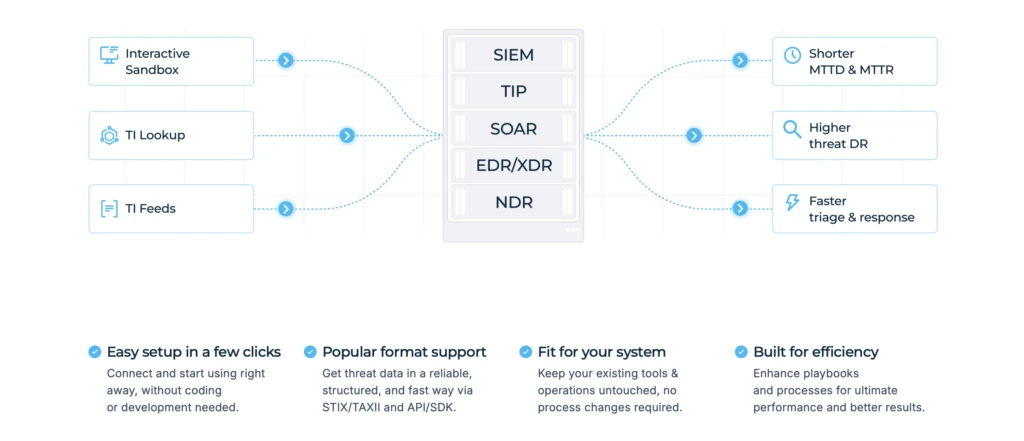
How SIEM and SOAR Support DORA Compliance
Disconnected security systems can delay containment, increasing the risk of financial losses and service disruption.
With ANY.RUN’s integrations, SOC teams can access malware analysis results and threat intelligence directly within their existing security systems, including SIEM and SOAR platforms. Incorporating these findings into incident response workflows reduces manual work, supports faster containment decisions, and helps financial entities limit the operational and financial impact of incidents.
Compliance evidence: Incident response playbooks, containment records, chain-of-custody documentation, audit trails, and post-incident review reports.
8. Collect and Analyze Cyber Threat and Vulnerability Information
Article 13 of DORA requires financial entities to gather information on vulnerabilities, cyber threats, and ICT-related incidents and assess their potential impact on operational resilience.
CTI integration in SOC operations supports this requirement through:
- Investigation of suspicious IOCs and related malicious infrastructure.
- Tracking malware families and attack techniques.
- Proactive threat hunting and detection engineering.
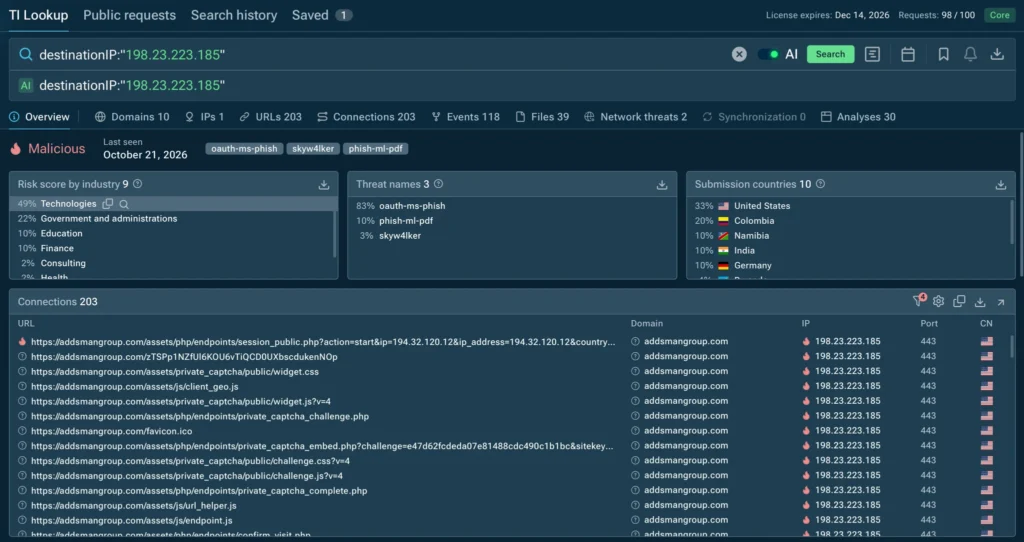
ANY.RUN’s Threat Intelligence Lookup provides access to real-world attack data powered by a global community of 700,000+ security professionals and 16,000+ organizations. This helps financial entities uncover related threats, assess their exposure to active attacks, and reduce manual intelligence research.
Cyber Threat Intelligence Sharing Under DORA
Article 45 allows financial entities to exchange IOCs, TTPs, and security alerts within trusted communities. Participation is voluntary, subject to information protection and regulatory notification requirements.
Compliance evidence: Threat intelligence assessments, threat hunting reports, CTI integration records, and updated detection rules.
9. Conduct Digital Operational Resilience Testing
Articles 24–26 of DORA establish requirements for digital operational resilience testing, including the identification and remediation of security weaknesses.
Financial entities subject to Article 24(6) must test all ICT systems and applications supporting critical or important functions at least annually. Entities designated under Article 26 must also conduct threat-led penetration testing (TLPT) at least every three years, unless competent authorities adjust the testing frequency.
For SOC teams, these exercises help determine how well existing security controls perform against realistic threats.
| Testing activity | SOC objective |
|---|---|
| Scenario-based testing | Evaluate detection and response against realistic attack scenarios. |
| Detection rule validation | Identify missed detections and gaps in SIEM coverage. |
| Response playbook testing | Assess SOAR workflows and escalation procedures. |
| TLPT | Evaluate defensive capabilities against intelligence-led simulated attacks. |
With Interactive Sandbox, security teams can examine real-world malware behavior, process execution, network activity, and attacker TTPs. These findings help develop relevant testing scenarios, refine detection rules, and address security gaps before attackers exploit them.
Learn more in our guide: DORA TLPT Requirements Explained: Where Threat Intelligence Fits.
Compliance evidence: Testing reports, detection coverage assessments, identified security weaknesses, and remediation records.
10. Manage ICT Third-Party Risks
Articles 28–30 of DORA require financial entities to manage risks associated with ICT third-party providers. Outsourcing ICT services does not transfer regulatory responsibility: financial entities remain accountable for their DORA compliance.
For SOC teams, this means extending incident management and response procedures to threats originating outside their own infrastructure.
Key operational priorities include:
- Identify third-party services supporting critical or important business functions.
- Incorporate provider incident notifications into existing SOC workflows.
- Establish communication and escalation procedures with ICT third-party providers.
- Assess the impact of third-party incidents on internal systems and financial services.
- Coordinate evidence collection, containment, and recovery activities with providers.
An incident originating at a third-party provider may still trigger mandatory DORA incident reporting if it meets the major incident classification criteria.
Compliance evidence: Third-party risk assessments, provider incident notifications, escalation records, and coordinated incident response documentation.
Strengthen DORA Compliance Without Increasing SOC Workload
For financial institutions, the challenge of DORA compliance goes beyond meeting regulatory deadlines. Security teams need to maintain strong detection and response capabilities while managing growing alert volumes, limited resources, and operational costs.
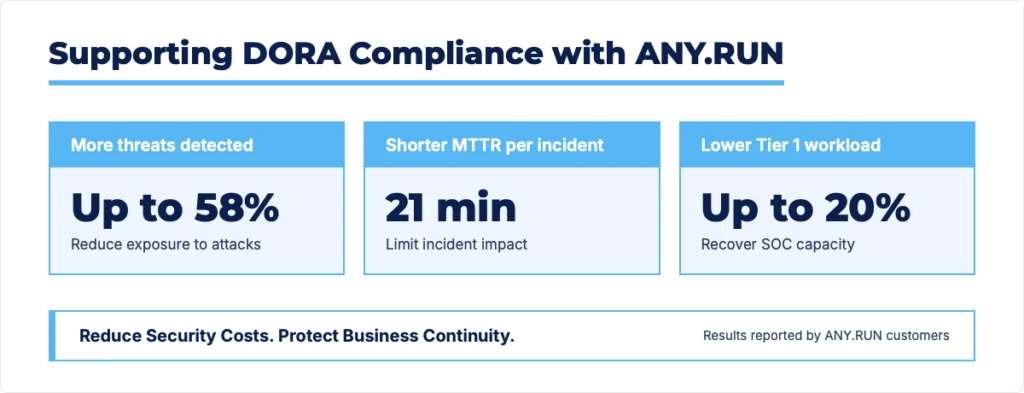
ANY.RUN’s malware analysis and threat intelligence solutions help financial entities improve SOC performance, with measurable results reported by customers:
- Up to 58% more threats detected: Reduce the risk of missed attacks and disruption to critical financial services.
- 21 minutes shorter MTTR per incident: Limit the operational and financial impact of security incidents.
- Up to 20% lower Tier 1 workload: Free up security resources for critical investigations and compliance-related activities.
Give your SOC the capabilities to support DORA compliance, protect business continuity, and keep security costs under control.
About ANY.RUN
ANY.RUN provides interactive malware analysis and threat intelligence solutions that help SOC teams accelerate investigations, detect emerging threats, and reduce incident response times.
Powered by real-world attack data from 700,000+ security professionals and 16,000+ organizations, ANY.RUN helps businesses strengthen their defenses, increase SOC efficiency, and reduce security operations costs.
Frequently Asked Questions
The Digital Operational Resilience Act (DORA) requires continuous ICT monitoring, threat detection, incident management, security logging, threat intelligence collection, and resilience testing.
DORA requires timely anomaly detection and defined alert thresholds. Continuous log analysis in SOC operations supports threat detection and investigation, while auditable security logs help preserve evidence.
An incident qualifies as major if it meets the critical services criterion and either the qualifying malicious unauthorized access threshold or at least two other materiality thresholds.
The standard deadlines are four hours from major incident classification and no later than 24 hours from awareness for initial notification, 72 hours from initial notification for the intermediate report, and one month from the latest intermediate report for the final report.
SIEM and SOAR support DORA compliance through continuous log analysis, alert correlation, ICT incident response automation, and audit trails.
Cyber threat intelligence sharing under DORA is voluntary. However, CTI integration in SOC operations helps support the mandatory threat information collection and assessment requirements under Article 13.
Applicable financial entities must test ICT systems supporting critical or important functions at least annually. Designated entities must generally conduct threat-led penetration testing (TLPT) at least every three years.



0 comments