

Cyber threats are becoming faster, more automated, and harder to investigate manually. Attackers are using automation and AI to scale phishing, malware development, reconnaissance, credential theft, and infrastructure operations. Meanwhile, security teams are dealing with growing volumes of alerts, indicators, vulnerabilities, and external threat signals.
Modern cyber threat intelligence (CTI) services can help security teams keep up with this growing complexity. Rather than simply providing lists of malicious IP addresses, domains, or hashes, such solutions add context to individual indicators, reveal connections between related threats, and help analysts bring intelligence into existing security workflows.
This guide covers 10 threat intelligence solutions to consider in 2026, from enterprise CTI services and external threat intelligence providers to digital risk and infrastructure-focused solutions. It also explores the key trends shaping the market, including AI-driven threat intelligence, agentic AI, IOC enrichment APIs, digital risk protection, and STIX/TAXII integration.
Why Threat Intelligence Matters for SOCs and MSSPs
Threat intelligence can help SOCs and MSSPs turn security data into actionable context. For SOC analysts, enrichment around suspicious IPs, domains, URLs, and file hashes can speed up alert triage and provide additional insight into related malware, infrastructure, campaigns, and attack techniques. The same intelligence can support threat hunting and detection engineering by helping teams identify emerging patterns and improve their analytics.
For MSSPs, the challenge is largely about scale. Intelligence feeds and APIs can enrich alerts across multiple customer environments, while information about emerging campaigns can support proactive hunting before related activity becomes a confirmed incident. With the right integrations and automation, CTI can make threat detection and investigation more consistent and efficient across both internal SOCs and managed security operations.
10 Cyber Threat Intelligence Solutions to Consider in 2026
The CTI market covers several different use cases. Some providers focus on technical threat intelligence and malware, while others specialize in external threats, cybercrime ecosystems, digital risk, or malicious infrastructure.
1. ANY.RUN Threat Intelligence
ANY.RUN takes a behavior-driven approach to threat intelligence, connecting threat research with interactive malware and phishing analysis.
The Interactive Sandbox is at the center of this approach. Analysts can execute suspicious files and URLs and observe processes, network connections, command-line activity, dropped files, registry changes, and other behavior in real time. For SOC teams, this provides technical context during alert investigation. MSSPs can use the same environment to analyze suspicious activity across customer environments.
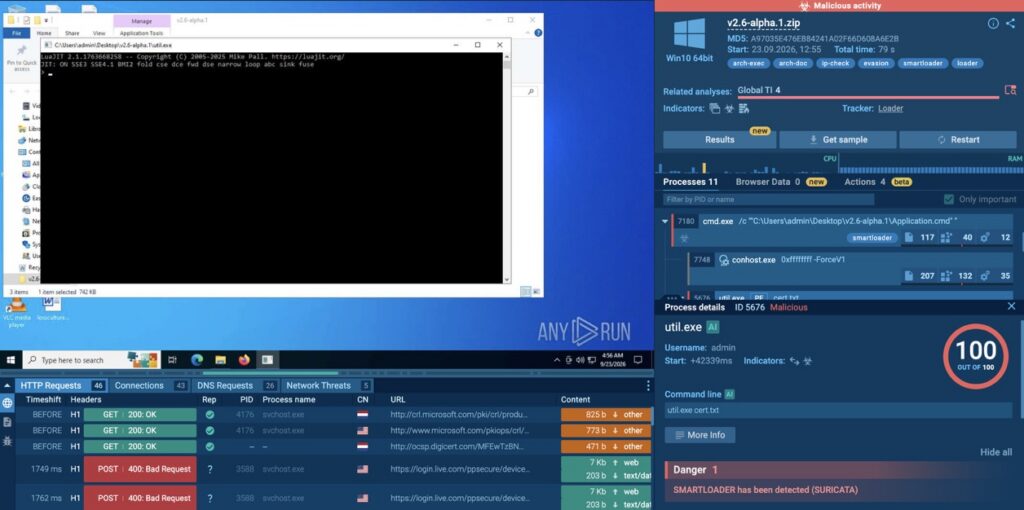
Sandbox data also feeds into ANY.RUN’s broader threat intelligence services, including TI Feeds, TI Lookup, and TI Reports.
1. Threat Intelligence Feeds
ANY.RUN Threat Intelligence Feeds (TI Feeds) bring threat intelligence into existing security infrastructure, providing malicious IPs, domains, and URLs enriched with sandbox analysis. 99% of unique, high-confidence IOCs are added after validation, helping keep the feeds focused on indicators that can be used in security operations.
Indicators can include links to the underlying sandbox analyses, providing additional context around malware behavior, C2 connections, and MITRE ATT&CK techniques. This means security teams can move beyond an isolated IOC and investigate the activity behind it when additional context is needed.
The feeds support API/SDK and STIX/TAXII integration, allowing organizations to connect intelligence with SIEM, SOAR, EDR/XDR, TIP, and other security systems.
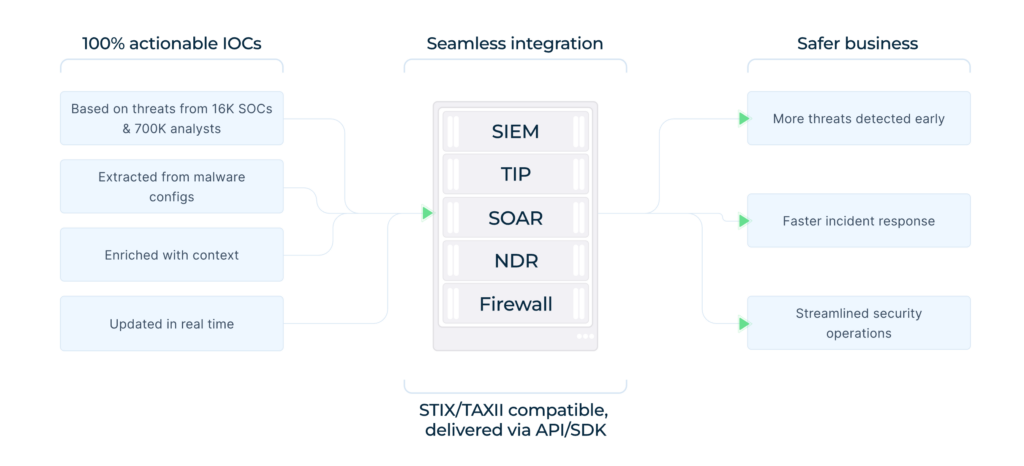
For SOCs, this can reduce manual enrichment work and help automate the transition from an external threat signal to detection or investigation. For MSSPs, centralized feeds can help distribute consistent, continuously updated intelligence across customer environments and support more scalable detection workflows.
2. Threat Intelligence Lookup
Threat Intelligence Lookup (TI Lookup) helps analysts investigate indicators and understand the activity behind them. Searches can cover IP addresses, domains, URLs, hashes, files, TTPs, YARA rules, Suricata rules, and other technical artifacts. Search results are returned in around 2 seconds, helping analysts get relevant context without adding significant time to an investigation.
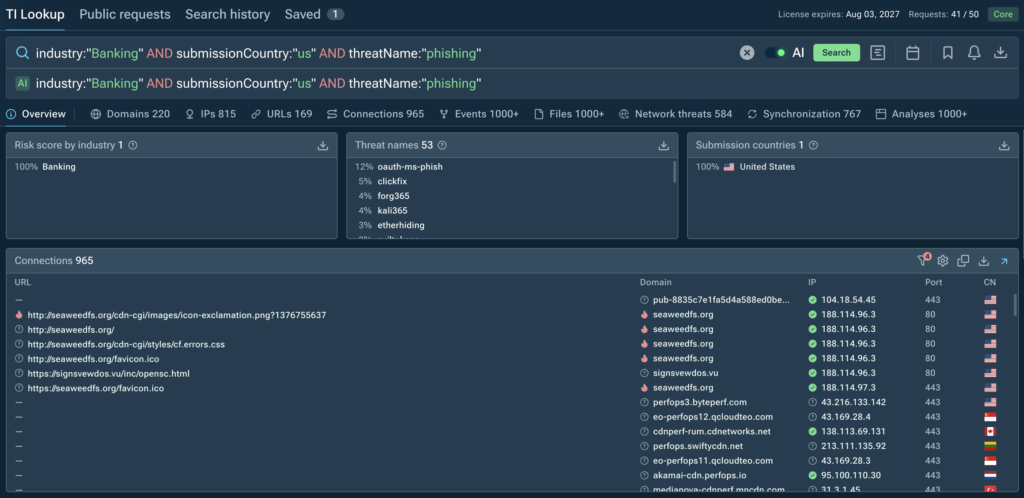
The value extends beyond speed. Analysts can pivot from an IOC to related infrastructure, malware, processes, files, and techniques, then open relevant sandbox sessions to examine the underlying behavior. This can help replace a series of separate reputation checks and manual searches with a more connected investigation.
For a SOC, faster access to technical context can shorten alert triage and help analysts focus their time on higher-priority investigations. In an MSSP environment, existing research can be reused when the same infrastructure or malware appears across different customers, reducing duplicated investigation work.
3. Threat Intelligence Reports
Threat Intelligence Reports (TI Reports) provide broader context around malware campaigns, APT activity, threat actors, attack techniques, and emerging threats. They can help security teams understand how individual indicators fit into a larger campaign and serve as a starting point for deeper investigation through TI Lookup and the Interactive Sandbox.
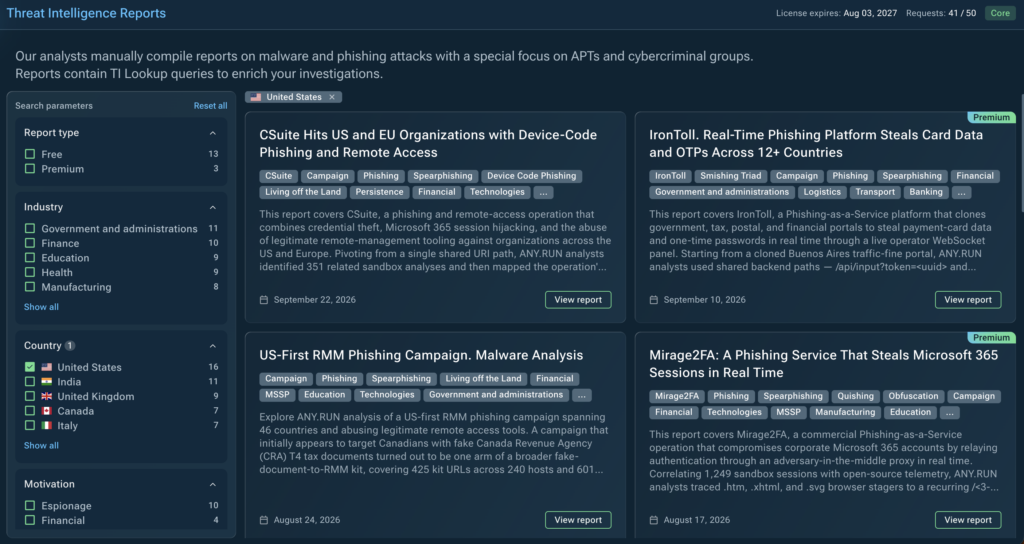
A SOC can use this research to turn emerging threats into hunting hypotheses, detection opportunities, and investigation leads. For MSSPs, campaign-level intelligence can help identify relevant activity across customer environments and give analysts a common reference point when responding to new threats.
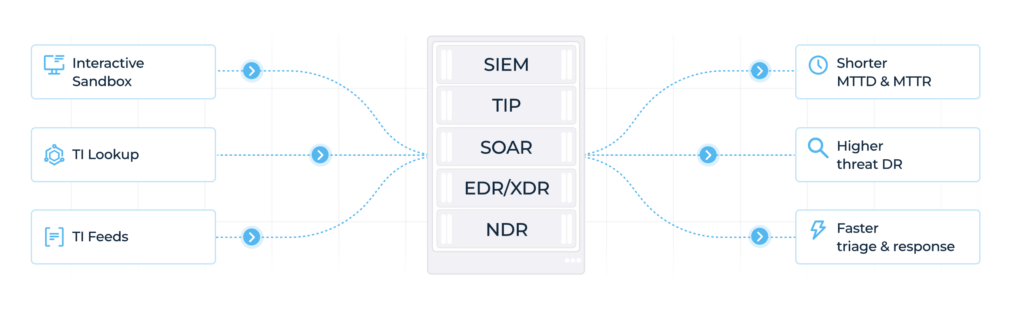
Together, the Interactive Sandbox, TI Lookup, TI Reports, and TI Feeds create a connected workflow: analysts can observe a threat, investigate related intelligence, understand the wider campaign, and operationalize relevant indicators.
2. Recorded Future
Recorded Future is a threat intelligence service covering threat actors, malware, vulnerabilities, malicious infrastructure, dark web activity, and external risk. Its intelligence is built from a broad range of sources and is designed to provide context around indicators, entities, and emerging threats.
The service brings together threat research, vulnerability intelligence, adversary intelligence, automated risk analysis, and integrations with security systems. AI-assisted analysis is also used to process and correlate large volumes of threat data.
A global organization, for example, could use Recorded Future to track a threat actor and connect its known infrastructure, malware, vulnerabilities, and related activity to build a broader picture of an emerging campaign.
3. Google Threat Intelligence
Google Threat Intelligence combines Google’s intelligence capabilities with Mandiant expertise and VirusTotal. It covers malware, threat actors, vulnerabilities, malicious infrastructure, and emerging campaigns.
VirusTotal adds broad visibility into files, URLs, domains, and IP addresses, allowing analysts to investigate indicators and pivot between related artifacts. The service also supports threat actor research, malware and vulnerability intelligence, and integration with Google’s security ecosystem.
For example, an enterprise investigating a suspicious file could use Google Threat Intelligence and VirusTotal to examine the file, identify related infrastructure, and connect the findings to known threat activity.
4. CrowdStrike
CrowdStrike provides threat intelligence as part of its broader security offering, covering adversaries, malware, infrastructure, vulnerabilities, and emerging threats. Its intelligence is closely connected with endpoint, identity, cloud, and detection telemetry within the Falcon ecosystem.
The service supports adversary intelligence, malware research, indicator enrichment, threat hunting, and intelligence-driven detection. Automated workflows and integrations can also connect intelligence with broader security operations.
For example, a security team investigating an endpoint alert could enrich an indicator with CrowdStrike intelligence and correlate it with known adversary activity, malware, or infrastructure observed across the organization’s environment.
5. Flashpoint
Flashpoint provides external threat intelligence based on open, deep, and dark web sources. Its coverage includes cyber threats, vulnerabilities, compromised credentials, threat actors, and cybercrime activity.
Its capabilities span dark web monitoring, vulnerability intelligence, credential exposure monitoring, threat actor research, and cybercrime intelligence. The service is particularly focused on activity occurring outside an organization’s traditional network perimeter.
A financial institution could use Flashpoint to monitor criminal forums and underground marketplaces for compromised employee credentials or discussions related to its brand, helping security teams identify external exposure before it develops into a confirmed incident.
6. ZeroFox
ZeroFox combines threat intelligence with external digital risk protection, covering threats that target an organization’s digital presence outside its internal infrastructure.
The service monitors risks such as brand impersonation, fraudulent websites, exposed credentials, executive targeting, phishing infrastructure, and other forms of digital abuse. Its approach extends CTI into areas such as brand protection and external attack surface monitoring.
A global brand could use ZeroFox to identify fraudulent domains and websites impersonating its services, then investigate the associated infrastructure and other indicators connected to the campaign.
7. ReliaQuest
ReliaQuest combines threat intelligence with security operations and detection capabilities. Its approach focuses on bringing external threat context together with security telemetry and investigation workflows.
Its offering brings together threat intelligence, detection engineering, threat hunting, security analytics, and integrations with existing security technologies. Intelligence can be used to enrich events and support investigations within broader security operations.
An enterprise investigating suspicious network activity could correlate an external indicator with internal telemetry and use the associated intelligence to determine whether the activity matches a known campaign or threat pattern.
8. Group-IB
Group-IB provides threat intelligence alongside capabilities for cyber investigations, fraud prevention, and digital risk monitoring. Its intelligence covers threat actors, malware, malicious infrastructure, compromised data, and cybercrime activity.
The service combines threat actor research, malware intelligence, infrastructure analysis, fraud intelligence, and monitoring of compromised information. Group-IB also publishes research on emerging campaigns and cybercrime ecosystems.
An e-commerce company could use Group-IB to investigate a fraud campaign by combining intelligence on malicious infrastructure with information about related threat actors, compromised accounts, and attack infrastructure.
9. KELA
KELA specializes in intelligence from cybercriminal and underground sources, including forums, marketplaces, messaging channels, and other parts of the digital underground.
Its research focuses on compromised credentials, stolen data, threat actors, criminal discussions, and emerging cybercrime activity. This provides organizations with visibility into threats and exposure originating from underground ecosystems.
A large enterprise could monitor underground sources for employee credentials or corporate data being offered for sale, then use those findings to investigate potential account compromise and prioritize remediation.
10. Hunt.io
Hunt.io takes an infrastructure-focused approach to threat intelligence, helping analysts investigate the technical infrastructure associated with malicious activity.
The service provides IP and domain intelligence, DNS analysis, certificate relationships, infrastructure discovery, threat hunting, and identification of related malicious assets. This makes it particularly relevant to investigations where infrastructure relationships are central to the analysis.
When investigating a suspected phishing campaign, a security team could start with a known malicious domain and pivot through DNS, certificates, and related infrastructure to identify additional domains or IP addresses that may belong to the same operation.
The State of the Cyber Threat Intelligence Market Today
A modern threat intelligence service should offer more than a database of malicious IPs, domains, and file hashes. In 2026, its value comes from combining fresh data with the context and tools analysts need to act on it.
Security teams need timely intelligence on malware, phishing campaigns, threat actors, vulnerabilities, malicious infrastructure, and other indicators of compromise. Just as importantly, they need to understand how individual indicators connect to broader campaigns, malware families, attack techniques, and related infrastructure.
Integrations are another key factor. APIs, automated feeds, SIEM and SOAR integrations, and standards such as STIX/TAXII allow teams to bring threat intelligence directly into their existing security workflows. In practice, effective cyber threat intelligence helps security teams move from data to context to action.
The broader threat intelligence market is also evolving toward more operational, integrated platforms. The Gartner Magic Quadrant Cyberthreat Intelligence 2026, officially published as Magic Quadrant for Cyberthreat Intelligence Technologies, reflects this shift by evaluating capabilities that go beyond traditional threat feeds, including IOC enrichment, digital risk protection, vulnerability and exposure intelligence, reporting, and machine-to-machine integrations.
The same direction can be seen in the Forrester Wave External Threat Intelligence Q3 2026. Forrester’s latest evaluation places greater emphasis on how providers embed intelligence requirements into workflows, operationalize intelligence, and use AI across threat hunting, detection engineering, and intelligence analysis. The report also highlights the growing role of agentic AI in external threat intelligence.
For organizations comparing cyber threat intelligence vendors, these reports provide useful market context, but they also underline an important point: CTI is not a single use case. Some teams need deep technical intelligence for malware investigations, while others prioritize external risk, underground intelligence, infrastructure discovery, or digital risk protection.
For SOCs and MSSPs, the practical question is therefore less about finding a platform that covers every possible intelligence category and more about how well a provider fits existing workflows. APIs, automated feeds, enrichment, integrations, and AI-assisted investigation can determine whether intelligence becomes part of everyday security operations or remains information that analysts have to manually look up.
AI-Driven Threat Intelligence
AI-driven threat intelligence is becoming a major trend in the CTI market. AI can help analysts search large datasets, summarize reports, connect related indicators, and prioritize relevant information. More advanced systems can also automate parts of an investigation.
Agentic AI threat intelligence takes this a step further. Instead of answering a single question about an IOC, an AI agent could investigate a domain, identify related infrastructure and malware, map relevant techniques, and prepare a summary for an analyst.
For SOCs, this can reduce repetitive investigation work. MSSPs could use similar workflows to scale certain types of analysis across customer environments. However, AI still depends on the quality, freshness, provenance, and context of the underlying intelligence.
IOC Enrichment API and STIX/TAXII Integration
An IOC enrichment API can make cyber threat intelligence part of an automated security workflow. A SOAR system, for example, can submit an IP address or domain to a TI service, retrieve related threat information, and enrich an alert before it reaches an analyst.
STIX/TAXII integration provides another way to connect threat intelligence with SIEM, SOAR, TIP, and other security systems. For SOCs, this can make intelligence part of routine alert processing, while MSSPs can use APIs and standardized feeds to distribute intelligence across customer environments.
As mentioned above, ANY.RUN’s TI Feeds support API/SDK access and STIX/TAXII, allowing threat intelligence to be incorporated into existing security infrastructure.
How to Evaluate Threat Intelligence Services in 2026
Choosing a cyber threat intelligence service is less about database size and more about how well its intelligence supports everyday security operations. Key factors to consider include:
Data quality and context: Look for reliable, well-sourced intelligence that connects indicators with malware, infrastructure, threat actors, and observed techniques.
Investigation depth: Analysts should be able to pivot from individual IOCs to related infrastructure, campaigns, malware, and TTPs.
Integration and automation: API access, automated feeds, and STIX/TAXII support can connect CTI with SIEM, EDR, SOAR, TIP, and other security systems.
Freshness and relevance: Consider how frequently intelligence is updated, how indicators are validated, and whether the coverage matches your threat landscape.
Scalability: SOCs and MSSPs may need bulk lookups, automation, and reusable research to handle large volumes of investigations efficiently.
Ultimately, the right threat intelligence service should fit existing workflows and turn external threat data into actionable context.
Conclusion
Threat intelligence in 2026 is increasingly becoming part of everyday security operations rather than a separate research function. The most useful services combine timely intelligence with investigation context, automation, integrations, and reliable data.
For SOCs and MSSPs, the right choice depends on the threats they need to monitor and how intelligence fits into existing workflows. Whether the priority is malware analysis, infrastructure discovery, external risk, underground intelligence, or automated IOC enrichment, the goal remains the same: turn threat data into context that security teams can use.
About ANY.RUN
ANY.RUN is a cybersecurity company specializing in interactive malware analysis and threat intelligence. Its services are used by more than 700,000 cybersecurity professionals and over 16,000 organizations worldwide.
The company builds its threat intelligence around investigations conducted in the Interactive Sandbox. By observing active malware behavior, C2 infrastructure, and execution patterns in real time, ANY.RUN turns sandbox research into threat intelligence for detection engineers, threat hunters, and incident response teams.
This approach connects hands-on malware analysis with TI Lookup, TI Reports, and TI Feeds, allowing security teams to investigate threats, discover related indicators, understand emerging campaigns, and integrate relevant intelligence into their existing security workflows.
Frequently Asked Questions (FAQ)
Cyber threat intelligence (CTI) is information about cyber threats that helps security teams understand, investigate, and respond to malicious activity. It can cover indicators such as IP addresses, domains, URLs, and file hashes, as well as threat actors, malware, infrastructure, vulnerabilities, campaigns, and attack techniques.
Different providers specialize in areas such as malware intelligence, external threat intelligence, digital risk protection, underground intelligence, and malicious infrastructure. The right choice depends on an organization’s threat landscape, workflows, integrations, and investigation requirements.
Threat intelligence can enrich alerts with context about suspicious indicators, related malware, infrastructure, threat actors, and techniques. This can help SOC analysts investigate alerts faster, develop threat-hunting hypotheses, and improve detection logic.
MSSPs can use threat intelligence to enrich alerts across multiple customer environments, distribute indicators through automated feeds, and identify activity associated with emerging campaigns. APIs and integrations can also make intelligence easier to incorporate into managed detection and response workflows.
AI-driven threat intelligence uses artificial intelligence to help process, correlate, search, summarize, and prioritize large volumes of threat data. More advanced approaches can automate multiple stages of an investigation, including indicator enrichment and infrastructure discovery.
An IOC enrichment API allows security systems to automatically submit indicators such as IP addresses, domains, URLs, or hashes and receive additional threat context. This can connect threat intelligence directly with workflows in SIEM, SOAR, EDR, and other security systems.
STIX/TAXII provides standardized ways to structure and exchange threat intelligence. This makes it easier to move intelligence between different security products and incorporate external threat data into existing security workflows.


0 comments