




Scaling threat detection as an MSSP doesn’t mean hiring more analysts — it means enabling the analysts you already have to handle more clients, more alerts, and more complex threats without burning out.
The practical path forward combines three capabilities: continuous real-time intelligence that keeps detection systems current automatically, instant IOC investigation that cuts triage from minutes to seconds, and behavioral malware analysis that exposes what attackers actually do — not just static file signatures.
ANY.RUN provides all three. MSSPs that integrate TI Feeds, TI Lookup, Interactive Sandbox, and TI Reports into their workflows report handling significantly more client volume with the same team, while improving detection accuracy and cutting mean time to respond.
The Force Multiplier Approach: Amplifying Human Intelligence
Hiring more analysts isn’t always possible. The global cybersecurity talent shortage makes it difficult. And even if talent were available, inflating staff costs could ruin the business model. Yet, overloading existing teams creates its own risks such as burnout, alert fatigue, and costly mistakes.
At the core of MSSP growth lies a paradox: human talent is your most valuable asset, but also your most limited resource.
Threat analysts are the backbone of MSSPs. But their daily work is often filled with repetitive tasks, cognitive overload, and stress from high expectations. Without the right support, even the most capable teams risk crumbling under pressure.
How To Scale Threat Detection in an MSSP Environment
- Integrate continuously updated threat intelligence into SIEM and detection platforms.
- Automate IOC enrichment and alert prioritization workflows.
- Use live malware analysis to validate suspicious activity faster.
- Standardize investigation and reporting procedures across all analysts.
- Reduce tool fragmentation by connecting investigation and intelligence workflows.
- Use AI-assisted summaries to accelerate triage and escalation.
- Continuously refresh detection logic with real-world attack data.
- Focus analyst time on high-confidence threats instead of manual research.
Analyst Burnout Crisis: Where Efficiency Goes to Die
Why won’t adding more analysts solve your scaling problem? Each additional team member inherits these same systemic issues, multiplying your operational costs without proportionally increasing your detection effectiveness.
| Work Aspect | Associated Challenge |
|---|---|
| Alert triage and prioritization | Decision fatigue: Constant high-stakes choices lead to poor judgment and delayed responses |
| Repetitive false positive investigation | Learned helplessness: Analysts become skeptical of all alerts, missing genuine threats |
| Context switching between multiple client environments | Cognitive overload: Mental energy wasted on remembering different tools, processes, and threat landscapes |
| Manual threat intelligence gathering | Research rabbit holes: Time spent hunting for IOCs that may not even be relevant |
| Escalation decision-making under time pressure | Imposter syndrome: Fear of making wrong calls leads to over-escalation and confidence erosion |
| 24/7 monitoring demands | Chronic stress and alert fatigue: Physical and mental exhaustion compromising analytical quality |
| Lack of closure on investigated incidents | Psychological incompleteness: Never knowing outcomes creates job dissatisfaction and turnover |
The danger? Analysts become reactive instead of proactive, struggling to keep up rather than driving MSSP growth.
1. Reduce Analyst Overload by Automating Threat Enrichment and Prioritization
One of the biggest scaling barriers for MSSPs is the growing flood of alerts. Analysts waste time manually validating indicators, checking external sources, and investigating false positives. Over time, this creates fatigue, slower triage, and missed threats.
ANY.RUN helps reduce this operational pressure through Threat Intelligence Feeds and Threat Intelligence Lookup.
Threat Intelligence Feeds continuously deliver fresh malicious IPs, domains, URLs, hashes, and behavioral indicators extracted from live malware analysis sessions. The data can be integrated directly into SIEM, SOAR, EDR, IDS/IPS, and TIP platforms using STIX/TAXII and API integrations.
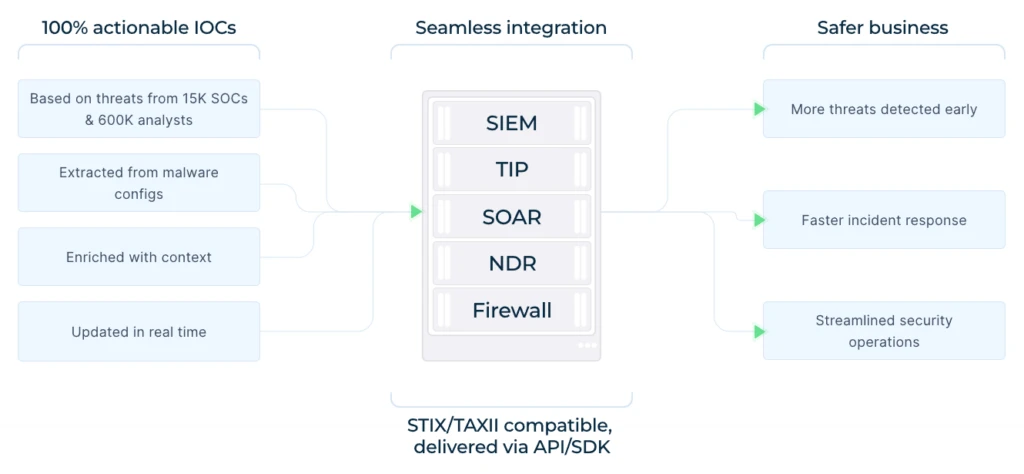
This allows MSSPs to:
- Automatically enrich alerts with current threat intelligence;
- Filter low-value noise earlier in the workflow;
- Detect emerging campaigns faster;
- Reduce time spent on repetitive IOC validation;
- Improve triage consistency across multiple client environments.
ANY.RUN Threat Intelligence Lookup complements this by giving analysts instant access to deep contextual intelligence connected to suspicious indicators. Instead of manually researching across multiple tools, analysts can immediately investigate domains, IPs, hashes, JA3 fingerprints, processes, command lines, registry keys, and MITRE ATT&CK techniques from a single interface.
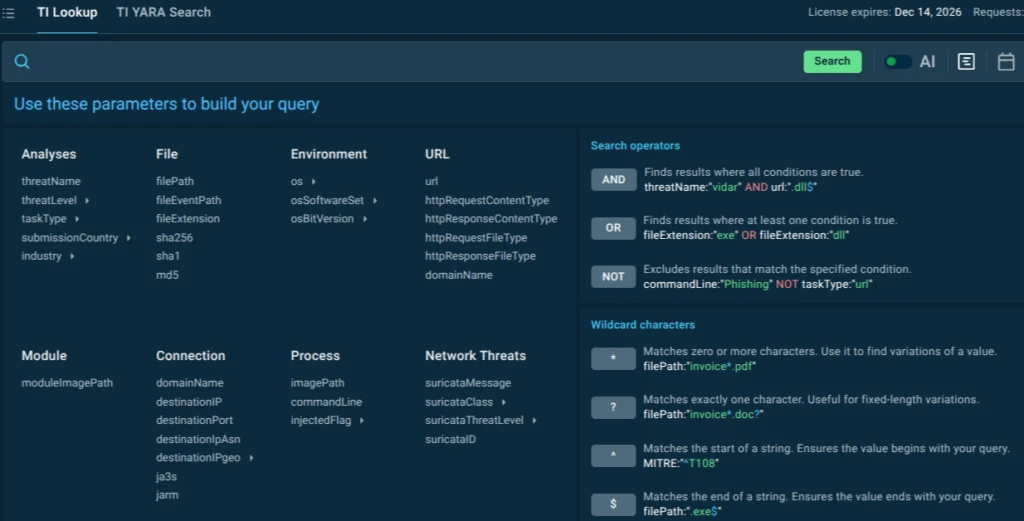
The result is a faster, less stressful workflow where analysts spend more time making decisions and less time assembling context manually.
2. Keep Detection Systems Continuously Updated with Fresh Threat Intelligence
Static detection logic becomes obsolete quickly. Attackers rotate infrastructure, modify payloads, and launch new campaigns faster than manual rule updates can keep pace. MSSPs that rely on outdated indicators inevitably develop blind spots.
ANY.RUN lets MSSPs maintain current detections through continuously updated Threat Intelligence Feeds generated from real malware executions inside the Interactive Sandbox.
Unlike traditional static IOC lists, the feeds include:
- Indicators extracted from active attacks;
- Behavioral context tied to malware activity;
- MITRE ATT&CK mappings;
- Threat relationships and campaign associations;
- Real-time updates from thousands of daily analysis sessions.
This helps MSSPs to:
- Detect active threats earlier;
- Improve proactive threat hunting;
- Correlate telemetry with current attacker infrastructure;
- Update SIEM detections automatically;
- Expand coverage without increasing manual workload.
ANY.RUN’s Interactive Sandbox strengthens this process by exposing full malware behavior in a controlled live environment. Analysts can safely observe process execution, network communication, dropped files, persistence mechanisms, and lateral movement attempts in real time.
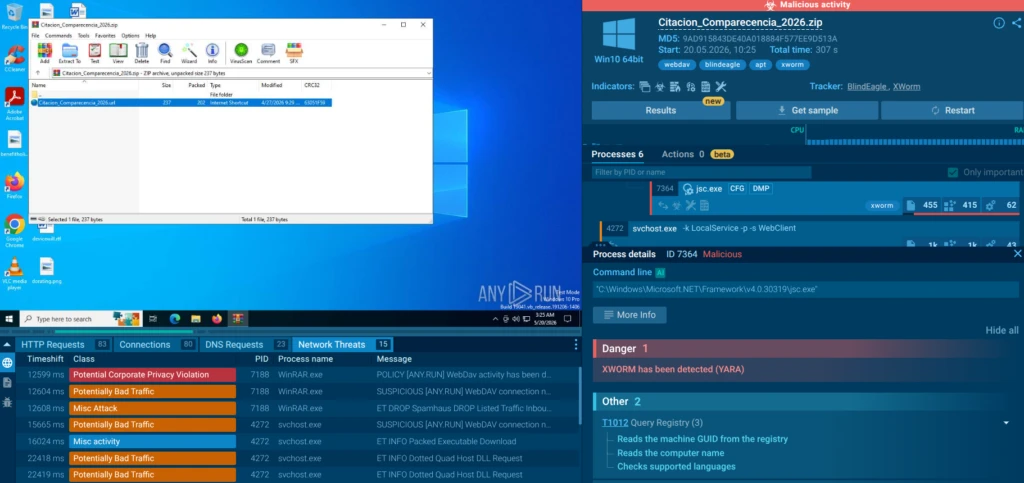
The Sandbox also generates structured intelligence that flows directly into TI products, turning individual investigations into reusable detection knowledge across all clients.
3. Accelerate Malware Analysis and Incident Investigations to Improve Response Times
As MSSPs grow, slow investigations become a major operational bottleneck. Context switching, fragmented tooling, and manual malware analysis increase MTTR and make SLA compliance harder.
ANY.RUN helps streamline investigations with its Interactive Sandbox. Instead of relying only on static analysis or isolated indicators, analysts can:
- Interact with malware during execution;
- Observe attack chains in real time;
- Analyze phishing payloads safely;
- Visualize process trees and network activity;
- Export IOCs and TTPs immediately;
- Correlate malware behavior with known campaigns.
This dramatically shortens investigation cycles and supports junior analysts in reaching confident conclusions faster.
Combined with Threat Intelligence Lookup, analysts can pivot directly from suspicious artifacts into broader intelligence data, linking incidents to related infrastructure, malware families, and attack patterns without leaving the investigation workflow.
- 36% higher detection rate
- 21 minute faster MTTR
- 30% fewer Tier 1 to Tier 2 escalations
- 20% lower load for Tier 1 analyst
- Trusted by 1,700+ MSSPs around the globe
- Data from 15,000+ organizations across finance, telecom, retail, government, and healthcare
4. Deliver Executive-Ready Reporting Faster with AI-Assisted Analysis
Client reporting is one of the most time-consuming parts of MSSP operations. Security teams often spend hours translating technical investigation data into understandable business context. ANY.RUN helps accelerate reporting with Tier 1 reports and AI Summary capabilities.
Tier 1 reports provide SOC-ready summaries that consolidate malware behavior, indicators, TTPs, and investigation findings into structured reports that analysts can use immediately during triage and escalation workflows.
AI Summary further reduces reporting time by automatically generating concise explanations of malicious activity observed during analysis sessions. Instead of manually reviewing every process and connection, analysts receive quick summaries highlighting:
- Threat behavior,
- Infection chains,
- Persistence mechanisms,
- Network activity,
- Risk indicators,
- Recommended investigation focus areas.
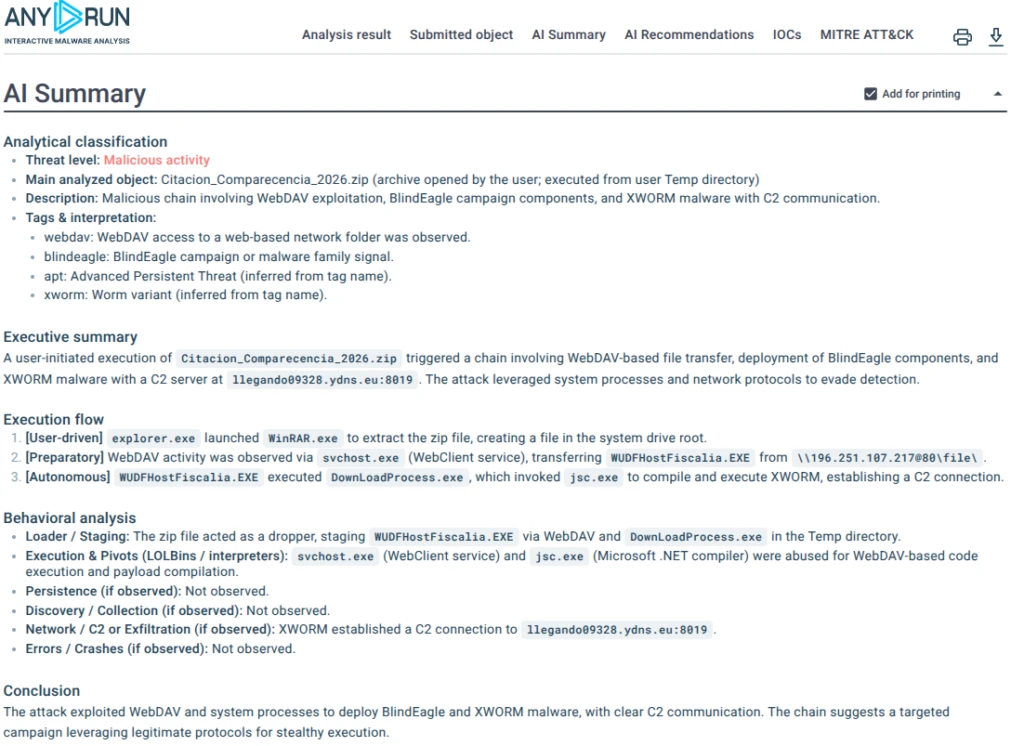
This helps MSSPs to:
- Reduce time spent writing reports,
- Improve communication between Tier 1 and Tier 2 analysts,
- Deliver faster client updates,
- Standardize reporting quality across teams,
- Shorten escalation cycles.
Together, Tier 1 reports and AI Summary allow analysts to move from raw telemetry to actionable conclusions significantly faster while maintaining consistency across growing client environments.
Scale Multi-Client Operations Without Linear Headcount Growth
The core MSSP scaling challenge is simple: revenue can grow exponentially, but analyst capacity usually cannot. Without workflow optimization, every new client increases operational pressure almost proportionally.
ANY.RUN helps break this pattern by creating a shared intelligence layer across detection, investigation, and reporting workflows.
Interactive Sandbox, Threat Intelligence Feeds, Threat Intelligence Lookup, Tier 1 reports, and AI Summary work together to:
- Reduce manual enrichment;
- Minimize tool switching;
- Standardize investigations;
- Accelerate analyst onboarding;
- Lower escalation rates;
- Improve consistency across client environments;
- Increase investigation throughput per analyst.
This allows MSSPs to scale operations more sustainably while maintaining detection quality and analyst well-being.
About ANY.RUN
Trusted by over 600,000 cybersecurity professionals and 15,000+ organizations in finance, healthcare, manufacturing, and other critical industries, ANY.RUN helps security teams investigate threats faster and with greater accuracy.
Our Interactive Sandbox accelerates incident response by allowing you to analyze suspicious files in real time, watch behavior as it unfolds, and make confident, well-informed decisions.
Our Threat Intelligence Lookup and Threat Intelligence Feeds strengthen detection by providing the context your team needs to anticipate and stop today’s most advanced attacks. ANY.RUN is SOC 2 Type II attested, reflecting strong security controls and a commitment to protecting customer data.
Try ANY.RUN to strengthen your proactive defense
FAQ
MSSPs scale more effectively by automating enrichment, reducing false positives, accelerating investigations, and continuously updating detections with real-time threat intelligence instead of relying solely on headcount growth.
ANY.RUN Threat Intelligence Feeds and Threat Intelligence Lookup help filter noise, enrich alerts automatically, and provide contextual intelligence that allows analysts to prioritize high-risk threats faster.
ANY.RUN’s Interactive Sandbox allows analysts to safely execute and observe malware behavior in real time, helping teams investigate phishing attacks, ransomware, loaders, and other threats more quickly and accurately.
Threat infrastructure changes rapidly. Fresh intelligence helps MSSPs detect active campaigns earlier, improve threat hunting, and keep SIEM detections aligned with current attacker behavior.
Tier 1 reports and AI Summary help analysts generate investigation summaries faster, reduce manual reporting work, standardize escalation quality, and speed up communication between SOC tiers and clients.
Yes. ANY.RUN supports integrations through APIs, SDKs, and standards such as STIX/TAXII, allowing MSSPs to connect intelligence directly into SIEM, SOAR, EDR, IDS/IPS, and TIP platforms.



0 comments