Black friday Up to 3 extra licenses FOR FREE + Special offer for TI LOOKUP Get it now
Webinar
February 26
Better SOC with Interactive Sandbox Practical Use Cases
Register now
185
Global rank
161 infographic chevron month
Month rank
110 infographic chevron week
Week rank

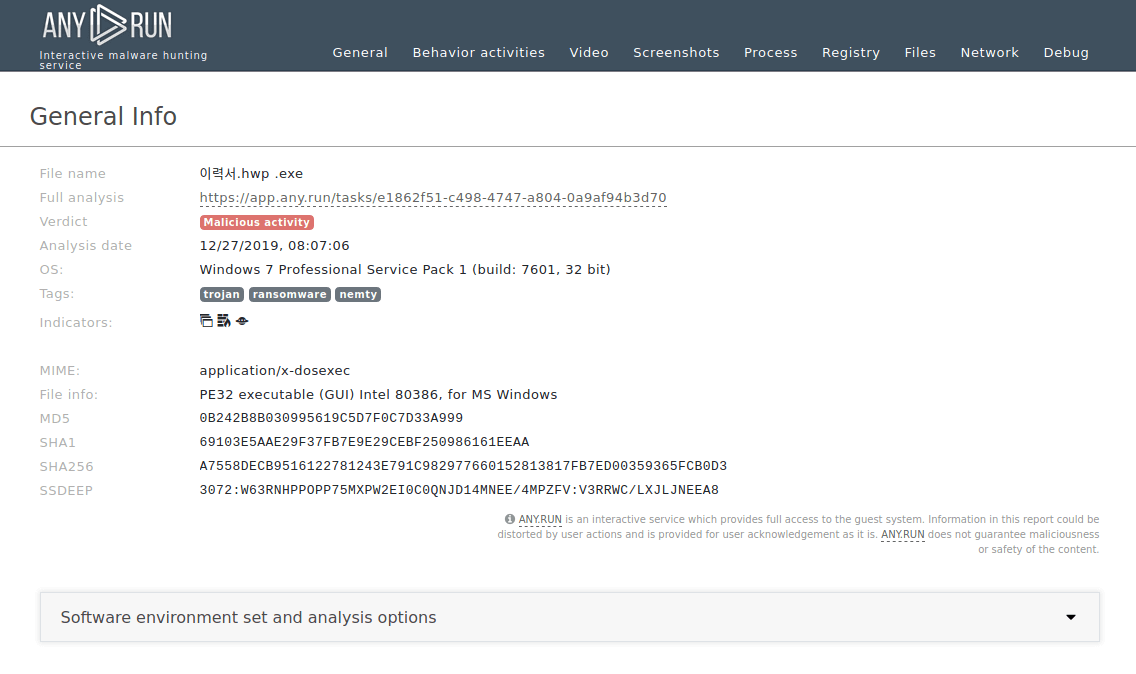
Nemty is ransomware with an unusually complex encryption algorithm. This malware encrypts user files and demands money so that they can be unlocked again. It may be connected to other famous ransomware, but we don’t know for sure.

Ransomware
Type
ex-USSR territory
Origin
1 August, 2019
First seen
19 September, 2026
Last seen
Also known as
NEMTY PROJECT

How to analyze Nemty with ANY.RUN

Type
ex-USSR territory
Origin
1 August, 2019
First seen
19 September, 2026
Last seen

IOCs

IP addresses
48.209.6.48
48.209.138.168
48.192.1.65
40.126.32.136
150.171.109.104
23.59.18.102
150.171.28.11
150.171.109.101
150.171.27.11
52.123.243.95
104.26.13.205
150.171.109.100
140.82.121.4
150.171.109.107
104.18.23.222
23.52.181.141
104.26.5.15
172.211.123.249
192.178.183.132
23.52.181.212
Hashes
ca6769a75bcb79eb4a25d3a3ae3af15ed7b292a73c2acce7e37f31b9738ebeb7
b9fa2d52a4ffabb438b56184131b893b04655b01f336066415d4fe839efe64e7
3a5078b626e41d20117d260d8b825b039884cfe062c6d462432216d9b07d82b5
80db4ccdca106d37b920206331fcfe3e9e50a9e763d89b54ce3ad5ac8cf30f03
75da533888189d13fc340d40637b9fc07a3f732e3fcf33ec300f4c7268790a62
907f2709d1d3c8fa26294938f4080bc477e62281c4c50a082c22db0195cda663
22ca9415e294d9c3ec3384b9d08cdaf5164af73b4e4c251559e09e529c843ea6
474d668707f1cb929fef1e3798b71b632e50675bd1a9dceaab90c9587f72f680
3d0361a85adfcd35d0de74135723a75b646965e775188f7dcdd35e3e42db788e
6028bd681dbf11a0a58dde8a0cd884115c04caa59d080ba51bde1b086ce0079d
9c70f766d3b84fc2bb298efa37cc9191f28bec336329cc11468cfadbc3b137f4
eacd09517ce90d34ba562171d15ac40d302f0e691b439f91be1b6406e25f5913
b3ece279943b28c8d855ec86ac1ce53bdfb6a709240d653508764493a75f7518
4ecedb9c1f3dd0d0e3aeb86146561b3d7e58656cbdbed1a39b91737b52ec7f2c
e758273c25fbad804fe884584e2797caefbbd1c2877dfd6f87ab1340cd25252e
3377a873db531113d79919e7a89369a79a602bac6ae09b9864b9378dc285f345
a3eb276fbd19dce2b00db6937578b214b9e33d67487659fe0bf21a86225ece73
a41670d52423ba69c7a65e7e153e7b9994e8dd0370c584bda0714bd61c49c578
54241ebe651a8344235cc47afd274c080abaebc8c3a25afb95d8373b6a5670a2
bbd37d41b7de6f93948fa2437a7699d4c30a3c39e736179702f212cb36a3133c
Domains
watson.events.data.microsoft.com
slscr.update.microsoft.com
raw.githubusercontent.com
edge-mobile-static.azureedge.net
config.edge.skype.com
api.edgeoffer.microsoft.com
edge-consumer-static.azureedge.net
settings-win.data.microsoft.com
ecs.office.com
crl.microsoft.com
www.microsoft.com
edge.microsoft.com
copilot.microsoft.com
client.wns.windows.com
edge-cloud-resource-static.azureedge.net
api.ipify.org
static.edge.microsoftapp.net
clients2.googleusercontent.com
activation-v2.sls.microsoft.com
www.bing.com
URLs
http://crl.microsoft.com/pki/crl/products/microoceraut2011_2011_03_22.crl
http://www.microsoft.com/pkiops/crl/microsoft%20secure%20server%20ca%202026.crl
http://ocsp.digicert.com/mfewtzbnmeswstajbgurdgmcgguabbq50otx%2fh0ztl%2bz8sipi7wewvxdlqqutijuibiv5unu5g%2f6%2brks7qyxjzkceaz1vqyrvgl0erhqlcpm8gy%3d
http://edge.microsoft.com/browsernetworktime/time/1/current?cup2key=2:drrd6zwcilyqokgkeequjaygdsbrxv4r-w4hho-wjbe&cup2hreq=e3b0c44298fc1c149afbf4c8996fb92427ae41e4649b934ca495991b7852b855
https://edge.microsoft.com/serviceexperimentation/v3/?osname=win&channel=stable&osver=10.0.19045&devicefamily=desktop&installdate=1661339457&clientversion=133.0.3065.92&experimentationmode=2&scpguard=0&scpfull=0&scpver=0
https://github.com/pyran1/malwaredatabase/raw/refs/heads/master/ransomware/old/613c390d6b3b792d6bf0765e97719ac4278741abcebdd03d9fe394c8a46a841c.zip
https://config.edge.skype.com/config/v1/edge/133.0.3065.92?clientid=4489578223053569932&agents=edge%2cedgeconfig%2cedgeservices%2cedgefirstrun%2cedgefirstrunconfig&osname=win&client=edge&channel=stable&scpfre=0&osarch=x86_64&osver=10.0.19045&wu=1&devicefamily=desktop&uma=0&sessionid=72&mngd=0&installdate=1661339457&edu=0&soobedate=1504771245&bphint=2&fg=1&lbfgdate=1766137499&lafgdate=0
https://copilot.microsoft.com/c/api/user/eligibility
https://api.edgeoffer.microsoft.com/edgeoffer/pb/experiments?appid=edge-extensions&country=us
https://raw.githubusercontent.com/pyran1/malwaredatabase/refs/heads/master/ransomware/old/613c390d6b3b792d6bf0765e97719ac4278741abcebdd03d9fe394c8a46a841c.zip
https://edge.microsoft.com/extensionwebstorebase/v1/crx?os=win&arch=x64&os_arch=x86_64&nacl_arch=x86-64&prod=edgecrx&prodchannel=&prodversion=133.0.3065.92&lang=en-us&acceptformat=crx3,puff&x=id%3djmjflgjpcpepeafmmgdpfkogkghcpiha%26v%3d1.2.1%26installedby%3dother%26uc%26ping%3dr%253d274%2526e%253d1
https://edge.microsoft.com/entityextractiontemplates/api/v1/assets/find-assets?name=arbitration_priority_list&version=24.*.*&channel=stable&key=d414dd4f9db345fa8003e32adc81b362
https://edge.microsoft.com/entityextractiontemplates/api/v1/assets/find-assets?name=edge_hub_apps_manifest_gz&version=4.11.*&channel=stable&key=d414dd4f9db345fa8003e32adc81b362
https://edge.microsoft.com/entityextractiontemplates/api/v1/assets/find-assets?name=domains_config_gz&version=3.*.*&channel=stable&key=d414dd4f9db345fa8003e32adc81b362
https://www.bing.com/api/shopping/v1/user/shoppingsettings?enabledservicefeaturesv2=edgeserverux.shopping.cashbackeumarkets,edgeserverux.shopping.msedgeshoppingcashbackdismisstimeout2s
https://update.googleapis.com/service/update2/json?cup2key=14:bvb3mhbigeabwnbz2_k61jqhqtrsz8milwpq7k9ks58&cup2hreq=a2cb8b08143448d6448350bbc0e651b48ea085f2d14c5289c6ed72d61bedf630
https://clients2.googleusercontent.com/crx/blobs/abe5cl52ck7wwbndbvvaem8oys3yhboz1h4zjji-spceoodztoqtbav4glxcdddxfkjcfz5qxdftce2lflmfl4fmgxvilhkmrudcuedenzrbmgjjiqxwnwfy8qwxmtkglheaxlka5bx6yvrdaanj1smxvmii4akl_ln2/ghbmnnjooekpmoecnnnilnnbdlolhkhi_1_110_1_0.crx
https://edge.microsoft.com/abusiveadblocking/api/v1/blocklist
https://config.edge.skype.com/config/v1/edge/133.0.3065.92?clientid=4489578223053569932&agents=edgeruntime%2cedgeruntimeconfig%2cedgedomainactions&osname=win&client=edge&channel=stable&scpfre=0&osarch=x86_64&osver=10.0.19045&wu=1&devicefamily=desktop&uma=0&sessionid=72&mngd=0&installdate=1661339457&edu=0&soobedate=1504771245&bphint=2&fg=1&lbfgdate=1789820553&lafgdate=0
https://go.microsoft.com/fwlink/?linkid=2257403&clcid=0x409
Last Seen at

Recent blog posts

post image
How MSSPs Can Prove Their Value When “Nothing...
watchers 3785
comments 0
post image
Enterprise Threat Intelligence Buying Guide:...
watchers 4251
comments 0
post image
ANY.RUN & SentinelOne: One Workspace, Ins...
watchers 5556
comments 0

Nemty, also known as NEMTY PROJECT is a ransomware-type of malware. A virus that puts encryption on all files that are stored on infected machines and only allows to restore them if victims pay a certain ransom amount.

Nemty has surfaced not so long ago. It was first observed in the wild in August 2019. Due to some similarities in the code and behavior, researchers think that Nemty might be related to GandCrab and Sodinokibi, though direct correlation hasn’t been proved. In any case, it is safe to assume that this is very advanced malware.

Additionally, the malware’s code apparently includes an affiliate ID which may indicate that Nemty is available as a Ransomware as a Service. If this information is correct Nemty has the potential to become a very widespread malware due to its easy availability.

General description of Nemty ransomware

Nemty ransomware is being actively upgraded by its creators. In fact, several versions of the virus have already been released and nothing suggests that this development should stop anytime soon.

Among other upgrades, threat actors employed a very strong encryption algorithm. It is actually so strong that no malware before Nemty has used anything similar. The RSA-8192 used here is 8192-bit encryption which is considered to be an overkill for use in malware. Even though this encryption protocol makes data decryption more difficult it also presents its own complications. For example, it causes longer encryption and key generation times and only encrypts 1024 bytes at a time.

Despite this, researchers have been able to create decryptors that work with versions 1.4, 1.5 and 1.6 of the malware, for example, the Avast Nemty decryption tool. This means that victims that have been attacked by the version of the malware mentioned above can restore their information without having to pay the ransom to the attackers.

Without the decryptors like the Avast Nemty tool, victims would have to pay a ransom of about $1000 equivalent in Bitcoin to the attackers. The ransom can be paid through a payment portal that is hosted using the TOR network. And if not paid on time, the amount is doubled to a $2000 equivalent.

We don’t know for sure who the people behind Nemty are. The malware has code that checks if the victim is from one of the following countries: Russia, Belarus, Kazakhstan, Tajikistan, or Ukraine.

However, victims from the countries mentioned above can still get attacked by the ransomware. This is strange since usually, viruses that check for the origins of victims terminate execution to avoid getting attention from local law enforcement structures.

In the case of Nemty, users from all over the world are in danger of being infected.

However, there are other interesting oddities in the code that point to a ex-USSR origin of the virus. The code contains a link to a similar picture that was linked in GandCrab’s code. Except, this time it contains on an overlay of the Russian president’s portrait. There are other weird things to be found in the code of this malware. For example, if you dig deep enough you will find a direct message to cybersecurity professionals telling them to, well, “mind their own business” in a less polite form.

More evidence suggesting the x-USSR origin of the malware creators is that the payment page is in the Russian language. Maybe the creators are in fact Russian or they are trying to plant a false lead and mislead researchers.

Malware analysis of Nemty ransomware

A video recorded in the ANY.RUN malware hunting service allows us to take a look at the execution of this malware in action.
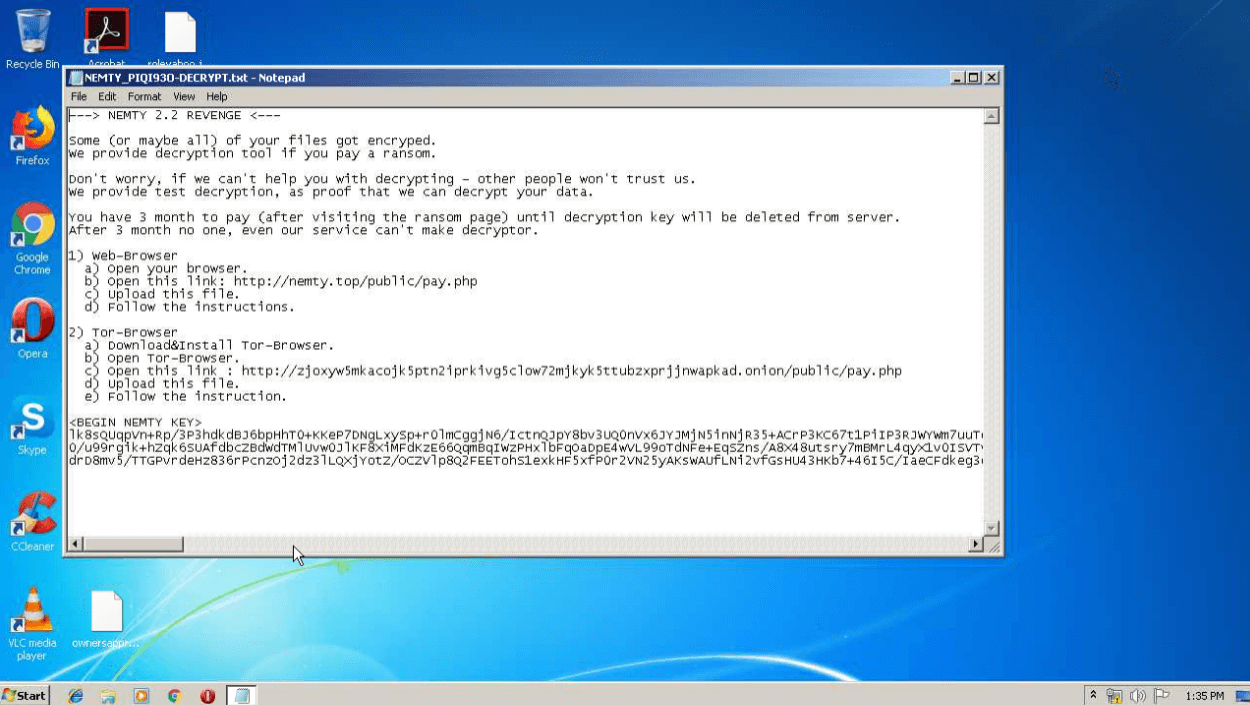
nemty's ransom note

Figure 1: Nemty's ransom note

text report of the Nemty ransomware analysis

Figure 2: Shows a customizable text report generated by the ANY.RUN malware analysis service which allows diving deeper into the details of the Nemty execution process.

Nemty execution process

The execution process of the Nemty ransomware is relatively typical for this type of malware. After the executable file makes its way into an infected system and runs, the main malicious activity begins. Like many other ransomware families, Nemty deletes shadow copy files. It also stops and kills processes from the hardcoded list. The malware creates a text file with a ransom note in every folder with encrypted files.

The interesting thing is that Nemty, as well as Sodinokibi, creates a registry key in which it stores values such as a public key and a file extension for encrypted files.

Nemty Distribution

Initially, Nemty was using RIG and Radio EK exploit kits for distribution purposes. In addition to that, malware authors employed spam email campaigns to distribute the virus primarily in Korea and China. These two countries are where the bulk of all Nemty infections is happening.

However, with the newer versions of the malware coming out, threat actors started using new distribution methods. Possibly they were trying to expand the reach of the malware and gain the ability to infect more victims.

One of such methods is a fake PayPal website that promises to save money with an unusually high cashback. The website is designed to look identical to the genuine PayPal and prompts users to download a file called “cashback.exe”. Although unsuspecting victims might think that they are downloading a PayPal app, in reality, they are installing and executing the Nemty ransomware.

In addition, later versions of the malware are delivered using the Trik botnet. Apparently, the authors of Nemty have partnered up with people behind Trik to increase their range.

How to detect Nemty using ANY.RUN?

To determine whether the sample under review is Nemty or not, you can take a look at the changes that it made in the registry. To do so, open "Advanced details of process" of the malicious process and look at the "Registry changes" tab in the "Events" section. If a process has created values with the names "cfg", "pbkey" or "fid" into the key HKEY_CURRENT_USER\Software\NEMTY, you can be sure that the given sample is Nemty.
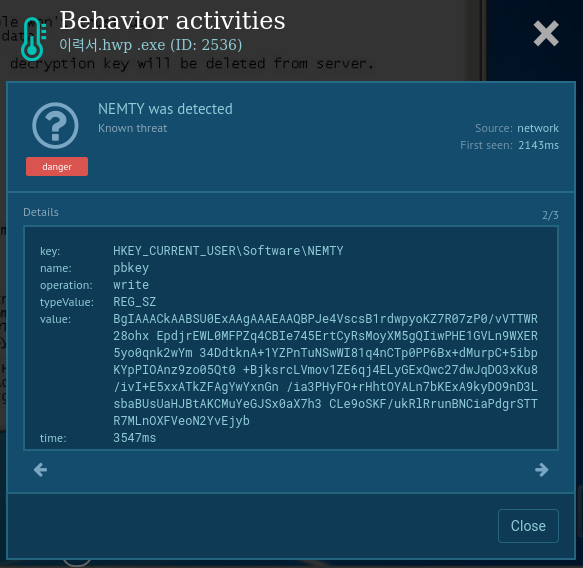
changes in registry made by nemty ransomware

Figure 3: Changes in registry made by Nemty ransomware

Conclusion

The constant evolution of distribution methods, as well as regular updates, prove that this malware is at a stage of active development. First seen in 2019, Nemty is a young threat that already shows signs of sophisticated malware.

Coupled with the potential use of the Ransomware as a Service business model that makes this malware available to many threat actors around the globe, these factors demand that this threat is not taken lightly.

One of the primary dangers of this Ransomware lies in the delivery techniques chosen by the attackers. While mail spam helps to reach millions of potential victims easily, heavy use of exploit kits allows attackers to control every step of the infection.

Thus, it is especially important that security researchers can evaluate this ransomware and continue developing countermeasures and encryptors, like the Avast Nemty. One more tool that can help in this pursuit is the ANY.RUN malware hunting service that will allow studying samples of Nemty in a controlled and safe environment.
HAVE A LOOK AT

Kratos screenshot
Kratos
kratos
Kratos is a mature Phishing-as-a-Service (PhaaS) platform that evolved from the Sneaky2FA kit to specialize in stealing Microsoft 365 credentials through sophisticated Adversary-in-the-Middle (AiTM) techniques. The service provides low-skilled affiliates with a turnkey solution featuring an advanced administrative dashboard, integrated anti-bot defenses, and real-time data exfiltration via the Telegram Bot API. Although an international law enforcement action known as Operation Olympus Blade disrupted its central infrastructure in July 2026, the kit remains a primary example of the industrialization of modern cybercrime.
Read More
Caminho Loader screenshot
Caminho Loader
caminho caminholoader
Caminho Loader is a Brazilian-origin Loader-as-a-Service operation that uses steganography to conceal .NET payloads within image files hosted on legitimate platforms. Active since March 2025, it has delivered a variety of malware and infostealers to victims within multiple industries across South America, Africa, and Eastern Europe.
Read More
DarkGate screenshot
DarkGate
darkgate
DarkGate is a loader, which possesses extensive functionality, ranging from keylogging to crypto mining. Written in Delphi, this malware is known for the use of AutoIT scripts in its infection process. Thanks to this malicious software’s versatile architecture, it is widely used by established threat actors.
Read More
Roning Loader screenshot
Roning Loader
roning
RoningLoader is a multi-stage Windows loader designed to operate quietly while preparing systems for deeper compromise. It abuses trusted system tools and interferes with security controls to reduce the chances of early detection. Instead of acting as a final payload, it creates conditions for follow-on malware to execute more effectively. Its use of staged execution and code injection allows attackers to blend into legitimate activity and escalate impact. This makes early behavioral detection critical before the attack chain progresses further.
Read More
Greatness screenshot
Greatness is a Phishing-as-a-Service (PhaaS) platform that enables cybercriminals, even those with limited technical skills, to launch sophisticated phishing attacks primarily targeting Microsoft 365 (M365) credentials. It acts as a man-in-the-middle (MitM) proxy, facilitating credential theft and MFA bypass while providing affiliates with easy-to-use tools like attachment builders and Telegram notifications.
Read More
Meduza Stealer screenshot
Meduza Stealer is an information-stealing malware primarily targeting Windows systems, designed to harvest sensitive data such as login credentials, browsing histories, cookies, cryptocurrency wallets, and password manager data. It has advanced anti-detection mechanisms, allowing it to evade many antivirus programs. The malware is distributed through various means, including phishing emails and malicious links. It’s marketed on underground forums and Telegram channels.
Read More