Black friday Up to 3 extra licenses FOR FREE + Special offer for TI LOOKUP Get it now
Webinar
February 26
Better SOC with Interactive Sandbox Practical Use Cases
Register now

Metamorfo

116
Global rank
146 infographic chevron month
Month rank
144 infographic chevron week
Week rank
0
IOCs

Metamorfo is a trojan malware family that has been active since 2018. It remains a top threat, focusing on stealing victims’ financial information, including banking credentials and other data. The malware is known for targeting users in Brazil.

Trojan
Type
Unknown
Origin
1 April, 2018
First seen
1 June, 2026
Last seen
Also known as
Casbaneiro

How to analyze Metamorfo with ANY.RUN

Type
Unknown
Origin
1 April, 2018
First seen
1 June, 2026
Last seen

IOCs

IP addresses
185.45.195.226
18.209.163.113
18.184.132.208
216.238.82.27
192.46.216.151
191.232.234.184
216.238.70.224
149.56.173.89
172.105.111.154
3.136.20.196
139.177.193.74
80.211.249.77
52.138.9.49
45.32.90.70
186.192.140.7
137.220.53.87
191.101.2.101
187.84.229.107
5.83.162.24
185.183.98.135
Hashes
2728e713ef60160ac8427b9dd550ba00885d2125fd03f1990618d9af7e8f1949
efb6169bbb869a849afb91184a75b906fe509cbf6e672b6b4f3311c02343bbbb
a74226654c5048cadb46d83b3778c554e0e02c6dc063f35b2721cb977f1285cf
681ccc9e5bab3a23b3ce31fdc1eb8db268e79e1521e748d8f8c951d10a3a096c
2d40da8ee687152fcb99a36442390885767b667005dba437a79e6d12c91cd7a9
237d1bca6e056df5bb16a1216a434634109478f882d3b1d58344c801d184f95d
389d19a3b377c4df6b78487099d15e0b2124ef82f6e841754157dfdeca2d6d41
74893879a20fa8dcd8bb86da5dfaa71509a392ab3bf5033b057de4a3485d5551
e53cab787bbe6719e2709b6c84eed0cbfa8468a2e239066880e4a4d444e5e770
f495d7c5c98457febc42ec96a959293788f6915e4245899d3bb1808ab84f0d9a
e5ec03622ffabb1a05c38b8b5bb79d03ebd7aab448582ab2f5a4b27725d7aa90
e8982066cc5b75706641a0ec20af285179528aad5368bdedea9965185b9ed0da
a55c83aa202f4ee218ac7aed24ce286481e8f570ad0b29004427122854db4166
27da7ddbbbca0bb2cba219e5b80461be2fb9cadd83885669dc3b54dca83236eb
0d8d44a2814be4f0f6a41a3173a081a62126acdd89d29d052d8bf38412003b62
afc82cce49b6bee26340b55d5a9e8a9b08406878f7cfafe69d6c7fd04dc132d1
6bb5f3a7147660db416b838893c7d0734872ada9f7db68b1d019043a1cb89397
b7f19731674fa76584ae1ff0193ff06acbf08cbaa60d12fdf81239f1f6591c99
b07462ea1a72d9b6ed7aecd132c39a420064a6a1f4667ede634e4e4accde4941
633d363baa5dd8b6353676843204ab91f899ab55b6e159cad39d24a459ff527b
Domains
hostsize.sytes.net
noturnis.zapto.org
seradessavez.ddns.net
4d9p5678.myvnc.com
agosto2019.servepics.com
tt.grupobedfs.com
grupobedfs.com
myrsvpsecure.com
facturas.co.in
ventasmex123.com.mx
url27.shop
facturacioncontable.com
archivosdwn.cloud
midiavideostv.click
adbd.tech
cfdimex.cloud
satventasfac.tech
cargafactura.life
archivesautomacion.ddns.net
facturasm.cloud
URLs
http://15.228.77.178/ytr/serv.php
http://185.34.52.145/zips/peru.zip
http://185.34.52.145/peru/ybnzkvj.php
http://15.228.14.203/PKJHGFRTJMNBVFDCV/serv.php
http://f0727071.xsph.ru/contador/serv.php
http://f0696125.xsph.ru/close/serv.php
http://f0717271.xsph.ru/serv.php
http://20.226.52.51/$/serv.php
http://20.226.52.51//mMES79281%23//DAIUYTREWDVBJIUYTXCS.png
http://20.226.52.51//mMES79281%23//JHGFDWQWERTYJNBVDSDE.gif
http://20.197.177.145//Loads//MNBVCXZSERTYHGFDWQ.png
http://20.197.177.145//Loads//ENVIOGSAYDSAGDDSADIS.gif
http://20.197.177.145/Envio/serv.php
http://20.197.177.145//Loads//MEUGSAYDSAGDDSADIS.gif
http://20.197.177.145/MEU/serv.php
http://sbaratao.com.br/controler/conta/inspecionando.php
http://20.206.241.68/v/serv.php
http://172.200.176.88/kitlouco.php
http://20.55.14.49/sucesso2023/kitlouco.php
http://154.223.16.114/25/index.php
Last Seen at

Recent blog posts

post image
From Infosecurity Europe to CONFidence and C1...
watchers 1848
comments 0
post image
Intelligence-Driven Threat Hunting: How SOCs...
watchers 3212
comments 0
post image
Protecting 50,000 Users: How ANY.RUN Drives I...
watchers 4492
comments 0

What is Metamorfo malware?

Metamorfo, also known as Casbaneiro, is a trojan malware family used for exfiltrating financial information. The operators behind the malicious software spread it primarily via phishing campaigns. While initially, users living in Brazil were the core victims of the malware, the attackers later expanded the list of targeted countries.

Keylogging serves as the main method of collecting information from the infected devices. To facilitate the process, Metamorfo can display fake bank forms requesting users’ credentials. At the same time, the malware can also be employed to steal other sensitive data, as well as take screenshots.

Use ANY.RUN free for 14 days

Try the full power of interactive analysis

Start your free trial

Technical details of the Metamorfo malicious software

One of the ways Metamorfo manages to collect users’ login banking info is by first killing all the browser processes and then modifying the registry to disable auto-complete and auto-suggest. This is done to force the user to enter their login and other form details manually, allowing Metamorfo’s keylogging capability to record the keys they press.

Metamorfo also can scan the clipboard and replace any saved crypto wallet address with that of the attacker. As a result, victims may unknowingly send their funds to criminals.

On top of that, the malware can search for certain files on the infected device using specific keywords and exfiltrate them to the attacker. Metamorfo can also download additional files from its C2, meaning that it can update itself and install other malicious software.

Many attacks involving the malware have been observed to implement DLL hijacking. This technique enables Metamorfo to run its code with the help of legitimate processes, which allows it to stay undetected by traditional security solutions.

The malware can also display fake security pop-ups of popular Brazilian banks, informing the users that their account has been compromised. The next window then requests the victim to share their login credentials.

Metamorfo gains persistence on the system by creating a task that launches the malware at every new startup.

Execution process of Metamorfo

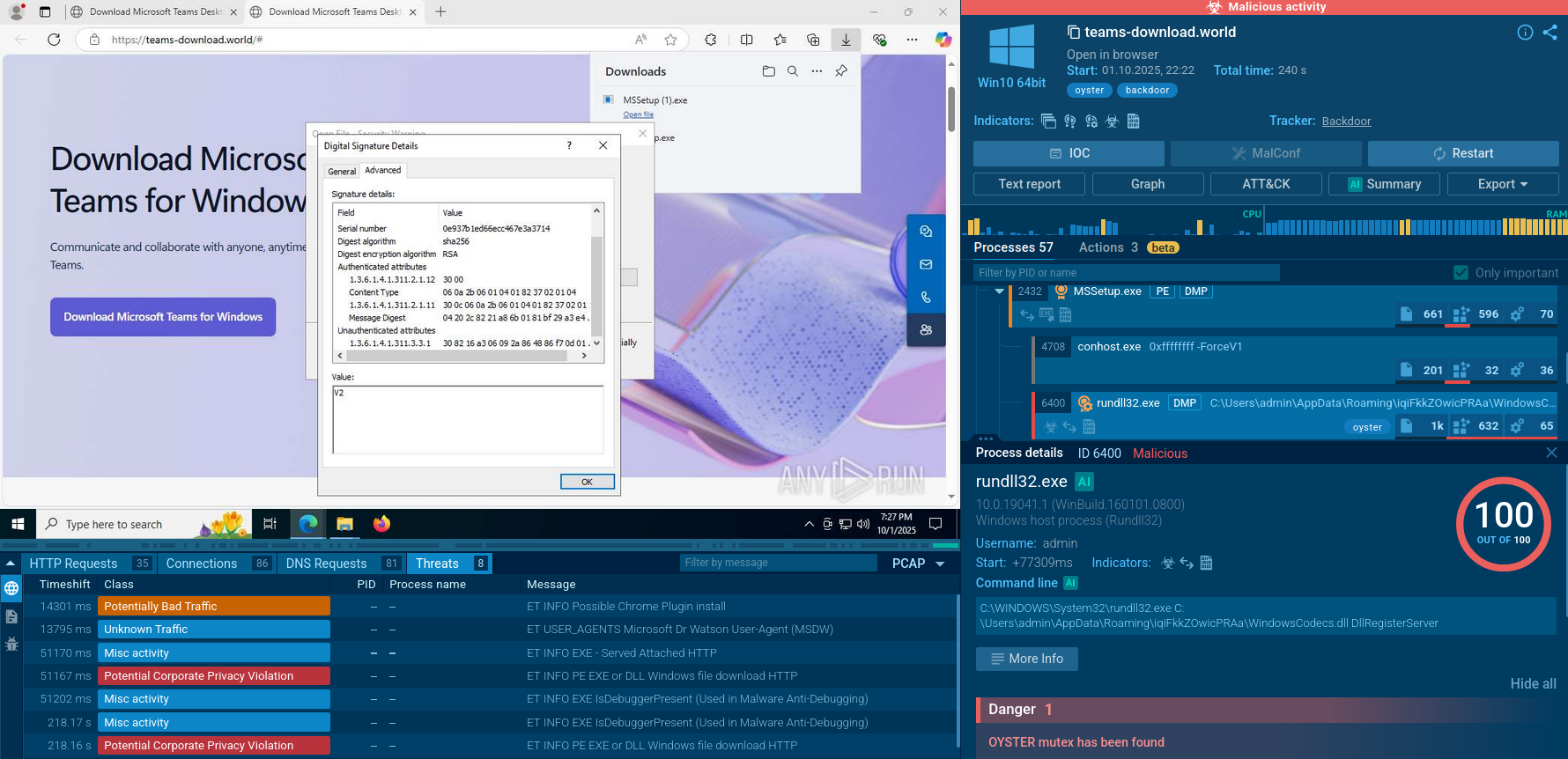
Let’s upload a sample of Metamorfo to the ANY.RUN sandbox to explore its execution chain.

This particular Trojan family often employs a deceptive strategy of embedding itself into installers that unsuspecting users download in the hopes of installing legitimate software. Our analyzed sample, also in MSI format, deviates from this common modus operandi by employing more sophisticated installation techniques. Instead of relying on fake installer windows to blend in, it utilizes a combination of a hidden window and the header "Installation Database" to conceal its installation process.

Upon execution, the downloaded sample establishes a connection to a remote server to retrieve the primary payload, Metamorfo. Once Metamorfo is downloaded, it is launched, initiating a series of malicious activities. These activities include creating a file in the startup directory to ensure its persistent operation and, to evade detection, subsequently removing this file from the startup registry.

Once established, the dropped file, SlimBoat, takes center stage, orchestrating a coordinated attack on the compromised system. It loads additional modules, establishes a connection to the remote server, and embarks on the primary objective of exfiltrating sensitive information.
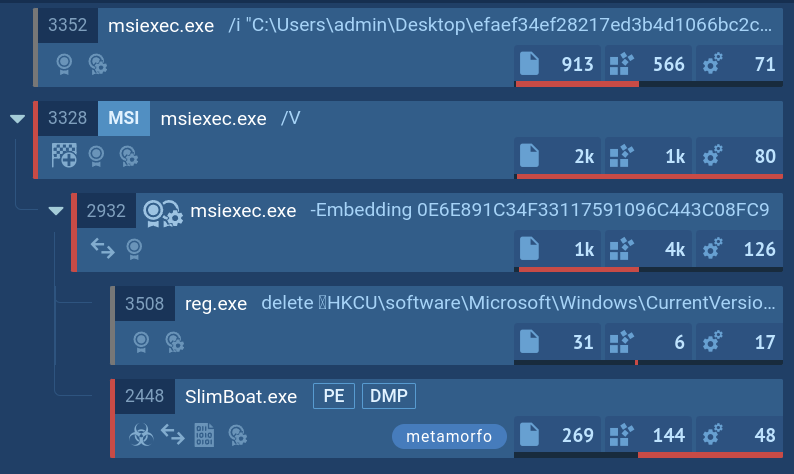
Metamorfo process tree shown in ANY.RUN Metamorfo's process tree demonstrated in ANY.RUN

Distribution methods of the Metamorfo malware

Similar to other trojan malware families like Agent Tesla and Remcos, Metamorfo is distributed using phishing emails with malicious attachments in the form of archives with an .MSI file inside and PDFs. In some attacks, criminals also send links. The subject of the email usually concerns finance, asking the recipient to conduct an invoice payment.

Conclusion

Despite being active since 2018, Metamorfo continues to pose a major threat to users in Brazil and other countries, including the United States. Organizations without reliable security measures in place are particularly vulnerable to such attacks. As Metamorfo typically spreads through emails, checking all the incoming files and links should be top priority for organizations that do not wish to fall victim to the malware.

ANY.RUN is a cloud-based malware analysis sandbox that lets you quickly analyze any suspicious file and URL to determine whether it is malicious. The service also generates reports on the threats identified, containing all the necessary intelligence, including indicators of compromise (IOCs).

Try ANY.RUN for free – request a demo!
HAVE A LOOK AT

Play Ransomware screenshot
Play aka PlayCrypt ransomware group has been successfully targeting corporations, municipal entities, and infrastruction all over the world for about three years. It infiltrates networks via software vulnerabilities, phishing links and compromised websites. The ransomware abuses Windows system services to evade detection and maintain persistence. Play encrypts user files and steals sensitive data while demanding a ransom.
Read More
Maze screenshot
Maze
maze ransomware
Maze is ransomware — a malware type that encrypts the victim’s files and restores the data in exchange for a ransom payment. One of the most distinguishable features of Maze is that it is one of the first malware of the kind to publicly release stolen data.
Read More
Xeno RAT screenshot
Xeno RAT
xenorat
Xeno RAT is an open-source malware mainly distributed through drive-by downloads. The core capabilities of this threat include remote control, keystroke logging, webcam and microphone access. Equipped with advanced utilities, such as Hidden Virtual Network Computing and Socks5 reverse proxy, Xeno RAT is most frequently used in attacks against individual users.
Read More
DarkGate screenshot
DarkGate
darkgate
DarkGate is a loader, which possesses extensive functionality, ranging from keylogging to crypto mining. Written in Delphi, this malware is known for the use of AutoIT scripts in its infection process. Thanks to this malicious software’s versatile architecture, it is widely used by established threat actors.
Read More
Botnet screenshot
Botnet
botnet
A botnet is a group of internet-connected devices that are controlled by a single individual or group, often without the knowledge or consent of the device owners. These devices can be used to launch a variety of malicious attacks, such as distributed denial-of-service (DDoS) attacks, spam campaigns, and data theft. Botnet malware is the software that is used to infect devices and turn them into part of a botnet.
Read More
Havoc screenshot
Havoc
havoc
Havoc is an advanced post-exploitation framework used by hackers to take control of a system once they've breached it. With Havoc, attackers can run commands remotely, inject malicious processes, and access sensitive data. It's often used in targeted attacks, allowing cybercriminals to stay hidden in a network while stealing information or launching further attacks. Its flexibility and ability to bypass detection make it a serious threat, especially in environments that rely on traditional security tools.
Read More