Black friday Up to 3 extra licenses FOR FREE + Special offer for TI LOOKUP Get it now
Webinar
February 26
Better SOC with Interactive Sandbox Practical Use Cases
Register now

Loda

110
Global rank
97 infographic chevron month
Month rank
119 infographic chevron week
Week rank
0
IOCs

Loda is a remote access trojan (RAT) that has been in active use among multiple threat actors since 2016. The malware’s functionality includes stealing passwords and other sensitive information, keylogging, capturing screenshots, and delivering other malicious payloads. Loda is typically distributed as part of phishing email campaigns.

RAT
Type
Morocco
Origin
Unknown
First seen
10 September, 2026
Last seen

How to analyze Loda with ANY.RUN

RAT
Type
Morocco
Origin
Unknown
First seen
10 September, 2026
Last seen

IOCs

IP addresses
138.252.131.215
40.8.195.179
170.152.242.52
54.233.180.158
74.220.199.6
210.171.58.203
137.87.99.163
210.153.191.83
25.243.55.92
213.133.94.133
215.241.245.86
210.168.137.88
107.36.31.109
113.143.138.111
66.62.183.77
92.183.233.66
210.229.165.153
84.129.161.208
190.139.187.252
213.168.208.28
Hashes
aac73b3148f6d1d7111dbca32099f68d26c644c6813ae1e4f05f6579aa2663fe
2ed27c1421e6928dbe13dbfdb5c59e1045b30341fe7ebe05700006bc5ac572c0
c9f9f193409217f73cc976ad078c6f8bf65d3aabcf5fad3e5a47536d47aa6761
28042dd4a92a0033b8f1d419b9e989c5b8e32d1d2d881f5c8251d58ce35b9063
8eee9284e733b9d4f2e5c43f71b81e27966f5cd8900183eb3bb77a1f1160d050
4ae7d63ec497143c2acde1ba79f1d9eed80086a420b6f0a07b1e2917da0a6c74
3e59379f585ebf0becb6b4e06d0fbbf806de28a4bb256e837b4555f1b4245571
eff52743773eb550fcc6ce3efc37c85724502233b6b002a35496d828bd7b280a
7b8dffd78eb43c4fa4472104dfc03c787196e5e6d852189f0f5bc0dc816e4f79
746b3b3ab8a597e6d6b753ebd409f496c19422bfa75d6b3cf42f4b74e8dc6c91
f89a08f38ea6ab3c317882d6b56f724593d92f24c356a9c6689286cb60d8baf4
80a265bed528211aa708dcd58f7a95db36eeb7f873c6fe4ddab0b3a1dc0973a4
c483ce5ac9273d1b93916da17888203c7baf1194f62cd1c77e317b7bad6e2730
72777139f330a2e7653c0b5d427b57172275edd4535c5f743bb0ade50037a0f5
c24ac6d4e0e76b39625fc9051e092439642c3a10122f712c11a562860703f27a
2fa6bab36be094e225d3cf814a84cfb643819f4af82b11a55f65b60abb429bec
c8d561a0f6e11970d1d70c790cfe78fa098788b12e57f54b715b110c615f806b
4097665303729e520334b2db9915dc3ef955e3518d08846af73d464bfdaea3a6
3e0c7c091a948b82533ba98fd7cbb40432d6f1a9acbf85f5922d2f99a93ae6bb
020f1fa6072108c79ed6f553f4f8b08e157bf17f9c260a76353300230fed09f0
Domains
slscr.update.microsoft.com
winnerscorner.gleeze.com
adclick.g.doubleclick.net
3xp3cts1aim.sbs
d.wanyouxi7.com
ftp.zhzy999.net
m.meta-dm.com
config.i.duba.net
abilityindisabilityindia.org
hnjgdl.geps.glodon.com
pvsa.gxfugy.cn
touvrlane.bet
cl.ssouy.com
download.pdf00.cn
infoc0.duba.net
toolshare.com.tr
www.blackhattoolz.com
static.ilclock.com
bravplo.click
update.cg100iii.com
URLs
https://go.microsoft.com/fwlink/?linkid=2257403&clcid=0x409
https://login.live.com/rst2.srf
https://login.live.com/ppsecure/deviceaddcredential.srf
http://ocsp.digicert.com/mfewtzbnmeswstajbgurdgmcgguabbq50otx%2fh0ztl%2bz8sipi7wewvxdlqqutijuibiv5unu5g%2f6%2brks7qyxjzkceaz1vqyrvgl0erhqlcpm8gy%3d
https://settings-win.data.microsoft.com/settings/v3.0/wsd/waasassessment?os=windows&osver=10.0.19041.1.amd64fre.vb_release.191206-&ring=retail&sku=48&deviceclass=windows.desktop&locale=en-us&deviceid=bad99146-31d3-4ec6-a1a4-be76f32ba5d4&flightring=retail&telemetrylevel=1&hidovergattreg=c%3a%5cwindows%5csystem32%5cdriverstore%5cfilerepository%5chidbthle.inf_amd64_9610b4821fdf82a5%5cmicrosoft.bluetooth.profiles.hidovergatt.dll&appver=10.0&processoridentifier=amd64%20family%2023%20model%201%20stepping%202&oemmodel=dell&updateoffereddays=4294967295&processormanufacturer=authenticamd&installdate=1661339444&oemmodelbaseboard=&branchreadinesslevel=cb&oemsubmodel=j5cr&isclouddomainjoined=0&deferfeatureupdateperiodindays=30&isdeviceretaildemo=0&flightingbranchname=&osuilocale=en-us&devicefamily=windows.desktop&wuclientver=10.0.19041.3996&uninstallactive=1&isflightingenabled=0&osskuid=48&processorclockspeed=3094&totalphysicalram=6144&securebootcapable=0&app=waasassessment&processorcores=6&currentbranch=vb_release&installlanguage=en-us&deferqualityupdateperiodindays=0&servicingbranch=cb&oemname_uncleaned=dell&tpmversion=0&primarydisktotalcapacity=262144&installationtype=client&attrdataver=186&processormodel=amd%20ryzen%205%203500%206-core%20processor&isedgewithchromiuminstalled=1&osversion=10.0.19045.4046&ismdmenrolled=0&activationchannel=retail&honorwufbdeferrals=0&firmwareversion=a.40&trendinstalledkey=1&osarchitecture=amd64&defaultuserregion=244&updatemanagementgroup=2
http://crl.microsoft.com/pki/crl/products/microoceraut2011_2011_03_22.crl
http://www.microsoft.com/pkiops/crl/micsecserca2011_2011-10-18.crl
http://62.60.226.140/files/unique2/file.exe
http://62.60.226.140/files/com/kliulij.exe
http://45.61.176.53/bin/screenconnect.clientsetup.exe
http://45.61.176.53/bin/support.client.exe
http://91.92.242.236/files-129312398/files/file_deaad5d12778941d.exe
http://91.92.242.236/files-129312398/files/file_3c7c16fb45b485e2.exe
http://91.92.242.236/files-129312398/files/file_ea7a051a82d4b3b5.exe
http://91.92.242.236/files-129312398/files/file_c02d1b6f3f7b2bea.exe
http://5.230.201.18/bin/support.client.exe
http://91.92.242.236/files-129312398/files/file_f560a93d91a75b5c.exe
http://5.230.201.18/bin/screenconnect.clientsetup.exe
http://193.178.158.107/1.exe
http://91.92.242.236/files-129312398/files/file_8eb65d0dcf9d4880.exe
Last Seen at
Last Seen at

Recent blog posts

post image
6 Months on Alert: Get H1 2026 Cyber Risk Rep...
watchers 438
comments 0
post image
ANY.RUN Secures Leader Status in G2’s Malware...
watchers 5189
comments 0
post image
15 Minutes Saved Per Alert: How a Lean German...
watchers 10301
comments 0

What is Loda RAT malware?

Loda is a remote access trojan that first appeared in 2016. It is written in AutoIT, a language designed for automating scripting on Windows systems, that is easy to learn and use. It is believed that the original creators behind Loda are the Kasablanka group, an advanced persistent threat (APT) from Morocco, which regularly published updated versions of the malware.

At the same time, the malware is also used by other threat actors, including YoroTrooper which has employed a variant of Loda malware to carry out assaults on various organizations around the world, with the most recent attacks occurring as early as 2023. TA558 is another APT that has implemented Loda in its malicious activities, primarily targeting hospitality businesses in Europe and North America.

Technical details of the Loda RAT malicious software

To make it difficult for security researchers to analyze its code, Loda RAT uses string obfuscation on most variables. At run time, Loda RAT deobfuscates the strings and initializes the variables accordingly. Another technique used by Loda RAT is function name randomization, involving randomly assigning names to functions in the code.

In order to evade detection, Loda replicates itself within the temporary files folder of the targeted computer and then executes the copy. Additionally, Loda RAT generates a scheduled task, which is configured to initiate itself automatically during system boot-up. After running, the malware reports key information about the system to its C&C server, including the IP address, OS version, and architecture.

Use ANY.RUN free for 14 days

Try the full power of interactive analysis

Start your free trial

In terms of functionality, Loda possesses the standard set of RAT capabilities, which allow attackers to:

  • Access the infected computer via Remote Desktop Protocol (RDP).
  • Steal files and data.
  • Upload other malicious software onto the system and run it.
  • Record users’ keystrokes and mouse clicks.
  • Listen to the microphone.
  • Take webcam photos and screenshots
  • Communicate with the victim via a chat window.
  • Query WMI to obtain a list of all the antivirus solutions that are installed on the host system.

There is also an Android version of Loda RAT. It functions as a tracking application that can capture victims’ whereabouts and record any audio-based communication originating from the user. Additionally, it possesses the ability to monitor SMS messages and even make calls without users’ knowledge.

Execution process of Loda RAT

A sample of Loda RAT executed in the ANY.RUN interactive sandbox exposes the malware’s malicious activities and IOCs.

It follows a straightforward execution process. Loda first drops executables into the %appdata%, Startup, and Temp directories, then creates a service via schtasks to gain persistence, executes a Visual Basic script, and finally connects to the C&C server.
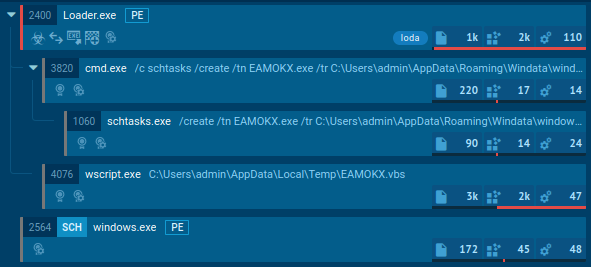
Loda RAT process tree

Loda RAT process tree

Distribution methods of the Loda RAT malware

Phishing email campaigns are the most common attack vector used by threat actors to infect victims’ systems with Loda. Typically, such emails contain attachments of different formats, including PDFs, executables, and Microsoft Office documents, embedded with malicious code. Some of the early instances of Loda RAT infections were carried out by exploiting the CVE-2017-11882 and CVE-2017-0199 vulnerabilities.

As mentioned above, Loda RAT is popular among various criminal groups. For instance, in 2019, TA558 utilized PowerPoint attachments injected with macros to distribute both Loda and Revenge RAT, while in 2022, the group switched to container formats (e.g., RAR) and expanded their payload selection to include AsyncRAT. Similarly, in 2022, the Kasablanka APT devised a multi-stage attack targeting government agencies, which employed .iso email attachments to spread Loda and WarZone RAT.

Conclusion

Loda remains a top cyber security threat, with no signs of slowing down. A large number of criminal actors take advantage of this malware’s configurable design and accessibility to conduct attacks against businesses and government organizations in different parts of the world. The best way to avoid compromising your system by accidentally downloading Loda is to steer clear of any unsolicited emails and take precautions before opening suspicious links and files. You can do it by analyzing them in an online sandbox like ANY.RUN. By uploading your sample to the platform, you quickly and safely gain the knowledge needed to prevent infection.

Try ANY.RUN for free – request a demo!
HAVE A LOOK AT

Cephalus screenshot
Cephalus
cephalus
Cephalus is a targeted ransomware threat discovered in 2025. It’s known for infiltrating organizations that deal with sensitive data through compromised RDP access. It leverages DLL sideloading with a legitimate SentinelOne executable. Cephalus is able to exfiltrate data and destroy backup options. Its payload is also tailored to each victim, which makes identification and mitigation more complex.
Read More
DarkTortilla screenshot
DarkTortilla
darktortilla
DarkTortilla is a crypter used by attackers to spread harmful software. It can modify system files to stay hidden and active. DarkTortilla is a multi-stage crypter that relies on several components to operate. It is often distributed through phishing sites that look like real services.
Read More
Zloader screenshot
Zloader
zloader trojan loader
Zloader is a banking trojan that uses webinjects and VNC clients to still banking credentials. This Trojan is based on leaked code from 2011, but despite its age, Zloader’s popularity has been only increasing through early 2020, when it relied on COVID-19 themed attacks.
Read More
DarkVision screenshot
DarkVision
darkvision
DarkVision RAT is a low-cost, modular Remote Access Trojan that gives attackers remote control of infected Windows hosts. Initially observed around 2020 and sold in underground marketplaces, DarkVision has become notable for its full feature set (keylogging, screen capture, file theft, remote command execution and plugin support) and for being distributed via multi-stage loaders in recent campaigns.
Read More
GravityRAT screenshot
GravityRAT
gravity
GravityRAT is a sophisticated spyware and remote access trojan that has been actively targeting organizations and government entities since 2016. It uses innovative anti-analysis techniques and made an evolution from a Windows-only threat to a cross-platform espionage tool capable of compromising Windows, Android, and macOS systems.
Read More
SSLoad screenshot
SSLoad
ssload
SSLoad is a malicious loader or downloader that is used to infiltrate target systems through phishing emails, perform reconnaissance and transmit it back to its operators delivering malicious payloads. To avoid detection, SSLoad employs various encryption methods and delivery techniques highlighting its versatile nature and complexity. It is believed to be a part of Malware-as-a-Service (MaaS) operation given its diverse delivery methods and implemented techniques.
Read More