Black friday Up to 3 extra licenses FOR FREE + Special offer for TI LOOKUP Get it now
Webinar
February 26
Better SOC with Interactive Sandbox Practical Use Cases
Register now

Fabookie

135
Global rank
169 infographic chevron month
Month rank
150 infographic chevron week
Week rank
0
IOCs

Fabookie is an infostealer malware that was first observed as early as October 2021. The threat is known for targeting account credentials of Facebook users. The collected information is then sold by the attackers to other criminals. Fabookie is often distributed via loaders such as SmokeLoader.

Stealer
Type
Unknown
Origin
1 October, 2021
First seen
10 December, 2025
Last seen

How to analyze Fabookie with ANY.RUN

Type
Unknown
Origin
1 October, 2021
First seen
10 December, 2025
Last seen

IOCs

IP addresses
95.86.21.52
213.6.54.58
201.119.15.212
109.73.242.14
187.140.86.116
187.134.87.130
95.154.196.56
5.42.78.22
181.230.206.248
189.143.158.99
179.43.155.195
183.100.39.157
190.219.153.101
79.137.205.112
104.47.53.36
193.106.175.148
187.204.8.141
201.124.98.97
60.246.82.1
37.34.248.24
Domains
j8hghe3uyf.2ihsfa.com
by4s6fngn.2ihsfa.com
facebook.websmails.com
aliyuncom.site
a4051b3f.site
aliyunstore.site
carrieremaken.com
adriaenclaeys.ta.imgjeoogbb.com
ww.hackacademy.me
nordskills.eu
apps.ecrubox.com
clicktotrust.com
astoriaresidency.com
as.imgjeoigaa.com
9e4491e7-99ad-40dd-9249-b07029fc7dd4.uuid.cdneurops.shop
paraslegal.com
fastprivate.me
580af1f8-4a49-4f1b-b74f-2aa299655155.uuid.zaoshanghao.su
server5.mastiakele.xyz
zaoshanghao.sucvwwajk56uu2la7jl4e2fdxy56veg5hqlaondeb7whvy2vlmreq6jnid.onioncommonpro
Last Seen at
Last Seen at

Recent blog posts

post image
Release Notes: Expanded Threat Intelligence A...
watchers 3408
comments 0
post image
Margin vs. Madness: Fixing MSSP Top 5 Operati...
watchers 1879
comments 0
post image
Phishing-to-RMM Attacks: The Remote Access Bl...
watchers 5574
comments 0

What is Fabookie malware?

Fabookie is a malicious software categorized as an information stealer. It primarily targets Facebook Business accounts, aiming to steal sensitive data like login credentials and account information.

This stolen data can then be exploited by attackers for various malicious purposes. Fabookie operates discreetly, running silently in the background without the user's knowledge, making it a significant threat to unsuspecting victims.

Fabookie primarily targets devices running 64-bit operating systems. Security researchers estimate over 100,000 infected machines worldwide, highlighting its widespread reach.

Use ANY.RUN free for 14 days

Try the full power of interactive analysis

Start your free trial

Technical details of the Fabookie malicious software

The primary capabilities of Fabookie include:

  • Credential theft (T1552): Fabookie searches infected machines for saved passwords, browser cookies containing login sessions, and other cached authentication information.
  • System information gathering (T1518): Beyond credentials, Fabookie may gather details about the system it infects. This information, such as installed software and hardware specifications, could be used to further exploit vulnerabilities or tailor future attacks.
  • Facebook Interaction (T1071): Once it acquires credentials, Fabookie interacts with the Facebook API. This allows the malware to extract additional information about the targeted Facebook Business account, including payment methods and account balances.
  • Command-and-Control Communication: The stolen data is then transmitted to a remote server controlled by the attackers.

Similar to other malware families, such as Amadey and RisePro, Fabookie is capable of ensuring persistence on the system by remaining active even after a reboot.

One notable feature of Fabookie is that it exploits .jpeg images to deliver malicious code.

Execution process of Fabookie

Let’s observe the execution process of the Fabookie malware by uploading its sample to ANY.RUN for analysis.

The Fabookie stealer infiltrates systems through various means such as malicious websites or phishing emails. Once installed, it silently collects sensitive information like login credentials and credit card details from the infected device. This data is then transmitted to remote servers controlled by the attackers. To remain undetected, Fabookie employs persistence techniques and may allow remote access for further malicious activities.

In our example, the execution chain of this stealer is straightforward. Once Fabookie initiates its own child process, it proceeds with its malicious activities centered around stealing credentials, cookies, and other valuable information from web browsers. The stealer collects this data and sends it to the C2 (Command and Control) server for remote access and further exploitation.

Overall, the execution chain of the Fabookie stealer is designed to silently compromise systems, steal valuable data, and maintain control for as long as possible without raising suspicion.
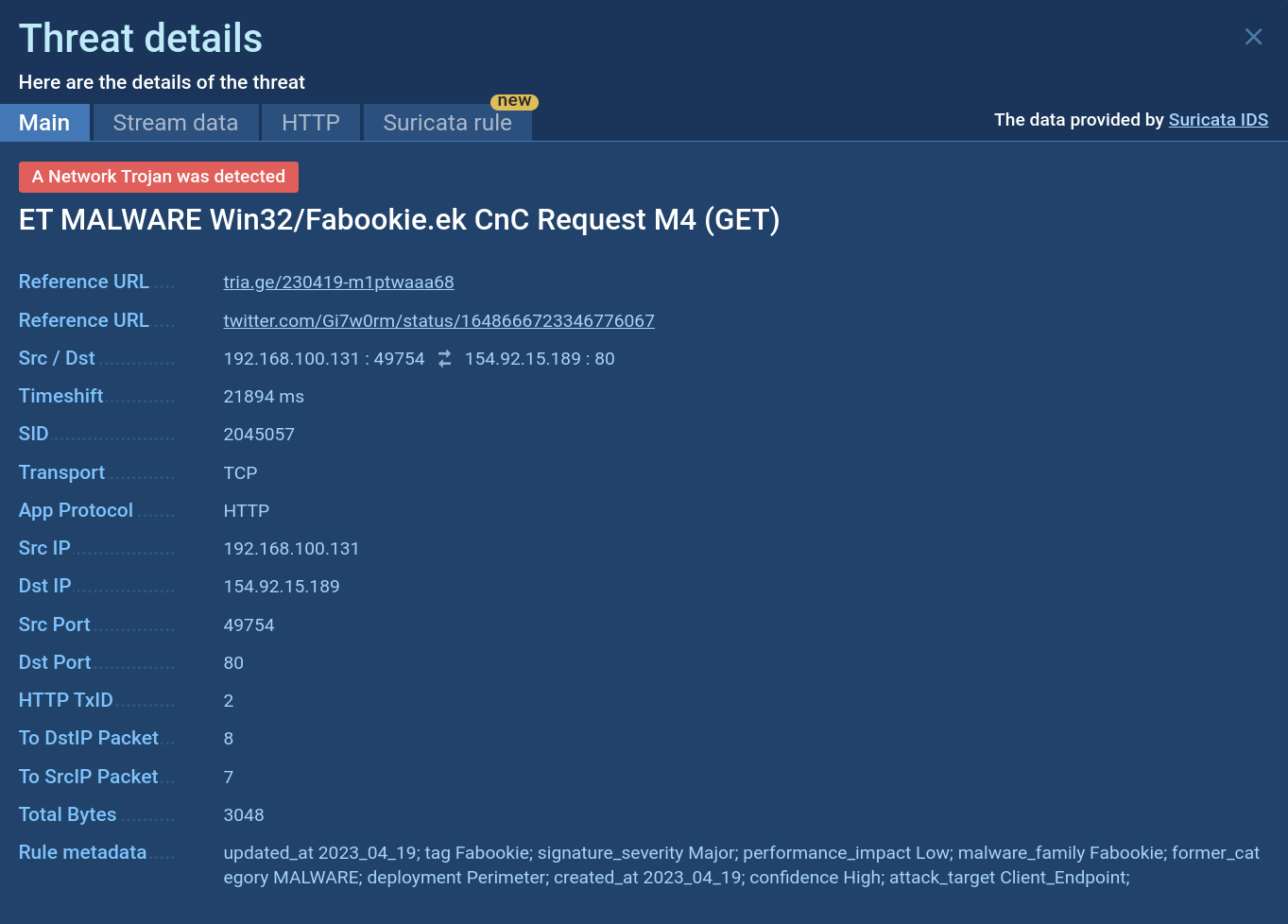
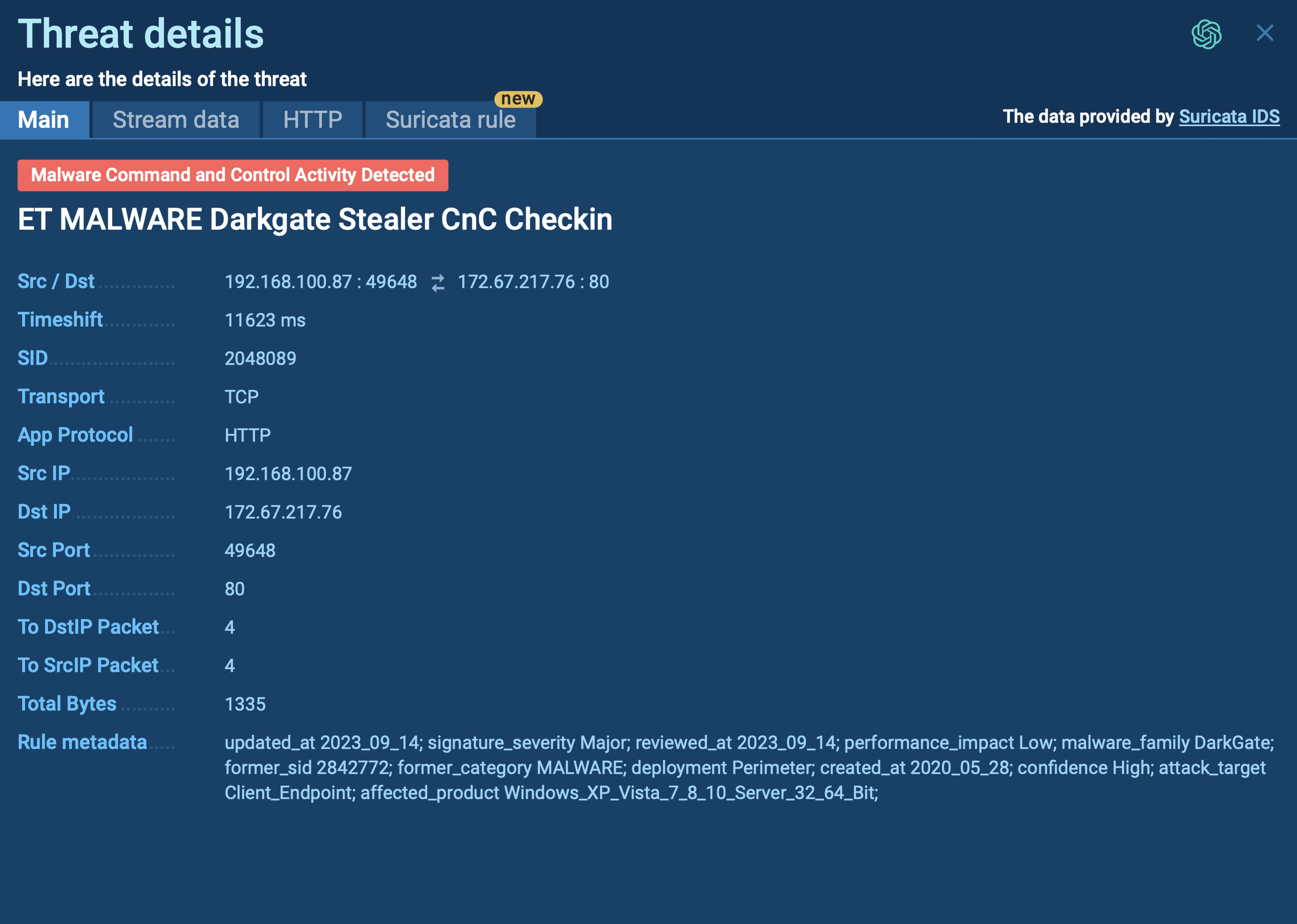
Fabookie Suricata rule shown in ANY.RUN Fabookie Suricata rule demonstrated in ANY.RUN

Distribution methods of the Fabookie malware

Attackers employ various ways of distributing Fabookie. One of the most common ones is via special loader malware that first penetrates defense systems of endpoints and delivers Fabookie to them. NullMixer and SmokeLoader are two examples of such loader malware.

Alternatively, Fabookie can be spread through spam emails that are crafted in a way to appear legitimate to users. These emails usually contain phishing links and files which eventually lead to the infection with Fabookie.

Conclusion

Fabookie is just one example of the ever-evolving threat landscape. By understanding its capabilities and implementing these protective measures, you can significantly reduce your risk of falling victim to such attacks and safeguard your sensitive information.

The ANY.RUN sandbox provides a cloud-based environment for analyzing files and links suspected of being malicious. It effectively identifies threats like Fabookie and generates reports summarizing the detected malware's technical characteristics, including TTPs and IOCs.

Try ANY.RUN for free – request a demo!
HAVE A LOOK AT

Ransomware screenshot
Ransomware
ransomware
Ransomware is a type of malicious software that locks users out of their system or data using different methods to force them to pay a ransom. Most often, such programs encrypt files on an infected machine and demand a fee to be paid in exchange for the decryption key. Additionally, such programs can be used to steal sensitive information from the compromised computer and even conduct DDoS attacks against affected organizations to pressure them into paying.
Read More
Bumblebee Loader screenshot
Bumblebee Loader
bumblebee
Bumblebee is a highly adaptable malware loader, often used by threat actors linked to the Conti and TrickBot cybercrime groups. Since its discovery in 2021, Bumblebee has been leveraged in phishing campaigns and email thread hijacking, primarily to distribute payloads like Cobalt Strike and ransomware. The malware employs obfuscation techniques, such as DLL injection and virtual environment detection, to avoid detection and sandbox analysis. Its command-and-control infrastructure and anti-analysis features allow it to persist on infected devices, where it enables further payload downloads and system compromise.
Read More
Rootkit screenshot
Rootkit
rootkit bootkit
A rootkit is a type of malicious software designed to provide unauthorized administrative-level access to a computer or network while concealing its presence. Rootkits are tools used by cybercriminals to hide their activities, including keyloggers, spyware, and other malware, often enabling long-term system exploitation.
Read More
Pulsar RAT screenshot
Pulsar RAT
pulsar
Pulsar RAT is a derivative of Quasar RAT with extensive functionality including keylogging, cryptocurrency wallet clipping, credential theft, file management, remote shell execution, and data exfiltration capabilities. As a modular, open-source remote administration tool designed for Windows systems, Pulsar introduces significant enhancements over its predecessor.
Read More
Mamba 2FA screenshot
Mamba 2FA
mamba
Mamba 2FA is an advanced phishing-as-a-service (PhaaS) platform designed to bypass multi-factor authentication (MFA) and target Microsoft 365 accounts. It focuses on intercepting authentication flows in real-time and enables threat actors to hijack user sessions and access sensitive systems even when additional security measures are in place.
Read More
Raspberry Robin screenshot
Raspberry Robin
raspberryrobin
Raspberry Robin is a trojan that primarily spreads through infected USB drives and exploits legitimate Windows commands. This malware is known for its advanced obfuscation techniques, anti-debugging mechanisms, and ability to gain persistence on infected systems. Raspberry Robin often communicates with command-and-control servers over the TOR network and can download additional malicious payloads.
Read More