Black friday Up to 3 extra licenses FOR FREE + Special offer for TI LOOKUP Get it now
Webinar
February 26
Better SOC with Interactive Sandbox Practical Use Cases
Register now
114
Global rank
122 infographic chevron month
Month rank
113 infographic chevron week
Week rank
0
IOCs

WSHRAT is a Remote Access Trojan — a malware that allows the attackers to take over the infected machines. The RAT has been in circulation since 2013 and it is arguably most notable for the numerous versions released into the wild.

RAT
Type
likely Algerian
Origin
24 September, 2013
First seen
12 August, 2026
Last seen
Also known as
Dunihi
Houdini
H-worm
Jenxcus
Kognito

How to analyze Wshrat with ANY.RUN

RAT
Type
likely Algerian
Origin
24 September, 2013
First seen
12 August, 2026
Last seen

IOCs

IP addresses
87.123.246.9
208.91.197.132
141.255.147.33
105.101.126.79
45.141.233.69
139.99.85.213
190.251.70.118
107.174.192.179
82.29.67.160
20.190.159.2
104.102.49.106
57.153.246.3
149.154.167.99
154.91.34.165
23.52.181.141
104.26.12.205
142.251.127.94
147.185.221.20
23.48.23.143
13.248.169.48
Hashes
0dc8b00e22590c407ad5ca8ba6ebab94952190103afe5cc934ad3fa8b305eba8
ddd66e94bd1c2a59954f564785a012b17c14605b8749f67565d9e7b8f6970436
7be4ac917c883f600b09f825b154ec121badbf82bbe32782d31ec463e38498e7
73c63f9a4376755b1e0f720459727852e179699a2196d8209ce3b5e7090bd463
bef0038bd5451916196cba39c10160837df3fa821da1d3b7aa86ddb4f3ca672d
01690e96ac83a8ef0138340dcc6c665df03252561470fbf20c695cadaea9d2a5
1fb6ce0dbc5ec922fa8b1b33205f08e8a727952c1f3ca5fce5d90d550ab515a9
dc6be8edb58ac014d39cb69f2b2dd8fce06c52ca61e7e8a3d05754d99bfa3edb
1c680deea6a8bf2448705dd5863c4fa495dde5322b4473e736b42ad7ec62a7f2
dcaa7b7a77bca39d1bb287b4a0b93634f3be654acd8d5077a6aa34bcdacc1219
9f059436bcc851ff2991318cefd533184f7fed8fa468ef16b90604e05c3b964f
ad4c8458777d8fd8ae05ea8ad10fd06f474a5e05426945751a9cea0a31b5f631
079ba7f5c0c2003932ef6adf360b08ff084e718cde1d45d82a65400f28a08fcc
8e9f20f6864c66576536c0b866c6ffdcf11397db67fe120e972e244c3c022270
74441313bb1fb62500484443c4937e90d4e335351a4fcd12a9ac48448500e33e
2ed27c1421e6928dbe13dbfdb5c59e1045b30341fe7ebe05700006bc5ac572c0
de055a89de246e629a8694bde18af2b1605e4b9b493c7e4aef669dd67acf5085
df83a0d6940600e4c4954f4874fcd4dd73e781e6690c3bf56f51c95285484a3c
4094d158e3b0581ba433a46d0dce62f99d8c0fd1b50bb4d0517ddc0a4a1fde24
99653a38c445ae1d4c373ee672339fd47fd098e0d0ada5f0be70e3b2bf711d38
Domains
pivo1.dynu.net
dns.msftncsi.com
lodostoongpu.system-ns.net
midodady.myq-see.com
goodday228.ddns.net
google.com
www.google.co.ck
www.bing.com
www.dontlookhere.com
api.pcloud.com
www.microsoft.com
slscr.update.microsoft.com
watson.events.data.microsoft.com
dbensoaupthreesdopsopsseead.ydns.eu
consent.google.co.ck
go.microsoft.com
settings-win.data.microsoft.com
x1.c.lencr.org
discord.com
licensing.mp.microsoft.com
URLs
https://gateway.discord.gg/?v=9&encording=json
http://ocsp.digicert.com/mfewtzbnmeswstajbgurdgmcgguabbq50otx%2fh0ztl%2bz8sipi7wewvxdlqqutijuibiv5unu5g%2f6%2brks7qyxjzkceaz1vqyrvgl0erhqlcpm8gy%3d
https://login.live.com/rst2.srf
https://t.me/m00f3r
http://crl.microsoft.com/pki/crl/products/microoceraut2011_2011_03_22.crl
http://www.microsoft.com/pkiops/crl/micsecserca2011_2011-10-18.crl
https://settings-win.data.microsoft.com/settings/v3.0/onesettings/client?osversionfull=10.0.19045.4046.amd64fre.vb_release.191206-1406&localdeviceid=s%3abad99146-31d3-4ec6-a1a4-be76f32ba5d4&flightring=retail&attrdataver=186&osuilocale=en-us&osskuid=48&app=wosc&appver=&isflightingenabled=0&telemetrylevel=1&devicefamily=windows.desktop
https://login.live.com/ppsecure/deviceaddcredential.srf
https://gstatic.com/generate_204
https://steamcommunity.com/profiles/76561199851454339
https://api.pcloud.com/listfolder?path=/
https://slscr.update.microsoft.com/sls/%7b522d76a4-93e1-47f8-b8ce-07c937ad1a1e%7d/x64/10.0.19045.4046/0?ch=686&l=en-us&p=&pt=0x30&wua=10.0.19041.3996&mk=dell&md=dell
http://www.microsoft.com/pkiops/crl/microsoft%20ecc%20product%20root%20certificate%20authority%202018.crl
http://www.microsoft.com/pkiops/crl/microsoft%20ecc%20update%20secure%20server%20ca%202.1.crl
https://cloud-api.yandex.net/v1/disk/resources?path=/&limit=500
https://api.ipify.org/
http://ip-api.com/line/?fields=hosting
http://ip-api.com/json/158.173.162.95
https://fe3cr.delivery.mp.microsoft.com/clientwebservice/ping
https://settings-win.data.microsoft.com/settings/v3.0/wsd/waasassessment?os=windows&osver=10.0.19041.1.amd64fre.vb_release.191206-&ring=retail&sku=48&deviceclass=windows.desktop&locale=en-us&deviceid=bad99146-31d3-4ec6-a1a4-be76f32ba5d4&flightring=retail&telemetrylevel=1&hidovergattreg=c%3a%5cwindows%5csystem32%5cdriverstore%5cfilerepository%5chidbthle.inf_amd64_9610b4821fdf82a5%5cmicrosoft.bluetooth.profiles.hidovergatt.dll&appver=10.0&processoridentifier=amd64%20family%2023%20model%201%20stepping%202&oemmodel=dell&updateoffereddays=4294967295&processormanufacturer=authenticamd&installdate=1661339444&oemmodelbaseboard=&branchreadinesslevel=cb&oemsubmodel=j5cr&isclouddomainjoined=0&deferfeatureupdateperiodindays=30&isdeviceretaildemo=0&flightingbranchname=&osuilocale=en-us&devicefamily=windows.desktop&wuclientver=10.0.19041.3996&uninstallactive=1&isflightingenabled=0&osskuid=48&processorclockspeed=3094&totalphysicalram=6144&securebootcapable=0&app=waasassessment&processorcores=6&currentbranch=vb_release&installlanguage=en-us&deferqualityupdateperiodindays=0&servicingbranch=cb&oemname_uncleaned=dell&tpmversion=0&primarydisktotalcapacity=262144&installationtype=client&attrdataver=186&processormodel=amd%20ryzen%205%203500%206-core%20processor&isedgewithchromiuminstalled=1&osversion=10.0.19045.4046&ismdmenrolled=0&activationchannel=retail&honorwufbdeferrals=0&firmwareversion=a.40&trendinstalledkey=1&osarchitecture=amd64&defaultuserregion=244&updatemanagementgroup=2
Last Seen at
Last Seen at

Recent blog posts

post image
Mirage2FA Hijacks Companies’ Microsoft 365 Se...
watchers 379
comments 0
post image
Intelligence-Driven SOC: Modernizing Threat M...
watchers 11437
comments 0
post image
Supply Chain Security: How ANY.RUN Helps US a...
watchers 6548
comments 0

What is WSHRAT malware?

WSHRAT is a Remote Access Trojan — a type of malware that attackers use to gain remote control of machines and steal information. This particular RAT has seen several revisions, and depending on the version it’s also known as Dunihi, Houdini, H-worm, Jenxcus, and Kognito.

This RAT was first used in attacks against energy sector companies all around the world. With time, the malware became widely available and attackers used it in less coordinated attacks. The most recent version of WSHRAT changed target victims and now focuses on the banking sector.

The functionality of this RAT can vary by version, but they commonly include:

  • The ability to take screenshots.
  • The ability to modify files.
  • The ability to access email and web browser credentials.
  • The ability to manipulate and kill running system processes.

General description of WSHRAT malware

The malware surfaced for the first time in 2013 when it was known under the name H-worm. At the time, it was a RAT written in VBS (Visual Basic Script) programming language. Already, some samples featured code obfuscation and the malware packed with some advanced info-stealing functions.

The malware was developed by a user known in the underground community as Houdini. Houdini used to host a website, where people could learn about the capabilities of the RAT from an explanation video. Analysis of the content allowed researchers to conclude with a high degree of certainty, that Houdini is likely to be Algerian. This is mainly based on his fluent knowledge of French and Arabic languages.

It should be noted while analyzing the first samples of WSHRAT, researchers found out that it has similarities in command and control infrastructure with NjW0rm, njRat/LV, XtremeRAT, and PoisonIvy. These are all RATs operated by the njq8 cybergang. It is likely, that Houdini is collaborating with the gang, or he could even be a part of the njq8 syndicate.

The malware became relatively popular and VBS versions circulated in the wild for a while. In 2015, the author came out with an announcement of his plans to rewrite the malware in the Delphi programming language.

However, another version that researchers started investigating in 2016 still used VBS. This time, the RAT came in SFX files and exhibited new behavior. For example, it would launch a YouTube or open a browser URL as a decoy to hide its execution and infection happening in the background. Among others, the 2016 version of WSHRAT can be distinguished by its use of mixed binary and ASCII protocols over TCP.

The newest version of WSHRAT has popped up in 2019. This iteration of the malware targets the commercial banking sector. The RAT was completely rewritten in JavaScript from the original code of Visual basic. However, most aspects of the updated version remained identical to the older iterations. For example, it uses the same URL structure for C2 servers and exhibits similar behavior patterns.

This version is available to purchase for 50 USD and it is heavily marketed on the underground forums. In particular, the marketing campaign highlights such features of the RAT like WinXP-Win10 compatibility and a large number of information stealing and remote control functions.

Malware analysis of WSHRAT

The ANY.RUN malware hunting service provides a video, where researchers can see the execution process of WSHRAT or other RATs like njRAT or NanoCore.
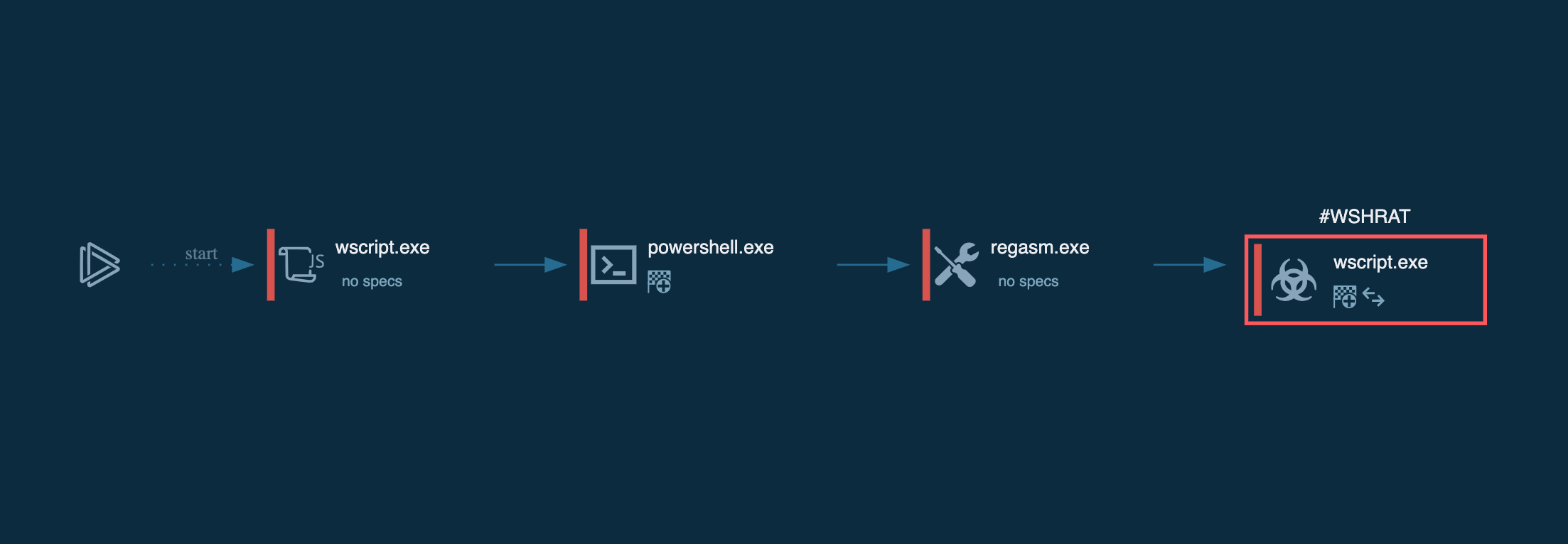
Wshrat process graph

Figure 1: Shows the Wshrat graph of processes created by the ANY.RUN interactive malware analysis service.

WSHRAT execution process

Execution process of WSHRAT is straightforward — after the trojan makes its way into the system as a script file it either runs directly by wscript process or uses system processes such as powershell and regasm for persistence and defense evasion. After it gains persistence in the system, WSHRAT starts sending requests to the C2 server for further commands and fetches additional payloads such as its modules with different functionality.

Distribution of WSHRAT

Criminals commonly distribute WSHRAT with emails that contain infected attachments. There is evidence to believe that this RAT is used both in highly targeted attacks as well as in more broadly distributed email spam campaigns. Phishing is used to trick victims into installing the malware.

How to detect WSHRAT?

Sometimes valuable information about the malware family can be found in the network activity. Wshrat is not an exception. This malware sends HTTP requests to the Command & Control server using POST method and it names itself as a User-Agent. You can find details at "HTTP Requests" tab by clicking at "POST" method icon. In an opened window, take a look at the User-Agent and if it says WSHRAT, you know which malware family you are dealing with.
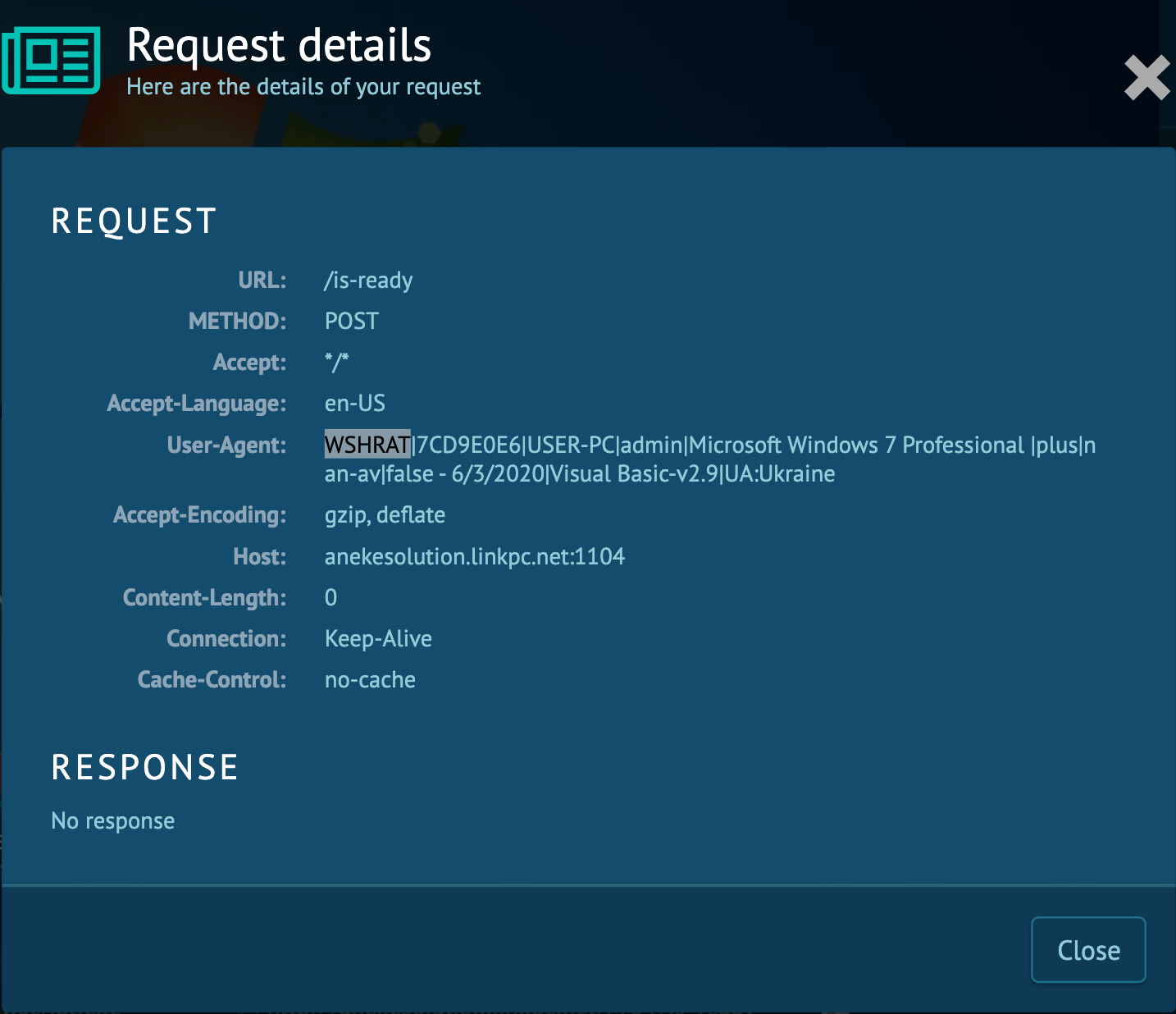
Wshrat request details

Conclusion

The danger of malware like WSH RAT lies not only in its robust feature set as a RAT but also in its morphing capability. Writing in VBS helped the attackers to push out an incredible number of versions. While security researchers were busy analyzing one sample, a new iteration could be released into the wild.

In cases like this, the ability to perform research fast is of crucial importance. This is especially true if we consider that certain samples of WSHRAT use code obfuscation and encryption that render static analysis ineffective. This means that a more complicated and time-consuming dynamic analysis is a must.

Thankfully, interactive analysis services like ANY.RUN help solve this problem. ANY.RUN allows launching samples in a secure, interactive online environment, where researchers can choose a variety of system parameters that influence the flow of execution. This vastly accelerates the research process and the results are presented in real-time.
HAVE A LOOK AT

Orcus RAT screenshot
Orcus RAT
orcus rat trojan
Orcus is a modular Remote Access Trojan with some unusual functions. This RAT enables attackers to create plugins using a custom development library and offers a robust core feature set that makes it one of the most dangerous malicious programs in its class.
Read More
Quasar RAT screenshot
Quasar RAT
quasar trojan rat
Quasar is a very popular RAT in the world thanks to its code being available in open-source. This malware can be used to control the victim’s computer remotely.
Read More
Crypto malware screenshot
Crypto malware
miner xmrig jsminer
Crypto mining malware is a resource-intensive threat that infiltrates computers with the purpose of mining cryptocurrencies. This type of threat can be deployed either on an infected machine or a compromised website. In both cases the miner will utilize the computing power of the device and its network bandwidth.
Read More
Backdoor screenshot
Backdoor
backdoor
A backdoor is a type of cybersecurity threat that allows attackers to secretly compromise a system and conduct malicious activities, such as stealing data and modifying files. Backdoors can be difficult to detect, as they often use legitimate system applications to evade defense mechanisms. Threat actors often utilize special malware, such as PlugX, to establish backdoors on target devices.
Read More
Gh0st RAT screenshot
Gh0st RAT
gh0st
Gh0st RAT is a malware with advanced trojan functionality that enables attackers to establish full control over the victim’s system. The spying capabilities of Gh0st RAT made it a go-to tool for numerous criminal groups in high-profile attacks against government and corporate organizations. The most common vector of attack involving this malware begins with spam and phishing emails.
Read More
SolarisLoader screenshot
SolarisLoader
solaris
SolarisLoader is a malware loader designed to neutralize security infrastructure before deploying high-risk secondary payloads. It utilizes a "Bring Your Own Vulnerable Driver" technique to gain kernel-level access and terminate antivirus processes. To remain undetected, the malware patches internal Windows monitoring interfaces and isolates the machine from security updates. Finally, it establishes a resilient three-layer persistence mechanism involving scheduled tasks, registry backups, and a watchdog component.
Read More