Black friday Up to 3 extra licenses FOR FREE + Special offer for TI LOOKUP Get it now
Webinar
February 26
Better SOC with Interactive Sandbox Practical Use Cases
Register now
80
Global rank
118 infographic chevron month
Month rank
99 infographic chevron week
Week rank
0
IOCs

Danabot is an advanced banking Trojan malware that was designed to steal financial information from victims. Out of the Trojans in the wild, this is one of the most advanced thanks to the modular design and a complex delivery method.

Trojan
Type
Unknown
Origin
6 May, 2018
First seen
9 August, 2026
Last seen

How to analyze Danabot with ANY.RUN

Type
Unknown
Origin
6 May, 2018
First seen
9 August, 2026
Last seen

IOCs

IP addresses
135.233.95.144
23.52.181.212
48.209.133.15
172.211.123.250
149.255.35.125
23.216.77.6
172.66.2.5
48.209.6.48
20.190.160.130
23.59.18.102
48.209.138.168
48.192.1.64
48.209.138.189
2.23.246.9
51.77.7.204
38.68.50.179
74.178.240.51
2.16.204.150
135.233.45.223
48.192.1.65
Hashes
abd75572f897cdda88cec22922d15b509ee8c840fa5894b0aecbef6de23908a3
bf2d1afe1aaf6d77ea47b4ee54e6434eb8d2bbb5c9ef53263deae606f695e5ed
c2064fd45fb3312e9d97f9ec4710f77db421dfa8292ac0e4ee8303044ae6bb18
db0d72bc7d10209f7fa354ec100d57abbb9fe2e57ce72789f5f88257c5d3ebd1
cfaa887cbf7755f3cb7b088a4fb18a68c3cedec58c889c8bbc3653bc4e217b93
1b3d6e1878afbd806dc16b15bf36ea113429b64c7597236f81c91406cf727b1c
9ff37c75f93e832e3f9b2a347e13351d26607640fb3f577be7511f50788b70a3
3a1f8b491235fc587b9c7957f27da42723b94183901f7452e6a50eb32f39ba8f
6796411f35cda48c4ec6af61414dadefc3998c5478bcb2e5aca7fe80aa508dae
53bb88a71b580b274dd68a2156f8613564b8da8504822988b4b7531c6a5fe255
af49995ad5ee72aa591a8834cd6dc00bd8f4e9948fda428ee9bb66beffed336f
89707bd7bf6ea1d5059bcd41b2e1ee071695ccf14fa5a64e7e3dd0e9f3e2949c
0e60b52689f3627486b9a77bb4f88bea0d8665a94f7f1ffc960a1fbc427626b7
e25efc2f3c542a995df70f85198b7fd6184be4700ec9756e00c0a8fd9e7a124c
1f69810b8fe71e30a8738278adf09dd982f7de0ab9891d296ce7ea61b3fa4f69
8b2e62ccaf3758d056d38071a1c4e0f0c9402fec9f951801e394020235f8c099
d1f0b68d87f6b09555851c30f0352a07952b5b0885efb8d3e3ff5cee4279e87b
d8a45bc6bd592ed29dc7f74666b6c22d4addca52261fdf2a929ce7205fc4efca
3d832cabf1c0daaa5314f32a8e412e36f5628f6d2a14a021901d667773b382d3
2a6aee4c8a9714223a3568077411a0c82d11b484b1c9ab93a19d50b99c57baa5
Domains
www.microsoft.com
google.com
settings-win.data.microsoft.com
slscr.update.microsoft.com
fe3cr.delivery.mp.microsoft.com
crl.microsoft.com
go.microsoft.com
watson.events.data.microsoft.com
login.live.com
client.wns.windows.com
ocsp.digicert.com
www.bing.com
activation-v2.sls.microsoft.com
s.w.org
github-cloud.s3.amazonaws.com
edge.microsoft.com
createcatalog.public.onecdn.static.microsoft
github.com
collector.github.com
sb.scorecardresearch.com
URLs
http://crl.microsoft.com/pki/crl/products/microoceraut2011_2011_03_22.crl
http://www.microsoft.com/pkiops/crl/micsecserca2011_2011-10-18.crl
https://watson.events.data.microsoft.com/telemetry.request
https://settings-win.data.microsoft.com/settings/v3.0/wsd/waasassessment?os=windows&osver=10.0.19041.1.amd64fre.vb_release.191206-&ring=retail&sku=48&deviceclass=windows.desktop&locale=en-us&deviceid=bad99146-31d3-4ec6-a1a4-be76f32ba5d4&flightring=retail&telemetrylevel=1&hidovergattreg=c%3a%5cwindows%5csystem32%5cdriverstore%5cfilerepository%5chidbthle.inf_amd64_9610b4821fdf82a5%5cmicrosoft.bluetooth.profiles.hidovergatt.dll&appver=10.0&processoridentifier=amd64%20family%2023%20model%201%20stepping%202&oemmodel=dell&updateoffereddays=4294967295&processormanufacturer=authenticamd&installdate=1661339444&oemmodelbaseboard=&branchreadinesslevel=cb&oemsubmodel=j5cr&isclouddomainjoined=0&deferfeatureupdateperiodindays=30&isdeviceretaildemo=0&flightingbranchname=&osuilocale=en-us&devicefamily=windows.desktop&wuclientver=10.0.19041.3996&uninstallactive=1&isflightingenabled=0&osskuid=48&processorclockspeed=3094&totalphysicalram=6144&securebootcapable=0&app=waasassessment&processorcores=6&currentbranch=vb_release&installlanguage=en-us&deferqualityupdateperiodindays=0&servicingbranch=cb&oemname_uncleaned=dell&tpmversion=0&primarydisktotalcapacity=262144&installationtype=client&attrdataver=186&processormodel=amd%20ryzen%205%203500%206-core%20processor&isedgewithchromiuminstalled=1&osversion=10.0.19045.4046&ismdmenrolled=0&activationchannel=retail&honorwufbdeferrals=0&firmwareversion=a.40&trendinstalledkey=1&osarchitecture=amd64&defaultuserregion=244&updatemanagementgroup=2
https://go.microsoft.com/fwlink/?linkid=2257403&clcid=0x409
https://settings-win.data.microsoft.com/settings/v3.0/onesettings/client?osversionfull=10.0.19045.4046.amd64fre.vb_release.191206-1406&localdeviceid=s%3abad99146-31d3-4ec6-a1a4-be76f32ba5d4&flightring=retail&attrdataver=186&osuilocale=en-us&osskuid=48&app=wosc&appver=&isflightingenabled=0&telemetrylevel=1&devicefamily=windows.desktop
https://login.live.com/rst2.srf
https://login.live.com/ppsecure/deviceaddcredential.srf
http://ocsp.digicert.com/mfewtzbnmeswstajbgurdgmcgguabbq50otx%2fh0ztl%2bz8sipi7wewvxdlqqutijuibiv5unu5g%2f6%2brks7qyxjzkceaz1vqyrvgl0erhqlcpm8gy%3d
https://settings-win.data.microsoft.com/settings/v3.0/flightsettings/fsservice?processorclockspeed=3094&isretailos=1&oemmanufacturername=dell&flightingpolicyvalue=3&enablepreviewbuilds=4294967295&osversionfull=10.0.19045.4046.amd64fre.vb_release.191206-1406&managepreviewbuilds=3&branchreadinesslevelsource=0&attrdataver=186&processorcores=6&branchreadinesslevelraw=16&totalphysicalram=6144&tpmversion=0&oemmodelnumber=dell&systemvolumetotalcapacity=260281&deviceid=s%3abad99146-31d3-4ec6-a1a4-be76f32ba5d4&app=fss&appver=10.0&smartactivehoursstate=1&activehoursstart=20&securebootcapable=0&activehoursend=13&devicefamily=windows.desktop
https://settings-win.data.microsoft.com/settings/v3.0/wsd/muse?processorclockspeed=3094&flightids=&updateoffereddays=4294967295&branchreadinesslevel=cb&oemmanufacturername=dell&isclouddomainjoined=0&processoridentifier=amd64%20family%2023%20model%201%20stepping%202&sku=48&activationchannel=retail&attrdataver=186&ismdmenrolled=0&processorcores=6&processormodel=amd%20ryzen%205%203500%206-core%20processor&totalphysicalram=6144&primarydisktype=4294967295&flightingbranchname=&chassistypeid=1&oemmodelnumber=dell&systemvolumetotalcapacity=260281&sampleid=95271487&deviceclass=windows.desktop&app=muse&disabledualscan=0&appver=10.0&oemsubmodel=j5cr&locale=en-us&isalwaysonalwaysconnectedcapable=0&ms=0&defaultuserregion=244&updateserviceurl=http%3a%2f%2fneverupdatewindows10.com&osver=10.0.19045.4046.amd64fre.vb_release.191206-1406&os=windows&deviceid=s%3abad99146-31d3-4ec6-a1a4-be76f32ba5d4&deferqualityupdateperiodindays=0&ring=retail&deferfeatureupdateperiodindays=30
https://slscr.update.microsoft.com/sls/%7b522d76a4-93e1-47f8-b8ce-07c937ad1a1e%7d/x64/10.0.19045.4046/0?ch=686&l=en-us&p=&pt=0x30&wua=10.0.19041.3996&mk=dell&md=dell
https://fe3cr.delivery.mp.microsoft.com/clientwebservice/ping
http://www.microsoft.com/pkiops/crl/microsoft%20ecc%20update%20secure%20server%20ca%202.1.crl
https://slscr.update.microsoft.com/sls/ping
https://slscr.update.microsoft.com/sls/%7be7a50285-d08d-499d-9ff8-180fdc2332bc%7d/x64/10.0.19045.4046/0?ch=686&l=en-us&p=&pt=0x30&wua=10.0.19041.3996&mk=dell&md=dell
https://settings-win.data.microsoft.com/settings/v3.0/wsd/updatehealthtools?os=windows&osver=10.0.19041.1.amd64fre.vb_release.191206-&sku=48&deviceclass=windows.desktop&locale=en-us&deviceid=s:bad99146-31d3-4ec6-a1a4-be76f32ba5d4&sampleid=s:95271487&appver=10.0.19041.3626&flightring=retail&telemetrylevel=1&hidovergattreg=c%3a%5cwindows%5csystem32%5cdriverstore%5cfilerepository%5chidbthle.inf_amd64_9610b4821fdf82a5%5cmicrosoft.bluetooth.profiles.hidovergatt.dll&appver=&processoridentifier=amd64%20family%2023%20model%201%20stepping%202&oemmodel=dell&updateoffereddays=4294967295&processormanufacturer=authenticamd&installdate=1661339444&oemmodelbaseboard=&branchreadinesslevel=cb&oemsubmodel=j5cr&isclouddomainjoined=0&deferfeatureupdateperiodindays=30&isdeviceretaildemo=0&flightingbranchname=&osuilocale=en-us&devicefamily=windows.desktop&wuclientver=10.0.19041.3996&uninstallactive=1&isflightingenabled=0&osskuid=48&processorclockspeed=3094&totalphysicalram=6144&securebootcapable=0&app=sedimentpack&processorcores=6&currentbranch=vb_release&installlanguage=en-us&deferqualityupdateperiodindays=0&oemname_uncleaned=dell&tpmversion=0&primarydisktotalcapacity=262144&installationtype=client&attrdataver=186&processormodel=amd%20ryzen%205%203500%206-core%20processor&isedgewithchromiuminstalled=1&osversion=10.0.19045.4046&ismdmenrolled=0&activationchannel=retail&firmwareversion=a.40&trendinstalledkey=1&osarchitecture=amd64&defaultuserregion=244&updatemanagementgroup=2
https://github.com/Da2dalus/The-MALWARE-Repo/raw/refs/heads/master/Banking-Malware/DanaBot.exe
https://settings-win.data.microsoft.com/settings/v3.0/wsd/waasassessment?os=windows&osver=10.0.19041.1.amd64fre.vb_release.191206-&ring=retail&sku=48&deviceclass=windows.desktop&locale=en-us&deviceid=bad99146-31d3-4ec6-a1a4-be76f32ba5d4&flightring=retail&telemetrylevel=1&hidovergattreg=c%3a%5cwindows%5csystem32%5cdriverstore%5cfilerepository%5chidbthle.inf_amd64_9610b4821fdf82a5%5cmicrosoft.bluetooth.profiles.hidovergatt.dll&appver=10.0&processoridentifier=amd64%20family%2023%20model%201%20stepping%202&oemmodel=dell&updateoffereddays=4294967295&processormanufacturer=authenticamd&installdate=1661339444&oemmodelbaseboard=&branchreadinesslevel=cb&oemsubmodel=j5cr&isclouddomainjoined=0&deferfeatureupdateperiodindays=30&isdeviceretaildemo=0&flightingbranchname=&osuilocale=en-us&devicefamily=windows.desktop&wuclientver=10.0.19041.3996&uninstallactive=1&isflightingenabled=0&osskuid=48&processorclockspeed=3094&totalphysicalram=6144&securebootcapable=0&app=waasassessment&processorcores=6&currentbranch=vb_release&installlanguage=en-us&deferqualityupdateperiodindays=0&servicingbranch=cb&oemname_uncleaned=dell&tpmversion=0&primarydisktotalcapacity=262144&installationtype=client&attrdataver=186&processormodel=amd%20ryzen%205%203500%206-core%20processor&isedgewithchromiuminstalled=1&osversion=10.0.19045.4046&ismdmenrolled=0&activationchannel=retail&honorwufbdeferrals=1&firmwareversion=a.40&trendinstalledkey=1&osarchitecture=amd64&defaultuserregion=244&updatemanagementgroup=2
http://edge.microsoft.com/browsernetworktime/time/1/current?cup2key=2:rgigdxg8b4-plakhd2bne5r0mlys5969tfqxyqseulk&cup2hreq=e3b0c44298fc1c149afbf4c8996fb92427ae41e4649b934ca495991b7852b855
Last Seen at

Recent blog posts

post image
Supply Chain Security: How ANY.RUN Helps US a...
watchers 326
comments 0
post image
Smile, You're on Camera. Part 2: Hiring Lazar...
watchers 14459
comments 0
post image
Safeguarding 200M Users: How ChongLuaDao Scal...
watchers 7510
comments 0

What is Danabot banking malware?

Danabot is a banking trojan that was spotted in the wild in 2018. Danabot differs from competing Trojans thanks to its robust delivery system and modular design. Since its first appearance, Danabot has obtained high popularity among cybercriminals and became an active threat in multiple regions of the world.

This malware is constantly updated by the creators, helping the Trojan continue to gain popularity in the hacking community. Danabot is written using the Delphi programming language carries several credential theft functions.

General description of Danabot

When first documented, Danabot malware was being used by just one actor who carried out a campaign against Australian companies. Since then, other malicious actors have started utilizing this malware and expanded the geography of attacks to Europe and North America.

In particular, the Danabot trojan was seen in attacks in Poland, Germany, Italy, Austria, and the US. Particularly, the US campaigns were carried out on a large scale, indicating that the malware is evolving and developing.

As far as the function set of this malware is concerned, Danabot can be classified as a banking trojan, though some of its features suggest that it is becoming a more versatile malware. Danabot is constructed out of three main components. The loader is a program created to download the main payload. The main component, which is installed by the loader, is configured to download the modules that the attacker can specify. Finally, once installed, the modules provide the functionality, which can vary depending on which modules were chosen by the ill-wisher in a particular campaign.

The malware can take screenshots, grant attackers remote control of the victims’ machine, collect system information, steal credentials, and record lists of files stored on infected PCs. Once collected, all information recorded by Danabot is sent to the control server in an encrypted form. Danabot aims to steal sensitive information that can be leveraged by the attackers later, therefore instead of confirming the victim head-on and demanding a ransom. This malware tries to stay hidden and collect valuable data over time. Some of the smaller distribution campaigns featuring Danabot were well made in terms of clever social engineering and carried on with the same philosophy of a more subtle approach.

In addition, researchers noticed that the attackers utilizing Danabot ventured beyond banking credentials theft and started utilizing this banking malware to host other spam and malicious campaigns, using the infected machines of their victims. What’s more, Danabot creators are thought to be collaborating with the group behind a different banking trojan – GootKit. Danabot was recorded as being used to distribute this type of threat. This case is a first for both malicious programs since neither has been distributed or distributed by other malware before.

In January 2019, researchers noticed a new version of the Danabot trojan in the wild. The investigation confirmed the new samples to be the evolution of Danabot, with a different C2 communication protocol that began to use multiple encryption layers and proved very complex. In the new variant, AES and RSA encryption algorithms were employed in particular. On top of that, the core design of the malware was also changed, as the loader was made responsible for downloading all the modules along with the main component. The researchers believe a technique was used to avoid detection on a network level that the attackers could have invented after reading existing analysis material on Danabot.

It should be noted that Danabot features several evasion techniques designed to make research as complicated as possible. For one, the banking malware is loaded with many lines of junk code, implemented solely to mislead the researchers. The malware also uses encryption and Windows API function hashing to fool automated sandboxes and researchers and prevent them from uncovering the true nature of the code.

Malware analysis of Danabot

A video recorded in the ANY.RUN malware hunting service enables us to take a look at Danabot in action.
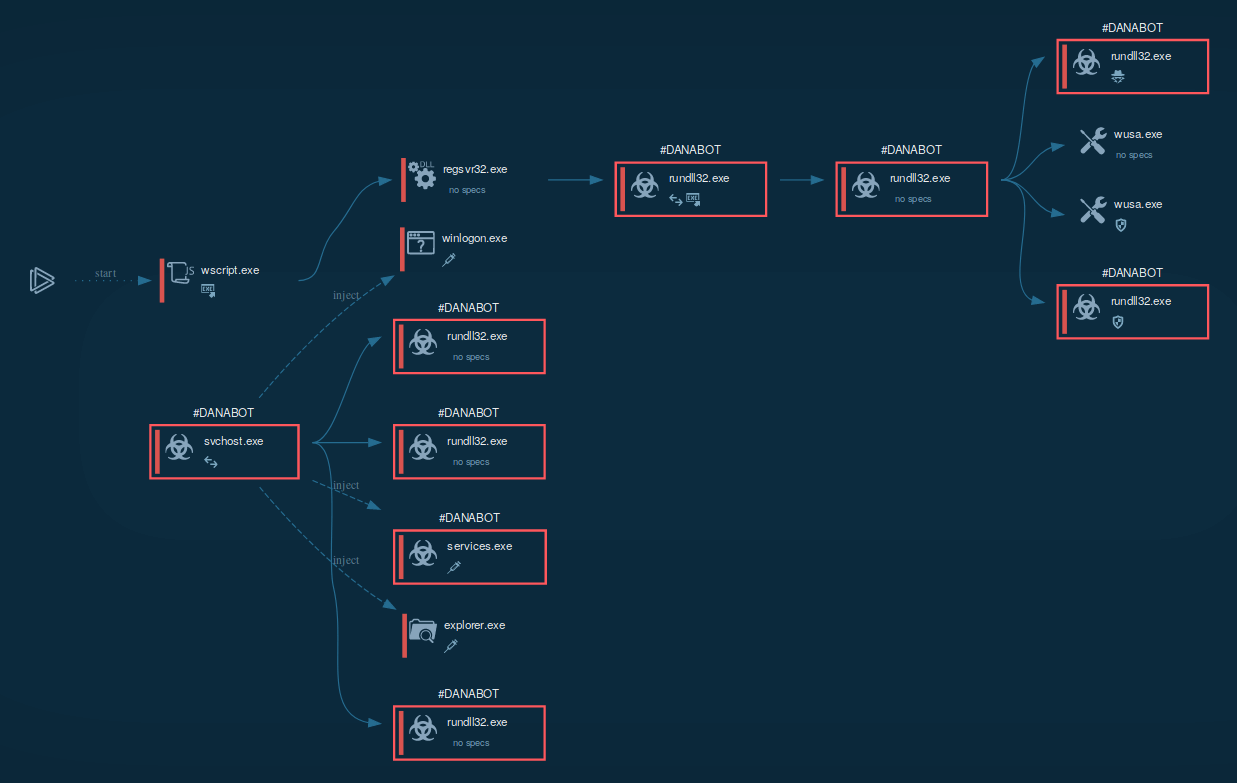
danabot execution process graph

Figure 1: A process graph generated by ANY.RUN for the convenience of the researchers
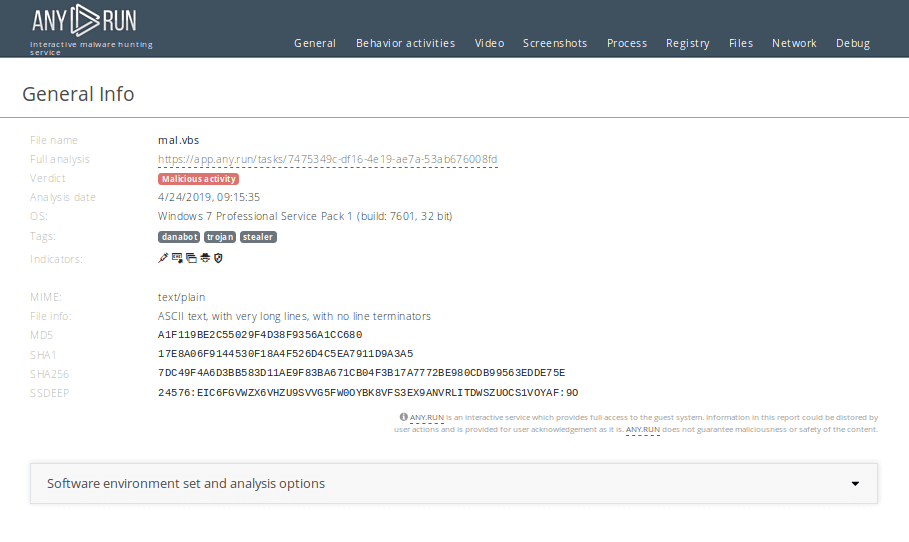
text report of the Danabot malware execution

Figure 2: The text report generated by ANY.RUN is created to allow easy sharing of the study results

Danabot banking malware execution process

Typically Danabot trojan infects devices according to the following scenario. First of all, the downloader establishes a connection with the C2 server and downloads an executable file with a DLL file, which can be either 32-bit or 64-bit based on the infected OS version.

After that, Danabot begins stealing information from the infected OS. The banking malware bypasses user access control by using a DLL hijacking vulnerability in the Windows Update Standalone Installer (wusa.exe). This allows Danabot to create services and execute the injection into system processes. After all of these steps, Danabot receives full system control.

How to avoid infection by Danabot?

Danabot is distributed in email spam campaigns targeting organizations and using social engineering to trick victims into downloading malicious documents the same scenario as

Danabot is also known to get into PCs with another malware called Hancitor. Email campaigns featuring Danabot were considered well crafted by some researchers, who noted that social engineering involved seemed very effective.

Communication with C&C

In older samples of Danabot, the loader component used HTTP protocol to communicate with the control server, whereas the main component utilized the binary protocol. In more recent iterations, both components started to communicate with the C2 server over TCP port 443 using TLS instead.

How to detect Danabot using ANY.RUN?

ANY.RUN uses Suricata IDS rule sets, so if malware trying to communicate with C&C servers, it will be detected. To look at what threats were detected, click on the "Threats" section of the "Network" tab.
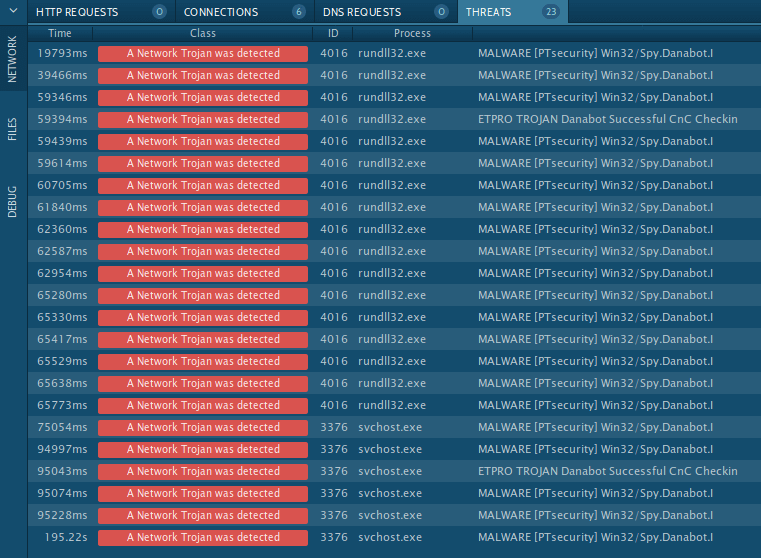
danabot network threats Figure 3: Danabot's network threats

Conclusion

Danabot is a very sophisticated malicious program used as a banking trojan and more. Targeting organizations across multiple continents, Danabot malware poses a high threat to businesses thanks to robust distribution methods and cutting-edge anti-evasion and persistence techniques.

In addition, the module nature of this banking malware allows attackers to fine-tune their campaigns, customizing them for every potential victim. All these traits combined helped make Danabot a very popular banking trojan that is only continuing to gain traction in the criminal community and further expand the geography of attacks.

To establish a reliable cyber defense, security professionals can utilize malware hunting and analysis services such as ANY.RUN, which allows to dissect malware samples and thoroughly study their behavior and architecture.
HAVE A LOOK AT

Gh0st RAT screenshot
Gh0st RAT
gh0st
Gh0st RAT is a malware with advanced trojan functionality that enables attackers to establish full control over the victim’s system. The spying capabilities of Gh0st RAT made it a go-to tool for numerous criminal groups in high-profile attacks against government and corporate organizations. The most common vector of attack involving this malware begins with spam and phishing emails.
Read More
Meduza Stealer screenshot
Meduza Stealer is an information-stealing malware primarily targeting Windows systems, designed to harvest sensitive data such as login credentials, browsing histories, cookies, cryptocurrency wallets, and password manager data. It has advanced anti-detection mechanisms, allowing it to evade many antivirus programs. The malware is distributed through various means, including phishing emails and malicious links. It’s marketed on underground forums and Telegram channels.
Read More
Roning Loader screenshot
Roning Loader
roning
RoningLoader is a multi-stage Windows loader designed to operate quietly while preparing systems for deeper compromise. It abuses trusted system tools and interferes with security controls to reduce the chances of early detection. Instead of acting as a final payload, it creates conditions for follow-on malware to execute more effectively. Its use of staged execution and code injection allows attackers to blend into legitimate activity and escalate impact. This makes early behavioral detection critical before the attack chain progresses further.
Read More
Orcus RAT screenshot
Orcus RAT
orcus rat trojan
Orcus is a modular Remote Access Trojan with some unusual functions. This RAT enables attackers to create plugins using a custom development library and offers a robust core feature set that makes it one of the most dangerous malicious programs in its class.
Read More
Adware screenshot
Adware
adware
Adware is a form of malware that targets users with unwanted advertisements, often disrupting their browsing experience. It typically infiltrates systems through software bundling, malicious websites, or deceptive downloads. Once installed, it may track user activity, collect sensitive data, and display intrusive ads, including pop-ups or banners. Some advanced adware variants can bypass security measures and establish persistence on devices, making removal challenging. Additionally, adware can create vulnerabilities that other malware can exploit, posing a significant risk to user privacy and system security.
Read More
Botnet screenshot
Botnet
botnet
A botnet is a group of internet-connected devices that are controlled by a single individual or group, often without the knowledge or consent of the device owners. These devices can be used to launch a variety of malicious attacks, such as distributed denial-of-service (DDoS) attacks, spam campaigns, and data theft. Botnet malware is the software that is used to infect devices and turn them into part of a botnet.
Read More