Black friday Up to 3 extra licenses FOR FREE + Special offer for TI LOOKUP Get it now
Webinar
February 26
Better SOC with Interactive Sandbox Practical Use Cases
Register now
68
Global rank
114 infographic chevron month
Month rank
133 infographic chevron week
Week rank
0
IOCs

Pony is a malware with two main functions — stealing information and dropping other viruses with different tasks on infected machines. It has been around since 2011, and it still actively attacks users in Europe and America.

Stealer
Type
Unknown
Origin
1 January, 2011
First seen
7 August, 2026
Last seen
Also known as
Fareit
Siplog

How to analyze Pony with ANY.RUN

Type
Unknown
Origin
1 January, 2011
First seen
7 August, 2026
Last seen

IOCs

IP addresses
48.192.1.65
20.190.160.3
2.19.13.249
57.153.246.3
48.209.138.168
48.209.6.48
172.211.123.250
91.121.93.178
95.100.102.101
20.190.160.4
74.178.240.51
74.178.76.128
162.159.142.9
172.211.123.248
4.155.89.87
23.216.77.6
48.209.138.189
2.17.22.34
88.221.169.205
54.243.117.197
Hashes
43d2ab0a4038f363901304c78f35b390dd1b332a878b3c3a22ba039287bc23da
1f0ed64ac1128b10a54ad87cf10d1145bf56e7046b1eb7da1ff5162a0661dc8a
c88224468a97e57f83bf25aa6c12909d5945dcea8d7ca649d878aee28e9c591e
93cfcf58ba02b6704041d8e036b4230a4ba9561723c5e7e8fdce681684864870
d098778a08df5c1e614908cf0b58c700cad58fb5cdf686aa1f8ef50060b14963
936d9411d5226b7c5a150ecaf422987590a8870c8e095e1caa072273041a86e7
ea0a96135f43d728b794bc9a9cbb0851ecf885f2d4f39985f1611c5bfac405f3
d5d93df326266d77cf3ab9a252818d46ab4fc9c0c7c5fc54dd221f3594313848
11bd2c9f9e2397c9a16e0990e4ed2cf0679498fe0fd418a3dfdac60b5c160ee5
4ba9b406d35f019a9df104a3727315800d7266e0ac3982b5828f2068e60716b7
be8ce15370faa9ba51b3be47bb9487267befe5e0033e9ebca8c3b2e98bdb4ca1
a53a03026dd4efe462769a6e8d648454efcf53d40eb765bae506249baf4d74c5
313f78a03de1797cdfba213a56ef5d5a01ac1e26713ec8c297d85126b238930d
e39f547dc0eae77672f5aab55dca78b00f43aa77f8e50c0a2d6d15ad4f7a4139
40d79f99e815e9157040af7e2d2179e9588be8346e98a715d86210380427dc70
b9675f8667b97e87589b803c7ef8c7538802e574977406a4ceee0d9d124a29b6
353b74e4fca84879a4f7406e1ab7972761bfec524b15294b9feab567b8d0744b
4fefd01f7254bc448be35653c612dd35abd9c229e259d1b2f93a91bdad4e088a
762d34adaef9bdd6a5a6e2d894bb4c5bda434e8740360adf82a399d7d1f7f46c
e855223cdbfdf179d0d59ff38a393efe51909e05fcbf76ab1c5909e0ff6b2bbe
Domains
go.microsoft.com
client.wns.windows.com
dns.msftncsi.com
login.live.com
www.microsoft.com
slscr.update.microsoft.com
licensing.mp.microsoft.com
fe3cr.delivery.mp.microsoft.com
google.com
ocsp.digicert.com
activation-v2.sls.microsoft.com
settings-win.data.microsoft.com
self.events.data.microsoft.com
crl.microsoft.com
nexusrules.officeapps.live.com
www.bing.com
mainserver.com
reservehost.com
oneocsp.microsoft.com
ocsp.digicert.cn
URLs
https://go.microsoft.com/fwlink/?linkid=2257403&clcid=0x409
https://login.live.com/rst2.srf
https://settings-win.data.microsoft.com/settings/v3.0/onesettings/client?osversionfull=10.0.19045.4046.amd64fre.vb_release.191206-1406&localdeviceid=s%3abad99146-31d3-4ec6-a1a4-be76f32ba5d4&flightring=retail&attrdataver=186&osuilocale=en-us&osskuid=48&app=wosc&appver=&isflightingenabled=0&telemetrylevel=1&devicefamily=windows.desktop
https://login.live.com/ppsecure/deviceaddcredential.srf
http://ocsp.digicert.com/mfewtzbnmeswstajbgurdgmcgguabbq50otx%2fh0ztl%2bz8sipi7wewvxdlqqutijuibiv5unu5g%2f6%2brks7qyxjzkceaz1vqyrvgl0erhqlcpm8gy%3d
http://crl.microsoft.com/pki/crl/products/microoceraut2011_2011_03_22.crl
http://www.microsoft.com/pkiops/crl/micsecserca2011_2011-10-18.crl
https://settings-win.data.microsoft.com/settings/v3.0/flightsettings/fsservice?processorclockspeed=3094&isretailos=1&oemmanufacturername=dell&flightingpolicyvalue=3&enablepreviewbuilds=4294967295&osversionfull=10.0.19045.4046.amd64fre.vb_release.191206-1406&managepreviewbuilds=3&branchreadinesslevelsource=0&attrdataver=186&processorcores=6&branchreadinesslevelraw=16&totalphysicalram=6144&tpmversion=0&oemmodelnumber=dell&systemvolumetotalcapacity=260281&deviceid=s%3abad99146-31d3-4ec6-a1a4-be76f32ba5d4&app=fss&appver=10.0&smartactivehoursstate=1&activehoursstart=20&securebootcapable=0&activehoursend=13&devicefamily=windows.desktop
https://settings-win.data.microsoft.com/settings/v3.0/wsd/waasassessment?os=windows&osver=10.0.19041.1.amd64fre.vb_release.191206-&ring=retail&sku=48&deviceclass=windows.desktop&locale=en-us&deviceid=bad99146-31d3-4ec6-a1a4-be76f32ba5d4&flightring=retail&telemetrylevel=1&hidovergattreg=c%3a%5cwindows%5csystem32%5cdriverstore%5cfilerepository%5chidbthle.inf_amd64_9610b4821fdf82a5%5cmicrosoft.bluetooth.profiles.hidovergatt.dll&appver=10.0&processoridentifier=amd64%20family%2023%20model%201%20stepping%202&oemmodel=dell&updateoffereddays=4294967295&processormanufacturer=authenticamd&installdate=1661339444&oemmodelbaseboard=&branchreadinesslevel=cb&oemsubmodel=j5cr&isclouddomainjoined=0&deferfeatureupdateperiodindays=30&isdeviceretaildemo=0&flightingbranchname=&osuilocale=en-us&devicefamily=windows.desktop&wuclientver=10.0.19041.3996&uninstallactive=1&isflightingenabled=0&osskuid=48&processorclockspeed=3094&totalphysicalram=6144&securebootcapable=0&app=waasassessment&processorcores=6&currentbranch=vb_release&installlanguage=en-us&deferqualityupdateperiodindays=0&servicingbranch=cb&oemname_uncleaned=dell&tpmversion=0&primarydisktotalcapacity=262144&installationtype=client&attrdataver=186&processormodel=amd%20ryzen%205%203500%206-core%20processor&isedgewithchromiuminstalled=1&osversion=10.0.19045.4046&ismdmenrolled=0&activationchannel=retail&honorwufbdeferrals=0&firmwareversion=a.40&trendinstalledkey=1&osarchitecture=amd64&defaultuserregion=244&updatemanagementgroup=2
https://settings-win.data.microsoft.com/settings/v3.0/wsd/waasassessment?os=windows&osver=10.0.19041.1.amd64fre.vb_release.191206-&ring=retail&sku=48&deviceclass=windows.desktop&locale=en-us&deviceid=bad99146-31d3-4ec6-a1a4-be76f32ba5d4&flightring=retail&telemetrylevel=1&hidovergattreg=c%3a%5cwindows%5csystem32%5cdriverstore%5cfilerepository%5chidbthle.inf_amd64_9610b4821fdf82a5%5cmicrosoft.bluetooth.profiles.hidovergatt.dll&appver=10.0&processoridentifier=amd64%20family%2023%20model%201%20stepping%202&oemmodel=dell&updateoffereddays=4294967295&processormanufacturer=authenticamd&installdate=1661339444&oemmodelbaseboard=&branchreadinesslevel=cb&oemsubmodel=j5cr&isclouddomainjoined=0&deferfeatureupdateperiodindays=30&isdeviceretaildemo=0&flightingbranchname=&osuilocale=en-us&devicefamily=windows.desktop&wuclientver=10.0.19041.3996&uninstallactive=1&isflightingenabled=0&osskuid=48&processorclockspeed=3094&totalphysicalram=6144&securebootcapable=0&app=waasassessment&processorcores=6&currentbranch=vb_release&installlanguage=en-us&deferqualityupdateperiodindays=0&servicingbranch=cb&oemname_uncleaned=dell&tpmversion=0&primarydisktotalcapacity=262144&installationtype=client&attrdataver=186&processormodel=amd%20ryzen%205%203500%206-core%20processor&isedgewithchromiuminstalled=1&osversion=10.0.19045.4046&ismdmenrolled=0&activationchannel=retail&honorwufbdeferrals=1&firmwareversion=a.40&trendinstalledkey=1&osarchitecture=amd64&defaultuserregion=244&updatemanagementgroup=2
https://settings-win.data.microsoft.com/settings/v3.0/waas/featuremanagement?isclouddomainjoined=0&processoridentifier=amd64%20family%2023%20model%201%20stepping%202&currentbranch=vb_release&accountfirstchar=&activationchannel=retail&oemmodel=dell&flightring=retail&attrdataver=186&installlanguage=en-us&osuilocale=en-us&webexperience=1&flightingbranchname=&chassistypeid=1&osskuid=48&app=cdm&installdate=1661339444&appver=&osarchitecture=amd64&defaultuserregion=244&telemetrylevel=1&osversion=10.0.19045.4046&devicefamily=windows.desktop
https://settings-win.data.microsoft.com/settings/v3.0/wsd/muse?processorclockspeed=3094&flightids=&updateoffereddays=4294967295&branchreadinesslevel=cb&oemmanufacturername=dell&isclouddomainjoined=0&processoridentifier=amd64%20family%2023%20model%201%20stepping%202&sku=48&activationchannel=retail&attrdataver=186&ismdmenrolled=0&processorcores=6&processormodel=amd%20ryzen%205%203500%206-core%20processor&totalphysicalram=6144&primarydisktype=4294967295&flightingbranchname=&chassistypeid=1&oemmodelnumber=dell&systemvolumetotalcapacity=260281&sampleid=95271487&deviceclass=windows.desktop&app=muse&disabledualscan=0&appver=10.0&oemsubmodel=j5cr&locale=en-us&isalwaysonalwaysconnectedcapable=0&ms=0&defaultuserregion=244&updateserviceurl=http%3a%2f%2fneverupdatewindows10.com&osver=10.0.19045.4046.amd64fre.vb_release.191206-1406&os=windows&deviceid=s%3abad99146-31d3-4ec6-a1a4-be76f32ba5d4&deferqualityupdateperiodindays=0&ring=retail&deferfeatureupdateperiodindays=30
http://www.microsoft.com/pkiops/crl/microsoft%20ecc%20product%20root%20certificate%20authority%202018.crl
https://slscr.update.microsoft.com/sls/%7b522d76a4-93e1-47f8-b8ce-07c937ad1a1e%7d/x64/10.0.19045.4046/0?ch=686&l=en-us&p=&pt=0x30&wua=10.0.19041.3996&mk=dell&md=dell
https://fe3cr.delivery.mp.microsoft.com/clientwebservice/ping
https://slscr.update.microsoft.com/sls/ping
http://www.microsoft.com/pkiops/crl/microsoft%20ecc%20update%20secure%20server%20ca%202.1.crl
https://slscr.update.microsoft.com/sls/%7be7a50285-d08d-499d-9ff8-180fdc2332bc%7d/x64/10.0.19045.4046/0?ch=686&l=en-us&p=&pt=0x30&wua=10.0.19041.3996&mk=dell&md=dell
https://settings-win.data.microsoft.com/settings/v3.0/wsd/updatehealthtools?os=windows&osver=10.0.19041.1.amd64fre.vb_release.191206-&sku=48&deviceclass=windows.desktop&locale=en-us&deviceid=s:bad99146-31d3-4ec6-a1a4-be76f32ba5d4&sampleid=s:95271487&appver=10.0.19041.3626&flightring=retail&telemetrylevel=1&hidovergattreg=c%3a%5cwindows%5csystem32%5cdriverstore%5cfilerepository%5chidbthle.inf_amd64_9610b4821fdf82a5%5cmicrosoft.bluetooth.profiles.hidovergatt.dll&appver=&processoridentifier=amd64%20family%2023%20model%201%20stepping%202&oemmodel=dell&updateoffereddays=4294967295&processormanufacturer=authenticamd&installdate=1661339444&oemmodelbaseboard=&branchreadinesslevel=cb&oemsubmodel=j5cr&isclouddomainjoined=0&deferfeatureupdateperiodindays=30&isdeviceretaildemo=0&flightingbranchname=&osuilocale=en-us&devicefamily=windows.desktop&wuclientver=10.0.19041.3996&uninstallactive=1&isflightingenabled=0&osskuid=48&processorclockspeed=3094&totalphysicalram=6144&securebootcapable=0&app=sedimentpack&processorcores=6&currentbranch=vb_release&installlanguage=en-us&deferqualityupdateperiodindays=0&oemname_uncleaned=dell&tpmversion=0&primarydisktotalcapacity=262144&installationtype=client&attrdataver=186&processormodel=amd%20ryzen%205%203500%206-core%20processor&isedgewithchromiuminstalled=1&osversion=10.0.19045.4046&ismdmenrolled=0&activationchannel=retail&firmwareversion=a.40&trendinstalledkey=1&osarchitecture=amd64&defaultuserregion=244&updatemanagementgroup=2
https://licensing.mp.microsoft.com/v7.0/licenses/content
Last Seen at

Recent blog posts

post image
Mirage2FA Hijacks Companies’ Microsoft 365 Se...
watchers 195
comments 0
post image
Intelligence-Driven SOC: Modernizing Threat M...
watchers 11403
comments 0
post image
Supply Chain Security: How ANY.RUN Helps US a...
watchers 6519
comments 0

What is Pony malware?

Pony, also known as Fareit or Siplog, is an information stealer and loader – a malware used to collect data from infected machines and install other malicious programs. This particular virus was First Spotted in the wild in 2011. It is known to attack users primarily in Europe and North America.

The earliest discovered version of Pony stealer is 1.7, and the latest updated known version is 2.2. Though being regularly updated, the malware did not gain groundbreakingly new features since the time of its first discovery by Microsoft. In addition to the core functionality, Pony can also steal cryptocurrency wallet credentials, FTP clients, and autofill values from the browsers.

In contrast to the majority of botnets, Pony stealer does not require a centralized C&C server or a group of C&C servers to carry out its attacks. Instead, each attacker can set up their own custom control server or purchase a server that was previously set up by another criminal, instantly gaining access to infrastructure that provides reports about the stolen data. In addition, the malware itself can be divided into two modules, the builder, which is used to construct clients that are then have to be downloaded on the victim’s machine to collect data, and the bot itself – the final payload.

General description of Pony malware

The robust functionality of Pony trojan helped this malware to keep its position as the most popular password stealer through 5 years. Apart from being able to steal credentials the same as RedLine, malware can disable certain antivirus and windows security features and run in the background completely hidden from the user, who may not have a clue that his or her PC is, in fact, infected. When activated, Pony stealer can use the infected PC to take part in botnet attacks, for example, using a hijacked machine to send spam emails. Pony can also download other malware to the victim’s machine and send harvested personal data to a destination specified by the attacker.

What’s more, Pony has been mentioned by multiple “hacker celebrities” as the backbone of many attack campaigns. For instance, the author of the infamous Andromeda botnet has referred to Pony as the “titanic work of the author of miracle (Fareit Bot),” further stating that the loader was incorporated in the Andromeda botnet attacks as a plug-in.

Part of the malware’s popularity is because the source code of multiple Pony loader versions has been leaked and is available for download on the darknet. Particularly, the source code of Pony builder and loader versions 1.9 and 2.0 are available for download on several underground forums.

The Pony stealer builder is a program that attackers can use to construct custom Pony bots with pre-programmed C&C addresses, where stolen data can be sent. The Pony Bot is the actual program that is used for information stealing. According to the analysis, the Bot is written primarily in assembly language. A peculiar feature of this malware that separates it from the rest of the pack is its unique decoding technique. The Bot itself does not come equipped with a decoding algorithm, instead of using just simple functions that are programmed to send encrypted information to the control server, where stolen passwords and other data are decrypted.

Even though the core feature-set of Pony trojan has not changed drastically over the course of its lifespan, newer versions of the malware gained several anti-detection features designed to prevent research and disassembly of the malware. As such, in addition to standard anti-evasion and debugging techniques, each attacker has the ability to implement various packers, including custom ones, to avoid detection by antivirus software.

With the use of Packers, the malware gains a Russian “matryoshka” nesting-doll like-design. While the payload is inactive when the package containing Pony stealer is analyzed, the final payload cannot be detected by antivirus signatures since it is hidden in the innermost and smallest package. However, once activated, the Pony loader has to unpack itself, thus revealing its presence.

Pony malware analysis

A video of a simulation recorded in ANY.RUN malware hunting service helps us to perform the analysis of the behavior of Pony in-depth.
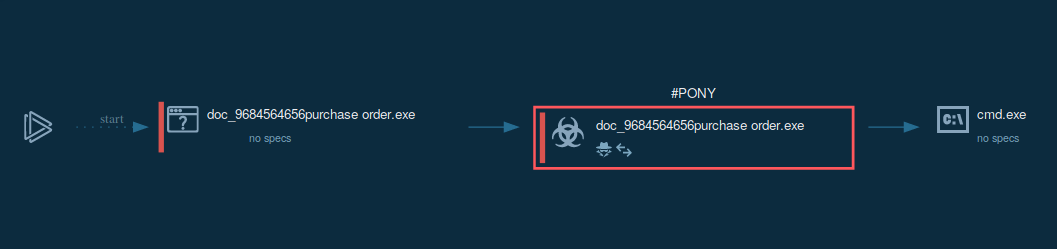
process graph of the pony execution Figure 1: A process graph generated by ANY.RUN enables to examine the lifecycle of Pony in a visual form
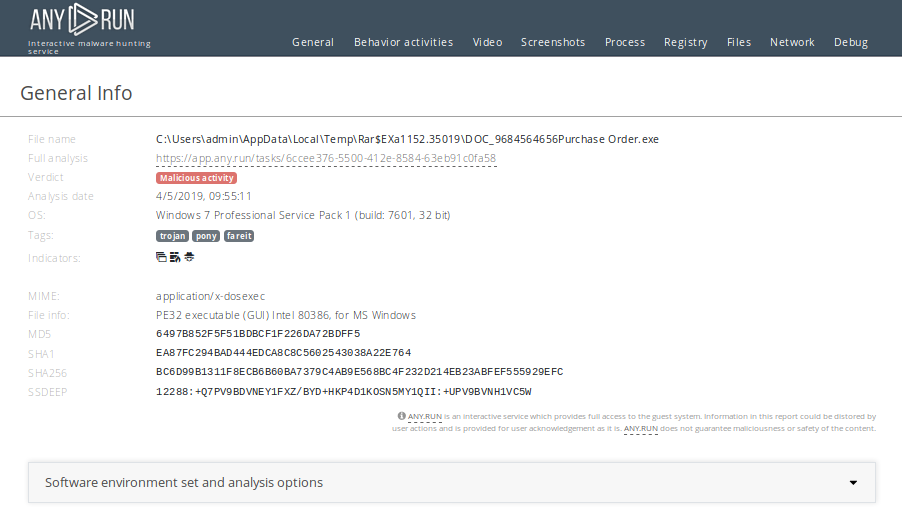
text report of a Pony analysis Figure 2: Customizable text reports provided by ANY.RUN gives more opportunities for research or sharing of study results

Pony malware execution process

In the case of our simulation, after the user ran the malicious file, the malware launched itself. Next, the malicious executable file connected to the C2 server and started stealing information from the infected system. It should be noted that in some cases, Pony is known to download other malware to the victim’s machine.

Distribution of Pony malware

Based on the analysis, Pony is distributed in multiple ways, including email spam campaigns, exploit kits and DNS poisoning. Also, Pony can be hidden within free downloadable online programs and can mimic legitimate software. For example, malicious emails usually include either a Microsoft Word archive or a JavaScript file. As soon as the document is downloaded and opened, Pony injects the victim’s PC and starts execution.

Another attack vector of Pony is through a compromised DNS server which is infected by another malware. In this case, the victim is redirected to a malicious website from where Pony downloads itself onto the users’ PC.

How to detect Pony stealer using ANY.RUN?

Analysts can perform an analysis of what changes the malware made in the registry. Just click on the process and then on the button "More Info" in the appeared window. Then, in the "Advanced details of process" window, switch to the "Registry changes" tab. Note that you can switch between the friendly and raw display of changes. You can also try this method while analyzing GootKit or Danabot.
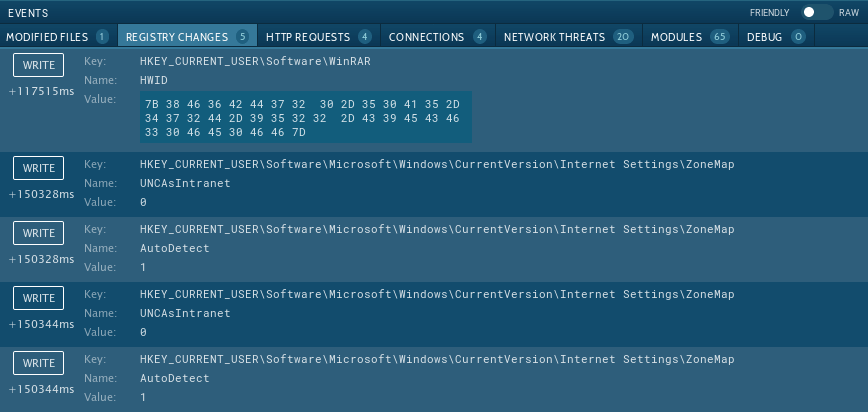
pony fareit registry changes Figure 3: Registry changes made by Pony

Conclusion

Availability and robust feature set helped make Pony stealer one of the most widely used information stealers. In fact, this malware is regularly being used in attacks targeting Europe and North America. The danger of Pony attacks is further enhanced by its nesting-doll-like design, where the final payload hides within a layered package, allowing to avoid easy detection. Interactive malware hunting service ANY.RUN gives researchers the ability to take a look at how this dangerous malware functions and examine its behavior in action in a safe environment.
HAVE A LOOK AT

Kamasers screenshot
Kamasers
kamasers
Kamasers is a multi-functional DDoS botnet malware that transforms infected machines into remotely controlled attack nodes. It combines network-layer flooding capabilities, resilient command-and-control (C2), and payload delivery, making it not just a disruption tool but a gateway to broader compromise.
Read More
Sality screenshot
Sality
sality
Sality is a highly sophisticated malware known for infecting executable files and rapidly spreading across networks. It primarily creates a peer-to-peer botnet that is used for malicious activities such as spamming, data theft, and downloading additional malware. Sality has strong persistence mechanisms, including disabling security software, making it difficult to remove. Its ability to spread quickly and silently, along with its polymorphic nature, allows it to evade detection by traditional antivirus solutions.
Read More
Jigsaw screenshot
Jigsaw
jigsaw
The Jigsaw ransomware, initially detected in 2016, encrypts files on compromised systems and requires a ransom payment in Bitcoin. If the ransom is not paid, the malware starts deleting files, increasing the pressure on victims to comply. Its source code is publicly accessible, allowing various threat actors to customize and repurpose the malware for different objectives.
Read More
LockBit screenshot
LockBit
lockbit
LockBit, a ransomware variant, encrypts data on infected machines, demanding a ransom payment for decryption. Used in targeted attacks, It's a significant risk to organizations.
Read More
ACR Stealer screenshot
ACR Stealer is a modern information-stealing malware designed to harvest sensitive data from infected devices. Like other infostealers, it targets credentials, financial details, browser data, and files, enabling cybercriminals to monetize stolen information through direct fraud or underground market sales.
Read More
MetaStealer screenshot
MetaStealer
metastealer
MetaStealer is an info-stealing malware primarily targeting sensitive data like login credentials, payment details, and browser history. It typically infects systems via phishing emails or malicious downloads and can exfiltrate data to a command and control (C2) server. MetaStealer is known for its stealthy techniques, including evasion and persistence mechanisms, which make it difficult to detect. This malware has been actively used in various cyberattacks, particularly for financial theft and credential harvesting from individuals and organizations.
Read More