Black friday Up to 3 extra licenses FOR FREE + Special offer for TI LOOKUP Get it now
Webinar
February 26
Better SOC with Interactive Sandbox Practical Use Cases
Register now

Lu0Bot

124
Global rank
76 infographic chevron month
Month rank
79 infographic chevron week
Week rank
0
IOCs

Lu0Bot is a Node.js malware that was first discovered in February 2021. It is a type of Trojan that primarily acts as a stealer by responding to commands from a command-and-control (C2) server and transmitting encrypted system data. It can also operate as a DDoS bot. Lu0Bot employs multiple obfuscation techniques to avoid detection and make analysis more difficult.

Trojan
Type
Unknown
Origin
1 February, 2021
First seen
6 June, 2026
Last seen

How to analyze Lu0Bot with ANY.RUN

Type
Unknown
Origin
1 February, 2021
First seen
6 June, 2026
Last seen

IOCs

IP addresses
5.188.206.211
45.141.26.119
45.141.27.41
Hashes
9c5898b1b354b139794f10594e84e94e991971a54d179b2e9f746319ffac56aa
Domains
dmz24.fun
zdm85.shop
pom39.fun
fuk09.fun
tes03.xyz
fast-difficult.monster
hri9.xyz
vhi46.shop
oun96.fun
hri2.xyz
xdk03.fun
hri10.xyz
llw18.fun
cdh80.fun
xio23.com
ykf88.fun
byk31.shop
irj55.shop
lu0.viewdns.net
zgg58.shop
Last Seen at

Recent blog posts

post image
Leader in Malware Analysis: ANY.RUN Named Top...
watchers 914
comments 0
post image
Q1 2026 Cyber Risk Report: Insights from 2.1...
watchers 2787
comments 0
post image
Release Notes: Decision-Ready SOC Reporting,...
watchers 3395
comments 0

What is Lu0Bot malware?

Lu0Bot is a trojan that was first observed in 2021. Although less widely used than other trojan malware, such as Agent Tesla, it has the potential to inflict serious damage on infected systems.

A notable feature of Lu0Bot is its use of Node.js, an unusual programming language choice for malware. However, this unconventional approach provides Lu0Bot with versatility compared to most malicious programs that are usually developed using the .NET framework, which is limited to Windows systems.

Despite being a highly capable threat, Lu0Bot has a relatively low level of activity. Currently, its primary function is data harvesting, but it can also be used as a DDoS attack bot and may have other capabilities.

Use ANY.RUN free for 14 days

Try the full power of interactive analysis

Start your free trial

Technical details of the Lu0Bot malicious software

Once Lu0Bot is fully deployed on the system, it can engage in:

  • Keystroke recording: It can perform keylogging and record the keys that are pressed by the user, for instance, when they enter their login credentials.
  • Identity theft: It can steal the victim’s personal information, including credit card numbers and other sensitive data.
  • System control: Using Lu0Bot, attackers can execute a wide variety of activities, as the malicious software is capable of establishing near-full control over the device.
  • DDoS attacks: The malware can exploit the compromised system and use it to participate in a distributed denial-of-service (DDoS) attack.

Lu0Bot is highly obfuscated, meaning that its code is deliberately made difficult to read and understand in order to prevent or obstruct analysis. It uses several encryption algorithms, including custom ones.

By comparing Lu0Bot samples from 2021 and 2023, it becomes clear that the software is being continuously updated by its developers.

Read a detailed analysis of a Lu0Bot sample in our blog.

Execution process of Lu0Bot

In order to see how Lu0Bot operates and collect up-to-date IOCs, let’s examine one of its samples in the ANY.RUN sandbox.

Analyze malware for free in a fully interactive cloud sandbox – sign up now!

The execution chain of this malware family is relatively straightforward. After the payload executes, it uses CMD to copy and initiate the main malware process. This process is responsible for carrying out all malicious activities, including data theft, C&C server communication, and, in this case, gathering process information using WMIC.EXE.
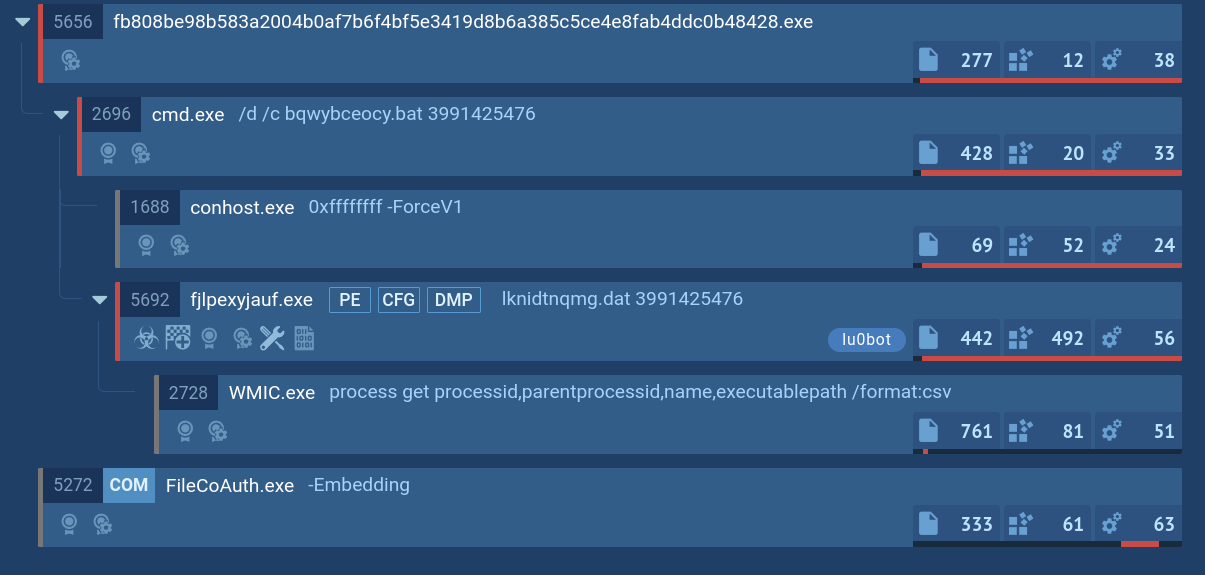
Lu0botprocess tree shown in ANY.RUN Lu0Bot's process tree demonstrated in ANY.RUN

Distribution methods of the Lu0Bot malware

In the early days, Lu0Bot was primarily dropped by GCleaner, a specialized software for deploying second-stage payloads. Yet, today, the main method of delivery for this malware is phishing emails. Essentially, attackers employ various social engineering techniques in order to get their victims to download malicious email attachments or open unsafe links and trigger the infection chain reaction on their systems.

Conclusion

Despite being a known threat, the true scale of Lu0Bot's operations remains unknown. This makes it a dangerous malware capable of dealing a significant blow to any infrastructure, if not addressed proactively. Therefore, organizations must implement proper security measures to prepare for Lu0Bot attacks.

One of the most effective ways to prevent a Lu0Bot attack is to check any incoming files and links, especially those sent by unknown senders, in the ANY.RUN sandbox. It is a malware sandbox that lets you quickly understand if the file or link your are dealing with is malicious or not.

ANY.RUN is fully interactive, enabling you to engage with the infected system like you would on your own computer but in a safe cloud environment to fully understand the behavior of the malware. It also provides comprehensive reports that include IOCs and malware configs.

Try ANY.RUN for free – request a demo!.
HAVE A LOOK AT

MetaStealer screenshot
MetaStealer
metastealer
MetaStealer is an info-stealing malware primarily targeting sensitive data like login credentials, payment details, and browser history. It typically infects systems via phishing emails or malicious downloads and can exfiltrate data to a command and control (C2) server. MetaStealer is known for its stealthy techniques, including evasion and persistence mechanisms, which make it difficult to detect. This malware has been actively used in various cyberattacks, particularly for financial theft and credential harvesting from individuals and organizations.
Read More
Tycoon 2FA screenshot
Tycoon 2FA
tycoon
Tycoon 2FA is a phishing-as-a-service (PhaaS) platform designed to bypass multi-factor authentication (MFA) protections, particularly targeting Microsoft 365 and Gmail accounts. Its advanced evasion techniques and modular architecture make it a significant threat to organizations relying on MFA for security.
Read More
Cephalus screenshot
Cephalus
cephalus
Cephalus is a targeted ransomware threat discovered in 2025. It’s known for infiltrating organizations that deal with sensitive data through compromised RDP access. It leverages DLL sideloading with a legitimate SentinelOne executable. Cephalus is able to exfiltrate data and destroy backup options. Its payload is also tailored to each victim, which makes identification and mitigation more complex.
Read More
GuLoader screenshot
GuLoader
guloader
GuLoader is an advanced downloader written in shellcode. It’s used by criminals to distribute other malware, notably trojans, on a large scale. It’s infamous for using anti-detection and anti-analysis capabilities.
Read More
Salty 2FA screenshot
Salty 2FA
salty2fa
Salty 2FA is a sophisticated Phishing-as-a-Service (PhaaS) framework tailored to hijack user sessions, steal credentials, and gain unauthorized access to corporate systems. Delivered primarily via targeted emails, this kit employs multi-stage evasion tactics, making it a stealthy tool for cybercriminals aiming at high-value enterprise accounts.
Read More
Fog Ransomware screenshot
Fog is a ransomware strain that locks and steals sensitive information both on Windows and Linux endpoints. The medial ransom demand is $220,000. The medial payment is $100,000. First spotted in the spring of 2024, it was used to attack educational organizations in the USA, later expanding on other sectors and countries. Main distribution method — compromised VPN credentials.
Read More