



Modern enterprise threats have escalated far beyond traditional signature-based attacks. Advanced persistent threat (APT) groups, initial access brokers (IABs), and cybercrime syndicates utilize fileless execution, living-off-the-land (LotL) tactics, and highly dynamic infrastructure. To maintain a proactive defense, enterprise Security Operations Centers (SOCs) and Managed Security Service Providers (MSSPs) rely on actionable Threat Intelligence (TI) solutions.
This guide reviews the top 10 threat intelligence platforms for enterprise security in 2026, detailing how each collects telemetry, structures data, and supports SOC workflows.
Top 10 Enterprise Threat Intelligence Solutions
1. ANY.RUN Threat Intelligence
ANY.RUN’s Threat Intelligence provides a comprehensive suite of solutions designed to empower security teams to detect, investigate, and respond to advanced malware and phishing attacks before initial access turns into a full-scale breach.
Unlike traditional Threat Intelligence vendors that aggregate recycled, third-party indicators, ANY.RUN draws directly from its Interactive Sandbox. Over 700,000 threat researchers and 16,000 organizations detonate and analyze live malware and phishing campaigns within the solution.
This crowdsourced ecosystem creates a continuous, high-volume telemetry loop, capturing real-world payloads, Command-and-Control (C2) infrastructure, and behavioral artifacts long before they appear in public repositories or standard blocklists.
1. Threat Intelligence Feeds
ANY.RUN Threat Intelligence Feeds stream verified, real-time Indicators of Compromise (IOCs), such as malicious IP addresses, phishing domains, C2 endpoints, and malware distribution URLs, directly into your SIEM, EDR, SOAR, or Threat Intelligence Platform (TIP) via standard STIX/TAXII protocols.
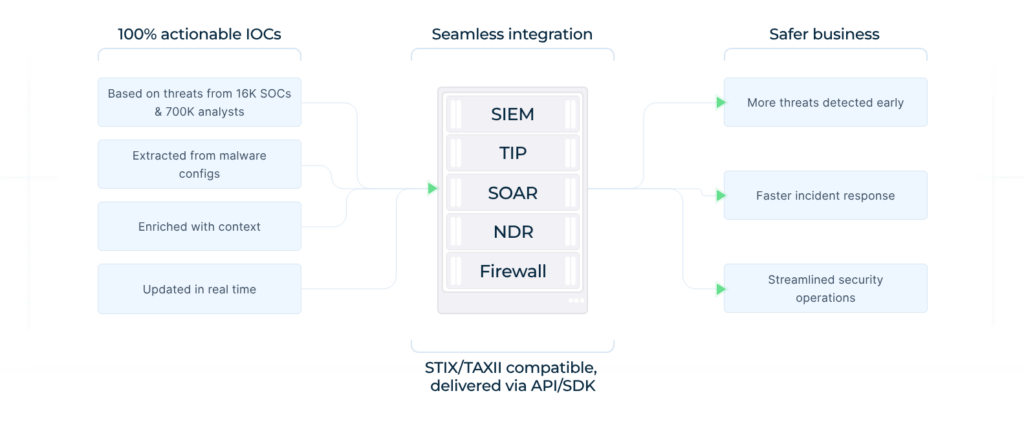
Indicators are extracted straight from verified sandbox executions, drastically minimizing false positives and ensuring perimeter rules are backed by real behavioral evidence.
SOC teams can block malicious infrastructure at the delivery stage, such as initial email link clicks or payload downloads, before malware executes on the local endpoint.
SOC Impact TI Feeds:
- Instantly updates defenses with the latest indicators, C2 servers, and emerging phishing infrastructure before traditional threat databases index them.
- Drops Mean Time to Detect (MTTD) and Respond (MTTR) by enriching SIEM/EDR systems to automatically cut connections to malicious infrastructure at the perimeter.
- Automatically populates SOAR blocklists and EDR firewall policies without requiring manual analyst intervention.
2. Threat Intelligence Lookup (TI Lookup)
Threat Intelligence Lookup serves a dual purpose in the SOC: it accelerates alert triage and provides the deep telemetry required for proactive threat hunting across global campaign data.
When an alert fires in your SIEM or EDR, analysts can instantly query TI Lookup to pull rich, real-world context, understanding the severity, origin, and behavior of an indicator in seconds rather than spending hours manually researching unknown artifacts.
Beyond resolving active alerts, threat hunters can proactively query ANY.RUN’s dynamic dataset using Indicators of Behavior (IOBs), Indicators of Attack (IOAs), and MITRE ATT&CK TTP mapping. Analysts can hunt for emerging campaigns targeting their specific industry or region before any internal detection triggers.
Here’s an example query showing the latest phishing campaigns targeting US financial entities:
industry:”Finance” AND submissionCountry:”us” AND threatName:”phishing”
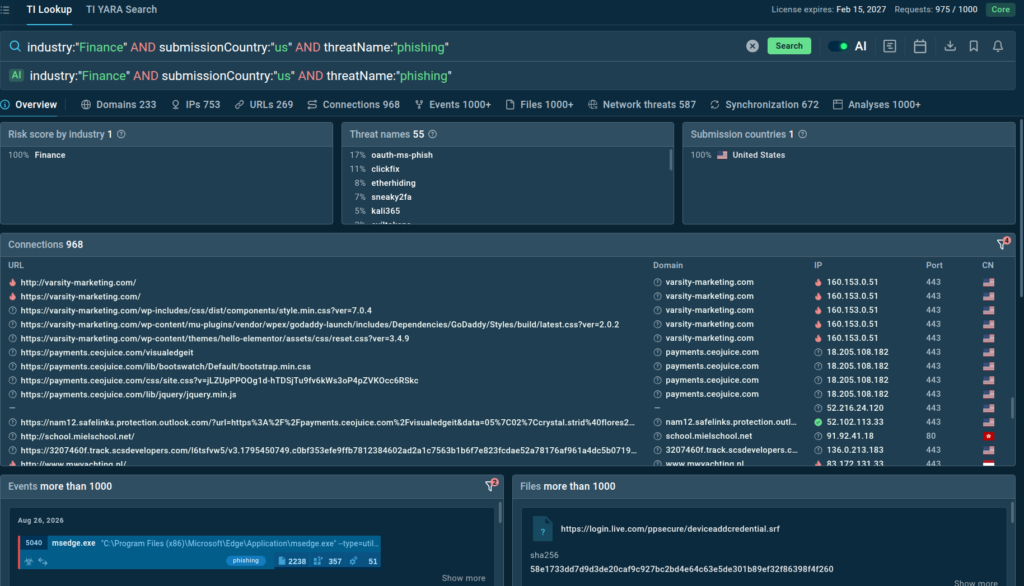
Within seconds, TI Lookup uncovers active infrastructure and indicators that can be exported directly into internal detection systems, ensuring early coverage against targeted sector threats.
The solution also offers a built-in TI YARA Search engine that allows SOC teams to hunt through ANY.RUN’s vast repository of binary samples using custom YARA rules, byte patterns, and regular expressions.
Every matched sample links directly to its original interactive sandbox session, offering instant access to execution process trees, decrypted network traffic, and memory dumps.
SOC Impact of TI Lookup:
- Cuts investigation time from hours to seconds by giving Tier 1/2 analysts immediate context on incoming alerts.
- Reduces adversary dwell time by enabling hypothesis-driven threat hunting across active campaigns.
- Elevates SOC operations from reactive alert-handling to proactive hunting, maximizing Tier 2 and Tier 3 efficiency.
3. Threat Intelligence Reports
Threat Intelligence Reports deliver in-depth analysis produced by ANY.RUN’s threat research team, breaking down emerging malware families, phishing tradecraft, initial access vectors, and infrastructure changes.
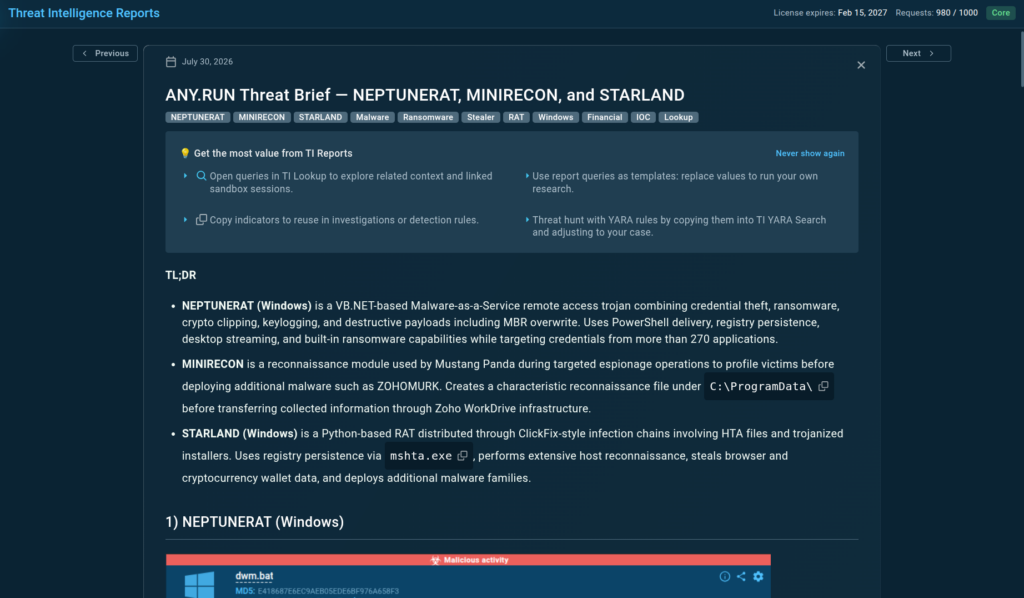
These reports detail adversary motives, targeting patterns, and first-seen timelines, helping security leaders prioritize vulnerability management and security controls based on active threats.
SOC Impact of TI Reports:
- Help direct security spending and defense controls toward active, verified threat actor tactics rather than theoretical risks.
- Speed up emergency patching and mitigation cycles by identifying the specific entry points actively exploited in current campaigns.
- Bridge the gap between technical SOC telemetry and executive-level decision-making with clear, contextualized risk guidance.
2. Google Threat Intelligence (Mandiant + VirusTotal)
Google Threat Intelligence unifies the frontline incident response expertise of Mandiant with VirusTotal’s massive global crowdsourced malware database and Google’s internet-scale telemetry. Powered by Gemini AI, the platform assists security teams in summarizing threat profiles, analyzing scripts, and mapping global threat actor operations.
- Key Capabilities: Frontline Mandiant IR analytics, global VirusTotal telemetry, AI-driven threat hunting (Gemini), and seamless integration with Google Chronicle/SIEM platforms.
- Enterprise Use Case: Deep technical attribution, early detection of zero-day exploitation campaigns, and multi-vector threat tracking.
3. CrowdStrike Falcon Adversary Intelligence
Integrated into the Falcon platform, CrowdStrike Falcon Adversary Intelligence automates threat correlation across millions of endpoints worldwide. It tracks over 200 adversary groups (e.g., SPIDER, PANDA families), automatically linking endpoint alerts with adversary profiles and dark web telemetry.
- Key Capabilities: Adversary attribution, real-time threat hunting rules (YARA/Snort), automated IOC correlation, and dark web monitoring.
- Enterprise Use Case: Mapping endpoint detections directly to MITRE ATT&CK and automating targeted response playbooks based on adversary profile data.
4. ThreatConnect
ThreatConnect provides an enterprise-grade Threat Intelligence Platform (TIP) combined with Cyber Risk Quantification (CRQ) and Orchestration. It serves as a centralized hub for aggregating, scoring, and operationalizing intelligence feeds across complex security architectures.
- Key Capabilities: Multi-source feed aggregation, automated threat scoring algorithms, risk quantification, and native SOAR integration.
- Enterprise Use Case: Centralizing heterogeneous threat intelligence streams, filtering duplicate noise, and prioritizing SOC alerts based on financial risk impact.
5. Palo Alto Networks Cortex XSOAR TIM
Palo Alto Networks Cortex Threat Intelligence Management (TIM) combines intelligence management directly with SOAR capabilities. It ingests, normalizes, and scores threat data from Unit 42 and third-party feeds, automating indicator distribution across network firewalls, EDRs, and cloud workloads.
- Key Capabilities: Direct SOAR integration, Unit 42 threat intelligence feeds, automated playbook enforcement, and real-time indicator scoring.
- Enterprise Use Case: Automating perimeter enforcement updates and deploying high-confidence blocklists across global network infrastructure.
6. Microsoft Defender Threat Intelligence (MDTI)
Microsoft Defender Threat Intelligence (MDTI) leverages hyper-scale telemetry derived from analyzing tens of trillions of daily security signals across Windows endpoints, Office 365, Azure, and Active Directory environments. MDTI provides security analysts with deep internet infrastructure mapping (passive DNS, WHOIS).
- Key Capabilities: Hyper-scale infrastructure mapping, passive DNS tracking, native Microsoft 365/Azure XDR integration, and automated adversary profiling.
- Enterprise Use Case: Uncovering threat actor infrastructure components to block malicious subnets across Microsoft enterprise environments.
7. IBM X-Force Exchange / Threat Intelligence
IBM X-Force Threat Intelligence delivers human-curated and machine-readable intelligence derived from global incident response engagements, malware research, and spam trap networks. Integrated with IBM QRadar and SOAR, X-Force provides actionable context during active breaches.
- Key Capabilities: Frontline Incident Response (IR) insights, STIX/TAXII automated feeds, malware technical breakdowns, and shared research collections.
- Enterprise Use Case: Accelerating incident response playbook execution with verified indicators straight from IBM IR responders.
8. OpenCTI
OpenCTI is an open-source Threat Intelligence Platform (TIP) designed to structure, store, organize, and visualize complex cyber threat intelligence datasets. Built on STIX2 standards, it uses a knowledge graph model to map relationships between threat actors, techniques, and indicators.
- Key Capabilities: Native STIX2 compliance, GraphQL API, interactive knowledge graph visualization, and an extensive connector ecosystem.
- Enterprise Use Case: Building custom enterprise threat repositories and visualizing structural relationships between APT groups, attack patterns, and organizational assets.
9. Bitsight
Bitsight focuses on external threat intelligence through Security Ratings, Cyber Risk Quantification, and Third-Party Risk Management. It continuously monitors an organization’s digital footprint and vendor ecosystem for misconfigurations, exposed services, and active compromised assets.
- Key Capabilities: Attack surface management (ASM), supply chain risk monitoring, continuous security ratings, and unpatched exposure detection.
- Enterprise Use Case: Identifying unpatched external vulnerabilities and open administrative ports (e.g., RDP/SMB) across an enterprise and its third-party supply chain.
10. MISP (Malware Information Sharing Platform)
MISP is an open-source threat intelligence sharing platform trusted worldwide by ISACs, CERTs, and enterprise SOCs. It enables automated collection, storage, and sharing of structured threat indicators, financial fraud indicators, and vulnerability data.
- Key Capabilities: Automated IOC correlation, peer-to-peer sharing communities, flexible taxonomies/galaxy matrices, and open APIs.
- Enterprise Use Case: Participating in sector-specific threat-sharing trust groups and ingesting shared community indicators directly into detection systems.
How to Choose a Threat Intelligence Platform for Enterprise Defense
When selecting a Threat Intelligence platform, enterprise security leaders should evaluate how effectively the solution addresses the entire threat lifecycle:
- Fidelity & Provenance: Prioritize platforms offering verified behavioral evidence (such as ANY.RUN interactive sandbox telemetry) over raw aggregators that increase alert fatigue.
- Actionable Context: Indicators must be mapped to MITRE ATT&CK TTPs, threat actor profiles, and risk scores rather than standalone hash lists.
- Seamless Integration: Intelligence must flow automatically into existing SIEM, EDR, and SOAR tools via standard protocols (STIX/TAXII, REST API).
Enterprise Threat Intelligence Buying Guide
Enterprise SOCs and MSSPs should consider these operational factors when procuring TI platforms:
- API Limits & Capacity: Ensure API quotas support heavy alert enrichment without throttling automated SOAR playbooks.
- Data Privacy & Handling: Verify that search queries and submitted files remain strictly private and compliant with regional standards (GDPR, SOC 2).
- Multi-Tenancy for MSSPs: Managed security providers require role-based access control (RBAC) and strict workspace separation between client organizations.
- PoC Evaluation: Test candidate platforms against historical enterprise alerts to evaluate real-world noise reduction and MTTR improvements.
Conclusion
Modern cyber threat operations evolve rapidly, shortening the timeframe between initial exposure and full system compromise. Relying solely on reactive perimeter controls or delayed public blocklists leaves enterprises exposed. By deploying high-fidelity, behavior-driven threat intelligence, SOCs and MSSPs can intercept threats during the staging phase, accelerate triage, and maintain a proactive security posture.
About ANY.RUN
ANY.RUN is a leading cybersecurity company specializing in interactive malware analysis and threat intelligence solutions. Trusted by over 700,000 cybersecurity professionals and 16,000 enterprise SOC teams worldwide, ANY.RUN transforms complex threat analysis into an intuitive, real-time experience.
ANY.RUN powers its Threat Intelligence directly from its Interactive Sandbox investigations. By capturing active malware behavior, C2 infrastructure, and execution patterns as they happen, ANY.RUN delivers high-fidelity intelligence that empowers detection engineers, threat hunters, and Incident Response teams to stay weeks ahead of emerging cyber threats.
Frequently Asked Questions (FAQ)
Threat intelligence (TI) is evidence-based knowledge containing context, mechanisms, indicators, and actionable advice regarding emerging threats. It allows SOCs to intercept threats early in the attack chain before endpoint execution or data exfiltration can occur.
When evaluating a Threat Intelligence Platform, enterprise security leaders should assess four main criteria:
– Data Source Quality (First-Party vs. Third-Party): Determine whether the vendor generates original, verified behavioral data (like ANY.RUN’s real-time sandbox telemetry) or simply aggregates and recycles public blocklists.
– Integration Capabilities: Ensure native support for standard protocols (STIX/TAXII) and seamless integration with your existing SIEM, EDR, SOAR, and firewall infrastructure.
– Operational Relevance: Look for tools that support both rapid triage (resolving active alerts in seconds) and proactive hunting (querying specific industries, regions, or malware families).
– Actionability & Noise Level: Prioritize platforms that deliver low false-positive rates to protect analysts from alert fatigue.
Threat Intelligence (TI) provides external context about adversary tactics, malicious infrastructure, and real-time indicators like IPs, domains, and malware hashes. It answers what the threat is and gives security teams the background needed to understand potential attacks.
SIEM (Security Information & Event Management) offers internal visibility by collecting and correlating log data across your entire network. It acts as the central monitoring system, watching internal traffic and firing alerts whenever suspicious activity or known threats appear inside your environment.
SOAR (Security Orchestration, Automation, & Response) serves as the execution engine that automates incident response. It uses pre-built playbooks to take immediate action on SIEM alerts and TI context, such as automatically blocking an IP or quarantining an infected host, without waiting for an analyst.
STIX and TAXII are the standard open-source protocols used to structure and transmit threat intelligence automatically. Together, STIX/TAXII allow security systems from different vendors to exchange threat intelligence seamlessly without manual formatting.
When evaluating top threat intelligence solutions, the most critical factor is the quality of the underlying telemetry. Enterprise security teams need fresh, high-fidelity data extracted from real-world attacks, not recycled, months-old indicators aggregated from public blocklists.
ANY.RUN Threat Intelligence stands out as a top solution because its feeds and lookup tools are powered by live, first-party data from its interactive sandbox, where over 700,000 security researchers analyze active malware and phishing campaigns daily. This direct behavioral pipeline delivers new C2 infrastructure and verified Indicators of Compromise (IOCs) weeks before they appear in traditional databases, ensuring high confidence and minimal false positives.
Unlike traditional aggregators, ANY.RUN extracts intelligence directly from its interactive malware analysis sandbox, where 700,000+ analysts detonate active threats daily.
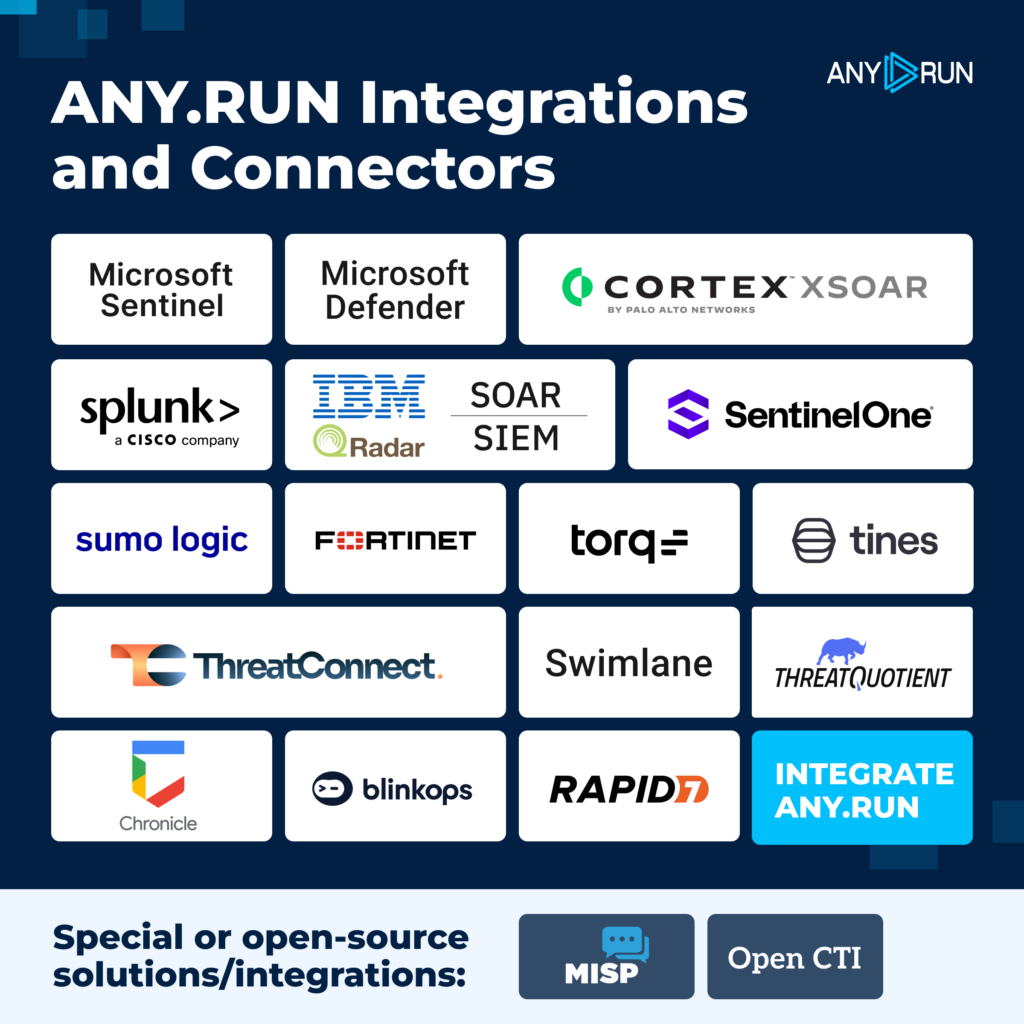
Enterprise TI solutions utilize standardized STIX/TAXII protocols and REST APIs to connect directly with platforms such as Microsoft Sentinel, Splunk, Palo Alto Cortex XSOAR, and IBM QRadar.



0 comments