


Supply chain vulnerabilities represent a growing attack surface for US and EU organizations. With advanced threat tactics on the rise, reducing Mean Time to Detect (MTTD) and Respond (MTTR) is essential. ANY.RUN integrates directly into the SOC workflows as an investigative layer, providing fast malware analysis and threat intelligence to help security teams boost their efforts in preventing third-party compromise from turning into a company-wide incident.
The Supply Chain Security: Trust as a Vulnerability
Threat actors increasingly utilize supply chain attacks, where they first compromise a smaller contractor or vendor to use their “trusted” status as a springboard into the head company. Because these communications arrive via verified email addresses and legitimate vendor mailboxes, they often bypass standard email gateways and static filters.
A typical enterprise, such as an automotive manufacturer, may manage over 200 active vendors. This creates a massive, constantly shifting entry point for risk where hundreds of files, invoices, technical specs, and contracts are exchanged weekly.
The window for response is shrinking rapidly. The median time for an attacker to move from initial access to lateral movement is now just 29 minutes. If a suspicious supplier file is not analyzed and contained immediately, the breach can escalate before a human analyst even begins the manual triage process.
SOC teams are often overwhelmed by fragmented tools that provide “red flags” without behavioral proof. As the Head of SOC at a US manufacturer noted:
“The volume itself was not the only challenge. The bigger issue was that analysts did not have enough context to quickly decide which supplier files were safe and which required further action”.
Head of SOC, US Automotive Manufacturer
Read a full case study of how an American manufacturing company reduced third-party risks →
When security operations lack a connected investigative layer, the SOC becomes a “relay race” where evidence is dropped during every handoff between Tier 1 analysts and senior responders.
Currently, many analysts spend over 20% of their work week on manual data correlation between disconnected tools. This manual overhead leads to alert fatigue, resulting in a dangerous reality where up to 62% of alerts are closed without a full investigation due to a lack of resources. This operational blind spot is exactly what supply chain attackers exploit: they hide their malicious activity within the noise of “trusted” but unverified vendor interactions.
What CISOs Can Do to Reduce Supply Chain Security Risks
1. Shorten the Detection Window for Phishing in Contractor Ecosystems
In a contractor-heavy ecosystem, the most dangerous phishing attempts are those that arrive from a legitimate, compromised vendor account. Standard email gateways and static URL scanners frequently fail to identify modern supply chain phishing because the malicious content is often dynamically rendered only after a user interacts with the page or passes an anti-bot check.
To an automated filter, the initial link appears benign, creating a significant “visibility gap” where critical attack stages unfold entirely within an encrypted browser session.
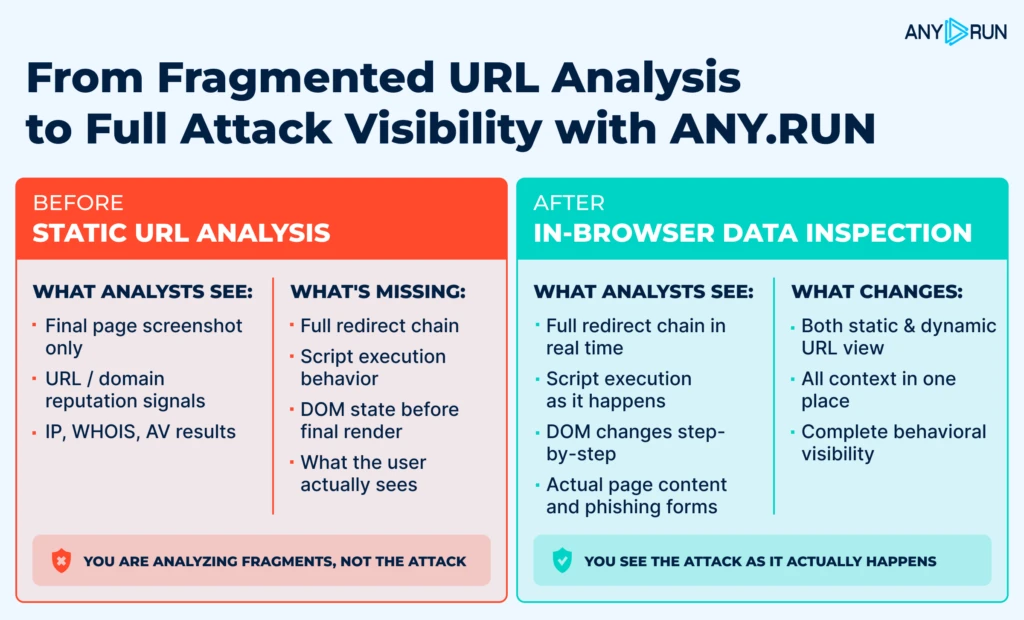
ANY.RUN’s Interactive Sandbox addresses this by providing in-browser data inspection. This allows analysts to observe the attack exactly as the user experienced it, capturing dynamically injected credential forms, hidden redirect chains, and DOM changes that static analysis structurally cannot see. By exposing what is happening inside the browser session, security teams can confirm a credential theft attempt even when there is no file-based trace on the endpoint.
In the context of a busy enterprise, security must not become a bottleneck for business-critical communications. Every minute an analyst spends manually correlating browser events or waiting for a static report is a minute where a compromised vendor could be harvesting corporate credentials.
By integrating behavioral evidence directly into the triage workflow, organizations can move from a suspicious signal to a confirmed verdict in a fraction of the time.
As a specialist at UMass Boston noted regarding their sandbox-driven workflow:
“Having ANY.RUN’s API connection with our email security vendor has really increased our performance… Instead of minutes, [investigations] take seconds”.
Senior Information Security Specialist, UMass Boston
Read a full case study of how UMass Boston scaled their triage to protect 50,000 users →
This transition from minutes to seconds is the primary driver of ROI, allowing lean teams to handle higher alert volumes without increasing headcount.
2. Power Proactive Defense with Live Tracking of Threat Actor Infrastructure
Resilient SOC teams in EU and US companies are moving toward a proactive defense model that involves monitoring the industry threat landscape to identify and neutralize malicious infrastructure used against their peers before it ever hits their own perimeter.
The primary obstacle to proactive defense is the volatility of attacker infrastructure. Threat actors frequently cycle their Command-and-Control (C2) IPs every 48 hours, meaning that intelligence found in static public reports is often outdated by the time it is operationalized.
To bridge this gap, ANY.RUN allows SOC teams to shift their focus from static artifacts to Indicators of Behavior (IOBs). While an attacker can easily change a file’s hash with a minor rebuild, their behavioral patterns, such as specific mutexes, command-line arguments, registry modifications, and process execution chains, are far more stable and difficult to alter without re-engineering the entire attack.
By using Threat Intelligence Lookup, analysts can pivot from a single suspicious artifact found in a supplier email to a broader campaign-level view.
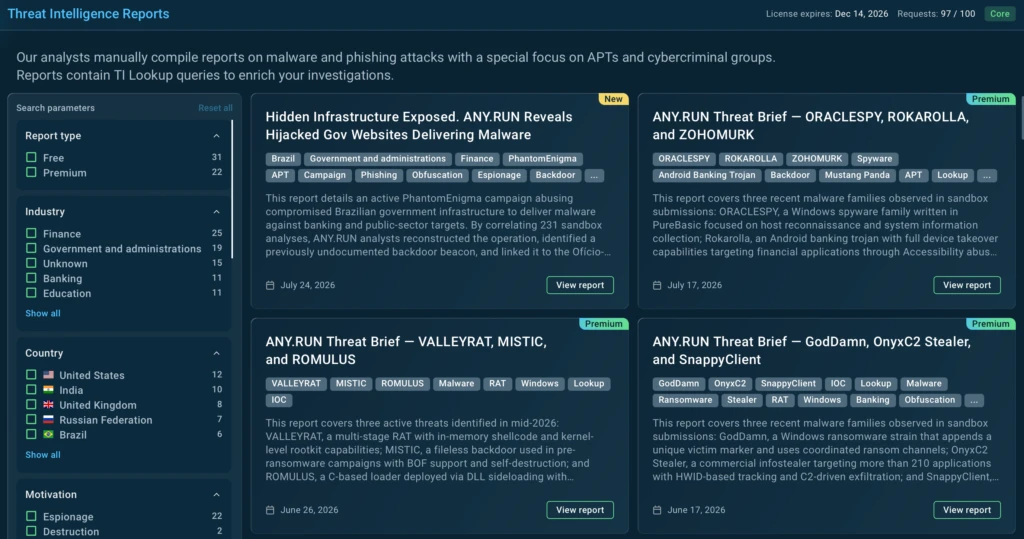
To learn about the latest supply chain attacks early, SOC teams also rely on ANY.RUN’s TI Reports that provide overviews of emerging threats. Curated by an expert team of threat intelligence analysts, these reports offer actionable indicators along with recommendations on how to detect new malware strains.
ANY.RUN’s intelligence is built on a global community of 15K organizations and 600K SOC analysts who analyze the latest malware & phishing attacks inside the Interactive Sandbox. The actionable indicators from these investigations then become available through TI Lookup and TI Feeds.
The result is SOC teams can track the latest intel on the threats that are targeting their industry or country at the moment. For example, here’s a TI Lookup query for banking companies in Germany:
submissionCountry:”de” AND industry:”Banking”
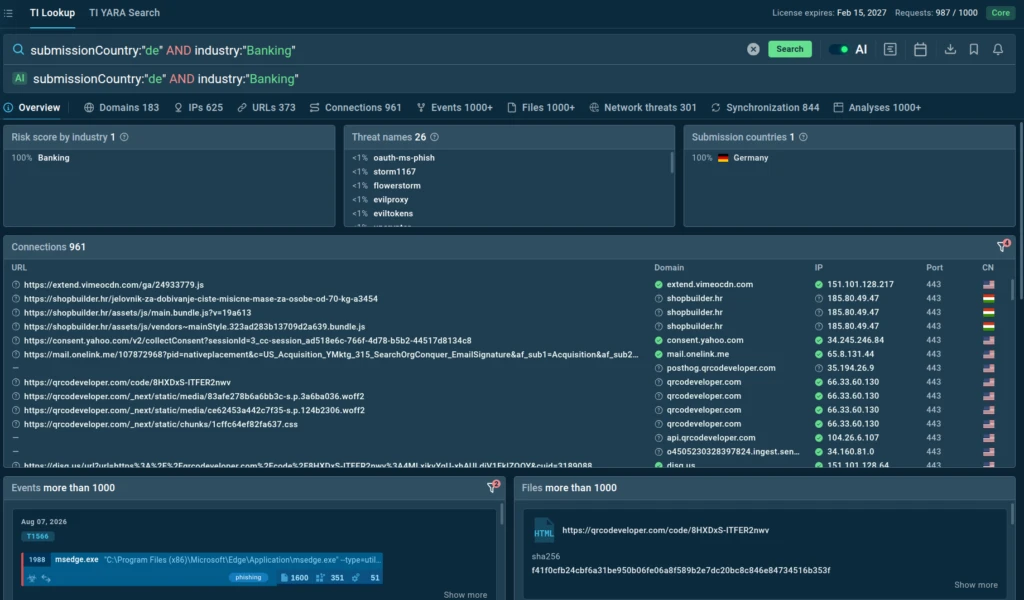
Within seconds, TI Lookup reveals that one of the key threats the German banking industry is currently facing is OAuth phishing. The analysts can continue the investigation and collect more intel on this threat to update the detection systems.
This transition from manual research to an intelligence-fed loop transforms how a SOC prioritizes its workload. Instead of treating every alert with the same urgency, teams can focus on threats that are actively “trending” within their specific industry. Reflecting on the operational impact of this real-time visibility, the CISO at an international transport company managing complex logistics across multiple continents shared:
“The result is that we can follow active threats that may potentially target our company almost in real time because TI Lookup is updated with fresh data”.
CISO at an International Transport Company
Read a full case study of how a transport company improved proactive defense →
By identifying these threats in advance, the SOC can update its detection rules and blocklists with sandbox-verified data before the vendor-based attack is even launched against their organization. This strategic lead time is what allows lean security teams to protect large-scale operations without a proportional increase in headcount.
3. Scale Early Detection without Headcount Growth
For US and EU enterprises, particularly those in the manufacturing and logistics sectors, the operational pressure on the SOC is reaching a tipping point. Security teams in these industries typically carry an 18% to 20% higher workload than those in other sectors due to the sheer volume of supplier-related file exchanges.
The business value of integrating ANY.RUN’s solutions lies in its ability to serve as a force multiplier, allowing existing teams to handle hundreds of suspicious supplier files weekly without adding headcount. By providing a cloud-based investigative layer that integrates directly into existing SIEM or SOAR platforms, enterprises can transform their SOC from a reactive “alert processor” into a streamlined intelligence hub.
A major drain on SOC productivity is fragmented threat context that forces analysts to manually correlate data across multiple dashboards.
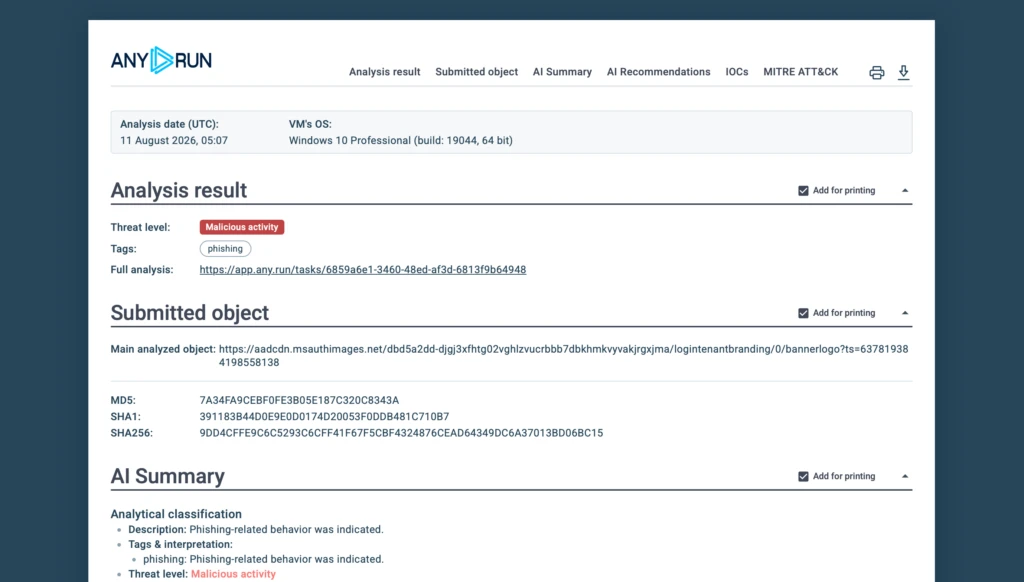
ANY.RUN addresses this by standardizing Tier 1 reports. These structured summaries package the entire behavioral analysis, including process trees, network activity, and MITRE ATT&CK mapping, into a single, decision-ready document. This ensures that findings move between tiers as intelligence rather than raw technical data, preserving the full context of a vendor-borne threat and eliminating the need for duplicated effort.
“We cut the time it takes to move from a suspicious supplier file to a clear decision in half. That gave the business faster answers and reduced the time potential threats remained unresolved.”
Head of SOC, US Automotive Manufacturer
Read a full case study of how an American manufacturing company reduced third-party risks →
ANY.RUN also provides Threat Intelligence Feeds that deliver fresh IOCs (IPs, domains, URLs) to companies’ existing security stacks, ensuring they have the ability to identify new malware and phishing early.
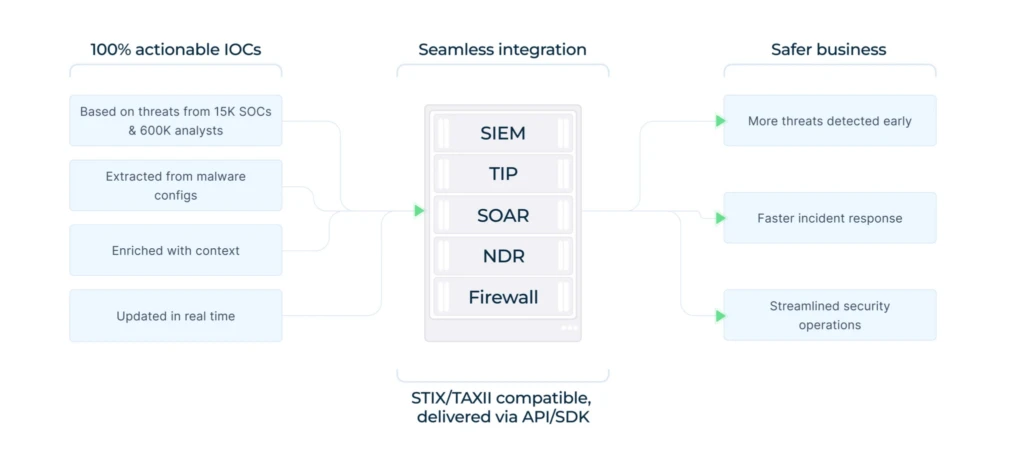
The continuous stream of updated indicators helps US and EU enterprises scale their security operations alongside their growing supplier networks, maintaining a lean, effective team that prioritizes response-ready decisions over manual data collection.
Conclusion
For US and EU enterprises, securing the supply chain means shortening the distance between a suspicious signal and a definitive business action. ANY.RUN serves as the connective investigative layer that transforms raw, unverified alerts from trusted partners into actionable behavioral proof. By replacing manual correlation and guesswork with interactive analysis and threat intelligence, security teams can effectively identify and act on third-party risks while maintaining global operations without interruptions.
FAQ: Strengthening Supply Chain Resilience
A supply chain attack, often categorized as “System Intrusion,” involves threat actors compromising a trusted vendor or contractor to use their verified status as a springboard into a larger head company. These attacks are difficult to detect because malicious payloads often arrive through legitimate, verified communication channels that bypass standard email gateways and static filters. ANY.RUN addresses this by providing an interactive behavioral analysis and threat intelligence. It allows analysts to detonate vendor files and enrich indicators with context.
Enterprises in sectors like manufacturing and logistics often face a 20% higher security workload due to the constant exchange of supplier documents. By integrating solutions like ANY.RUN via API into existing workflows, organizations can achieve a 2x improvement in triage speed and increased Tier 1 closure rates. This efficiency ensures that business-critical supplier communication isn’t stalled by security bottlenecks.
Attackers frequently use compromised vendor accounts to launch Adversary-in-the-Middle (AiTM) attacks, which often leave no file-based trace on the endpoint. To neutralize this visibility gap, SOC teams can utilize in-browser data inspection. This capability allows security teams to observe dynamically rendered content, hidden redirect chains, and injected forms as the user experiences them, providing the definitive proof needed to confirm credential theft even when traditional endpoint controls see nothing.
Relying on static Indicators of Compromise (IOCs) is a liability because attackers often cycle their infrastructure every 48 hours. ANY.RUN enables a proactive defense by providing Threat Intelligence Lookup, which allows analysts to pivot from a single suspicious artifact (like a vendor’s IP) to a broader campaign-level view. By tracking Indicators of Behavior (IOBs), such as specific mutexes or process patterns, teams can identify malicious infrastructure used against their peers before it ever hits their own perimeter.

0 comments