


AI is now everywhere in cybersecurity. But how much of it is actually making SOC teams’ jobs easier?
Almost every vendor offers AI-powered solutions promising faster threat detection, automated malware analysis, and smarter investigations. For SOC teams, separating real value from AI branding has become a challenge of its own.
Meanwhile, alert volumes keep growing, attacks get more complex, and analysts lose hours to repetitive investigations. Senior specialists get pulled into routine escalations, while SOC leaders are expected to cut response times without increasing budgets.
The biggest opportunity? Putting AI to work where it matters most; reducing manual effort, accelerating investigations, and uncovering threats that might otherwise go unnoticed.
Where AI Makes the Biggest Difference in SOC Operations
The greatest value of AI comes from addressing the bottlenecks that slow SOC teams down every day. From uncovering evasive attacks to making faster response decisions, the right capabilities can help analysts handle more incidents without increasing their workload.
Here’s how ANY.RUN puts AI to work across critical stages of an investigation, using a real phishing attack to show what changes for the SOC.
Uncover What Basic Automation Misses: Automated Interactivity in Action
What if the threat your SOC is looking for is hiding just one click away?
Modern phishing and malware attacks often require user interaction before revealing their malicious behavior. Embedded links, QR codes, CAPTCHA challenges, and multi-stage redirects can prevent automated analysis from reaching the actual threat.
For SOC analysts, this means more time spent manually reproducing attacks, while critical malicious activity risks going undetected.
ANY.RUN brings AI automation to malware and phishing analysis with Automated Interactivity, taking over these repetitive steps. It automatically opens attachments, follows embedded links, extracts malicious URLs hidden in QR codes, solves CAPTCHAs, and navigates multi-stage attacks to expose the full attack chain with minimal manual effort.
And here’s the best part: automation doesn’t take control away from the analyst. ANY.RUN’s Interactive Sandbox lets security professionals step in at any moment to interact with the environment, examine suspicious behavior, or guide the investigation down a specific path.
This combination of automation and hands-on control helps SOC teams handle routine investigations faster while keeping analysts focused on complex threats that require their expertise.
Real Case: From a Legitimate Adobe Link to a Hidden Phishing Attack
Let’s see how AI-powered malware analysis works in a real phishing investigation.
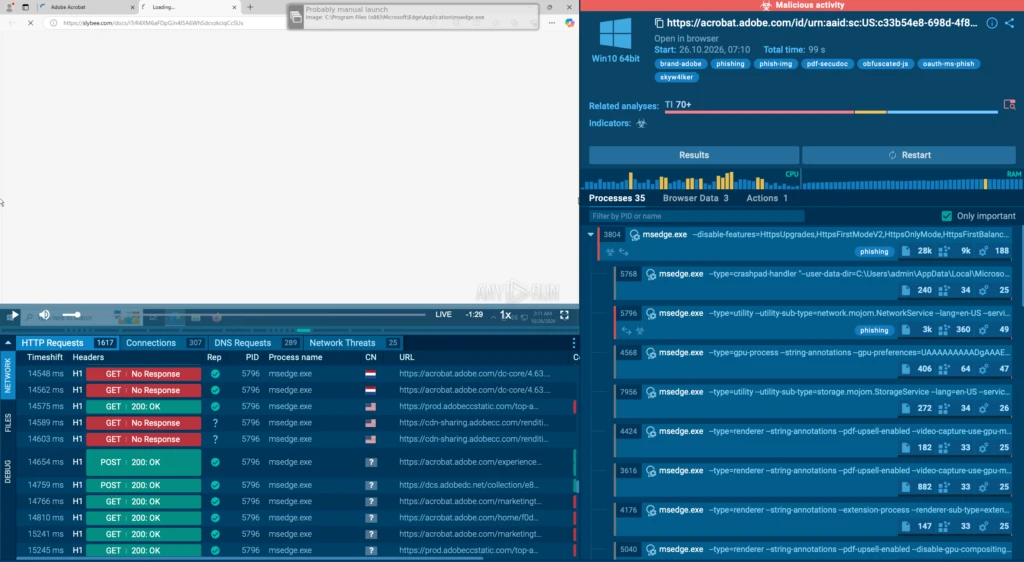
The analysis starts with a legitimate acrobat.adobe.com link hosting a PDF document. Inside the PDF is another link that leads further into the attack.
With Automated Interactivity enabled, the sandbox opens the document, follows the embedded URL, and continues through the attack chain without requiring the analyst to perform each action manually.
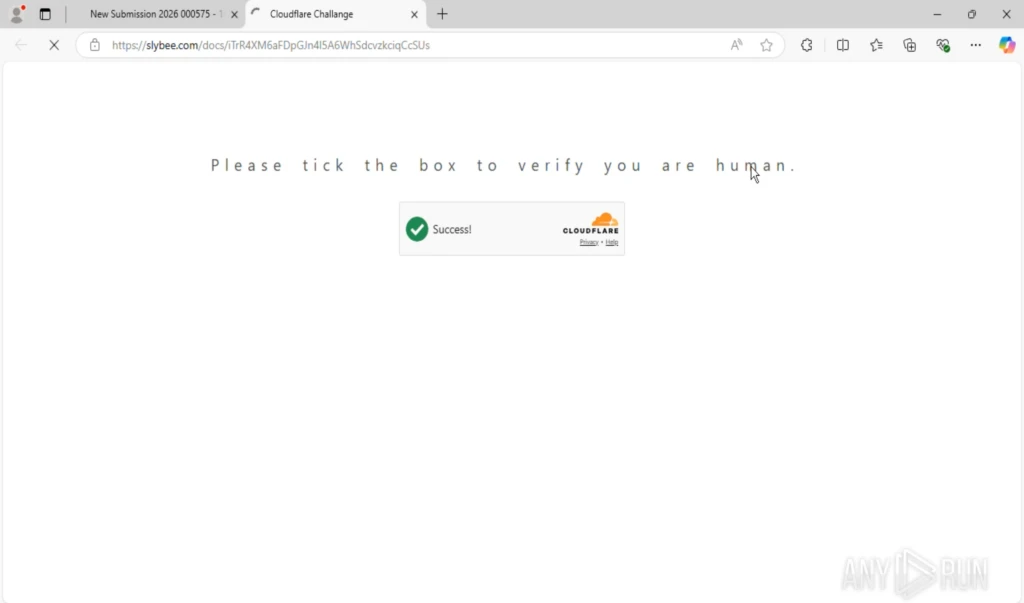
The result: ANY.RUN exposes a Microsoft OAuth phishing flow hidden behind the initial document.
Along the way, the sandbox captures suspicious URLs, network connections, and other indicators, giving analysts the evidence needed to understand the attack and investigate its potential impact.
For SOC teams, the advantage is clear: Less time spent navigating suspicious files and URLs, greater visibility into evasive threats, and more analyst capacity for investigations that require human judgment.
With API-based automated malware analysis, SOCs and MSSPs can investigate suspicious files and URLs at scale, while analysts retain the freedom to step in whenever deeper investigation is needed.
A Shortcut to the Bigger Threat Picture: Uncover Related Threats with One Click
AI-powered malware analysis can expose a threat in minutes. But what if the evidence points to something much bigger?
A malicious URL rarely tells the whole story. Analysts still need to determine whether suspicious infrastructure has appeared in previous investigations, identify related activity, and understand how far the threat might extend.
That additional research can take valuable time, especially when every alert requires another round of manual IOC lookups and correlation.
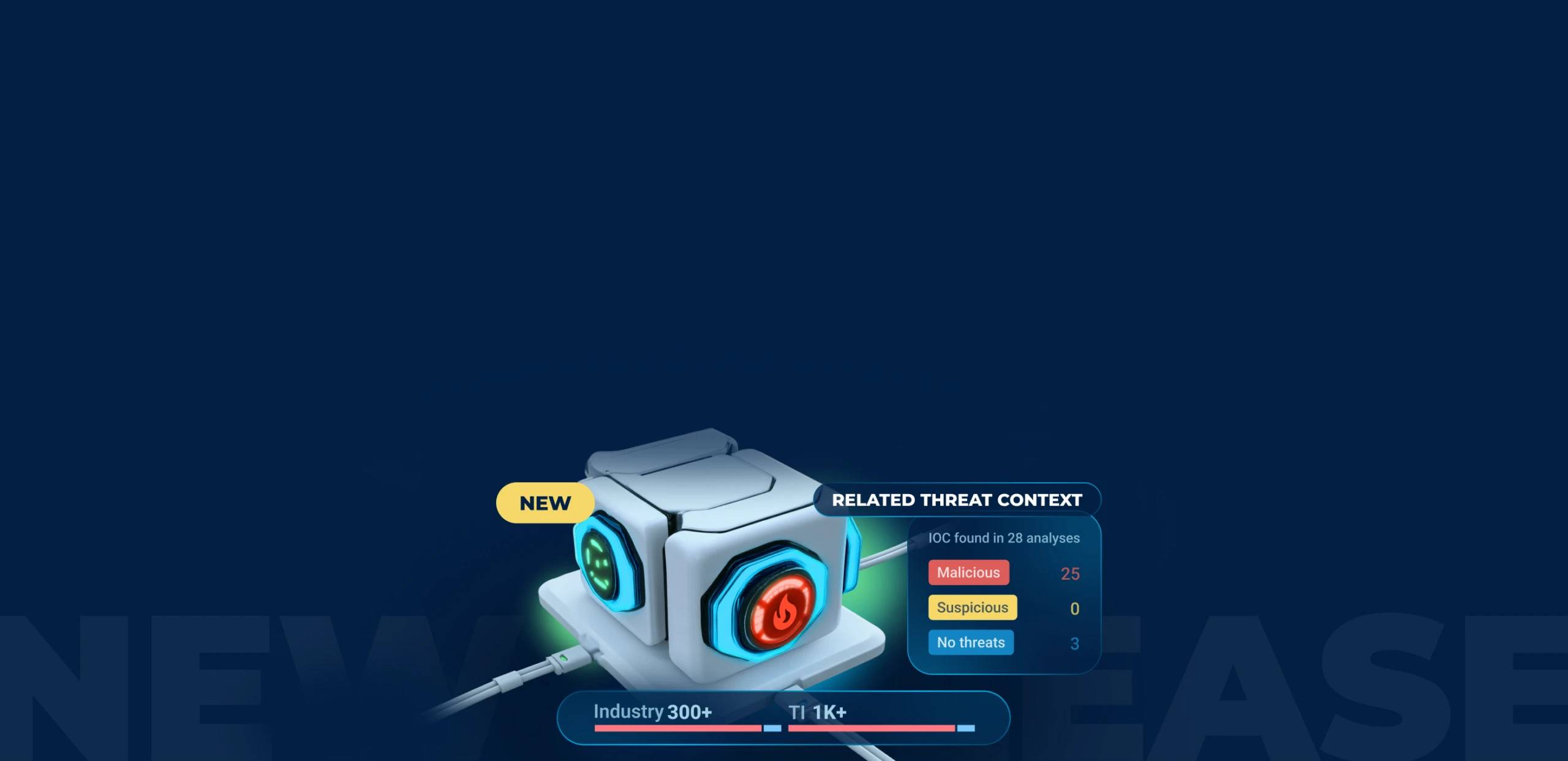
ANY.RUN’s major new upgrade, Related Threat Context, takes AI-assisted malware analysis further by bringing related threat intelligence directly into Interactive Sandbox.
Available to Enterprise clients, the capability connects findings from automated malware and phishing analysis with previous investigations and ANY.RUN Threat Intelligence. Analysts can immediately discover related activity, investigate suspicious infrastructure, and build on existing evidence without starting their research from scratch.
And with intelligence drawn from a data of 700,000+ security professionals and 16,000+ organizations, SOC teams gain access to a much wider picture of real-world threat activity.
From One Suspicious Domain to a Wider Phishing Operation
Let’s return to the OAuth phishing attack uncovered earlier.
Automated Interactivity has already exposed the malicious authentication flow. Now, Related Threat Context helps the analyst see what lies beyond the original attack.
Directly inside the malware analysis sandbox, the analyst can see 70+ related analyses available through ANY.RUN Threat Intelligence.
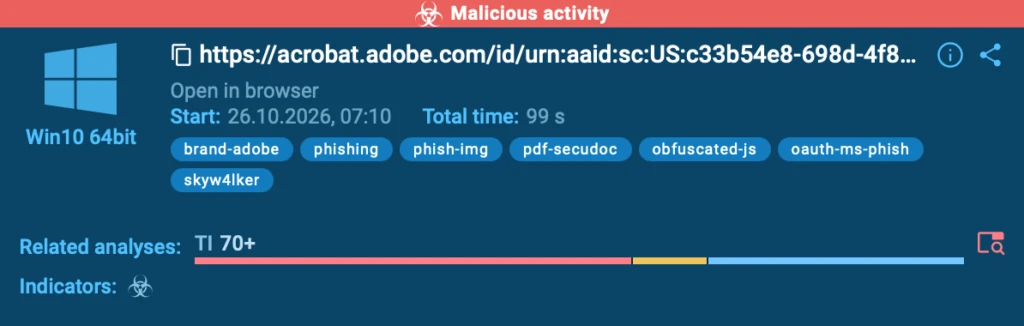
One indicator worth investigating is slybee[.]com.
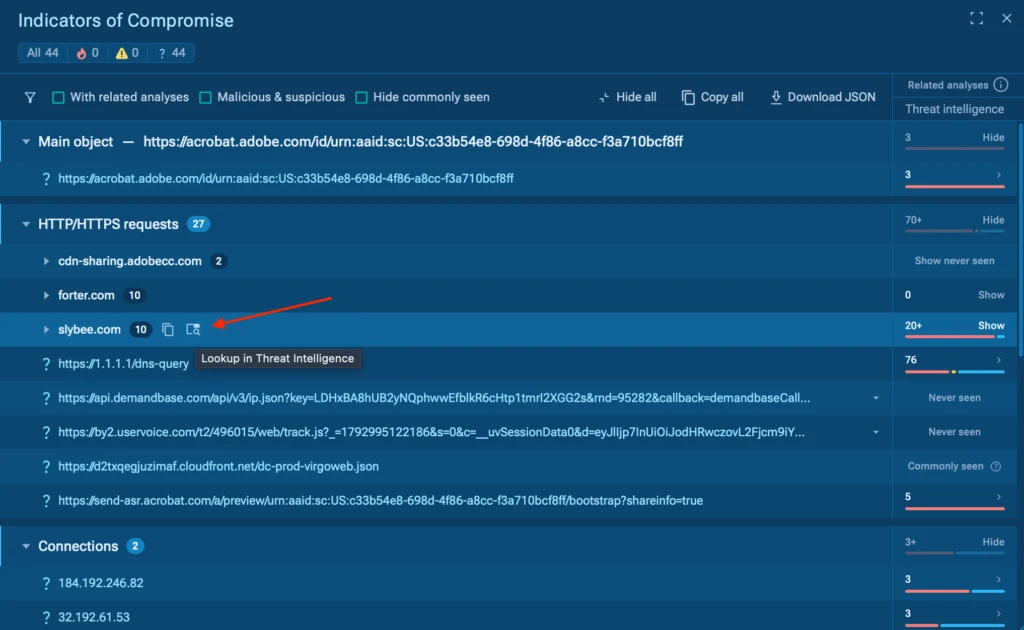
With a click on the Lookup icon, the analyst can move directly into TI Lookup and search for domainName:”slybee.com”. The results reveal:
- 40 related analyses, connecting the domain to previous sandbox investigations.
- 8 IP addresses, 29 URLs, and 41 network connections, exposing associated infrastructure and activity.
- Threat classifications including oauth-ms-phish and skyw4lker, connecting the domain to a wider phishing campaign.
- Industry risk scores and geographic insights, including a 78% risk score for Technologies, 38% for Manufacturing, and submissions from 9 countries.
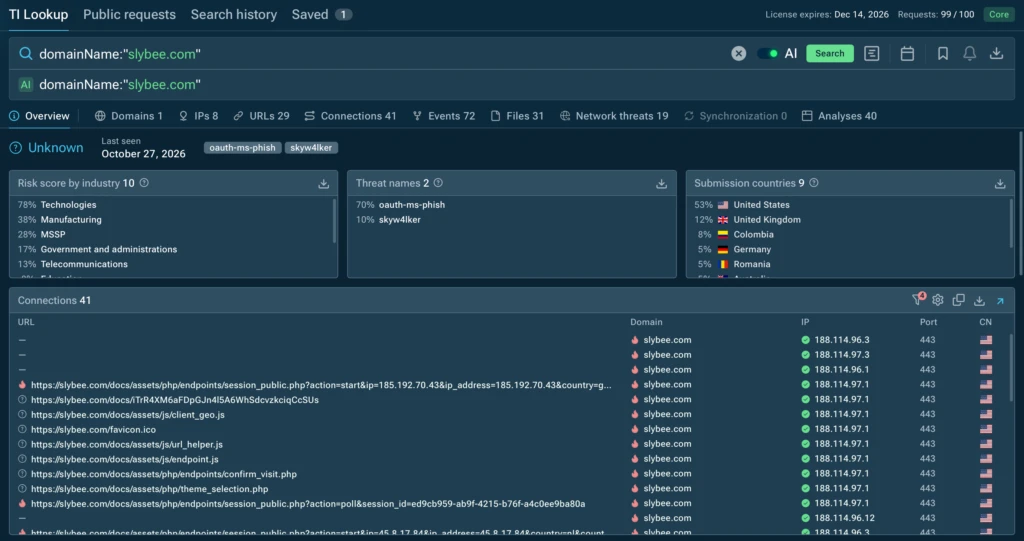
One suspicious domain has now led the analyst to infrastructure associated with SkyW4lker, a Microsoft 365 device-code phishing campaign.
And that’s the real advantage of connecting AI-powered threat investigations with broader intelligence.
Instead of ending the investigation with a malicious verdict, SOC teams can explore related infrastructure, identify additional threats, and use the findings to strengthen detection across their environment.
From AI-Assisted Investigation to Stronger SOC Detection
The value of AI in cybersecurity shouldn’t end when the sandbox finishes analyzing a sample.
When AI-assisted malware analysis is connected to threat intelligence, the findings support much more than resolving the original alert.
SOC teams use the additional context to:
- Expand threat hunting by searching for related indicators across SIEM, EDR, and network telemetry.
- Strengthen detection engineering by using validated IOCs and attack patterns uncovered through AI-assisted investigations to improve detection coverage.
- Reduce duplicated work by accessing previous investigation findings instead of researching the same indicators again.
- Improve investigation prioritization by identifying connections that deserve further analysis.
For SOC managers, this means getting more value from every investigation while reducing the time analysts spend searching for related evidence.
One investigation can now become the starting point for uncovering an entire cluster of related threats and strengthening future detection.
From Complex Evidence to Confident Decisions: AI-Powered SOC Reporting
Uncovering the attack is one challenge. Turning technical evidence into confident decisions is another.
Even after automated malware analysis reveals malicious activity, analysts still need to interpret the findings, assess potential risks, and prepare reports for further investigation or response. Across hundreds of alerts, these tasks can become a serious bottleneck for SOC teams.
ANY.RUN’s AI-powered SOC-ready Tier 1 reports accelerate SOC triage by turning complex investigation findings into clear explanations and actionable recommendations.
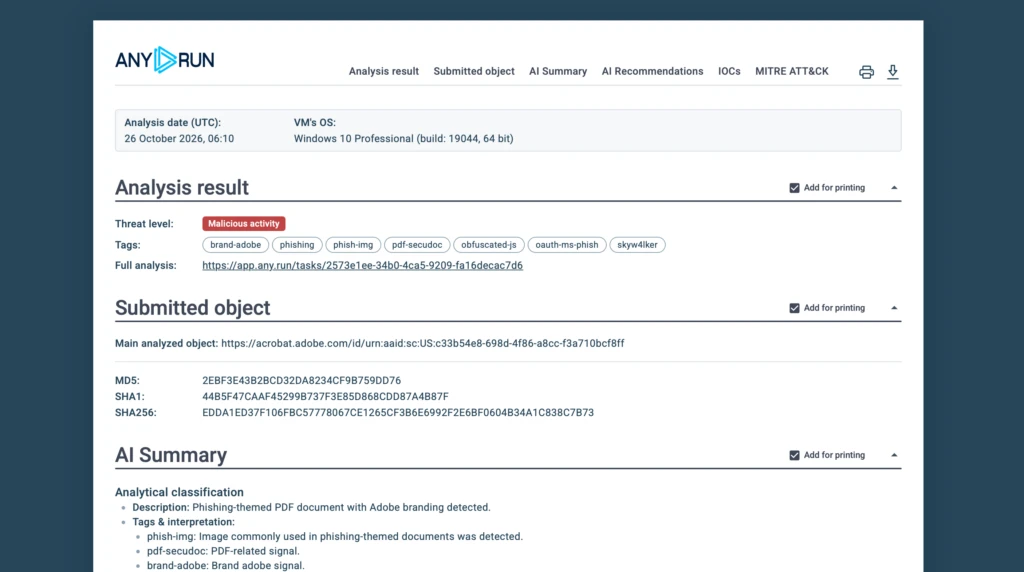
Generated directly from Interactive Sandbox, these reports combine technical evidence with AI-generated explanations and recommendations, helping analysts move from detection to decisions faster.
AI Summary: Understand the Threat Without Hours of Manual Analysis
A single malware or phishing investigation can produce dozens of network connections, suspicious URLs, behavioral indicators, and IOCs. But analysts need more than raw data. They need to understand what happened, why it’s dangerous, and which evidence matters most.
AI Summary turns complex sandbox findings into a structured explanation of the threat, highlighting key behaviors, threat classification, and potential impact.
Let’s return to our phishing investigation.
After the sandbox uncovers the Microsoft OAuth phishing activity, the analyst can generate a SOC-ready Tier 1 report containing an AI Summary alongside the threat verdict and supporting technical evidence.
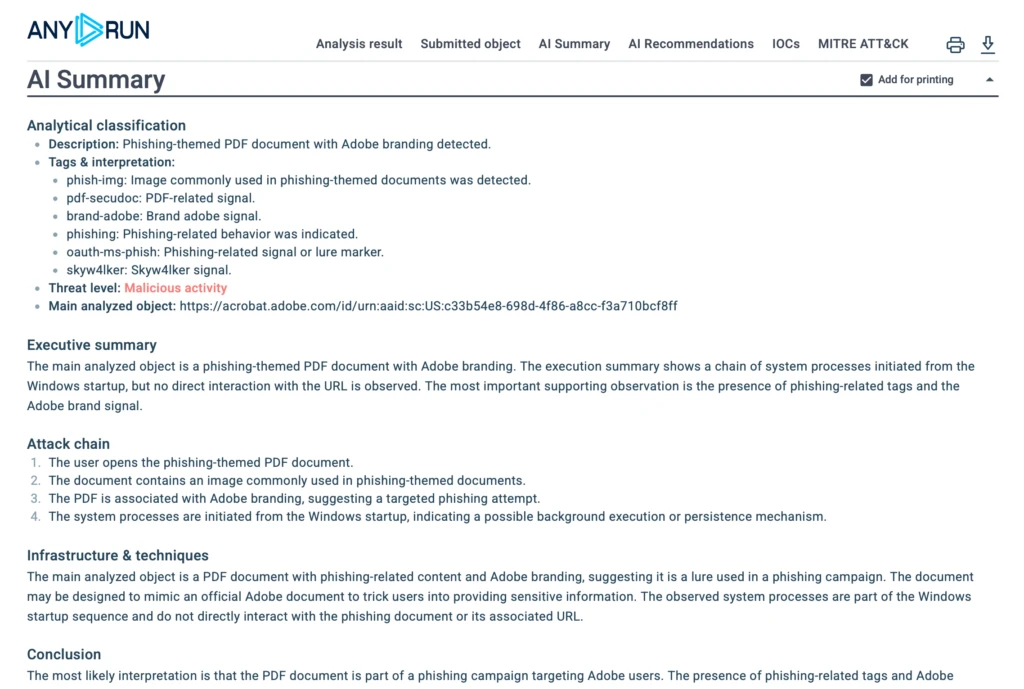
Instead of manually reconstructing the attack from individual artifacts, Tier 1 analysts receive a clear overview they can verify against the sandbox findings.
For teams looking to use AI for faster SOC triage, this means quicker threat validation, clearer handoffs, and less time spent preparing investigation reports.
When an incident requires escalation, Tier 2 can start with documented evidence rather than repeat the initial analysis.
AI Recommendations: Turn Investigation Findings into Clear Next Steps
A malicious verdict confirms the threat. But which actions should analysts prioritize next?
ANY.RUN’s AI Recommendations provides suggested investigation and response steps based on sandbox findings, helping Tier 1 analysts determine where to focus next and whether further investigation or escalation is needed.
For our OAuth phishing investigation, AI Recommendations provides specific detection and investigation steps, including system call and process spawn analysis, with relevant MITRE ATT&CK mappings and log sources.
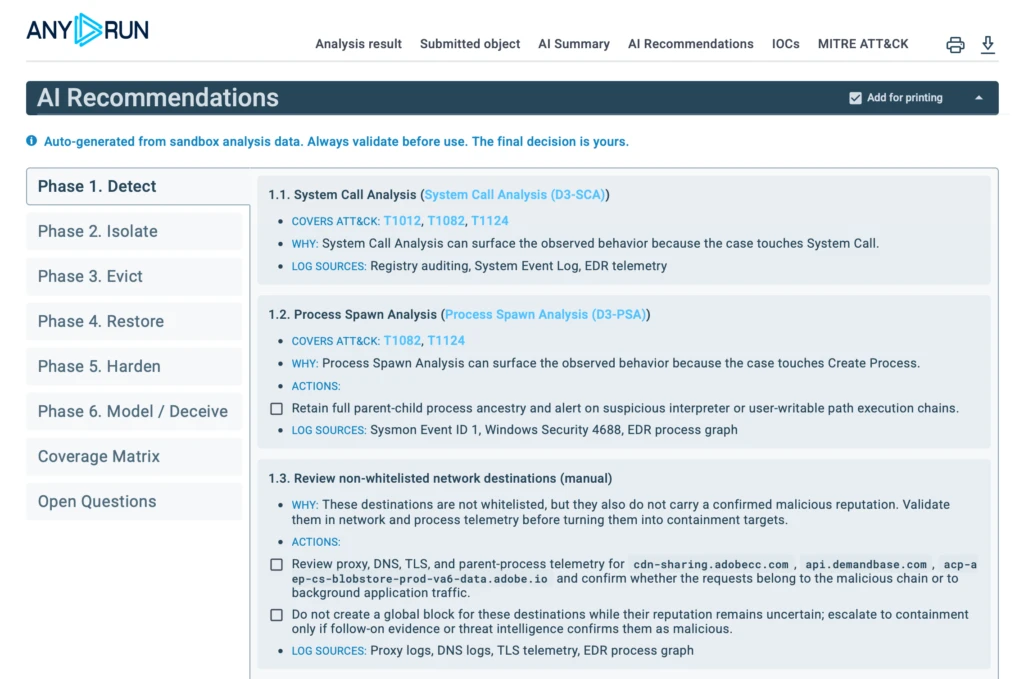
Rather than building a response plan from scratch, Tier 1 analysts can use these recommendations to prioritize their next steps, validate additional risks, and prepare more complete escalations when needed.
For SOC managers, this means less repetitive work, fewer unnecessary handoffs, and more senior analyst capacity for complex incidents.
MTTR Reduction with AI: Where SOC Teams Save the Most Time
For SOC leaders, MTTR reduction is one of the clearest ways to measure the impact of AI on SOC performance. Here’s how ANY.RUN addresses these delays across different stages of a real OAuth phishing investigation.
| Investigation stage | Where time is lost | What changed with ANY.RUN |
|---|---|---|
| Validation | Manually opening files, following links, and completing CAPTCHA challenges | Automated Interactivity navigated from the Adobe link through the PDF and subsequent attack stages to expose the phishing flow. |
| Scoping | Repeated IOC lookups and manual correlation | Related Threat Context led to 40 domain-specific analyses and infrastructure associated with Skyw4lker. |
| Decision | Interpreting technical findings and deciding what to investigate next | AI Summary helped explain the threat, while AI Recommendations provided suggested next steps. |
| Escalation | Reconstructing findings when a case moves from Tier 1 to Tier 2 | The SOC-ready Tier 1 Report provided structured evidence to support a more efficient handoff. |
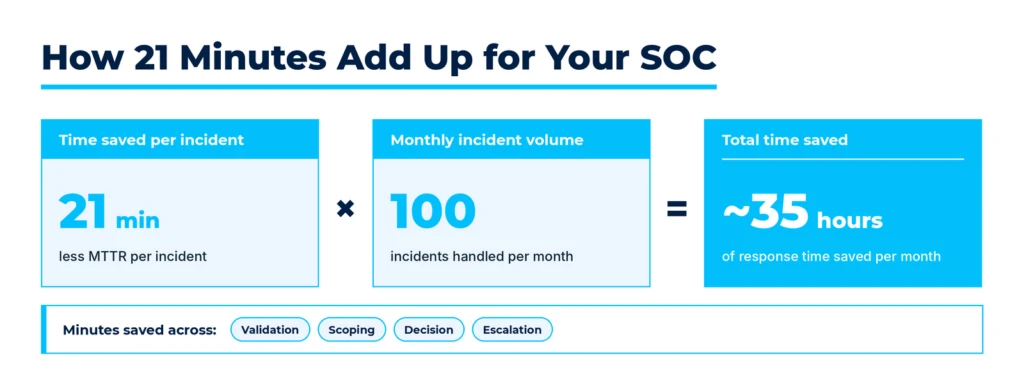
Saving minutes across these stages can add up to substantial operational gains. ANY.RUN customers report 21 minutes less MTTR per incident. For a SOC handling 100 incidents monthly, achieving the same reduction would mean approximately 35 hours of cumulative response time saved per month.
How to Measure MTTR Reduction After AI Adoption
- Establish a baseline: Measure MTTR before introducing AI-assisted investigation workflows.
- Identify bottlenecks: Track validation, scoping, decision, and escalation times to see where improvements occur.
- Compare similar incidents: Measure results by incident type and severity to avoid misleading comparisons.
The goal is to establish how much faster your SOC can move from identifying a threat to taking effective action, and how that improvement affects response capacity.
AI Cybersecurity Risks for SOC Teams: What Can Go Wrong and How to Prevent It
AI can take repetitive work off a SOC’s plate. But when its outputs influence triage and response decisions, mistakes can have serious consequences.
For SOC leaders, adopting AI means understanding its limitations and putting the right safeguards in place. Here are five risks worth addressing before relying on AI for critical investigations.
1. Inaccurate or unverifiable conclusions
AI can misinterpret technical evidence or present uncertain findings with too much confidence. Without access to the underlying data, analysts may struggle to validate conclusions, justify response decisions, or prepare reliable escalations.
How to reduce the risk: Prioritize solutions that allow analysts to verify AI-generated conclusions against observable technical evidence.
2. Overreliance on AI recommendations
Under pressure to process growing alert volumes, analysts may begin accepting AI recommendations without sufficient verification. This can lead to missed threats, inappropriate response decisions, and unnecessary escalations.
How to reduce the risk: Establish clear review requirements for critical decisions, particularly incident closure, containment, and escalation.
3. Incomplete analysis of evasive threats
Multi-stage attacks may conceal malicious behavior behind CAPTCHA challenges, QR codes, redirects, and delayed execution. If automated analysis stops before reaching the malicious stage, the resulting findings may give analysts an incomplete picture of the threat.
How to reduce the risk: Choose solutions that can navigate complex attack chains and allow analysts to intervene when deeper investigation is necessary.
4. Attacks designed to manipulate AI
Attackers can embed malicious instructions in documents, websites, or other content processed by AI systems. Known as indirect prompt injection, this technique attempts to influence AI-generated conclusions or redirect automated actions.
How to reduce the risk: Treat attacker-controlled content as untrusted, limit the actions AI systems can perform, and validate conclusions against independent technical evidence.
5. Exposure of sensitive investigation data
Suspicious files, URLs, and investigation artifacts may contain confidential business or customer information. Processing them without appropriate safeguards can create privacy, security, and compliance risks.
How to reduce the risk: Evaluate data handling policies, access controls, private analysis options, and independently assessed security practices.
How ANY.RUN Helps SOC Teams Manage AI Risks Without Sacrificing Speed
Faster investigations shouldn’t come at the expense of accuracy, visibility, or data security.
ANY.RUN combines AI-assisted malware analysis with capabilities that help SOC teams maintain control over critical investigation decisions:
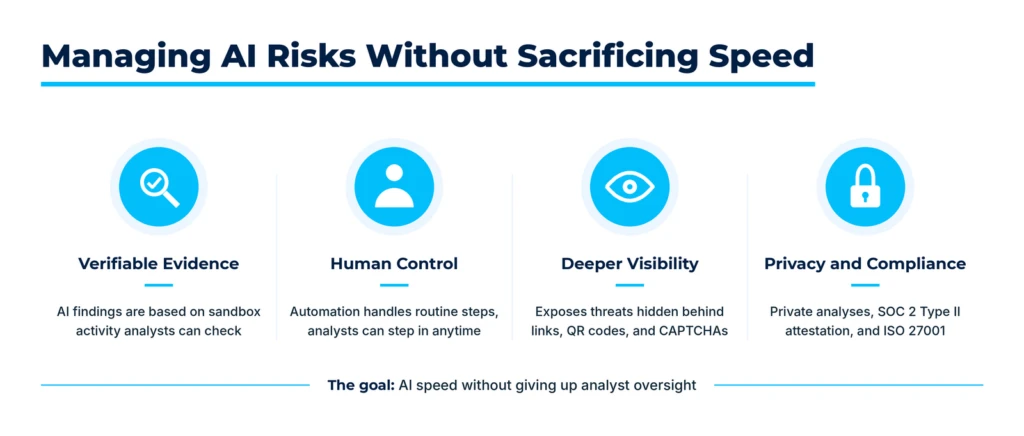
- Verifiable technical evidence: AI Summary and AI Recommendations are generated from sandbox findings, allowing analysts to examine the underlying activity rather than relying solely on AI-generated conclusions.
- Human control when it matters: Automated Interactivity handles repetitive actions, while analysts can take manual control of Interactive Sandbox whenever closer examination is needed.
- Deeper visibility into evasive threats: Automated Interactivity navigates embedded links, QR codes, CAPTCHA challenges, and multi-stage attacks to help expose malicious behavior that requires user interaction.
- Privacy and compliance: ANY.RUN offers private sandbox analyses and enterprise privacy controls to protect sensitive investigation data. Its SOC 2 Type II attestation and ISO 27001 certification demonstrate a commitment to independently assessed security controls and information security management.
The goal is to get the speed benefits of AI without giving up analyst oversight. With ANY.RUN, security teams can accelerate investigations while maintaining access to technical evidence, control over response decisions, and safeguards for sensitive data.
How to Evaluate an AI Cybersecurity Solution: 5 Key Criteria
AI capabilities can look impressive in a demonstration. But for SOC leaders, the real test is how they perform under growing alert volumes, tight response deadlines, and limited analyst capacity.
Use these five criteria to evaluate the operational and business impact of an AI cybersecurity solution.
| Criterion | What to look for | KPI to track | How ANY.RUN addresses it |
|---|---|---|---|
| Detection coverage | Ability to expose evasive, multi-stage attacks and uncover related malicious activity | Detection rate, threats identified | Interactive Sandbox and Threat Intelligence support deeper investigations. Customers report up to 58% more threats identified. |
| Response speed | Faster threat validation, investigation, and response decisions | MTTR, time to verdict | AI-assisted analysis and Tier 1 Reports support faster workflows. Customers report 21 minutes less MTTR per incident. |
| Analyst productivity | Less manual work and fewer unnecessary escalations | Tier 1-to-Tier 2 escalation rate, alerts resolved per analyst | Automated Interactivity and AI-powered reporting reduce repetitive work. Customers report 30% fewer escalations and up to 20% lower Tier 1 workload. |
| Transparency and control | Verifiable AI conclusions and opportunities for analyst intervention | AI output accuracy, analyst override rate | AI Summary provides explanations alongside technical evidence, while Interactive Sandbox allows analysts to intervene during analysis. |
| Operational integration | API access, SIEM/SOAR connectivity, and reusable threat intelligence | Integration time, automated enrichment coverage | ANY.RUN offers API/SDK access, SIEM/SOAR integrations, and STIX/TAXII threat intelligence delivery. |
Evaluate AI by what it changes in your SOC, not how many AI features appear on a product page. Better threat coverage, shorter response times, fewer escalations, and greater analyst capacity are the outcomes worth investing in.
Make Your Next SOC Investment Count
AI in cybersecurity is creating new opportunities for SOC teams to work more efficiently, investigate threats in greater depth, and make better use of their existing resources. The key is choosing capabilities that address real operational needs and deliver results beyond individual investigations.
As threats grow more complex and security demands increase, the greatest advantage comes from combining intelligent automation, human expertise, and actionable threat intelligence. Together, they can help SOC teams build the capacity to handle growing workloads while maintaining the depth and quality of their investigations.
The next step is turning that potential into measurable improvements across your security operations.
About ANY.RUN
ANY.RUN is a cybersecurity company providing cloud-based solutions for malware analysis and threat intelligence. Trusted by 700,000+ security professionals and 16,000+ organizations, ANY.RUN helps SOC teams and MSSPs detect threats, investigate suspicious activity, and respond to incidents faster.
Its solutions include Interactive Sandbox, which combines automated malware and phishing analysis with hands-on investigation capabilities, and Threat Intelligence Lookup and Feeds, which provide actionable intelligence on emerging threats and malicious infrastructure.
With AI-powered capabilities and integrations, ANY.RUN helps security teams reduce manual investigation work, improve threat visibility, and handle growing workloads without proportionally increasing resources.
Frequently Asked Questions
AI-powered malware analysis uses artificial intelligence to automate investigation steps and explain findings for suspicious files and URLs. It helps SOC teams uncover evasive threats and make triage decisions faster.
AI performs the interactions that reveal hidden threats, such as following embedded links, extracting URLs from QR codes, and solving CAPTCHAs. This exposes multi-stage attacks that basic automation misses.
AI cuts the time spent validating alerts, interpreting evidence, and deciding next steps. ANY.RUN customers report 21 minutes less MTTR per incident.
Look for dynamic behavioral analysis, automated interaction with files and URLs, and the option to take manual control. AI-assisted reporting, threat intelligence enrichment, and API integrations also matter.
It surfaces validated IOCs, related infrastructure, and attack patterns that detection engineers can turn into new detection rules and threat hunting queries.
The main risks are inaccurate conclusions, over-reliance on AI, incomplete analysis of evasive threats, and attacks designed to mislead AI. Choosing tools that keep findings verifiable and analysts in control reduces them.



0 comments