Black friday Up to 3 extra licenses FOR FREE + Special offer for TI LOOKUP Get it now
Webinar
February 26
Better SOC with Interactive Sandbox Practical Use Cases
Register now
77
Global rank
73 infographic chevron month
Month rank
63 infographic chevron week
Week rank
0
IOCs

Ryuk is a Ransomware — a type of malware that encrypts files of the victim and restores access in exchange for a ransom payment. Operating since 2018, Ryuk has been continually carrying out successful targeted attacks on organizations, netting operators millions of dollars throughout its lifetime.

Ransomware
Type
Unknown
Origin
1 August, 2018
First seen
13 September, 2026
Last seen

How to analyze Ryuk with ANY.RUN

Type
Unknown
Origin
1 August, 2018
First seen
13 September, 2026
Last seen

IOCs

IP addresses
48.209.138.168
23.46.189.219
95.100.248.133
48.192.1.64
2.23.246.101
184.86.251.11
2.21.20.138
48.209.133.15
2.16.241.205
95.100.102.101
2.21.20.152
48.192.1.65
2.16.241.201
48.209.6.48
57.153.246.3
74.178.76.54
40.126.32.138
172.211.123.249
23.58.193.160
2.21.20.144
Hashes
5e9df6d39b25455a16f0b33e0bfe3f4558cf449b0e4b121d258deee9a5ed5916
53b4be3ed1cfd712e53542b30cfe30c5db35cc48be7c57727dfec26c9e882e90
be9aeaeab5a2e4899ba7e582274ba592c1b9baf688b340a754b8ef32b23cfa9c
1f6c05feabe71f2d0236fd74faf1243bcaac0c9b70e51a0e718988f088b138fb
b96613eb6c6f2b5ef14fab4344c65863f0272d43f4f4f167204da10e1665b8c0
fcbbff501baed484c257ba9a4c337347b2994a4340534e2a896b45bb52b8aca4
f49b515eedeed1abe391bc32f15ce43d3582cb6c41ff944fa9c79f476d5824ba
2ebfc675bbed34ad1194921d989cbd7e2937273b4968c9c7e1f13d440e4e431b
3cbd0ae69e04bc21f11ad20cba0f567b7084d11bcc48fda6d48aa7fde956708f
176dc89eab773d5c26707de37d24825bb6f0424fd8add1bb020e8b3d3c1b05d7
0df7cc34e079492af7f10a4e513b054cc4c8832d73e066ab9bd75d3f366ebccd
9c1c6b085f2908f8f4f723bd045e9d1770b993150d5a2c890ac462dfccc4b7cb
9747092774ae2574be06fc70b6fffdce97a03ba6958f18046325f3261cfb0b02
c945371c3268b2ab72ff1ee24120625d257ce5cfe31553a034e08eeacfaee1c9
eeab92e3f11ef895684afe0765e5c4ff5c5fef9aec072e9f8557fa07c190723d
21b48dec2bdc5761e31c5f09c133726066451db25009249c3696af9f156eb7bb
1dc6ccf06786828dd56c969e5a6960f5b16742d3d3306c6314d29d9516ff18cb
4ec34a4f5963ef936d55b220c951f971532d277fcfdd8170be4b5ec76e9b9289
587715508a5ff933d43cfe6167bce886d868f002d7787cde4899e88160cdbf87
42b9b6639ffff1fb372d83413169ee7f221ed05da8df13796a2c26142ea281be
Domains
ecs.office.com
www.microsoft.com
google.com
crl.microsoft.com
self.events.data.microsoft.com
activation-v2.sls.microsoft.com
settings-win.data.microsoft.com
www.bing.com
login.live.com
client.wns.windows.com
slscr.update.microsoft.com
fe3cr.delivery.mp.microsoft.com
go.microsoft.com
nexusrules.officeapps.live.com
fs.microsoft.com
ctldl.windowsupdate.com
mrodevicemgr.officeapps.live.com
ocsp.digicert.com
dns.msftncsi.com
update.googleapis.com
URLs
http://crl.microsoft.com/pki/crl/products/microoceraut2011_2011_03_22.crl
http://www.microsoft.com/pkiops/crl/micsecserca2011_2011-10-18.crl
https://activation-v2.sls.microsoft.com/slactivateproduct/slactivateproduct.asmx?configextension=retail
https://www.bing.com/threshold/xls.aspx?t=5&dl=1&f=9&wsbc=1
http://www.microsoft.com/pkiops/crl/microsoft%20update%20signing%20ca%202.2.crl
http://crl.microsoft.com/pki/crl/products/microoceraut_2010-06-23.crl
http://www.microsoft.com/pkiops/crl/microsoft%20time-stamp%20pca%202010(1).crl
https://settings-win.data.microsoft.com/settings/v3.0/wsd/muse?processorclockspeed=3094&flightids=&updateoffereddays=4294967295&branchreadinesslevel=cb&oemmanufacturername=dell&isclouddomainjoined=0&processoridentifier=amd64%20family%2023%20model%201%20stepping%202&sku=48&activationchannel=retail&attrdataver=186&ismdmenrolled=0&processorcores=6&processormodel=amd%20ryzen%205%203500%206-core%20processor&totalphysicalram=6144&primarydisktype=4294967295&flightingbranchname=&chassistypeid=1&oemmodelnumber=dell&systemvolumetotalcapacity=260281&sampleid=95271487&deviceclass=windows.desktop&app=muse&disabledualscan=0&appver=10.0&oemsubmodel=j5cr&locale=en-us&isalwaysonalwaysconnectedcapable=0&ms=0&defaultuserregion=244&updateserviceurl=http%3a%2f%2fneverupdatewindows10.com&osver=10.0.19045.4046.amd64fre.vb_release.191206-1406&os=windows&deviceid=s%3abad99146-31d3-4ec6-a1a4-be76f32ba5d4&deferqualityupdateperiodindays=0&ring=retail&deferfeatureupdateperiodindays=30
https://settings-win.data.microsoft.com/settings/v3.0/onesettings/client?osversionfull=10.0.19045.4046.amd64fre.vb_release.191206-1406&localdeviceid=s%3abad99146-31d3-4ec6-a1a4-be76f32ba5d4&flightring=retail&attrdataver=186&osuilocale=en-us&osskuid=48&app=wosc&appver=&isflightingenabled=0&telemetrylevel=1&devicefamily=windows.desktop
https://settings-win.data.microsoft.com/settings/v3.0/wsd/waasassessment?os=windows&osver=10.0.19041.1.amd64fre.vb_release.191206-&ring=retail&sku=48&deviceclass=windows.desktop&locale=en-us&deviceid=bad99146-31d3-4ec6-a1a4-be76f32ba5d4&flightring=retail&telemetrylevel=1&hidovergattreg=c%3a%5cwindows%5csystem32%5cdriverstore%5cfilerepository%5chidbthle.inf_amd64_9610b4821fdf82a5%5cmicrosoft.bluetooth.profiles.hidovergatt.dll&appver=10.0&processoridentifier=amd64%20family%2023%20model%201%20stepping%202&oemmodel=dell&updateoffereddays=4294967295&processormanufacturer=authenticamd&installdate=1661339444&oemmodelbaseboard=&branchreadinesslevel=cb&oemsubmodel=j5cr&isclouddomainjoined=0&deferfeatureupdateperiodindays=30&isdeviceretaildemo=0&flightingbranchname=&osuilocale=en-us&devicefamily=windows.desktop&wuclientver=10.0.19041.3996&uninstallactive=1&isflightingenabled=0&osskuid=48&processorclockspeed=3094&totalphysicalram=6144&securebootcapable=0&app=waasassessment&processorcores=6&currentbranch=vb_release&installlanguage=en-us&deferqualityupdateperiodindays=0&servicingbranch=cb&oemname_uncleaned=dell&tpmversion=0&primarydisktotalcapacity=262144&installationtype=client&attrdataver=186&processormodel=amd%20ryzen%205%203500%206-core%20processor&isedgewithchromiuminstalled=1&osversion=10.0.19045.4046&ismdmenrolled=0&activationchannel=retail&honorwufbdeferrals=1&firmwareversion=a.40&trendinstalledkey=1&osarchitecture=amd64&defaultuserregion=244&updatemanagementgroup=2
https://login.live.com/rst2.srf
https://go.microsoft.com/fwlink/?linkid=2257403&clcid=0x409
https://login.live.com/ppsecure/deviceaddcredential.srf
https://slscr.update.microsoft.com/sls/%7b522d76a4-93e1-47f8-b8ce-07c937ad1a1e%7d/x64/10.0.19045.4046/0?ch=686&l=en-us&p=&pt=0x30&wua=10.0.19041.3996&mk=dell&md=dell
http://www.microsoft.com/pkiops/crl/microsoft%20update%20signing%20ca%202.3.crl
http://www.microsoft.com/pkiops/crl/microsoft%20ecc%20product%20root%20certificate%20authority%202018.crl
https://fe3cr.delivery.mp.microsoft.com/clientwebservice/ping
http://www.microsoft.com/pkiops/crl/microsoft%20ecc%20update%20signing%20ca%202.2.crl
https://slscr.update.microsoft.com/sls/ping
https://slscr.update.microsoft.com/sls/%7be7a50285-d08d-499d-9ff8-180fdc2332bc%7d/x64/10.0.19045.4046/0?ch=686&l=en-us&p=&pt=0x30&wua=10.0.19041.3996&mk=dell&md=dell
Last Seen at

Recent blog posts

post image
ANY.RUN Secures Leader Status in G2’s Malware...
watchers 4744
comments 0
post image
15 Minutes Saved Per Alert: How a Lean German...
watchers 9543
comments 0
post image
HVNC Backdoor Targets LATAM Organizations wit...
watchers 11471
comments 0

What is Ryuk Ransomware?

Ryuk is a highly targeted Ransomware — a malware that encrypts files of its victims and demands a payment to restore access to information. Ryuk was first identified in august 2018 and remains active to this day. It attacks newspapers, public institutions, banks, restaurants, and other businesses.

Although it is not considered to be the most high-tech malware in its class, Ryuk Ransomware is very successful. In fact, according to the FBI, it is the number one Ransomware in terms of completed ransom payments.

Thanks to a highly targeted approach to distribution, the malware has managed to infiltrate thousands of PCs and yielded attackers millions of US dollars. In fact, some of the ransoms paid by organizations reach 400,000 US dollars.

Despite not being the most cutting-edge, Ryuk is not be toyed with.

General description of Ryuk Ransomware

The success of Ryuk Ransomware likely can be tied to its selective attack approach. While a lot of malicious programs nowadays are starting to move away from widespread email spam campaigns, Ryuk malware goes another step forward. Its attacks not only use collected information about the victim for initial payload delivery but even the encryption process is being tailored to each victim, targeting the most valuable files.

This fact indicates that operators behind Ryuk malware carefully study each victim and perform expensive scouting and network mapping.

On top of that, Ryuk Ransomware operators are flexible with Ransom demands and adjust not only the ransom amount but also the ransom note context. At least two variants of the ransom note were observed since Ryuk Ransomware became active in 2018. One was well-written, almost polite, and quite long, used in an attack on a large organization with a high ransom demand. The use of a second variant was recorded in the majority of attacks on smaller victims. It is much shorter and uses more blunt and straightforward wording.

Some researchers expressed an opinion that this variation in ransom notes may indicate that the Ryuk Ransomware team uses two separate attack approaches with different complexity.

Preparing for attacks very carefully and learning about each victim allowed the Ryuk malware team to carry out successful campaigns with huge ransom demands. According to some data the average demanded ransom amount is around 674,039 US dollars, while the highest recorded ransom demand was over a million US dollars.

It is not exactly obvious who stands behind this Ransomware. Some evidence and code similarities to another Ransomware called Hermes point towards a North Korean APT, Lazarus Group. However, this is not hard evidence, considering that a sample of Hermes could have fallen into the hands of another criminal and serve as a base for Ryuk's development.

Other reports based on more recent data link Ryuk Ransomware to a Russian criminal group named WIZARD SPIDER, which is known for its work with TrickBot malware. For example, cybersecurity researchers found documents that contained Russian words in filenames while investigating a compromised network, that fell victim to Ryuk. This suggests that the WIZARD SPIDER hypothesis is more likely than the Korean connection.

Additionally, Ryuk checks the keyboard language and terminates execution if it detects Russian, Belarus, or Ukrainian languages, which can be used as a killswitch. This kind of behavior is typical for a malicious program that originated on an ex-USSR territory.

Ryuk malware analysis

A video recorded in the ANY.RUN malware hunting service allows us to watch the execution process of Ryuk malware in action.
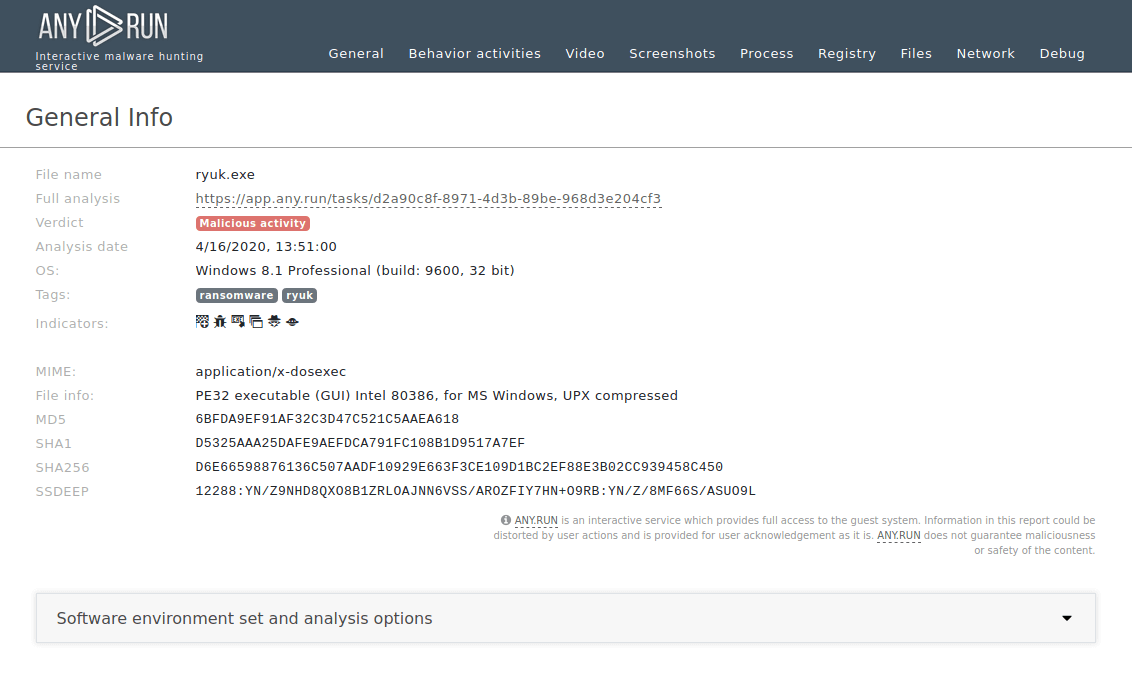
ryuk_ransomware_text_report

Figure 1: Displays the text report generated by the ANY.RUN malware hunting service

ryuk_ransomware_ransom_note_variant

Figure 2: One of the variants of the Ryuk ransom note
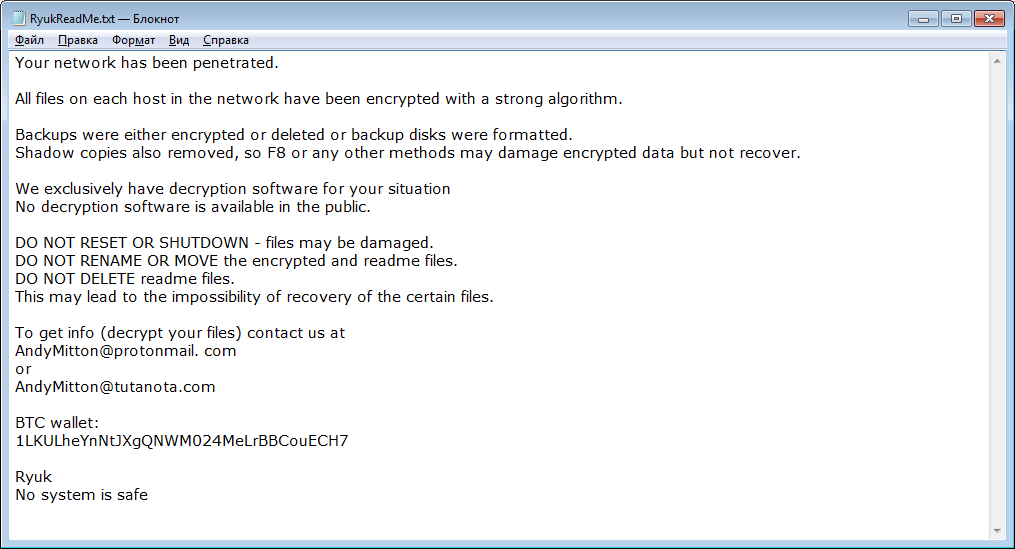
ryuk_ransomware_ransom_note_variant

Figure 3: One of the variants of the Ryuk ransom note
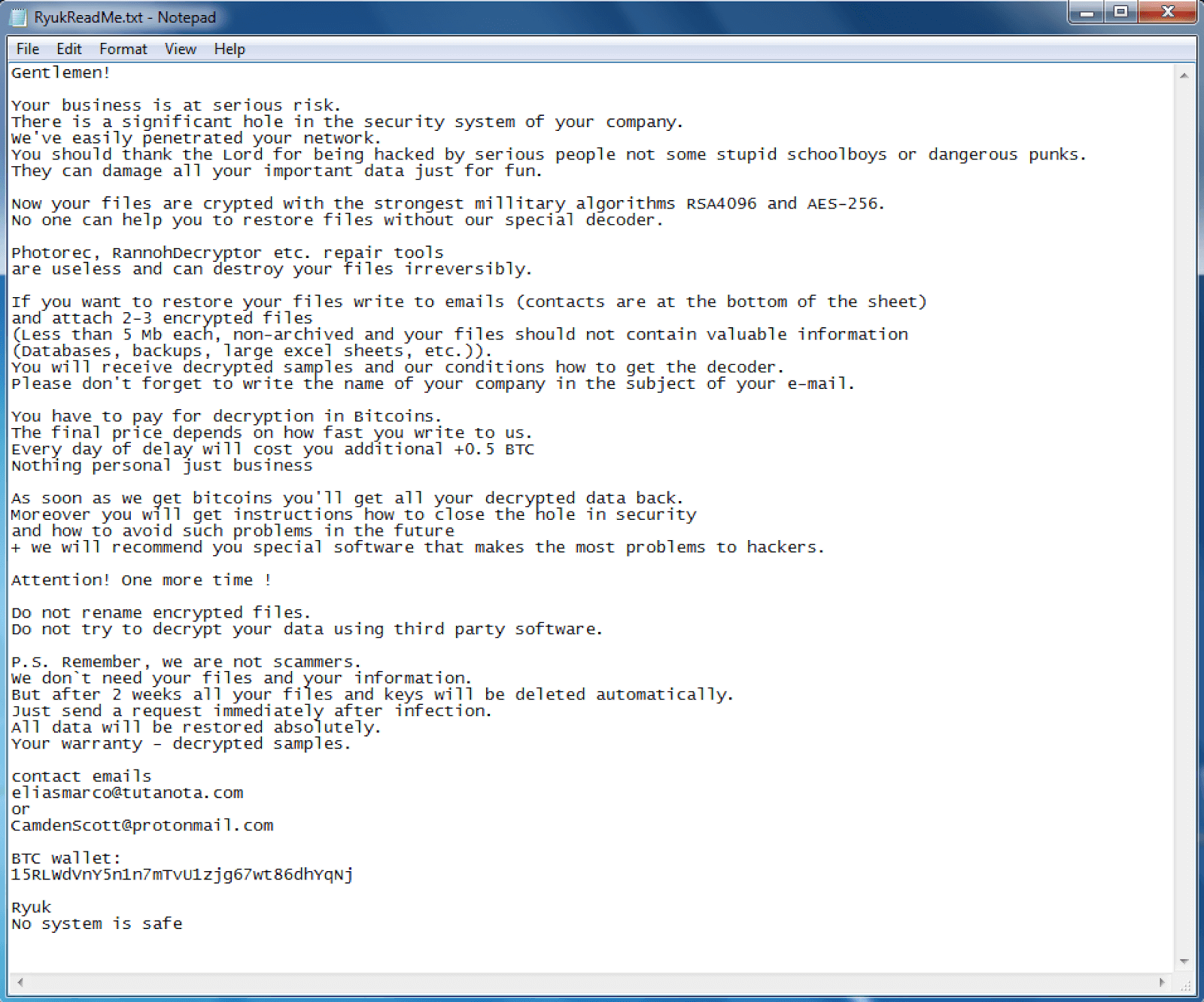
ryuk_ransomware_ransom_note_variant

Figure 4: One of the variants of the Ryuk ransom note

Ryuk Ransomware execution process

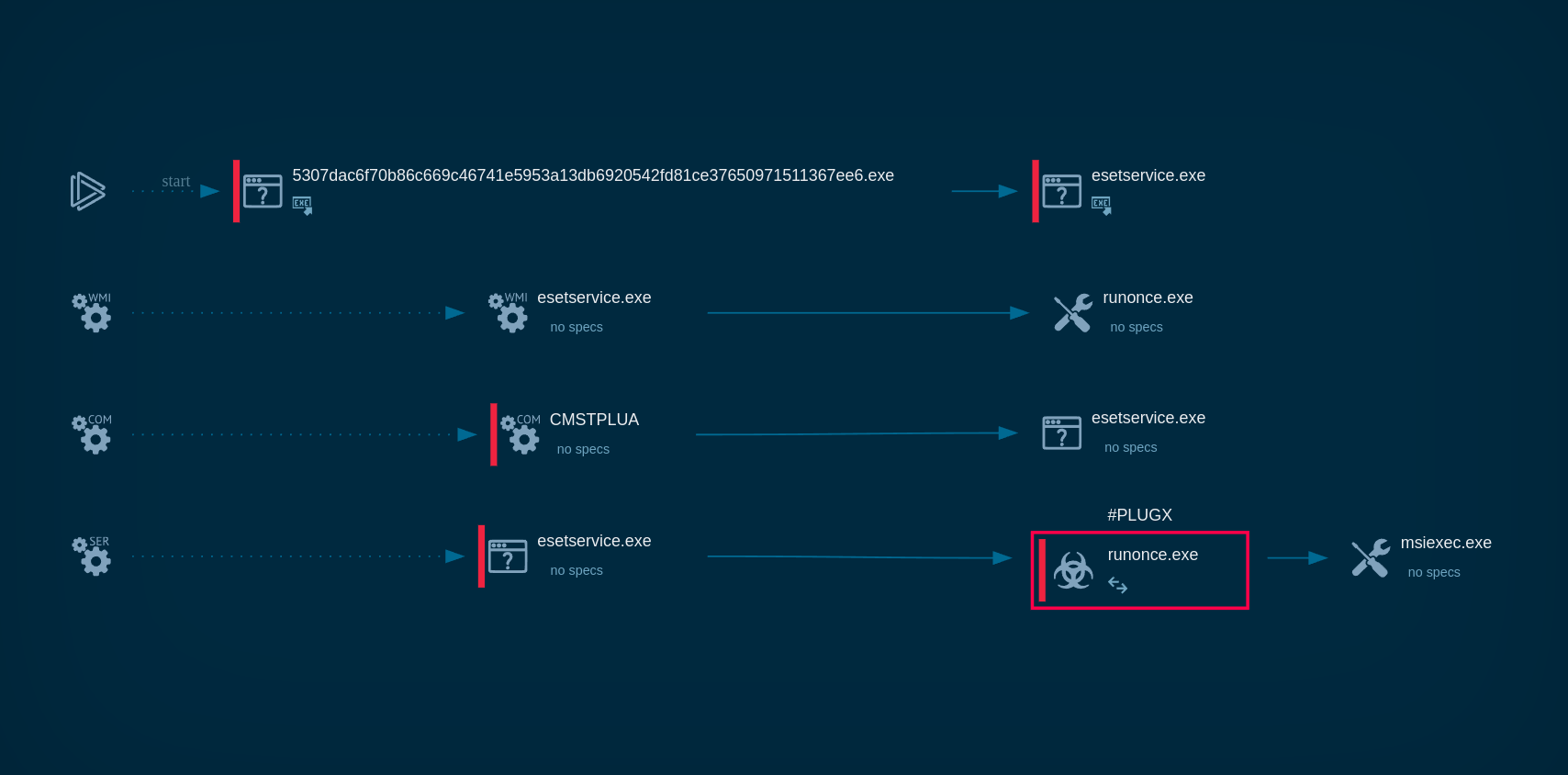
The execution process of Ryuk is not much different from other ransomware such as WannaCry or Netwalker. After the executable file makes its way into an infected system and runs, the main malicious activity begins. Like many other ransomware families, Ryuk deletes shadow copy files. It also stops processes from the hardcoded list. Like other malware of this type, it creates a text or HTML file with a ransom note.

Ryuk Ransomware distribution

In many instances of confirmed Ryuk malware infections, the victim’s machine was also infiltrated by TrickBot. This led researchers to believe that Ryuk Ransomware makes its way into computers with TrickBot, which in turn is usually delivered through mail spam or with a Trojan Emotet.

This distribution method further supports the theory that Ryuk is operated by WIZARD SPIDER.

It is a known fact that the organization associated with Emotet is MUMMY SPIDER, which has been connected with the WIZARD gang in the past.

Conclusion

A high degree of personalization and a careful approach to victim selection made Ryuk Ransomware exceptionally successful. To date, malware operators behind the Ransomware have already collected over 64 million US dollars in payments, according to the FBI reports. The recipe for success is simple but solid — attackers choose successful businesses, that are definitely capable of paying the ransom and quite often will lose more money if they withhold the payment since their operation becomes completely frozen by the inability to access the most vital information.

Unfortunately, this means that a lot of the victims gave in to the demands of the criminals and unwillingly supported future attacks. It is a known fact, that besides capturing Ransomware operators, arguably the most important thing to do — is not paying the ransom.

Sadly, with the success that Ryuk malware has, it is unrealistic to hope that the attacks will stop in the near future. Therefore, the best thing to do now is to study this malware and prepare defense measures against it. Thankfully, ANY.RUN malware hunting service gives cyber teams all the tools they need to analyze Ryuk Ransomware in a secure online interactive sandbox.
HAVE A LOOK AT

Sality screenshot
Sality
sality
Sality is a highly sophisticated malware known for infecting executable files and rapidly spreading across networks. It primarily creates a peer-to-peer botnet that is used for malicious activities such as spamming, data theft, and downloading additional malware. Sality has strong persistence mechanisms, including disabling security software, making it difficult to remove. Its ability to spread quickly and silently, along with its polymorphic nature, allows it to evade detection by traditional antivirus solutions.
Read More
Stealc screenshot
Stealc
stealc
Stealc is a stealer malware that targets victims’ sensitive data, which it exfiltrates from browsers, messaging apps, and other software. The malware is equipped with advanced features, including fingerprinting, control panel, evasion mechanisms, string obfuscation, etc. Stealc establishes persistence and communicates with its C2 server through HTTP POST requests.
Read More
EvilProxy screenshot
EvilProxy
evilproxy
EvilProxy is a phishing-as-a-service (PhaaS) platform that enables cybercriminals to bypass multi-factor authentication (MFA) and hijack user sessions. It leverages reverse proxy techniques to harvest credentials and session cookies, posing a serious threat to both individuals and enterprises.
Read More
XRed screenshot
XRed
xred
XRed operates as a stealthy backdoor, enabling cybercriminals to gain unauthorized remote access to infected systems. XRed has gained particular notoriety for its distribution through trojanized legitimate software and hardware drivers, making it exceptionally dangerous due to its ability to masquerade as trusted applications.
Read More
Phorpiex screenshot
Phorpiex
phorpiex
Phorpiex is a malicious software that has been a significant threat in the cybersecurity landscape since 2016. It is a modular malware known for its ability to maintain an extensive botnet. Unlike other botnets, Phorpiex does not concentrate on DDoS attacks. Instead, it has been involved in numerous large-scale spam email campaigns and the distribution of other malicious payloads, such as LockBit.
Read More
Orcus RAT screenshot
Orcus RAT
orcus rat trojan
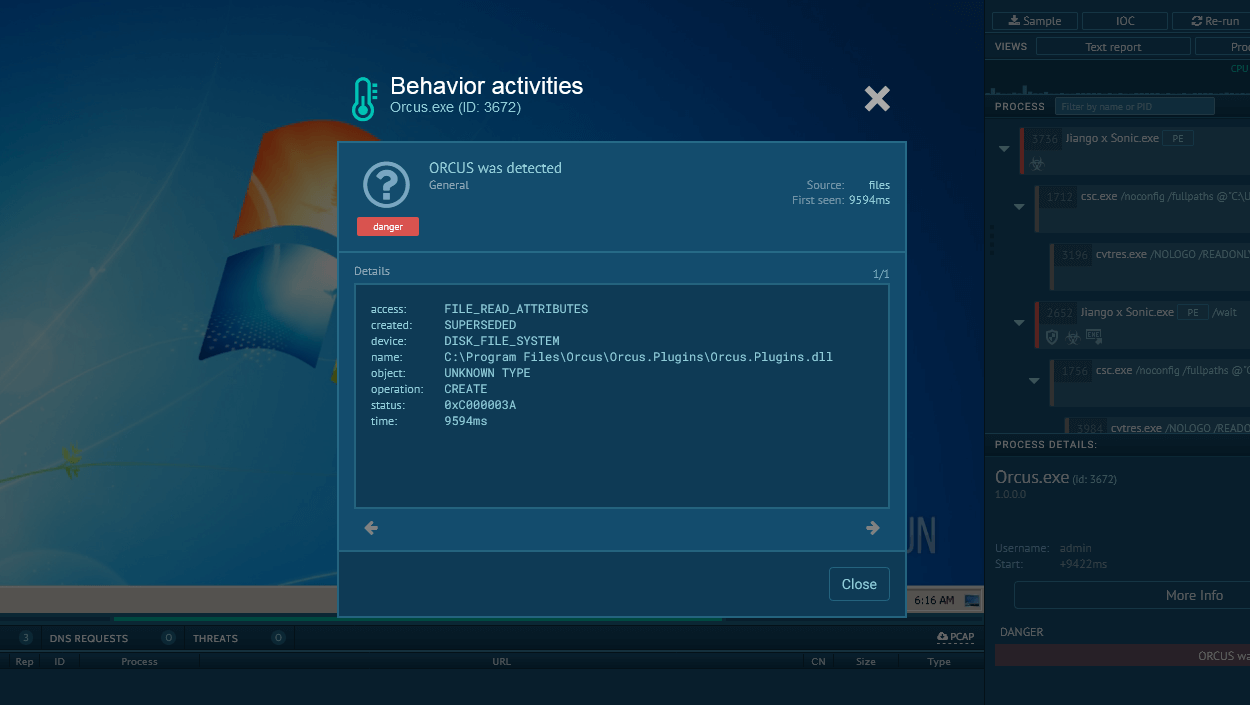
Orcus is a modular Remote Access Trojan with some unusual functions. This RAT enables attackers to create plugins using a custom development library and offers a robust core feature set that makes it one of the most dangerous malicious programs in its class.
Read More