Black friday Up to 3 extra licenses FOR FREE + Special offer for TI LOOKUP Get it now
Webinar
February 26
Better SOC with Interactive Sandbox Practical Use Cases
Register now

MetaStealer

63
Global rank
112 infographic chevron month
Month rank
89 infographic chevron week
Week rank
0
IOCs

MetaStealer is an info-stealing malware primarily targeting sensitive data like login credentials, payment details, and browser history. It typically infects systems via phishing emails or malicious downloads and can exfiltrate data to a command and control (C2) server. MetaStealer is known for its stealthy techniques, including evasion and persistence mechanisms, which make it difficult to detect. This malware has been actively used in various cyberattacks, particularly for financial theft and credential harvesting from individuals and organizations.

Stealer
Type
Unknown
Origin
1 March, 2022
First seen
9 August, 2026
Last seen

How to analyze MetaStealer with ANY.RUN

Type
Unknown
Origin
1 March, 2022
First seen
9 August, 2026
Last seen

IOCs

IP addresses
135.236.137.174
65.9.130.56
65.9.130.84
13.226.244.116
188.114.96.3
142.250.154.113
135.233.95.144
23.52.181.141
20.190.159.129
52.222.136.87
76.76.21.98
131.253.33.203
104.19.230.21
18.239.36.63
18.173.205.46
23.59.18.102
2.16.204.141
48.209.6.48
172.64.149.23
2.21.20.133
Hashes
226eec4486509917aa336afebd6ff65777b75b65f1fb06891d2a857a9421a974
32d83ff113fef532a9f97e0d2831f8656628ab1c99e9060f0332b1532839afd9
1f78f1056761c6ebd8965ed2c06295bafa704b253aff56c492b93151ab642899
fdace7f8ebf8cd4a8ca18a172a604132cc2bcf000083df69a4b9d54a10dc1be6
38ca46547c8c7c5c0c8e394ea355a03c26a08adb63b39fc95aa5461b5321da7c
b79838b15a988ea1aaaead3ba1353d54085cc76008489fb42f614e96f8b46aab
7852fce59c67ddf1d6b8b997eaa1adfac004a9f3a91c37295de9223674011fba
f9d31b278e215eb0d0e9cd709edfa037e828f36214ab7906f612160fead4b2b4
ec1702806f4cc7c42a82fc2b38e89835fde7c64bb32060e0823c9077ca92efb7
2fb9826a1b43c84c08f26c4b4556c6520f8f5eef8ab1c83011031eb2d83d6663
91ea40cc15f4a35b32dcb60e26399b0fa9f98181241a19fbff0ed72909c8a738
d221d61edebd3d8b99f14ce7d39d71c5e758ef6208c9abeaf11b7385cb36e94c
958537c09081d179e33363c71403765334a1f3018cb81b776000db4e46ce4818
68ef74342ede5098c3ccedb81830e406219cba1fbb5ce96b707a83efb1f90331
58c4998d749792af709d3af03c0ca9a315244d20711a6ee1132f42c73a2d752b
675b32ef4ad9f8f90bc5620461bbf2a9e2a4d85b23f2ebe10cc38910af09676c
4989ed047eb9cae91186d93dc0c73674cccb83764d3a00347323124b1fa44546
90a95f5b14f4508d0e4b2df222e18e7f354c1452e597cecff851049b3e0f7747
2a9976d4efcfdf3d98de3e61ef32b6404e9d59182f0fa48f487c059d81415d3b
8c0b098e42a851810cdea2b5f158304d3eff9115b1cddf3b7a5287873f59ad80
Domains
mc6.reasonsecurity.com
b.stripecdn.com
3bc008208b67.w.hcaptcha.com
fe3cr.delivery.mp.microsoft.com
js.stripe.com
crl.microsoft.com
login.live.com
ocsp.sectigo.com
api.reasonsecurity.com
www.gstatic.com
m.stripe.network
pac.rlinfraservices.com
nexusrules.officeapps.live.com
newassets.hcaptcha.com
config.reasonsecurity.com
d0dcde225147.w.hcaptcha.com
client.wns.windows.com
api2.hcaptcha.com
www.microsoft.com
play.google.com
URLs
https://go.microsoft.com/fwlink/?linkid=2257403&clcid=0x409
https://pac.rlinfraservices.com/
https://login.live.com/rst2.srf
https://settings-win.data.microsoft.com/settings/v3.0/onesettings/client?osversionfull=10.0.19045.4046.amd64fre.vb_release.191206-1406&localdeviceid=s%3abad99146-31d3-4ec6-a1a4-be76f32ba5d4&flightring=retail&attrdataver=186&osuilocale=en-us&osskuid=48&app=wosc&appver=&isflightingenabled=0&telemetrylevel=1&devicefamily=windows.desktop
http://ocsp.digicert.com/mfewtzbnmeswstajbgurdgmcgguabbq50otx%2fh0ztl%2bz8sipi7wewvxdlqqutijuibiv5unu5g%2f6%2brks7qyxjzkceaz1vqyrvgl0erhqlcpm8gy%3d
http://crl.microsoft.com/pki/crl/products/microoceraut2011_2011_03_22.crl
http://www.microsoft.com/pkiops/crl/micsecserca2011_2011-10-18.crl
https://login.live.com/ppsecure/deviceaddcredential.srf
https://settings-win.data.microsoft.com/settings/v3.0/wsd/waasassessment?os=windows&osver=10.0.19041.1.amd64fre.vb_release.191206-&ring=retail&sku=48&deviceclass=windows.desktop&locale=en-us&deviceid=bad99146-31d3-4ec6-a1a4-be76f32ba5d4&flightring=retail&telemetrylevel=1&hidovergattreg=c%3a%5cwindows%5csystem32%5cdriverstore%5cfilerepository%5chidbthle.inf_amd64_9610b4821fdf82a5%5cmicrosoft.bluetooth.profiles.hidovergatt.dll&appver=10.0&processoridentifier=amd64%20family%2023%20model%201%20stepping%202&oemmodel=dell&updateoffereddays=4294967295&processormanufacturer=authenticamd&installdate=1661339444&oemmodelbaseboard=&branchreadinesslevel=cb&oemsubmodel=j5cr&isclouddomainjoined=0&deferfeatureupdateperiodindays=30&isdeviceretaildemo=0&flightingbranchname=&osuilocale=en-us&devicefamily=windows.desktop&wuclientver=10.0.19041.3996&uninstallactive=1&isflightingenabled=0&osskuid=48&processorclockspeed=3094&totalphysicalram=6144&securebootcapable=0&app=waasassessment&processorcores=6&currentbranch=vb_release&installlanguage=en-us&deferqualityupdateperiodindays=0&servicingbranch=cb&oemname_uncleaned=dell&tpmversion=0&primarydisktotalcapacity=262144&installationtype=client&attrdataver=186&processormodel=amd%20ryzen%205%203500%206-core%20processor&isedgewithchromiuminstalled=1&osversion=10.0.19045.4046&ismdmenrolled=0&activationchannel=retail&honorwufbdeferrals=1&firmwareversion=a.40&trendinstalledkey=1&osarchitecture=amd64&defaultuserregion=244&updatemanagementgroup=2
https://settings-win.data.microsoft.com/settings/v3.0/flightsettings/fsservice?processorclockspeed=3094&isretailos=1&oemmanufacturername=dell&flightingpolicyvalue=3&enablepreviewbuilds=4294967295&osversionfull=10.0.19045.4046.amd64fre.vb_release.191206-1406&managepreviewbuilds=3&branchreadinesslevelsource=0&attrdataver=186&processorcores=6&branchreadinesslevelraw=16&totalphysicalram=6144&tpmversion=0&oemmodelnumber=dell&systemvolumetotalcapacity=260281&deviceid=s%3abad99146-31d3-4ec6-a1a4-be76f32ba5d4&app=fss&appver=10.0&smartactivehoursstate=1&activehoursstart=20&securebootcapable=0&activehoursend=13&devicefamily=windows.desktop
https://update.reasonsecurity.com/v2/update
https://settings-win.data.microsoft.com/settings/v3.0/waas/featuremanagement?isclouddomainjoined=0&processoridentifier=amd64%20family%2023%20model%201%20stepping%202&currentbranch=vb_release&accountfirstchar=&activationchannel=retail&oemmodel=dell&flightring=retail&attrdataver=186&installlanguage=en-us&osuilocale=en-us&webexperience=1&flightingbranchname=&chassistypeid=1&osskuid=48&app=cdm&installdate=1661339444&appver=&osarchitecture=amd64&defaultuserregion=244&telemetrylevel=1&osversion=10.0.19045.4046&devicefamily=windows.desktop
https://settings-win.data.microsoft.com/settings/v3.0/wsd/muse?processorclockspeed=3094&flightids=&updateoffereddays=4294967295&branchreadinesslevel=cb&oemmanufacturername=dell&isclouddomainjoined=0&processoridentifier=amd64%20family%2023%20model%201%20stepping%202&sku=48&activationchannel=retail&attrdataver=186&ismdmenrolled=0&processorcores=6&processormodel=amd%20ryzen%205%203500%206-core%20processor&totalphysicalram=6144&primarydisktype=4294967295&flightingbranchname=&chassistypeid=1&oemmodelnumber=dell&systemvolumetotalcapacity=260281&sampleid=95271487&deviceclass=windows.desktop&app=muse&disabledualscan=0&appver=10.0&oemsubmodel=j5cr&locale=en-us&isalwaysonalwaysconnectedcapable=0&ms=0&defaultuserregion=244&updateserviceurl=http%3a%2f%2fneverupdatewindows10.com&osver=10.0.19045.4046.amd64fre.vb_release.191206-1406&os=windows&deviceid=s%3abad99146-31d3-4ec6-a1a4-be76f32ba5d4&deferqualityupdateperiodindays=0&ring=retail&deferfeatureupdateperiodindays=30
https://electron-shell.reasonsecurity.com/v1.6.0/reasonlabs-x64-v1.6.0.7z
https://settings-win.data.microsoft.com/settings/v3.0/wsd/waasassessment?os=windows&osver=10.0.19041.1.amd64fre.vb_release.191206-&ring=retail&sku=48&deviceclass=windows.desktop&locale=en-us&deviceid=bad99146-31d3-4ec6-a1a4-be76f32ba5d4&flightring=retail&telemetrylevel=1&hidovergattreg=c%3a%5cwindows%5csystem32%5cdriverstore%5cfilerepository%5chidbthle.inf_amd64_9610b4821fdf82a5%5cmicrosoft.bluetooth.profiles.hidovergatt.dll&appver=10.0&processoridentifier=amd64%20family%2023%20model%201%20stepping%202&oemmodel=dell&updateoffereddays=4294967295&processormanufacturer=authenticamd&installdate=1661339444&oemmodelbaseboard=&branchreadinesslevel=cb&oemsubmodel=j5cr&isclouddomainjoined=0&deferfeatureupdateperiodindays=30&isdeviceretaildemo=0&flightingbranchname=&osuilocale=en-us&devicefamily=windows.desktop&wuclientver=10.0.19041.3996&uninstallactive=1&isflightingenabled=0&osskuid=48&processorclockspeed=3094&totalphysicalram=6144&securebootcapable=0&app=waasassessment&processorcores=6&currentbranch=vb_release&installlanguage=en-us&deferqualityupdateperiodindays=0&servicingbranch=cb&oemname_uncleaned=dell&tpmversion=0&primarydisktotalcapacity=262144&installationtype=client&attrdataver=186&processormodel=amd%20ryzen%205%203500%206-core%20processor&isedgewithchromiuminstalled=1&osversion=10.0.19045.4046&ismdmenrolled=0&activationchannel=retail&honorwufbdeferrals=0&firmwareversion=a.40&trendinstalledkey=1&osarchitecture=amd64&defaultuserregion=244&updatemanagementgroup=2
http://www.microsoft.com/pkiops/crl/microsoft%20ecc%20product%20root%20certificate%20authority%202018.crl
http://www.microsoft.com/pkiops/crl/microsoft%20ecc%20update%20secure%20server%20ca%202.1.crl
https://settings-win.data.microsoft.com/settings/v3.0/wsd/updatehealthtools?os=windows&osver=10.0.19041.1.amd64fre.vb_release.191206-&sku=48&deviceclass=windows.desktop&locale=en-us&deviceid=s:bad99146-31d3-4ec6-a1a4-be76f32ba5d4&sampleid=s:95271487&appver=10.0.19041.3626&flightring=retail&telemetrylevel=1&hidovergattreg=c%3a%5cwindows%5csystem32%5cdriverstore%5cfilerepository%5chidbthle.inf_amd64_9610b4821fdf82a5%5cmicrosoft.bluetooth.profiles.hidovergatt.dll&appver=&processoridentifier=amd64%20family%2023%20model%201%20stepping%202&oemmodel=dell&updateoffereddays=4294967295&processormanufacturer=authenticamd&installdate=1661339444&oemmodelbaseboard=&branchreadinesslevel=cb&oemsubmodel=j5cr&isclouddomainjoined=0&deferfeatureupdateperiodindays=30&isdeviceretaildemo=0&flightingbranchname=&osuilocale=en-us&devicefamily=windows.desktop&wuclientver=10.0.19041.3996&uninstallactive=1&isflightingenabled=0&osskuid=48&processorclockspeed=3094&totalphysicalram=6144&securebootcapable=0&app=sedimentpack&processorcores=6&currentbranch=vb_release&installlanguage=en-us&deferqualityupdateperiodindays=0&oemname_uncleaned=dell&tpmversion=0&primarydisktotalcapacity=262144&installationtype=client&attrdataver=186&processormodel=amd%20ryzen%205%203500%206-core%20processor&isedgewithchromiuminstalled=1&osversion=10.0.19045.4046&ismdmenrolled=0&activationchannel=retail&firmwareversion=a.40&trendinstalledkey=1&osarchitecture=amd64&defaultuserregion=244&updatemanagementgroup=2
https://licensing.mp.microsoft.com/v7.0/licenses/content
http://oneocsp.microsoft.com/ocsp/mfqwujbqme4wtdajbgurdgmcgguabbtdhsfuqfubd3pihvq4mgqvwghwnwquyh7saouqg8ozmaqhj89qee9oqkicezmaaaahh6m0o3uljhwaaaaaaac%3d
Last Seen at

Recent blog posts

post image
Supply Chain Security: How ANY.RUN Helps US a...
watchers 326
comments 0
post image
Smile, You're on Camera. Part 2: Hiring Lazar...
watchers 14459
comments 0
post image
Safeguarding 200M Users: How ChongLuaDao Scal...
watchers 7510
comments 0

What is MetaStealer malware?

MetaStealer is an information-stealing malware first observed in 2022. Initially announced on underground forums, MetaStealer is available as a malware-as-a-service (MaaS) for a subscription price of $125 per month or $1,000 for lifetime use.

Based on the RedLine stealer codebase, it includes several improvements, making it a more effective tool for credential theft and data exfiltration.

This malware has been distributed mainly through malspam campaigns, often using phishing emails to drop the malicious payload into the victim's machine.

MetaStealer has been observed in malvertising campaigns and cracked software distributed through compromised YouTube accounts. Its ability to steal login credentials, cryptocurrency wallet information, and browser-stored data has made it a popular choice among cybercriminals.

Get started today for free

Analyze malware and phishing in a fully-interactive sandbox

Create free account

MetaStealer malware technical details

The primary functionality of MetaStealer malware is to exfiltrate sensitive data from infected systems. Its key features include:

  • Steals login credentials, browser data, and cryptocurrency wallet info.
  • Sends stolen data to a remote command and control server.
  • Targets web browsers and email clients for stored credentials.
  • Modifies registry keys to reinfect systems after reboot.
  • Uses obfuscation to avoid detection by antivirus tools.
  • Spreads via phishing emails, malvertising, and cracked software.
  • Focuses on exploiting browsers to steal saved login info.
  • Available for subscription, making it widely accessible to attackers.
  • Can install additional malware on infected systems.

Once executed, MetaStealer is capable of establishing persistence on the infected system by modifying registry keys, making sure that it can reinfect the machine after a reboot. This persistence mechanism helps attackers maintain prolonged access to compromised systems.

MetaStealer's focus on browser exploitation is particularly dangerous, as it targets saved login credentials, autofill data, cookies, and other session information stored in web browsers. This gives attackers the ability to access a wide range of online accounts, from social media to financial services, without needing direct interaction from the victim.

MetaStealer malware execution process

To see how MetaStealer operates, let’s upload its sample to the ANY.RUN sandbox.
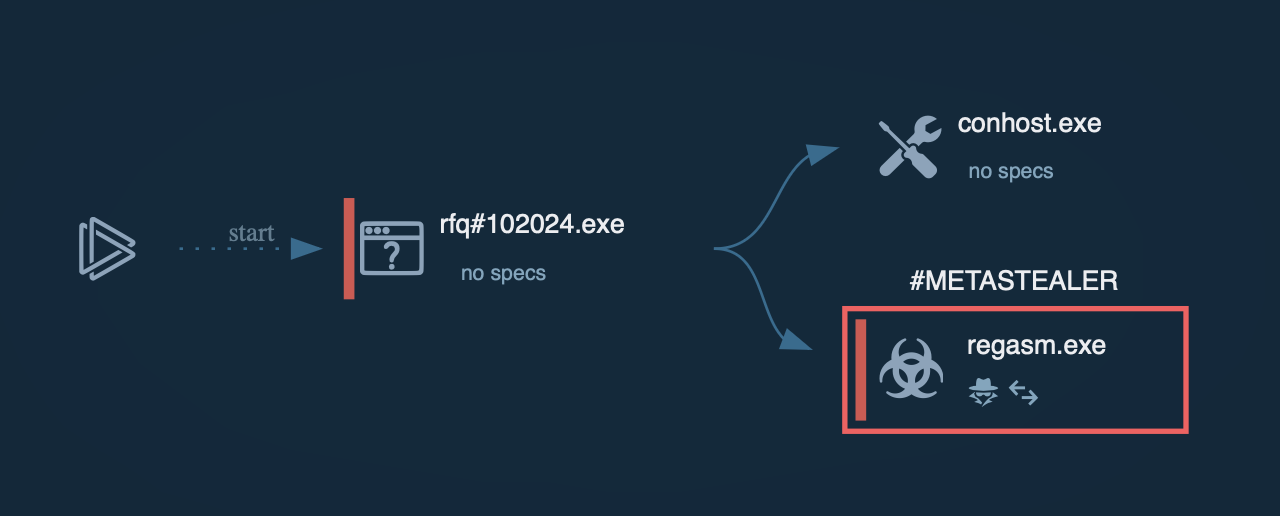
Metastealer process graph in ANY.RUN Metastealer process graph shown in ANY.RUN sandbox

Upon execution, MetaStealer may retrieve information about the operating system using winver.exe. It then duplicates itself, creating a copy that is placed in the local application data directory (%localappdata%\Microsoft\windows) and executed to maintain persistence.

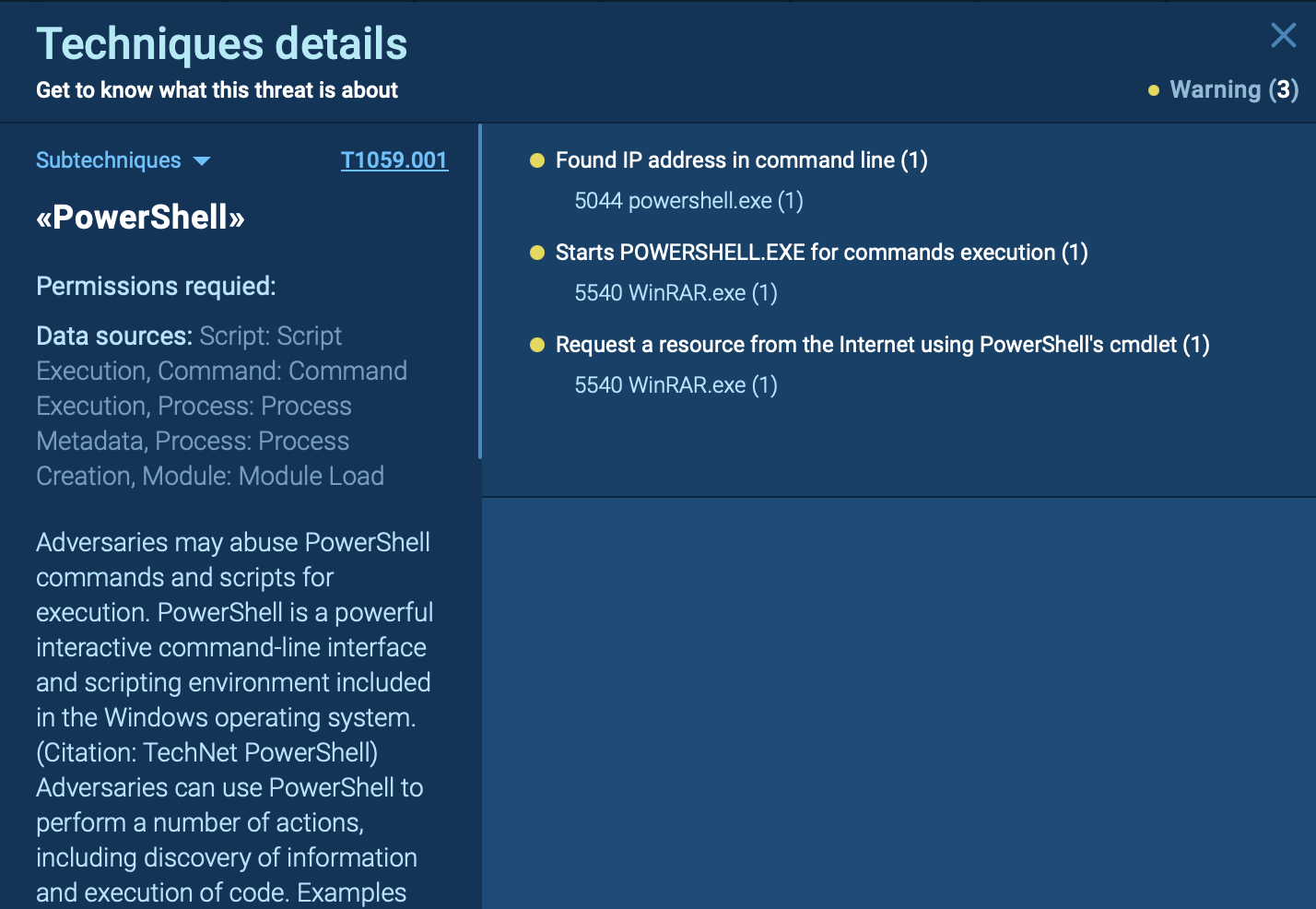
To evade detection by Windows Defender, the malware may employ a PowerShell command to add exclusions for certain file types, allowing it to execute without triggering antivirus alerts. This command specifically targets executable files, facilitating the malware's operation without hindrance.

MetaStealer then collects extensive system details by executing systeminfo.exe.

Following this, it focuses on extracting sensitive information from installed web browsers, such as autofill data, cookies, and login credentials. This information is crucial for attackers as it can provide access to various online accounts and services.

After gathering the necessary information, MetaStealer prepares to send the stolen data back to the attackers, typically by establishing a connection to remote servers where the collected information is transmitted.

The exact mechanisms for exfiltration can vary but often involve HTTP POST requests to predefined command and control (C&C) servers.

In our example task, MetaStealer injects itself into the RegAsm system process to evade process-based defenses and possibly elevate privileges. The injected process attempted to connect to the C2 server, triggering a Suricata rule.

In some cases, the malware may arrive on the system alongside legitimate software, masquerading to avoid suspicion.

Use ANY.RUN free for 14 days

Try the full power of interactive analysis

Start your free trial

MetaStealer malware distribution methods

MetaStealer is distributed through various methods, with attackers using different tactics to target victims. Some of the key distribution methods include:

  • Phishing emails with malicious attachments: One of the most common methods, MetaStealer is often delivered via phishing emails containing malicious attachments such as Word documents (.doc/.docx) or compressed files (.zip/.rar). These files may contain macros or embedded executables that launch the malware.
  • Malicious links: Emails can also include links that redirect the user to a malicious site where the malware is downloaded, disguised as legitimate software or documents.
  • Malvertising: Attackers sometimes use malicious online advertisements that lead to infected websites. These websites can either directly download MetaStealer or prompt users to install disguised malicious software.
  • Cracked software: MetaStealer has been found bundled with cracked or pirated software. Users who download software from untrusted sources may inadvertently install the malware along with what they believe to be legitimate applications.
  • Fake websites: Attackers may create fake websites that mimic legitimate ones, prompting users to download infected files or software updates that actually deliver MetaStealer.

Gathering threat intelligence on MetaStealer malware

To collect up-to-date intelligence on MetaStealer, use Threat Intelligence Lookup.

This service provides access to a large database filled with insights from millions of malware analysis sessions conducted in the ANY.RUN sandbox. With more than 40 customizable search parameters, you can find relevant data on threats including elements like IPs, domains, file names, and process artifacts.
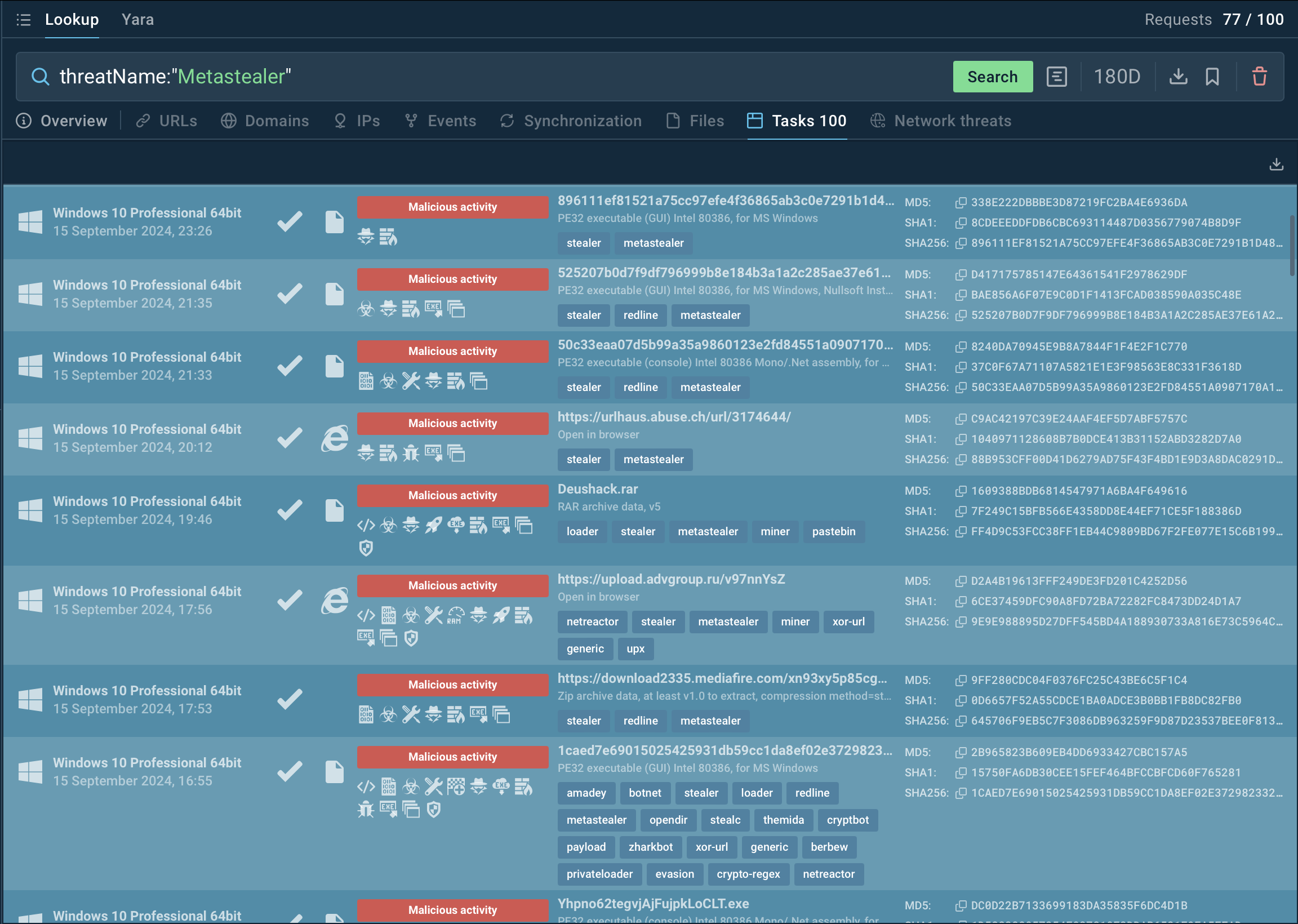
Metastealer lookup search in ANY.RUN Search results for Metastealer in Threat Intelligence Lookup

For example, to gather intelligence on MetaStealer, you can search directly for its threat name or use a related artifact. By submitting a query like threatName:"MetaStealer", TI Lookup will bring up all associated samples and sandbox results relevant to this malware.

Get a 14-day free trial of Threat Intelligence Lookup along with the ANY.RUN sandbox

Conclusion

MetaStealer poses a significant threat due to its ability to steal credentials and spread through various distribution methods. It’s crucial to proactively analyze suspicious files and URLs to protect against this and similar malware.

ANY.RUN offers real-time threat analysis, letting users investigate suspicious files, track malware behavior, and collect actionable intelligence to improve security defenses.

Sign up for a free ANY.RUN account today and start analyzing emerging threats with no limits!
HAVE A LOOK AT

RondoDox screenshot
RondoDox
rondodox
RondoDox is an emerging Linux-based botnet malware that exploits dozens of known vulnerabilities in internet-facing devices like routers, DVRs, and web servers to build massive networks for DDoS attacks, cryptomining, and data exfiltration. First spotted in mid-2025, its "exploit shotgun" tactic (firing multiple payloads at once) has made it a rapid escalator in the IoT threat landscape, compromising unpatched edge devices worldwide.
Read More
Jigsaw screenshot
Jigsaw
jigsaw
The Jigsaw ransomware, initially detected in 2016, encrypts files on compromised systems and requires a ransom payment in Bitcoin. If the ransom is not paid, the malware starts deleting files, increasing the pressure on victims to comply. Its source code is publicly accessible, allowing various threat actors to customize and repurpose the malware for different objectives.
Read More
Rootkit screenshot
Rootkit
rootkit bootkit
A rootkit is a type of malicious software designed to provide unauthorized administrative-level access to a computer or network while concealing its presence. Rootkits are tools used by cybercriminals to hide their activities, including keyloggers, spyware, and other malware, often enabling long-term system exploitation.
Read More
SnappyClient screenshot
SnappyClient is a sophisticated C++-based command-and-control (C2) implant first identified in December 2025. Delivered primarily via the modular HijackLoader, it functions as a versatile remote access tool with strong information-stealing capabilities, particularly focused on cryptocurrency wallets, browser data, and system control. It employs advanced evasion techniques, encrypted communications, and modular configurations to maintain persistence and evade detection.
Read More
Socelars screenshot
Socelars
socelars
Socelars is an information-stealing Trojan (often categorized as spyware/stealer) that focuses on collecting sensitive data from Windows systems, with standout reporting around Facebook Ads Manager and session cookie theft. Unlike “noisy” malware that immediately breaks something, Socelars quietly converts a single infected machine into access: logged-in sessions, business account data, and pathways to monetization.
Read More
zgRAT screenshot
zgRAT
zgrat
zgRAT is a malware known for its ability to infect systems and exfiltrate sensitive data to command-and-control (C2) servers. It is primarily distributed through loader malware, as well as phishing emails. zgRAT employs various advanced techniques, including process injection and code obfuscation, to evade detection and maintain persistence on infected systems. The malware can also spread via USB drives and uses popular messaging platforms like Telegram and Discord for data exfiltration.
Read More