
Germany’s economy is a precision machine: finance fuels it, manufacturing builds it, telecom connects it, IT optimizes it, and healthcare sustains it. The country sits at the crossroads of industrial power and digital transformation, making it irresistibly attractive to attackers.
In this article, we explore real-world attacks targeting five critical German industries, analyzed by ANY.RUN’s analysts using Interactive Sandbox and Threat Intelligence Lookup. Each case is not theory. It is a live wire, recently observed, carefully dissected.
Executive Summary
- Germany’s top industries are under coordinated pressure, not isolated attacks.
- Identity is the new perimeter: attackers are bypassing infrastructure defenses by hijacking sessions and abusing legitimate authentication flows.
- Phishing has evolved into real-time session interception, rendering traditional MFA insufficient on its own.
- Attackers adapt lures to business context, increasing success rates against employees.
- Threat intelligence is no longer optional: it is critical for reducing detection time, preventing escalation, and protecting revenue
Germany’s Digital Landscape: A High-Value Target
Why Germany?
- Largest economy in Europe with strong global ties;
- Highly digitized enterprise sector;
- Deep reliance on Microsoft 365, cloud services, and SaaS ecosystems;
- Critical industries interconnected across supply chains.
Germany’s industrial backbone — the Mittelstand of small and medium-sized enterprises, alongside globally recognized corporations in chemicals, automotive, and engineering — represents a vast attack surface. These organizations often store sensitive IP, manage critical infrastructure, and handle large financial transactions, yet historically have underinvested in cybersecurity relative to their size and importance.
Geopolitics adds fuel to the fire provoking a sharp increase in professional, often state-directed attacks by APT groups (Advanced Persistent Threats) linked to geopolitical conflicts. Germany’s role in the EU, NATO, and global trade makes it a high-value intelligence target for foreign actors.
- In 2024, cyberattacks caused approximately €178.6 billion in financial losses to German businesses, equivalent to 67% of all damage from corporate crime. (Bitkom).
- 83% of German businesses fell victim to ransomware in 2024, according to the Cyber Security Report 2025 by Schwarz Digits.
- The BSI’s 2024/2025 reports describe the IT security situation as “tense,” with 309,000 new malware variants appearing daily, ransomware attacks up 77%, and 22 state-sponsored APT groups active on German soil.
Phishing remains the most prevalent attack vector. The BSI confirmed that phishing attacks expanded well beyond the financial sector in 2024, with attackers impersonating streaming services, logistics firms, government agencies, and enterprise software platforms like Microsoft 365.
How German Companies Can Discover Industry-Specific Cyberattacks
ANY.RUN’s Threat Intelligence Lookup, a searchable database of threat data from live malware analysis by a community of over 15K SOC teams, supports the mapping of attack indicators to specific sectors and regions.
A local cyberthreat landscape can be revealed by combining lookups for an industry and a malware sample submission country, and by limiting the search period to see the most recent threats.
industry:”Telecommunications” AND submissionCountry:”DE”
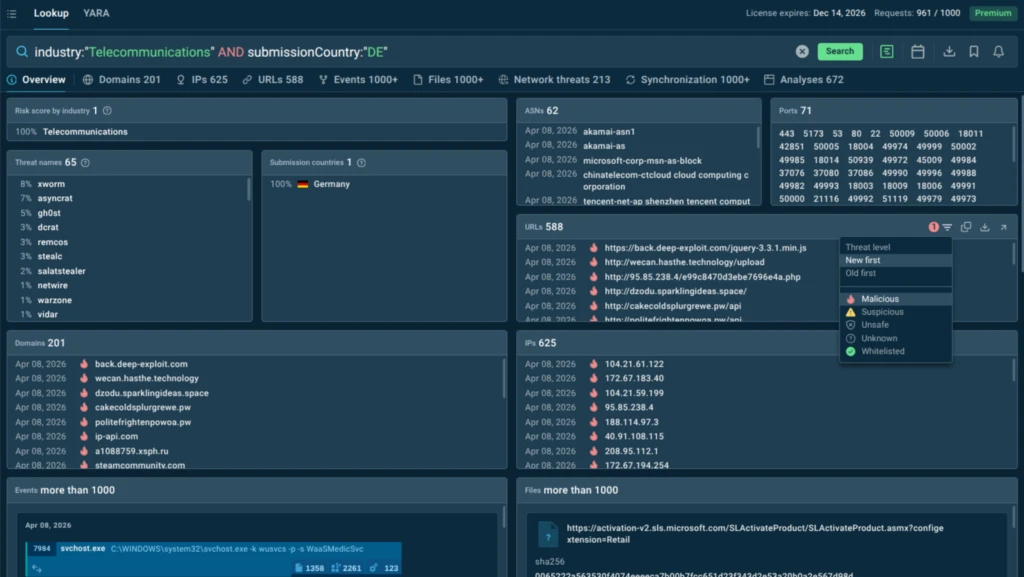
Search for a threat, country, and industry, switch to the Analyses tab in the results, and see a selection of sandbox analyses.
industry:”Telecommunications” AND submissionCountry:”DE” AND threatName:”xworm”
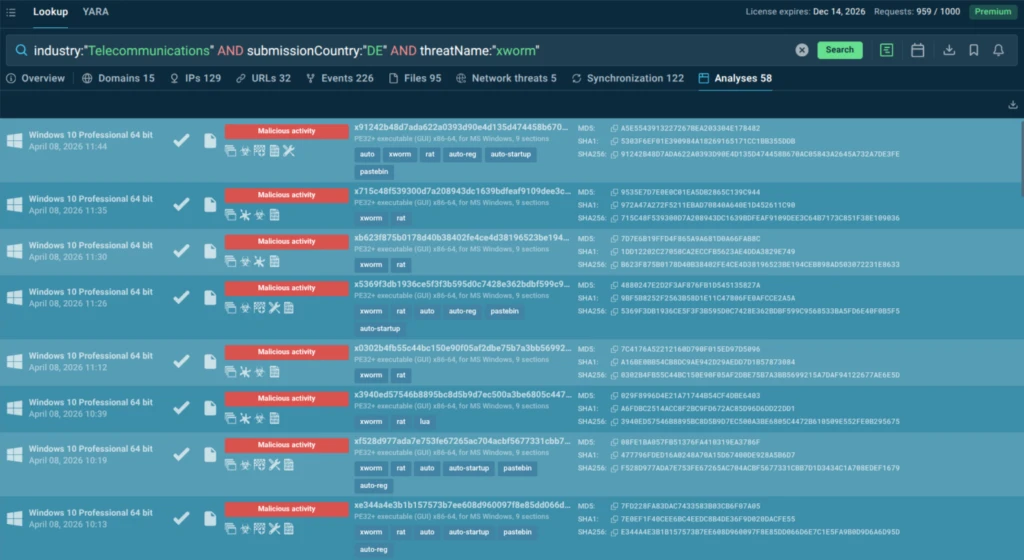
Pivot your research via TI Lookup using IOCs from search results and sandbox analyses and boost triage, detection, and threat hunting in your SOC.
1. Finance: FlowerStorm Targets a German Investment Firm
Financial organizations in Germany operate in a high-trust, high-value environment:
- Sensitive investment and client data;
- Heavy use of cloud-based collaboration tools;
- Strict compliance requirements
This makes employee credentials a golden key. Microsoft 365 credential theft is a dominant threat vector in this sector. Attackers seek to compromise corporate email accounts to intercept transactions, conduct Business Email Compromise (BEC) fraud, or use valid credentials as a launchpad for deeper network intrusion.
Threat in Focus: Spearphishing with FlowerStorm
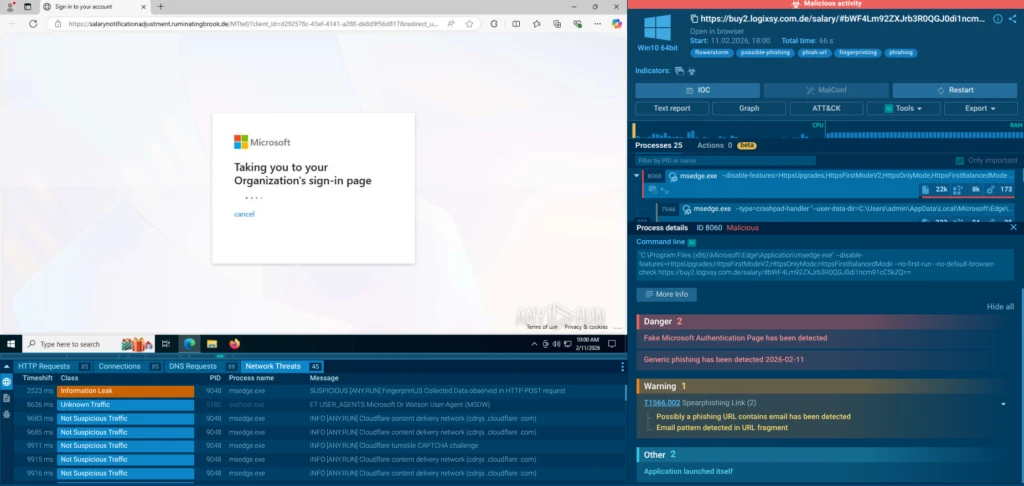
Target
A German investment company managing portfolios in private equity, real estate, and hedge funds. The attack was precision-targeted: the victim’s corporate email address was embedded directly into the phishing link, encoded in Base64.

Attack Type
Spearphishing (targeted credential theft) for Microsoft 365 accounts. ANY.RUN’s sandbox classified this threat as FlowerStorm — a sophisticated phishing-as-a-service platform known for its multi-stage evasion techniques and precision targeting.
Kill Chain
- In this case, the attacks starts with a malicious URL. However, as we can see in other analysis sessions, such links are usually delivered via phishing emails containing a PDF attachment. Inside the PDF is a QR code — a deliberate choice to bypass email-based URL scanners that cannot decode visual content.
- The victim scans the QR code and is taken to a landing page with a salary-related lure.
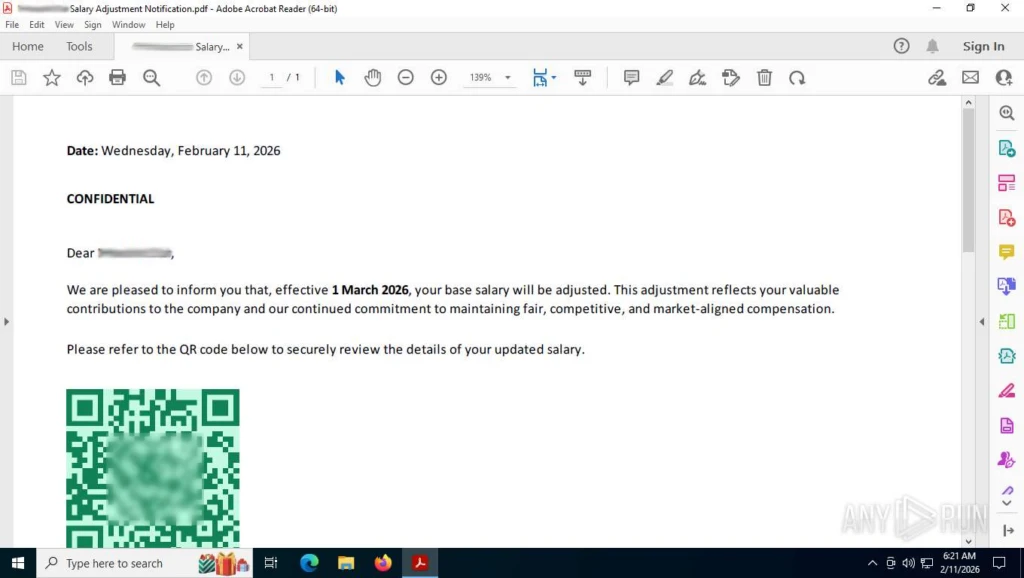
- The page loads a FingerprintJS script to profile the victim’s browser before showing any phishing content. This profiling helps attackers filter out security researchers and automated scanners.
- Cloudflare Turnstile CAPTCHA is activated, blocking automated analysis tools and sandbox detection attempts.
- The victim is redirected to the main phishing domain, which presents a pixel-perfect replica of the Microsoft 365 sign-in page, including a full OAuth flow simulation with client_id, redirect_uri, and response_type parameters.
- Credentials entered by the victim are immediately exfiltrated to attacker-controlled infrastructure.
Why It Works
FlowerStorm combines multiple layers of evasion (QR codes, browser fingerprinting, CAPTCHA, Base64 encoding) with surgical targeting. The salary-themed lure is psychologically effective: employees in a finance firm expect payroll-related communications, reducing suspicion. The Microsoft 365 OAuth imitation is technically convincing enough to fool even security-conscious users.
2. Healthcare: Microsoft OAuth Abuse Targets a Research Center
Healthcare in Germany is:
- Highly decentralized;
- Data-sensitive (patient records, research);
- Often underfunded in cybersecurity.
This creates a perfect storm for authentication abuse attacks.
Healthcare breaches carry compounded consequences: regulatory penalties under GDPR, reputational damage, potential disruption to patient care, and the loss of research data that may represent years of work and significant public investment.
Threat in Focus: Microsoft OAuth Abuse with Fake Outlook Login
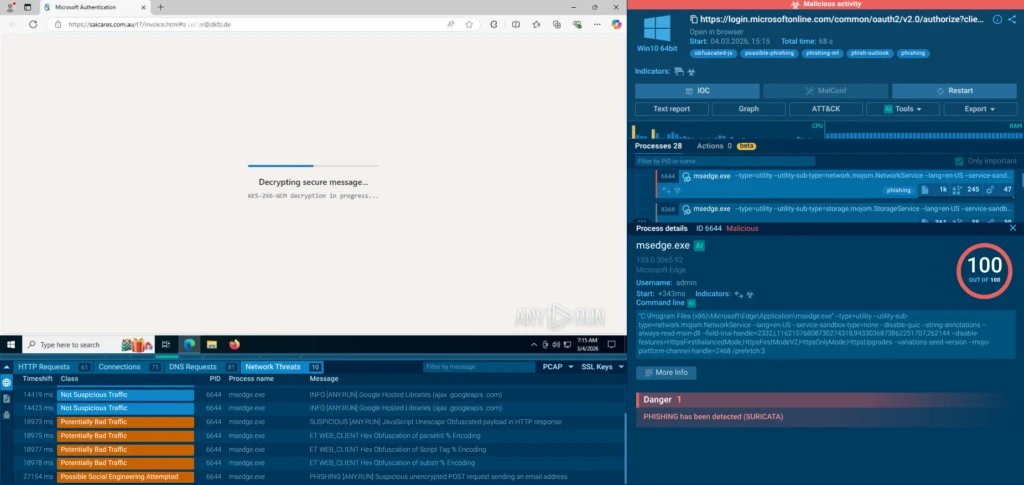
Target
Germany’s largest medical research center. The attack was highly targeted: the victim’s corporate email appeared in plaintext in the OAuth state parameter and in Base64 in the URL fragment of the phishing page.
Attack Type
Phishing via Microsoft OAuth abuse combined with a fake Outlook login page. The attackers exploited Microsoft’s legitimate OAuth 2.0 authentication mechanism, substituting a malicious redirect_uri to capture credentials after the authentication handshake.
Kill Chain
- The victim receives a link that begins as a legitimate request to login.microsoftonline.com. The redirect_uri, however, points to a compromised website. The state parameter contains the victim’s email address in plaintext.
- If no active Microsoft session exists, Microsoft returns an error=interaction_required response and redirects the user to the redirect_uri, the compromised WordPress site (saicares.com.au), which loads an intermediate invoice.html page.
- The intermediate page pulls content from ArDrive (a decentralized storage platform), adding another layer of obfuscation and hosting that is difficult to block.
- The victim is redirected to ogbarberschool[.]com — the primary phishing page. The victim’s email appears in the URL fragment both in Base64 and in plaintext, creating a personalized login experience.
- The phishing page contains obfuscated JavaScript and displays a convincing fake Outlook login form.
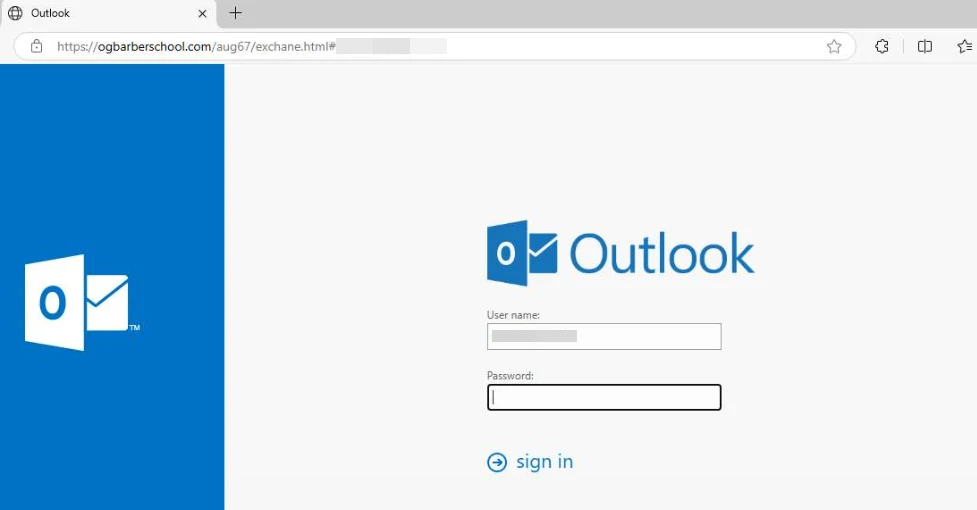
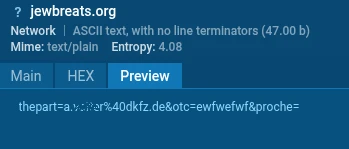
- Credentials entered by the victim are exfiltrated via a POST request to jewbreats[.]org/rexuzo/owa/apiowa[.]php. Suricata network rules flagged this as a suspicious unencrypted POST request transmitting an email address.
Why It Works
This attack is particularly dangerous because it begins with a genuine Microsoft domain. A victim who inspects the initial link sees a legitimate login.microsoftonline.com URL, providing false reassurance. By the time the malicious redirect occurs, the victim is already engaged. The use of a compromised WordPress site and decentralized storage makes the infrastructure difficult to detect and take down quickly.
3. Technology: Reverse Proxy Phishing Targets an IT Company
IT companies:
- Manage infrastructure and credentials;
- Have privileged access across systems;
- Are often stepping stones for supply chain attacks.
The sector’s familiarity with technology can create a paradoxical blind spot: IT professionals may be more likely to click links in emails that appear technical or work-related, assuming their technical knowledge makes them immune to social engineering.
Threat in Focus: EvilProxy + EvilGinx2 Combined Attack
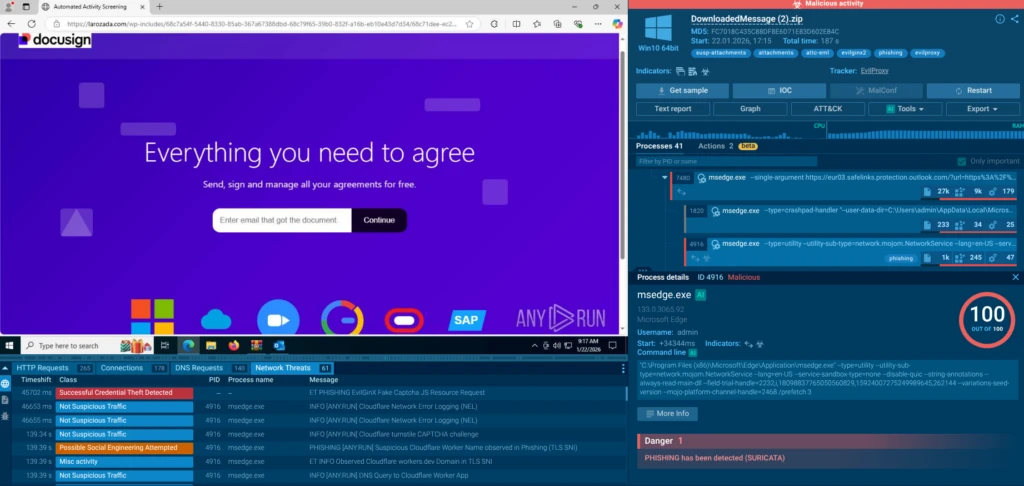
Target
A German IT company. The attack targeted a specific employee, whose email was extracted from the data parameter of a Microsoft Safe Links wrapper, indicating the attacker had prior visibility into the target’s email infrastructure.
Attack Type
Phishing via a combination of EvilProxy and EvilGinx2: two reverse proxy tools used in tandem. EvilProxy serves as the primary credential harvesting platform, while EvilGinx2 handles session token interception. Together, they create a real-time proxy of Microsoft’s login infrastructure capable of bypassing multi-factor authentication.
Kill Chain
- The victim receives a phishing email urging them to “Review document,” a work-relevant lure that fits the daily workflow of an IT professional.
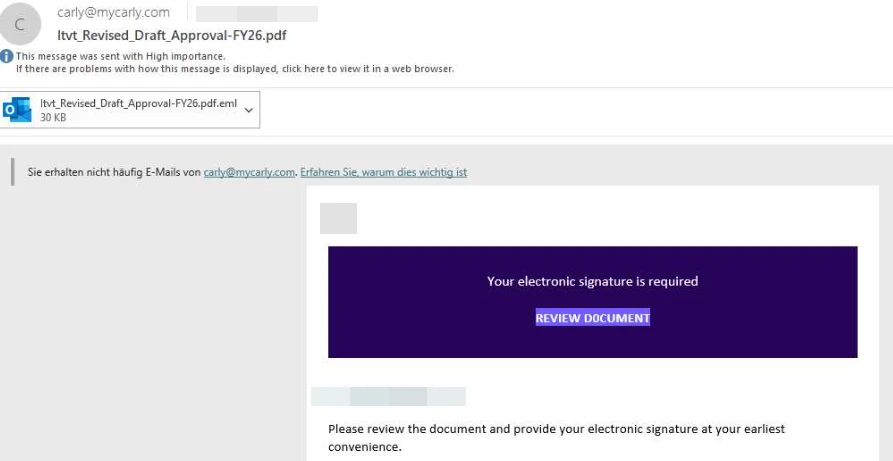
- The embedded link routes through a Mailchimp tracking URL (aviture[.]us7[.]list-manage[.]com), a legitimate email marketing service that lends the link apparent credibility and bypasses reputation-based URL filters.
- Mailchimp redirects to larozada[.]com, a compromised WordPress site hosting an intermediate page with a Cloudflare Turnstile CAPTCHA.
- After CAPTCHA verification, the victim is routed through a Cloudflare Workers serverless function, which performs additional routing to frustrate analysis and attribution.
- The final destination is the main phishing domain (googlmicrozonfaceb0xfileshar3instacloud0fftkdoctormedixxqqw[.]digital) — an EvilProxy instance that reverse-proxies the real Microsoft Login page in real time. The victim sees an authentic Microsoft experience.
- As the victim authenticates, EvilProxy intercepts the session cookie. The attacker now has a valid authenticated session. No password or MFA code required.
Why It Works
The use of legitimate services (Mailchimp, Cloudflare Workers, WordPress) at each stage of the attack chain makes it nearly impossible for conventional email filters and web gateways to block. The final EvilProxy stage defeats MFA entirely by hijacking the post-authentication session rather than attempting to steal the second factor. This is an adversary-in-the-middle attack that neutralizes one of the most commonly recommended security controls.
Using TI Lookup, we can see that larozada[.]com is intensely correlated with this attack scenario:
domainName:”larozada.com”
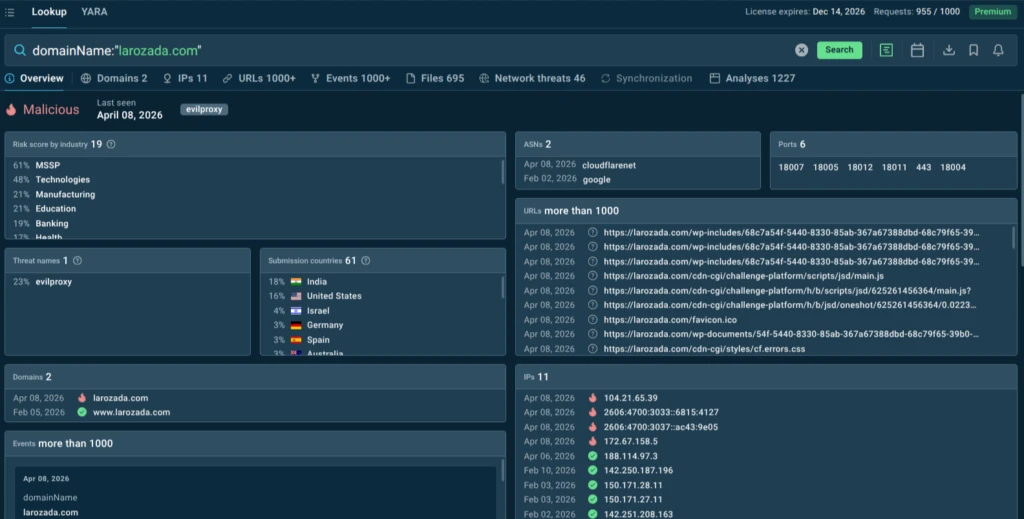
Integrate Threat Intelligence Feeds in your security stack to have it continuously updated with a real-time stream of indicators (domains, URLs, IPs) for early detection and timely response.
4. Telecom: Phishing-as-a-Service at Scale
Telecom companies:
- Sit at the heart of communications infrastructure;
- Handle massive volumes of user data;
- Operate complex, distributed environments.
Telecom companies are targeted for multiple strategic reasons: access to customer data at scale, the potential for SIM-swapping attacks, the ability to intercept communications, and the value of internal network access for espionage or infrastructure disruption.
Account takeover via Microsoft 365 credential theft is a priority threat for this sector, as telecom employees use cloud platforms extensively for internal communications, customer management, and operational coordination.
Threat in Focus: EvilProxy without personalization
Target
An employee of a German telecommunications company. Unlike the finance and healthcare cases, this campaign used a non-personalized phishing page (no email embedded in the URL) suggesting a broader campaign that may target multiple companies simultaneously rather than a single individual.
Attack Type
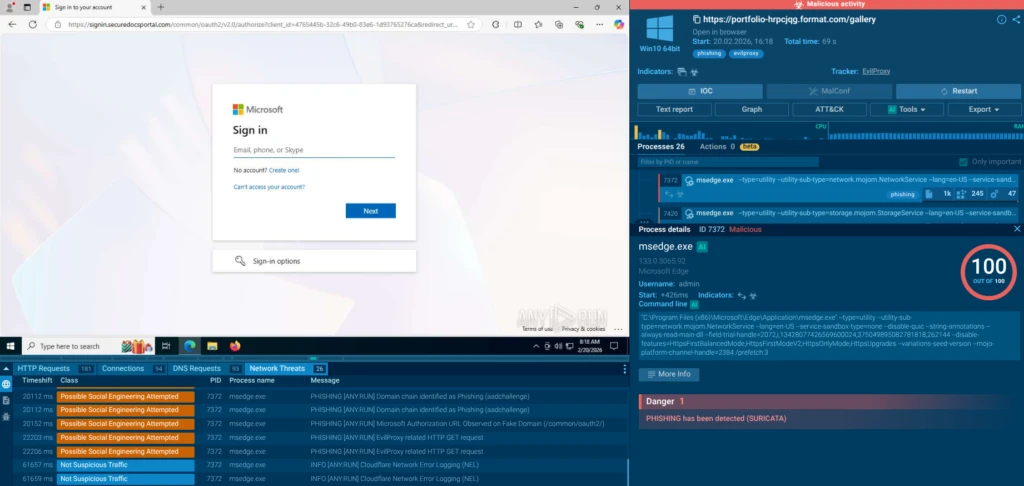
Phishing via EvilProxy (Phishing-as-a-Service) — a commercial reverse proxy platform that proxies the real Microsoft login page in real time, intercepting session tokens and bypassing MFA without ever needing to steal a password.
Kill Chain
- The victim receives a link pointing to portfolio-hrpcjqg[.]format.com/gallery — a legitimate portfolio hosting platform (Format.com). Using a reputable platform as the first hop bypasses domain reputation filters.
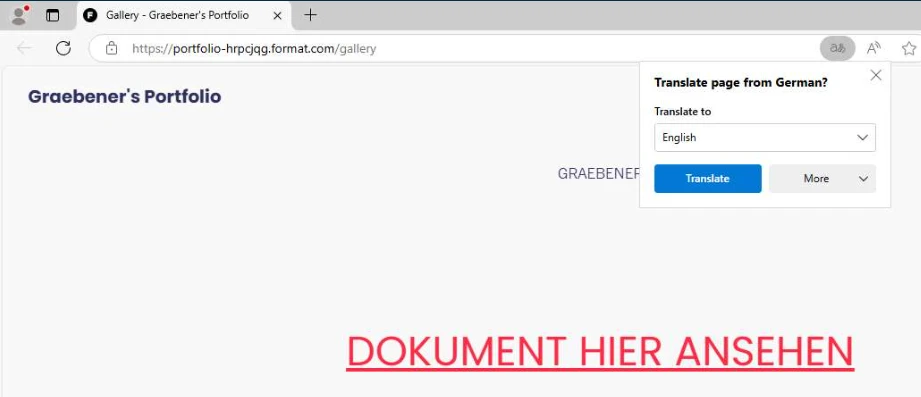
- Format.com redirects to signin[.]securedocsportal.com/cyb3rusr131 — a phishing domain crafted to resemble a secure document signing portal, a plausible context for a telecom business user.
- Cloudflare Turnstile CAPTCHA filters automated scanners and security tools.
- After passing CAPTCHA, the victim reaches a page mimicking Microsoft 365 OAuth authorization, complete with client_id and redirect_uri parameters pointing to office.com for added legitimacy.
- EvilProxy proxies the real Microsoft Login through its own subdomains, giving the victim a fully functional Microsoft login experience.
- The victim enters credentials and completes MFA. EvilProxy intercepts the session cookie in real time, granting the attacker full authenticated access to the victim’s Microsoft 365 account without needing the password or MFA token.
Why It Works
EvilProxy is commercially available as a service, dramatically lowering the skill threshold for attackers. The use of a legitimate portfolio platform as the initial URL makes detection by email gateways extremely difficult. The MFA bypass via session cookie theft is highly effective against organizations that believe MFA alone is sufficient protection.
5. Manufacturing: Brand-Impersonation and Teams Lure
Germany’s manufacturing sector:
- Is globally dominant;
- Relies on internal communication platforms;
- Often integrates IT and OT environments.
Germany’s manufacturing sector is the engine of its economy, encompassing global leaders in chemicals, automotive, engineering, and consumer goods. They are also increasingly connected: Industry 4.0 technologies, IoT sensors, operational technology (OT), and cloud-integrated production systems have blurred the line between IT and physical operations.
The consequences of a successful attack extend beyond data loss to potential operational shutdown, physical equipment damage, and supply chain disruption.
Social engineering attacks targeting manufacturing employees are particularly effective because plant-floor and operations staff are not traditionally cybersecurity-trained, and Microsoft Teams has become a standard communication tool across these large organizations.
Threat in Focus: Teams Voice Message Phishing
Target
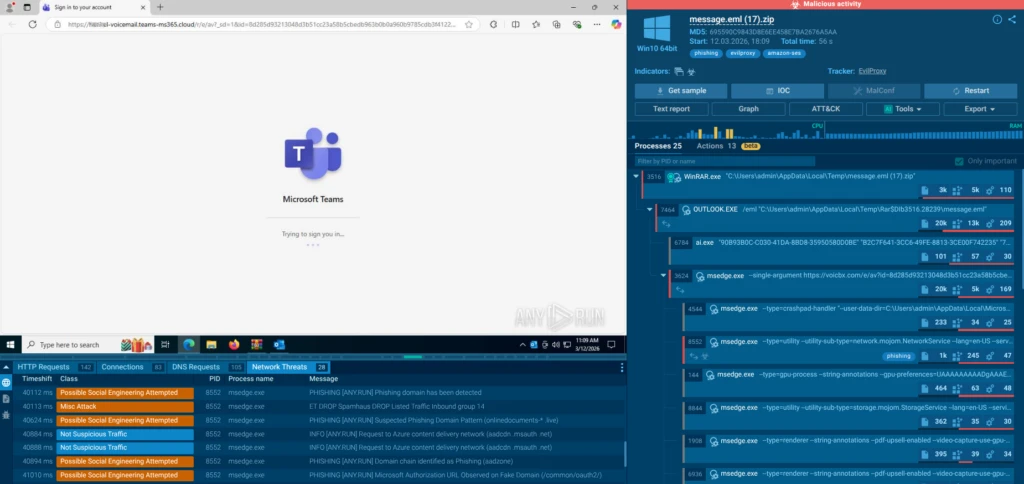
A large German industrial conglomerate, a global producer of chemical products and consumer goods. This attack was unusually specific: the phishing domains were registered to include the target company’s name, and the fake login page was styled to match the company’s Microsoft Teams branding — indicating advance reconnaissance.
Attack Type
Phishing via EvilProxy using a Microsoft Teams voice message as bait. The attack was delivered via Amazon SES, a legitimate email delivery infrastructure, making it difficult for email security tools to flag based on sender reputation.
Kill Chain
- The victim receives an email sent through Amazon SES, notifying them of a missed voice message in Microsoft Teams — a common notification that workers in large organizations receive regularly
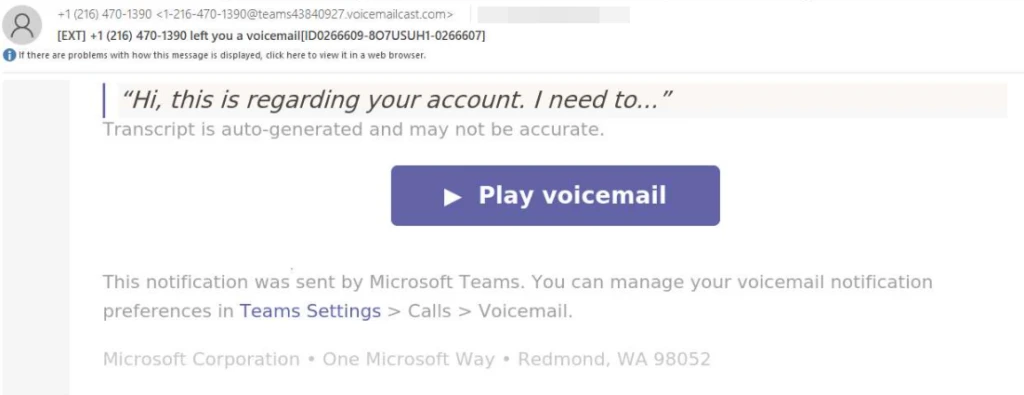
- The link leads to voicbx[.]com, a redirect service mimicking a Teams voice notification interface.
- Redirects to noncrappyandroidapps[.]com for an anti-bot verification step.
- TinyURL then routes the victim to teams-ms365[.]cloud, a phishing domain mimicking Microsoft Teams infrastructure.
- The victim lands on a fake Teams voice message page, styled specifically to match the target company’s branding — a degree of customization that indicates prior research into the target.
- When the victim attempts to play the voice message, they are redirected to EvilProxy domains that also contain the company’s name in the URL.
- The victim enters their credentials into a fake Okta authentication page and completes MFA. EvilProxy intercepts the session cookie, granting the attacker full access to the corporate Microsoft 365 environment without requiring the password or MFA factor.
Why It Works
The combination of a highly plausible lure (missed Teams voice message), delivery via Amazon SES (bypassing sender reputation filters), and company-branded phishing pages makes this attack unusually convincing. The use of Okta for the fake authentication page suggests the attackers were aware of the target company’s specific identity infrastructure.
Food for Thought: What CISOs Need to Be Aware Of
1. Five Critical German Industries Are Under Active Attack Right Now
All five cases have been collected between January and March 2026. Finance, healthcare, IT, telecommunications, and manufacturing, the five most economically significant sectors in Germany, are not theoretical targets. They are active targets. This is systematic pressure on the German economy, not isolated incidents.
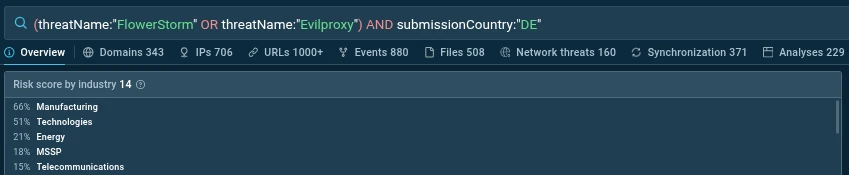
ANY.RUN’s Threat Intelligence Lookup data reinforces this: searching for EvilProxy and FlowerStorm threats linked to German organizations over the past 60 days returned more than 220 analyses, confirming that these campaigns are ongoing and widespread.
(threatName:”flowerstorm” OR threatName:”evilproxy”) and submissionCountry:”DE”
2. Selective Targeting Is a Growing Trend
Several of these attacks show clear signs of advance reconnaissance. Phishing domains were registered with the target company’s name embedded, pages were styled to match corporate branding, and victim email addresses were pre-loaded into URLs. This level of preparation (particularly in the manufacturing case) goes beyond generic mass phishing and suggests attackers are investing in targeted intelligence gathering before launching campaigns. Some cases also used universal phishing pages, indicating a mix of targeted and mass-scale approaches within the same threat actor ecosystem.
3. Social Engineering Is Being Adapted to Professional Context
The lures used in these attacks are not generic. A salary-themed document for a finance employee, a missed Teams voice message for a manufacturing executive, a “Review document” prompt for an IT professional. Attackers appear to be selecting bait that fits the professional context of their targets, increasing click rates and reducing suspicion. This contextual adaptation of social engineering is a significant evolution in phishing tradecraft.
4. Phishing-as-a-Service Platforms Have Democratized MFA Bypass
EvilProxy, EvilGinx2, and FlowerStorm are not bespoke tools used by elite threat actors. They are commercially available phishing platforms sold as services. This means the barrier to launching a sophisticated, MFA-bypassing attack against a German enterprise is now accessible to a broad range of cybercriminals. These platforms proxy real Microsoft login pages in real time, intercept session cookies after successful MFA completion, and provide the attacker with a fully authenticated session — all without ever knowing the victim’s password or one-time code.
Organizations that rely on MFA as their primary defense against credential theft need to understand that adversary-in-the-middle phishing renders standard MFA ineffective. Phishing-resistant MFA (such as FIDO2 hardware keys) and Zero Trust session validation are required to defend against these techniques.
Protecting High-Risk Organizations: A Practical Approach for Decision-Makers
For executives across finance, healthcare, telecom, IT, and manufacturing, cybersecurity is no longer just a technical function. It is a business continuity and risk management discipline.
The attacks described in this article share a common trait: they move fast, abuse trusted services, and bypass traditional defenses.
To counter this, organizations need more than tools. They need a workflow-driven approach, where threat intelligence and malware analysis directly improve how the SOC operates.
Here is how this translates into measurable protection across core SOC workflows.
1. Monitoring: Detect Earlier, Reduce Exposure
The Challenge:
Detection gaps, delayed visibility into new campaigns, and high volumes of low-context alerts.
What to do:
- Integrate TI Feeds into SIEM, EDR, and email gateways
- Leverage sandbox-verified indicators tied to real attack activity
- Continuously monitor infrastructure linked to phishing and session hijacking campaigns
Instead of waiting for alerts, your SOC gains early visibility into attacker infrastructure, often within hours of campaign emergence
Business impact:
- Higher detection rates across environments (36% DR increase);
- Earlier identification of threats before user interaction;
- Reduced likelihood of successful initial compromise.
Executive outcome: lower probability of high-severity incidents and reduced exposure window.
2. Triage: Increase Speed, Reduce Cost per Incident
The Challenge:
Slow investigations, manual enrichment, and excessive escalation to senior analysts.
What to do:
- Use TI Lookup to instantly enrich indicators with behavioral and campaign context;
- Combine enrichment with interactive sandbox analysis for rapid validation;
- Enable Tier 1 analysts to resolve more alerts independently.
Analysts move from fragmented investigation to instant, evidence-based decisions, with average detection times measured in seconds.
Business impact:
- Faster MTTD and MTTR;
- Up to 30% fewer escalations to higher tiers;
- Reduced cost per investigation.
Executive outcome: more efficient SOC operations with lower staffing pressure and faster decision cycles.
3. Incident Response: Contain Faster, Minimize Damage
The Challenge:
Limited visibility into attack scope and delayed containment decisions.
What to do:
- Use Interactive Sandbox to analyze full attack chains (redirects, payloads, exfiltration);
- Correlate findings with TI Lookup to understand spread and related infrastructure;
- Generate detailed reports for response and compliance.
Incidents are no longer black boxes. Teams gain full kill-chain visibility within seconds and reduce response time significantly
Business impact:
- Faster containment and remediation (90% of threats visible in 60 seconds);
- Reduced operational disruption;
- Lower likelihood of repeat incidents.
Executive outcome: minimized financial and operational impact from active threats.
4. Threat Hunting: Shift from Reactive to Proactive Security
The Challenge:
Outdated data, manual validation, and lack of prioritization based on business risk.
What to do:
- Use TI Feeds to track emerging threats targeting your industry and region;
- Pivot with TI Lookup across related indicators and campaigns;
- Use sandbox insights to refine detection logic and hunt hypotheses.
Threat hunting becomes data-driven and context-aware, leveraging live attack activity across thousands of organizations.
Business impact:
- Detection of threats before alerts trigger;
- Reduced attacker dwell time;
- More precise prioritization of high-risk threats.
Executive outcome: improved risk visibility and proactive defense posture.
Operational Impact → Business Outcomes
When these capabilities are aligned across workflows, the effect compounds:
Operational gains:
- Faster case processing (minutes saved per investigation);
- Higher detection rates (up to +36%);
- Fewer escalations and analyst overload;
- Shorter incident lifecycle.
Business outcomes:
- Reduced risk of breaches and account takeover;
- Lower cost of security operations;
- Minimized downtime and service disruption;
- Stronger compliance and audit readiness;
The difference between a resilient organization and a vulnerable one is not whether attacks happen. It is whether your teams can see threats early, understand them instantly, and act before impact spreads.
By combining TI Feeds (visibility), TI Lookup (context), and Interactive Sandbox (depth), you turn security operations into a measurable business advantage, not just a defensive necessity.
Conclusion
The five attacks documented in this report share a common thread: they are sophisticated, targeted, and actively exploiting the trust that German employees place in familiar platforms like Microsoft 365, Outlook, and Teams. They represent a new generation of phishing campaigns that have moved far beyond bulk spam — into precision-engineered operations that research their targets, customize their lures, and deploy infrastructure specifically designed to survive detection.
The good news is that these attacks are detectable. ANY.RUN’s Interactive Sandbox can analyze suspicious URLs and files in real time, tracing every redirect, every script, every network connection in the attack chain. The Threat Intelligence Lookup provides historical context — showing how many organizations have seen the same indicators, which industries are most targeted, and what threat families are most active.
In an economy where a single successful breach can cost billions and disrupt national supply chains, visibility and speed of response will define resilience.
About ANY.RUN
ANY.RUN, a leading provider of interactive malware analysis and threat intelligence solutions, helps security teams investigate threats faster and with greater clarity across modern enterprise environments.
It allows teams to safely execute suspicious files and URLs, observe real behavior in an Interactive Sandbox, enrich indicators with immediate context through TI Lookup, and monitor emerging malicious infrastructure using Threat Intelligence Feeds. Together, these capabilities help reduce investigation uncertainty, accelerate triage, and limit unnecessary escalations across the SOC.
ANY.RUN is trusted by thousands of organizations worldwide and meets enterprise security and compliance expectations. It is SOC 2 Type II certified, demonstrating its commitment to protecting customer data and maintaining strong security controls.
FAQ
Germany’s strong economy, high digitalization, and reliance on cloud services make its organizations high-value targets with scalable attack surfaces.
Finance, healthcare, IT, telecom, and manufacturing show consistently high risk due to data sensitivity, operational complexity, and business impact.
They now use reverse proxy tools and OAuth abuse to capture authenticated sessions, allowing attackers to bypass MFA and access accounts in real time.
Session hijacking allows attackers to steal active login sessions instead of credentials, granting immediate access without needing passwords again.
It provides context, detection speed, and visibility into attacker infrastructure, enabling faster decisions and proactive defense.
TI Lookup is used for investigating specific indicators in real time, while TI Feeds provide continuous streams of threat data for proactive blocking.
Yes, with the right combination of threat intelligence, sandboxing, and fast-response workflows, organizations can detect and contain threats early.
0 comments