Black friday Up to 3 extra licenses FOR FREE + Special offer for TI LOOKUP Get it now
Webinar
February 26
Better SOC with Interactive Sandbox Practical Use Cases
Register now

RisePro

98
Global rank
64 infographic chevron month
Month rank
55 infographic chevron week
Week rank
0
IOCs

RisePro, an information-stealing malware, targets a wide range of sensitive data, including credit cards, passwords, and cryptocurrency wallets. By compromising infected devices, RisePro can steal valuable information and potentially cause significant financial and personal losses for victims.

Stealer
Type
ex-USSR
Origin
1 December, 2022
First seen
15 September, 2026
Last seen

How to analyze RisePro with ANY.RUN

Type
ex-USSR
Origin
1 December, 2022
First seen
15 September, 2026
Last seen

IOCs

IP addresses
107.174.192.179
150.171.28.11
118.194.235.187
208.95.112.1
188.114.96.3
149.154.167.99
104.18.23.222
2.16.204.161
142.251.155.119
142.251.20.132
139.99.85.213
74.178.240.51
154.91.34.165
104.26.12.64
142.250.154.97
172.217.117.4
154.23.184.57
98.177.107.142
23.59.18.102
142.251.14.95
Hashes
74441313bb1fb62500484443c4937e90d4e335351a4fcd12a9ac48448500e33e
2ed27c1421e6928dbe13dbfdb5c59e1045b30341fe7ebe05700006bc5ac572c0
4094d158e3b0581ba433a46d0dce62f99d8c0fd1b50bb4d0517ddc0a4a1fde24
99653a38c445ae1d4c373ee672339fd47fd098e0d0ada5f0be70e3b2bf711d38
c158322bd963d2a68ffc878d72213a7394d8c16de72279771ffc924365eec0df
59345c006cd9bde5ef532aae1f119758d45030993181c272bb0dd6fc0c5d01e5
2ae1142b08d296c25000e451237ea919f981da28f6a723d39540f43f18bac762
5639c845d56dedecd2cfdb082b734593b5d618a87f1bd8ec612a8b3f4245566a
32ae9531405ef3c59448fe6dbd3be435e726eb17f3ca0d16530a4c6317dea286
7c68f28c6995f47dd77596bab28c6b4388ff93840c3becfd37733ddb640cd0cd
40cf1af5650b699a947899d2b43a00dcb64cdeaf080651c82a7930910c1c03f4
ec249b0dab6fda20cc24f0f25a504c55a05b23fb6cbb4938aa7a41df0c8744b6
0162159b64eb092f94964faf937f263fb9947b25d40e0d82bd3224d136a140de
77eed9211cd8464482f0da3fac4c0f003c2b8a6d76f15445927e66400f102d60
6558013f984e594bb57534910ce0b17bfa15da3cc9bb4b6e0b5c6e4ddf9eb14e
a7109b8374dffa7a0cd69558990f7e96fea9ef61736d89043dad5a6694cdfa4a
758a0b404b3daadbd0d4e88a0bedf5c21d5507392f7b54d4906ffea49d58ab32
558bbe6193a202dcb00cc441421f5d838764e495b8e4d2e10877db7f661b8cd5
db3ac1fd3d65df45d805adb8dfe0c5209db07ef93406db17dfb783dd8048720a
19acfa0adce363a9c9a3be73f5ec0fac0dcf3c630ce18125fd265040ad6ffb6c
Domains
tpc.googlesyndication.com
api.edgeoffer.microsoft.com
fe3cr.delivery.mp.microsoft.com
settings-win.data.microsoft.com
static.admaster.cc
msedge.b.tlu.dl.delivery.mp.microsoft.com
identitytoolkit.googleapis.com
lh3.googleusercontent.com
must-directed.gl.at.ply.gg
api.telegram.org
edge.microsoft.com
googleads.g.doubleclick.net
activation-v2.sls.microsoft.com
bucket-cf-weur-a.uploadnow.io
nexusrules.officeapps.live.com
www.bing.com
api.pcloud.com
client.wns.windows.com
slscr.update.microsoft.com
edge-consumer-static.azureedge.net
URLs
http://crl.microsoft.com/pki/crl/products/microoceraut2011_2011_03_22.crl
http://www.microsoft.com/pkiops/crl/micsecserca2011_2011-10-18.crl
http://edge.microsoft.com/browsernetworktime/time/1/current?cup2key=2:wre-eutrtw_lzyylfryn5gipqsah5d90nzfi4jwh-im&cup2hreq=e3b0c44298fc1c149afbf4c8996fb92427ae41e4649b934ca495991b7852b855
https://uploadnow.io/f/0bcds7g
https://config.edge.skype.com/config/v1/edge/133.0.3065.92?clientid=4489578223053569932&agents=edge%2cedgeconfig%2cedgeservices%2cedgefirstrun%2cedgefirstrunconfig&osname=win&client=edge&channel=stable&scpfre=0&osarch=x86_64&osver=10.0.19045&wu=1&devicefamily=desktop&uma=0&sessionid=72&mngd=0&installdate=1661339457&edu=0&soobedate=1504771245&bphint=2&fg=1&lbfgdate=1766137499&lafgdate=0
https://edge.microsoft.com/serviceexperimentation/v3/?osname=win&channel=stable&osver=10.0.19045&devicefamily=desktop&installdate=1661339457&clientversion=133.0.3065.92&experimentationmode=2&scpguard=0&scpfull=0&scpver=0
https://copilot.microsoft.com/c/api/user/eligibility
https://uploadnow.io/en/share?utm_source=0bcds7g
https://cdn.uploadnow.io/_next/static/css/df97d9751ec3abda.css
https://cdn.uploadnow.io/_next/static/css/cda03e3a1ab65c17.css
https://cdn.uploadnow.io/_next/static/css/ae110469aab9e883.css
https://cdn.uploadnow.io/_next/static/css/5ded0d5ca9ecc5c1.css
https://cdn.uploadnow.io/_next/static/chunks/webpack-541c27ed8494cc3b.js
https://cdn.uploadnow.io/_next/static/chunks/framework-b6335179e7eea00c.js
https://cdn.uploadnow.io/_next/static/chunks/main-86f0684c1b20f38d.js
https://cdn.uploadnow.io/_next/static/chunks/pages/_app-a7a0c0b843b84887.js
https://cdn.uploadnow.io/_next/static/chunks/62867-950590631f5ceb03.js
https://cdn.uploadnow.io/_next/static/chunks/38993-a4121c3c0d1b9d33.js
https://cdn.uploadnow.io/_next/static/chunks/41480-7aa8c357827879bd.js
https://cdn.uploadnow.io/_next/static/chunks/3816-6a0007c41b67cb89.js
Last Seen at
Last Seen at

Recent blog posts

post image
6 Months on Alert: Get H1 2026 Cyber Risk Rep...
watchers 303
comments 0
post image
ANY.RUN Secures Leader Status in G2’s Malware...
watchers 5151
comments 0
post image
15 Minutes Saved Per Alert: How a Lean German...
watchers 10231
comments 0

What is RisePro malware?

RisePro is a malware program primarily designed to exfiltrate sensitive information from compromised devices. It is often distributed through deceptive methods, such as fake cracks sites or malicious email attachments. Once installed, RisePro infiltrates the target system and silently collects a variety of personal and financial data.

First detected in late 2022, the malware continues to be actively updated and developed by its creators. It is sold openly online, including via a Telegram bot, where users can choose a preferred subscription plan and control the malware.

Get started today for free

Analyze malware and phishing in a fully-interactive sandbox

Create free account

Technical details of the RisePro malicious software

RisePro's underlying architecture is similar to Vidar’s, another well-known password-stealing malware. It employs a system of embedded DLL dependencies to achieve its malicious goals.

The malware's typically focuses on stealing the following types of information:

  • Web browser credentials: RisePro can steal login credentials and cookies from various web browsers, including Google Chrome, Mozilla Firefox, and Microsoft Edge.
  • Crypto wallets: The malware can identify and steal cryptocurrency wallet addresses and private keys, granting attackers access to victims' digital assets.
  • Credit card information: RisePro may collect credit card numbers, expiration dates, and CVV codes.

Additionally, RisePro gathers information about the compromised system, including operating system, installed software, and hardware specifications. It can also capture screenshots of the victim's desktop, providing attackers with visual insights into their activities.

Once collected, the stolen data is bundled and sent to the attacker's command and control (C2) server. As mentioned, RisePro is constantly evolving, as its creators continue to enhance its capabilities. In a recent development, the malware has transitioned from HTTP-based C2 communication to a custom TCP protocol.

Check out a comprehensive analysis of RisePro’s C2 communication.

RisePro employs various obfuscation techniques to evade detection by security software, making it more challenging for antivirus and anti-malware solutions to identify and neutralize the threat.

Execution process of RisePro

To see how RisePro behaves on an actual system, let’s upload its sample to ANY.RUN sandbox for detailed analysis.

Like most malware, RisePro's execution chain can vary significantly even within one version. It can be either a single process performing all malicious activities or multiple processes involving the operating system's system utilities.

In our case, using the Static discovering function, we can see that a macro launches a process named crome.exe, which was downloaded from a remote server with the address 89.23.98.22.

Subsequently, we can use Script Tracer to verify this information and ensure that this process was also launched after the download. The WINWORD process, through macros, downloaded and initiated the crome process, which was the RisePro stealer, and carried out the main malicious activity. Additionally, the malware added itself to the Task Scheduler to ensure persistence on the infected system.
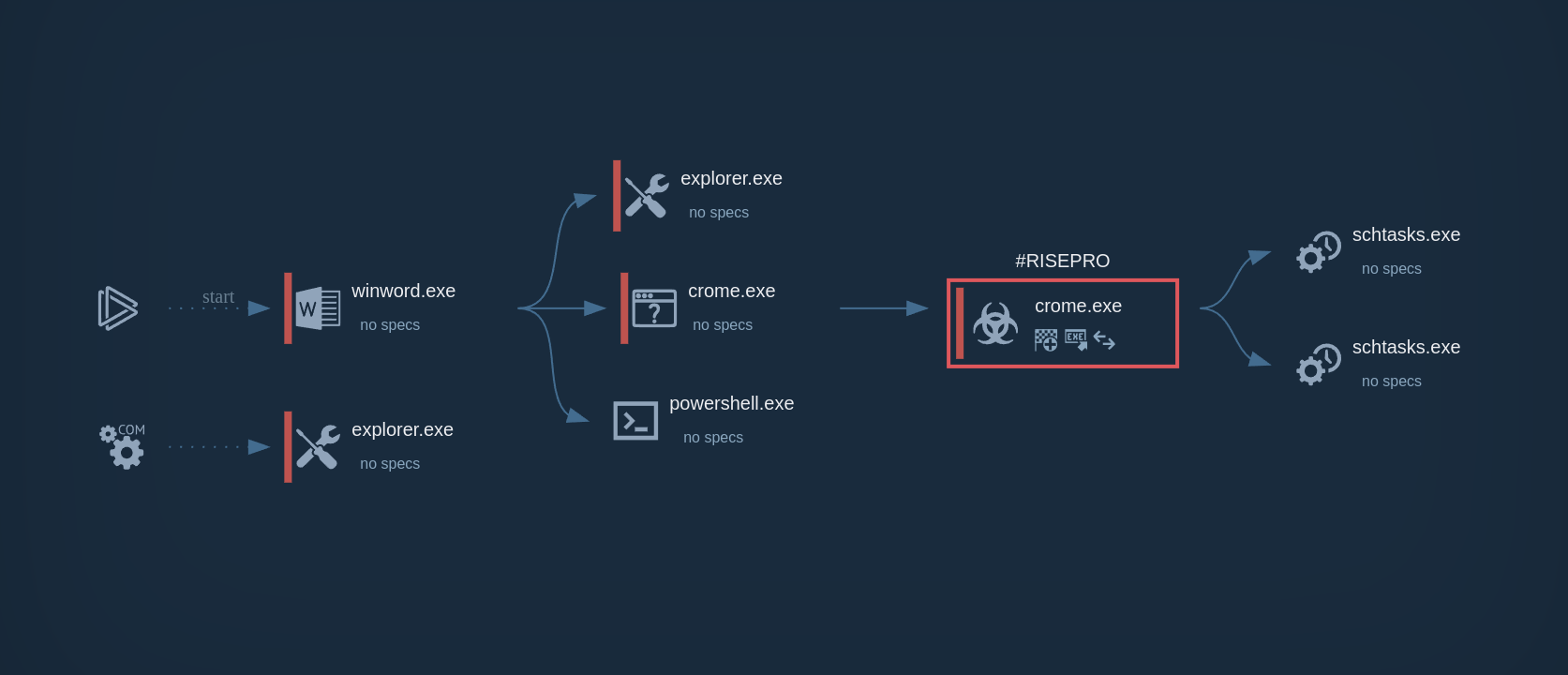
RisePro process graph shown in ANY.RUN RisePro`s process graph demonstrated in ANY.RUN

Distribution methods of the RisePro malware

RisePro is often spread by a loader called PrivateLoader. PrivateLoader is a pay-per-install service that charges malware distributors for each installation of their harmful software.

PrivateLoader's most common tactic is to disguise itself as pirated software. This means that they create websites that look like they are offering free downloads of popular programs.

One way that PrivateLoader makes its websites look legitimate is by using SEO poisoning. This is a technique that involves manipulating search engines to rank websites higher in search results.

Conclusion

As RisePro is constantly changing, it's important for individuals and organizations to take steps to protect themselves from its attacks. To make sure you avoid downloading any suspicious files or clicking links, it’s crucial you check them in a malware analysis sandbox.

ANY.RUN helps you identify if a suspicious file or link is safe by analyzing it in seconds. It provides detailed threat reports with all the necessary information, such as indicators of compromise (IOCs), for effective prevention and incident response.

Try ANY.RUN for free – request a demo!
HAVE A LOOK AT

MetaStealer screenshot
MetaStealer
metastealer
MetaStealer is an info-stealing malware primarily targeting sensitive data like login credentials, payment details, and browser history. It typically infects systems via phishing emails or malicious downloads and can exfiltrate data to a command and control (C2) server. MetaStealer is known for its stealthy techniques, including evasion and persistence mechanisms, which make it difficult to detect. This malware has been actively used in various cyberattacks, particularly for financial theft and credential harvesting from individuals and organizations.
Read More
Raspberry Robin screenshot
Raspberry Robin
raspberryrobin
Raspberry Robin is a trojan that primarily spreads through infected USB drives and exploits legitimate Windows commands. This malware is known for its advanced obfuscation techniques, anti-debugging mechanisms, and ability to gain persistence on infected systems. Raspberry Robin often communicates with command-and-control servers over the TOR network and can download additional malicious payloads.
Read More
Mallox screenshot
Mallox
mallox
Mallox is a ransomware strain that emerged in 2021, known for its ability to encrypt files and target database servers using vulnerabilities like RDP. Often distributed through phishing campaigns and exploiting exposed SQL servers, it locks victims' data and demands a ransom. Mallox operates as a Ransomware-as-a-Service (RaaS), making it accessible to affiliates who use it to conduct attacks.
Read More
PhantomEnigma screenshot
PhantomEnigma
phantomenigma
PhantomEnigma (also known as Operation Phantom Enigma) is a sophisticated crimeware operation primarily targeting banking organizations and the public sector in Brazil. The campaign is characterized by its strategic abuse of compromised legitimate infrastructure, specifically Brazilian government (.gov.br) portals and municipal websites, to host and distribute malicious payloads.
Read More
Sneaky 2FA screenshot
Sneaky 2FA
sneaky2fa
Sneaky 2FA is an Adversary-in-the-Middle (AiTM) phishing kit targeting Microsoft 365 accounts. Distributed as a Phishing-as-a-Service (PhaaS) through a Telegram bot, this malware bypasses two-factor authentication (2FA) to steal credentials and session cookies, posing a significant threat to individuals and organizations.
Read More
Remus Stealer screenshot
Remus Stealer is a sophisticated 64-bit information stealer operating under a Malware-as-a-Service (MaaS) model. Identified as a direct evolution of the infamous Lumma Stealer, Remus specializes in harvesting credentials, cookies, and cryptocurrency wallets while utilizing blockchain technology for command-and-control (C2) resilience.
Read More