Black friday Up to 3 extra licenses FOR FREE + Special offer for TI LOOKUP Get it now
Webinar
February 26
Better SOC with Interactive Sandbox Practical Use Cases
Register now

CryptoWall

62
Global rank
62 infographic chevron month
Month rank
61 infographic chevron week
Week rank
0
IOCs

CryptoWall is a notorious ransomware family that emerged in early 2014 and rapidly became one of the most destructive cyber threats of its time. This malware encrypts victims' files using strong AES encryption, demands ransom payments in Bitcoin, and has generated hundreds of millions of dollars for cybercriminals.

Ransomware
Type
Unknown
Origin
1 January, 2014
First seen
17 August, 2026
Last seen

How to analyze CryptoWall with ANY.RUN

Type
Unknown
Origin
1 January, 2014
First seen
17 August, 2026
Last seen

IOCs

IP addresses
45.141.119.82
62.60.226.185
152.42.130.4
64.89.163.22
140.82.121.4
40.126.31.3
121.53.85.3
178.16.54.109
185.199.109.133
88.151.96.4
156.253.32.122
36.138.125.70
91.92.242.236
209.145.51.44
2.23.246.9
180.178.234.61
196.251.107.186
104.21.43.241
101.200.193.211
192.227.135.223
Hashes
92804faaab2175dc501d73e814663058c78c0a042675a8937266357bcfb96c50
e728f79439e07df1afbcf03e8788fa0b8b08cf459db31fc8568bc511bf799537
7f0121322785c107bfdfe343e49f06c604c719baff849d07b6e099675d173961
3e54286e348ebd3d70eaed8174cca500455c3e098cdd1fccb167bc43d93db29d
aac73b3148f6d1d7111dbca32099f68d26c644c6813ae1e4f05f6579aa2663fe
2ed27c1421e6928dbe13dbfdb5c59e1045b30341fe7ebe05700006bc5ac572c0
dc58d8ad81cacb0c1ed72e33bff8f23ea40b5252b5bb55d393a0903e6819ae2f
c43668eec4a8d88a5b3a06a84f8846853fe33e54293c2db56899a5a5dfb4d944
26b4699a7b9eeb16e76305d843d4ab05e94d43f3201436927e13b3ebafa90739
15ffbb8d382cd2ff7b0bd4c87a7c0bffd1541c2fe86865af445123bc0b770d13
8eee9284e733b9d4f2e5c43f71b81e27966f5cd8900183eb3bb77a1f1160d050
2d79af8e1ff3465703e1dc73d3ef2182fd269ea2609c8afabdf1b80693405c1d
96425ae53a5517b9f47e30f6b41fdc883831039e1faba02fe28b2d5f3efcdc29
4ae7d63ec497143c2acde1ba79f1d9eed80086a420b6f0a07b1e2917da0a6c74
b5fc4fd50e4ba69f0c8c8e5c402813c107c605cab659960ac31b3c8356c4e0ec
db0c7e3029fb2a048e7a3e74c9cbf3e8bcec06288b5eafac5aae678d8663bffc
3e59379f585ebf0becb6b4e06d0fbbf806de28a4bb256e837b4555f1b4245571
031ed0378f819926d7b5b2c6c9367a0fb1cbae40e1a3959e2652fe30a47d52f2
27f13c4829994b214bb1a26eef474da67c521fd429536cb8421ba2f7c3e02b5f
45791627ae8e67e6b616117cf21f04da381722faf08d07c0c25e0f28c9b8f82b
Domains
book.rollingvideogames.com
www.newkey.co.kr
2398.35go.net
cdn-10049480.file.myqcloud.com
release-assets.githubusercontent.com
chrome-windows.ru
client.wns.windows.com
www.myvcart.com
lomeqpe.com
c.pki.goog
vizyonuniversitesi.com.tr
licensing.mp.microsoft.com
www.salonmarketing.ca
fe3cr.delivery.mp.microsoft.com
pub-bbbdebc2599c4d74b04c5d53e439f7a7.r2.dev
alineeleuterio.com.br
down.pcclear.com
areyouready.co.za
geschmeidig6307-kotyatanet.sbs
github.com
URLs
https://go.microsoft.com/fwlink/?linkid=2257403&clcid=0x409
https://settings-win.data.microsoft.com/settings/v3.0/onesettings/client?osversionfull=10.0.19045.4046.amd64fre.vb_release.191206-1406&localdeviceid=s%3abad99146-31d3-4ec6-a1a4-be76f32ba5d4&flightring=retail&attrdataver=186&osuilocale=en-us&osskuid=48&app=wosc&appver=&isflightingenabled=0&telemetrylevel=1&devicefamily=windows.desktop
https://login.live.com/rst2.srf
https://login.live.com/ppsecure/deviceaddcredential.srf
http://ocsp.digicert.com/mfewtzbnmeswstajbgurdgmcgguabbq50otx%2fh0ztl%2bz8sipi7wewvxdlqqutijuibiv5unu5g%2f6%2brks7qyxjzkceaz1vqyrvgl0erhqlcpm8gy%3d
http://crl.microsoft.com/pki/crl/products/microoceraut2011_2011_03_22.crl
http://www.microsoft.com/pkiops/crl/micsecserca2011_2011-10-18.crl
https://settings-win.data.microsoft.com/settings/v3.0/flightsettings/fsservice?processorclockspeed=3094&isretailos=1&oemmanufacturername=dell&flightingpolicyvalue=3&enablepreviewbuilds=4294967295&osversionfull=10.0.19045.4046.amd64fre.vb_release.191206-1406&managepreviewbuilds=3&branchreadinesslevelsource=0&attrdataver=186&processorcores=6&branchreadinesslevelraw=16&totalphysicalram=6144&tpmversion=0&oemmodelnumber=dell&systemvolumetotalcapacity=260281&deviceid=s%3abad99146-31d3-4ec6-a1a4-be76f32ba5d4&app=fss&appver=10.0&smartactivehoursstate=1&activehoursstart=20&securebootcapable=0&activehoursend=13&devicefamily=windows.desktop
https://settings-win.data.microsoft.com/settings/v3.0/wsd/waasassessment?os=windows&osver=10.0.19041.1.amd64fre.vb_release.191206-&ring=retail&sku=48&deviceclass=windows.desktop&locale=en-us&deviceid=bad99146-31d3-4ec6-a1a4-be76f32ba5d4&flightring=retail&telemetrylevel=1&hidovergattreg=c%3a%5cwindows%5csystem32%5cdriverstore%5cfilerepository%5chidbthle.inf_amd64_9610b4821fdf82a5%5cmicrosoft.bluetooth.profiles.hidovergatt.dll&appver=10.0&processoridentifier=amd64%20family%2023%20model%201%20stepping%202&oemmodel=dell&updateoffereddays=4294967295&processormanufacturer=authenticamd&installdate=1661339444&oemmodelbaseboard=&branchreadinesslevel=cb&oemsubmodel=j5cr&isclouddomainjoined=0&deferfeatureupdateperiodindays=30&isdeviceretaildemo=0&flightingbranchname=&osuilocale=en-us&devicefamily=windows.desktop&wuclientver=10.0.19041.3996&uninstallactive=1&isflightingenabled=0&osskuid=48&processorclockspeed=3094&totalphysicalram=6144&securebootcapable=0&app=waasassessment&processorcores=6&currentbranch=vb_release&installlanguage=en-us&deferqualityupdateperiodindays=0&servicingbranch=cb&oemname_uncleaned=dell&tpmversion=0&primarydisktotalcapacity=262144&installationtype=client&attrdataver=186&processormodel=amd%20ryzen%205%203500%206-core%20processor&isedgewithchromiuminstalled=1&osversion=10.0.19045.4046&ismdmenrolled=0&activationchannel=retail&honorwufbdeferrals=1&firmwareversion=a.40&trendinstalledkey=1&osarchitecture=amd64&defaultuserregion=244&updatemanagementgroup=2
https://settings-win.data.microsoft.com/settings/v3.0/waas/featuremanagement?isclouddomainjoined=0&processoridentifier=amd64%20family%2023%20model%201%20stepping%202&currentbranch=vb_release&accountfirstchar=&activationchannel=retail&oemmodel=dell&flightring=retail&attrdataver=186&installlanguage=en-us&osuilocale=en-us&webexperience=1&flightingbranchname=&chassistypeid=1&osskuid=48&app=cdm&installdate=1661339444&appver=&osarchitecture=amd64&defaultuserregion=244&telemetrylevel=1&osversion=10.0.19045.4046&devicefamily=windows.desktop
https://settings-win.data.microsoft.com/settings/v3.0/wsd/muse?processorclockspeed=3094&flightids=&updateoffereddays=4294967295&branchreadinesslevel=cb&oemmanufacturername=dell&isclouddomainjoined=0&processoridentifier=amd64%20family%2023%20model%201%20stepping%202&sku=48&activationchannel=retail&attrdataver=186&ismdmenrolled=0&processorcores=6&processormodel=amd%20ryzen%205%203500%206-core%20processor&totalphysicalram=6144&primarydisktype=4294967295&flightingbranchname=&chassistypeid=1&oemmodelnumber=dell&systemvolumetotalcapacity=260281&sampleid=95271487&deviceclass=windows.desktop&app=muse&disabledualscan=0&appver=10.0&oemsubmodel=j5cr&locale=en-us&isalwaysonalwaysconnectedcapable=0&ms=0&defaultuserregion=244&updateserviceurl=http%3a%2f%2fneverupdatewindows10.com&osver=10.0.19045.4046.amd64fre.vb_release.191206-1406&os=windows&deviceid=s%3abad99146-31d3-4ec6-a1a4-be76f32ba5d4&deferqualityupdateperiodindays=0&ring=retail&deferfeatureupdateperiodindays=30
https://settings-win.data.microsoft.com/settings/v3.0/wsd/updatehealthtools?os=windows&osver=10.0.19041.1.amd64fre.vb_release.191206-&sku=48&deviceclass=windows.desktop&locale=en-us&deviceid=s:bad99146-31d3-4ec6-a1a4-be76f32ba5d4&sampleid=s:95271487&appver=10.0.19041.3626&flightring=retail&telemetrylevel=1&hidovergattreg=c%3a%5cwindows%5csystem32%5cdriverstore%5cfilerepository%5chidbthle.inf_amd64_9610b4821fdf82a5%5cmicrosoft.bluetooth.profiles.hidovergatt.dll&appver=&processoridentifier=amd64%20family%2023%20model%201%20stepping%202&oemmodel=dell&updateoffereddays=4294967295&processormanufacturer=authenticamd&installdate=1661339444&oemmodelbaseboard=&branchreadinesslevel=cb&oemsubmodel=j5cr&isclouddomainjoined=0&deferfeatureupdateperiodindays=30&isdeviceretaildemo=0&flightingbranchname=&osuilocale=en-us&devicefamily=windows.desktop&wuclientver=10.0.19041.3996&uninstallactive=1&isflightingenabled=0&osskuid=48&processorclockspeed=3094&totalphysicalram=6144&securebootcapable=0&app=sedimentpack&processorcores=6&currentbranch=vb_release&installlanguage=en-us&deferqualityupdateperiodindays=0&oemname_uncleaned=dell&tpmversion=0&primarydisktotalcapacity=262144&installationtype=client&attrdataver=186&processormodel=amd%20ryzen%205%203500%206-core%20processor&isedgewithchromiuminstalled=1&osversion=10.0.19045.4046&ismdmenrolled=0&activationchannel=retail&firmwareversion=a.40&trendinstalledkey=1&osarchitecture=amd64&defaultuserregion=244&updatemanagementgroup=2
https://licensing.mp.microsoft.com/v7.0/licenses/content
https://slscr.update.microsoft.com/sls/%7b522d76a4-93e1-47f8-b8ce-07c937ad1a1e%7d/x64/10.0.19045.4046/0?ch=686&l=en-us&p=&pt=0x30&wua=10.0.19041.3996&mk=dell&md=dell
http://www.microsoft.com/pkiops/crl/microsoft%20ecc%20update%20secure%20server%20ca%202.1.crl
https://fe3cr.delivery.mp.microsoft.com/clientwebservice/ping
https://slscr.update.microsoft.com/sls/ping
https://slscr.update.microsoft.com/sls/%7be7a50285-d08d-499d-9ff8-180fdc2332bc%7d/x64/10.0.19045.4046/0?ch=686&l=en-us&p=&pt=0x30&wua=10.0.19041.3996&mk=dell&md=dell
http://217.60.241.248/bin/support.client.exe
http://217.60.241.142/bin/screenconnect.clientsetup.exe
Last Seen at
Last Seen at

Recent blog posts

post image
Mirage2FA Hijacks Companies’ Microsoft 365 Se...
watchers 195
comments 0
post image
Intelligence-Driven SOC: Modernizing Threat M...
watchers 11403
comments 0
post image
Supply Chain Security: How ANY.RUN Helps US a...
watchers 6519
comments 0

CryptoWall Ransomware: How the Comeback Veteran Still Costs Businesses Millions

Key Takeaways

  1. CryptoWall remains active through code reuse and updated variants.
  2. Its main vectors: phishing, exploit kits, and RDP brute force.
  3. Businesses lose not only money — but operations and reputation.
  4. Detection requires layered security: EDR, logging, sandboxing.
  5. Offline backups dramatically reduce impact and negotiation leverage.
  6. Threat Intelligence Lookup lets analysts instantly check IOCs against data from 15K SOCs worldwide.

filePath:"Project_Workshop_7th_Minutes.txt".
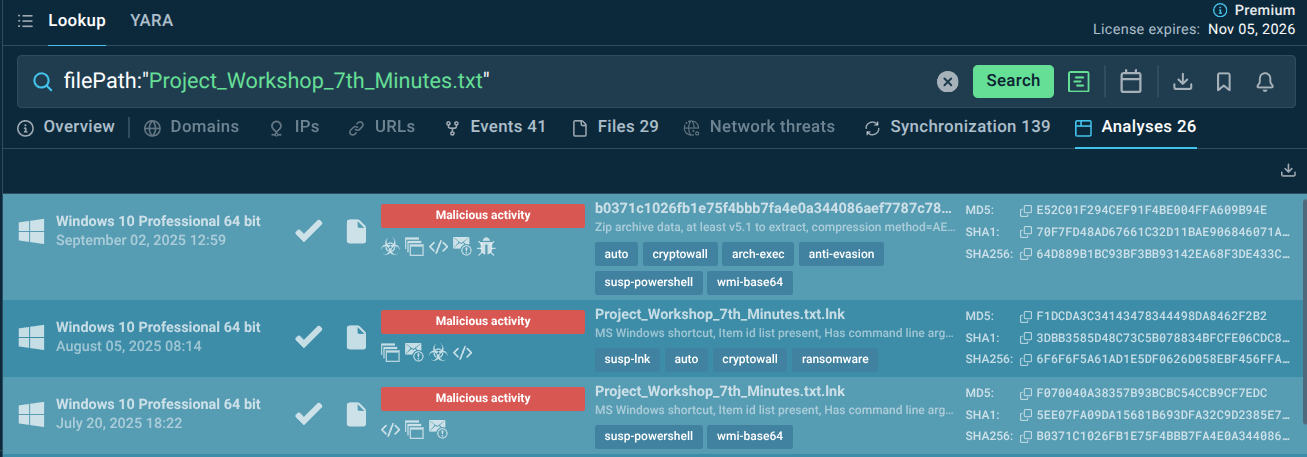
File detected as CryptoWall IOC via TI Lookup File detected in CryptoWall malware samples via TI Lookup
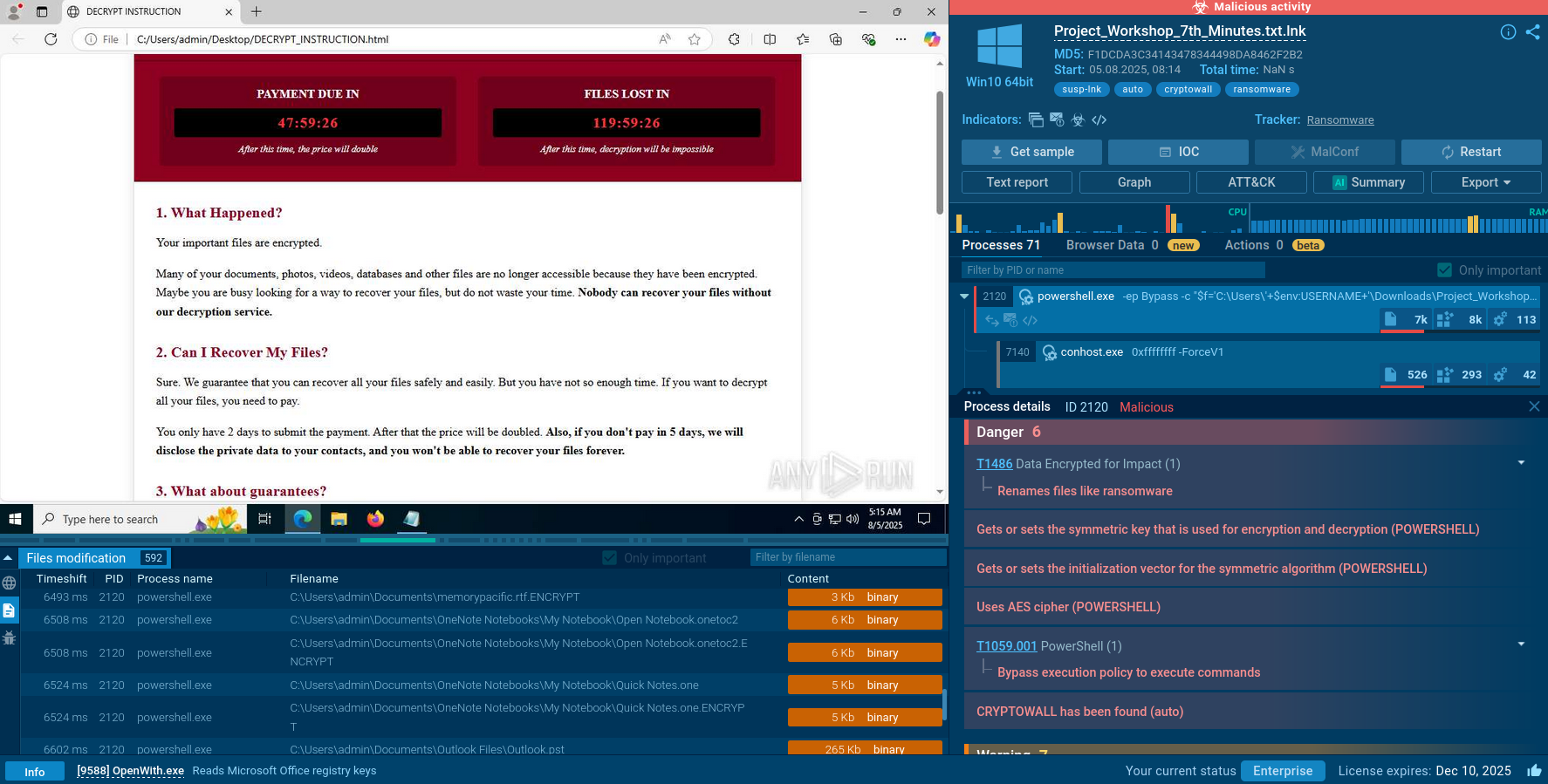
  1. ANY.RUN's Sandbox helps analyze CryptoWall behavior and extract fresh indicators.

View analysis

CryptoWall sample in the Sandbox CryptoWall sample detonated in the ANY.RUN Sandbox

What is CryptoWall Malware?

CryptoWall represents a pivotal evolution in ransomware, transforming from a crude CryptoLocker clone into a sophisticated, polymorphic threat. Initially distributed in November 2013, it gained prominence in early 2014, after law enforcement dismantled CryptoLocker's infrastructure. By mid-2015, it has generated an estimated $325 million in revenue for its operators through relentless campaigns.

Unlike earlier ransomware that merely locked screens, CryptoWall employs asymmetric RSA encryption to scramble files across local drives, network shares, and removable media, appending extensions like .cryptowall to affected documents, photos, and databases. Its variants, up to CryptoWall 4.0, incorporated anti-detection techniques, such as Tor and I2P anonymity networks for command-and-control (C2) communication, RC4-encrypted traffic, and polymorphic code to evade antivirus signatures.

The malware communicates with command-and-control servers over the Tor anonymous network, making it difficult to trace or disrupt. After encryption, victims receive detailed ransom notes with instructions for payment, typically ranging from $200 to $10,000, though some victims reportedly paid significantly more. CryptoWall's trademark is its psychological warfare: ransom notes taunt victims with countdown timers, previews of decryptable files to build false hope, and threats to destroy keys if unpaid, often within 72 hours.

What distinguishes CryptoWall from simpler ransomware is its technical sophistication. It operates on both 32-bit and 64-bit systems, deletes shadow copies to prevent file recovery, disables System Restore features, and even installs spyware to steal passwords and Bitcoin wallets. The encryption implementation is effectively unbreakable without the private key held by attackers, making prevention the only viable defense strategy.

Use ANY.RUN free for 14 days

Try the full power of interactive analysis

Start your free trial

CryptoWall Ransomware Victimology

The targeting strategy appears opportunistic rather than selective. CryptoWall campaigns have affected individuals who accidentally opened malicious email attachments, businesses whose employees fell victim to phishing schemes, and organizations with unpatched software vulnerabilities. Notable incidents included the Australian Broadcasting Corporation, which experienced disrupted television programming due to a CryptoWall infection, and numerous healthcare organizations that faced operational challenges when patient records became encrypted.

Geographic analysis shows that targets have primarily been concentrated in the United States and United Kingdom, though infections occurred globally. The ransomware infected over 625,000 systems within its first six months of widespread distribution, encrypting approximately 5.25 billion files.

How CryptoWall Functions

The attack sequence begins when the malware gains initial access through various infection vectors. Email remains the primary distribution method, with attackers using the Cutwail spam botnet sending massive campaigns that contain malicious attachments or links.

When victims open attachments disguised as PDF files, Word documents, or ZIP archives, they actually execute the dropper, which then contacts compromised websites to download the CryptoWall payload. This multi-stage delivery complicates detection, as the initial file may appear benign to security software while the actual ransomware is fetched dynamically.

Exploit kits represent another major infection vector. Major advertising networks serving sites including Disney, Facebook, and The Guardian were compromised in campaigns that exposed millions of users to potential infections.

Within organizational networks, CryptoWall spreads by encrypting files on network shares accessible to the infected user account. While the malware doesn't include worm-like capabilities for self-propagation between systems, its ability to encrypt files across mapped network drives means a single infected endpoint can potentially encrypt data throughout an entire organization.

Upon execution, the ransomware immediately attempts to establish persistence mechanisms, though later variants operate entirely in memory to avoid disk-based detection.

The malware's first critical action involves contacting command-and-control servers, typically hosted on the Tor network for anonymity. This communication serves multiple purposes: retrieving the public key used for encrypting the symmetric encryption keys, registering the victim with a unique identifier, and receiving configuration parameters that control the encryption process. If network connectivity fails, some variants will wait and retry rather than proceeding, as the C2 communication is essential for the attack's success.

Once connected, CryptoWall initiates its file discovery and encryption routine. The malware creates malicious instances of legitimate Windows processes like explorer.exe and svchost.exe to perform its operations, helping it blend with normal system activity. It systematically enumerates all accessible storage, identifying files with targeted extensions. The encryption process uses AES symmetric encryption for speed, with each file receiving a unique AES key. These symmetric keys are then encrypted with an RSA public key, making recovery impossible without the corresponding private key held by attackers.

Throughout the encryption process, CryptoWall takes defensive actions to prevent recovery. It deletes Volume Shadow Copies using the Windows vssadmin.exe utility with commands like "vssadmin delete shadows /all /quiet" to eliminate backup copies without user notification. The malware modifies registry entries to disable System Restore and may clear Windows Event Logs to remove evidence of its activities. Some variants also attempt to disable or evade antivirus software through various techniques including process injection and rootkit-like behaviors.

Sandbox Analysis of a CryptoWall Sample

ANY.RUN's interactive malware sandbox allows analysts to safely execute and analyze CryptoWall samples, revealing evasion techniques, C2 communications, and encryption behaviors that inform detection rules and defensive strategies.

View a CryptoWall sample analysis
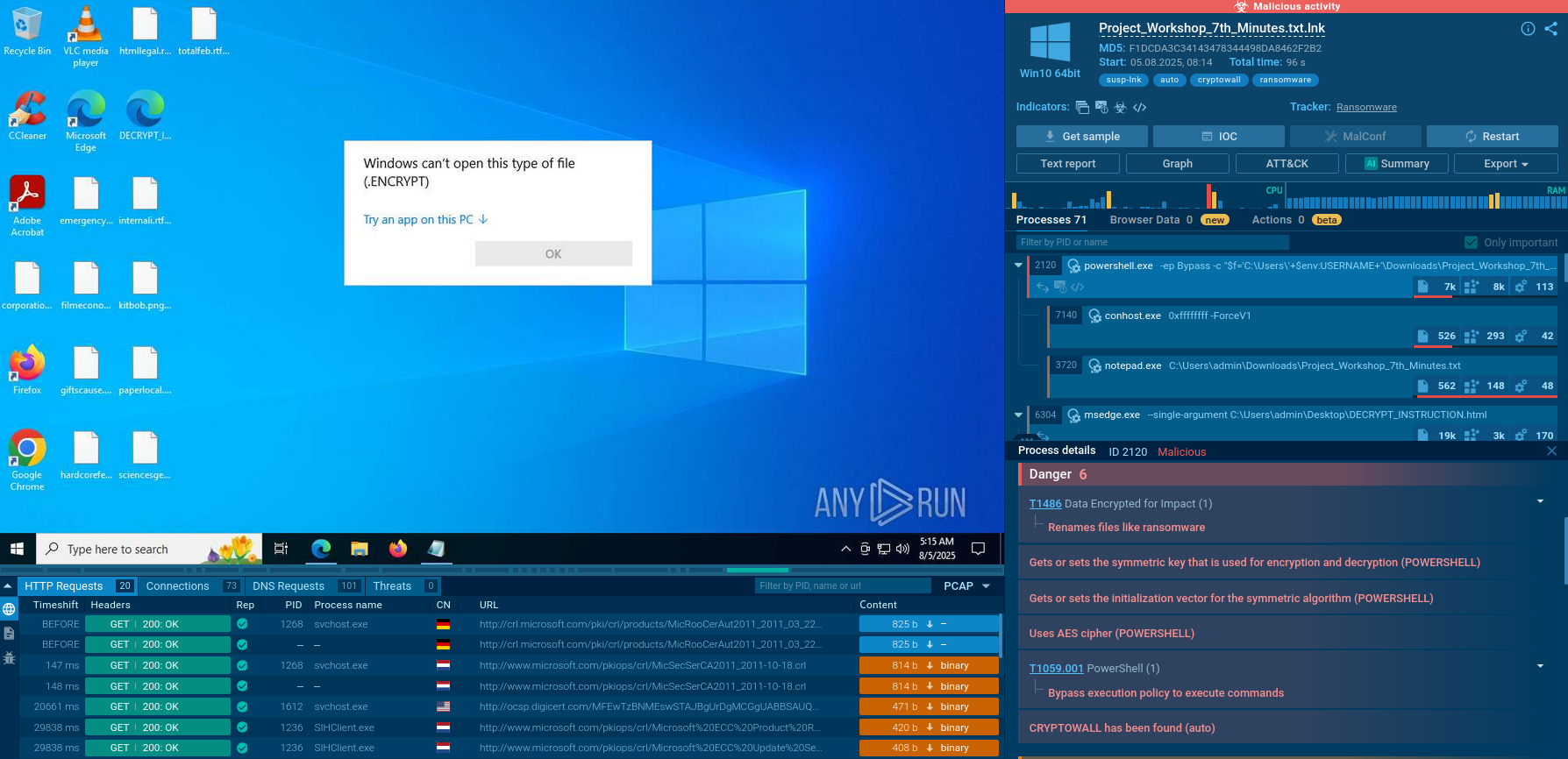
CryptoWall Sandbox analysis CryptoWall Sandbox analysis

The malware is distributed as an LNK file disguised as a legitimate shortcut. When opened, the LNK launches a PowerShell script that executes the core functionality.

The script tracer of the Sandbox shows how at the start, the malware creates a scheduled task to ensure persistence. The parameters are added: daily mode, no additional day intervals or random delays, and an exact start time of 17:00. Additional options are configured so the task runs even on battery power, does not stop when switching to battery, starts as soon as possible, and ignores the computer's sleep mode.
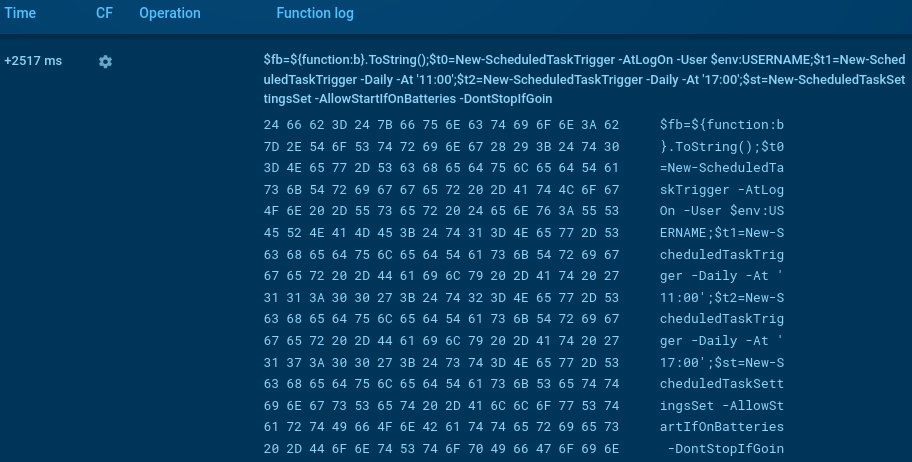
CryptoWall script establishing persistence CryptoWall script establishing persistence

The malicious program also launches Windows Notepad to display the file Project_Workshop_7th_Minutes.txt, created to mask the program's main functionality.
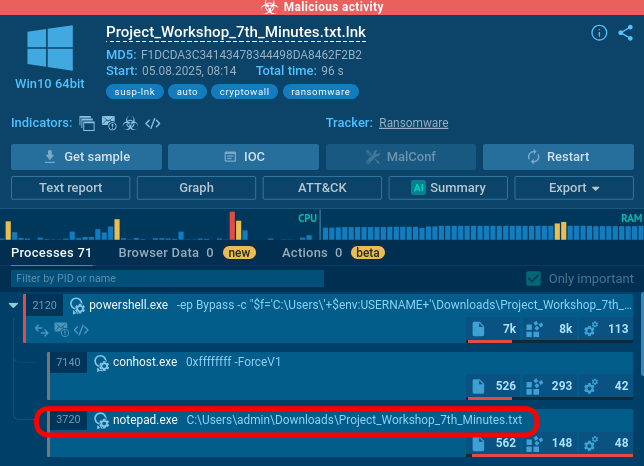
CryptoWall key processes CryptoWall key processes

The encryption process can be divided into several stages. File discovery occurs recursively through user directories, skipping system folders.

Encryption uses the typical combination of symmetric AES for file encryption. The AES key is encrypted with the attackers' public RSA key. This encrypted AES key, along with the initialization vector and the encrypted file contents, is appended to the end of the file.

Encryption code snippet PowerShell commands showing AES key generation and RSA encryption

A ransom note is created as an HTML file with detailed payment instructions and a timer to pressure the victim into acting quickly.
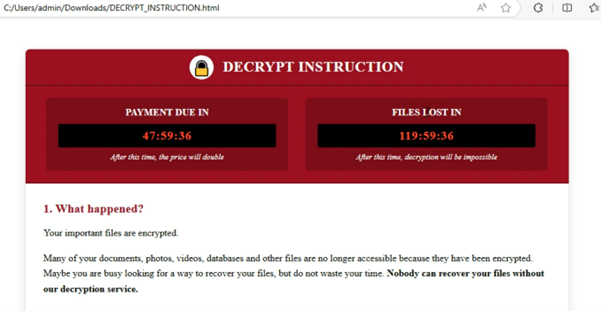
CryptoWall ransom note screenshot CryptoWall ransom message screenshot with countdown timers for payment and file deletion

Overall, CryptoWall is a classic ransomware specimen: a combination of stealthy infection, rapid encryption, and mechanisms to pressure the victim. Regularly back up important files to external media, use up-to-date antivirus software, monitor the Windows Task Scheduler for suspicious entries, disable macros in Office and PDF files, and train users not to open suspicious shortcuts from emails or downloaded files.

How CryptoWall ransomware threatens businesses and organizations

For healthcare organizations, CryptoWall infections can delay patient care, limit access to medical records, and force reliance on paper-based systems. Educational institutions face interrupted classes, lost research data, and administrative challenges. Financial services organizations risk regulatory penalties for data security failures, while manufacturing and logistics companies experience supply chain disruptions when production systems become unavailable.

Customers and partners lose confidence in organizations that suffer ransomware attacks, particularly if sensitive data is potentially compromised. Media coverage of infections can damage brand value and market position. Even organizations that successfully recover from attacks often face long-term trust deficits that affect business relationships and customer retention.

Gathering Threat Intelligence on CryptoWall ransomware

Threat Intelligence Lookup enables security teams to quickly search for information about suspicious files, URLs, domains, and IP addresses potentially associated with CryptoWall.

By querying file hashes or URLs encountered in environments, analysts can immediately determine if they match known CryptoWall samples, view detailed behavioral analysis, and understand the specific capabilities and infrastructure of particular variants.

This rapid intelligence access accelerates incident response and enables proactive blocking of threats before they impact systems.

Start exploring the threat by looking it up by the name:
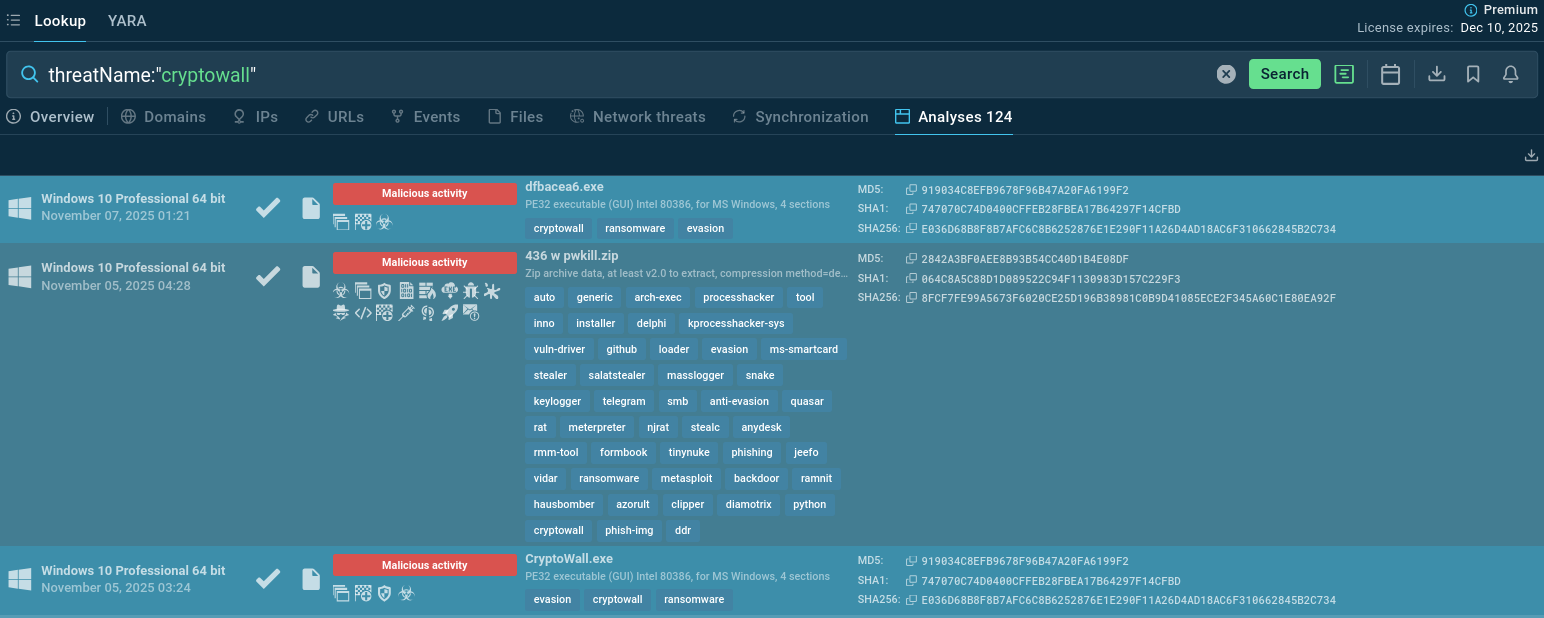
threatName:"cryptowall".

CryptoWall samples found via TI Lookup Malware samples with CryptoWall detected, found via TI Lookup]

Integrate ANY.RUN’s threat intelligence solutions in your company

Contact us

Conclusion

CryptoWall demonstrates how cybercriminals can weaponize strong encryption to generate hundreds of millions of dollars while causing widespread organizational disruption. Though newer ransomware families have emerged since CryptoWall's peak activity, the fundamental threat model it established (combining multiple infection vectors, strong encryption, anonymous infrastructure, and cryptocurrency payments) persists across modern ransomware operations.

Modern threat intelligence and analysis tools have evolved significantly in response to threats like CryptoWall. Malware sandboxes, threat intelligence platforms, and security automation enable faster detection, more effective response, and proactive defense strategies that were unavailable during CryptoWall's emergence. Organizations that leverage these capabilities while maintaining security fundamentals position themselves to resist not only CryptoWall variants that may still circulate but also the next generation of ransomware threats.

Start gathering actionable threat intelligence on CryptoWall by signing up to ANY.RUN’s TI Lookup: protect your business with timely detection and response.
HAVE A LOOK AT

Orcus RAT screenshot
Orcus RAT
orcus rat trojan
Orcus is a modular Remote Access Trojan with some unusual functions. This RAT enables attackers to create plugins using a custom development library and offers a robust core feature set that makes it one of the most dangerous malicious programs in its class.
Read More
JOMANGY screenshot
JOMANGY is a PHP webshell and backdoor family targeting vulnerable FreePBX servers. It is designed to establish long-term access to compromised VoIP infrastructure, enable toll fraud, and survive remediation attempts through multiple self-reinforcing persistence mechanisms. Unlike many traditional webshells, JOMANGY employs a highly resilient architecture that can automatically restore itself even after partial removal.
Read More
Zloader screenshot
Zloader
zloader trojan loader
Zloader is a banking trojan that uses webinjects and VNC clients to still banking credentials. This Trojan is based on leaked code from 2011, but despite its age, Zloader’s popularity has been only increasing through early 2020, when it relied on COVID-19 themed attacks.
Read More
BQTLock screenshot
BQTLock
bqtlock baqiyatlock
BQTLock is a ransomware-as-a-service (RaaS) malware family that emerged in 2025 and quickly gained attention due to its combination of file encryption, credential theft, and data exfiltration. BQTLock encrypts files using a hybrid AES-256 and RSA-4096 encryption scheme, demands payment in Monero cryptocurrency, and performs data theft and system reconnaissance.
Read More
PureCrypter screenshot
PureCrypter
purecrypter
First identified in March 2021, PureCrypter is a .NET-based loader that employs obfuscation techniques, such as SmartAssembly, to evade detection. It has been used to distribute malware families including AgentTesla, RedLine Stealer, and SnakeKeylogger. The malware is typically delivered through phishing campaigns and malicious downloads, often masquerading as legitimate files with extensions like .mp4 or .pdf. PureCrypter utilizes encryption and compression to conceal its payloads and can inject malicious code into legitimate processes to maintain persistence on the infected system.
Read More
Netwalker screenshot
Netwalker
netwalker ransomware
Netwalker is ransomware — it belongs to a malware family which encrypts files and demands users to pay a ransom to get their data back. Netwalker utilizes several sophisticated techniques, such as process hollowing and code obfuscation to target corporate victims.
Read More